
26

BY THE MIDDLE OF THE SECOND YEAR OF THE CIVIL WAR, THE ELEVEN states of the Confederacy could boast only a handful of professional artists still actively pursuing their craft. The inescapable demands of military conscription meant the armed forces scooped up every able-bodied man for active duty, and the draft by no means excluded painters and engravers. Unfortunately for the South, this meant that potentially morale-building artworks introducing new Confederate military heroes and celebrating their significant battlefield triumphs never made it to the Southern home front. Any initial hope that English or French artists might step in and supply this need evaporated with the tightening of the Union blockade. When one blockade-runner did slip past the federal “anaconda” with a boatload of Scottish engravers on board, government officials promptly assigned these artists to the “official printmaking” that still held priority in the deprived region, meaning the design of Confederate currency and postage stamps.
The Confederacy actually lost one of its most talented propagandists—one who might well have made a significant difference in satisfying the yearnings of picture-starved Southern customers—before the fighting war even began. His disappearance had nothing to do with the blockade or the military draft. Rather, once the Lincoln administration headed off secession in Maryland and imposed strict martial law in Baltimore, the local artist Adalbert Johann Volck (1828–1912) fell silent—or at least began working in secret. While he continued to churn out a breathtaking variety of anti-Union, pro-Confederate etchings at the highest level of artistic ingenuity and skill under the pseudonymous anagram “V. Blada,” he did so for limited editions that circulated only among trusted friends who shared his political passions. Though the works achieved fame after the war, the ubiquity of later nineteenth- and twentieth-century reproductions long encouraged the mistaken belief that they originally appeared in significant quantities while the war raged. The truth is they did not; however capable, and inspired, Volck did not wield a mighty wartime pen. By the spring of 1861, this gifted would-be propagandist was all but driven underground. His rare Confederate War Etchings was first republished free from censorship in 1882. However limited its impact during the war, the ambitious portfolio stands as a remarkable testament to the resilience of Confederate patriotism in a Union-controlled border slave state. Notwithstanding censorship or racism, Volck either invented or illustrated some of the most intractable falsehoods attached to Union occupation and some of the most indelible mythology of the Lost Cause.
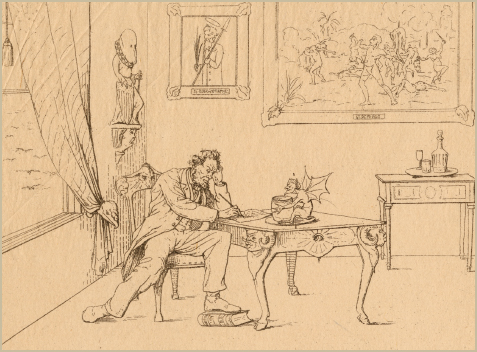
PLATE 26–1
Born in Bavaria, Volck immigrated to America after the failed European revolutions of 1848 but, unlike most of his fellow Germans, headed not north but south to Maryland. While German-born leaders like Carl Schurz became major figures in the antislavery movement, Volck absorbed Southern values, graduating from the Baltimore College of Dental Surgery in 1852 and establishing a successful professional practice there. Always interested in drawing, he also joined the Allston Association, a local artists’ club whose members proved passionately pro-secession and pro-Confederate. Union occupying forces came to consider the group a “nest of rebels.” Astonishingly, there is no evidence that Volck ever received professional art training. He was entirely self-taught.
During the war, Volck seems to have become something of a Confederate agent as well, smuggling volunteers into the South and investing whatever money he earned from his dental practice in ultimately worthless Confederate bonds. His subsequent claims that he was also a blockade-runner, and briefly a prisoner in Fort Henry, were very likely efforts to bolster his Confederate credentials. In a century of searching, historians have unearthed no records to substantiate either boast. But Volck certainly became acquainted with Jefferson Davis’s family either before or shortly after the war, and there is little doubt but that the Confederate president came at some point to know of his work. We just do not know when. After the war, Volck turned to oil painting, creating two portraits of the former general Robert E. Lee, one showing him meditating at Stonewall Jackson’s grave, and the other sitting quietly in his study at Washington College—both as models for print reproductions meant to raise funds for a Lee statue. Volck also tried his hand at sculpture. But his considerable talents were definitely best suited to the delicate craft he practiced most skillfully: etching.
Infuriated by General Benjamin F. Butler’s occupation of his home city, Volck made his artistic debut with a series of highly polished anti-Butler etchings in 1861. Ye Exploits of ye Distinguished Attorney and General B.F.B. (Bombastes Furioso Buncombe)savagely portrayed the New England–born general as a vain, corrupt, bloated, and baroquely costumed villain. One of these pictures suggested the general had declared himself “head of the church” in occupied Norfolk, where, Volck insisted, Butler had “sent their priests off to sweep the streets, cut down the crosses and substituted Union flags in their place.” It was the first of many inflammatory calumnies—most false or ridiculously exaggerated—that Volck would reimagine in his work.
Volck next produced a broader collection he titled Comedians and Tragedians of the North. Like his subsequent work a marvel of acute portraiture, it exhibited a strong element of satirical humor but also revealed a streak of unapologetic racism. He depicted the Reverend Henry Ward Beecher as an African American and suggested that Lincoln and his fellow Republicans were Negro worshippers. Volck portrayed Secretary of War Simon Cameron as a thief (which he arguably was) and the pro-Union Maryland governor Thomas Hicks as a Judas. The artist reserved particular venom for Lincoln, whom he blamed for both Volck’s own woes and those of the entire South. One of his earliest etchings devastatingly satirized Lincoln and Butler as Don Quixote and Sancho Panza. Another portrayed a frightened president hiding in fear on a freight car at the Baltimore railroad depot, recoiling from the mere sight of a hissing cat.
In 1863, Volck published the first edition of his masterwork, Sketches from the Civil War in North America. (The Society obtained its copy of the portfolio soon after its issue.) It was stamped with a false London imprint to disguise its Baltimore origins and thereby reduce the likelihood of seizure by Union army officials. What it lacked in circulation, however—the edition of two hundred was privately distributed—the Sketches more than made up for in raw power. In Volck’s world, Northerners were plunderers, rapists, devils, and brutes; Southern men were invariably noble; white women brave, self-sacrificing, and virtuous victims of poverty and degradation; and slaves eternally grateful for their subjugation and determined to remain in bondage with their white masters. In one of his most extraordinary demonstrations of loyalty to his adopted “country,” Volck produced an etching titled Valiant Men “Dat Fite mit Sigel,” depicting fellow German-born Union soldiers of General Franz Sigel’s army killing helpless and innocent women and children. No comparably graphic atrocity picture was ever produced by any other artist during the Civil War.
One of Volck’s most unforgettably venomous efforts was inspired by the Emancipation Proclamation, which Northern artists, if they treated the subject at all, viewed as an almost sacred text inspired by the Constitution and the holy book and animated by Lincoln’s own early life as a laborer. In an etching that has come to be known by the title Writing the Emancipation Proclamation, Volck took a rabidly contrary view, depicting Lincoln as a devilish-looking, slovenly figure sprawled across a cloven-hoofed desk—meant to symbolize satanic influences—and scribbling his document with ink drawn from an inkwell proffered by the winged Prince of Darkness himself. In Volck’s extraordinary composition, Lincoln’s foot rests rudely on a Bible as if to suppress its true guidance on slavery.
The walls of the room Volck imagined for this scene are decorated with a portrait of John Brown as a haloed saint, along with a celebratory depiction of the bloody—and successful—1791 slave uprising at Santo Domingo. On a table in the background in this improvised White House setting lies a liquor decanter and drinking glasses, suggesting that Lincoln must have composed his document under the influence of alcohol. (In fact, he was a teetotaler.) The window curtains are tied back with a vulture’s head, while outside the birds of prey flock, presumably to feast on the devastated South. Perhaps the subtlest symbol in the entire scene is the almost indecipherable cloaked statue standing in the corner—a device that would have been recognizable to Volck’s contemporaries, particularly his neighbors in Baltimore. It shows the national symbol, Columbia, partly covered over by a Scotch cap—a reference to the disguise that President-elect Lincoln allegedly wore to pass safely through Baltimore en route to his inauguration back in 1861. In an era in which most emancipation tributes were celebratory, Volck’s over-the-top view of the muses that inspired Abraham Lincoln to compose his most important document—devil worship, drunkenness, sacrilege, tyranny, and cowardice—would have provided a powerful visual contradiction to otherwise unanswered sanctification pictures, had it been allowed to circulate the year it was created. But it was not.
Volck’s love for the Confederacy proved as strong as his hatred for the Union, and he vividly depicted, or perhaps created, some of the most powerful legends in Lost Cause lore, including the hardships of cave life in besieged Vicksburg (see chapter 30); the God-fearing reverence of General Stonewall Jackson, whom he portrayed leading a prayer meeting in camp; the selfless sacrifice of impoverished Southern ladies sewing clothes for “boys in the army”; and the supposed loyalty of grateful black slaves hiding their white owners from rampaging Union troops.
In early 1862, Volck was inspired to visualize another tribute to Confederate generosity when he learned that General P. G. T. Beauregard had encouraged residents of the Mississippi valley “to send your plantation-bells to the nearest railroad depot, to be melted into cannon for the defense of your plantations.” The plea caused an instant sensation throughout the South and no doubt gave rise to what turned out to be one of Volck’s most evocative etchings, Offering of Bells to Be Cast into Cannon. The print took Beauregard’s limited request one step further and depicted an Episcopal priest, positioned like Christ revealing his stigmata, urging his parishioners to melt down their church bells for the holier purpose of providing metal for Confederate weaponry. As well-dressed white neighbors look on sadly, a cruelly caricatured slave willingly does the labor required to move the heavy bells into a forge. In etchings like these, Volck equated the Confederacy with Christianity, and the Union with sacrilege and satanism.
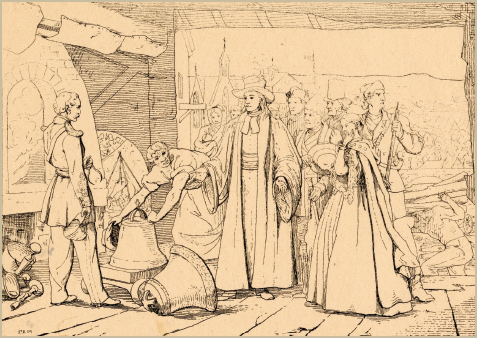
PLATE 26–2
Offering of Bells to Be Cast into Cannon,
etching by Adalbert Johann Volck, 1863
After the war, Volck told the Library of Congress that even though he had created nearly two dozen more original, unissued plates, he decided to suspend domestic publication once he became “a suspected man, and in daily fear of arrest.” Then, after what he called “the deplorable murder of Lincoln,” he further explained, “I thought it best to go into retirement and an officious friend persuaded me to let him take the last plates (20) to England and have them printed there.”
Not everyone believed in his repentance. The Cincinnati war correspondent Murat Halstead, for one, never allowed himself to be convinced of Volck’s allegedly “changed” sentiments. As he later complained of the artist’s works: “We find these etchings full of the sharpest scorn and of rancorous hatred.” To Halstead, they constituted “a record of the fierce animosities, the bitter resentments, the implacable prejudices, the passion, the frenzy and the ferocity of the war.” They would undoubtedly have stung less if they had been crafted less brilliantly.
For his part, Adalbert Volck never entirely recanted the political beliefs he had so brilliantly evoked during the Civil War. But he did confess in 1905, four years before creating a carved silver shield for the Museum of the Confederacy in Richmond, dedicated to the “Brave Women of the South”: “I feel the greatest regret ever to have aimed ridicule at that great and good Lincoln.”
For some, his apology constituted too little and came much too late.