
27

WHEN NEWS FIRST REACHED THE UNION ARMY IN THE FIELD THAT Abraham Lincoln had issued the Emancipation Proclamation on January 1, 1863, a regiment from the president’s home state of Illinois promptly reacted by deserting, vowing to “lie in the woods until moss grew on their backs rather than help free slaves.”
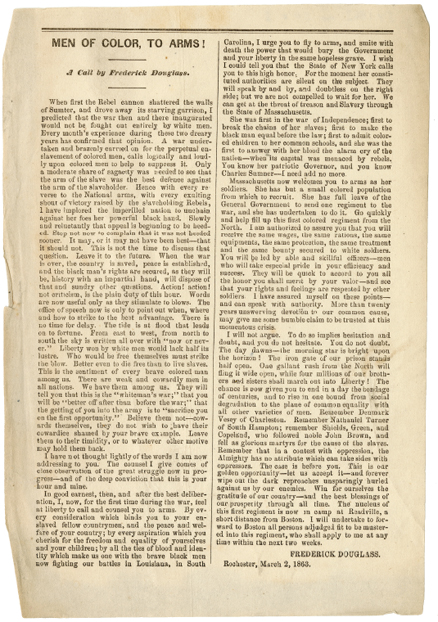
PLATE 27–1
Ultimately, Lincoln’s proclamation had a broader and much more positive effect on the federal fighting force—not only on its morale but also on its size and color. For it did more than offer freedom: for the first time it called specifically on African Americans “to garrison forts, positions, stations, and other places, and to man vessels of all sorts in said service.” The result swelled the federal ranks and undoubtedly helped the Union win the war and end slavery.
On the heels of Lincoln’s order, the House of Representatives passed a bill in March that specifically made free African Americans eligible to serve in the military for the first time. It gave the president new authority “to enroll, arm, equip, and receive into the land and naval service of the United States such number of volunteers as he may deem useful to suppress the present rebellion.”
“Yes, there is a God,” Thaddeus Stevens exulted after the bill sailed through, “an avenging God, who is now punishing the sins of this nation for the wicked wrongs which for centuries we have inflicted upon a blameless race.” In the end, the Senate declined to take up the House bill on the grounds that Lincoln’s proclamation had already accomplished the objective.
Soon thereafter, Secretary of War Edwin M. Stanton made the new state of things official, ordering the army “to arm, uniform, equip, and receive into the service of the United States” the first “volunteers of African descent.” That same month the Union War Department officially opened its first Bureau of Colored Troops.
For the first few months of this revolutionary new era of black recruitment, however, manpower did not increase as quickly as the Lincoln administration had initially hoped. Massachusetts led the way as early as January with fund-raising and recruitment for a “separate corps,” but the unavoidable fact remained that the state had few eligible African American residents. Governor John A. Andrew did what he could by raising the soon-to-become-legendary 54th Massachusetts, the first all-black regiment ever formed in a Northern state. Eager to do more, Governor Andrew recruited his friend and ally George L. Stearns, a onetime adviser to John Brown, and invited him to assume overall responsibility for African American recruitment. Stearns wisely invested in advertising and in the establishment of recruitment centers but soon concluded that he also needed African American leaders to spread the word among their own constituents. On February 23, Stearns made his way to Rochester, New York, to enlist the support of a man who proved vital to the recruiting effort: Frederick Douglass.
Douglass needed little convincing. As early as May 1861, he had published an editorial making clear his view that the swiftest and surest way to suppress the rebellion was to let “the slaves and free colored people be called into service, and formed into a liberating army, to march into the South and raise the banner of Emancipation among the slaves.” Now the editor and orator quickly agreed to renew his call, and the result was a landmark editorial in Douglass’ Monthly that was soon adapted into a separately printed, hugely influential, and justly renowned circular, a copy of which the New-York Historical Society has owned since the year it was issued.
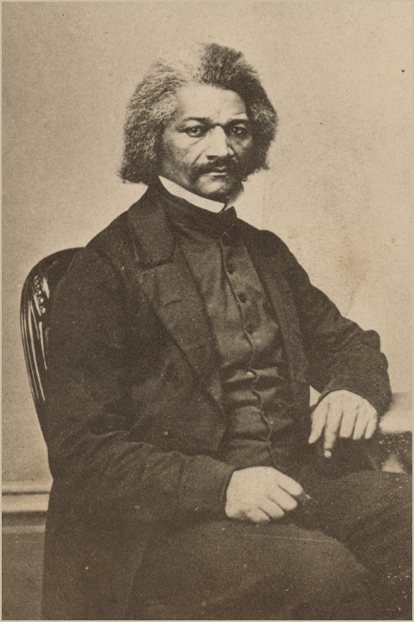
PLATE 27–2
Fred[erick] Douglass (1818–1895), carte-de-visite (albumen print), n.d.
The Emancipation Proclamation was less than three months old when Douglass issued a proclamation of his own, titled Men of Color, to Arms! For the first time, as he told his readers (perhaps conveniently ignoring his earlier suggestions along the same line), he felt “at liberty to call and counsel you to arms.…I urge you to fly to arms, and smite with death the power that would bury the Government and your liberty in the same hopeless grave.” With risk, he promised, would come liberty and equality. In a curiously self-serving introduction, Douglass confessed he was disappointed that the government had taken so long to heed his frequent advice that the country use “her powerful black hand” to suppress the rebellion. But then he said, “This is not the time to discuss that question. Leave it to the future.” Instead, he issued what amounted to a bugle call to rally black volunteers:
Action! action! not criticism, is the plain duty of this hour. Words are now useful only as they stimulate to blows. The office of speech now is only to point out when, where and how to strike to the best advantage. There is no time for delay. The tide is at flood that leads on to fortune. From east to west, from north to south the sky is written all over with “now or never.” Liberty won by white men would lack half its lustre. Who would be free themselves must strike the blow. Better even to die free than to live slaves. This is the sentiment of every brave colored man among us. There are weak and cowardly men in all nations. We have them among us. They will tell you this is the “whiteman’s war;” that you will be “[no] better off after than before the war;” that the getting of you into the army is to “sacrifice you on the first opportunity.” Believe them not—cowards themselves, they do not wish to have their cowardice shamed by your brave example.
Three weeks after Douglass called on black men to volunteer, Lincoln wrote to Andrew Johnson, the pro-Union military governor of Tennessee, to urge him to support black recruitment, too. In quick order, Lincoln also authorized African American enlistment in Union-occupied areas of Florida, Louisiana, and the Mississippi valley. When commanders in the field resisted, he overruled them. Lincoln’s military aide Henry Halleck, for example, ordered General Grant, who was initially reluctant, to free “all the slaves you can, and to employ those…to the best possible advantage against the enemy.” The Union similarly ignored General Sherman’s retrograde belief that the “Negro…is not the equal of the white man” and brushed off General Burnside’s insistence that the “enrollment of these negroes is what the loyal people fear.” As Lincoln told a group of church leaders visiting the White House in May, he “would gladly receive into the service not ten thousand but ten times ten thousand colored troops.” By June 30, 1863, the first regiment of “U.S. Colored Troops” had mustered into service at Washington.
For a time, the Lincoln administration feared that the enlistment of black soldiers might depress the recruitment of white troops—that white soldiers would so intractably resent the arrival of black regiments they might refuse to fight alongside them, even though the “colored” units would improve their numerical advantage over the enemy and be entirely separate and commanded by white officers. To increase the likelihood that white soldiers supported the new arrivals, Lincoln rather shamefully agreed at first to pay black recruits a lower salary than white soldiers earned—a measure that Frederick Douglass, among others, bitterly resented. What was worse, black soldiers were compelled to pay for their uniforms, the cost deducted from their pay. (According to these strikingly inequitable rules, white privates earned thirteen dollars per month plus three dollars for clothing; black troops received only ten dollars a month and had three dollars of that deducted for uniforms.)
Nonetheless, some white soldiers still refused to accept their new comrades-in-arms. One soldier wrote home to complain that the conflict had “turned into a nigger war and all are anxious to return to their homes for it was to preserve the Union that they volunteered.” Still, a significant number welcomed the additional manpower—there was safety in numbers, after all—and many even embraced the new crusade their arrival represented: not just reuniting the country but also destroying slavery. “I have no heart in this war if the slaves cannot go free,” one such soldier declared. Another wrote home, “If the doom of slavery is not sealed by the war I shall curse the day I entered the Army or lifted a finger in the preservation of the Union.”
In August, Frederick Douglass himself called at the White House to plead with Lincoln to provide black soldiers equal pay. The president welcomed him with a kind of stiff cordiality. Lincoln did concede that unequal pay was a “terrible remedy” but pledged that it was only temporary. “I assure you, Mr. Douglass,” the president concluded, “that in the end they shall have the same pay as white soldiers.” Lincoln did finally approve equal pay a year later.
The president never wavered from his commitment to enlist African Americans—or from his fury at pro-Union whites who objected. “I know as fully as one can know the opinion of others, that some of the commanders of our armies in the field who have given us our most important successes, believe the emancipation policy, and the use of colored troops, constitute the heaviest blow yet dealt to the rebellion,” he wrote around the same time as Douglass’s visit to the White House, “and that, at least one of those important successes, could not have been achieved when it was, but for the aid of black soldiers.”
In words directed at his old neighbors back in Springfield, Lincoln proved especially blunt, suggesting that their continued resistance to black enlistment would damn them in history. When victory and peace finally came, he warned in a speech he asked an old neighbor to deliver for him, “there will be some black men who can remember that, with silent tongue, and clenched teeth, and steady eye, and well-poised bayonet, they have helped mankind on to this great consummation; while, I fear, there will be some white ones, unable to forget that, with malignant heart, and deceitful speech, they have strove to hinder it.” By war’s end, upwards of 180,000 African Americans had served in the Union army, with as many as 18,000 more in the Union navy.