
29

IN RESPONSE TO SOME MODERN OBSERVERS WHO PERSISTENTLY MAKE the unsustainable argument that the Emancipation Proclamation freed no actual slaves, here is powerful evidence to the contrary in the form of an on-the-spot sketch by one Frederick B. Schell (d. ca. 1905). The Philadelphia-born illustrator covered the western theater of the war as a “special artist” for Frank Leslie’s Illustrated Newspaper, sending personally observed sketches of incidents large and small back to New York to be adapted into woodcuts for the popular weekly. This particular neglected piece of visual testimony inspired no major headlines at the time but is historically important nonetheless, for it shows slaves actually achieving freedom seven months after Lincoln’s proclamation took effect half a continent from Washington—in this case, notably, slaves owned by Lincoln’s Confederate counterpart, Jefferson Davis.
The deceptively simple 9⅝-by-13½-inch graphite drawing on wove paper—inscribed by the artist in the upper left-hand corner “Arrival at Chickasaw Bayou of Jeff. Davis [sic] Negroes, from his plantation on the Mississippi below Vicksburg”—is one of a trove of 107 surviving Leslie’s-commissioned original sketches from the John T. Kavanaugh Collection acquired by the Historical Society in 1945. The archive boasts priceless eyewitness visual accounts of the Union naval attack on the Carolina coast, eastern land battles at Acquia Creek, Antietam, New Berne, and elsewhere, and western engagements along the Mississippi, as well as sketches of Lookout Mountain, Murfreesboro, Atlanta, and Vicksburg. This example may be the most compelling among them, particularly because it demonstrates the actual impact of the Emancipation Proclamation half a continent from Washington and Richmond—and in Jefferson Davis’s own household.
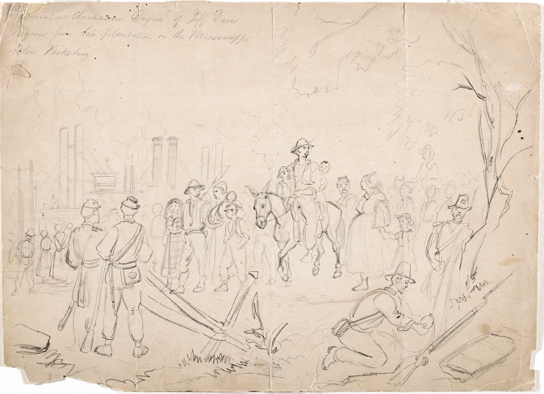
PLATE 29–1
Like the Declaration of Independence, Lincoln’s proclamation required the force of arms to fulfill its liberating promise. It freed no slaves by words alone, but its words authorized action. Thus, whenever Union troops conquered Confederate territory after January 1, 1863, they were encouraged to alert enslaved people that they were legally free by the president’s order—although many so knew already. Quite often, in fact, slaves took the initiative and used the mere approach of Union forces—the irresistible confluence of government authorization and the opportunity presented by Union military presence—to free themselves.
One such incident involved the human property still owned in the summer of 1863 by no less a symbol of the slaveholding aristocracy than Jefferson Davis, president of the Confederate States of America. Davis was not only a slave owner himself but an unrepentant advocate of slavery as a humane condition designed to protect so-called inferior races (and of course put them to good use for superior ones). “My own convictions, as to negro slavery, are strong,” he proudly told a visitor during the secession crisis. “It has its evils and abuses,” he acknowledged, but “we recognize the negro as God and God’s Book and God’s Laws, in nature, tell us to recognize him—our inferior, fitted expressly for servitude.” Indeed, as the biographer William C. Davis (no relation) has pointed out, Jefferson Davis convinced himself that freedom would only hurt African Americans, for “the innate stamp of inferiority is beyond the reach of change.…You cannot transform the negro into anything one-tenth as useful or as good as what slavery enables him to be.”
Davis remained prepared to defend slavery to the last. When he first learned that the Lincoln administration was considering African American recruitment, the Confederate president issued this chilling decree: “That all negro slaves captured in arms be at once delivered over to the executive authorities of the respective States to which they belong to be dealt with according to the laws of said States.” In other words, such captives could be sent back into slavery. Moreover, white officers leading black men with weapons in their hands were to be treated as men fomenting a servile insurrection—a crime punishable by death. Long after the war, Davis opened his memoirs with a lengthy defense of “African servitude” and its protected standing in America. He never repented. But events intervened much sooner.
As early as 1862, Davis began receiving disquieting news concerning the slaves he had left behind to work his Mississippi plantation, Brierfield, after he assumed leadership of the Confederacy first in Montgomery, then in Richmond. With Grant’s forces menacing nearby Vicksburg, some of his slaves had been emboldened to rob the main house and flee. The overseer told Davis he had been unable to stop them. While Vicksburg itself was enduring a forty-seven-day siege that would end with the city’s capitulation on July 4, 1863, Union soldiers found an opportunity to visit the Davis plantation. (Around the same time, Confederate forces marching through Pennsylvania toward Gettysburg torched the abolitionist Thaddeus Stevens’s ironworks in Caledonia, confiscating all his transportable property; such homes were considered trophies of war.) Although federal forces spared the Davis mansion, 137 family slaves escaped, with more soon to follow. The remaining enslaved people were then liberated by federal troops, who took out their fury by plundering the contents of the Davis property. Chained—at least figuratively—to his desk in Richmond, Davis resisted the temptation to rush home to inspect the losses for himself. But the mass escape of his human “property” never convinced the unyielding white supremacist that African Americans yearned for, much less deserved, freedom. Instead, he regarded their flight as an act of ingratitude.
Worse, as noted previously, Davis’s response to the Union’s decision to recruit “colored troops” was to declare their service a capital crime. If captured, he warned, rebellious slaves would not be treated as ordinary prisoners of war; instead, they would be returned to their owners for suitable punishment or handed over to local courts as criminals for trial and hanging. Their white officers would be regarded as insurrectionists who deserved death sentences, too. But Davis’s threats did little to arrest the tide of liberation—even at his own doorstep. The wife of a North Carolina congressman accurately observed: “I don’t think we will have many slaves after Jeff and Abe get done fighting to free them.”
On August 8, 1863, Leslie’s published its woodcut engraving of Schell’s sketch of the Davis slaves entering the safe haven of Union headquarters, along with a brief, front-page account of what had occurred, under the headline “The Slaves of Jefferson Davis Coming on to the Camp at Vicksburg.” The former Confederate secretary of state Robert Toombs, a Georgian (and no friend of Davis’s) who had quit the administration to join the Confederate army and suffered injury at Antietam, had recently boasted that slavery would not only endure in the South, war notwithstanding, but ultimately spread as far north as Massachusetts. Though the space the editors devoted to the incident was small, Leslie’s clearly viewed the flight of the commander in chief’s own slaves as a stunning rejoinder to this racist braggadocio.
Few incidents have been more curious and instructive than that witnessed some time before the fall of Vicksburg, when the slaves of Jefferson Davis from his plantation on the Mississippi came into camp. It seemed in itself the doom of slavery, and formed such a contrast to the vaunt of Toombs, that he would call the roll of his slaves on Bunker Hill, that none can help being struck by it. The President of the Confederate States may call the roll of his slaves at Richmond, at Natchez, or at Niagara, but the answer will not come.
Leslie’s woodcut adaptation, rushed into print while the event it portrayed was still newsworthy, inevitably coarsened Schell’s hastily drawn but respectfully detailed composition, which showed the Davis slaves walking proudly into the Union camp. Schell strove for individualized portraiture and a realistic environment. But in the published woodcut, retitled Arrival at Chickasaw Bayou of the Negro Slaves of Jefferson Davis, from His Plantation on the Mississippi, smoke can be seen belching from the stacks of what in Schell’s original was a more believably idle steamboat. Shorn trees remarkably take on new foliage. And the slaves themselves assume more stereotypical physical features, postures, and attire. But even the insensitive visual editing could not rob the scene of its breathtaking meaning: that here was proof of freedom cast ever wider, even to the very doorstep of the slave republic’s own chief executive.
True to his retrograde racial beliefs to the end, Davis clung to his faith in slavery. And when the Confederate president ran perilously short of funds in the early weeks of his final year in office, 1865, he responded in character: Davis disposed of “property” to raise much-needed cash, selling three horses for $7,330—and two slaves for $1,612. Only when Union troops closed in on Richmond a few weeks later did the beleaguered president finally decide to set aside a lifetime of racist conviction and propose enlisting black troops to fight for Confederate survival in return for their subsequent freedom. But by then such gestures held no meaning. Davis’s own slaves at Brierfield had signaled two years earlier that their liberty was already fairly won—and permanent.
The Emancipation Proclamation actually “freed” as many as 500,000 slaves before war’s end. That is, enslaved African Americans like those forced to labor at Jefferson Davis’s plantation rushed into army camps at the first sign of Union troops. The proclamation’s effectiveness as a freedom document has been vastly underestimated. But then, so has the determination and courage of the slaves who based their risky escapes on its promise of legal freedom.
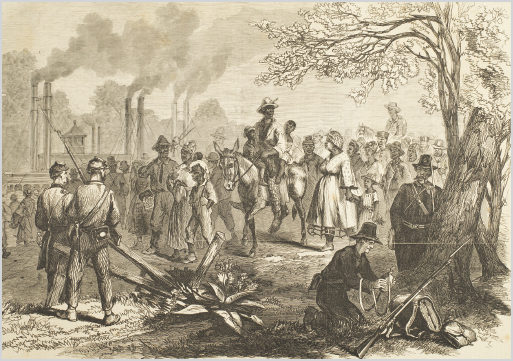
Arrival at Chickasaw Bayou of the Negro Slaves of Jefferson Davis,
from his Plantation on the Mississippi, wood engraving, 1863
PLATE 29–2