
30

EVEN THE PERENNIALLY OPTIMISTIC CONFEDERATE STATES ALMANAC admitted midway through the Civil War that a Southern newspaper might be “short enough for a pocket handkerchief one day, and big enough for a paper tablecloth another.”
The problem was paper itself—that is, the chronic lack of it. The South could claim only a fraction of the nation’s paper mills before the war began, and after federal troops occupied Nashville in 1862, one of the region’s last prime sources of this essential raw material fell under Union control. The paper supply to the Confederacy’s voracious publishers quickly dwindled to a trickle. At best, available stock became inferior, expensive, and scarce—made from rags or straw, incapable of holding ink; at worst, it disappeared altogether. As one Savannah editor admitted: “We are reduced to printing on paper, which, half the time, nobody can read.” Most journals had no choice but to curtail their frequency and size, publishing hitherto routine “extra” bulletins on small slips only a column wide. Others closed down in the wake of unrelieved shortages. In 1862, an imperturbable Baton Rouge editor, forced to suspend publication for want of supplies, used the final edition of his newspaper to good-naturedly advertise himself for other employment. “The editor of this paper being now out of employment, owing to a temporary suspension of the same,” read the notice, “is anxious and willing to do something for a livelihood…[and] has no objection to serving as a deck-hand on a flat-boat, selling ice-cream, or acting as paymaster to the militia.”
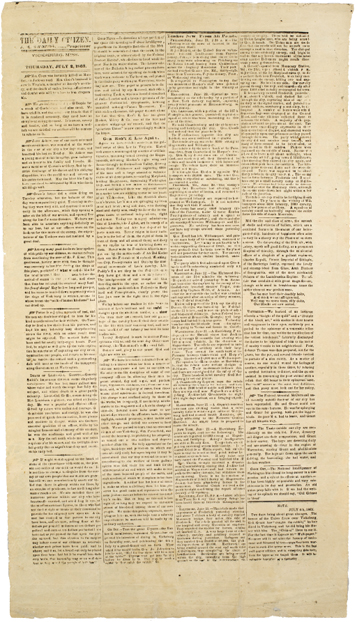
PLATE 30–1
Although the supply crisis caused many established newspapers to shut down, a few new ones did open—at least for a time. Convinced in the teeth of the paper famine that the Confederacy required the equivalent of the North’s Harper’s Weekly and Frank Leslie’s to sustain civilian morale through patriotic pictures, the intrepid Richmond publishers E. W. Ayres and W. H. Wade gamely launched a pictorial weekly, the Southern Illustrated News, in 1862. The first edition boasted the hopeful motto “Not a luxury, but a necessity.” The periodical limped along for about two years, regularly advertising for ink and engravers, but soon began appearing irregularly as employable artists, the wood required for making engraved pictures, and paper for printing all became scarcer. Once, when the Confederate military took control of a nearby railroad station “and prevented the arrival of our useful supply of paper,” the proprietors were forced to cancel an entire 1863 issue. The last known edition was published early the following year. The Southern publishing industry was by then so crippled it had barely found the resources to celebrate the inspiring bravery of Vicksburg, the citadel city on the Mississippi River that resisted Union conquest for nine months and two separate military campaigns.
Resourceful and desperate, newspapers there and in other cities took to issuing one-sided editions on any scrap they could find stored in idle warehouses—including brightly hued wallpaper. Even amid such humiliating deprivation, one crippled Southern journal that had once advocated strongly for secession would now offer “no apology for the…color and quality of the paper.” Its variety, it proudly maintained, reflected “the hardships of war.” None became more famous than the so-called wallpaper editions published in Vicksburg.
For two months beginning in May 1863, the Union fleet operating under a strategy devised by Ulysses S. Grant laid siege to the strategically located “Hill City.” The shelling drove its starving citizens underground, where they literally took up residence in caves, a perilous situation glorified into myth by the intrepid Baltimore artist Adalbert Johann Volck in one of the Society’s best-known Confederate war etchings. But as demonstrated in chapter 26, Volck’s potentially morale-building tributes did not find their way into the Confederate marketplace while the war raged—especially to places like Vicksburg, once it came under attack by Union forces. In plate 30–2, Volck’s horrific but uplifting vision shows a brave and somehow still beautifully dressed and coiffed Southern heroine kneeling in prayer in her ersatz parlor, a crucifix inspiringly nailed to one of the wooden posts precariously supporting her cave. Volck, a Catholic himself, perhaps meant to suggest that faith alone would save these courageous women. In the end, it did not.
One acute observer who managed to keep a more realistic record of the appalling conditions in the besieged city was the diarist Mary Ann Webster Loughborough. The young Arkansas-born mother had chosen, despite the danger, to follow her husband into active war zones when he left their hometown of Jackson with his regiment. In early May, however, she found herself trapped in imperiled Vicksburg. When authorities advised noncombatants to leave, she refused, instead retreating with her daughter to one of the bomb-resistant but rat-infested caves just outside town. Within a year she had revised and completed her journal under the title My Cave Life in Vicksburg—publishing it not in the South but, unsurprisingly, in New York. In one of the most compelling of her entries, Loughborough described the bombing that drove her underground with her child—and the constant fear, danger, and pathos of cave life:
In the evening, we were terrified and much excited by the loud rush and scream of mortar shells; we ran to the small cave near the house and were in it during the night, by this time wearied and almost stupefied by the loss of sleep.
The caves were plainly becoming a necessity, as some persons had been killed on the street by fragments of shells. The room that I had so lately slept in had been struck by a fragment of a shell during the first night, and a large hole made in the ceiling. I shall never forget my extreme fear during the night, and my utter hopelessness of ever seeing the morning light. Terror stricken, we remained crouched in the cave, while shell after shell followed each other in quick succession. I endeavored by constant prayer to prepare myself for the sudden death I was almost certain awaited me. My heart stood still as we would hear the reports from the guns, and the rushing and fearful sound of the shell as it came toward us. As it neared, the noise became more deafening; the air was full of the rushing sound; pains darted through my temples; my ears were full of the confusing noise; and, as it exploded, the report flashed through my head like an electric shock, leaving me in a quiet state of terror the most painful that I can imagine—cowering in a corner, holding my child to my heart—the only feeling of my life being the choking throbs of my heart, that rendered me almost breathless. As singly they fell short, or beyond the cave, I was aroused by a feeling of thankfulness that was of short duration. Again and again the terrible fright came over us in that night.
I saw one fall in the road without the mouth of the cave, like a flame of fire, making the earth tremble, and, with a low, singing sound, the fragments sped on in their work of death.
Morning found us more dead than alive, with blanched faces and trembling lips. We were not reassured on hearing, from a man who took refuge in the cave, that a mortar shell in falling would not consider the thickness of earth above us a circumstance.
…Sitting in the cave one evening, I heard the most heartrending screams and moans. I was told that a mother had taken a child into a cave about a hundred yards from us; and having laid it on its little bed, as the poor woman believed, in safety, she took her seat near the entrance of the cave. A mortar shell came rushing through the air and fell with much force, entering the earth above the sleeping child—cutting through into the cave—oh! most horrible sight to the mother—crushing in the upper part of the little sleeping head, and taking away the young innocent life without a look or word of passing love to be treasured in the mother’s heart.
I sat near the square of moonlight, silent and sorrowful, hearing the sobs and cries—hearing the moans of a mother for her dead child.
Cave dwellers were hardly the most reliable newspaper subscribers—they had other necessities foremost on their minds—but one local journal somehow continued for a while to cover the siege for the benefit of the few news-starved readers brave enough to emerge from their shelters long enough to buy the daily. The publisher J. M. Swords ran out of his paper stock in June, but on the sixteenth, eighteenth, twentieth, twenty-seventh, and thirtieth he issued four-column-wide, single-sheet editions 167⁄8 by 91⁄8 inches in size on the back of wallpaper fragments. Some of the newspapers appeared on the reverse of rose-and-purple brocade designs, others on pink-and-red floral patterns set against cream-colored or pale-blue backgrounds. Swords used what he could get.
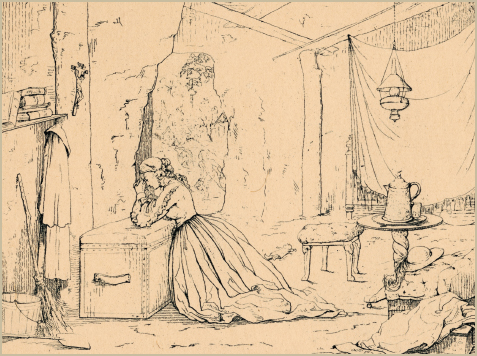
Cave Life in Vicksburg During the Siege, etching by Adalbert Johann Volck, 1863
PLATE 30–2
On July 2, the publisher prepared what turned out to be his last issue. It offered belated news of General Lee’s “brilliant and successful” triumph against Joseph Hooker at the Battle of Chancellorsville the previous month. “Today Maryland is ours,” the paper mistakenly reported, vowing, “To-morrow Pennsylvania will be, and the next day—Ohio—now midway like Mohammed’s coffin—will fall.” Little did Swords know that even as his July 2 edition hit the streets, Lee’s forces were furiously engaged in their ill-fated contest at Gettysburg. Closer to home, the paper managed to acknowledge and admonish “the lax discipline of some of our company officers in allowing their men to prowl around, day and night, and purloin fruit, vegetables, chicken, etc. from our denizens, and, in the majority of cases, from those whose chief subsistence is derived therefrom.…A soldier has his honor as much at stake as when a civilian; then let him preserve his good name and reputation with the same jealous care as before he entered his country’s ranks.…We make this public exposure, mortifying as it is to us, with the hope that a salutary improvement in matters will be made by our military authorities.”
In fact, discipline among Vicksburg’s Confederate defenders no longer mattered. His ranks of defenders reduced by disease and starvation, the commanding general John Pemberton surrendered his twenty-nine-thousand-man army to Grant on July 4.
In that final July 2 edition, J. M. Swords had mocked “the great Ulysses—the Yankee Generalissimo, surnamed Grant,” for expressing “his intention of dining in Vicksburg…and celebrating the 4th of July with a grand dinner and so forth.” Taunted the Daily Citizen: “Ulysses must get into the city before he dines in it. The way to cook a rabbit is ‘first catch the rabbit.’”
Not long after the issue hit the streets, as it happened, Grant did just that. Swords fled town while his newspaper’s metal type was still in its racks. Union conquerors stormed into the office and reset the story appearing in the paper’s lower right-hand corner. A handful of surviving July 4 editions of the Daily Citizen concluded with the following acerbic update—the Union conquerors’ last laugh after a brutal season of Confederate weeping:
NOTE
JULY 4th, 1863.
Two days bring about great changes. The banner of the Union floats over Vicksburg. Gen. Grant has “caught the rabbit”; he has dined in Vicksburg, and he did bring his dinner with him. The “Citizen” lives to see it. For the last time it appears on “Wall-paper.” No more will it eulogize the luxury of mule-meat and fricasseed kitten—urge Southern warriors to such diet nevermore. This is the last wall-paper edition, and is, excepting this note, from the types as we found them. It will be valuable hereafter as a curiosity.
Indeed, few Civil War papers are more valuable today than surviving copies of the last wallpaper editions of the Daily Citizen—with or without the Union-authored July 4 postscript. It remains not only among the rarest but the most frequently reproduced of all Civil War newspapers. At least thirty reprint editions are known, many passed off as genuine over the years, and their owners have often mistakenly believed they possessed the scarce originals. The New-York Historical Society owns four unquestionably genuine copies of the precious July 2 edition—three containing the last-minute inserted notice of Union occupation, and one without. In donating his “relic of the war” to the Society in 1875, the former Ohio cavalry officer Edward Crapsey offered unquestionable provenance: he had found the papers in Vicksburg himself—on the very day Union troops marched in. Together with Loughborough’s recollections and Volck’s etching, they constitute the most reliable record in existence of an instance of Southern endurance—and Union relentlessness—that changed the course of the war and evolved into myth.