
31

THE ADMINISTRATION IS ACTING WISELY IN ORDERING THE immediate enforcement of the draft,” the New York Times editorialized on July 10, 1863. “We have just achieved two great victories which it seems should paralyze the war power of the rebellion”—meaning Gettysburg and Vicksburg—but now, the paper recommended, “a new army of 300,000 men must be got ready to move upon the Confederacy. Let the rebel States see that not only are they beaten now, by the forces at present in the field, but that in the Fall they must meet the same veteran armies, recruited, and 300,000 stronger. And then, if they mean to stop short of annihilation, they will certainly see the propriety and necessity of yielding.” Surely, the Times reasoned, even the “chiefs of faction” opposed to conscription would never “deter the Government from carrying it out to its complete execution.”
In this prediction, the Times proved correct—but at what enormous cost in life, property, and civic image they could not have prophesied. In mid-July, provost marshals throughout New York City began drawing the first names of draft-eligible men from large, hand-cranked wooden wheels like this exceptional surviving original. Officials used this very relic that day on the Lower East Side.
Standing on a trestle frame held in place by bracketed wooden feet, the wheel features a lockable hatch and an iron-and-wood handle to rotate it, along with some one hundred of the small draft cards it originally contained for that initial drawing—all bearing the names and occupations of men who, it turned out, were never drafted: an ethnic tapestry of names and occupations like tailor David Jones, mason Joseph Huber, upholsterer John Jacobs, shoemaker Joseph Illwitzer, carpenter Mike Johnson, and “colored waiter” George Jones.
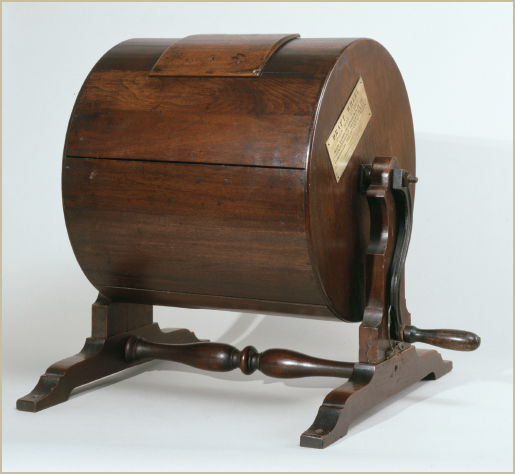
PLATE 31–1
The federal conscription act that Congress passed in March 1863 was by no means perfect. Though it applied to most male citizens between the ages of twenty-five and forty-five, it exempted any draftee who could provide a substitute to serve in his place or could pay a bounty of three hundred dollars to the government—an amount equal to the average annual salary of the Irish American laborers who so vociferously opposed the Lincoln administration, emancipation, and the military service the Union now required. To head off any show of opposition, Lincoln suspended the privilege of the writ of habeas corpus nationwide and established the offices of provost marshals, constituted almost as a secret police force with the power to seize spies, deserters, and war critics. These initiatives in some ways made a bad situation worse.
With the first conscription lottery scheduled for July 11, the blatantly racist anti-administration Freeman’s Journal fanned the flames of discord by advising New Yorkers to resist the draft in order to prove that they were not an “enervated, emasculated, and slavish people.” Other Democratic organs similarly denounced conscription as part of a plot by Republicans in Washington to override local and state rights, impose black equality, and force Irish-born Democrats into what some of them called a “nigger war”—requiring them to risk their lives to free black men who would soon compete for their low-paying jobs.
Nonetheless, the provost marshal drew the initial conscript names without incident on Saturday, July 11, and after a day off for Sabbath observance resumed the lottery on Monday the thirteenth. But early that steamy morning, enraged protesters stormed the uptown draft headquarters on Third Avenue between Forty-sixth and Forty-seventh streets, beating policemen who stood in their way. The mob tossed bricks through its plate-glass window and proceeded to smash the draft wheel, scatter the cards, trash the interior, and set the office ablaze. Then the rioters stormed downtown, their numbers increasing as they moved south toward the city’s armories to seize guns and ammunition to continue their rampage, leaving the entire Forty-seventh Street block burning. Meanwhile, aroused residents in the city’s poor Irish neighborhoods swarmed into black enclaves, torched businesses and homes, and menaced residents, beating hundreds, perhaps thousands of African Americans, maiming and sexually mutilating dozens, and lynching by some accounts eleven innocent victims. The New York City draft riots—more accurately race riots—were under way.
Other mobs targeted well-known Republicans and their personal and business properties. Protesters attacked the offices of Horace Greeley’s New York Tribune on two separate occasions. At the newly opened nearby headquarters of the New York Times, the publisher Henry J. Raymond took no chances, ordering guards manning Gatling guns to his roof to protect the lavish building. One mob pillaged the Brooks Brothers clothing store, and still another broke into a town house owned by two known Republican-inclined merchants, breaking up their expensive furniture and hurling a framed portrait of President Lincoln into the street, where cohorts merrily stomped it into smithereens. Mobs attacked abolitionists and so-called amalgamationists, including Mary Burke, a prostitute who reputedly took black men as clients, and Ann Martin and Ann Derrickson, two women married to black men. Imposing a reign of terror throughout Manhattan, rioters looted more stores and businesses, pummeled police officers, tore up railroad tracks, burned down the armory on Second Avenue and Twenty-first Street, and invaded the nearby Union Steam Works in an effort to gain control over the four thousand rifles stored inside. It took a huge police contingent to clear the factory in a horrific scene in which outnumbered occupiers leaped to their deaths from the steam works’ windows or fell where they stood to gunfire or clubbing. When Archbishop John Hughes pleaded for calm, the predominantly Catholic mobs responded by setting fire to a number of Protestant churches and assaulting firemen who tried to extinguish the flames.
Not until July 17, when Union troops summoned to quell the riots reached New York from the vicinity of their recent triumph at Gettysburg, did order return to the shattered city after four days of plunder, arson, and death. Within days, against the urgent advice of the Democratic governor Horatio Seymour, federal officials resumed pulling names for the draft. But by then the city’s Common Council had passed an emergency bill providing funds to underwrite the three-hundred-dollar bounties of every conscript who desired to avoid service by hiring a substitute. Many white men took advantage of the new loophole. Meanwhile, more than four thousand African Americans enlisted in all-black regiments voluntarily.
When officials tallied the human and financial costs of the worst urban violence in memory, the ugly riots had cost some 119 lives and left more than 110 soldiers and policemen wounded and untold hundreds of civilians, black and white, injured. It was, by all accounts, the bloodiest civil insurrection in the history of the country—save for the Civil War itself. But little evidence survived to attest to its ferocity: what was not burned to ashes was tossed into rivers or smashed and later discarded. Damaged buildings were torn down and new structures built on their sites. Whole communities disappeared. Unique relics like the Lower East Side draft wheel survived in far better condition than many battered New York neighborhoods and residents.
Provost Marshal Frederic C. Wagner, who donated the pristine memento of that rampage, later received ample political reward for his wartime loyalty and courage. A wealthy descendant of the seventeenth-century Lord of the Manor of Fordham, he went on to serve for more than twenty years as a deputy tax commissioner.
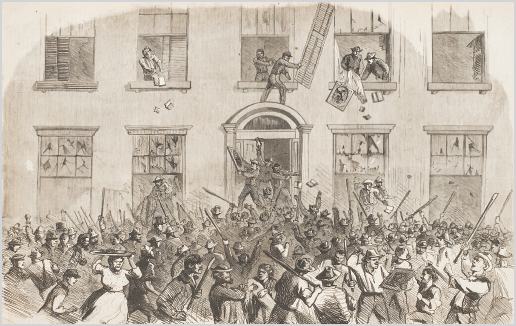
Sacking of Brownstone Houses in Lexington Avenue
by the Rioters on Monday, July 13, wood engraving, 1863
PLATE 31–2