
33

ONLY GENERALS LIVED IN WHAT AMOUNTED TO LUXURY IN THE FIELD during the Civil War—often commandeering private homes near their encampments to use as headquarters or dwelling in capacious canvas tents, where they ate, drank, and smoked the best products that their aides could procure, and where they were faithfully attended by military personnel and civilian servants alike.
Privates, on the other hand, endured in comparative squalor, sleeping outdoors or inside inadequate tepee-shaped Sibley tents, “packed like sardines in a box.” They survived on tasteless rations like hardtack, toting overloaded “knapsack, haversack, [and] three pound canteen, all full,” on their frequent marches. In between these two extremes of luxury and privation, high-ranking officers at least made do with more compact and easily transportable living supplies. None was more ingeniously designed than the military footlocker—the nineteenth-century equivalent of modern carry-on luggage. Footlockers could hold a bounty of personal items in a remarkably small space.
Here is a rare example of these remarkable military footlockers—this one fully stocked with living supplies, military gear, and souvenirs—that appears to have remained intact, in much the same condition in which it was used and then left for posterity by its owner, Lieutenant Colonel William H. Paine (1828–1890) of the 4th Wisconsin. Paine was a New Hampshire–born, self-educated topographical engineer, surveyor, and mapmaker who served with the Army of the Potomac through the entire war. The detail-oriented Paine must have appreciated the intricate, suitcase-like contraption he toted from battlefield to battlefield: he was responsible, after all, for modernizing and improving the systems used by military surveyors during the war. At one point the creative officer perfected and secured a patent for a coiled, flat-steel tape measure, the forerunner of today’s familiar, retractable Stanley PowerLock models. Paine practiced innovation and surely appreciated it in others.
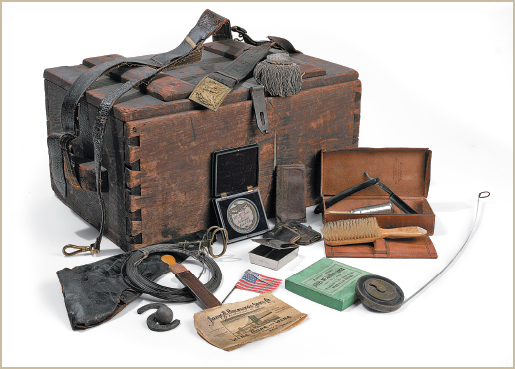
PLATE 33–1
His lockable wooden footlocker, just 10¾ by 21½ by 15¼ inches in size, and made to be carried by two side handles, was itself a utilitarian marvel. Perhaps because it was not only highly useful but irresistibly attractive, Paine made sure it was sufficiently personalized to inhibit covetous comrades from purloining it. Painted on the lid is the bold identification: “Col. W. H. Paine / A.D.C. / HdQs Army of the Potomac / DC 1.” Apparently, it remained safe. The footlocker still features its original two tray-like compartments, each still stocked with the personal and professional supplies Paine used on campaign and later: pince-nez-style engineering spectacles and a shaving kit that included a metal-handled shaving brush and a razor (the case is stamped “W. H. PAINE, 107 WEST 122 STREET, NEW YORK”). Also in the locker trays are a black comb and a wooden hairbrush with yellow bristles, a leather belt holster, a richly decorated leather-brass-and-cotton sword belt and buckles, paper fragments, a silver-colored skeleton key on a string, a single round metal grapeshot, a leather strap, a single gilt souvenir epaulet dating to the War of 1812, insignia of the U.S. Army Engineers, a miniature silk American flag on a metal flagpole (its stripes bearing the names of various Civil War battle sites), a wooden accessory box filled with personal items like ribbons, two coin purses with metal snap fasteners, a paper election roster, a dark-brown leather billfold, and two metal tape measures of the type Paine patented. Inside, too, was discovered a medal Paine earned from the American Institute, featuring on one side a female allegorical figure grasping a liberty pole and on the other an American eagle with a banner in its beak. The banner reads: “Awarded to Wm. H. Paine, for a Surveyors Measure & Case 1865.” Paine apparently entered his tape-measure gadget in a postwar contest for new inventions—and won.
If these items could talk, they would no doubt offer a monologue on the most famous engagement they “witnessed,” for after beginning his army career by mapping out the locations of all the destroyed bridges between Washington and Richmond in 1861, Paine saw service under General Irvin McDowell and a number of other commanders of the Army of the Potomac. For all of them he efficiently produced maps (several of which exist among his papers at the Society) in a singularly personal fashion: by placing a sketch board on the pommel of his saddle and drawing topographical features while riding horseback. “Making use of the lithographing process and having his assistants trained according to his own methods,” The National Cyclopaedia of American Biographyreported years later, “he would complete in a day a map that other engineers required three weeks to produce. Many of his maps are filed in the archives of the war department.”
No doubt most memorably of all, Paine toted his gear all the way to Gettysburg. “Engaged in gathering information correcting maps securing guides etc.,” Paine wrote from the village on the first day of battle there, July 1, 1863, in a diary that found its way into the collection in 1978 along with the footlocker. “At 10 pm guided Gen Meade and escort to near Gettysburg.…Spent the night in examining our position which is along a ridge extending SW and SE.”
Paine made note of “a hard fought battle raging nearly all day” on July 2, then recorded his impressions of the loud Confederate bombardment that preceded Pickett’s Charge the following afternoon—an attack “repulsed by a most terrible fire from our artillery as well as infantry the 2d corps which held the immediate front where the fire was most firm and met the infantry in front of the rifle pits. On visiting this part of the field after the action the ground was literally strown [sic] with dead and wounded rebels thousands lay in one small field.” Conceivably, it was from this corpse-filled site that Paine picked up the grapeshot he subsequently consigned to his locker. “Their repulse was final,” he said of the Confederates in the last entry in his account. “There is no danger of another attack from them. All the corps did well no one faltered.…It was the most fearfully magnificent scene imaginable. Shots & shells struck on every hand.…Having just repulsed the rebels after a hard fought battle we can celebrate with feeling.”
Paine and his footlocker survived both the fight and the celebration intact. After the war, the former colonel married, moved to New York, produced some illustrations for Horace Greeley’s and William Swinton’s histories of the war, became chief engineer of the Flushing & Northern Railroad, worked on locating a new Hudson River tunnel, secured fourteen additional patents, became a trustee of the Harlem Savings Bank, and, in what was surely the highlight of his peacetime career, generated advance surveys in preparation for construction of the so-called eighth wonder of the world: the new Brooklyn Bridge. He evidently continued to use his footlocker on his postwar engineering assignments: one of its contents is a silk advertisement for Roebling & Sons, the designers and builders of the miraculous suspension span across the East River between Brooklyn and Manhattan.