
34

AMID THE DEPRIVATION THAT HELD MOST OF THE SOUTH IN ITS unrelenting grip by mid-war, it is a source of surprise that the Raleigh, North Carolina, publisher Branson, Farrar & Company managed to assemble the talent—not to mention the ink and paper—to produce Mrs. M. B. Moore’s First Dixie Reader in the tumultuous year of 1863. The New-York Historical Society owns a copy from a second printing issued, even more surprisingly, the following year of even greater scarcity: 1864. Printed on brittle, inferior paper—nothing better was likely available—by one A. M. Gorman, the book sold for seventy-five cents with the “usual discounts to the trade” and with ten cents on the dollar required for mail orders. The copy owned by the New-York Historical Society entered the collection in 1949.
“This little volume is intended to follow the Dixie Primer,” Marinda Branson Moore declared in her preface, “also to accompany a Speller, which will be brought out as early as circumstances will permit. At no distant period we hope to complete the series of Readers.” Designed “as a stepping-stone…to the large Speller,” the primer alternated rote spelling lessons and reading exercises designed for children still unable “to understand properly the sounds of letters, and the rules of pronunciation.” The publishers emphasized the primer’s regional appeal: it was not only “well adapted to young readers,” they advertised, but “entirely a Southern book” as well.
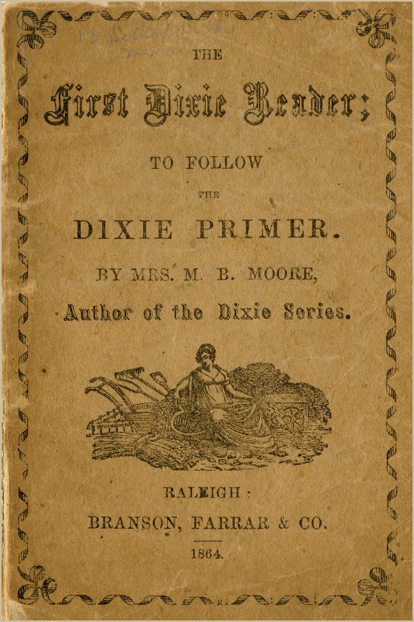
PLATE 34–1
Few such titles were by then appearing in the South. As the historian Mary Elizabeth Massey observed in her classic 1952 study, Ersatz in the Confederacy: Shortages and Substitutes on the Southern Homefront, “Books were more scarce than either newspapers or magazines. Prior to 1861, books were brought into the South in quantity from the North and from England, for the works of the English authors were greatly admired by the Southern reading public. The blockade practically halted this importation, although a few books did come through. Whenever a new book made its appearance, it was received with much applause and passed around among many. The publishing houses…were handicapped by lack of paper, manpower, good ink, and by old worn-out, irreplaceable machinery. They published a fair number of new novels, histories, military works, textbooks, song books, and music” often in “brown paper editions, bound in any available material,” but “they could not possibly keep up with the demand.” In such a depressed and depressing market, Moore’s little book must have been looked upon in its day as a literary and commercial triumph.
At first blush, The First Dixie Reader follows a familiar track typical of early childhood education in the mid-nineteenth century: repetition followed by more repetition. The book employed relentless rhyming to teach proper spelling: the words “cat,” “bat,” “fat,” “mat,” “pat,” and “rat” introduced the publication, followed by such matching sounds as “bet,” “get,” and “met”; “bit,” “fit,” and “pit”; “cot,” “dot,” and “got”; and “cut,” “gut,” and “nut.”
Many of the sentence-by-sentence reading exercises sound not unlike the numbing “Dick and Jane” stories of the next century. But there was surely more than a bit of proselytism behind the paralyzing tautology. In addition to such paeans to home-front industriousness, Moore managed to slip in moral and religious instruction alongside lessons about owls, colts, sheep, pigs, crows, dogs, and the mystery of rain. Character-building read-along passages emphasized sobriety, good behavior, Sabbath observance, and the constant presence of a judgmental God who watched children “all the day long.” The book even contained a truly frightening nine-sentence explanation for the death and funeral of an infant, an all too common occurrence in nineteenth-century America, North as well as South—but offered here as a warning against bad but now see its pale white face. God saw it would be best to take it to heaven now. Perhaps he looked away in the future, and saw that the child would not be good if it grew to be a man.” Yet another lesson promised redemption in return for reverence:
1. Who made you, child?
2. God made me of dust.
3. For what did he make you?
4. To be good, and to do good.
5. Who loves good boys and girls?
6. Pa, and ma, and all good men.
7. Who else loves them?
8. God loves them.
9. Can you be good of yourself?
10. No, I must ask God to help me.
11. Will God hear a child pray?
12. He says he will.
Branson, Farrar & Company’s surprisingly robust list of 1864 publications suggests that the yearning for instruction and the obligation for childhood education never deserted Southerners despite the absence of breadwinning men and the difficulty that home-front women experienced obtaining basic necessities like food. Emma Edwards Holmes, a South Carolina aristocrat who turned to tutoring during the war (being a “schoolmistress,” she confided, was “what I have always wished myself to be”), found that maintaining discipline was difficult—especially with so many fathers and older brothers away at the front. “My little school does not progress very smoothly,” she recorded in her diary in June 1862, “for neither of the boys are studious and give me a great deal of trouble—besides being very much spoiled & telling me ‘I will and I won’t’ very frequently.”
The New Dixie Primer was but one of eight spellers, rhyme books, and grammar manuals the publishers promoted in the endpapers for the Moore primer. But despite Mrs. Moore’s optimistic expectations for additional supplements, The First Dixie Readerturned out to be the last in her series of primers—and not only because the Southern publishing industry collapsed altogether in 1864. That year, Mrs. Moore herself died. This was her last book.
On the final leaf of its sixty-three pages of rote spelling instruction, chilling appeals to conscience, honesty, fair play, and industriousness, and the most mundane examples of animal lore, Marinda Branson Moore probably came closest to summarizing the Southern ideal of God-fearing education with a concluding poem titled “I’m Not Too Young for God to See.” One can almost imagine entire classrooms full of impressionable children reciting the lines in abject terror. However “Southern” she thought such instruction to be, the author might have been surprised to learn a lesson for herself—that in 1864, Northern primers featured many of the same techniques, lessons, and warnings:
I’m not too young for God to see,
He knows my name and nature too;
And all day long, he looks at me,
And sees my actions through and thro’.
He listens to the words I say,
And knows the thoughts I have within,
And whether I am at work or play
He’s sure to know it if I sin.