
35

ON MARCH 5, 1864, “A VAST CROWD” OF 100,000 NEW YORKERS “OF EVERY shade of color, and every phase of social and political life” thronged into the city’s principal outdoor rallying point, Union Square, to wave flags and handkerchiefs and cheer themselves hoarse for a newly organized army regiment. This was no ordinary outpouring of appreciative civilians. But then, this was no ordinary regiment. Less than a year after the New York draft riots, the city’s philanthropic liberal Republicans attempted to atone by financing, recruiting, training, outfitting, and now robustly celebrating the brand-new 20th Regiment of the U.S. Colored Troops—the first all-black unit raised in the Empire State.
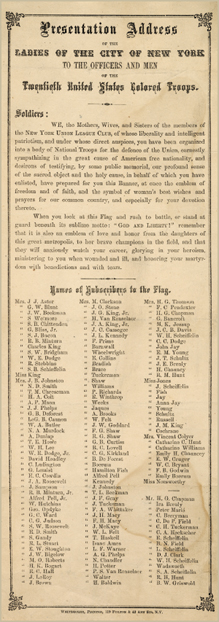
PLATE 35–1
That day, the police superintendent led a hundred city patrolmen at the head of the parade, followed by members of the regimental sponsor, the Union League Club, and hundreds of “Colored Friends of the Recruits marching with hands joined.” The Governors Island Band provided musical accompaniment, and the crowd offered “cheers upon cheers,” according to one rather sanctimonious account, “given in a manner which showed how truly the brave spirit of the once-despised colored man was appreciated by the intelligent citizens of New-York.”
The ceremony got under way at 1:00 p.m. on a specially built, flag-festooned wooden platform outside the club building, when a noted educator offered what was intended to be an inspiring lecture. Then, most dramatically, the club unfurled and presented the regiment with an “elaborately embroidered” regimental flag (designed by the Washington Crossing the Delaware artist, Emanuel Gottlieb Leutze, no less). Emblazoned with the words “God and Liberty,” the banner was adorned with a “conquering eagle and broken yoke”—emblems intended to “speak as plainly as symbols can of the might of Freedom and the overthrow of Slavery.”
Accepting it in behalf of his men, the regimental commander acknowledged that the banner “symbolizes our country” and declared: “It is this that makes death glorious beneath its starry folds.” Echoing these sentiments, the principal orator that day predicted that the colors would “form a spell of such power as to bind up every generous heart with one firm, fierce resolve that these flags…shall not be surrendered—but shall go marching on, and marching on, and still marching on to triumph, and final victory!” The flag itself has long disappeared, but the ornate words that its female donors spoke and published that day in presenting it to the 20th survive in the collection in the form of a period handbill published especially for the regiment’s dazzling send-off.
Trained on Rikers Island, then transported by boat across the East River hours earlier for the outdoor ceremony, the thousand soldiers of the 20th paraded that day from the riverfront to Union Square. Along the way, they enjoyed a Manhattan welcome every bit as enthusiastic and colorful as the flag-suffused parade given in honor of the members of the all-white 7th Regiment when they headed off for the seat of war back in the spring of 1861. George Templeton Strong, a Union League founder who attended both ceremonies, proudly noted of the latter, “Our labors of a year ago have borne fruit,” adding that he thought the “phenomenon—Ethiopia marching down Broadway, armed, drilled, truculent, and elated—was” as memorable as the departure of the first white regiments for the front three years earlier. “The regiment was ‘black but comely,’” he added in a somewhat unfortunate afterthought, “and marched well…not below the average of new regiments. Both sidewalks and all the windows were full of applauding spectators. There was hearty cheering and clapping and waving of handkerchiefs, and I neither heard nor heard of any expression of sound, constitutional, conservative disapproval.”
The 20th had been the brainchild of the “Mothers, Wives, and Sisters” of the Union League, if they did say so themselves—which they proudly did, right in the handbill prepared for the flag-presentation ceremony: Presentation Address of the Ladies of the City of New York to the Officers and Men of the Twentieth United States Colored Troops. There was no doubting the ladies’ charitable intentions, yet there was something excruciatingly patronizing about the published reminder (floridly composed by the writer Henry T. Tuckerman) that it was their own “liberality and intelligent patriotism” that had made it possible to fashion these soldiers “into a body of National Troops for the defense of the Union, earnestly sympathizing in the great cause of American free nationality.”
Organizing a “colored” regiment in New York had not been an easy task. Although Lincoln’s Emancipation Proclamation had specifically urged African American recruitment, prompting other Northern governors to respond enthusiastically by raising regiments, New York’s Democratic chief executive, Horatio Seymour, fearful of alienating his downstate, predominantly Irish American supporters, did little to encourage it here—not even when proponents pointed out that every African American recruited would mean one less white conscript drafted. Significantly, Lincoln’s most recent call for more men had made no reference to race. Finally, local white philanthropists organized their own New York Association for Colored Volunteers in November. After its first meeting the committee made it clear to Seymour that “justice and patriotism alike require that all men who are subject to a draft, shall have equal privileges in volunteering,” and warned the governor to place “no impediments” in the way of “colored men who are willing to comply.”
Seymour backed down, or at least he deferred to the War Department, but the challenge of recruiting in New York remained formidable. At first, no Manhattan landlord would rent an office for “such a purpose as a depot for recruiting negroes.” Finally, the committee found space to share in a building on Broadway and Fourth Street, in rooms already occupied as a relief center for black draft riot victims. Although offered less pay than white recruits, African Americans were still eligible for a handsome seventy-five-dollar federal bounty just for signing up. Unfortunately, some were reportedly swindled by bounty brokers; others were drugged and virtually shanghaied into service. Worse, when the regiment shipped out to Rikers Island for training, the men were crammed into tents “without floors or warming, causing great suffering from cold.” The committee took it upon itself to buy the extra tents the army had failed to provide, and purchased stoves to heat them, but not before many of the recruits fell ill. There was “no proper hospital” on the island to treat them. Miraculously, the enlistees recovered, survived, and learned their military drills. After only two months to learn how to be soldiers, they headed to Manhattan to receive their regimental colors.
On March 5, “desirous of testifying, by some public memorial, our profound sense of the sacred object and the holy cause, in behalf of which you have enlisted,” the Union League women reminded the recruits that they had “prepared for you this Banner, at once the emblem of freedom and of faith, and the symbol of woman’s best wishes and prayers for our common country, and especially for your devotion thereto.” The mothers and sisters left the troops with this final piece of what they hoped would be inspiring advice: “When you look at this Flag and rush to battle, or stand at guard beneath its sublime motto…remember that it is also an emblem of love and honor from the daughters of this great metropolis, to her brave champions in the field, and that they will anxiously watch your career, glorying in your heroism, ministering to you when wounded and ill, and honoring your martyrdom with benedictions and with tears.”
The notion of white women referring to black men as their “champions in the field” was radical indeed for 1864, but the soldiers for whom the compliment was intended probably paid more attention to its rather chilling reminder about the very real possibility of death. The entire passage was read aloud that afternoon from a copy engrossed on parchment and signed by 153 subscribers to the flag project—the crème de la crème of New York society—including the wives of John Jacob Astor, William Cullen Bryant, Hamilton Fish, and of prominent men named Phelps, Dodge, Jay, Roosevelt, and Van Rensselaer. The New-York Historical Society’s four pristine copies of the rare handbill version are undoubtedly among the thousands handed out to the throng that gathered that afternoon at Union Square.
Presentation of Colors to the 20th U.S. Colored Infantry,
March 26, 1864
PLATE 35–2
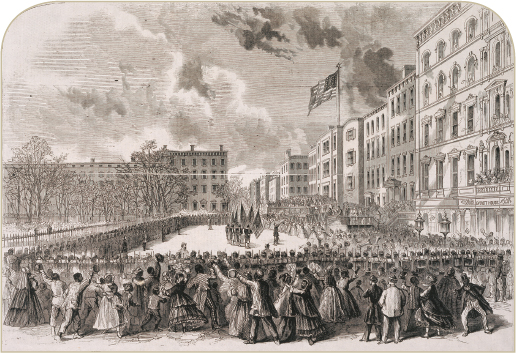
“This march will be the subject of cords of historical paintings before 1900 A.D.,” George Templeton Strong immediately predicted. Indeed, the March 5 event proved significant enough to inspire a beautiful E. L. Henry commemorative painting for the Union League clubhouse itself, along with widespread coverage in the press. This included a woodcut illustration published in Frank Leslie’s Illustrated Newspaper on March 26, which showed the large, and integrated, crowd (the people of color, to be sure, relegated to the rear outskirts of the audience), cheering and waving as the regiment goes through its precision drills. As the Times reported in its own detailed coverage: “They are a fine, strong and hearty set of men, and their splendid appearance, combined with the apparentreadiness and determination with which they enter their new profession, created a very favorable impression in the minds of all who saw them.…They marched to the front of the stand and performed one or two military movements in good style, their order of arms being almost, if not quite, equal to that of the famous 7th Regiment. They were then formed in square, open ranks, officers to the front, color-guard to the front and centre, the Colonel in front of his regiment and opposite President King of Columbia College, who presented the stand of colors to the regiment, then addressed them.”
Surely it was not lost on the audience, particularly the African American attendees, that all the regiment’s officers were white—including the regimental commander, Lieutenant Colonel Nelson B. Bartram, a former public school assistant principal, though a veteran of the Peninsula Campaign, Fredericksburg, and Chancellorsville. Bartram came with useful experience in managing African American soldiers. He had recently returned to New York after serving as commander of the brave and “resolute” men of the 8th USCT in Florida. Rounding out the contingent of officers were Lieutenant Colonel Andrew E. Mather of Cooperstown and Major Amos P. Wells, who had served in Ellsworth’s Fire Zouaves early in the war. As in virtually all black regiments, the surgeons, quartermasters, line captains, and first and second lieutenants were Caucasian as well. Thanks to federal policy, the USCT was not only slow to organize regiments in New York State and unable to offer equal pay for its recruits but also resistant to the idea of bestowing rank on people of color.
That was evident when the March 5 ceremonies came to a close. Bartram mounted his handsome gray horse; called the 20th into close order; received three cheers for himself, his officers, and his men; and in return proposed three cheers for the Union League, which his soldiers offered “as only strong lungs and willing men can.” Then the officers headed into the clubhouse to partake “of a splendid collation, which had been prepared for them” by members. The black recruits remained outside and according to one report got only coffee, albeit brewed “under the personal supervision of the ladies, who seemed well to understand the soldiers’ tastes.” Only then did the regiment begin its final march down Broadway and across Canal Street to the Hudson River, where its men boarded the steamer Ericsson bound for service in New Orleans. There they began their military service not as warriors but as occupiers. Indeed, most African American troops were initially assigned to garrison duty or providing security for railroads and prison camps, but they also proved their valor, whenever asked, at battlefields from Port Hudson, Louisiana, to Petersburg, Virginia.
The 20th served at Port Hudson, too, but departed for a brief assignment at Point Cavalho, Texas, the month before the battles got under way at the more important Mississippi River target. In May 1864, the 20th returned to the New Orleans area. Stationed at nearby Carrollton, they saw little action, though by one report they became “the best drilled and best disciplined regiment in the department of the Gulf.”
While the 20th saw none of the kind of memorable, heroic action that the 54th Massachusetts experienced at Battery Wagner in 1863, other New York USCT units did go on to earn their share of glory before the war ended. The year after the 20th mustered into service in the city where the draft riots had raged, the 102nd USCT helped seize the city where the rebellion itself had begun: Charleston, South Carolina. Altogether, New York State sent 4,125 African American soldiers into the ranks of the U.S. Colored Troops—far smaller totals than Southern states like Kentucky (23,703) and Tennessee (20,133), but notably fewer as well than Northern states like Pennsylvania (8,612) and Ohio (5,092). It is worth noting that African American soldiers from free states were predominantly free blacks who were in some cases decades removed from slavery, whereas blacks recruited in slave states tended to be escaped or liberated former slaves.
Attention soon shifted to the volatile issue of appointing black officers. “Why equal privileges are withheld from one class and not from the other, I am at a loss to conjecture,” Sergeant James T. S. Taylor wrote in a letter to the editor of the Anglo-African after his own USCT regiment marched into Key West, Florida. “Are we still to be deprived of all these rights and privileges which, by our sacrifices, we justly merit? This nation had to be taught some very severe lessons by Providence before they would even let the negro have a musket, and now, not until equal rights are given us as soldiers will the God of all Wisdom lead the nation to a victorious triumph and a lasting peace.”
It is likely that few of the tens of thousands of civilian onlookers massed in Union Square on March 5, 1864, for the Presentation of Colors to the 20th USCT gave a second thought to the inequity of the command structure among African American regiments. Instead, the New York Times spoke for many who thought that the mere enlistment of USCT volunteers constituted a revolutionary advance in race relations. “The scene of yesterday was one which marks an era of progress in the political and social history of New-York,” wrote the reporter covering the event.
“In the month of July last the homes of these people were burned and pillaged by an infuriated political mob,” the Times pointed out. “They and their families were hunted down and murdered in the public streets of this city; and the force and majesty of the law were powerless to protect them. Seven brief months have passed, and a thousand of these despised and persecuted men march through the City in the honorable garb of United States soldiers, in vindication of their own manhood, and with the approval of a countless multitude—in effect saving from inevitable and distasteful conscription the same number of those who hunted their persons and destroyed their homes during those days of humiliation and disgrace. This is noble vengeance—a vengeance taught by Him who commanded, ‘Love them that hate you; do good to them that persecute you.’”
In the end, the legacy of the 20th had more to do with symbolism than sacrifice. The regiment served until October 1865—mustering out six months after the war ended. During its year and a half under arms, the 20th did suffer heavy casualties, losing a total of 283 soldiers. Nearly all fell victim to disease, but also to suicide, drowning, and sunstroke. Only a single soldier died of “wounds received in action.”