
37

IN THE ERA BEFORE GOVERNMENTS ROUTINELY EARMARKED TAXPAYER-funded care for the casualties of war, the Union’s private relief organizations—above all, the U.S. Sanitary Commission—worked tirelessly to raise and direct enormous sums of money for this desperately needed philanthropic cause. New York led the way.
By the summer of 1863, Frederick Law Olmsted, who took time from his work as landscape architect for the city’s new Central Park project to serve as the commission’s general secretary, had proudly noted that the organization had already raised four million dollars “to relieve suffering among the sick & wounded of the Union.” The commission’s specific goals included educating the troops about health, nourishment, and sanitation; providing food, clothing, medicine, and writing material to the wounded in soldiers’ convalescent homes and military hospitals; and financing direct nursing care to those injured in battle. That the U.S. Sanitary Commission pursued these objectives in the face of open hostility from the army’s hidebound medical hierarchy made its accomplishments all the more remarkable. By early 1864, the New York Times had acknowledged: “One of the most remarkable features of the present war, is the humane aspect given it by the non-combatant population of the North [who supply] comforts to the weary, shivering, bleeding soldier, to alleviate his distresses, to furnish balm for his wounds and linen for his sores.”

PLATE 37–1
By then, Abraham Lincoln himself had become a contributor to the movement. In October 1863, the organizers of the Great Northwestern Sanitary Fair in Chicago asked the president to contribute his “original manuscript” of the Emancipation Proclamation to their event. Not surprisingly, the proclamation turned out to be the most valuable item donated to the Chicago charity benefit, for which Lincoln enjoyed the consolation of winning a gold watch that a Chicago jeweler had provided to reward its “largest contributor.”
Other fairs attracted comparable crowds, similarly generous donations, and equally enthusiastic press coverage when they occurred in Brooklyn, Philadelphia, Cincinnati, Boston, St. Louis, Stamford, Albany, and later Baltimore. But no event of its kind produced the funds, the attendance, or the legacy generated by the Metropolitan Fair in New York City, which took place April 4–27, 1864, and raised a record total of $1.34 million for wartime relief. Altogether, the fair may have drawn more than 100,000 visitors (no one ever totaled the attendance) to its headquarters building at the extraordinarily transformed 22nd Regiment Armory and adjoining temporary structures along Sixth Avenue, a block from Union Square. It proved the biggest attraction in the city’s history.
Planners decided at the outset that the New York fair must be “national” enough to be “worthy of the occasion, the place, and the necessity” but also “universal” in appeal, “enlisting all sympathies from the highest to the lowest.” It would be “democratic, without being vulgar; elegant, without being exclusive; fashionable, without being frivolous; popular, without being mediocre…inspired from the higher classes” but designed to “include, and win the sympathies and interest of all classes.” Goods would be made available for sale at no more than “current market value.” Fine art would go on view for the enlightenment of the masses. An in-house journal would ballyhoo daily events. Punch would not be served.
The overwhelming result offered plenty to dazzle the soberest visitor. The Metropolitan Fair was a combination museum, curiosity shop, theater, state fair, sideshow, rummage sale, and mega–department store, unquestionably the largest exposition of any kind yet organized in a single venue. Few in its throngs of visitors had seen anything quite like it. On entering the flag-festooned main pavilion through a temporary building erected in front of the armory, attendees could choose from a dizzying array of eye-catching options. One of the most popular attractions was a display in the hall of arms, trophies, and more than a thousand historic battle relics (including uniforms worn by Washington and Jackson and a drinking cup said to have been made by a heartless rebel from a Union soldier’s skull after the Battle of Bull Run). Nearby stood an indoor “wigwam,” complete with authentic Rocky Mountain Native Americans (few New Yorkers had ever before set eyes on an Indian) who periodically sang and performed war, scalp, and thanksgivingdances. A few steps away was a refreshment center that featured a restaurant serving such delicacies as turtle soup for fifty cents and porterhouse steak with mushrooms for seventy-five cents. Coffee, at an expensive fifteen cents per cup, could be accompanied by such treats as charlotte russe and meringue for a quarter dollar each. An adjacent ice-cream parlor offered vanilla or lemon at fifteen cents per scoop. Entertainment was never far away. Within yards, a spectacular fifty-horsepower steam engine imported from the Fishkill Works grandly belched out sound and fury, though signifying little except the churning of mammoth gears.
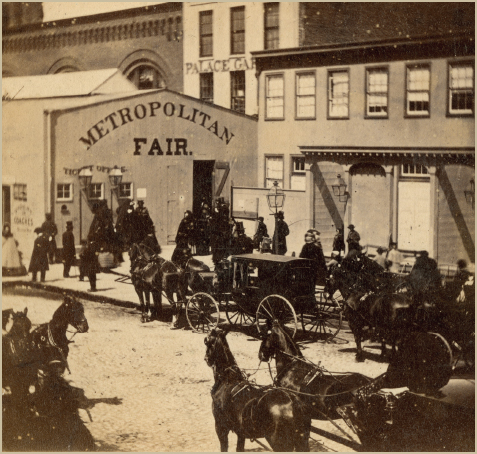
Ticket Office, Metropolitan Fair, New York,
stereograph by E. & H. T. Anthony & Co., 1864
PLATE 37–2

Entrance to the Grand Moving Diorama and
Miniature Battle Field, Metropolitan Fair, New York,
stereograph by E. & H. T. Anthony & Co., 1864
PLATE 37–3

Exhibition Room, Metropolitan Fair, New York,
stereograph by the Bierstadt Brothers, 1864
PLATE 37–4

Department of Photographs & Engravings, Metropolitan Fair, New York, stereograph by J. Gurney & Son, 1864
PLATE 37–5
The vast armory drill room featured eight bins and counters offering children’s clothing, hardware and furnishings, lingerie, perfumes, sewing machines, rubber products, fine jewelry, soaps and candles, leather products, architectural ornaments, harnesses and bridles, and church goods abounding with a “bewildering profusion” of “afghans…pincushions, tidies, and glove-boxes,” all “triumphed over by wax-dolls and fate-ladies.” A cozy concert hall offered band concerts and school-group recitals, along with a sold-out performance of Cinderella. Nearby, the visitor could enter a “curiosity shop” abounding with fossils and rare minerals or visit an autograph counter boasting signatures donated by literary and musical luminaries like Dickens, Macaulay, Thackeray, Rossini, Donizetti, and Verdi, not to mention Florence Nightingale, Garibaldi, and most of the crowned heads of Europe, Queen Victoria included.
This profusion of main-level displays all radiated from the fragrant central Floral Temple and Flower Department, which surrounded a lavish indoor fountain that somehow produced a lighting effect that resembled an ever-present ghost. Not many yards away, the braver curiosity seekers could submit themselves to a small electric shock from a newfangled magnet. Close by stood the headquarters of the official newspaper, the Spirit of the Fair, and a knickknack stand featuring wax fruits, flowers, and a “wounded Zouave” doll fetchingly posed before a basket for donations.
Perhaps most dazzling of all was the cavernous art gallery “rich in pictures that had for years lurked in the seclusion of drawing rooms and private collections.” In the age before public museums, the Metropolitan Fair gallery gave art lovers their greatest, and in many cases their very first, opportunity to see so large and important an exhibition of paintings—some 360 in all. The breathtaking installation boasted among its large-scale landscapes Frederic Edwin Church’s Heart of the Andes, hung directly opposite Albert Bierstadt’s equally formidable Rocky Mountains—with both treasures surrounded by works by the great painters of the day: Huntington, Inman, Durand, Cropsey, and Eastman Johnson. Dominating even these masterpieces was the floor-to-ceiling display of the ornately framed Emanuel Gottlieb Leutze painting Washington Crossing the Delaware. It took up an entire wall, but it failed to impress every viewer. A critic from the New York Times complained that Leutze’s Washington had “the head and air of a dancing master” who looked as if he were planning to “dance a pirouette on the snow.”
Occupying the armory’s second floor was a library and bookstore, along with exhibits of stained glass, tapestry, and engravings and lithography. And one floor higher still was an exhibit of Mathew Brady photographs alongside a working photo studio manned by Gurney & Son, where visitors could sit for carte-de-visite portraits or purchase “nice stereographic views of the Fair”—dozens of which later entered the New-York Historical Society collections. And there was more. Featured in adjacent wings were displays of musical instruments, international exhibits, a science and medical display, and a “Knickerbocker Kitchen” where Dutch-costumed volunteers demonstrated new recipes for specialties like mince pie while an “ancient darkey in the chimney corner scraped away upon his still more ancient fiddle.” For urban fairgoers curious about rural life, a nearby structure on Seventh Avenue and Fifteenth Street offered a livestock exhibition that featured a representative population of cows, sheep, ponies, and horses, along with a 3,602-pound white ox.
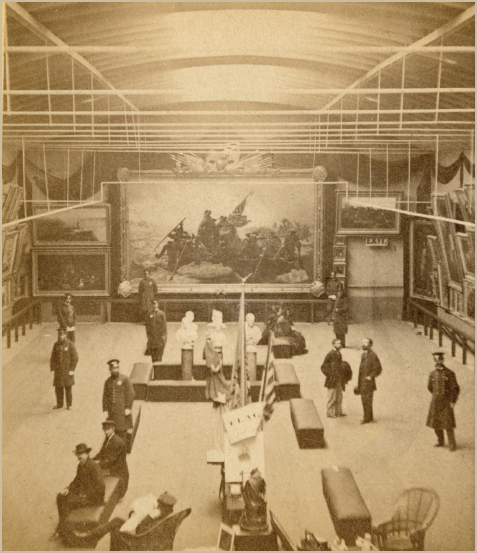
Art Gallery, Metropolitan Fair, New York,
stereograph by J. Gurney & Son, 1864
PLATE 37–6
The fair threw open its doors to the public on a dazzling spring day. Neighborhood residents marked the occasion by hanging flags from their windows. Music filled the streets, and military units marched to the armory for the opening ceremony. With ten thousand troops in the procession, it was the largest military display in civic history. At one point a “double line of bayonets” glistened “from Sixth to Second Avenue.” The public response was strong and grew stronger. Steamboat companies whose vessels groaned with commuters and tourists heading to the event gratefully donated a share of their receipts to the fair; similarly, local rail lines sent between twenty-five hundred and five thousand dollars each in gratitude for the “enormous business” the fair generated.
Visits were costly. Patrons paid five dollars for “season tickets” to the Metropolitan Fair or fifty cents for daily entrance. By the end of its three-week run, some thirty thousand visitors had thronged the event each day, with the press fanning public interest by publishing breathless reports of its wonders almost daily. No one ever estimated how many thousands of products passed to buyers from its scores of booths and counters.
The New-York Historical Society’s exceptional collection of relics and records from this unforgettable charity event includes a set of forty-eight stereographic cards of its displays; Mathew Brady’s souvenir album, Recollections of the Art Exhibition, Metropolitan Fair, New York, April 1864; correspondence among its organizers; donor books; account ledgers; product lists; promotional broadsides; and one rare, surviving two-day ticket to the event for April 11 or 12, 1864 (plate 37–1).
Included in the trove as well are isolated copies of the long-forgotten official newspaper, Spirit of the Fair, in one of which its editor attempted to imagine how the city might appear one hundred years into the future—when, as it happened, another giant exposition took place in New York: the 1964 World’s Fair. This is how the 1864 newspaper answered the question “How then will this city look in 1964?”
First, it will be the heart of the world, which electricity will thrill every instant with the pulses of all the earth. Midway between Asia and Europe, it will be to both their market, bank, mine, granary and library.
…There will be bridges across the East River, and tunnels beneath the North; and vast docks at Harlem and Brighton. A belt of marble and granite piers shall gird it. The Croton [reservoir] will be quadrupled.
The Central Park will weave secular elms, and find all its groves too small for the multitudes. Railways, or whatever succeeds them, shall thread all the depths of the island, and Broadway be but an alley. Two national holidays, the old Fourth, and that auspicious day which we shall see crowned with peace and reunion, will be exulted here by the millions.
Not all of these bold Metropolitan Fair dreams came true, but enough did become reality to remind the modern observer how much this thrilling municipal event inspired what seemed at the time to be incredibly bold aspirations for a limitless future.