
38

HERE ARE THE GRIM, STIFFLY POSED VISAGES OF THE MEN WHO WENT to war for the Union and New York—many of whom, no doubt, never returned. Their portraits exist in this format because the armed revolution against the Union unexpectedly coincided with a technological revolution in American photography. As a result, not only were many of the unforgettable scenes of war recorded by some of the greatest photographic artists of the era—Mathew Brady, Timothy O’Sullivan, George Barnard, and Alexander Gardner, among many others—but long-forgotten enlisted men and officers who served on both sides of the conflict were able to carry pictures of their loved ones into battle and to leave behind images of themselves in uniform so their wives, sweethearts, and mothers would not forget them. Despite these dramatic improvements, the Union inexplicably employed only one official photographer: Captain Andrew J. Russell of the 141st New York Volunteers, who limited his work to landscapes and railroad bridges.
“The year 1861 is memorable for a revolution in pictures” is how the editor of the American Journal of Photography put it at the time, noting that “the card photograph has swept away everything before it, and is the style to endure.” By “card photograph” the observer meant the newly introduced cartes-de-visite, small prints the size of, and named for, visiting cards. They were taken simultaneously by a multiple-lens camera and mounted on two-and-a-half-by-four-inch cardboard. Patented in Paris by a flamboyant Frenchman named Adolphe-Eugène Disdéri—hence the Gallic appellation—the new process first took Europe by storm and then arrived in America sometime in 1860. Its appeal was instantaneous and obvious: sitters could now pose for four simultaneous images in a single exposure, quadrupling the number yielded by the suddenly outdated single-lens tintype camera. That meant a subject could retain one of the resulting prints for himself and give away three to loved ones—or, to fill albums like Euen’s, to fellow members of an army regiment.
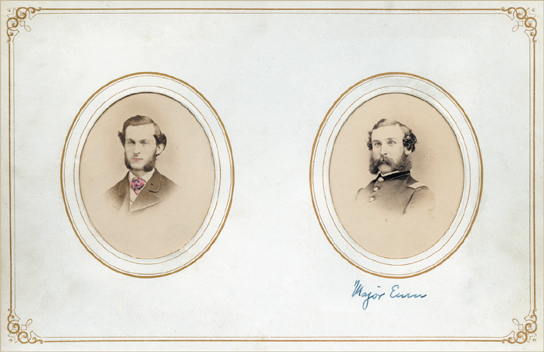
PLATE 38–1
Photographers also lured celebrities into their galleries to pose free of charge for pictures they then reproduced by the thousands at significant profit—increasing the subjects’ fame in return. By 1865, E. & H. T. Anthony, official distributors for Mathew Brady’s vast portrait archive, advertised that their catalog had swelled to include cartes of 5,000 “eminent Americans,” including 550 statesmen, 300 generals, 125 writers, 120 “divines,” and 50 “prominent women,” all priced at $1.90 per dozen, along with albums ranging in cost from fifty cents to fifty dollars. Countless families purchased and enthusiastically preserved portraits of favorite politicians, military heroes, and actors alongside images of their own families.
In 1863, Oliver Wendell Holmes would observe:
Card portraits, as everybody knows, have become the social currency, the “green-backs” of civilization.…The sitters who throng to the photographer’s establishment are a curious study. They are of all ages, from the babe in arms to the cold wrinkled patriarchs and dames whose smiles have as many furrows as an ancient elm has rings that count its summers.…Attitudes, dresses, features, hands, feet betray the social grade of the candidates for portraiture. The picture tells us no lie about them. There is no use in their putting on airs; the make-believe gentleman and lady cannot look like the genuine article. Ill-temper cannot hide itself under the simper of assumed amiability.
The carte-de-visite morphed from a novelty to a craze when another, unnamed innovator perfected leather albums to hold them: they featured thick multilayered leaves with open windows to display the images and a slot at the bottom of each page to insert pictures. Some included designated spaces for autographs. Their covers boasted attractive brass fastening clasps that made the larger albums look like Bibles. Indeed, in many homes, these treasured keepsakes bulging with memories became second in importance only to scripture.
Surviving undisturbed albums of the day are extremely rare—subsequent generations often removed and sold off the celebrity shots to collectors—but the Society owns this unusual presentation album, given as a gift to an otherwise unknown Civil War officer. In a tangible way, the collection reflects all the optimism and patriotism that characterized so many of the volunteers who first went off to war to save the Union.
Little is known about its original owner, Matthias Selah Euen (often misspelled “Ewan” in regimental records), except that he may have begun the war as a captain in Company C of New York’s 71st, but later signed on as a captain in Company E of the 156th Infantry Regiment of volunteers drawn principally from the Hudson valley at the foot of the Catskill Mountains—hence its nickname, the Mountain Division. (Company E was organized in Plattekill, Newburgh, and surrounding towns.) According to an obituary published in the New York Times in 1898, Euen “served throughout the war, escaping without serious injury, and at its close was brevetted Colonel for bravery.” His surviving album, which contains 119 mounted and loose images, features this gold-embossed inscription on its leather cover: “Presented to Major M. S. Euen by Co. C, P.P.” It was evidently a gift from his fellow officers, and their pictures fill its pages.
Though Euen was said to have ended his association with that particular outfit early in the conflict, he evidently kept the album current during his subsequent years of military service. Most of the photographs are unsigned, and the vast majority unidentifiable. But like most owners of carte-de-visite albums, Euen supplemented the original collection of portraits of his extravagantly bearded, now-forgotten comrades-in-arms with easily obtainable cartes of public figures, which were sold by newsdealers and other distributors. And these offer clues to his military loyalties and political orientations. For example, Euen included photographs of two generals under whom he probably served, George B. McClellan and Ambrose E. Burnside. Like the Lincolns, he added a carteof Major Robert Anderson, the commander of Fort Sumter when it fell to the Confederacy in April 1861. A picture showing a sculpted cross may have offered succor before battles.
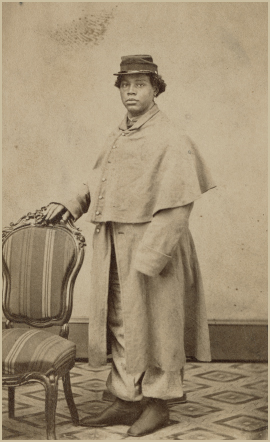
Unidentified African American Soldier, carte-de-visite, from the Euen album, ca. 1861
PLATE 38–2
Euen’s strong sense of New York loyalty may explain his inclusion of a portrait of Secretary of State William H. Seward, a former governor of New York, while a possible hint of pro-abolitionist political sentiments might be discernible from a carte of the famous antislavery senator from Massachusetts, Charles Sumner. His longing for an end to the war is evident in his inclusion of the late New York–born writer John Howard Payne, best known for writing the song “Home, Sweet Home.” Oddly, the book includes only one image of Euen himself (plate 38–1), relegated to the middle, and it also includes unexplained, thought-provoking portraits of unidentified African Americans. The album also features a carte of Nathaniel Banks, a onetime and future Massachusetts congressman who led a Union expedition up the Red River in Louisiana in 1864—a campaign in which Euen participated.
The 156th saw plenty of action during its three years of service beginning in November 1862. Euen and his men fought at Fort Bisland and Port Hudson, Louisiana, and, after performing garrison duty at the latter outpost, participated in the battles of Pleasant Hill, Alexandria, and Mansura during the Red River Campaign. Later reassigned to the East, the regiment confronted Jubal Early during Philip Sheridan’s Shenandoah Valley Campaign, going into combat at such famous battlefields as Winchester, Fisher’s Hill, and Cedar Creek. After William T. Sherman captured Savannah at Christmastime 1864, the unit joined Union occupying forces there, then marched with Sherman all the way to the Carolinas. When the final casualty tolls were calculated, the 156th New York had lost 231 men—not surprising, considering its exhausting schedule of deployments—64 in action and 167 to disease. Euen escaped unscathed—and with a tooled leather, gilt-embossed photo album in which to preserve his memories. His grandson Donald E. Morgan donated it to the Society in 1963.