
41

CONTROVERSY STILL SWIRLS AROUND MAJOR GENERAL BENJAMIN Franklin Butler. It followed him through the war, dogged him during Reconstruction, and continues to haunt his reputation. He was, without question, an indifferent, if not entirely inept, field commander, and in the South he was excoriated for alleged corruption, especially as the officer in charge of occupied New Orleans. More recently, however, scholars have come to acknowledge his pioneering efforts to promote black freedom and later equality.
A Democrat before the war, Butler had not only opposed Lincoln for the presidency in 1860 but cast his vote at the Democratic convention for one Jefferson Davis of Mississippi. When Stephen A. Douglas prevailed instead, Butler backed the Southern Democrat John C. Breckinridge of Kentucky for the White House. Butler even ran unsuccessfully on the Breckinridge ticket for governor of Massachusetts.
Lincoln nevertheless appointed Butler a major general in the Union army, mainly because he needed the support of anti-secession War Democrats. Because Butler was one of the first generals named in the war, he was senior to many of the professional soldiers with whom he served. For the rest of the war, Lincoln had to find him assignments where his seniority did not give him the command of major Union armies. It did not help that he was manifestly ugly, practically grotesque. Admire him or loathe him, he was one of the unique characters of the era. Whatever his shortcomings on the battlefield, the Civil War truly radicalized Benjamin Butler where race was concerned.
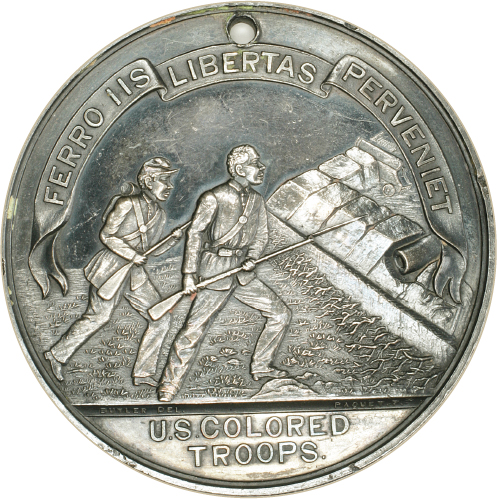
PLATE 41–1
Born in New Hampshire in 1818, Butler lost his father to yellow fever when he was only five months old, and he grew up shuttled back and forth between relatives. Not until the age of ten was he reunited with his struggling, widowed mother, who had opened a boardinghouse in Lowell, Massachusetts. Short, stocky, homely, pugnacious, and cursed with an incurable eye defect that made him appear constantly to be squinting, Butler managed to graduate from Colby College, then studied law and launched a successful criminal practice that rapidly expanded from Lowell to Boston. An early and ardent supporter of banking reforms and shorter working hours for laborers, Butler next turned to politics, winning election to the Massachusetts state assembly as a Democrat in 1853 and to the state senate in 1859. Meanwhile, he invested his money wisely in a profitable new Lowell woolen mill.
Though he had supported conservative Southern Democrats for national office, when war broke out, Butler, a brigadier in the state militia mainly for its social cachet, immediately demonstrated his loyalty to the Union (and his own self-interest). He not only organized a regiment of Massachusetts militia, he saw to it that its men were outfitted in brand-new woolen overcoats purchased from Butler’s own factory. Federal officials overlooked such conflicts of interest because the Lincoln administration desperately needed loyal and well-known Democrats—“political generals,” they came to be called—in the volunteer army. It could not be a Republican fight alone.
Butler stirred up controversy almost immediately. On one hand, he became the first Union commander to reach Washington with his troops and unlock the capital from its isolation after the Baltimore riots of April 1861. On the other hand, it was Butler who announced that he would imprison any Maryland legislator who attempted to take the state out of the Union—arousing the enmity of many residents, including the Baltimore artist Adalbert Johann Volck (see chapter 26). Butler’s flamboyant and, some said, illegal gestures included taking possession of the state seal so that a secession ordinance, if it passed, could not be officially stamped.
Although the commanding general Winfield Scott was outraged to learn that Butler had decided to occupy Baltimore without proper orders, Lincoln demonstrated his gratitude the next month by making Butler the first volunteer commander to earn the rank of major general. Butler betrayed his ineptitude almost immediately when his forces were humiliated at the Battle of Big Bethel, Virginia, in June. Assigned to a quieter command at Fort Monroe, Virginia, Butler quickly raised eyebrows—and made history—by welcoming, and giving an appealing new name to, the African American “contrabands of war” who began seeking refuge at his headquarters. Butler not only set a precedent by deciding to shelter these black refugees and to assign them to work at the fort despite protest by their owners, he made news in other fields by introducing such novelties as reconnaissance balloons and Gatling guns to his command.
In May 1862, Butler finally earned a new field assignment, taking an army all the way to New Orleans. He entered the city as its conqueror, even though the Union victory there had in fact been accomplished by naval forces under David G. Farragut. What followed, to put it mildly, was a stormy occupation. As military governor, Butler imposed martial law and infamously threatened to treat any angry New Orleans female who hurled verbal abuse at Union soldiers as “a woman of the town plying her avocation.” The ungentlemanly order appalled residents, inspired his onetime political favorite Jefferson Davis to suggest he should be executed, and earned the general the nickname Beast Butler. Meanwhile, Butler’s hard hand effectively reduced confrontations on New Orleans’s streets. Sanitary conditions also improved, and yellow fever epidemics abated.
However effective in some areas, Butler imposed what some occupants protested was a reign of terror in New Orleans. When a pro-Confederate local gambler tore down an American flag and dragged it through the streets, for example, the general ordered him hanged. Butler bullied, menaced, and allegedly purloined funds from foreign consulates, triggering more than one diplomatic crisis. Locals whispered that he also plundered silverware from nearby homes. The jury is still out on whether or not Butler actually stole treasure or took bribes. He certainly left New Orleans wealthier than when he arrived, and at the very least he allowed his brother to enrich himself during his regime by selling banned goods on the river and conducting an illicit business in trade permits. Reports of these abuses brought increased pressure on Lincoln, and the president yielded in late 1862, replacing Butler with General Nathaniel Banks.
Butler’s last field command was as the general in charge of the army-navy assault on Wilmington, North Carolina, in December 1864. After the explosion of a bomb vessel and a heavy naval bombardment, Butler declared that the rebel fort had not been sufficiently weakened to ensure a successful assault, and he reembarked his troops. Grant was furious and replaced him with another general, Alfred H. Terry, who captured the fort in January 1865. Butler resigned from the army and ran for Congress, this time as a Republican, and spent the postwar years arguing for tough Reconstruction policies and black voting rights in the South.
Though he became a champion in the struggle to extend rights to African Americans in peacetime, Butler’s true epiphany may have come during wartime with the Army of the James, when in late September 1864 he admiringly observed troops from an all-black regiment fighting at New Market Heights near the Confederate capital. USCT regiments made up only a fifth of Butler’s force during that two-day struggle but lost more than half of their men. In unexpected recognition of their valor, Butler commissioned the assistant engraver of the U.S. Mint, Anthony C. Paquet (1814–1882), to design a medal in their honor. He did so—as usual—without permission from higher authorities.
The obverse of the resulting medal shows two soldiers in high relief charging a Confederate position under a scroll reading “FERRO IIS LIBERTAS PERVENIET” (“Freedom Will Be Theirs by the Sword”). Below the action scene are the words “U.S. COLORED TROOPS” and “BUTLER DEL.PAQUET, F” (the credit line that indicates Butler wanted personal credit for the design). The reverse side features a wreath of oak leaves amid the legends “DISTINGUISHED FOR COURAGE” and “CAMPAIGN BEFORE RICHMOND 1864.” A Boston company created the ribbons and fasteners.
The so-called Butler Medal, sometimes called the Army of the James Medal, is the only award of its kind created during the Civil War to mark a specific battle or celebrate a specific regiment. It is a memento not only of the bravery of the U.S. Colored Troops before Richmond but of the ever-audacious Benjamin Butler’s remarkable wartime conversion from supporter of the white supremacist Jefferson Davis to white supremacy’s worst nightmare. Butler used personal funds to strike the 197 silver and 11 bronze copies of the Army of the James Medal and took the opportunity to present many of them to veterans of the action personally. He also sent one to the Oxford University historian Goldwin Smith, who had observed the Army of the James in action in 1864. Butler accompanied the gift with a proud note: “I venture to send to you…the first medal ever struck in honor of the negro soldiers by the white man.” The Society acquired its own silver copy of the extremely rare Butler Medal by purchase in 2011 from the widow of the furniture maker Duncan Phyfe’s great-grandson. Surviving records offer no clue to how the family of a prominent white cabinetmaker came into possession of the war’s most famous token of esteem for black soldiers.
Not that it should have surprised any of his contemporaries that Butler might act independently, but in his 1892 autobiography the general finally offered an explanation for what inspired him to create and finance this consummate expression of generosity and gratitude. As Butler put it:
I had the fullest reports made to me of the acts of individual bravery of colored men on that occasion, and I had done for the negro soldiers, by my own order, what the government has never done for its white soldiers—I had a medal struck of like size, weight, quality, fabrication, and intrinsic value with those which Queen Victoria gave to her distinguished private soldiers of the Crimea.…These I gave by my own hand, save where the recipient was in a distant hospital wounded, and by the commander of the colored corps after it was removed from my command, and I record with pride that in that single action there were so many deserving that it called for a presentation of nearly two hundred. Since the war I have been fully rewarded by seeing the beaming eye of many a colored comrade as he drew his medal from the innermost recesses of his concealment.
As usual, not all of his fellow commanders shared Benjamin Butler’s enthusiasm or embraced his methods. The two hundred soldiers who received these unsanctioned medals were never allowed to wear them on their uniforms. Butler’s superior officers had the last laugh, delegitimizing a gesture of genuine beauty because it came from the hands of a “Beast.”