
40

IN SOME CASES, THE WAR BROUGHT OUT LATENT TALENTS AMONG otherwise ordinary soldiers—particularly those who enjoyed months of leisure between battles and used the time to start diaries, draw pictures of their comrades and surroundings, or transform found objects like tree branches and human bones into carved sculptures. But perhaps no population produced more amazing work than the men held for long periods in Union and Confederate prison camps. Here, particularly after the Lincoln administration suspended prisoner exchanges in mid-1862, relegating thousands of soldiers to extended periods of captivity, those in confinement turned to such callings as art and journalism (see chapter 45) to help pass the time.
That examples of their efforts survive comes as no surprise—considering the sheer numbers of wartime prisoners. During the four-year conflict, by most accounts, about 212,000 Confederates and 463,000 Union men fell into enemy hands, and since only some 265,000 were paroled before 1862, that left more than 400,000 who were imprisoned for the duration, resulting in starvation, exposure, sickness, or worse. Those strong enough to endure the filthy, undersupplied, rodent-infested, disease-ridden hellholes understandably searched for ways to survive. Sheer creativity may have provided some of these durable men reason to go on.
One of the most surprisingly talented and prolific of the artistic primitives was John Jacob Omenhausser (1830–1877), a private in Company A of the 46th Virginia Infantry, who in 1864 was sent to the Union prison camp at Point Lookout, Maryland—a twenty-three-acre facility that, with as many as twenty thousand men incarcerated, was the largest in the North. At one point so many of his works began popping up in public and private collections around the country that many scholars concluded they must be the work of several different men: no single prisoner-artist, they reasoned, could possibly have produced such a huge body of work. They were wrong. The New-York Historical Society owns a portfolio containing forty-two vivid Omenhausser watercolors—later preserved and bound into a single volume by the son of James Barnes, commandant of the Point Lookout facility.
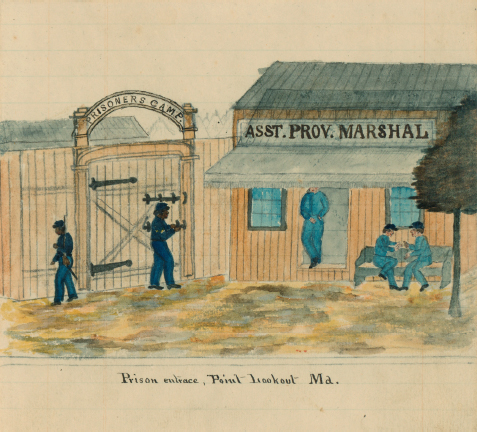
PLATE 40–1
If we accept the authenticity and single authorship of all these pictures, Omenhausser was among the most prolific of all the self-taught painters who toiled away in Civil War prison camps: a total of 222 watercolors have been unearthed and attributed to date, not counting as many as a dozen isolated pieces that reportedly exist in other collections. The artist’s surviving great-grandson, Richard Brooks, emerged around 1999 to add credence to the identification of his ancestor as the creator of all these works. Apparently, Omenhausser had been an accomplished folk artist before the war, and Brooks possessed an early landscape effort to prove it.
Omenhausser was either Austrian-born or second-generation Austrian American—sources disagree—and spent his early years with his parents in Philadelphia. The family resettled in Baltimore, but young John was left fatherless when still a child. By the 1840s, when he was still a teenager, he had begun painting—producing at least one urban street scene. Evidently, his early art did not sell. To earn a living, he became a professional candy maker. Why Omenhausser pledged his allegiance to the South no one knows for certain—it would not have been unusual in secession-minded Baltimore—but he appears to have joined the Richmond Light Infantry Blues early in the war. He was thirty or thirty-one years old. Omenhausser saw action around Big Sewell Mountain in western Virginia as part of a brigade commanded by the former Virginia governor General Henry A. Wise. In November 1861, Omenhausser, a recent widower, wrote to a female friend: “Enclosed you will find a true picture of camp life, and its mess that cooks together that I belong to and by their clothing you will see that we are not fit to stand much cold weather. It being such a true picture of camp life. I had to draw a great many of them for members of our company and others of the regiment. The Co’s says it is a very good picture, some of them have been sent to different parts of the southern Confederacy, as far south as New Orleans.”
Omenhausser subsequently fought in North Carolina, where he fell into the hands of Union troops, but he was almost immediately paroled to Richmond, a town he came to like. He proved less lucky when he returned to active service. On June 15, federal soldiers again captured an injured Omenhausser near Petersburg, Virginia. By this time, prisoner exchanges had ceased. The following month, he wrote to his lady friend to report: “I was left crippled on the Battle field of the 15th at a time that our men retreated from the breastworks, and was captured by the enemy. I expect you and my company all thought that I was Kill’d. I was captured by black soldiers, and did not expect any quarters, but god ordained it otherwise.” Omenhausser remained confined at Point Lookout for more than a year.
Like most prisons, Point Lookout had too little food and too many malicious or corrupt overseers. Confederate prisoners were no doubt particularly galled to discover that most of their armed guards were African American. Prisons were often governed not only by abusive keepers but by self-appointed inmate gangs. On the other hand, many prisoners seemed to prefer life in captivity to life with the army. Hearing that they might be paroled in October 1863, a group of captives at Point Lookout actually petitioned authorities not to be returned to the rebel army. Some claimed they had been coerced to join the Confederate army in the first place, one such Point Lookout prisoner insisting that “it never was our intention that we should fight against the united States to support a rotten government for Jeff Davis.” Another offered not only to take the oath of allegiance to the Union but even to join the federal army—if, as he scrawled, he could be “plaste whear thar will be no danger of falling in to the hands of the Confederate rebs.”
Omenhausser himself did little such complaining. Instead, he spent his time writing poems and letters to his lady—with whom he reached an understanding about future marriage—and creating his thick portfolio of watercolors, no doubt to the wonder of the other inmates. Conceivably, he used some of the portraits as gifts to his fellow prisoners or perhaps traded them in lieu of payment for special consideration or extra rations. Judging from the Omenhausser works in the Historical Society portfolio, it appears that every convenience at Point Lookout cost something extra, be it jewelry, souvenirs, or perhaps art.
The Historical Society’s unfailingly compelling pencil, ink, and watercolor works by Omenhausser cover a wide range of prison-life experience, from the facility’s front gates to its inner workings. Omenhausser certainly knew how to tell a story and compose a picture, and he neatly balanced landscape with what passed for portraiture, almost always evocatively or amusingly presented. Thus his Prisoners Post Office shows not only inmates depositing mail in crude wooden boxes but also a broadly caricatured African American guard looming on patrol nearby. A crowded, almost Bosch-like scene at the prisoners’ cookhouse focuses not on the revolting food but on a brawl erupting between prisoners over spilled—or thrown—soup. And a view of the prison schoolhouse is enlivened by a small image of a soldier in the foreground pumping water from a well while “students” lounge in the doorway, perhaps a subtle reminder that mere sustenance remained far more vital to prisoners than education. Omenhausser’s depiction of the prison hospital, at first glance little more than a rendering of a series of cabins on stilts, is enhanced by the inclusion of the tiny figure of an amputee on crutches hobbling from its entranceway.
A fellow prisoner was probably referring to Omenhausser’s work when he recorded in his diary in December 1864 that an inmate at Point Lookout was producing “some very amusing caricatures, or cartoons, depicting the humorous side of prison life.” Indeed, Omenhausser often employed the device of voice balloons to provide comic dialogue for his little scenes. Thus, a view of nine prisoners heading off “to Swallow the Oath” offers a wry glimpse into the reluctant oath takers’ attitudes as well, with one uneasy and resentful prisoner telling another, “If you push by me again I’ll break your head,” while another crouches in a corner scratching his insect-pocked leg, muttering: “I wonder what makes this place so lousy.”
In Omenhausser’s world, clever prisoners made the best of deprivation: inventive prisoners trade silver rings for soup crackers, somehow bake and sell pies and biscuits, brew and imbibe corn beer, stir ugly stews of rat liver hash, and hawk every kind of nourishment available from the land or water, from “appels” and “potators” to Maryland crabs and watermelon. They craft and sell paper fans to sunbaked Union officers and offer homemade molasses to starving comrades—at a price, of course.
Although Point Lookout was located on the southern tip of Maryland’s St. Mary’s County on a small tongue of land at the confluence of the Potomac River and the Chesapeake Bay, it was evidently never completely isolated from civilization. One Omenhausser scene shows an unscheduled inspection—we can surmise this because one of the prisoners has his shirt off in front of a lady—with hostile prisoners mocking the female visitor who had come “to see the sights.” In yet another of the artist’s clever and affecting scenes, a prison barber offers shaves in return for two crackers, and a half-naked prisoner unself-consciously launders his trousers in a cauldron of boiling water.
Omenhausser’s subjects are feisty, rowdy, and irreverent (characters are constantly shouting epithets like “Go to the devil”). Their “sports” activities consist of gambling with handmade dice or cards. They bathe on the beach in sight of a Union gunboat and resentfully endure the evident humiliation of being supervised by black guards. Omenhausser’s African American soldiers are invariably presented as racist stereotypes who speak in minstrelish dialect and are easily cheated or confused by their “superior” prisoners. “Git away from dat dar fence white man,” commands one armed soldier in a typical print, rifle raised, “or I’ll make Old Abe’s Gun smoke at you. I can hardly hold de ball back now. De bottom rails on top now.” In another such scene, Omenhausser expressed his obvious doubts about his guards’ competence with firearms—a frequent, if inaccurate, canard about black soldiers—by suggesting that one African American had accidentally shot and killed one of his comrades. “Git up, Abram,” the guard pleads to his prostrate, bleeding friend, “and don’t act Possum…don’t make a fool of your self, don’t you see de white folk’s laughing at you—for de Lord I believes the nigger dead for Sartain.”
As for himself, an evidently stubborn Omenhausser never took the oath of allegiance to the Union—even after Lee’s surrender. Instead, he remained a prisoner at Point Lookout until June 1865, then moved to Richmond, returned to his prewar occupation as a confectioner, married his faithful wartime fiancée, and died young of cancer in 1877. He left no known evidence of further artistic efforts.
When Point Lookout’s remaining prisoners were removed from the camp at war’s end in 1865, some, thirty-five hundred men were still behind its walls.