
43

ABRAHAM LINCOLN HAD LITTLE INFLUENCE OVER THE CHOICE OF A running mate when he was first, and unexpectedly, nominated for the presidency in 1860. In the mid-nineteenth century, delegates made such decisions on their own. Conceiving of Lincoln as a quintessential westerner, delegates to the Republican National Convention meeting in Chicago that year concluded that they must have an easterner for the vice presidency. They turned to Hannibal Hamlin, an antislavery senator from as far east as the map would allow: Maine. Neither man attended the convention, and neither could recall that they had ever shaken hands.

PLATE 43–1
Two weeks later, the nominee headed to Chicago to meet the man with whom he would share the national ticket. At the city’s Tremont House hotel, Lincoln and Hamlin exchanged greetings for the first time. Lincoln remarked that he had once heard his new running mate give an antislavery speech in the Senate. Hamlin remembered Lincoln delivering an oration in the House “so full of good humor and sharp points,” he recalled, that it left him “convulsed with laughter.” But when Lincoln asked if they had ever been formally introduced to each other, Hamlin thought for a moment and then replied: “No, sir; I think not.” They were not expected to work together.
Such was the reigning tradition of the day, and to his credit Lincoln tried for a while to reform it. He spent the rest of his Chicago trip conferring with Hamlin on the pressing issue of Cabinet selection. Then, three months later, when he planned his inaugural journey, he arranged to meet Hamlin in New York so they could proceed to Washington together as a team. In Manhattan, the vice president–elect even stood in once for Lincoln, delivering a speech at their New York hotel following an especially exhausting late night at the opera. Otherwise, Hamlin stayed in the background.
Once Lincoln began his term on March 4, Hamlin had little further to do with the administration. Vice presidents of the day remained firmly tied to the legislative, not the executive, branch of government. Unlike today’s vice presidents, they had no White House office of their own, attended no Cabinet meetings, and certainly enjoyed no routine luncheons or regularly scheduled briefings with the chief executive. In popular prints of the day showing crowded receptions at the mansion, Hamlin is nowhere to be seen—conspicuously absent, like nearly all of his predecessors. He had served his purpose as a candidate.
When news of the proclamation’s announcement finally reached him, poor Hamlin was home in Maine and could do no more than write an ardent fan letter, congratulating Lincoln for what he predicted would “stand as the great act of the age,” and adding confidently: “It will be enthusiastically approved and sustained, and future generations will, as I do, say God bless you for this great and noble act.” In what he labeled a “Strictly private” reply, a deeply worried Lincoln confided, “My expectations are not as sanguine,” admitting in an anguished, justly famous letter: “It is six days old, and while commendation in newspapers and by distinguished individuals is all that a vain man could wish, the stocks have declined, and troops come forward more slowly than ever. This, looked soberly in the face, is not very satisfactory.” That exchange ended all known communications between Abraham Lincoln and Hannibal Hamlin on matters of substance.
By the time Lincoln stood for renomination less than two years later, few party professionals gave Hamlin a second thought as a serious candidate for another run as vice president, whatever his real or imagined experiences during the run-up to Lincoln’s most historic act. Party politics still mattered most, and the exquisite art of ticket balancing remained the highest priority. Hamlin, Republicans concluded, simply no longer fit the bill. Like the proverbial bee, he had stung once in 1860 and now was dead. By then, Lincoln was known more as a Northern man than as a western man, and when it redesignated itself the National Union Party, the Republican organization looked for an anti-secession Southerner to balance the 1864 ticket. The choices were limited. Only one Southern senator had refused to leave his post during the formation of the Confederacy. Only one had remained fully loyal to the Union, albeit no friend of the African American. Though otherwise untested, Andrew Johnson of Tennessee had the potential to fill a political need.
The extent of Lincoln’s involvement in the switch to Johnson from Hamlin, if any, has been much debated but never proven. One of his private secretaries, William Osborn Stoddard, later claimed in memoirs written only for the eyes of his children that Lincoln in fact dispatched him to the Baltimore convention to make sure that Johnson indeed won the coveted spot on the ticket for vice president. “I had somehow strengthened my idea that Lincoln did not want Hamlin, and that he had been leaning toward Johnson,” Stoddard recalled. If such was indeed the case, it may rank as the worst political mistake Abraham Lincoln ever made. But presidents seldom consider their own mortality, even now, and Lincoln had no good reason to imagine he might soon be killed and succeeded by his vice president—even though he had received plenty of letters that threatened otherwise.
On paper, Johnson seemed a good political fit. Born in North Carolina and raised in eastern Tennessee, he had opened a tailor shop before he even knew how to read, a skill he did not learn until his fiancée gave him instruction. Nonetheless, he became mayor of Greeneville at a young age, went on to the state senate, then Congress, became governor of Tennessee in 1853, and a U.S. senator in 1857. Lincoln rewarded Johnson’s loyalty by naming him military governor of Tennessee once Union forces took control of the state in 1862. Like most settlers from the eastern part of his state, Johnson disliked slavery, but he was deeply racist and, some hinted, too fond of drink as well. Stoddard thought he had a “not very good temper.”
In another bow to tradition, neither candidate did any direct campaigning for the ticket in 1864. Johnson came to think of himself as so isolated from the administration he was about to join that he wrote to the president in January asking to be excused from attending the inauguration, since Tennessee was scheduled soon to vote on abolishing slavery. Besides, the state would be choosing a new governor the day of the inaugural ceremonies, March 4. Lincoln rejected Johnson’s proposal, and the newly elected vice president reluctantly made his way to Washington. When the ceremony was over, Lincoln may have wished he had permitted Johnson to remain in Nashville. Johnson’s drunken behavior at his inaugural—whether or not it was the result of too much alcohol-laced medicine to combat a cold—mortified the entire audience, the president included. Six weeks later, Lincoln was dead and Johnson was president. Stoddard, the clerk who claimed he had advocated for Johnson at the 1864 convention on Lincoln’s instructions, later admitted both pride and regret in the result. “But for me,” he insisted, Johnson “would never have been President and would never have been so dreadfully impeached.”
Although the 1864 Lincoln-Johnson campaign inspired its share of broadsides, pictures, and tokens, they were no match in quantity for the avalanche of graphics that abounded during the four-way presidential race four years earlier. By 1864, Lincoln no longer needed the artist’s help in introducing himself to a national public that had hardly heard of him; Johnson, too, had achieved a degree of fame. Prints and other homespun work faced increased competition from the growing proliferation of carte-de-visitephotographs. Publishers spent more time on cartoons and caricatures, along with pictorial commentary on the Emancipation Proclamation.
Nonetheless, the Society owns a number of beautifully preserved pieces of 1864 campaign ephemera, including a large Lincoln-Johnson poster and a rare lantern containing a portrait of the president. But perhaps the most unusual of all these surviving relics suggests that not every Lincoln enthusiast appreciated the switch in running mates or thought the substitution important enough to trigger the purchase of a new campaign banner. In the Historical Society collection is the American flag in plate 43–1, originally affixed to which are the names of Lincoln and Hamlin, the Republican standard-bearers of 1860, though Hamlin’s name is now invisible. The banner was no doubt tailored for the hurrah campaign before the war, when New Yorkers marched in parades jubilantly waving flags and banners. For the more subdued 1864 contest, the flag’s owners decided to repair rather than replace. As this surviving flag shows, they simply covered Hamlin’s name with Johnson’s. The letters that spelled out the alliterative name of Lincoln’s first vice president still linger like a ghostly shadow under close scrutiny and bright light—neither of which, in subsequent years, Andrew Johnson proved able to withstand.
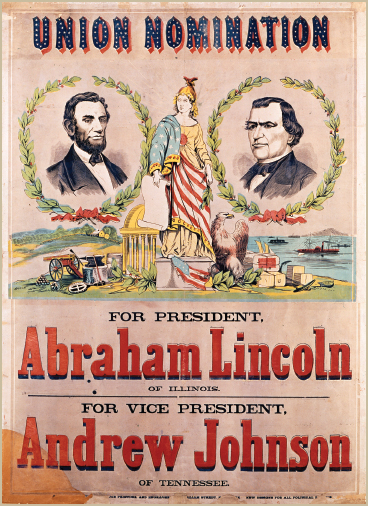
Union Nomination for President, Abraham Lincoln of Illinois.
For Vice President, Andrew Johnson of Tennessee,
election poster, 1864
PLATE 43–2