
44

ABRAHAM LINCOLN’S PRIVATE SECRETARIES AND LATER BIOGRAPHERS John G. Nicolay and John M. Hay admired many things about their boss, but one of the skills they esteemed most, yet discussed least, was the president’s remarkable acumen as a vote counter. Long before computerized record keeping and political track polling, Lincoln seemed uncannily able to comprehend, retain, and analyze even the most fragmented early voting trends.
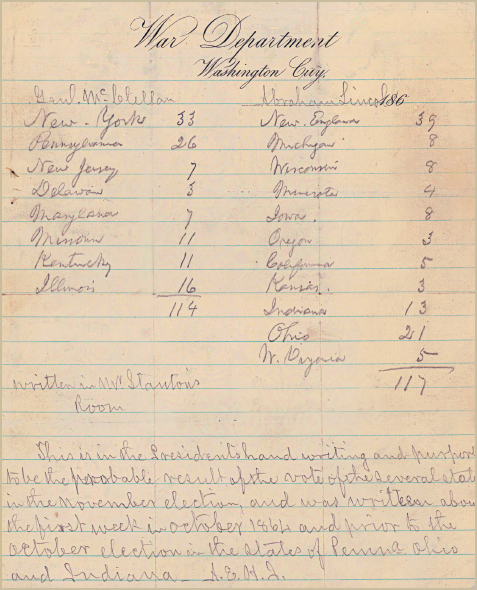
PLATE 44–1
“He was completely at home among election figures,” marveled Nicolay and Hay. “All his political life he had scanned tables of returns with as much care and accuracy as he analyzed and scrutinized maxims of government and platforms of parties. Now, as formerly, he was familiar with all the turning-points in contested counties and ‘close’ districts, and knew by heart the value of each and every local loss or gain, and its relation to the grand result.” Indeed, as the two acknowledged, Lincoln had been a serious student of voting trends ever since his days as a poll watcher in rural New Salem.
The loyal staff aides made these comments on Election Day 1860 when they watched in awe as the then presidential candidate Lincoln sifted through the initial returns that arrived on that historic night and “understood at a glance whether” they represented “a loss or gain to his party” from the Frémont-Buchanan canvass four years earlier. Whatever Lincoln could not trust to his understanding of cold statistics, as he reminded friends four years later on election night 1864, he usually trusted to a higher power, occasionally interpreting minor incidents as major omens. For example, on the “dark, rainy, and gloomy night” in 1858 when his customarily astute reading of early returns indicated that Republicans would lose the 1858 Illinois legislative elections, thus guaranteeing his defeat for the U.S. Senate, he decided to head home early, hope gone. Although he was usually “surefooted,” as he remembered, the “path had been worn hog-back and was slippery.” As Lincoln recalled: “My foot slipped from under me, knocking the other one out of the way, but I recovered myself and lit square, and I said to myself, ‘It’s a slip and not a fall.’”
Lincoln rarely slipped politically again. And as a prized relic of his campaign for a second presidential term seems to indicate, by 1864 he had abandoned fate altogether and resumed his interest in raw numbers—sacrificing none of his sharp focus and frank self-analysis when it came to predicting his own prospects for reelection. That year, Lincoln believed he might well “fall” after all—jeopardizing not only his own legacy but also the future of the Union and emancipation. In this long-unknown document—tangible proof of his preelection jitters—Lincoln tallied the numbers and allowed himself to believe, just five weeks before Election Day and at the end of one of the most brutal presidential campaigns in American history, that he might just squeak by on November 8 after all. But only just. The autograph document from the Society’s archive is published here for the first time.
Lincoln had done no campaigning in his own behalf during the 1860 presidential race and maintained his determination to remain similarly above the fray in 1864. But in a remarkable greeting to the 166th Ohio that August, he summed up what he believed the race was all about in a pep talk that could have served well as a campaign manifesto. “It is not merely for to-day, but for all time to come,” he reminded the soldiers, “that we should perpetuate for our children’s children this great and free government, which we have enjoyed all our lives. I beg you to remember this, not merely for my sake, but for yours. I happen temporarily to occupy this big White House. I am a living witness that any one of your children may look to come here as my father’s child has. It is in order that each of you may have through this free government, which we have enjoyed, an open field and a fair chance for your industry, enterprise and intelligence; that you may all have equal privileges in the race of life, with all its desirable human aspirations.…The nation is worth fighting for, to secure such an estimable jewel.”
However lofty those beautifully expressed sentiments, by early autumn Lincoln saw the political handwriting on the wall—and what it spelled out was far less eloquent. He came to believe he would in fact not be dwelling in that “big White House” much longer. Internecine Republican challenges had weakened him, and unrelieved Union battlefield setbacks had undermined his argument that the sections could ever be reunited with slavery destroyed. Supporters continued looking for alternatives. His own campaign chairman told him he could not possibly win reelection.
So convinced did Lincoln become of his own impending political doom that on August 23 he scribbled an extraordinary memorandum all but conceding defeat, then sealed it with paste and asked his Cabinet members to sign it sight unseen. To a man, they did so. What the pledge declared, they learned only later, was: “This morning, as for some days past, it seems exceedingly probable that this Administration will not be re-elected. Then it will be my duty to co-operate with the President elect, as to save the Union between the election and the inauguration; as he will have secured his election on such ground that he can not possibly save it afterwards.” He was paving the way for a graceful exit, hoping that even during a four-month interregnum, his lame-duck administration might, with the help of a Democratic president-elect, crush the rebellion.
As it turned out, Sherman’s victory in Atlanta, Farragut’s heroics at Mobile Bay, and news of the destruction of the commerce raider Alabama by the USS Kearsarge in distant France conspired to brighten not only Lincoln’s spirits but also his prospects for a second term. And no one understood the shifting momentum more incisively than the president. Encouraged, he reunited his fractured party, made a change in his Cabinet to placate congressional liberals, and worked behind the scenes to make sure that soldiers and sailors unable to obtain passes to return home in time to vote on November 8 would enjoy the opportunity to cast ballots in camp. Still, he remained understandably nervous and uncertain as the final weeks of the campaign arrived.
The proof of his anxiety is visible in the beautifully preserved handwritten ledger in plate 44–1. As it shows, just a month before Election Day, Lincoln apparently felt emboldened to summon his old vote-guessing prowess and make a stab at estimating how the electoral vote count would end up in the approaching presidential contest. During a visit to Secretary of War Edwin M. Stanton’s office during the first week of October, he took up this sheet of departmental stationery and scrawled in one column the names of the states he expected to win together with the electoral vote value of each. In the other column he listed those he anticipated losing to the Democrats. When he added each column, he found he had awarded himself 117 votes to 114 for George B. McClellan—just one scant vote more than he needed to win.
Lincoln’s preelection tally surprisingly ceded not only New York and Pennsylvania but even Lincoln’s home state of Illinois—a whopping total of 75 electoral votes—to McClellan. The president must have dispirited himself with his accounting, for he left the paper behind when he left Stanton’s rooms. A clerk named A. E. H. Johnson fortuitously picked it up and later added an affidavit of his own attesting to its authenticity. Still visible are these penciled sentences on the bottom: “Written in Mr. Stanton’s Room. This is in the President’s hand writing and purports to be the probable result of the vote of the several states in the November election, and was written about the first week in October 1864 and prior to the October election in the states of Penna, Ohio and Indiana. A.E.H.J.” Precisely how and when it entered the New-York Historical Society collection remains a mystery.
Evidence exists that Lincoln took one more stab at vote prediction, on Military Telegraph Office stationery, not long after the heartening results arrived from these early statewide contests. A previously published copy of a remarkably similar tabulation sheet exists in the Huntington Library. Lincoln’s subsequent, hitherto unknown second crack at predicting the outcome varied not a whit from the copy owned by the Historical Society—except that in the revised tally the president awarded himself three additional electoral votes from the newly admitted state of Nevada. For now, he still believed he would secure no more than 120 electoral votes in all—enough for a clear majority, but still not by much.
As it turned out, Abraham Lincoln far underestimated his strength on both of these attempts at predicting his political future. On November 8, he swept to victory, winning every state but Delaware, Kentucky, and New Jersey and amassing a total of 212 electoral votes to McClellan’s meager 21. For once, the old vote counter had miscalculated. That night, Lincoln grew sentimental as he awaited returns in the telegraph office. “It is a little singular,” he confided to Hay, “that I, who am not a vindictive man, should have always been before the people in canvasses marked for the bitterness—always, but once; when I came to Congress it was a quiet time. But always besides that, the contests in which I have been prominent have been marked with great rancor.” Of course, the latest results cheered him immeasurably.
Back in 1860, he had left the Springfield telegraph office armed with assurances of his first election to the presidency to inform his wife they were headed to Washington, explaining to his friends in the office that it was about time he “went home and told the news to a tired woman who was waiting up for him.” He reached his house a few minutes later only to find Mary fast asleep. Lincoln “gently touched her shoulder” to wake her and announced: “Mary, Mary! we are elected!” Now, four years later, he thoughtfully sent the first congratulatory fruit basket of the night over to the White House with a message assuring Mary they were reelected. As he explained to his friends in the War Department telegraph office, “She is more anxious than I.” One can hardly believe so, judging from the razor-thin margin he initially predicted he would win that evening.
Three days later, Lincoln assembled his Cabinet and at last unsealed and read aloud the blind memorandum he had asked his ministers to sign a few months earlier. Thinking back to his desperation in August, he admitted that while he would have been prepared to cooperate with George B. McClellan had the Democratic candidate prevailed, he doubted whether McClellan, if elected, would have helped him in “finishing the war.” Secretary of State William H. Seward agreed that he “would have done nothing at all.”
“At least,” said Lincoln, “I should have done my duty, and have stood clear before my own conscience.”
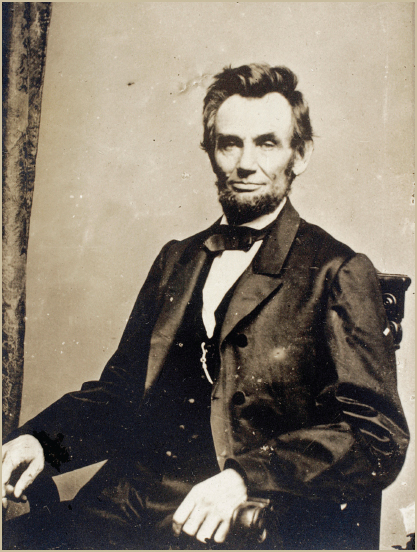
Abraham Lincoln (1809–1865),
albumen silver print from glass negative, 1864
PLATE 44–2