
48

THAT ABRAHAM LINCOLN’S DEATH ELEVATED HIM TO THE STATUS OF secular saint practically overnight should surprise no one. His almost sacrilegious decision to go out in public on Good Friday ironically worked to sanctify his reputation. By Sunday, when the churchgoing American public gathered at their places of worship to observe what many later described as a “Black Easter,” ministers throughout the North openly compared Lincoln to Jesus. Like the Messiah, he had died for his nation’s sins. For the nation’s Jews, Sunday marked the final weekend of the equally important festival of Passover, and rabbis took to the pulpit to liken the martyred leader to the hero of that holiday, Moses. Like the Hebrew prophet and lawgiver, they pointed out, Lincoln had led an enslaved people to freedom but had not lived to see the promised land. It was said that Jews actually chanted the mourners’ Kaddish prayer in his memory, the first time a non-Jew was ever so honored in an American synagogue. No American tragedy had ever stirred such deep emotions. In a single day a controversial politician had morphed into a second George Washington, equally revered. Foes who dared to whisper that they were glad of his death were beaten on the streets.
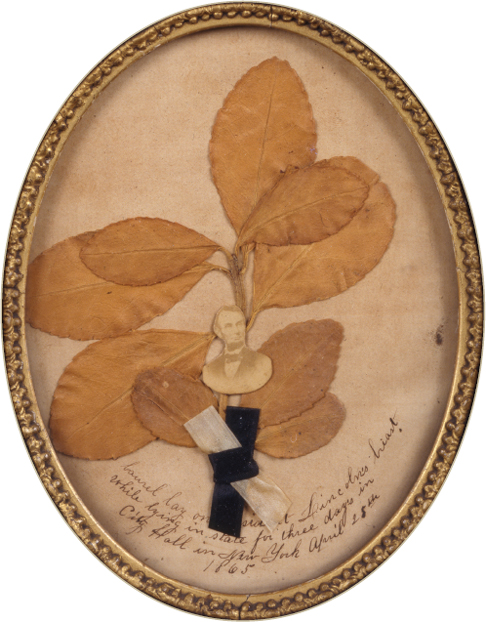
PLATE 48–1
“Lincoln’s death,” Walt Whitman ruminated when news of the murder first reached New York, “—thousands of flags at half mast & on numbers of them long black pennants—from the shipping densely crowding the docks, the same—numerous ferry boats constantly plying across the river, the same solemn signal—black—business public & private all suspended, & the shops closed—strange mixture of horror, fury, tenderness, & a stirring wonder brewing….
“Black, black, black,” continued Whitman, “—as you look toward the sky—long broad black like great serpents slowly undulating in every direction.…All Broadway is black.” The ubiquitous diarist George Templeton Strong similarly noticed that “not a building on Wall Street, Broadway, Chambers Street, Bowery, Fourth Avenue, is without its symbol of the profound public sorrow. What a place this man, whom his friends have been patronizing for four years as a well-meaning, sagacious, kind-hearted, ignorant, old codger, had won for himself in the hearts of the people! What a place he will fill in history!”
No single funeral could possibly accommodate such widespread and overwhelming grief. In an eerie re-creation of his portentous recent dream, Lincoln’s body first lay in state in the East Room at the White House, where an initial memorial service took place on April 19. Six hundred people thronged the ceremony, crowded onto specially built indoor risers, though an inconsolable Mary Lincoln was unable to summon the strength to come downstairs and attend. Somehow Robert Lincoln, no less consumed with guilt than poor Henry Rathbone, took over as family representative and chief planner for his father’s long and emotional journey home. Robert and the late president’s closest advisers devised an ingenious itinerary, dictated by the vagaries of still-limited railroad connections but surely informed as well by a sense of history and nostalgia. Lincoln’s body would be taken home along the almost identical route the living man had traveled from Springfield to Washington to assume the presidency only four years before.
The first stop was Baltimore. Only this time, unlike 1861, neither fears over security nor mania for secrecy shrouded the event from the population. Thousands turned out in the once-hostile city to pay their respects. After additional, equally effusive demonstrations of public grief at Harrisburg and Philadelphia, Lincoln’s remains arrived in New York City on April 24, ten days after the assassination. The passionate mourning had not abated. Now the biggest funeral of all got under way, as a huge but largely silent procession accompanied the horse-drawn hearse down Broadway to the sound of rolling wheels, cadenced boot steps, muffled drumbeats, and the chimes of Trinity Church’s tower bells tolling “Praise God, from Whom All Blessings Flow.”
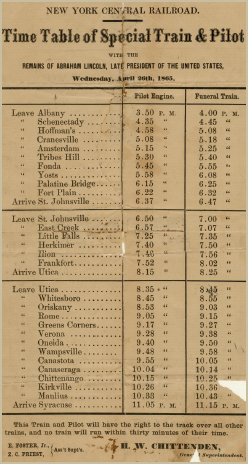
New York Central Railroad. Time Table of Special Train & Pilot with the Remains of Abraham Lincoln, Late President of the United States, Wednesday, April 26th, 1865
PLATE 48–2
Thousands of marchers followed the hearse that day, among them civic leaders, military companies, labor groups, uniformed police and firemen, veterans, and religious, political, and fraternal organizations. Looking on, rich and poor competed for a glimpse of the procession from thickly crowded sidewalks, “the velvets and rustling silks of the rich” mingling in one tearful throng with “the humbler garments of the honest poor.” Reporters spied solemn groups of mechanics and benevolent associations on parade, rows of politicians twenty abreast, German “turners” (gymnasts) in “plain linen coats” in step with Irish children “in green blouses, and hand in hand.” In an inexcusably cruel gesture, city officials had earlier decided to ban African Americans from the funeral march entirely, but the mourners persisted. The Evening Post complained, “We have accepted the service of colored citizens in the war and it is disgraceful ingratitude to shut them out of our civil demonstration,” and by order of the secretary of war himself, the heartless municipal order was overturned. Two hundred marchers of color ended up walking at the very back of the endless line, proudly carrying banners that read “Two Million of Bondsmen He Liberty Gave” and “ABRAHAM LINCOLN Our Emancipator.”
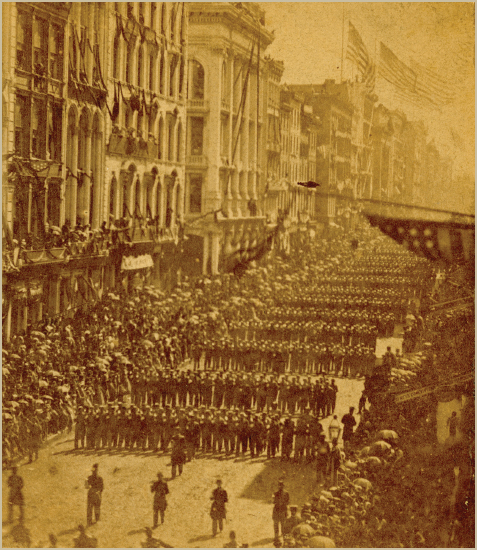
Lincoln’s Funeral Procession in New York City, stereograph, 1865
PLATE 48–3
When the hearse finally reached Chambers Street that day, pallbearers deposited the president’s ornate, fifteen-hundred-dollar walnut-and-silver coffin on a dais atop the grand double staircase on the second floor of City Hall, the building’s facade now draped in black and adorned by a huge banner that read “The Nation Mourns.” For their final stop in the biggest city in the country, Lincoln’s remains, hastily and imperfectly retouched by an embalmer, went on public view in the open coffin just outside the rooms where President-elect Lincoln had uneasily attended a reception with the city’s secession-minded mayor in February 1861. This time, no expressions of disloyalty greeted him. But there would be one more demonstration of New York–style audacity. The photographer Jeremiah Gurney, who had manned the cameras at the Metropolitan Fair a year before, ventured early to City Hall and climbed to the walkway ringing the interior of the rotunda dome, from which he made one final portrait of the lamented leader: a distant photograph of Lincoln in death. (Outraged, Secretary of War Edwin M. Stanton later confiscated the prints.) Despite this distraction, Lincoln’s private secretary John G. Nicolay declared, “The reception in New York was worthy alike of the great city and of the memory of the man they honored.”
All through the night and into the next morning, mourners patiently stood on line, often for hours, for a brief glimpse of the face so familiar from the countless photographs and prints in circulation—many of them published over the war years on Fulton or Nassau Street, not far from this very spot. By the time the lid was closed on Lincoln’s coffin in Manhattan, some 150,000 people had viewed the remains. It was, the New York Times summarized, “a day long to be remembered as one marked by the most tremendous crowds ever seen in this city.” The throng included “young boys, who will live to tell of this great day to their children when this century has passed,” as well as “old men, who have seen the wars of 1812 and of 1861–5, and now come out into the genial sunshine to see our second WASHINGTON carried to his tomb. Their aged and tear-dimmed eyes,” the analysis breathlessly concluded, “have beheld the country twice convulsed by war, and are now preparing to go to that bright abode to which our heroic LINCOLN has gone before.” The Times judged the outpouring to be not only an expensive tribute to a hero but also “a prompt, spontaneous and deliberate sacrifice by the industrious, the frugal, the pecuniarily responsible body of the people.” It was not just “the grandest oblation ever made on the altar of departed worth.” It had disproved “the theory that republics are ungrateful.”
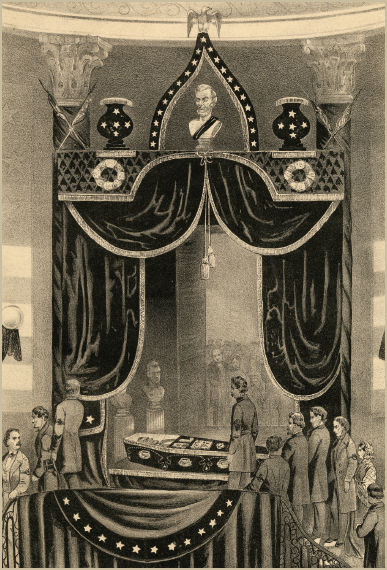
The Body of the Martyr President, Abraham Lincoln, Lying in State at the City Hall, N.Y., April 24th & 25th, 1865, lithograph, 1865
PLATE 48–4
From Manhattan, Lincoln’s body headed toward New Jersey, then north for another public funeral in Albany, and ultimately west for ceremonies in Buffalo, Indianapolis, Chicago, and finally Springfield. Lincoln was laid to rest inside a temporary receiving vault at Oak Ridge Cemetery outside the town he left, never to see again, just over four years before—what must have seemed to his old neighbors a lifetime ago. For the hundreds of thousands who personally witnessed any or all of these spectacular events, and for the millions more who did not but wished they had, souvenirs again provided a tangible link to the mass mourning long after Lincoln had been interred. Once again, just as at all the peak periods of public hunger for Lincoln images and artifacts, New York entrepreneurs supplied the majority of keepsakes—and profited royally from the demand.
The New-York Historical Society’s large holdings in artifacts from Lincoln’s various funerals include an unexpected number of accomplished, on-the-spot, firsthand sketches showing the president’s catafalque on view in sites in various cities, including the White House, the main Chicago courthouse, and the Springfield state capitol. They are all part of the vast trove of original model drawings that unidentified artists supplied to Frank Leslie’s Illustrated Newspaper from 1861 to 1865. Among the collection’s mass-produced mementos are a timetable of the special funeral train for April 26, 1865, and original lithographic prints and photographic stereo cards depicting the funeral procession as well as mourners filing past the coffin at City Hall in New York.
But perhaps no relic more evocatively symbolizes the city’s grieving than the simple spray of laurel taken from Lincoln’s bier at City Hall by a man named Jeremiah Wood and preserved ever after in a gilded oval frame together with a small photograph of the late president and a black-and-white crossed ribbon. It was given to the Society in 1947.
Similar keepsakes must have inspired the New York poet Walt Whitman, though he expressed his grief in words, not relics. We do not know whether he saw Lincoln’s remains during those extraordinary days, but we do know that when he returned to the theme of mourning, this time in his acclaimed poem “When Lilacs Last in the Door-Yard Bloom’d,” the subject was not only a dead president but living flora like the sprig preserved by Jeremiah Wood:
Coffin that passes through lanes and streets,
Through day and night, with the great cloud darkening the land,
With the pomp of the inloop’d flags, with the cities draped in black,
With the show of the States themselves, as of crape-veil’d women, standing,
With processions long and winding, and the flambeaus of the night,
With the countless torches lit—with the silent sea of faces, and the unbared heads,
With the waiting depot, the arriving coffin, and the sombre faces,
With dirges through the night, with the thousand voices rising strong and solemn;
With all the mournful voices of the dirges, pour’d around the coffin,
The dim-lit churches and the shuddering organs—Where amid these you journey,
With the tolling, tolling bells’ perpetual clang;
Here! coffin that slowly passes,
I give you my sprig of lilac.
(Nor for you, for one, alone;
Blossoms and branches green to coffins all I bring:
For fresh as the morning—thus would I chant a song for you, O sane and sacred death.
All over bouquets of roses,
O death! I cover you over with roses and early lilies;
But mostly and now the lilac that blooms the first,
Copious, I break, I break the sprigs from the bushes;
With loaded arms I come, pouring for you,
For you, and the coffins all of you, O death.)