
47

HER FATHER WAS AN IMPORTANT REPUBLICAN U.S. SENATOR FROM New York State, but young Clara Harris was not President and Mrs. Lincoln’s first choice to accompany them on their excursion to the theater on the night of April 14, 1865.
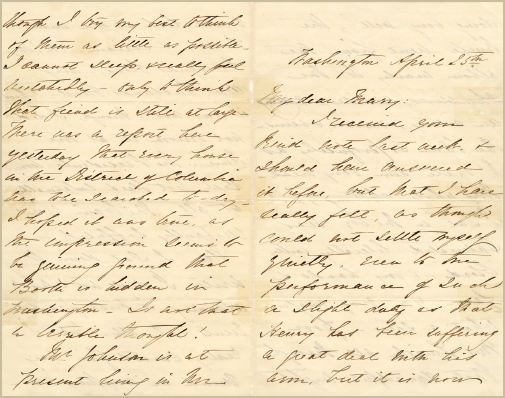
PLATE 47–1
Others had been asked—and had declined. Maybe it was the wrong play for a city swelling with patriotic pride: a boisterous English drawing room comedy that made Americans look oafish and stupid. Perhaps it was the inconvenient date: April 14 was Good Friday, the holiest day on the Christian calendar, and the more observant would understandably resist even a presidential summons to a heathen playhouse on so sacred an evening. A few weeks earlier, in fact, the bishop of New Hampshire, Carlton Chase, had strongly urged Lincoln to mark the occasion a different way, by appointing “Good Friday, the fourteenth day of April next—to be observed as a day of Fasting and Prayer throughout the United States. I have reason to believe,” the bishop added, “that day would be agreeable to Christian people of all denominations.” But the plan was not agreeable to Abraham Lincoln. Worn out and desperate for relief, he determined instead to go to Ford’s Theatre on April 14 to laugh along with Our American Cousin.
For a time, no one wanted to attend as his guests. General Grant had been the first choice to share the double-sized presidential box at Ford’s with the Lincolns. But Julia Dent Grant understandably had no desire to see Mrs. Lincoln again—anywhere. During the Lincolns’ last visit to Grant’s headquarters at City Point, Virginia, Mary had repeatedly pulled rank and demanded acknowledgment as Mrs. Grant’s superior, at one point castigating her host, “I suppose you think you will get to the White House yourself?” Julia had not forgotten. Even though the theater’s manager, John T. Ford, put out a handbill advertising the Grants’ presence for that night’s gala performance, Julia would have no part of it. The general made a feeble excuse—they had to rush off to New Jersey to see their children—so the Lincolns began looking elsewhere for replacements. Thomas Eckert, the assistant secretary of war, turned them down, too. Even their son Robert declined, claiming he was exhausted by his Appomattox ordeal and wanted only to enjoy a good night’s sleep in a real bed. Desperate to fill the box, Mrs. Lincoln finally turned to Miss Harris—and to her twenty-seven-year-old fiancé, Major Henry Rathbone.
That afternoon, the president invited Mary for an afternoon carriage ride and this time specified that he wanted no other guests along. “I prefer to ride by ourselves today,” he insisted. Mary’s recent public outbursts had revealed her to be close to a complete nervous breakdown. But her husband evidently still harbored a deep affection for his spouse of nearly twenty-three years. “He was almost boyish, in his mirth,” Mary later told the artist Francis B. Carpenter of that final afternoon together, “& reminded me, of his original nature, what I had always remembered of him, in our own home—free from care. I never saw him so supremely cheerful—his manner was even playful.…During the drive he was so gay, that I said to him, laughingly, ‘Dear Husband, you almost startle me by your great cheerfulness,’ he replied, ‘and well may I feel so, Mary, I consider this day, the war has come to a close’—and then added, ‘We must both be more cheerful in the future—between the war & the loss of our darling Willie—we have both, been very miserable.’” As Mary remembered it, they made plans that afternoon to visit California and the Holy Land some day.
Mary, in her own way, had been as worried about her husband as he was about her. Not long before this day, he had almost sadistically confided to his fragile wife the details of a strange dream. As he remembered the chilling experience:
About ten days ago, I retired very late. I had been waiting up for important dispatches. I could not have been very long in bed when I fell into a slumber, for I was weary. I soon began to dream. There seemed to be a death-like stillness around me. Then I heard subdued sobs, as if a number of people were weeping. I thought I left my bed and wandered downstairs.
I was puzzled and alarmed. What could be the meaning of all this? Determined to find the cause of a state of things so mysterious and so shocking, I kept on until I arrived in the East Room, which I entered. There I met with a sickening surprise. Before me was a catafalque, on which rested a corpse in funeral vestments. Around it were stationed soldiers who were acting as guards; and there was a throng of people, some gazing mournfully upon the corpse, whose face was covered, others weeping pitifully.
“Who is dead in the White House?” I demanded of one of the soldiers.
“The president,” was his answer. “He was killed by an assassin.”
Then came a loud burst of grief from the crowd, which awoke me from my dream. I slept no more that night.
“That is horrid,” Mary burst out in response. “I wish you had not told it. I am glad I don’t believe in dreams, or I should be in terror from this time forth.” Lincoln sheepishly tried to console her: “It was only a dream, Mother. Let us say no more about it, and try to forget it.”
By the day of their carriage ride, both of them may indeed have forgotten it—or at least nervously confined it to the backs of their minds. For days, the city had been ablaze in illumination in celebration of Lee’s surrender, with church bells loudly ringing and bands marching in the streets playing music. This was a time to celebrate, not worry.
After returning to the White House, Lincoln took care of remaining business, saw a few callers, and only then began dressing for the theater. His last-minute chores would make the couple late. The play was already under way when the Lincolns boarded the presidential carriage. A few minutes later, they pulled up at Senator Ira Harris’s house at Fourteenth and H streets to pick up Henry and Clara. Then they set off for the theater, a redbrick building a few blocks away on Tenth Street. When they finally entered Ford’s, they walked up to the mezzanine level, then circled their way around the back aisle toward their box at stage left. The audience quickly caught sight of them and began to applaud, and the actors stopped mid-performance to join in the ovation. By the time the Lincoln party reached the box, the orchestra was in the midst of a full-blast rendition of “Hail to the Chief.” Lincoln acknowledged the welcome and then took his seat in an upholstered rocking chair drawn close to the rail. Mary sat down next to him in an upright chair. Miss Harris and Major Rathbone settled on a settee along the back wall.
When a shot rang out, most members of the audience at first thought it was part of a special effect in the play. No one remembered who screamed first, but many thought it must have been Mrs. Lincoln calling almost incoherently for help. “I struck boldly,” John Wilkes Booth icily boasted in his diary of what happened next, shortly after 10:00 p.m. “I walked with a firm step through a thousand of his friends, was stopped but pushed on. A col. [sic] was at his side. I shouted Sic Semper [‘Thus Ever to Tyrants,’ the motto of Virginia] before I fired.…I shall never repent it.”
As the audience erupted in pandemonium, Booth leaped to the stage, injuring his leg, limped unmolested toward the wings, and fled without interference. He remained a fugitive for days. The scene inside the box was no less frantic. Booth had jammed a thick wooden beam against the door before attacking the president, and people now straining to come to the president’s aid could not force their way in from the outside. Finally, spectators in the closest rows lifted a surgeon toward the box, which the physician found to be spattered with blood.
The New-York Historical Society has a handwritten letter from the remarkably composed eyewitness Clara Harris written to a friend we know only as Mary, describing the shocking events of April 14, 1865, in all their bloody detail. Harris had a victim of her own to worry about, for right after Booth shot Lincoln, Rathbone made a belated effort to seize the assassin, who sliced deeply into his arm with a large knife. The major fell back, spurting blood. Even when Dr. Charles Leale and others came to the president’s aid, Rathbone lay in the box all but ignored, bleeding profusely. That he survived the loss of so much blood was something of a miracle. This is the harrowing update Clara provided just eleven days after the assassination:
Henry has been suffering a great deal with his arm, but it is now doing very well,—the knife went from the elbow nearly to the shoulder, inside,—cutting an artery, nerves, & Veins. He bled so profusely as to make him very weak. My whole clothing, as I sat in my box was saturated literally with blood, & my hands & face. You may imagine such a scene. Poor Mrs. Lincoln all through that dreadful night would look at me with horror & scream, oh! my husband’s blood,—my dear husband’s blood—which it was not, though I did not know it at the time. The President’s wound did not bleed externally at all. The brain was instantly suffused.
Just as Clara hoped, Henry Rathbone ultimately recovered. Two years after the Lincoln assassination, in 1867, the couple married and relocated to Germany when the major was appointed American consul to Hannover. But Rathbone could never forget the events of April 14, 1865. Racked by guilt, he tormented himself that he had been unable to do anything to save the president. He began taking drugs to relieve his depression, but addiction only increased his paranoia. On December 23, 1883, he took out a gun and brandished it at Clara as he accused his wife of secretly plotting to leave him. “There is devilment afoot!” Clara screamed to the household help. “Lock the children’s door.” The last sounds her maid heard were a gunshot and Clara Harris Rathbone’s cry “Henry, let me live! Oh don’t!” Police rushed to the scene, but it was too late. Clara was dead of a bullet and stab wounds. Her dazed husband was curled up in the kitchen, once again bleeding—but this time from a few halfhearted self-inflicted knife slashes, muttering as if still in the throes of a nightmare: “Who could have done this to my darling wife?”
A court judged Rathbone to be criminally insane and committed him to a mental asylum in Hildesheim, Germany. He was still confined there when he died at age seventy-four in 1911—the last survivor of the bloody presidential box at Ford’s Theatre the night Abraham Lincoln was murdered.