
6

JOHN BROWN’S TRIAL WAS SWIFT (HIS REQUEST FOR A DELAY WAS denied), the verdict unsurprising, and the death sentence fully anticipated. After a weeklong proceeding, the Charles Town, Virginia, court convicted Brown of “conspiring with slaves to commit treason and murder” and ordered him to be hanged.
Brown proved a model of deportment during the trial, seemingly content with his approaching martyrdom and pleased that so many journalists were on hand to observe and report the proceedings. He seemed to one military observer a “crafty old fiend,” pretending to be too weak to listen one moment, but occasionally sitting upright to make an emphatic point or two to the judge. Meanwhile, as expected, editorial comment ran along strict geographic lines, with New England newspapers describing Brown as something of a saint and a typical opposition journal branding him and his band as “a handful of crazed fanatics.”
Before the judge pronounced the death sentence, the ailing old warrior summoned the strength to make an impassioned closing statement, expressed with quiet dignity, but with enough passion to send chills through the South nearly as powerful as the October raid itself. Ralph Waldo Emerson later expressed the opinion that the words were surpassed in beauty only by the Gettysburg Address. But Brown’s final condemnation against the slave power did little to win sympathy, much less clemency:
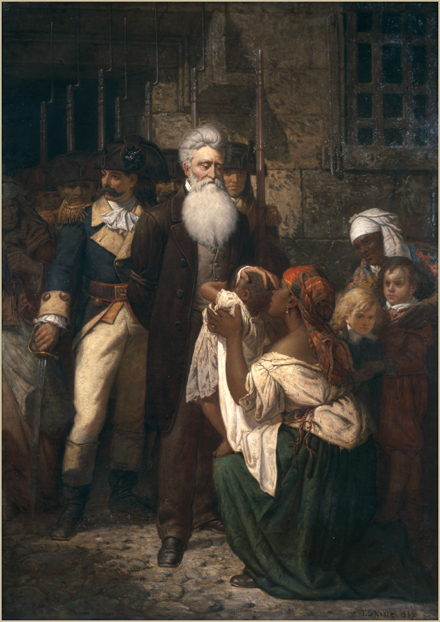
PLATE 6–1
In the first place, I deny everything but what I have all along admitted: of a design on my part to free slaves. I intended certainly to have made a clean thing of that matter, as I did last winter, when I went into Missouri and there took slaves without the snapping of a gun on either side, moving them through the country, and finally leaving them in Canada. I designed to have done the same thing again on a larger sale. That was all I intended. I never did intend murder, or treason, or the destruction of property, or to excite or incite slaves to rebellion, or to make insurrection.…Had I interfered in the manner which I admit, and which I admit has been fairly proved…in behalf of the rich, the powerful, the intelligent, the so-called great, or in behalf of any of their friends, either father, mother, brother, sister, wife or children, or any of that class, and suffered and sacrificed what I have in this interference, it would have been all right. Every man in this Court would have deemed it an act worthy of reward rather than punishment.
On December 2, 1859, Brown read one more time from the Bible and wrote a final statement: “I, John Brown, am now quite certain that the crimes of this guilty land will never be purged away but with blood.” At eleven in the morning, the jailer John Avis, accompanied by Sheriff James W. Campbell, warrant in hand, led John Brown from his cell and down the jailhouse steps, ready to usher him into a horse-drawn cart scheduled to take him a short distance to the gallows. Brown wore a black cashmere suit, a collarless cotton shirt, and red slippers. According to some accounts, his hands were tied.
What supposedly happened next, however, became the stuff of myth that transcends history. By some reports forced to walk from the jail with the noose already hanging loosely from his collar, Brown reportedly surveyed the scene before him: a crowd of two thousand hostile whites and a few sympathetic African Americans, all held in check by soldiers wearing the almost comical-looking Colonial-style uniforms of the local Jefferson Guard. And then Brown caught sight of a black woman and her baby pressing to the front of the throng. According to legend, the woman dramatically held her small child in her outstretched arms and asked Brown to pronounce his blessing. If the doomed man really spoke at this point, we have no record of his words, but one newspaper insisted that Brown bent his head low, leaned across the porch railing, muttered a prayer, and kissed the child’s brow. In truth, the overwhelming show of force had efficiently kept the crowd far from the scene, and his jailers certainly would not have allowed their prisoner to offer such a dangerous and potentially inciteful gesture. Moreover, it is hard to imagine that local slaves were given a day off from their labors to pay their respects to a man their owners believed an abolitionist madman who meant to see them liberated.
Inaccurate or not, the reports alone were enough in some quarters to transform Brown’s image overnight from maniac to martyr, inspiring poets and artists for the next generation. The deification became as extreme as the vitriol. Ralph Waldo Emerson, for example, predicted that “the new saint” would “make the gallows as glorious as the cross.” John Greenleaf Whittier spoke for many abolitionists when he published “Brown of Osawatomie” in the New York Independent just three weeks after the execution:
John Brown of Osawatomie spake on his dying day:
“I will not have to shrive my soul a priest in Slavery’s pay;
But let some poor slave-mother whom I have striven to free,
With her children, from the gallows-stair put up a prayer for me!”
John Brown of Osawatomie, they led him out to die;
And lo! a poor slave-mother with her little child pressed nigh:
Then the bold, blue eye grew tender, and the old harsh face grew mild,
And he stooped between the jeering ranks and kissed the negro’s child!
The shadows of his stormy life that moment fell apart,
And they who blamed the bloody hand forgave the loving heart;
That kiss from all its guilty means redeemed the good intent,
And round the grisly fighter’s hair the martyr’s aureole bent!
Needless to say, the drama and the verse soon inspired artists, too. None had been on hand to witness, much less record, Brown’s final moments, but with imagination, talent, and a keen understanding of the appeal of legend over fact, they expanded the myth further. But Brown’s emergence as a divinity could prove powerful and convincing even when handled more subtly.
One artist who did so was the Kentucky-born painter Thomas Satterwhite Noble (1835–1907), a late bloomer where the cause of antislavery was concerned. Reared on a Lexington plantation, Noble grew up being ministered to night and day by slaves, then studied art in Europe. Shortly before the Civil War, Noble’s father freed his laborers, and the family set an example for the community by hiring all of them back for wages. That bold gesture was not enough, however, to persuade Thomas to fight for the Union. Instead, like many Kentuckians, he cast his lot with the South and rose to the rank of captain in the Confederate army, serving for a time as a staff aide to the governor of Louisiana. After the war he settled in St. Louis, then moved to New York to establish himself as an artist, and there he unexpectedly emerged as something of an abolitionist painter. Perhaps Noble was telling the truth when he argued in 1861 that his only quarrel with Lincoln’s government had revolved around the somewhat specious issue of states’ rights, not slavery. Other secessionists offered the same explanation, although few contemporaries doubted that the “right” that Southern states wanted primarily to protect was of course the right to own slaves.
In any event, the war, or Confederate defeat, or perhaps emancipation, somehow transformed Noble, because he soon produced a series of sympathetic canvases titled Past, Present, and Future Conditions of the Negro—now sadly lost—followed by a bravura 1865 painting depicting (and implicitly condemning) the last sale of slaves on the steps of the St. Louis courthouse. This was the same building, many contemporaries surely knew, where the Dred Scott case had been first heard before making its way in 1856 to the U.S. Supreme Court (where the ruling that black men had no rights that “a white man was bound to respect” inflamed abolitionists like John Brown). In 1867, Noble turned his attention to the most controversial abolitionist of them all: Brown himself.
Immune to the dubious legend of the final kiss, Noble focused instead on the purported blessing, basing his extravagantly bearded portrait of Brown on period photographs but giving him the air of a biblical prophet. He showed the Jefferson Guards in their anachronistic uniforms and merely guessed at the likenesses of Brown’s captors, a detail that proved so uncannily accurate it moved the Cincinnati journalist Murat Halstead, who had witnessed the scene, to inquire whether Noble had been on hand too. (He had not—though somewhere in the crowd that day stood a civilian who had obtained a special pass to the hanging, so eager was he to see Brown dangle from the rope. Perhaps a few of the other onlookers at the execution noticed that rather famous Maryland actor among them: John Wilkes Booth.)
Thomas Noble’s finished painting, showing the condemned man placing his hand on the slave child’s head, was widely exhibited before arriving at the New-York Historical Society in 1939 and lavishly praised from the start, with one nineteenth-century critic extolling its “marvellous power.” More to the point, it helped usher in the decisive image of John Brown as a latter-day Moses. It certainly marked the artist’s full conversion on the slavery issue. There is evidence that the painter’s courage was enough to get him in trouble back in Kentucky. In 1867, a newspaper reported that Noble had jeopardized his “position at home by representing so unwelcome a matter to the South.”
The historian Albert Boime has persuasively argued that Thomas Noble’s melodramatic picture helped establish John Brown as the quintessential white patriarch who selflessly gave up his life for the liberty of others. Not everyone at the time shared this belief, of course, not even all opponents of slavery, but there is little doubt that after his hanging, Brown emerged into abolitionist nobility—propelled to this mythic status by an artist named Noble, no less.
By the time the first Union troops began heading south to the defense of Washington, D.C., in April 1861, they were singing a new song that crystallized this metamorphosis. More than a year before these soldiers began chanting Julia Ward Howe’s newer lyrics to the same tune attributed to one William Steffe, the soldier Thomas Brigham Bishop’s version, “The John Brown Song,” seemed to perfectly capture the spirit of the Union fighting for its own existence—and something more:
John Brown’s body lies a-mouldering in the grave;
John Brown’s body lies a-mouldering in the grave;
John Brown’s body lies a-mouldering in the grave;
His soul is marching on!
Glory, glory, hallelujah! Glory, glory, hallelujah!
Glory, glory, hallelujah!
His soul is marching on!