
7

HERE IS THE GARGANTUAN HAND OF A FRONTIER RAIL-SPLITTER, champion wrestler, and acclaimed prairie debater who always strove to refrain from gesturing while he spoke in public because his paws were so large it made him appear as if he were swatting bees. Here, too, is the oversized hand that would one day sign the Emancipation Proclamation and grasp the text of both the Gettysburg Address and the second inaugural.
There is no shortage of irony in the fact that this cast, which ranks among the most influential sculptures ever made of the quintessential Republican Abraham Lincoln, was executed by a relative—albeit by marriage—of Lincoln’s lifelong archrival in politics, the Democrat Stephen A. Douglas. Though but a side story to an amazing saga of artistic ingenuity and the triumph of marketing over originality, it serves to remind us that much of nineteenth-century art, especially mass-produced popular art, was inspired by profit, not philosophy.
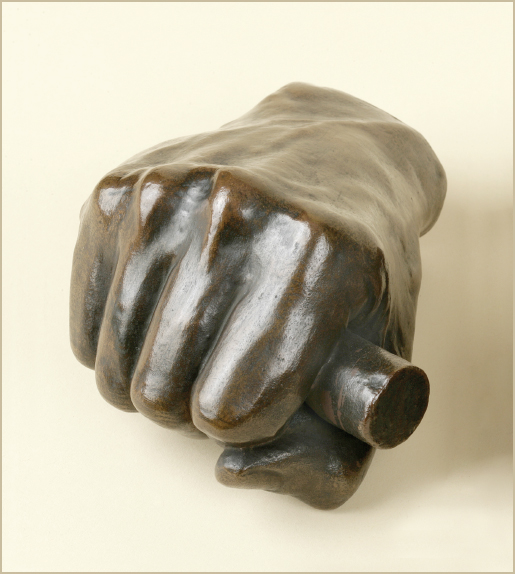
PLATE 7–1
Leonard Wells Volk (1828–1895) was a moderately talented journeyman sculptor who had studied in Rome, then relocated to Chicago, where he produced a workmanlike statue of the patron who had helped arrange his trip abroad: his wife’s cousin the controversial U.S. senator known to the public as the “Little Giant.” Evidently where Volk was concerned, art should be nonpartisan. When he learned in March 1860 that Douglas’s nemesis Abraham Lincoln would soon be in Chicago to represent a client in what promised to be a lengthy railroad case, he persuaded him to visit his Dearborn Street studio to pose for a likeness. Volk clearly felt he would be well-advised to produce a portrait of the politician who had so vigorously engaged his cousin in their widely covered debates for the U.S. Senate two years earlier (the sculptor had witnessed one of their earlier encounters). Lincoln had gone on to lose that 1858 contest, but the defeat had not halted his steady rise to national prominence. Now one of the leading Republican antislavery advocates in the West, he was being widely discussed as a candidate for the presidency.
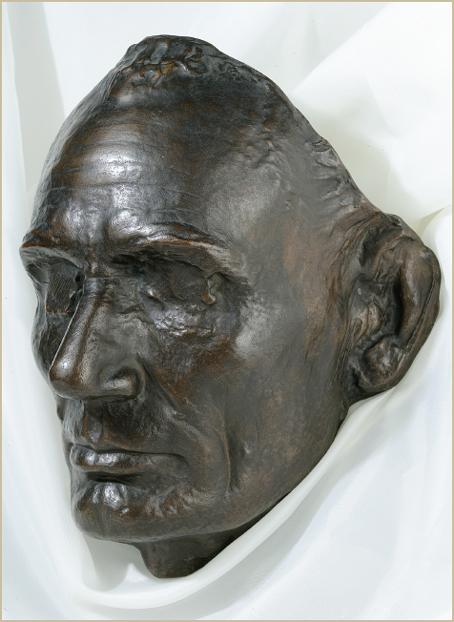
PLATE 7–2
Life Mask of Abraham Lincoln, bronze cast by Augustus Saint-Gaudens, 1886, from 1860 original by Leonard Wells Volk
Volk was the first artist, aside from photographers, for whom Lincoln consented to pose. It is possible he had begun to realize that to be taken seriously as a statesman, he had to make himself more readily available to painters and sculptors. Lincoln was amenable to Volk’s plan but had no idea what was expected of him. “I have never sat before to sculptor or painter.…What shall I do?”
Volk promised to make the sculpting process as efficient as possible by first creating a plaster cast of Lincoln’s face, which he would then use as a model for the proposed statue, limiting the need for protracted sittings. All that the subject needed to do was allow his face to be smothered in plaster and wait an hour for it to harden. The sculptor would be left with a perfect intaglio cast of Lincoln’s features—something like a photographic negative—into which he could pour fresh wet clay to make a positive “print.” Intrigued, Lincoln offered to have his hair cut before his appointment, but Volk cautioned him not to trim it too short: he wanted the cast to look like the Lincoln his neighbors and supporters knew. Meanwhile, Volk measured Lincoln against his studio wall and pronounced him exactly one foot taller than his diminutive cousin-in-law Douglas.
As it turned out, Lincoln hardly enjoyed the actual process of sitting for the life mask. After the wet plaster had hardened on his face for about sixty minutes, with nothing but straws inserted into his nostrils to help him breathe, Volk had trouble easing it off. Lincoln, the sculptor remembered, then “bent his head low and took hold of the mold, and gradually worked it off without breaking or injury,” adding compassionately, “It hurt a little, as a few hairs of the tender temples pulled out with the plaster and made his eyes water.” At least the painful experience did not dissuade Lincoln from returning to Volk’s studio and sitting a few more times for a bust, as promised. On one of these occasions, Volk asked Lincoln to remove his coat, vest, and shirt, and pull down his undershirt as well, so he could model his subject’s brawny shoulders. Lincoln cooperated but was evidently embarrassed by the ordeal, for when the sitting was over, he fled so quickly he failed to realize he had hastily gotten dressed in the studio without pulling up the top half of his union suit. When he reached the street, a passerby pointed out that he was trailing its two dangling sleeves behind him. Lincoln sheepishly returned to the artist’s headquarters, where Volk helped to reassemble his outfit, after which “out he went with a hearty laugh at the absurdity of the thing.”
When Volk completed the statuette, Lincoln was suitably impressed, telling another sculptor: “In two or three days after Mr. Volk commenced my bust, there was the animal himself!” The following month, the Republican Party indeed chose Lincoln as its nominee for the presidency, and Volk’s project took on new urgency. Though yet to realize the commercial potential of his unique Lincoln life mask, the sculptor became more determined than ever to create his planned life-sized statue. To accomplish it, he decided he must also obtain casts of Lincoln’s “two great hands.”
Literally overnight, Volk rushed downstate to the nominee’s Springfield hometown and proposed to apply plaster to him yet again—this time to his extremities. Once again, Lincoln agreed to undergo the ordeal and named the following morning for the sitting.
Early on May 19, 1860, Volk reappeared at Lincoln’s home at the appointed hour, only to find his subject’s right hand badly “swollen as compared with the left, on account of excessive hand-shaking the evening before.” His left appeared lean and sinewy as usual, the right disproportionately bulbous. But Volk had no time to wait for the swelling to subside and decided to proceed as planned. To minimize the distortion, he suggested that the candidate clutch something in his puffy right hand so the difference between the two would be less apparent.
“I wished him to hold something in his right hand, and he looked for a piece of pasteboard, but could find none,” Volk recalled in a reminiscence published in the Century Magazine in 1881. “I told him a round stick would do as well as anything. Thereupon he went to the woodshed, and I heard the saw go, and he soon returned to the dining-room (where I did the work), whittling off the end of a piece of broom-handle. I remarked to him that he need not whittle off the edges.”
“Oh, well,” Lincoln replied, “I thought I would like to have it nice.”
When Volk finished casting the right hand, he began applying plaster to the left, and Lincoln felt the need to explain a barely detectable imperfection. “You have heard that they call me a rail-splitter,” he told the sculptor, “and you saw them carrying rails in the procession Saturday evening; well, it is true that I did split rails, and one day, while I was sharpening a wedge on a log, the axe glanced and nearly took my thumb off, and there is the scar, you see.”
Back in Chicago, Volk took an unusual amount of time to find a venue for the planned work. Not until 1876—eleven years after Lincoln’s death—was it finally unveiled in the Springfield state capital. The final work presented Lincoln as a liberator, clutching not a sawed-off, whittled-down broomstick but the Emancipation Proclamation. Although he had enjoyed more life sittings with Lincoln than almost any other artist of the day, Volk’s bearded figure looked too squat and bulky, the face oddly generic. Ultimately, though he had commissioned not only life casts to help him fashion a lifelike figure but also a remarkable photograph of a full-figured Lincoln, Volk was unable to make his own statue look very lifelike or realistic at all.
In the 1880s, however, Volk belatedly realized the commercial potential of his earlier portraits of the clean-shaven Lincoln, which he had been wise enough to patent at the time of their creation. He authorized a number of large and small plaster and bronze copies of his 1860 bust, some draped, some in the classical “Hermes” or “nude” style. And he began mass-producing copies of the life mask as well and, ultimately, of the hands. Plaster, bronze, and modern-blend copies have abounded in the marketplace ever since.
It comes as no surprise that the sculptor George Grey Barnard appreciatively called Volk’s early work “the best thing done in Lincoln’s life time.” The mask and the casts show the future president on the threshold of war and greatness. The contents of Volk’s studio burned in the 1871 Chicago fire, but the life mask and hands survived: the sculptor carried them wherever he traveled, even overseas. And in ubiquitous replicas they have endured in popularity as have no other artistic representations of the man.
Moreover, subsequent generations of sculptors—from Daniel Chester French to Augustus Saint-Gaudens—acknowledged a major debt to Volk. Both French and Saint-Gaudens used his originals as guides to fashion works of their own. Few modern viewers realize that the marble hands grasping the throne-like chair of the Lincoln Memorial and the hand clutching his lapel in the great monument at Lincoln Park in Chicago owe their inspiration—and their lifelike detail—to Volk’s pioneer castings. The bronze hand in the New-York Historical Society collection in fact was Saint-Gaudens’s own—the very bronze from which he sculpted his acclaimed Lincoln statue. Volk may have intended his casts as a model for his own work, but they live primarily in the work of many others.
Richard Watson Gilder, the nineteenth-century poet and editor who organized a committee to purchase the life mask and hands from Volk when the sculptor was near the end of his life, later wrote verses that beautifully expressed his belief, shared by many contemporaries, that no other portraits had ever come as close as Volk’s did to capturing the “majestic ghost” of Lincoln:
This bronze doth keep the very form and mold
Of our great martyr’s face. Yes, this is he:
That brow all wisdom, all benignity;
That human, humorous mouth; those cheeks that hold
Like some harsh landscape all the summer’s gold;
That spirit fit for sorrow, as the sea
For storms to beat on; the lone agony
Those silent, patient lips too well foretold.
Yes, this is he who ruled a world of men
As might some prophet of the elder day—
Brooding above the tempest and the fray
With deep-eyed thought and more than mortal ken.
A power was his beyond the touch of art
Or armed strength—his pure and mighty heart.