
Joseph Stalin 1879–1953
Born 21 December 1879, Josef Vissarionovich Dzhugashvili is better known to history by his adopted name – Stalin, ‘man of steel’.

Joseph Stalin, 1949
Bundesarchiv, Bild 183-R80329 / CC-BY-SA
Training to be a priest, Stalin was expelled from his seminary in 1899 and from there followed the revolutionary path of a Marxist.
Following the October Revolution in 1917 and the formation of the Soviet Union, Lenin delegated numerous tasks to his eager protégé, culminating in 1922 with Stalin’s appointment as general secretary of the Communist Party. But Lenin began to regret his decision and Stalin’s fast-track rise through the party hierarchy, believing Stalin to lack the necessary tact and skill for such a post. In January 1923, Lenin penned a secret memorandum, known as Lenin’s Testament, suggesting Stalin’s removal from power: ‘I am not sure whether [Stalin] will always be capable of using [his] authority with sufficient caution … Stalin is too rude and this defect … becomes intolerable in a secretary general. That is why I suggest that the comrades think about a way of removing Stalin from that post and appointing another man in his stead.’
The other man Lenin had in mind was Stalin’s great rival Lev Trotsky. Together with Trotsky, Lenin was going to use the party congress in April that year as his opportunity to have Stalin removed. But in March Lenin suffered a stroke, his third, which confined him to home and effectively ended his political career.
In January 1924 Lenin died. Trotsky may have been the obvious successor but two of his rivals, Lev Kamenev and Grigori Zinoviev, suppressed Lenin’s memorandum and decided to side with Stalin, from whom they felt they had nothing to fear. Trotsky was promptly sidelined and eventually expelled from the party and exiled from the country. But if Kamenev and Zinoviev thought they could tame the Georgian beast they were wrong. Stalin sided with Nikolai Bukharin to have them removed from the party before turning on Bukharin as well. Between 1936 and 1938 Kamenev, Zinoviev and Bukharin were all put on show trial accused of ridiculous charges, sentenced and executed.
Stalin’s final years were marked by increasing paranoia and obsession about security to the point he trusted no one, including, as he once said, himself.
In March 1953, Stalin suffered a stroke and, unable to move or call for help, was left unaided, his staff too fearful to disturb him. He died on 3 March, a victim of his own power.
Stalin’s body was embalmed and placed next to Lenin’s. But in 1961, during the years of de-Stalinization, the body was removed from its pride of place and reburied in a common grave along the Kremlin wall.
Mao Zedong 1893–1976
The son of a wealthy peasant farmer, Mao Zedong (also Mao Tse-Tung) was born in Hunan Province, in south-central China, in 1893. Aged thirteen, he began working on the family farm and was forced into an arranged marriage. He left home to escape his overbearing father and the rigours of rural life. He served briefly in the revolutionary army during the 1911 Chinese Revolution which saw the end of the Qing Dynasty and the formation of the Chinese republic. As a student he began dabbling in politics, then worked as a library assistant at Peking University, during which time he converted to Marxism.

Mao Zedong, 1946
Mao was an early supporter of the Chinese Communist Party (CCP), established in Shanghai in June 1921.
Having originally turned his back on the rural life, he began to see the future of revolutionary power not in the urban classes but in the countryside. He established various peasant organizations, giving the peasants a political voice.
In 1923, the communists formed an alliance with the Kuomintang (Nationalist Party) and Mao became a member of its Executive Bureau and head of its propaganda arm. But following the death of the Nationalist Party leader, Chiang Kai-Shek was appointed leader of the Kuomintang, and immediately began purging the party of its communist element. Its survivors forced to relocate in what became known as the Long March, with Mao leading 100,000 followers over 8,000 miles into north-west China
During China’s struggle against Japan, Mao’s communists and Chiang Kai-Shek’s nationalists joined forces, but following the end of World War Two and the surrender of Japan, the two parties fought a civil war. Having finally defeated the Chinese Nationalists, Chairman Mao proclaimed the People’s Republic of China on 1 October 1949, with the words: ‘The Chinese people have now stood up!’
Harry S. Truman 1884–1972
In January 1945 Truman was appointed US vice-president, but following Roosevelt’s death eleven weeks later, found himself taking the leading role as the Second World War drew to a close. He remains the only person in history to authorize the use of atomic weapons which, in August 1945, brought about Japan’s surrender and the end of the war.
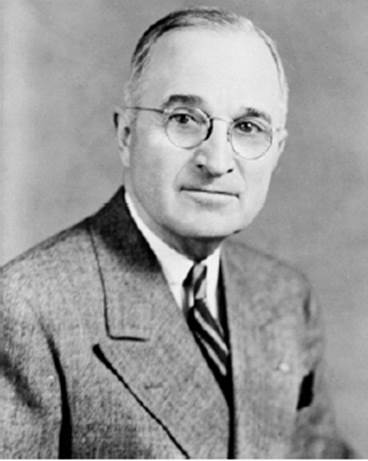
Harry S. Truman, 1945
Edmonston Studio
In March 1947, Truman articulated the need to alleviate poverty within Europe to prevent extreme ideologies taking route. ‘The seeds of totalitarian regimes,’ he said, ‘are nurtured by misery and want.’ In other words, communism appealed to those suffering from hardship. Remove the hardship; you remove the appeal of communism. Known as the ‘Truman Doctrine’, Truman believed that communism had to be contained, and that America could not, as it did after the First World War, turn its back on Europe – isolationism was no longer an option. In the post-war era a stable Europe and the future of the ‘free world’ was a necessity.
The Truman Doctrine initiated the European Recovery Programme, more commonly known as the Marshall Plan, after its facilitator, George C. Marshall.
Truman also oversaw the successful Berlin Airlift and the formation of NATO but his later years in office were overshadowed by the Korean War.
Dwight D. Eisenhower 1890–1969
During the Second World War, Eisenhower, as supreme commander of Allied Forces, masterminded the D-Day landings in Normandy and the subsequent battle for France and push into Germany.

Dwight D. Eisenhower
He was often resented for his lack of combat experience, but was known for his diplomacy, bringing together a sense of collaboration between the British and Americans, and his ability to cope with conflicting egos.
Post-war Eisenhower was feted by both the Republicans and Democrats but served in various non-political posts, culminating with his appointment as supreme commander of NATO. In 1952 he resigned from the army and entered politics as the Republican candidate for the presidency, winning the November 1952 election under the slogan ‘I like Ike’. He brought about the end of the Korean War, and allowed Joseph McCarthy free rein in the anti-communist witch-hunts.
He was re-elected in 1956.
Nikita Khrushchev 1894–1971
A devoted servant of Stalin, Khrushchev survived the Great Purges and, having actively supported them, rose through the ranks of the Soviet hierarchy. Following Stalin’s death in March 1953, Khrushchev emerged from the political manoeuvring within the Politburo to become Stalin’s unlikely successor.
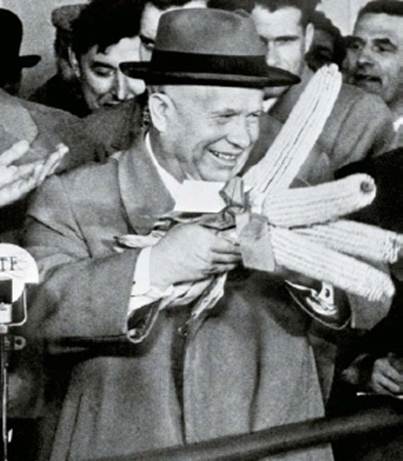
Nikita Khrushchev
A Ukrainian peasant by origin, Khrushchev was impulsive, rotund, by turns vindictive and charming. During a UN meeting in New York in October 1960, Khrushchev famously protested against the proceedings by banging his shoe against his desk. But his ‘different roads to socialism’ meant a very different type of leadership to that of his predecessor.
In February 1956, at the Soviet Twentieth Party Congress, in front of a gathering of the Kremlin hierarchy, Khrushchev delivered a six-hour speech in which he denounced Stalin’s reign and his cult of personality whilst promising a degree of autonomy to the countries of the Eastern Bloc.
Khrushchev loved to travel. In September 1959, he visited the USA, and on a tour of the country, was impressed and intimidated in equal measure. Two months earlier, in an exchange with the US Vice President, Richard Nixon, Khrushchev said, ‘We [the Soviet Union] have existed not quite forty-two years but in another seven years we will be on the same level as America. When we will catch you up, and in passing you by, we will wave to you.’
The Soviet Union’s relations with China fared little better during Khrushchev’s term in power. Chairman Mao viewed with growing disdain what he saw as the Soviet Union’s coexistence with America. Khrushchev’s withdrawal of missiles from Cuba was, to Mao, further evidence of his weakness.
Khrushchev dealt brusquely with the 1953 uprisings, first in Poland, then in Hungary; and in 1962 brought the world to the brink of nuclear war during the Cuban Missile Crisis.
Domestically, Khrushchev’s attempts at introducing new initiatives, such as harvesting grain in Central Asia, backfired despite some initial success, leaving whole tracts of land useless.
In 1964, Khrushchev was disposed and immediately sidelined. Depressed and isolated, Khrushchev dictated his memoirs, which, although denounced by the Soviet Union, were published to much acclaim in the West. He died in 1971 but was denied a state funeral and a place of honour in the Kremlin Wall. His death was announced by Pravda with a single sentence.
John Fitzgerald Kennedy 1917–63
John Fitzgerald Kennedy graduated from college with the ‘Most Likely to Succeed’ prize. An energetic child and fond of practical jokes, Kennedy was nonetheless beset with ill health from an early age.

John Fitzgerald Kennedy, 1962
Cecil Stoughton, White House
The son of the US ambassador to the UK, Kennedy was well travelled and was in London the day Germany invaded Poland, thus triggering the Second World War. Kennedy wrote a book about Britain’s policy regarding Hitler, Why England Slept, which became a bestseller.
Rejected by the US army because of his back pain, an ailment that would haunt him his whole life, Kennedy joined the navy in 1941, becoming an intelligence officer, and was later promoted to lieutenant in the Motor Torpedo Boat Squadron.
In August 1943, patrolling near the Solomon Islands in the South Pacific, Kennedy’s boat was hit by a Japanese destroyer. Two of his men were killed outright but Kennedy and the six surviving crew members clung to the wreckage of the boat. Kennedy managed to get his men to safety, for which he earned a medal and high praise.
His older brother, Joseph Junior, was killed during the war in 1944.
In 1952, Kennedy was elected to the US Senate but his rise through the ranks of the Democrat Party was hampered by continuing back problems, twice needing major spinal surgery. On one occasion, he become so ill, Kennedy received his last rites. In 1956, whilst recovering from surgery, Kennedy wrote a biographical book about US senators, a publication that won him the 1957 Pulitzer Prize for Biography.
Aged forty-three, Kennedy became the youngest elected US president, when in November 1960 he defeated the future president, Richard Nixon, by a mere 0.3 per cent. He was also the first Roman Catholic to hold the post. Popular and respected, his youth symbolized a new, bright beginning within the free world.
However, in April 1961, a US-backed invasion of Cuba at the Bay of Pigs failed to raise a counter-uprising against the newly installed Marxist regime of Fidel Castro. Kennedy was heavily criticized but held his nerve during the subsequent Cuban Missile Crisis of 1962.
On 22 November 1963, whilst on the campaign trail in Dallas, Kennedy was assassinated.
Richard Nixon 1913–1994
As a Republican congressman, Richard Milhous Nixon made his name during the 1950s McCarthy era of communist witch-hunts, particularly in his rigorous prosecution of Alger Hiss, a high-ranking State Department official accused of passing information to the Soviets.

Richard Nixon, 1973
White House
From 1953 to 1961 Nixon served as Dwight D. Eisenhower’s vice-president, but allegations of financial irregularity almost finished his career and Nixon had to defend himself on television. At the time this was seen as a revolutionary use of this new medium. He survived and, in 1960, stood for president, narrowly losing to John F. Kennedy.
Failure two years later in his bid for governor of California marked the low point of Nixon’s pre-presidential career. However, in November 1968, Nixon re-emerged and stood again for president, promising to ‘bring us together’, and pledging the withdrawal of troops from Vietnam. This time he was successful and, true to his promise, he gradually handed back the organization of the day-to-day military operations to the South Vietnamese in what he called a policy of ‘Vietnamization’. Following the Paris Accords of January 1973, the last American soldiers left Vietnam by the end of March.
Nixon advanced the Cold War period of détente, an acknowledgement of the differences between the East and the West and an attempt to make the world a more secure place. He exchanged visits with both China and the Soviet Union and oversaw the SALT agreements (Strategic Arms Limitation Talks).
Nixon was re-elected in 1972 in one of the largest landslide victories in US history. Within two years however, a failed burglary on the Democratic Party’s HQ in the Watergate buildings in Washington DC started the process that would lead to Nixon’s downfall. His attempts to conceal his involvement and tamper with evidence only damaged him further. Claiming that he was ‘not a crook’, the Watergate prosecutor nonetheless found enough evidence to start the process of impeachment. On 8 August 1974, Nixon resigned, the only president in American history to do so.
His successor, Gerald Ford, unconditionally pardoned the disgraced ex-president. In reply, Nixon said, ‘No words can describe the depths of my regret and pain at the anguish my mistakes over Watergate have caused the nation and the presidency, a nation I so deeply love and an institution I so greatly respect.’
He died from a stroke, aged eighty-one, on 22 April 1994.
John Paul II (Karol Wojtyla) 1920–2005
Karol Wojtyla experienced at first hand the German occupation of Poland during the Second World War. During the war, he worked as a stonecutter in a limestone quarry outside Krakow, then in a chemical factory. The factory work, deemed essential by the Nazis, gave Wojtyla a work permit, which saved him from deportation. In August 1944 the Nazis initiated a round-up of able-bodied men and boys, but Wojtyla, hiding in the archbishop’s palace, managed to avoid detection.

Pope John Paul II, 1993
Wojtyla’s mother died when he was eight years old, and his older brother four years later. His father, a lieutenant in the Polish army, died in February 1941. The grieving Wojtyla kept vigil over his body the whole night. He was to say later, ‘At twenty, I had already lost all the people I loved.’
Wojtyla was ordained as a priest in 1946 and appointed Archbishop of Krakow in 1967, often criticizing the communist regime of Poland. He was made a cardinal three years later and in 1978, following the death of Pope John Paul I, Wojtyla was elected pope as John Paul II, the first non-Italian to hold the post since 1522.
Known as the Travelling Pope, the energetic John Paul visited 129 countries during his pontificate, touring cities in his famous Popemobile. On his first visit home as pope, in June 1979, the he fell to his feet and kissed the ground at Warsaw Airport.
On 13 May 1981, the pope survived an assassination attempt as he entered St Peter’s Square in Rome. He recovered and during Christmas 1983 visited his would-be assassin in prison. Rumours persisted that the Soviet Union, threatened by the pope’s support for Solidarity, was behind the attempt.
In his latter years, John Paul suffered from Parkinson’s disease and he died on 2 April 2005. He had served for twenty-six years, the third longest pontificate in history. His funeral attracted the largest ever crowd for a funeral and the greatest number of heads of state in history, including nine monarchs and over seventy presidents. Mikhail Gorbachev said of Pope John Paul II, ‘The collapse of the Iron Curtain would have been impossible without him’.
Pope John Paul II was beatified on 1 May 2011.
Ronald Reagan 1911–2004
Ronald Reagan worked as a baseball commentator before joining the US army reserve in 1937 as a second lieutenant. Whilst in the army, Reagan also started his film career, in which he became a successful B-movie actor, appearing in over twenty-five largely forgettable films during a period of twenty-five years up to 1964.

Ronald Reagan, 1984
During the Second World War, Reagan’s two careers coincided. His poor eyesight prevented him from seeing active service, so instead he was employed in numerous army training films.
In 1940, Reagan married the actress Jane Wyman, but the marriage ended and he remains the only US president to have divorced. He remarried in 1952, this time to Nancy Davis.
Following the war and his discharge from the army, Reagan entered politics as a Democrat and a supporter of Harry S. Truman before changing his allegiance to the Republicans. In 1966, he was elected to serve as governor of California, a post he held for eight years.
In 1980, on the third time of trying, Reagan was nominated the Republican presidential candidate and won the subsequent election, becoming the fortieth US president and, a few days short of his seventieth birthday, the oldest president in America’s history.
In 1983 Reagan predicted: ‘Communism is another sad, bizarre chapter in human history whose last pages even now are being written,’ and that the ‘forward march of freedom and democracy will leave Marxism-Leninism on the ash heap of history.’ The ‘Reagan Doctrine’ provided support for anti-communist fighters throughout the world. In 1979 the Soviet Union invaded Afghanistan and Reagan provided the Mujahideen, fighting the Soviets, with cash, arms and training.
Reagan met several times with Soviet leader Mikhail Gorbachev and between them they ushered in a new period of rapprochement and greater understanding, which led, ultimately, to the ending of the Cold War.
In 1994, Reagan announced that he was suffering from Alzheimer’s disease. He died ten years later, aged ninety-three, on 5 June 2004.
Mikhail Gorbachev 1931–
Mikhail Gorbachev’s grandfather, a Communist Party member, was caught up in Stalin’s purges during the 1930s and, having been arrested by the NKVD, was tortured and imprisoned. But his grandfather never lost faith with the communist cause and introduced the young Gorbachev to the writings of Marx and Lenin.

Mikhail Gorbachev, 1987
White House
During the Second World War, the family village was occupied by the invading Germans and Gorbachev later described the experience of war on his generation: ‘It has burned us, leaving its mark both on our characters and in our view of the world.’
Gorbachev studied law and on graduation, joined the Komsomol (the Communist Youth Organization). Over the next three decades he rose through the ranks of the party, sponsored by his mentor, Yuri Andropov.
Andropov succeeded Leonid Brezhnev as first secretary of the party in 1982 and Gorbachev was tipped to be his successor. But on Andropov’s death in February 1984, the post fell, not to Gorbachev, but to the ageing Konstantin Chernenko. However, Gorbachev spread his influence so when Chernenko died after only thirteen months as leader the post finally fell to him. Aged fifty-four, Gorbachev was the youngest first secretary in Soviet history, and the first to be born after the Russian Revolution of 1917.
His youth and progressive ideas alarmed the communist hardliners, whose fears were confirmed when Gorbachev ushered in a reformist programme, and introduced into the political lexicon the words perestroika (reconstruction) and glasnost (openness). The Soviet system’s inept handling of the Chernobyl crisis highlighted the need for reform.
Immediately on coming to power, Gorbachev was proposing a reduction in the number of nuclear arms held between the superpowers. In November 1985, Gorbachev met US president Ronald Reagan for the first time. Reagan, who had referred to the Soviet Union as the ‘evil empire’, was impressed by the new man in the Kremlin.
As general secretary, Gorbachev inherited the problem of Afghanistan where his predecessors had become embroiled in a lengthy war. Gorbachev hoped for a speedy conclusion to the conflict by committing greater number of troops. Although initially successful, Soviet forces were unable to maintain the momentum. The human cost was unacceptable to public opinion in the Soviet Union and ultimately Gorbachev had to agree, calling Afghanistan a ‘bleeding wound’. The last Soviet troops withdrew on 15 February 1989.
Gorbachev will be remembered for his role during the Cold War. Through their several meetings, Reagan and Gorbachev helped ease international tension and, despite their ideological and cultural differences, the two men built a rapport that was to have a real and lasting effect on the ending of the Cold War.