
Kiwis, Aussies, Springboks, Canucks, and many others; they could have waited, enjoyed the peace of their own lands for a little longer—but they did not. A lode-star has drawn them; Britain standing alone / Clear in the darkness, not to be overcome, Though the huge masses of hate are hurled against her, / Wherever the spirit of freedom breathes, is Home.
—from Airmen From Overseas by Laurence Binyon
Towards 4:35 p.m. on Friday 30 August, one pilot’s role-reversal, on a routine training flight, marked a turning point in the Battle of Britain. At 10,000 feet, north of the tiny cathedral city of St Albans, in Hertfordshire, the twenty-three Poles of No. 303 (Kosciuszko) Squadron, their Hurricane fuselages distinguished by small red and white checkerboards, were set to rendezvous with six Blenheims and execute dummy attacks on them. For Squadron Leader Zdzislaw Krasnodebski’s pilots, all of whom had undergone two years training and clocked up 500 flying hours, it was an assignment they viewed the profound-est contempt.
Just then Flying Officer Ludwig Paszkiewicz, a very shy and unassuming boy, saw a Hurricane much like his own aircraft, plunging downwards towards a smoking cluster of rooftops. A thousand feet above the squadron, to port, he saw that German bombers, as many ME109s and a scatter of British fighters, were caught up in a frenzied dogfight. But although Paszkiewicz alerted 303’s joint commander, Squadron Leader Ronald Kellett, “Hullo, Apany Leader, bandits ten o’clock,” Kellett seemed not to have heard. So, pressing the emergency control which sent his supercharger to a maximum of twelve boosts, Paszkiewicz streaked for the fray.
Kellett, a florid, chunkily-built peacetime stockbroker had, in fact, heard clearly; his grunted response was no more than, “If you want to be a hero, be one.” As of 30 August, the squadron’s status, because of well-nigh insuperable language barriers, was strictly non-operational.
But Paszkiewicz recognised no such constraints. Ahead of him, a strange plane was banking in a steep dive; as he followed in a half-roll, he glimpsed the black cross marking the wing of a slim pencil-shaped Dornier. From 100 yards dead astern Paszkiewicz fired—303’s very first symbolic burst in the Battle of Britain—and kept firing until the bomber’s starboard engine gouted flame. Abruptly, one prescient crewman baled out before the Dornier powerdived towards the earth.
And that evening, impressed despite himself, Kellett phoned Headquarters, Fighter Command, urging, “Under the circumstances, I do think we might call them operational.” Accordingly, next day, 31 August, 303 was at last made part of the Battle.
This was ironic, for among almost 600 Allied pilots who fought alongside the British throughout the Battle, few were more seasoned in the air warfare than the Poles. Yet most British commanders had known grave initial doubts as to the wisdom of all-Polish squadrons, and no one more so than Air Chief Marshal Sir Hugh Dowding. “But my doubts were laid to rest,” Dowding conceded later, “because all three squadrons (besides 303, 302 Polish Squadron and 310 Czech Squadron were operational from 20 August and 26 August respectively) swung into the fight with a dash and enthusiasm which is beyond praise.” For could they, many had at first wondered, preserve their fighting spirit after the disastrous campaigns in Poland and France? As Winnepeg-born Flight Lieutenant Johnny Kent summed up his reaction to an appointment as a 303 flight commander: “That really gave me the screamers! All I knew about the Polish Air Force was that it had been shot out of the sky in two days flat.”

Flying Officer Alan C. Deere, a New Zealander whio flew with No. 54 Squadron, Hornchurch in the Battle of Britain.

Some of the Polish pilots who flew Spitfires in the Battle.

Flight Lieutenant A.G. Malan of No. 74 Squadron in the Battle of Britain.
The overriding problem had been that of language. Although the Poles were fluent in French, English was an unknown quantity. Flying Office Mirslaw Feric knew the words of Roll Out The Barrel and It’s A Long Way To Tipperary through the coaching of a helpful girl on Blackpool Promenade. Squadron Leader Krasnodebski knew, “Four whiskies,” though this was an order which pertained whether four Poles or eight were present. In the Battle of France, whither they had drifted through the Balkans and Italy, “as leaves driven by the wind or a ship’s wreckage drifting with the tide,” they had scored notable victories in such obsolete planes as Moranes and Dewoitines, but few had ever flown planes with retractable undercarriages. Prone to open the throttle by pulling it back instead of pushing it forward, they promptly wrote off a number of Hurricanes with undercarriages retracted.
Virtually grounded for two months following their arrival in England in June, the Poles had listened bitterly as the Station Commander of their base at Northolt airfield, Group Captain Stanley Vincent, time and again told them forthrightly, “You can’t go up until you can understand the Controller perfectly—we can’t have people crashing all over the sky.”
Yet as Kellett was the first to admit, from 31 August onward, 303 were ‘really doing the work of two squadrons,” and this in a month when pilot wastage was approaching 120 men a week. In six weeks of non-stop combat, with 126 Luftwaffe planes destroyed against a loss of eight pilots, 303 would justify to the hilt the tribute of The New York Times war correspondent Dorothy Thompson when she wrote, “Poles are pure courage.”
Quite understandably, Group Captain Vincent grew deeply suspicious: the Poles’ claims of Luftwaffe planes written off surpassed all 11 Group’s known totals. When Northolt’s Intelligence Officer complained, in despair, that every pilot corroborated the other, Vincent, a World War One Royal Flying Corps veteran, determined to check for himself.
What Vincent saw, at 21,000 feet over Thameshaven, astern of the Poles and 1,000 feet below them, was a spectacle that he was to recall with awe a quarter of a century later. He saw Poles crash-diving into space with near-suicidal impact, and a mighty horde of glinting Dorniers breaking formation like dolphins fleeing before a shark. Pole after Pole was holding his fire until twenty yards distant, accepting with grim equanimity the risk that the last great explosion would equally claim his own life. Planes and parachutes were fluttering like charred paper across the sky, yet even in this mass slaughter Poles were angrily nosing Vincent’s Hurricane aside, grudging him so much as a shot.
“My God, they are doing it,” the flabbergasted Vincent told Northolt’ Intelligence Officer that day, “It isn’t just imagination.”
As Johnny Kent was to record ruefully: The Poles were playing the game for keeps far more than we were.”
Even the light-hearted ambiance of a British squadron failed to soften the Poles’ implacable enmity At. Warmwell airfield, Dorset, the ranks of No. 609 Spitfire Squadron were from the first stiffened by two Poles, Flying Officers Tadeusz Nowierski and Piotr Ostaszewski. “Their hatred of the Germans was quieter and more deadly than I have ever seen before,” wrote Flight Lieutenant David Crook, a flight commander, and in time every 609 survivor would bear this out. Flying Officer Jimmie Baraldi recalled how both men would lie for hours on their bunks at dispersal, strengthening their long-distance vision by watching flies creep up the wall. Their commander, Squadron Leader Horace Darley, who kept open house for all the pilots in a cottage by the airfield perimeter, remembered a party when one British pilot, attempting a barrel roll over a sofa, caught his head an agonising crack. “Nowi and Osti were pretty blood-thirsty,” Darley summed up, “That was the first time they ever laughed.”
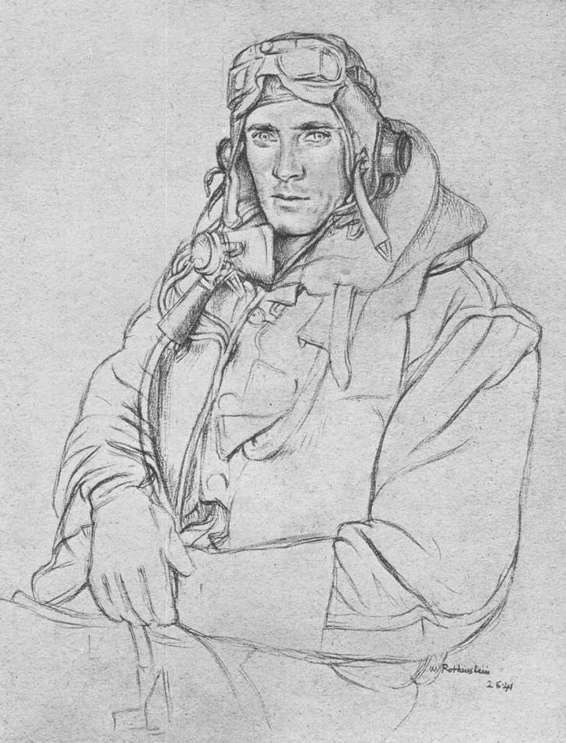
Flight Lieutenant J. A. Kent of Nos. 303 and 92 Squadrons in the Battle.
At Duxford airfield, Cambridgeshire, forty miles north of London, Squadron Leader Douglas Blackwood had faced identical problems to Kellett’s. As commander of No. 310 (Czech) Squadron, Blackwood, in peacetime an Edinburgh publisher, had charge of thirty-six Czech pilots who had travelled a similar rough road, via the Balkans and France, to that of the Poles. Save for their interpreter Flying Officer Cesek, no man among them was versed in either English or French. Yet from 18 June onwards, when the first contingent of Czechs emerged from a heavy bomber in southern England, they took infinite pains to demonstrate their willingness. When the contractor assembling their hutted camp at Duxford bemoaned the shortage of hands, 310, under Squadron Leader Sasha Hess, weighed in as builder’s labourers—donating the ten pounds in wages to the Czechoslovak Red Cross in London.
Whatever they lacked, it was not belly-fire. On 26 August, their first operational flight, 310 dispensed with the vexatious business of taxiing round the airfield and took off riskily downwind—a manoeuvre that won them an extra two minutes of precious combat time. Returning to base with all their ammunition spent, they had already accounted for two Dornier 215s and one Messerschmitt 110 twin-engined fighter.
As determined as the Poles never to lose face before their RAF hosts, the Czechs had a summary way with any who let down the side. On one occasion, a Czech non-com, in an abortive take-off, tipped a Hurricane clumsily on its nose. Immediately Squadron Leader Hess led the man summarily behind a hangar, prompting Blackwood to intervene. Fisticuffs between officers and men, he stressed, was strictly forbidden in the RAF. “Fists?,” echoed Hess, appalled by such a plebeian suggestion, “I shoot him!”
By chance, the Battle’s top-scoring Czech pilot served not with 310 but as a lone wolf among the Poles of 303: Sergeant Josef Frantisek, a stocky impressive youngster with beetling eyebrows, who had nurtured a deadly hatred for the Germans for almost two years. A regular in the Czech Air Force, Frantisek’s last act above his native soil was to strafe the German troops annexing the Republic in 1939 before flying on to Poland. Phlegmatically accepting a drop in rank from Lieutenant to Corporal, Frantisek was to serve as an air observer with the Poles until September, 1939. In that three-week war, airborne in an ancient PZL fighter, he shot down three German aircraft before escaping through Rumania and Syria to France.
Few other Allied pilots—whether New Zealanders, Irishmen, Canadians, Australians or South Africans—knew any such corroding emotions. The one factor that most had in common was a burning ambition, often nourished since their teens, to fly and keep on flying. A case in point was the New Zealander Colin Flakland Gray, born in Papanui, Christchurch, in 1914, whose whole life was changed, while still at school, by an RAF recruiting talk. Told to report for a medical examination in Wellington while still groggy with flu, Gray still made the 300-mile journey in an old car, only to be turned down on grounds of nervous instability. Still convinced that flying was his life, Gray settled for a farm hand’s life for almost twelve months, milking cows and mustering sheep in the open air. This single-minded determination paid off, and by 1939 he had arrived in England to join the Royal Air Force.

Polish airmen flying from England in 1940, as depicted by Felix Topolski.
Francis Victor Beamish, a tough, trigger-tempered Northern Irishman, had a near identical case history. Graduating through Cranwell and serving with the peacetime RAF, Beamish abruptly went down with tuberculosis and was invalided from the service. As undeterred as Gray, he emigrated to Canada, went to work as a lumberjack and was cured within the year. Six months before the Battle of Britain, Beamish, back in the RAF and promoted to Wing Commander, was given the command of North Weald airfield. Although then thirty-seven and essentially an indifferent shot, Beamish would still leap clean through his open office window rather than miss a scramble—and was credited with six “kills” before the Battle ended.
Much the same gung-ho spirit infused Gray’s best friend and fellow New Zealander, Flight Lieutenant Al Deere. A rugged twenty-two-year-old from Wanganui, with a cheery grin and a broken nose, a legacy of his prowess as the RAF middle-weight champion, Deere’s appetite for danger was as legendary as his hunger for solid protein. Always the first to the breakfast table at Hornchurch mess, ready to wolf the fried eggs of any pilots feeling off-colour, Deere’s ebullient cry, as the first bomber sweep approached Hornchurch, was long treasured by Squadron Leader Ronald Adam, one of the four Sector Controllers: “Ho! Tally Ho! Here they come—fucking hordes of them!”
From his teens, Deere, like Gray, had envisaged no other life but flying, and following his application for an RAF short-service commission, his examiners seemingly found his enthusiasm infectious; one of the first twelve accepted from 2,000 applicants he, too, was soon on his way to England. Enthusiasm was equally a marked feature of Deere’s first solo flight in a Gypsy Moth. In his eagerness to take-off, land and take-off again, he three times floored his furious instructor with his slip-stream.
This was of a piece with Deere’s impetuous progress throughout the Battle, although Deere insisted that there was no finite Battle of Britain period—“Dunkirk … the Battle of Britain … to me it was one thing.” Already, in the third week of May, he had shot down his third ME109 before making a pancake landing in his Spitfire, “Kiwi”, on the beaches of Dunkirk. It was only the first of a succession of “Kiwis”: with good reason Deere was to entitle his best-selling 1959 memoirs Nine Lives. All told, Al Deere was destined to make four crash-landings in ten weeks.
His first ‘life’ was in jeopardy as early as 9 July, when Deere led a section of Spitfires in to attack two groups of Messerschmitts a reconnaissance seaplane near Dover As a 109 headed straight at him, both Deere and the German pilot were firing simultaneously, neither giving ground; with devastating impact, the aircraft collided. Unable to bale out, since the 109 had caught his propeller and hood, Deere, his engine stopped, half blinded and choked by glycol fumes, somehow headed inland, ploughed through a cat’s cradle of anti-invasion poles, finally juddering to a halt in a cornfield where his plane caught fire. Next day, though sore with minor burns and abrasions, Deere was on patrol again.
On 15 August, Deere was once more in dire straights—this time, as reckless as the Poles of 303, tangling with seven ME 109s over Calais-Marck airfield. “My instrument panel was shattered, my eye was bleeding from splinters, my watch had been shot clean off my wrist by an incendiary bullet,” he reported later, “and it seemed only a matter of minutes before the end.” Miraculously his Spitfire limped back across the Channel, then, close to Folkstone and now down to 800 feet, his Merlin engine erupted in flames. Nursing the Spitfire to 1,500 feet, Deere turned the aircraft on its back and plunged from the cockpit, only to be blown alongside the fuselage, fracturing his wrist on the tailplane. With a sudden jolt, the parachute opened and Deere landed ‘with a mighty thud’ in a plantation of thick shrubs.
In time, a passing ambulance took him to East Grinstead Hospital, the nearest to the scene, and its chief, Archibald McIndoe, the famous plastic surgeon and a fellow New Zealander rang Wing Commander Bouchier the Hornchurch station commander, to announce that Deere had arrived safely. With a wholly-comprehensible mixture of relief and anger, Bouchier roared, “Well, keep the little bugger there—he’s costing us too many Spitfires.”
Along with many commonwealth pilots, Deere was becoming increasingly conscious of the overwhelming odds they faced. On 24 August, he complained bitterly of “being unable to get a decent bead because of constant attacks from behind.” And in that same engagement, Colin Gray, harried by a dozen Messerschmitts, confessed “being rather outnumbered I found it difficult to get in a burst.” On 2 September alone, Gray was involved in five sorties; one day earlier he had landed at Hornchurch with his elevator control wire totally severed by a cannon shell, yet such was the pressure of combat that one hour later, with the Spitfire repaired by a ground crew working flat out, Gray was once again airborne in combat. When Churchill paid his immortal tribute to The Few, Al Deere had but one heartfelt comment: “By Christ, he can say that again. There aren’t many of us left.”

Flight Lieutenant J.C.F. Hayter of No. 605 Squadron.
Thus, as the Battle wore on, more and more Allied pilots became increasingly analytical. This was in marked contrast to the devil-may-care attitudes of the aces of the Battle of France, men like the Australian Leslie Clisby, who first shot down a Heinkel 111, then landed to rugger-tackle an escaping crewman, or the New Zealander Edgar James ‘Cobber’ Kain, to his credit yet who, in a fit of bravado, fatally flick-rolled his Hurricane into a crash at Echmines. But from August on, the name of the game was survival. If death was an ever-present familiar, how could the pilots contrive to cheat him?
Of the twenty-three South Africans engaged in the Battle, the supreme analyst of tactics, the past master of survival, was thirty-year-old Flight Lieutenant Adolph Gysbert Malan, known inevitably, after service as a Third Officer with the Union Castle Steamship Line, as ‘Sailor’. ‘Sailor’ was incomparably the greatest,” Wing Commander Bouchier was to avow later, for few but Sailor, commanding 74 Squadron at Hornchurch, would have taken pains to compute that a Spitfire’s four Browning machine-guns, blasting 1,260 rounds a minute, possessed a firepower equivalent to a five-ton truck hitting a brick wall at sixty miles an hour. In that era, when the slow-paced and poorly-armed Blenheims fought a losing battle against the menace of the night bomber, it took a Sailor Malan, airborne on the night of 18 June during a raid on Southend, to single out two Heinkels trapped by searchlight beams and put paid to both of them in ten minutes flat.
A man as modest as Al Deere—on trips to London, both men were prone to leave their DFCs behind on the dressing table—Sailor once astounded the war correspondent, Quentin Reynolds, by confessing that he had never in his life read a book. “You see, I have no imagination,” he admitted frankly, “If I had any imagination I’d have been dead by now.” Yet after 21 August, when 74 Squadron took a three-week break at Kirton-in-Lindsey, Sailor surprisingly emerged as the author of one of the most cogent documents the Battle of Britain was to produce Ten of My Rules For Air Fighting, later famous as a poster pasted up in many Fighter Command and U.S. Army Air Force fighter station dispersal huts.
Most pilots from the western hemisphere—eighty-seven Canadians and nine Americans—knew a lesser emotional involvement. Squadron Leader Aeneas McDonnell, who commanded 64 Squadron at Kenley recalled Flying Officer Art Donahue, a likeable Minnesota farm-boy, who had built up his expertise barnstorming as a stunt flier in the Depression, as possessing ‘almost the detachment of a war correspondent.’ The way that many felt was summed up by the light-hearted aphorism of Pilot Officer Red Tobin, a six-foot redhead from Los Angeles, recruited to 609 Squadron: “Ah, hell, we had a million laughs.”
Even in late August, at least one squadron had seen no fighting whatsoever. No 1 Squadron, Royal Canadian Air Force, commanded by Squadron Leader Ernest McNab, stationed alongside the seething Poles at Northolt airfield. A task force of wealthy Canadian dilettantes, they boasted a 1911 Rolls Royce and a liveried chauffer, Sebastian, but their vainglorious offer to furnish their own squadron of Hurricanes had misfired woefully. When Dowding learned that the planes, still on the high seas, possessed no armour plating and did not have Rotol propellers, he quietly earmarked them for an operational training unit.
It was the bleakest misfortune that on the afternoon of 24 August, the squadron, which had fired at a moving target in the air only once, should have been ordered to intercept a force of German bombers bound to hit Tangmere Sector Station. At the same time, three slow-paced Blenheims of Coastal Command based at RAF Thorney Island were ordered up on the same mission. Few of the Canadians had ever seen a Blenheim; their sole aircraft recognition training had been an instructor’s hasty shuffling through a pile of silhouettes.

Flight Lieutenant R.W. Bungey, an Australian who flew with No. 145 Squadron in the Battle.
Thus, when McNab first spotted the Blenheims, 6,000 feet north and east of Thorney Island, he first mistook them for Junkers 88s, although ack-ack puffs and blinding sunlight did not make for easy identification. To his section of three, McNab first ordered “Echelon, starboard—go!” and they dived, at 300 mph, faster and faster, too fast for all to hear McNab’s next electrifying order, “Break, break, break. Don’t attack!” For just in time, McNab had seen the gun turrets which Junkers 88s lacked, and the white flash on the aircrafts’ fins that marked them as British. He and his section broke to port and did not attack. But the following planes, seeing what appeared to be long yellow spears of tracer opened fire—not realising that the gunners were firing the colours of the day, yellow and red Very pistol flares, that spelt out the recognition signal.
Two of the Blenheims, though badly shot up, escaped by crash-landing on Thorney Island, but the third, its starboard engine blazing like a petrol-soaked brand, vanished beneath the waters of Bracklesham Bay, east of Thorney. It was Group Captain Stanley Vincent who gently broke the news to the appalled Squadron Leader McNab, explaining compassionately, “There’s nothing you can do, these things happen in war—the one thing you must do is to fly down and see them and explain.”
From this moment on, the Canadians ached to redeem themselves—and that chance at length came over Biggin Hill at 2:30 p.m. on Sunday 15 September. Swooping like angry falcons on a formation of twenty Heinkels, eleven Hurricanes between them cut them to ribbons, and one Canadian, Flying Officer Phil Lockman, of Ottowa, belly-landing his Hurricane beside one of the bombers, personally escorted the crew from the aircraft—one of the few fighter pilots ever to take a prisoner.
Long afterwards, at the Nuremberg Trials, witnesses like Field Marshal Gerd von Rundstedt offered many alibis for the German defeat: the decision to delay the invasion of England until 1942, the sentimental bias of a Führer who had no desire to annihilate Britain. As always, Churchill had the last word. Speaking not only for the RAF but for almost 600 Allied pilots, his verdict was final: “They met better men on better planes.”
All the squadrons that had Polish pilots posted to them formed an equally high opinion of them, and the feats of the Polish Squadron, who in five days fighting over London destroyed at least forty-four German machines, as well as probably destroying many more, must rank as one of the best shows of the whole summer. Such indomitable courage and determination cannot go unrewarded, and when this war is won we must see that Poland is again restored to her former liberty and freedom, which her sons fought so valiantly to maintain.
—Flight Lieutenant D.M. Crook
My country is the world, and my religion is to do good.
—from Rights of Man by Thomas Paine