
CHAPTER 10

AUSTRALIAN TROOPS ADVANCE TOWARDS ENEMY
LINES AS DAWN BREAKS OVER THE DESERT. GENERAL
LESLIE MORSHEAD OF THE AUSTRALIAN 9TH ARMY
ANNOUNCED TO HIS MEN BEFORE THE DEFENCE OF
TOBRUK: ‘THERE’LL BE NO DUNKIRK HERE.’
ROMMEL
The war fought for North Africa between 1941 and 1943 was a conflict no one had ever planned to undertake. Yet, before it was finished, it would turn into a campaign neither side could afford to lose. What began as a minor territorial dispute between the British and Italian empires in Africa eventually dragged into combat hundreds of thousands of tanks, guns and men from countries as far apart as Poland, India, New Zealand, Australia and South Africa, as well as France, Italy, Britain and the USA.
Adolf Hitler was not, at first, particularly interested in a North African war, but partly because of the hero status acquired by his commander in the area, General Erwin Rommel, even he was forced to commit Germany to the fighting. The Desert War, where the battleground was large, featureless wastes of rock and sand, had its own character and its own rules, and made unique demands on the men who fought it.
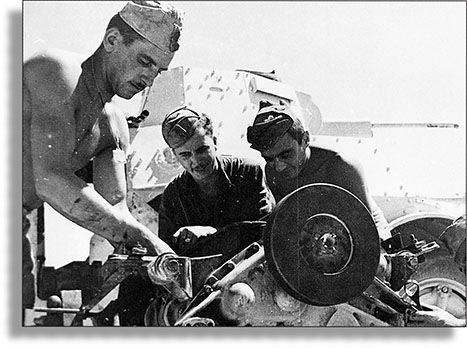
BRITISH TROOPS GET TO GRIPS WITH A TANK IN THE WORKSHOP IN PREPARATION FOR THE DEFENCE OF TOBRUK.

FRESH BRITISH TROOPS ARRIVE AT ALEXANDRIA IN 1940. DESPITE THEIR EARLY SUCCESS AGAINST THE ITALIANS, THEY WERE SOON TO FACE A MUCH TOUGHER FOE.
When General Rommel arrived in North Africa with two German armoured divisions on 9 February 1941, his orders were simply to sustain the Italian Army. The Italians had already proved incompetent in Greece and Albania in 1940, and had been kicked out of Egypt by the British eight weeks before. They were, in fact, in danger of being forced out of Africa altogether. Weighing up the situation, Rommel almost immediately decided that attack was the best form of defence and on 31 March 1941 he launched an offensive on the British positions facing him without even waiting until his Afrika Korps was up to strength. The British, seriously depleted by the recent Greek campaign, were both overstretched and unprepared for the speed and ferocity of Rommel’s attack. His men swept through the British lines in days, capturing the British Commander General O’Connor and pushing the enemy out of Italian Cyrenaica and eastwards towards Egypt. Rommel was held up only by the courage of the 9th Australian division, whose leader, General Leslie Morshead, announced to his men as they prepared to defend the port of Tobruk in Libya: ‘There’ll be no Dunkirk here.’
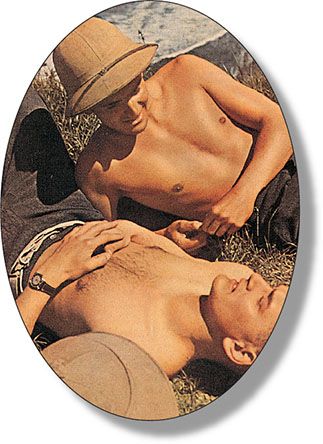
THE HARSH CONDITIONS OF LIFE IN THE NORTH AFRICAN DESERT LED TO A RELAXATION OF NORMAL MILITARY RULES FOR THE MEN WHO FOUGHT THERE.

EXHAUSTED ARMY GUNNERS GRAB SOME MUCH-NEEDED REST IN THEIR DUGOUT. THEIR NUMBERS ALREADY DEPLETED BY THE DISASTROUS CAMPAIGN IN GREECE, THEY HAD LITTLE HEAVY EQUIPMENT OR AMMUNITION WITH WHICH TO COUNTER THE GERMAN THREAT.
The speed of Rommel’s advance took both sides by surprise. Originally ordered to carry out nothing more than a ‘blocking action’, he was now in a position to attempt an advance on Egypt and the vital Suez Canal, an indispensable lifeline, without which British supply routes to the Middle East and India would be severed, and Britain might be starved out of the war. The British fleet at Alexandria would be crippled, leaving Axis troops free to march across the Middle East and attack the Soviet Union from the south. In order to stop this happening, the British had to be reinforced and reorganised, and it had to be done fast.
First, General Archibald Wavell, Commander-in-Chief of the British forces in the area, was replaced by General Claude Auchinleck. This was perhaps unfair. Wavell had warned against weakening his forces by sending men to Greece just when they were starting to get the better of the Italians. It was obvious, too, that the Germans would be considerably harder to beat. Auchinleck had at his disposal British, Indian, Australian, New Zealand and South African divisions, which he reorganised into a single 8th Army. But they were still poorly equipped. A huge offensive, Operation Battleaxe, was launched in June 1941 to relieve the siege of Tobruk, which had begun two months earlier, but here 200 new British tanks met disaster. Rommel had made his name as a panzer tank commander in France, and his highly trained and mobile fighting force had proved themselves perfectly suited to war in the desert. The British, by contrast, were still beginners in these stakes. Not only were the German panzer Mark IV tanks tougher than anything the British had, but they were supported by the huge 88mm anti-tank guns. At Tobruk, half the British tanks were destroyed in a single day, and Battleaxe was called off.

DESPITE BEING ASKED TO FIGHT A CAMPAIGN FOR WHICH HITLER HAD NEVER PLANNED, THE MEN OF THE AFRIKA KORPS ENJOYED A SERIES OF SPECTACULAR SUCCESSES IN THE EARLY DAYS OF THE NORTH AFRICAN CAMPAIGN.

A GERMAN SOLDIER SURVEYS THE VAST WASTES OF EMPTY SAND THAT WERE TO MAKE UP THE DESERT BATTLEGROUND. IN SUCH CONDITIONS, SUPPLIES OF FOOD AND FRESH WATER WERE TO BECOME VITAL.
It was not until November 1941 that Auchinleck was ready to move again. He had planned his next move carefully, and this time, the siege of Tobruk was successfully raised by Operation Crusader, which also retrieved Cyrenaica from the Italians. In addition, the Libyan town of Benghazi was retaken on Christmas Eve, 1941, and the Afrika Korps was forced to retreat after five days of fighting. Though these locations would be contested again, both these victories had as much to do with the state of British and Axis supply lines as with military prowess, and for the next two years, the issue of supplies would dominate the North African campaign.
No army can operate without food, fuel and ammunition, and the Desert War was characterised by shortages of all three. Rommel’s troops could be supplied only by convoy across the Mediterranean, and the RAF and Royal Navy were doing their utmost to ensure they did not get through. An Afrika Korps counter-attack on Benghazi, a valuable petrol and ammunition dump, failed due to lack of tank fuel – a telling illustration of how high the stakes were for both sides. Tobruk, though strategically worthless, was stocked full of food and supplies. When Rommel eventually captured the town on 21 June 1942, the surrender of 35,000 men paled beside German joy at finding thousands of tins of fruit, potatoes, cigarettes and canned beer.
Between January and May 1942, as Rommel sought to secure his supply lines, the British attempted to consolidate their position along the Gazala Line, which ran from the coastal plain up the Libyan escarpment. The British troops were becoming accustomed to the day-to-day problems of life in the desert – the perennial lack of water, the extremes of temperature that meant roasting by day and freezing by night, and the depressing effect of staring out at what the soldiers called ‘miles and miles of eff all’. Uniform rules were relaxed and a uniquely casual working relationship was built up between officers and their men that, elsewhere, would have been regarded as contrary to discipline. Nevertheless, the British in the desert, nicknamed the ‘Desert Rats’, took justified pride in their abilities. They also had a great deal of respect for the skill of their opponents, and especially for the brilliance of Erwin Rommel, who became known, admiringly, as the ‘Desert Fox’. The general opinion among the Rats was that the Afrika Korps contained men of considerable honour, which was more than had ever been said of the Italians.
Tobruk, though strategically worthless, was stocked full of food and supplies. When Rommel eventually captured the town on 21 June 1942, the surrender of 35,000 men paled beside German joy at finding thousands of tins of fruit, potatoes, cigarettes and canned beer

BRITISH INFANTRY MEN ADVANCE TOWARD A KNOCKED-OUT GERMAN TANK.
AFRIKA KORPS V DESERT RATS
Throughout the Desert War, the British 8th Army and the soldiers of the Afrika Korps retained a unique respect for each other. Although in part this was due to the absence of any units of the German SS, who were responsible for atrocious crimes against soldiers and civilians alike in other theatres of war, there was also a genuine sense of chivalry between the two sides. This was reflected in the relationship between Rommel and Montgomery, who held each other in high regard. As one Desert Rat later remembered, he and his comrades felt their adversaries were ‘a fine body of men, good clean fighters and well led’.
In May 1942, Rommel was on the move again. The Free French troops, who held the southern end of the Gazala Line, managed to repulse a major attack, but when the German armour swung south, the British began to retreat. With less than 60 operational tanks at his disposal, Rommel nevertheless pressed on for Egypt. Tobruk fell again, and in Italy, with typically arrogant panache, Fascist dictator Benito Mussolini ordered a white horse to be prepared on which he planned to ride into Alexandria behind the triumphant German tanks. In Cairo, staff at British Middle East headquarters burned all their files in advance of the expected invasion, and the British fleet was moved from Alexandria to the Red Sea. It was then, on 23 October 1942, that the 8th Army mounted its make-or-break, do-or-die defence at the town of El Alamein, in northern Egypt, only 65 miles from Alexandria.

AN ANTI-AIRCRAFT CREW MAN THEIR POSITION DURING AN AIR RAID ON MALTA.
MALTA
The position of Malta in the central Mediterranean was of huge strategic importance as a base for Allied attacks on enemy supply lines to North Africa. Throughout 1940 and 1941 these raids, carried out by RAF planes and Royal Navy submarines, were so successful that 25 German U-boats were eventually recalled from the Atlantic to deal with the threat. As British successes against enemy shipping increased, Hitler decided to commit the full might of the Luftwaffe to subduing the island’s population, and from 1941 onwards, Malta came under one of the heaviest and most sustained bombing campaigns of the war, as German planes attempted to ‘neutralise’ the island as a prelude to invasion.
Conditions for the Maltese were appalling. RAF fighter pilots and anti-aircraft gunners did their best to keep the island’s vital runways open, but by the spring of 1942, Malta was under almost constant bombardment day and night. Most of the island’s 300,000 inhabitants were reduced to living in a vast network of caves under the capital city, Valletta. British convoys of food and supplies from Gibraltar, unable to get through the U-boat blockade, were suspended. Morale was kept up only by the people’s Roman Catholic faith and regular inspirational radio broadcasts from the island’s governor, Sir William Dobie. At the end of April 1942, 47 RAF Spitfires were flown in to defend the island and reopen the convoy route, but most were destroyed in a surprise Luftwaffe attack while refuelling. Another 60 Spitfires flown in to replace them only narrowly avoided the same fate.
In June 1942, two supply ships got through from Gibraltar and disaster was averted. More supplies followed in August, by which time Hitler had begun to reconsider his invasion plans. Altogether, nearly 1500 Maltese civilians had been killed during the siege, and 1000 RAF planes had been lost, but their role in the war had been crucial. By stopping supplies of ammunition, fuel and food from reaching the Germans and Italians in North Africa, Malta ensured their eventual defeat, a fact that was recognised by both sides. The entire population of Malta was awarded the George Cross, the highest civilian award for bravery, by King George VI ‘to bear witness to a heroism and devotion that will long be famous in history’. The George Cross has been an official symbol of Malta ever since
‘MONTY’
Pinned down between the Mediterranean and the vast, impassable Qattara depression, the two sides faced each other along a narrow strip of land, the only corridor into or out of Egypt. Arranged in four defensive ‘boxes’, the 8th Army held off wave after wave of German tanks for four days until Rommel, his troops exhausted and far from their supply lines, pulled back. At the same time, Winston Churchill once again shuffled his North African pack, replacing Auchinleck with General Sir Harold Alexander and appointing General Bernard Montgomery, ‘Monty’, head of the 8th Army.
Montgomery’s arrival immediately galvanised those around him. He reportedly introduced himself to one brigadier with the words: ‘Well, Freddie, you chaps seem to have been making a bit of a mess of things. Now what’s the form?’ What distinguished Montgomery most of all was his meticulous and patient approach. He was known for refusing to move unless his men had every piece of equipment it was possible to provide. He had studied Rommel’s previous successes, and was confident that he knew how to defeat the Desert Fox. Noting that ‘what Rommel liked to do was to get our armour to attack him’, Montgomery planned to do precisely the opposite. Instead of throwing British armour forward and into the range of Rommel’s anti-tank guns, he would dig in, and wait for Rommel to come to him. All Montgomery needed to ensure victory was the time to prepare. As he later wrote: ‘Give us two weeks and Rommel could do what he liked. He would be seen off and then it would be our turn.’
Montgomery was right. Rommel’s next attack, at Alam Halfa on 31 August 1942, was a failure, and his offensive was called off. After that, he was in no position to retreat. Nevertheless, Montgomery waited for two months before launching his counter-attack. Where Rommel was impulsive and brilliant, Montgomery was careful and methodical. Though total opposites, the two men were nevertheless almost perfectly matched. It was not until the pitch black desert night of 23 October 1942 that the 8th Army began a massive artillery bombardment on the German positions. The film record, which showed men and guns revealed only by brilliant flashes of light as the guns fired, became a classic of the war. Montgomery had amassed a force of nearly 200,000 men, almost twice those ranged against them, and 1000 tanks, many of them the new heavy ‘Grant’ modified M3s, lent by the Americans. For the next three days and nights, the 8th Army gradually battered down the enemy defences, until Operation Super-charge, led by New Zealand troops, smashed through the German lines. It was a decisive victory and signalled the beginning of the end of the Afrika Korps. From then on, the initiative belonged to the British and their allies.

THE CHARISMATIC AND BRILLIANT AFRIKA KORPS LEADER, ERWIN ROMMEL, GERMANY’S YOUNGEST FIELD MARSHALL. HIS TACTICAL GENIUS EARNED HIM THE ADMIRING NICKNAME OF ‘THE DESERT FOX’ AMONG HIS BRITISH ENEMIES.

GENERAL BERNARD MONTGOMERY ATTENDS MORNING PRAYER. A GREAT LEADER OF MEN AND A MASTER OF THE MILITARY SET PIECE, MONTY WAS A PERFECT FOIL FOR ROMMEL. HIS SUCCESS AT EL ALAMEIN MARKED THE TURNING POINT OF THE DESERT WAR.
El Alamein represented a turning point, not only for British fortunes in North Africa, but for the course of the war itself. Churchill would later claim: ‘Up to Alamein we survived. After Alamein, we conquered.’ One British soldier who was present recalled events less cryptically: ‘It was clear to us that this was to be the final battle and if we lost, it would be every man for himself.’ The effect of the German defeat was felt around the world. For the first time in the war, German tanks and troops had been beaten in combat. The British Empire had been saved and Britain’s ability to make war had been confirmed. For Rommel, it was the start of a long, though often brilliantly fought, withdrawal. He was also about to run into a new enemy.
The plan to mount a joint Anglo–American invasion of north-west Africa had already been formulated four months earlier, after much heated discussion between the two allies. Eager to open a second front against Germany to aid the beleaguered Soviet Union, the USA had originally called for a direct invasion of France, but the British, far from ready for an undertaking of this magnitude, had vetoed the idea. Instead, they agreed to a plan that, they hoped, would both relieve the pressure on the Russian front and aid British troops already fighting in the desert: a series of Allied landings along the coast of French Morocco and Algeria, which were controlled by the collaborationist Vichy regime under Marshal Petain. A task force had been quickly set up, headed by US General Dwight D. Eisenhower. Despite the USA’s recent entry into a war Britain had been fighting for nearly three years, the US military was to have the much higher profile during the campaign. In terms of resources – men, guns and equipment – the US war machine dwarfed that of Britain, although it had yet to be tested against the might and skill of Nazi Germany. As US General Joseph Stilwell explained: ‘The Limeys want us in (even) with our hastily made plans and our half-trained and half-equipped troops.’ But the Americans, if green, were also fresh.
the US war machine dwarfed that of Britain, although it had yet to be tested against the might and skill of Nazi Germany. As US General Joseph Stilwell explained: ‘The Limeys want us in (even) with our hastily made plans and our half-trained and half-equipped troops’
OPERATION TORCH
On 8 November 1942, Operation Torch was launched. A total of 650 British and US ships converged on the North African coast to land troops at Algiers and Oran in Algeria and Casablanca in Morocco. At the same time, Free French underground agents were supposed to be seizing local military installations and communications lines to aid the Allied advance. Unfortunately, this action was uniformly unsuccessful, and in a number of places the invasion force met with considerable resistance. At Oran, despite radio broadcasts from President Roosevelt informing the startled locals that ‘We come among you as friends, not as conqueror’, the French opened fire on the Allied troops as soon as they had cleared the beach. Around Casablanca, where 35,000 US troops were attempting to get ashore, things went even more badly wrong. Landing craft capsized in heavy seas, drowning a number of men before they even reached the shore. Many of those who gained the beach found their units had broken up, and so had to wait for new orders before they could advance. In Casablanca itself, heavy resistance from the local French military lasted for over three days. Only at Algiers did the landings go off without major setbacks, although, to many who took part, even that seemed to be more by luck than judgement. As one American soldier reported: ‘We received no opposition whatsoever. If we had, those in the water would have been helpless against enemy fire.’
The French were quick to condemn the Torch landings. From Vichy, Marshal Petain announced that ‘France and her honour are at stake’ and promised ‘we shall defend ourselves’. Now, it was Eisenhower’s turn to try and offer the French a deal. He approached Admiral Darlan, Commander-in-Chief of the French Navy, even though neither the Allies nor the Germans entirely trusted him, and he was known to be an Anglophobe. But there was little alternative, and at least the French accepted Darlan’s authority in North Africa. Eisenhower made Darlan a tempting offer: in return for guaranteeing French support for the Allied military operation, he would have full control of French internal affairs in the region. Darlan accepted, and a French cease-fire was speedily arranged.
OPERATION TORCH

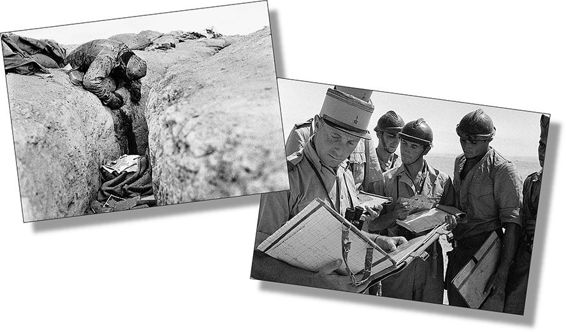
ABOVE: A DEAD GERMAN SOLDIER IS LEFT IN THE WAKE OF AN ADVANCE BY ALLIED TROOPS. BY THE TIME OPERATION TORCH BEGAN, THE AFRIKA KORPS WERE ALREADY ON THE RETREAT.
BELOW: A FREE FRENCH PATROL STOPS TO CONSULT BATTLE PLANS. THE COALITION BETWEEN BRITISH, FRENCH AND US TROOPS WAS TESTED FOR THE FIRST TIME IN NORTH AFRICA.
Nevertheless, the deal provoked considerable outrage in Britain, where Darlan had long been viewed as a Nazi sympathiser for his support of the Vichy regime. It had been Darlan’s refusal to ally with the British that had led to the destruction or crippling by the Royal Navy of almost all the French ships in port at Mers el Kebir on 3 July 1940. The Free French General de Gaulle was also angered, not least because he had not been informed of events in advance. De Gaulle warned the Allies: ‘You don’t get France by burglary.’ French fury did not stop at words, though. On Christmas Eve, 1942, Darlan was assassinated by a Frenchman. As the political in-fighting continued, Germany was quick to react to the Allied landings and on 11 November invaded and occupied Vichy France. The Germans also attempted to seize what remained of the French fleet at the port of Toulon. Hitler planned to use the fleet to support his forces already in North Africa, but on 27 November French sailors scuttled their ships rather than let them fall into Nazi hands.

CONDITIONS AT AN ALLIED HEADQUARTERS, CONSTRUCTED INSIDE AN ABANDONED WELL OUTSIDE THE TOWN OF BARDIA.

MEMBERS OF THE ROYAL CANADIAN AIR FORCE ENJOY THEIR MEAGRE RATIONS OUTSIDE THEIR TENT. BY NOW THE MEN HAD ADAPTED THEMSELVES TO LIFE IN THE DESERT.
While the Allied High Command was busy negotiating, the Allied troops had already begun moving on. The British 1st Army advanced into Tunisia, hoping to beat German and Italian reinforcements who were already arriving from Sicily at the port of Tunis.
TUNISIA

The British High Command was soon complaining about the ‘poor fighting value of the Americans’ and the tactical shortcomings of Eisenhower, a ‘desk’ general who never experienced the heat of battle in person. Montgomery himself summed up Eisenhower with the words: ‘Nice chap, no General’
They were supported by US soldiers, who got their first taste of war in the battle for Longstop Hill, an attempt to take a heavily defended German position that ended in Allied defeat. Although poor supplies and bad weather were probably more responsible than American inexperience, this defeat did nothing to improve the low opinion the British had already formed of the US military. The British High Command was soon complaining about the ‘poor fighting value of the Americans’ and the tactical shortcomings of Eisenhower, a ‘desk’ general who never experienced the heat of battle in person. Montgomery himself summed up Eisenhower with the words: ‘Nice chap, no General.’ As far as the British were concerned, their US allies were untrained, undisciplined and unreliable in combat. For their part, the US military felt they were being forced to overextend themselves before they were up to strength. Their reputation was not enhanced when a unit of the US 1st Armoured Division was set upon by a surprise German assault through the pass they were supposed to be holding. General Omar Bradley, with the honesty typical of him, remarked: ‘For the most part our soldiers abandoned their weapons and fled.’
The crunch for the US military came when Rommel’s Afrika Korps, withdrawing westwards from Montgomery’s 8th Army, broke through American lines at the Kasserine pass in Tunisia and threatened the Allied rear. Only the timely arrival of Montgomery himself forced Rommel to retreat, allowing US forces to reoccupy the pass. By that time, 3000 US soldiers had been taken prisoner and another 300 killed. Having learned the hard way that something had to change, Eisenhower took a number of important decisions after Kasserine. He handed over command of Allied military operations to his deputy, the British General Sir Harold Alexander, and then brought in the controversial General George S. Patton to take over and retrain the US II corps. Patton turned out to be the perfect man for the job. A flamboyant soldier famous for his habit of carrying two pearl-handled revolvers, he soon earned the nickname of ‘Old Blood and Guts’ from his men. His influence was soon apparent, too, as even Rommel reported himself astonished at ‘the speed with which the Americans adapted’. Once better prepared and better supplied for the task in hand, US soldiers were ready to distinguish themselves. It was, Rommel later suggested, exactly the Americans’ ‘lack of regard for tradition and worthless theories’ that enabled them to mend their ways so quickly.
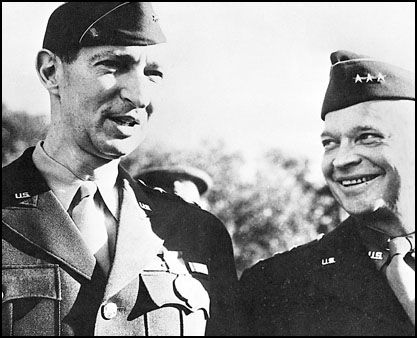
GENERAL MARK CLARK WITH GENERAL DWIGHT D. EISENHOWER, LEADER OF THE JOINT ALLIED FORCES IN NORTH AFRICA.
GENERAL MARK CLARK
In order to secure support from the French Resistance forces in the weeks leading up to the Allied invasion of North Africa, US General Mark Clark was sent on a top secret mission to Algeria in October 1942. After travelling to Gibraltar in a US Liberator bomber, Clark was transported by British submarine to the North African coast, where, under cover of darkness, he was rowed ashore in a dinghy by two British commandos. In a small house not far from the beach, Clark met up with a group of French agents. In return for their support, he had been instructed to offer the overall leadership of Allied forces in the area, following the invasion, to the French General Henri Giraud, a war hero famous for twice escaping from German prison camps. The offer was actually a bluff, but Clark, as he later wrote, kept ‘a poker face’ throughout the negotiations. When the house was visited by suspicious police, Clark and his commando escort were forced to hide in the cellar, before making a dash back to the sea and returning to the submarine, unsure whether or not their mission had been successful.
For Rommel, the African campaign was now all but over. Denied permission to reorganise his forces, he returned to Germany in March 1943 after suffering a defeat along the heavily defended Mareth Line. The Allied victory there had been due to a brilliant combination of British, Free French, New Zealand and US armour, most of it advancing by night, and it signalled the end of Rommel’s hopes for victory. In his absence, the Afrika Korps, now under the command of General Jurgen von Arnim, were finally trapped by British and US troops on the Cap Bon peninsula to the east of Tunis. With their backs to the sea, the Germans prepared for a siege. Instead, they were taken by surprise by a moonlight British tank charge, and had no choice but to surrender, despite Hitler’s orders that they fight to the death. On 12 May 1943, nearly 250,000 German and Italian troops were taken prisoner, bringing the war in the desert to an end.
Once better prepared and better supplied for the task in hand, US soldiers were ready to distinguish themselves. It was, Rommel later suggested, exactly the Americans’ ‘lack of regard for tradition and worthless theories’ that enabled them to mend their ways so quickly
The success of the Allied campaign in North Africa would have great consequences for the course of the war. Altogether, over one million German and Italian troops had been lost trying to gain control of the region. Combined with the losses they were suffering in Russia, this was a blow from which the Germans would never recover. For the British, the campaign had lasted three years and had been hugely expensive in terms of both men and equipment. In Tunisia, there had been over 20,000 US casualties, but the US Army had proved itself in battle, and, for the first time, British and US troops had fought side by side, despite their continued misgivings about each other. The landings on the North African coast had also provided experience that would prove invaluable when the Allied High Command turned its attention to the invasion of France. Most importantly of all, the Allies were now poised to strike at Italy, the ‘soft underbelly’ of Hitler’s ‘Fortress Europe’.
The success of the Allied campaign in North Africa would have great consequences for the course of the war.… over one million German and Italian troops had been lost… Combined with the losses they were suffering in Russia, this was a blow from which the Germans would never recover

’OLD BLOOD AND GUTS’, THE ABRASIVE GENERAL GEORGE S. PATTON, CAUGHT FOR ONCE WITHOUT HIS FAMOUS PEARL HANDLED REVOLVERS. HE WOULD CARRY HIS SUCCESSES IN NORTH AFRICA THROUGH TO THE INVASION OF EUROPE.

A GERMAN SOLDIER DIGS A FOXHOLE IN THE WESTERN DESERT. DEMORALISED AND WITHOUT THEIR LEADER, THE AFRIKA KORPS WERE FINALLY DEFEATED BY THE COMBINED ALLIED FORCES IN THE SPRING OF 1943.