
CHAPTER 11
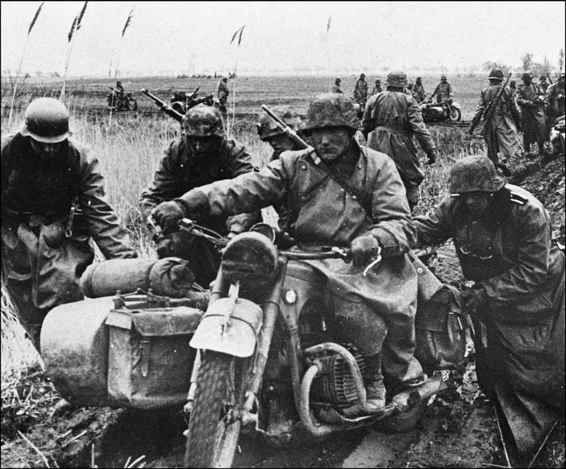
GERMAN TROOPS STRUGGLE WITH THE ELEMENTS ON THE
EASTERN FRONT AS THE ONCE MIGHTY AND ‘INVINCIBLE’
WEHRMACHT FACES DEFEAT AT THE HANDS OF THE
RUSSIANS – THE UNTERMENSCH WHOM HITLER
HAD ARROGANTLY PRESUMED TO VANQUISH WITHIN THREE
MONTHS OF THE COMMENCEMENT
OF OPERATION BARBAROSSA.
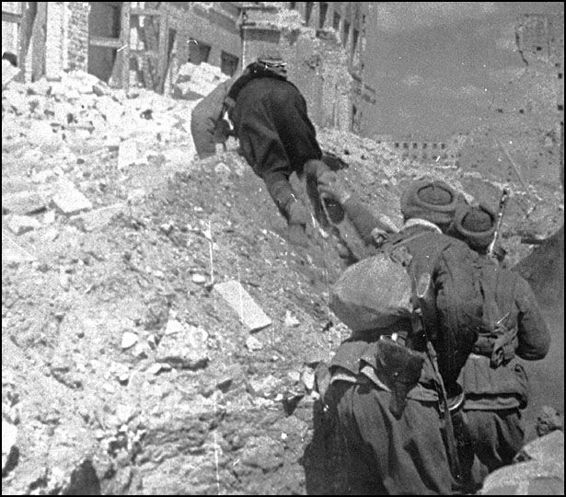
A SOVIET ‘STORM GROUP’ ADVANCES THROUGH THE SHATTERED REMAINS OF STALINGRAD. UNABLE TO BRING THEIR HEAVY WEAPONS TO BEAR INSIDE THE CITY, THE WEHRMACHT WERE FORCED TO ENGAGE THE RUSSIAN TROOPS AT CLOSE RANGE.
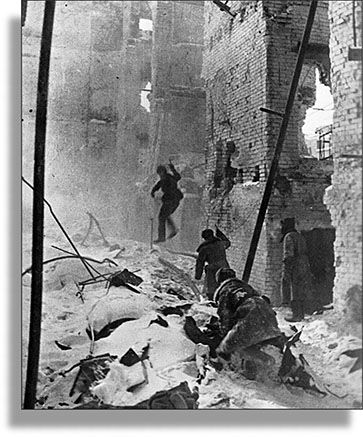
THE BATTLE FOR STALINGRAD SAW SOME OF THE FIERCEST FIGHTING OF THE SECOND WORLD WAR. ONE GERMAN OFFICER NOTED: ‘STALINGRAD IS NO LONGER A TOWN. IT IS A FURNACE.’
THE BATTLE OF STALINGRAD
In the summer of 1942, Adolf Hitler, now leading the German Army from his Wolf’s Lair in East Prussia, ordered his troops fighting in the Soviet Union to carry out a series of fresh offensives on the Soviet Union’s most important centres. He had been thwarted in his attempts to take Moscow the previous winter, and decided that the Soviet capital could now wait. Instead, he would seize the city of Stalingrad, which stood on the River Volga near the junction of the Volga-Don canal. Hitler believed that Stalingrad, a major strategic and industrial centre, was also the defensive key to the valuable coal fields of the Don basin, which lay beyond. His plan was to hit at the industrial heart of the Soviet Union, rather than try to defeat outright its seemingly endless supplies of men and arms. Once he had shut down the country’s industrial output, tanks would no longer be able to run, and guns would not fire. Then, the German armies would be able to take the Soviet capital at last.
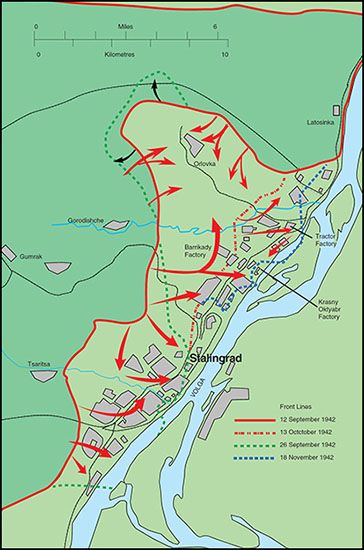
The assault began on 23 August 1942. For the first two months, the German offensive rolled all before it, taking the towns of Kharkov and Kursk; by 4 September, it reached the outskirts of Stalingrad itself. The 6th Army under General Freidrich von Paulus was poised to overrun the city and secure a historic German victory. Back in Germany, Hitler was confident enough to claim that the war had been won.
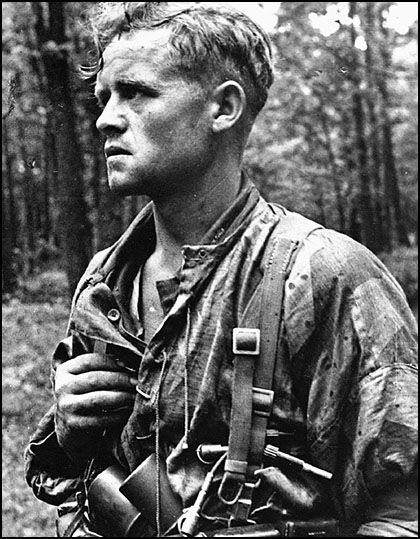
BY THE END OF 1942 THE TERRIBLE CONDITIONS OF THE EASTERN FRONT WERE TAKING THEIR TOLL ON THE GERMAN FORCES, AS CAN BE SEEN IN THE FACE OF THIS EXHAUSTED GERMAN PARATROOPER. WHAT HAD ONCE LOOKED LIKE AN EASY VICTORY WAS TURNING INTO A LONG AND BLOODY DEFEAT.
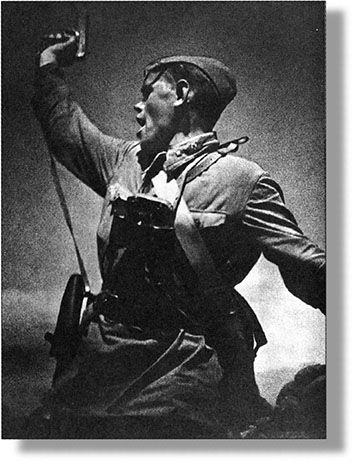
A RED ARMY SOLDIER BRANDISHES HIS TT33 SEMI-AUTOMATIC PISTOL. THE DESPERATE SOVIET DEFENCE OF THEIR MOTHERLAND ALLOWED NO QUARTER, AND RUSSIAN TROOPS USED EVERY WEAPON AT THEIR DISPOSAL.
Throughout the autumn and winter of 1942, Chuikov’s 62nd Army forced the advancing Germans to fight for every single inch of Stalingrad. Street by street, house by house, even room by room, Soviet soldiers put up savage resistance, often engaging German troops hand to hand
He had, however, once against counted without the Soviets’ capacity for resistance. Hitler had also counted without General Vassili Chuikov, who had assumed the task of defending Stalingrad at this desperate time. Chuikov, a veteran of the Don front, had spent a great deal of time studying German military strategy and tactics. He had noted how the German infantry relied on air support from the Luftwaffe. Before any troops advanced, Chuikov had observed, the air force would always first bombard the enemy front lines to ‘soften them up’ for the tanks and men on the ground who would follow. Chuikov quickly realised that the best way to counter this strategy was to ‘get as close to the enemy as possible’ and lure the German infantry into fighting at such short range that the Luftwaffe would be unable to attack for fear of bombing their own men. But there was going to be a horrendous cost: it meant fighting the Wehrmacht in the streets and houses of Stalingrad itself.
Throughout the autumn and winter of 1942, Chuikov’s 62nd Army forced the advancing Germans to fight for every single inch of Stalingrad. Street by street, house by house, even room by room, Soviet soldiers put up savage resistance, often engaging German troops hand to hand, taking by night the territory they had lost by day. Most of the time, the two sides were close enough to throw insults at each other across the street. Sometimes, they were separated only by the rooms of a house. Chuikov had organised his soldiers into highly mobile ‘storm groups’, each containing a small number of men with a mixture of weapons – grenades, machine-guns and anti-tank rifles. They were able to carry out lightning attacks on German troops and then disappear back into the rubble of the city. By contrast, the German tanks were largely useless. In the narrow streets, they were unable to turn quickly when attacked from behind or from the side. Their guns lacked the elevation to fire on the upper floors of buildings from where Soviet troops aimed anti-tank guns at them. Meanwhile, hidden snipers, picking the enemy off without warning, struck terror into the hearts of the German infantry.
THE BATTLE OF STALINGRAD
Under the ruins of Stalingrad, the Soviet guerrilla army had turned cellars, sewers and even the caves in the banks of the River Volga into field hospitals, ammunition dumps and command posts. Their only supply line was across the river itself, from where reinforcements were ferried under cover of night
The charismatic Chuikov, an inspiration to the men under his command, soon gained a reputation among the Germans for being indestructible. Even so, his troops sustained huge losses as the enemy, supplied by over 3000 Luftwaffe flights a day, slowly took control of the south and central areas of the city. Under the ruins of Stalingrad, the Soviet guerrilla army had turned cellars, sewers and even the caves in the banks of the River Volga into field hospitals, ammunition dumps and command posts. Their only supply line was across the river itself, from where reinforcements were ferried under cover of night. But soon, even this was threatened. At the beginning of October 1942, as the front moved into the factory district in the north of the city, the fighting became even more intense. A German lieutenant reported that ‘the street is no longer measured by metres, but by corpses’. Fighting raged for days around a strategically situated grain elevator, with the upper and lower levels changing hands a number of times. Inside the huge Barrikady and Krasny Oktyabr tractor factories, which dominated the area, gunfire blazed for three weeks.
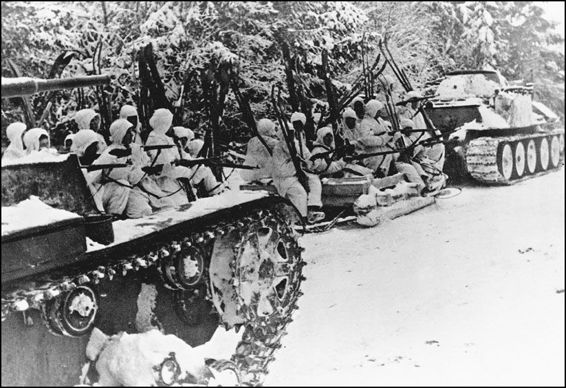
SOVIET T-34 AND T-26 TANKS (RIGHT AND LEFT) TOW RED ARMY SKI TROOPS TO THE FRONT. THE RUSSIANS WERE LEARNING FAST HOW TO BEAT THE GERMAN ENEMY, AND THEIR ADAPTABILITY AND VAST RESOURCES WOULD EVENTUALLY CARRY THEM ALL THE WAY TO THE BORDERS OF GERMANY.
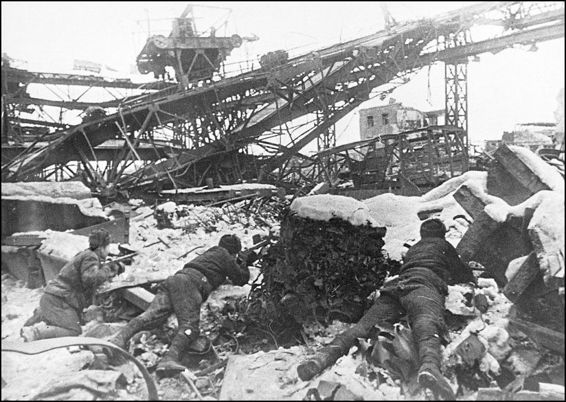
THROUGHOUT OCTOBER 1942 FIGHTING BETWEEN RUSSIAN AND GERMAN TROOPS INTENSIFIED AROUND THE INDUSTRIAL HEART OF STALINGRAD. THE COMING WINTER WAS ONCE AGAIN TO PROVE LETHAL TO THE WEHRMACHT, AS 90,000 MEN WERE LEFT TRAPPED INSIDE THE CITY.
By the end of October, both sides seemed to have exhausted themselves. The rapid approach of another punishing Russian winter had restricted Luftwaffe flights into the city, severely cutting the 6th Army’s supplies. But the Soviets had been preparing a nasty surprise. On 19 November, the Red Army launched a huge counter-attack on the enemy lines around Stalingrad. For months, General Georgi Zhukov had been building up a garrison of over one million men on the far bank of the River Volga. Now, they cut through the Romanian divisions stationed to the north and south and within three days surrounded the city. Von Paulus and his men were trapped inside Stalingrad. Predictably, Hitler ordered them to hold the city at all costs. Convinced that a German retreat at this stage would be psychologically devastating, the Führer denied his men even an attempt to fight their way out. Instead, he promised to mount a rescue mission, led by Field Marshal von Manstein. A column of panzers was sent to their aid, but was turned back by Soviet troops some 35 miles from Stalingrad. The few Luftwaffe flights that could get through the deteriorating weather became the beleaguered 6th Army’s only lifeline.
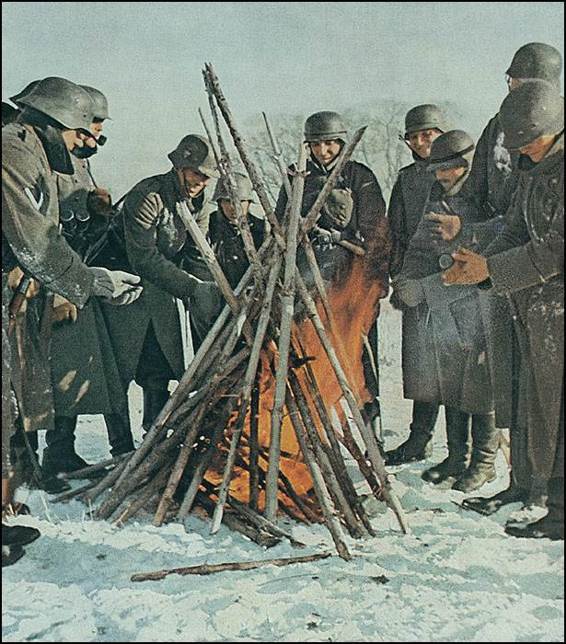
GERMAN TROOPS CONSTRUCT A MAKESHIFT FIRE TO WARM THEMSELVES IN THIS PROPAGANDA PHOTOGRAPH. IN REALITY, MEN WERE FREEZING TO DEATH IN THEIR TANKS AS THEIR FUEL AND SUPPLIES SLOWLY RAN OUT. NEVERTHELESS, THE FÜHRER HIMSELF HAD EXPRESSLY FORBIDDEN SURRENDER.
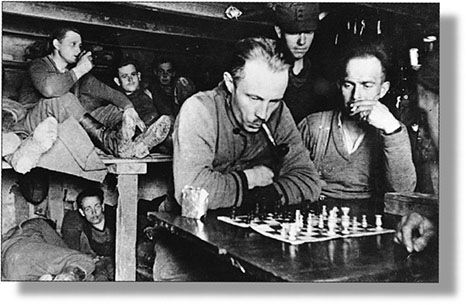
A TRUER PICTURE OF LIFE INSIDE A GERMAN BUNKER ON THE EASTERN FRONT IN 1943 SHOWS CRAMPED CONDITIONS AND HOPELESSNESS ON THE FACES OF MANY OF THE MEN. MORALE WAS AT AN ALL-TIME LOW, AS SOLDIERS BROODED ON THEIR FATE.
Throughout December 1942 and January 1943, in the most appalling conditions, von Paulus’s men held out, despite constant day and night bombardment from Soviet guns. Food and fuel were scarce. Men froze to death in their tanks as they slept. Others injured themselves as a ploy to be airlifted out of the city, even though they were committing an offence punishable by death. Suicides were not uncommon. Then, on 24 January 1943, Soviet troops captured the two remaining German airfields in the city. Now, von Paulus and his men were totally cut off. It was the end. Seven days later, von Paulus and the 90,000 troops under his command surrendered to the Red Army. Eyewitnesses reported columns of German prisoners stretching for miles. Back in Germany, the government announced three days of national mourning. Hitler himself was devastated. The same day that von Paulus surrendered, Hitler had made him a Field Marshal, reminding him that no one of that rank in the German armed forces had ever capitulated. Hitler was unable to understand why von Paulus had not had the honour to die in battle or kill himself. He complained that ‘the heroism of so many soldiers is nullified by the actions of one single characterless weakling’.
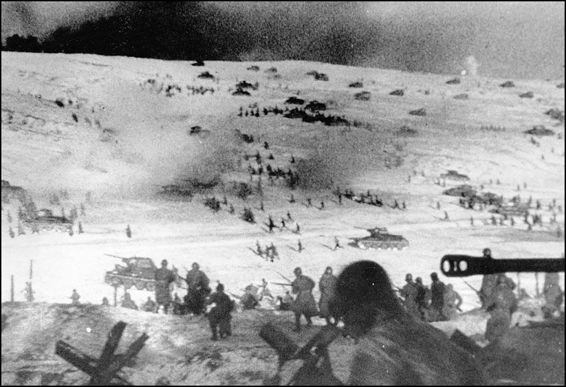
THOUSANDS OF SOVIET TROOPS AND TANKS POUR ACROSS THE RUSSIAN COUNTRYSIDE DURING THE STALINGRAD OFFENSIVE. BY EARLY 1943 THEY WERE FORCING THE DEMORALISED NAZI FORCES INTO RETREAT RIGHT ACROSS THE SOVIET UNION.
The surrender of Stalingrad was the nadir of German fortunes and morale. To the German people, as well as to the rest of the world, it had suddenly been made clear that their armies were no longer invincible. Hitler himself, deep in his Wolf’s Lair, was said to have brooded over Stalingrad for months afterwards, unable to come to terms with the magnitude of the failure. Once he had been convinced that history was on his side. Now, he was obsessed with the fact that his armies had been out-thought and outfought by supposedly inferior Slavs. At the same time, his armies in North Africa were being thrashed by the combined efforts of the British, and a powerful new enemy, the USA. With the USA’s entry into the war, an almost unlimited new supply of men, tanks, aircraft and guns would soon be added to the forces now ranged against Germany. The heady days of early success, when Europe seemed to be at his mercy, had turned dark with defeat and despair.
General Zhukov’s counter-attack on Stalingrad was followed by a quick and decisive victory over the Italian 8th Army on the Don river. Soon afterwards, the German forces in the Caucasus were forced to retreat through the town of Rostov in the face of overwhelming Soviet numbers. Almost all the territory the German forces had taken in the previous 12 months had now been lost. The Soviet advance continued in 1943, with Kharkov falling to the Soviet troops in mid-February. But there, a horrifying secret was revealed as the Russian troops discovered the atrocities of the Nazi occupation. They found a city that had lost half its 700,000 inhabitants in less than two years. Those who had not been transported to Germany or murdered by the SS had starved to death. It was a scenario that was to be repeated many times as the German retreat uncovered the full horrors that their occupation had inflicted on the Soviet people, and this hardened still further the Russians’ resolve not to stop until the German war effort had been trampled into extinction.
To the German people, as well as to the rest of the world, it had suddenly been made clear that their armies were no longer invincible. Hitler himself, deep in his Wolf’s Lair, was said to have brooded over Stalingrad for months afterwards, unable to come to terms with the magnitude of the failure
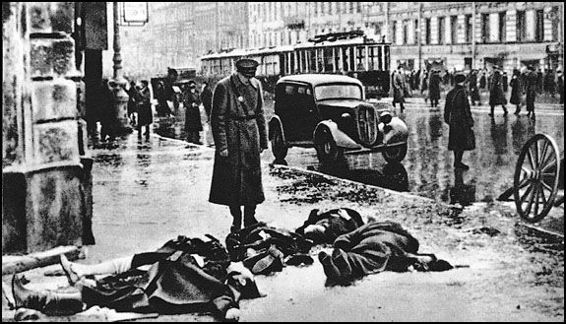
DEAD BODIES LIE IN THE STREETS OF LENINGRAD AFTER A HEAVY GERMAN ARTILLERY BOMBARDMENT.
THE SIEGE OF LENINGRAD
In the summer of 1941, as German troops approached Leningrad, this historic birthplace of the Russian Revolution of 1917 saw a desperate scramble to evacuate nearly two million people. Those who remained behind began the process of turning Leningrad into a fortress. Hundreds of gun emplacements and trenches were constructed, along with ammunition dumps and air raid shelters. Factories turned out tanks and guns as fast as they could go. On Stalin’s orders, General Georgi Zhukov had flown to the city to organise its defences. Since the Leningrad Home Guard was formed from its workforce, Zhukov soon found himself sending people ‘straight from the factory floor to meet the enemy’.
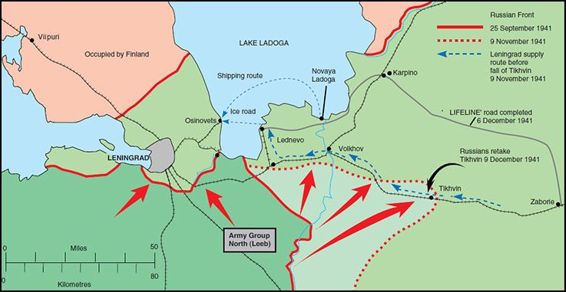
From the earliest days of Operation Barbarossa, Hitler had made the destruction of Leningrad into a personal quest. German artillery units were given specific orders to destroy historic buildings and sites of cultural interest such as the Hermitage museum and the Kirov theatre, which was famous for its ballet company. On 8 September 1941, 700,000 German and Finnish troops surrounded the city, but their attempts to storm it were defeated. Instead, as their numbers were gradually reduced to feed offensives elsewhere, they laid siege, bombarding Leningrad with shells day and night and hoping to demoralise and starve out the inhabitants. The stalemate was to last for two years, and cost the lives of nearly one million people.
Lake Lagoda, on which it stood, was crucial to Leningrad’s survival. The southern shore of the lake was still held by Soviet forces, and this became the city’s one and only lifeline. When the lake froze in the winter, the Russians built a road across it to ferry supplies into the city. Even then, what could get through was far from adequate. Inside Leningrad, there was never enough to eat, nor enough fuel to keep people warm. Bread made from sawdust, and soup from the bones of slaughtered horses, formed the staple diet. By the end of the siege, it was reported that no animals or birds could be found anywhere in the city. Between September 1941 and January 1944, over 600,000 people died in Leningrad from cold or starvation. Another 200,000 were killed by enemy shelling before the siege was finally lifted by the Red Army on 27 January.
With the coming of Spring in 1943, the rains once again halted all activity on the Russian front. This pause gave the German forces in the area a final chance to regroup and strengthen their lines around the panzer armies of Field Marshal von Manstein. German and Soviet troops were now facing each other across the River Donetz. To the north, the Red Army held the town of Kursk, as well as a large bulge of territory reaching some 100 miles forward of the Soviet lines. It was here that Hitler planned a final offensive. The success of the German counter-attack, which retook Kharkov on 14 March, convinced him that he could still win the war in the east. By launching an all-out attack on Kursk, Hitler believed his remaining forces – some one million men – would be able to cut off the 500,000 Soviet troops holding the area. New Tiger and Panzer tanks had been delivered to the front, and, to the north and south, the 9th and 17th Armies had regrouped. Hitler told his generals that victory at Kursk would ‘shine like a beacon to the world’ and would inspire his armies to a new assault on Moscow. But despite this bravado, even he had doubts and confessed to Heinz Guderian, the tank warfare specialist, that ‘whenever I think of this attack, my stomach turns over’. It would be all or nothing. The future course of the war depended on the result.
THE SIEGE OF LENINGRAD
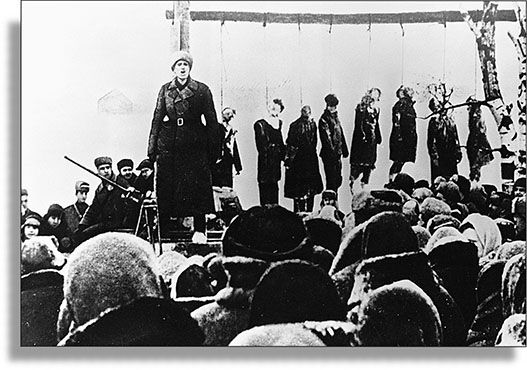
A MEETING IS HELD IN A LIBERATED RUSSIAN VILLAGE TO HONOUR THE DEATH OF EIGHT PARTISANS WHO HAD BEEN TORTURED AND KILLED BY THE NAZIS DURING THE GERMAN OCCUPATION.
OPERATION CITADEL
On 4 July 1943, the Germans launched Operation Citadel. But the Soviets had not been idle in the intervening months and had already planned their defence of the Kursk area. It did not take long for the Germans to discover its strength. First, their advance encountered the Soviet anti-tank defences – 50 miles of minefields and heavy artillery positions. Although, initially, their new Tiger tanks pushed forward with great success, the Germans soon found themselves stranded. Without machine-gun support, they were unable to defend themselves at close range, and fell victim to Soviet infantry armed with anti-tank rifles. Within a single day, the Soviets reported the destruction of nearly 500 enemy tanks.
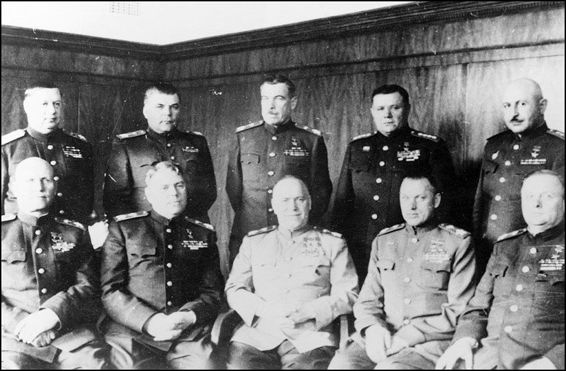
THE LEADERS OF THE SOVIET WAR EFFORT, WITH MARSHALL GEORGI ZHUKOV, THE MASTERMIND BEHIND COUNTLESS SOVIET VICTORIES, IN THE CENTRE.
Then, Zhukov unleashed the Red Army’s counter-attack. On 12 July, the 600 tanks of the 4th Panzer Army met the Soviet 5th Tank Army. The result was reputed to be the largest tank battle in history, fought over an area of less than 12 square miles. This was the first time the German Army had ever faced such a concentrated Soviet force, and the losses on both sides were enormous. On 13 July, Hitler called off Operation Citadel, but the fighting continued. And on 17 August, after a day’s continuous exchange of fire, victory went to the Russians. The 4th Panzer Army, which lost over 300 tanks, was routed. Hitler’s final offensive on the Russian front had ended in failure. There could be no doubt now that the German Army was on the verge of defeat in Russia.
Inspired by the overwhelming success at Kursk, the Red Army resumed its advance westwards. Kharkov was liberated again on 23 August. On 6 November, Kiev was also reclaimed. There, the troops discovered yet more atrocities. In a city of nearly 500,000 people, less than 100,000 had survived the German occupation. Now, Hitler issued his ‘Directive 51’ to the German forces in the east, making the German retreat from the Russian front all but official. He announced that despite ‘the hard and costly struggle against Bolshevism’, which his men had waged for over two years, ‘a greater danger now appears in the west’. Troops and guns, Hitler explained, were needed in western Europe to shore up defences against the ‘Anglo-Saxon landing’, which now seemed inevitable. However true the threat of an Allied landing may have been, it could do little to disguise the fact that the German Army had been beaten, and that Hitler was ordering its retreat.
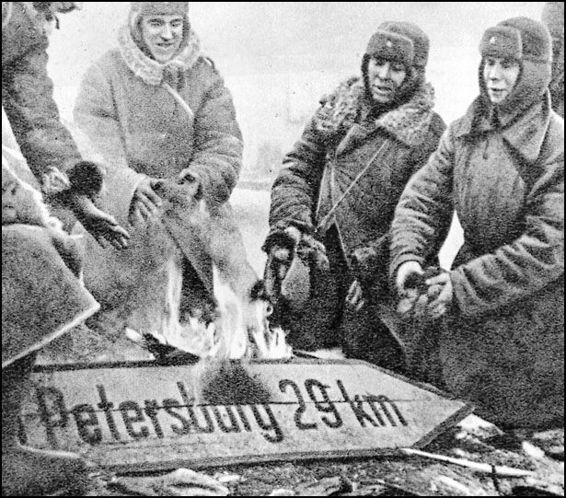
SOVIET SOLDIERS ON THE ROAD TO LENINGRAD STOP TO WARM THEIR HANDS ON A BURNING ROAD SIGN THAT BEARS THE GERMAN NAME FOR THE CITY. THE RAISING OF THE SIEGE OF LENINGRAD SENT A MESSAGE OF HOPE FLASHING AROUND THE WORLD.
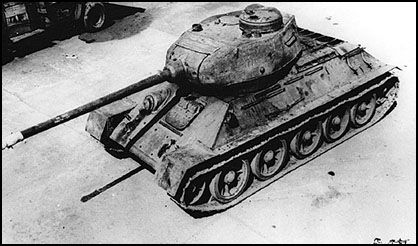
THE SOVIET T-34 – THE TANK THAT DEMOLISHED GERMAN ‘INVINCIBILITY’.
THE SOVIET T-34 TANK
The huge tank battle at Kursk in July and August 1943 was proof that, with the T-34, the Soviet military had come up with the answer to the feared German panzer tank. Faster, more manoeuvrable and better armoured than its German counterpart, the T-34 was also put to better use than the outdated BT tanks that it replaced. As the T-34s rolled off the Russian production lines, Soviet commanders were observing and learning from the Germans how to use tanks to attack the enemy’s flanks rather than assaulting them head on. The defeat of Operation Citadel, like the Soviet victory at Stalingrad, showed that the Germans could be outfought and out-thought, and by an army that, in their arrogance, they had once presumed was easy prey.
Early in 1944, the Soviet advance reached Leningrad and the raising, on 27 January, of a siege which had lasted almost 900 days was celebrated right across the Soviet Union. It was quickly followed by further Soviet gains. In March, at Korsun on the River Dneiper, upwards of 20,000 German and Belgian troops were massacred trying to escape encirclement. In the south, the drive to take back the Crimea from the German 17th Army began in April. Sevastopol was freed on 9 May, as its German occupiers attempted to flee by boat across the Black Sea to Romania. Much like the British at Dunkirk in 1940, they found themselves easy prey for the attacking air force. The local Tatar population fared little better. Thousands were deported by the Soviet Government, who suspected them of collaborating with the Germans. In Belarus, partisan groups aided the Red Army offensive by sabotaging railways and German communications. Here, Hitler had ordered his troops to hold their positions, but they could do little when confronted by the 1,500,000 men and 5000 tanks now ranged against them. Thirty-two German divisions were routed, and on 1 July 1944, the city of Minsk fell, with over 100,000 German casualties. By the end of the month, on 28 July, the town of Brest Litovsk was back in Soviet hands and the German invasion of the Soviet Union was over. The Red Army was preparing to advance into Poland and all points west towards Germany itself.
Overall, upwards of 20 million Soviet citizens died during the German occupation. In Belarus alone, nearly one million lost their lives. To judge by the characteristically meticulous SS records, over two million Russians died in prisoner of war camps or during ‘transportation’. Millions of others simply disappeared. Many were kidnapped children who had looked sufficiently Aryan enough to be taken to Germany. One million Soviet Jews were either murdered, or died in concentration camps. More than any other single nation, the Soviet Union suffered the most appalling losses as a result of Hitler’s ambitions.
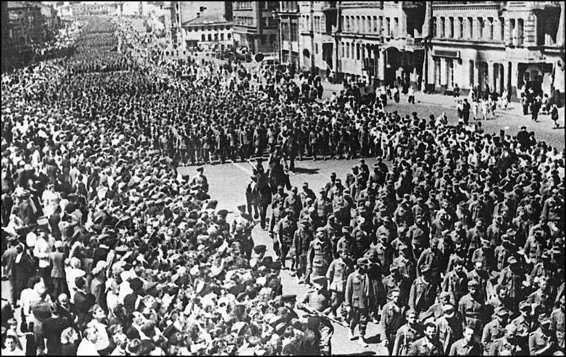
GERMAN POWS ARE MARCHED THROUGH THE STREETS OF MOSCOW. TWO MILLION OF THEM WOULD NEVER SEE THEIR HOMELAND AGAIN, AS THE RUSSIANS EXTRACTED A BLOODY VENGEANCE FOR THEIR OWN COUNTRY’S SUFFERING.
CHAPTER 12
The Second Front
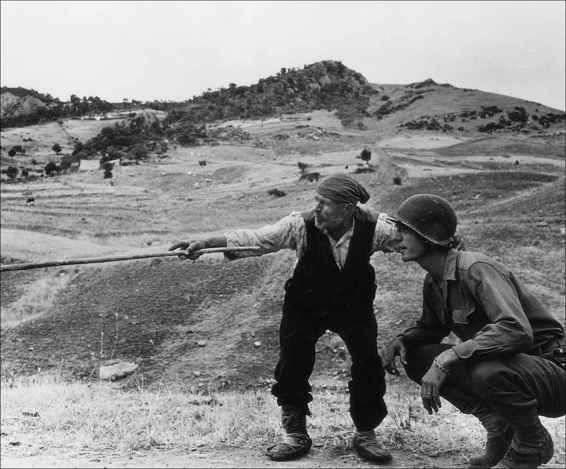
AN AMERICAN SOLDIER TAKES DIRECTIONS FROM AN ITALIAN
CIVILIAN, ITALY 1943–4. THE MOUNTAINOUS TERRAIN OF
NORTHERN ITALY WOULD TAKE AN ENORMOUS TOLL ON BOTH
SIDES AS THE WAR ON THE SECOND FRONT RAGED INTO
THE BITTER WINTER OF 1944.
THE ‘SOFT UNDERBELLY’
In April 1943, the Royal Navy submarine Seraph dropped a dead body in Spanish waters carrying fake papers referring to an imminent Allied invasion of Greece. The body floated ashore on the Spanish coast on 30 April. ‘Major Martin’, later known as the ‘Man Who Never Was’, was an invention of British Naval Intelligence. He had been given an entirely bogus identity, including a bank manager, a tailor and a fiancée called Pam. The ruse was good enough to convince the German High Command, which soon received news of the find from their old allies, the government of General Franco. As a result, they were busy preparing for an Allied assault from the Aegean Sea while across the Mediterranean the British 8th and US 7th Armies began landing troops on the south coast of Sicily on 10 July 1943.
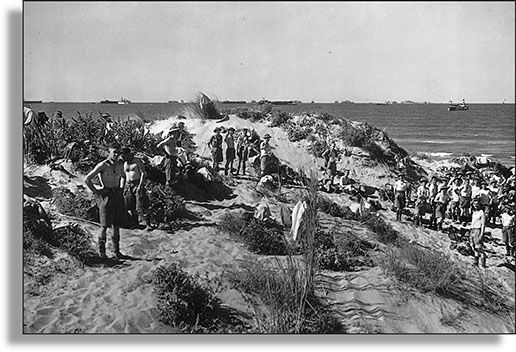
BRITISH SERVICEMEN DRY THEIR CLOTHES AFTER LANDING ON SICILY. HARDENED BY THEIR EXPERIENCES IN THE AFRICAN DESERT, THEY WERE NOW READY TO STRIKE AT GERMAN DEFENCES IN MAINLAND EUROPE.
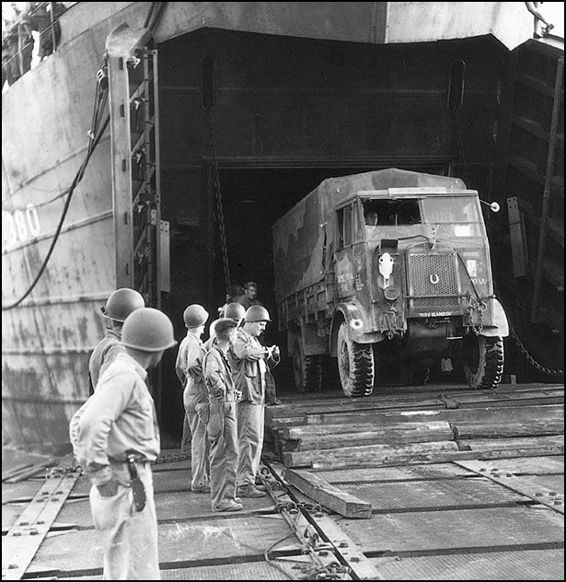
US ORDNANCE AND EQUIPMENT ROLLS ASHORE ON SICILY. THE ISSUE OF WHETHER OR NOT TO BUILD ON THE VICTORY IN NORTH AFRICA BY INVADING ITALY HAD BEEN HOTLY CONTESTED AMONG THE ALLIED HIGH COMMAND.
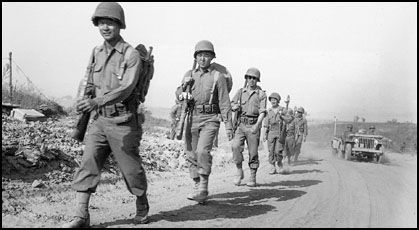
JAPANESE-AMERICAN TROOPS ADVANCE THROUGH THE ITALIAN COUNTRYSIDE.
ALLIED FORCES IN ITALY
The Allied forces in Italy contained the most diverse collection of soldiers ever formed into a field force. As well as US, British and French troops, the fighting forces co-ordinated by General Alexander included men from India, New Zealand, South Africa and Canada. They were joined by Poles, French Moroccans, a Jewish unit from Palestine and a Brazilian Expeditionary Force. Although Italy itself declared war on Germany on 13 October 1943, Italians were never granted the status of ‘allies’. Instead, Italian soldiers were invited to fight alongside Allied troops as ‘co-combatants’. In the event, their limited actions against German troops were totally overshadowed by the activities of the 100,000 Italian civilians who became partisan guerrillas.
A joint British and US invasion of Sicily had always been the long-term aim of the Allied campaign in North Africa, despite arguments between them over whether or not an assault on the Italian mainland should ensue. The Soviet Union was urgently requesting that a ‘second front’ be opened against German forces in Europe to relieve the pressure on the beleaguered Russian troops, and Churchill favoured a strike against what he called Europe’s ‘soft underbelly’. The USA preferred the idea of a single, massive assault on northern France across the English Channel, and felt that an Italian campaign would be a waste of men and resources. Although an early Italian surrender was likely, the Allies still expected stiff opposition from the strong, disciplined and well-led German forces already stationed in Italy. For the next two years, that is exactly what they got.
Defended by 10 Italian and two German divisions, the mountainous island of Sicily was not easy territory to conquer. It took General Montgomery and General Patton, who led the joint Allied forces, 38 days to achieve victory. In that time, the German Field Marshal Alfred Kesselring, Commander-in-Chief of the German forces in Italy, managed to evacuate over 100,000 German and Italian soldiers to the mainland.
The question for the Allies now was what to do next. Two weeks after the landings, Benito Mussolini had been called before the Italian Fascist Grand Council and removed from power by King Victor Emanuel III. The stunned dictator was then bundled into an ambulance and taken to a disused mountain hotel, where, it was intended, he would be imprisoned for the rest of the war. He was replaced as head of the Italian Government by Field Marshal Pietro Badoglio, the former commander-in-chief of the Italian armed forces, who had himself been sacked by Mussolini during Italy’s ill-fated invasion of Greece in 1940. The Italians, however, had never been wholehearted about the war. Now, three years later, with an Allied invasion looming, the Italian Government seemed only too glad of a chance to surrender and get out. But the Allies were not to come by this ‘whitewash’ all that easily.
The Italians, however, had never been wholehearted about the war. Now, three years later, with an Allied invasion looming, the Italian Government seemed only too glad of a chance to surrender and get out. But the Allies were not to come by this ‘whitewash’ all that easily
Negotiations between the new government and the Allied High Command began almost immediately after the end of the Sicilian campaign on 19 August, but for 45 days the Italian leadership stalled over announcing a cease-fire. Not only was Badoglio hoping for better terms than the unconditional surrender demanded by the Allies, but he was also aware that the German Army was preparing to occupy and defend Italy.
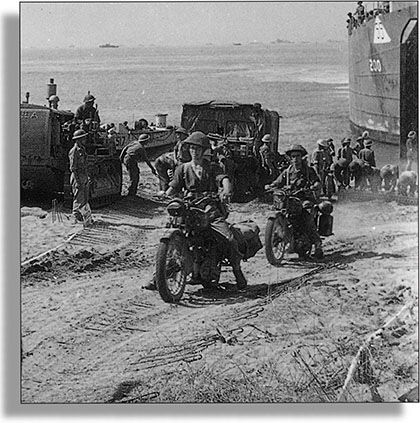
US FORCES LANDING AT SALERNO IN MAINLAND ITALY FACED STIFF RESISTANCE FROM THE HEAVILY DEFENDED GERMAN POSITIONS. SOON, EVERY MAN WHO COULD CARRY A RIFLE WOULD BE PUSHED INTO THE FRONT LINE, AS GENERAL MARK CLARK’S RESERVES WERE RAPIDLY EXHAUSTED.
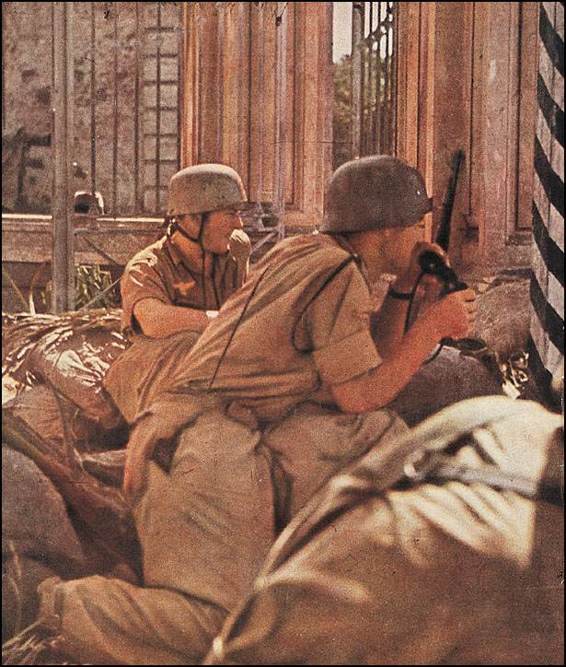
FOLLOWING THE ITALIAN SURRENDER, GERMAN TROOPS QUICKLY OCCUPIED TOWNS AND VILLAGES ACROSS THE COUNTRY. THESE PARATROOPERS ATTEMPT TO HOLD MONTE CASSINO AGAINST THE ALLIED ADVANCE.
Throughout July and August 1943, Allied planes mounted almost continuous bombing of the Italian mainland in an effort to persuade the government to make up its mind. During the same period, a wave of strikes protesting at Italy’s continued involvement in the war threatened to cripple the industrial north of the country. In the end, the Allies decided to force the Italians’ hand by invading the mainland on 3 September 1943. After covering the short distance across the Straits of Messina, which was between two and eight miles wide, the British 8th Army carried out a series of landings near the town of Reggio di Calabria. They encountered little resistance and, by the end of the day, the Allied presence in Italy was established. The Italian surrender was made official five days later, the day before US troops began landing at Salerno, 30 miles from Naples, in south-western Italy. The American GIs ran into considerably more difficulty than the British. Within hours of the cease-fire, German troops had occupied Rome and other major towns and cities across Italy. At Salerno, they had already established well-defended artillery positions in the hills surrounding the town, and the US 5th Army met fierce resistance. It took General Mark Clark’s troops five days to fight their way inland. Despite this setback, by 1 October the Allies had succeeded in their initial military objectives: the capture of the port of Naples and the airfields at Foggia. From there, they could then land a complete invasion force supported by air cover.
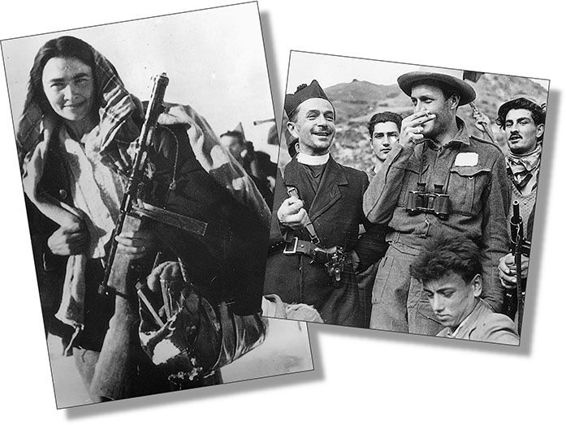
ABOVE DON LUIGI PIAZZA, AN ITALIAN PRIEST AND LEADER OF A PARTISAN BAND, SHARES A JOKE WITH A FELLOW PATRIOT. EQUIPPED WITH SUPPLIES DROPPED BY ALLIED PLANES, THESE MEMBERS OF ‘THE ARMY OF NATIONAL LIBERATION’ ORGANISED IN SECRET HIDEOUTS IN THE ITALIAN MOUNTAINS.
ABOVE LEFT: THE ITALIAN PEOPLE FINALLY TOOK UP ARMS AGAINST THE GERMANS. THIS SCHOOL TEACHER FOUGHT IN A PARTISAN UNIT IN NORTHERN ITALY, COMMITTED, LIKE THOUSANDS OF OTHERS, TO FREEING HER COUNTRY FROM THE NAZI YOKE.
As he had already done in Sicily, Field Marshal Kesselring once again made a series of tactical retreats, pulling the German troops back towards the Apennine mountains, the central ‘spine’ of Italy, which ran 800 miles from the north down to the Straits of Messina. Kesselring knew he would have the rugged mountain terrain on his side and planned to exploit it to the full in order to prevent the Allied troops reaching their next target: Rome.
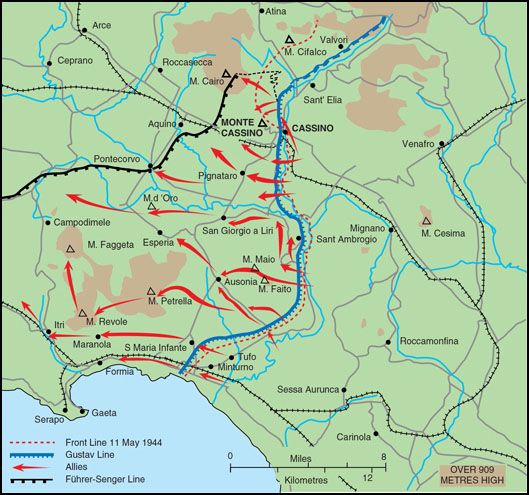
Kesselring’s ‘Gustav Line’ was dominated by Monte Cassino, a 1703-ft-high peak capped by a beautiful 1300-year-old Benedictine monastery that stood at the entrance to the Liri valley, blocking the only road north to the Italian capital 75 miles to the northeast. To clear the path, the Allies would have to flush the Germans out of the mountains. What followed were six months of some of the most bitter fighting of the war as US, British and New Zealand troops made repeated attempts to capture the heavily defended German positions. The conditions were atrocious. Not only did fighting along exposed mountain roads leave troops almost permanently open to attack from above, they were also vulnerable to the elements. The freezing mountain cold took a heavy toll of Allied troops who had spent the last year in the simmering deserts of North Africa. One GI later remembered: ‘For years afterwards, my toes were numb from frostbite.’ Losses on both sides were severe. Over 80,000 Allied troops lost their lives in the campaign, as did 50,000 German soldiers. Gurkhas from Nepal, who had fought for the British ever since the early days of the Raj in India, were particularly hard hit as their phenomenal valour and experience of mountain warfare made them natural front-line troops.
MONTE CASSINO
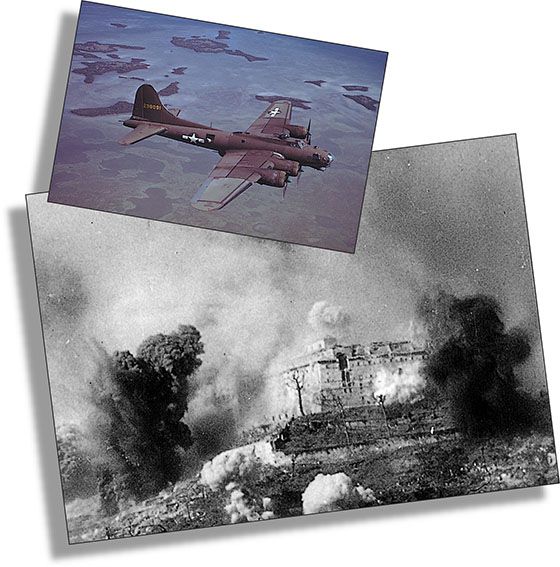
TOP: AMERICAN B17 BOMBERS WERE USED IN THE ATTACK ON THE HEAVILY ENTRENCHED GERMAN POSITIONS AT MONTE CASSINO, BUT THEIR BOMBARDMENT ONLY SERVED TO GIVE THE ENEMY BETTER COVER.
BOTTOM: THE HISTORIC MONASTERY AT MONTE CASSINO EXPLODES UNDER THE WEIGHT OF THE ALLIED BOMBING. AS THE FIGHT FOR THE PEAK DRAGGED ON, CONDITIONS FOR THE MEN ON BOTH SIDES OF THE CONFLICT SOON BECAME INTOLERABLE.
The conditions were atrocious…The freezing mountain cold took a heavy toll of Allied troops who had spent the last year in the simmering deserts of North Africa. One GI later remembered: ‘For years afterwards, my toes were numb from frostbite.’ Losses on both sides were severe
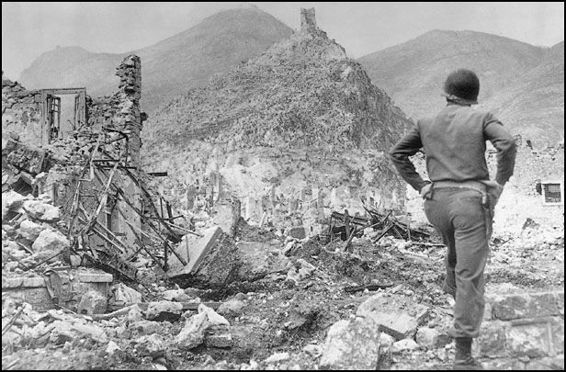
AN ALLIED SOLDIER SURVEYS THE UTTER DEVASTATION WREAKED ON THE AREA AROUND MONTE CASSINO. THE BATTLE FOR THE MOUNTAIN WOULD EVENTUALLY COST THE LIVES OF OVER 100,000 MEN.
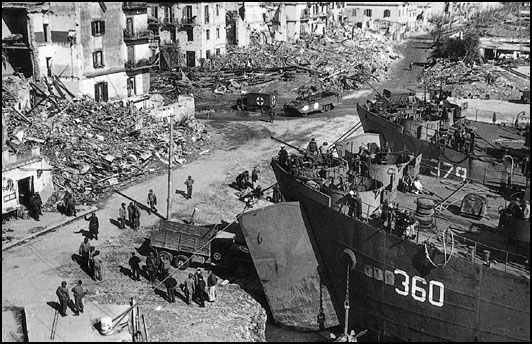
ALLIED LANDING SHIPS UNLOAD SUPPLIES AS THE FIGHT FOR ANZIO RAGES ON.
ANZIO
The landings behind German lines at Anzio, 30 miles south of Rome, on 22 January 1944 were carried out to try to relieve pressure on Allied troops fighting in the Apennine mountains. However, after coming ashore and spending a week digging into defensive positions, the 50,000 men of the US 6th Army were pinned down by a German counter-attack, and for the next four months suffered almost constant bombardment from inland. During the fighting, the town of Carrocetto changed hands no less than eight times as the Allied troops repeatedly tried, but failed, to break out of their beachhead. Churchill referred to the operation as ‘a stranded whale’ and US General John Lucas was roundly criticised for not having advanced when he had the opportunity. After suffering considerable losses, the Allied forces eventually broke through the German defences on 23 May 1944.
The key to Monte Cassino was the ancient monastery on top of the mountain, which overlooked the entire area. Determined that it should not fall into German hands, the British General Bernard Freyberg requested, with reluctance, that it be destroyed by Allied bombers, despite the fact that it was still inhabited by the Benedictines. On 15 February 1944, having gained permission from Pope Pius XII, Allied aircraft dropped some 600 tons of bombs on the historic monastery, levelling it to a mass of smashed stone and smoking ruin. The destruction of this historic building was for nothing, however. Its ruins presented even better defensive opportunities and German troops soon dug themselves into the rubble. When the German positions were finally taken three months later, it was due to the combined efforts of Polish and French Moroccan troops. The Moroccans, known as ‘Goums’, dressed in traditional native costume and, armed with long knives, broke through the German lines by climbing the ‘impassable’ Petrella Peak and attacking from the rear. Their spectacular advance was so successful that it soon gave rise among Allied troops to the phrase ‘Goumed right off the map’. On 18 May, the Polish troops, who had suffered appalling casualties, finally entered the ruins, by which time Kesselring had already begun another long retreat.
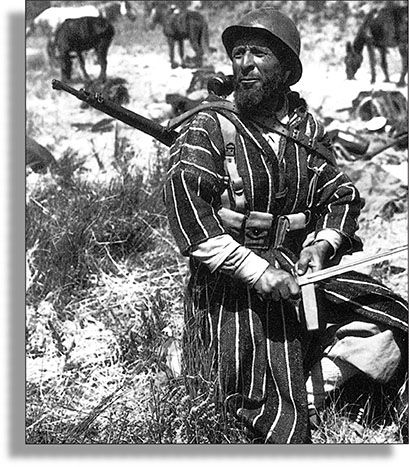
A FRENCH MOROCCAN GOUM OF THE FRENCH EXPIDITIONARY FORCE IN ITALY TAKES ADVANTAGE OF A PAUSE IN THE FIGHTING TO SHARPEN HIS KNIFE. RENOWNED FOR THEIR BRAVERY AND SAVAGERY, THE GOUM TROOPS WHO ATTACKED MONTE CASSINO GAVE THE GERMAN ENEMY NO QUARTER.
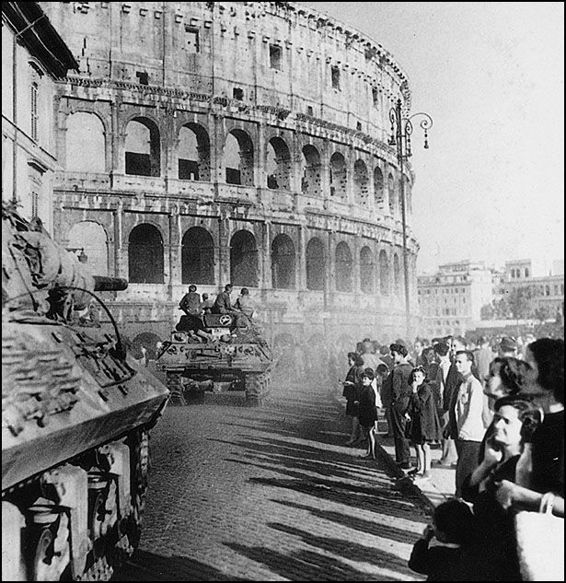
TANKS OF THE ALLIED 5TH ARMY ROLL PAST THE ANCIENT COLISEUM AFTER THE LIBERATION OF ROME IN JUNE 1944. THE FIRST AXIS CAPITAL HAD FALLEN.
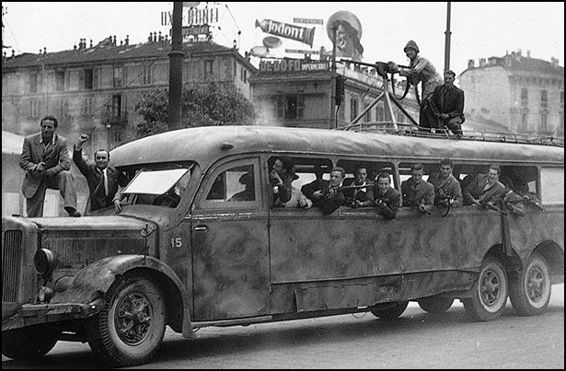
ITALIAN PARTISANS FILL A COMMANDEERED BUS. ALTHOUGH FEW ITALIAN SOLDIERS OFFICIALLY FOUGHT ALONGSIDE THE ALLIES, THE ITALIAN PEOPLE THEMSELVES PLAYED A MAJOR PART IN ALLIED VICTORIES ACROSS ITALY.
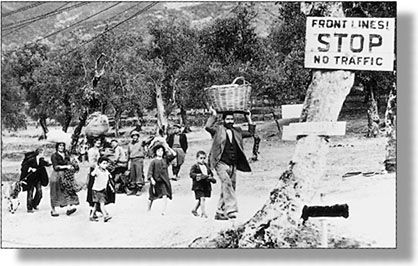
ITALIAN REFUGEES ON THE MOVE WITH THE FEW POSSESSIONS THAT THEY MANAGED TO CLING ON TO.
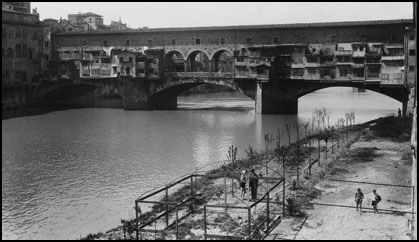
MANY OF FLORENCE’S HISTORIC BRIDGES DID NOT SURVIVE THE WAR. THE PONTE VECCHIO WAS A LUCKY EXCEPTION.
FLORENCE AND THE PONTE VECCHIO
Birthplace of the 15th-century Italian Renaissance and home of countless art treasures, the city of Florence was occupied by German troops as part of the defensive Gothic Line until August 1944, when it was liberated by the combined efforts of Italian partisans and Allied troops. Although many of the city’s magnificent statues had been covered or removed to prevent damage from Allied bombs, the retreating Germans attempted to buy themselves time as Allied forces entered the city by blowing up the series of historic bridges that crossed the River Arno. Only the famous, and historic, Ponte Vecchio was saved, after locals pleaded with the German forces to spare it.
Meanwhile, in an attempt to relieve the pressure on Monte Cassino, US troops had landed at Anzio, 20 miles south of Rome, on 22 January 1944, but were pinned down on a critically exposed beachhead for the next four months. The breakout did not come until 23 May. The link-up with forces moving up from the south took place on 25 May, and 10 days later, amid scenes of joy, tears and cheers, US troops entered Rome on 4 June. Emotional scenes like this were soon to take place elsewhere in Europe as the Allied saviours liberated towns and cities from their Nazi bondage, but, for the moment, it was enough that President Roosevelt could proudly announce: ‘The first Axis capital is in our hands. One up and two to go!’
In his eagerness to reach the Italian capital before the British, General Mark Clark had failed to encircle Rome and, as a result, most of the German 10th Army, of almost 30,000 men, escaped. German headquarters presented the retreat rather differently, issuing a report explaining that ‘as there was a danger that Rome, one of the oldest cultural centres in the world, would be directly involved in the present fighting, Hitler has ordered the withdrawal of German troops in order to prevent its destruction.’ This, though, did little to disguise the fact that an eventual Allied victory in Italy was starting to look more and more likely, despite Kesselring’s considerable defensive skills.
In the meantime, though, the Allies had found themselves with other pressing problems. As the Allied forces liberated more and more territory, they faced great difficulty in providing for the Italian population. Millions had been rendered homeless and hungry by the war, which had also destroyed most of the country’s infrastructure. An Allied Military Government of Occupation (AMGOT) was set up to feed the starving Italians, keep the streets clean, issue money and carry out the other essential duties of government. However, as Roosevelt warned, its work would be ‘gradual’ at best. The port of Naples, occupied by the Allies between October 1943 and December 1944, illustrated the problems they faced. A city of over one million inhabitants, most of them living in dire poverty, Naples had first been occupied by German troops who attempted to impose forced labour on the population. The Neapolitans would have none of it. There was a widespread public uprising and four days of open warfare in the city streets. By the time the Allies took control, starvation and disease were rife, largely as a result of the massive Allied bombing campaign that led to the city’s liberation on 1 October 1943. US soldiers reported that hundreds of thousands of children who had been orphaned by the war were turning to crime and prostitution to survive. There was little that could be done. Attempts to remedy the situation were already hampered by arguments between the British and US governments over how much Italy should be punished for its role in the war. The British favoured a much tougher line than the USA.
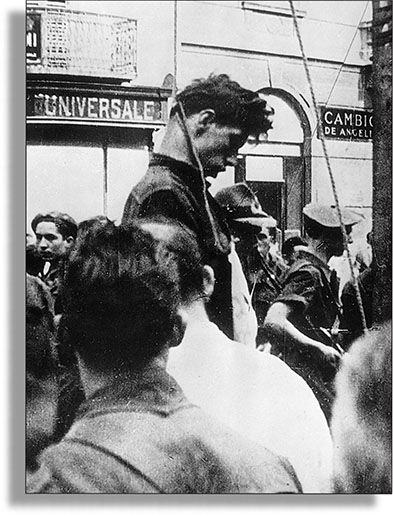
A PUBLIC HANGING OF A SUSPECTED ITALIAN PARTISAN MEMBER IS CARRIED OUT BY GERMAN TROOPS AS A WARNING TO OTHERS. GERMAN RETRIBUTION FOR PARTISAN ACTIVITIES WAS CHARACTERISTICALLY BRUTAL.
The British were now also becoming increasingly concerned about growing support among the poor and dispossessed for the numerous Italian communist organisations that had sprung up since the surrender. They feared an eventual communist takeover. This, though, was an over-anxious attitude. The communists were only a few among many groups of Italians intent on resisting the German forces. For instance, following the cease-fire declaration, 10,000 Italian soldiers on the Greek island of Cephalonia had been executed for refusing to surrender to their former German comrades. The German occupation of Rome on 11 September 1943 had been met by fierce local resistance, and 600 Romans had been killed. Later, as the retreating German Army established new defensive positions at the Gothic Line along the River Arno, Italian partisan organisations took up the fight. As in the rest of occupied Europe, an underground resistance movement had quickly sprung up in Italy and, by 1944, there were almost 100,000 partisans operating in the north alone. In many places, they set up their own local governments, as well as engaging in savage fighting with German and fascist soldiers. Made up largely of local peasants, who lived off the land and operated from hide-aways in the hills, partisan units sabotaged German supply lines and communications and ambushed their troops, as well as preventing the seizure of grain for transportation back to Germany. Partisan organisations even took control of the northern half of Florence after assisting in the liberation of the historic city on 5 August 1944.
GRAN SASSO
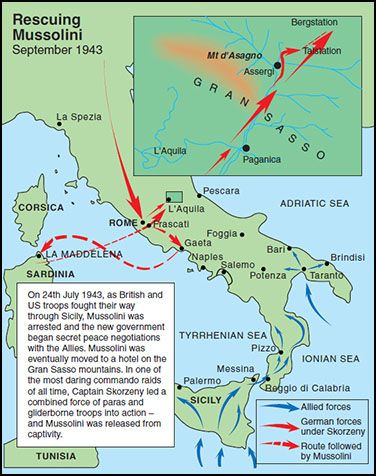
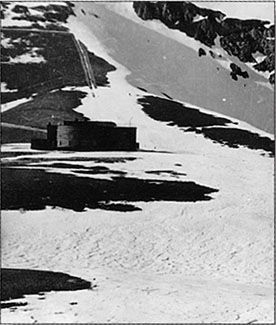
IN AN AUDACIOUS COMMANDO RAID.
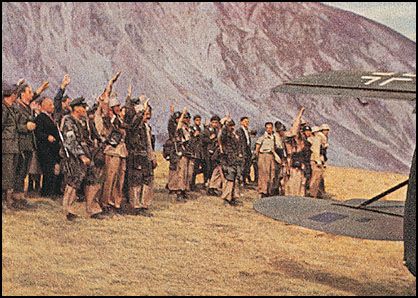
MUSSOLINI IS RESCUED FROM HIS MOUNTAIN PRISON.
THE RESCUE OF MUSSOLINI
After being removed from power in July 1943, the former fascist dictator of Italy, ‘Il Duce’ Benito Mussolini, was imprisoned by what was left of his own government. Three months later, at Hitler’s personal request, a daring mission was mounted to rescue him by Colonel Otto Skorzeny, a dashing 6ft 6ins tall German commando with a scar across his cheek. Skorzeny, once known as ‘the most dangerous man in Europe’, together with a team of crack parachute troops landed at the mountain resort where Mussolini was held, subdued the guards and quickly removed Hitler’s old ally. Later, Mussolini was installed as head of the Republic of Salo, with a ‘capital’ at Gargagnano on Lake Garda. From there, Il Duce was supposed to lead fascist operations, but his most noteworthy action was the trial and execution of five politicians who had voted for his removal when the Allies invaded. One of them was Mussolini’s own son-in-law, Count Galeazzo Ciano, who was shot on 11 January 1944.
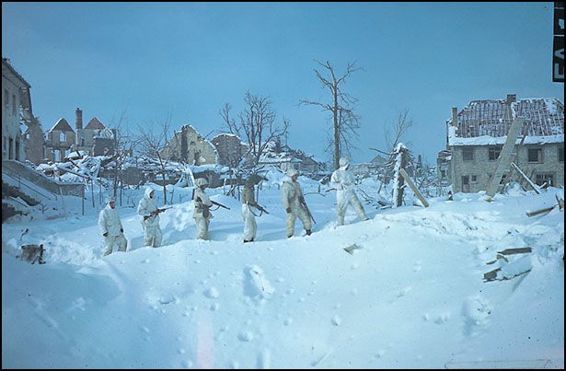
US TROOPS ON PATROL IN NORTHERN ITALY DURING THE HARSH WINTER OF 1944, WHICH STALLED THE ALLIED OFFENSIVE UNTIL THE FOLLOWING SPRING.
German reprisals against partisan activities were extremely retributive. As in occupied Russia, SS units were unleashed on the Italian countryside to use brutality and terror in an effort to subdue the civilian population. In September 1943, the town of Boves in Piedmont had been burned to the ground in response to partisan activities in the area. During August 1944, one SS battalion, commanded by Major Walter Reder, embarked on a ‘march of death’ across Tuscany, executing every man, woman and child in each of the villages they entered. The situation grew even worse during the harsh winter of 1944 as Kesselring’s troops launched their own campaign to destroy the Italian resistance once and for all. Trapped in the hills and poorly equipped, many partisans were hunted to their deaths. At the Marzabotto commune in Emilia, almost 2000 of them were killed by German soldiers.
Meanwhile, the Allied advance had stalled and General Alexander announced that there would be no fresh Allied offensive until the following spring. He suggested that partisan groups in northern Italy cease activity and ‘go to ground’ for their own safety. This was taken as an insult by many partisans. It also encouraged Mussolini’s remaining fascists to begin their own campaign against peasant villages ‘suspected’ of harbouring the resistance fighters.
During August 1944, one SS battalion, commanded by Major Walter Reder, embarked on a ‘march of death’ across Tuscany, executing every man, woman and child in each of the villages they entered. The situation grew even worse during the harsh winter of 1944
The effects of the winter were also felt in the industrial cities of northern Italy, the more affluent part of the country. There, people were living without food or fuel in homes shattered by Allied bombs. In cities like Turin, sabotage and lack of raw materials for factories administered by the occupying Germans had led to mass unemployment. The SS had begun rounding up workers for transportation back to Germany to aid the ailing Nazi war effort. Resistance took the form of a series of widespread strikes organised by communist groups and trade unions throughout the winter and into the spring of 1945, accompanied by equally widespread industrial sabotage and the occupation of factories by their workers. As in the countryside, the urban resistance paid a high price for these activities. In Milan, 15 ‘political prisoners’ were shot in public for the destruction of one German lorry. Nevertheless, in the last week of April 1945, as Allied troops once again began to advance northwards, a combined force of workers and partisans finally rose up en masse against the German occupation. This ‘National Insurrection’ spread through the cities of northern Italy within hours. In Genoa, the resistance cut off supplies and communications to the local German barracks and seized the city after two days of fighting. In Turin, armed factory workers battled German soldiers until partisans arrived to relieve them. In Milan, where fighting centred around the Pirelli tyre plant, the German forces surrendered on 26 April as Allied soldiers approached.
By then, the struggle for Italy and, in fact, the war in Europe itself were almost at an end. At midday on 2 May 1945, Kesselring, who had already been negotiating with the Allies for some days, announced the total surrender of the German forces. On hearing the news, Mussolini immediately attempted to escape to Switzerland with his mistress, Claretta Petacci, and a large amount of gold bullion. Mussolini and Claretta were captured by partisans outside the village of Dongo near Lake Como. They were executed on the spot. Afterwards, their bodies were hung upside down from a girder in a filling station at Milan’s Piazza Loreto. There, a large crowd massed to abuse, spit upon, curse and otherwise excoriate them. The scene was so brutal that even the Allies protested.
The Italian campaign had cost the Allies over 300,000 casualties and the Germans over 500,000. In addition, 30,000 resistance fighters had lost their lives struggling to free their country. Later, there was considerable debate over whether the campaign in Italy should have taken place at all. However, the fact remained that by allowing Italy to surrender and then tying down considerable German resources, those who fought and died on the ‘second front’ made a major contribution to the eventual defeat of Nazi Germany.
Mussolini and Claretta were…executed on the spot. Afterwards, their bodies were hung upside down from a girder in a filling station at Milan’s Piazza Loreto. There, a large crowd massed to abuse, spit upon, curse and otherwise excoriate them. The scene was so brutal that even the Allies protested
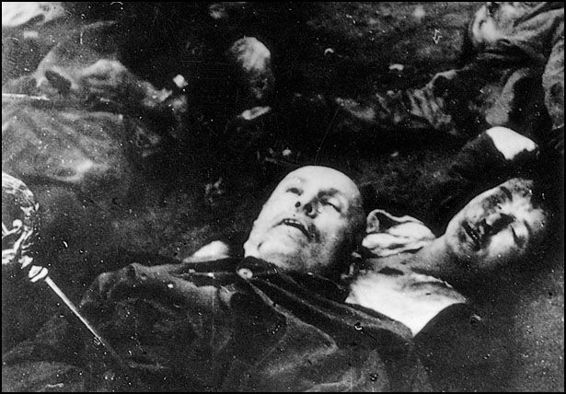
MUSSOLINI AND HIS MISTRESS, CLARETTA PETTACI, LIE DEAD IN A MILANESE SQUARE, THE ITALIAN PUBLIC HAVING ENACTED A GRUESOME REVENGE ON THEIR CORPSES. ONE OF THE ITALIAN DICTATOR’S FAVOURITE SAYINGS HAD BEEN: ‘EVERYONE GETS THE DEATH HE DESERVES.’