
CHAPTER 4
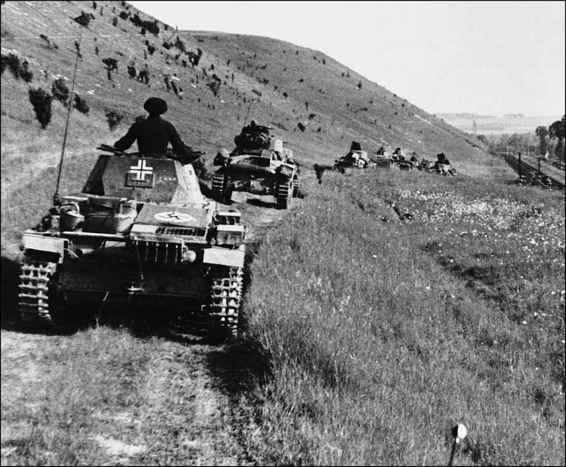
ACHTUNG PANZER! A GERMAN PANZER DIVISION UNDER
THE COMMAND OF GENERAL ERWIN ROMMEL PLOUGHS
THROUGH THE FRENCH COUNTRYSIDE AS THE WAR IN
THE WEST FINALLY GETS UNDER WAY.
OPERATION YELLOW
On 10 May 1940, the Phoney War came to an abrupt end as Hitler’s armies moved into France and the neutral Low Countries – Belgium, the Netherlands and Luxembourg. The war in the west was finally under way. The speed of the German invasion and the skill with which it was executed took the Allies and the neutrals by surprise. German paratroopers captured key bridges in the Netherlands, where they were aided in part by Dutch Nazis disguised as military police. Meanwhile, 78 paratroopers landed gliders on what was described as the world’s greatest fortress, Eben Emael, on the Albert Canal in Belgium. Next day, the Germans captured the fortress and the key defensive positions it commanded with the aid of explosive charges. They lost only six men in the process.
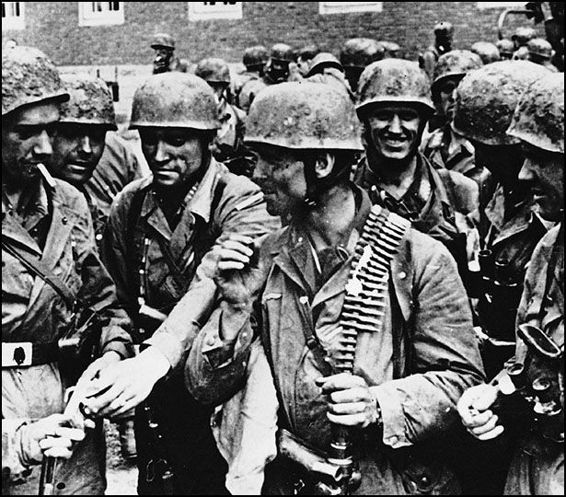
GERMANY’S ELITE PARATROOPERS. THESE MEN HAVE JUST PULLED OFF THE IMPRESSIVE STUNT OF CAPTURING THE ‘WORLD’S STRONGEST FORTRESS’, EBEN EMEAL IN BELGIUM, IN JUST 24 HOURS.
Hitler had mobilised 136 divisions, over 2000 tanks and more than 4000 planes against the Allies in the hope of conquering France in a single knockout blow before wheeling his armies around to the east and attacking Russia. There, Hitler aimed to defeat Stalin, his ally, which would leave Germany free to colonise eastern Europe and, at the same time, deal worldwide communism a mortal blow.
BATTLE OF THE LOW COUNTRIES

As the Nazis began their assault on France and the Low Countries, the neutrals immediately asked the Allies for assistance. Accordingly, the cream of the British and French armies now moved north to take up defensive positions along the Dyle Line in Belgium. Unfortunately, their movements were just as Hitler had predicted and before the Allied armies could move forward to take up their new positions, Nazi para-troopers were already overwhelming the Belgian defenders. The Germans gave the Allies no time to set up firm defences in either the Netherlands or Belgium. The day before he launched the attack, codenamed Operation Yellow or ‘Fall Gelb’, Hitler told his generals: ‘Gentlemen, you are about to witness the most famous victory in history.’ Although the risks he was taking were enormous, Hitler was not far wrong.
The German paratroopers fighting to secure the bridges and communications in the Netherlands and Belgium were only part of one of the three German Army groups now advancing on the Allies. Hitler had divided his 136 divisions into three main groups. Army Group B under General von Bock moved into Belgium. Army Group C under General Ritter von Leeb advanced against the Maginot Line on the Franco–German border, with the intention of keeping the 400,000 men garrisoned there tied down. Both these attacks had been anticipated by the Allies, but what they failed to predict was the route taken by Army Group A, which, under General von Runstedt, possessed the greater part of Germany’s armoured divisions.
‘Gentlemen, you are about to witness the most famous victory in history’ Adolf Hitler to his generals on the eve of Operation Yellow or ‘Fall Gelb’. Although the risks he was taking were enormous, he was not far wrong
Following a plan put to him by General von Manstein, the outstanding German strategist of the war, Hitler sent Army Group A with its seven panzer divisions through the Belgian Ardennes. This, of course, exposed the great weakness of the much-vaunted Maginot Line, which ended at the Franco–Belgian frontier. When the Line was built in 1935–6, it had not been thought right to place this massively strong defence line along the border of a friendly country, but the omission was a fatal one. Some reassurance had been drawn from the notion that the Germans could not penetrate the heavily wooded terrain of the Ardennes at the western end of the Maginot Line. Certainly, the Allies never imagined that the German tanks could get through. Therefore, the French had felt it unnecessary to place top-class soldiers close to the Ardennes. In fact, the French forces in the area, General Corap’s 9th Army and General Huntziger’s 2nd Army, were not of the highest quality.

GENERAL ERWIN ROMMEL, LEGENDARY PANZER COMMANDER, WHO LED THE CHARGE THROUGH THE ARDENNES ACROSS THE MEUSE AND ON TO THE CHANNEL.
The Germans, however, confounded all expectations, circumventing the Maginot Line, pushing through the Ardennes and emerging in good order on 12 May. Even then, the French were not unduly concerned. But what they failed to realise was that the forces now massing on the opposite bank of the River Meuse comprised the main force of the German attack. According to military textbooks of the First World War, which were still regarded as relevant 20 years later, the Germans would take several days to cross the Meuse. In the event, the received military wisdom got it wrong again. General Erwin von Rommel, commanding the 7th Panzer Division at Dinant and General Hans Guderian, a tank expert, commanding the 2nd and 10th Panzer Divisions at Sedan, were across the river in a single day. By 13 May, both generals, aided by the German terror dive-bombers and tanks, had crossed the Meuse with frightening speed, using captured footbridges, pontoons and rubber boats.

THE GERMAN DECISION TO PLACE ALL THEIR HOPES OF SUCCESS IN THE STRENGTH OF THEIR PANZER DIVISIONS PAID OFF HANDSOMELY AND, AS A RESULT, GERMAN CASUALTIES IN FRANCE PROVED EXTREMELY LIGHT.
Just as they managed to establish a panzer bridgehead on the western banks of the Meuse with unprecedented speed, so the Germans were eager to break out into the countryside of north-eastern France and force their way towards the Channel coast. When he heard the news that the Germans had crossed the Meuse and taken Sedan, the French General Alphonse Georges, Commander of the North-East Front, burst into tears.
Within days of their attack, the Germans had managed to tear a hole in the Allied lines that the Allies would never manage to plug. On the same day, the Dutch port of Rotterdam was bombed by the Luftwaffe and over 800 civilians were killed. Just one day later, on 14 May, the Dutch Army, which had not fought a war since 1830, surrendered. The Dutch Queen, Wilhelmina, fled to England.
Winston Churchill, who had become British prime minister on 10 May, the same day as the German invasion of western Europe, flew to Paris to discuss the rapidly deteriorating situation with his French allies. Churchill was appalled by both the scene and the news that greeted him. At the Quai d’Orsay, officials of the French foreign ministry were burning government papers in huge bonfires. It was a dark portent of the impending French defeat and the country’s future.
As the Allied front began to collapse, Churchill asked the French Commander-in-Chief, General Gamelin, which troops he was going to use to shore up the widening gap in the Allied line. Gamelin dumbfounded Churchill by saying he had no troops to spare. Without a mobile reserve to stop it, the German advance could now proceed virtually at will.
Realising the situation was desperate, French Prime Minister Reynaud sought a replacement for his Commander-in-Chief. Banking on the reassurance of past successes, Reynaud sent for two heroes of the First World War: General Maxime Weygand, aged 73, was to replace Gamelin, and Marshal Philippe Petain, 84, was to serve as Reynaud’s deputy.
Meanwhile, the Germans continued their race for the Channel, following the line of the River Somme, where they had succeeded in opening up a ‘panzer corridor’ between the Allied armies fighting in Belgium and northern France, and those positioned further south towards Paris. As German armour fought its way to the sea, the Allies mistakenly assumed they were heading for the French capital. This had been Hitler’s intention all along and he was correct when he observed that the Allies had ‘failed to appreciate the basic idea of our operations’.
THE FALL OF FRANCE

On 20 May, the Germans reached Abbeville and by 21 May had established themselves on the Channel coast. The Allied armies, including the British Expeditionary Force, had been separated from their supplies and communications and were effectively cut in two. The obvious course of action would have been to counter-attack in force, separating the German tanks at the head of the ‘panzer corridor’ from the infantry and supplies following behind them. But neither the French nor the British were capable of such a move. The speed of the German blitzkrieg was something no Allied general had contemplated before the war. In order to mount an effective counter-attack, the Allies needed time – something that Hitler was certainly not prepared to give them.
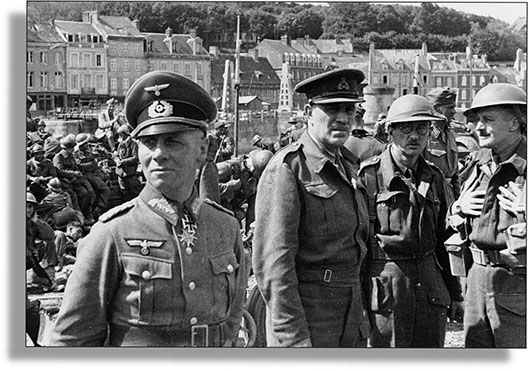
THE 51ST HIGHLAND DIVISION SURRENDERS AT VALERY-EN-CAUX. ROMMEL (LEFT) STANDS NEXT TO MAJOR GENERAL VICTOR FORTUNE.
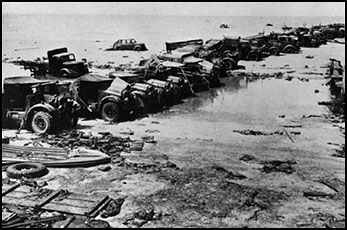
BRITISH TRUCKS AND ARMOUR LIE DESTROYED AFTER THE BEF’S WITHDRAWAL FROM FRANCE, JUNE 1940.

BATTERED TOMMIES DISEMBARK IN SOUTHERN ENGLAND AFTER THEIR SAFE RETURN FROM THE HORRORS OF THE BEACHES AND THE LUFTWAFFE’S PURSUIT ACROSS THE CHANNEL.
DUNKIRK: THE SCENES ON THE BEACHES
As May 1940 drew to its close and the speed of the German advance caused increasing British fear for the safety of its army in France, steps were taken to evacuate the rear echelons of the British Expeditionary Force. As the situation darkened, British and French frontline troops retreating to the Dunkirk perimeter found that, fortunately, the local countryside was ideal for fighting a rearguard action. But it was here that the breakdown of the Franco–British alliance became clear. While the French were hoping to defend Dunkirk, the British were retreating back to their island home and did not intend to leave anything behind that could help the enemy. Consequently, in one incident, British troops took 28lb sledgehammers to their brand-new lorries, trucks and Bren gun carriers, but when the French refused to do the same, the two sides almost came to blows.
The shallow beaches at Dunkirk, which afforded precious little draught, made the evacuation extraordinarily difficult for Royal Navy vessels and also for the civilian volunteers, who between them brought nearly 900 ‘little ships’ across the Channel. Before their rescue, troops were forced to stand out in the water while small craft, many owned by British or Belgian fishermen, took them on board and ferried them to the larger ships further offshore. Most men were prepared to queue in an orderly fashion, but some officers managed to maintain discipline only at gunpoint.
Conditions on the beaches were appalling. Much of Dunkirk was on fire and the smell of burning machinery and corpses hung oppressively over the shoreline. The RAF, which lost over 170 planes in the process, did its best to provide air cover for the stranded soldiers, but due to limited resources, the British and French troops were left unprotected for periods of half an hour or even 90 minutes. That was when they were exposed, helpless, to the ministrations of the Luftwaffe. During this time, German planes were able to bomb the beaches and the shallows at will.
Nor was the ordeal of the British ‘Tommies’ finished once they had managed to board a rescue ship. German aircraft, torpedo boats and U-boats operating in the Channel claimed many lives. Nevertheless, 338,226 exhausted men returned safely to Britain.
The evacuation lasted 10 tense, perilous days, and once back home, the Tommies were greeted by volunteers and the Salvation Army offering tea, cigarettes and pork pies.
With the evacuation complete, Prime Minister Churchill, speaking to the House of Commons, made clear to the Germans and whoever else was listening, that Britain’s resolve to fight on was absolute. Dunkirk, as Churchill reminded the House, may have been a defeat, but he said: ‘We shall fight in France, we shall fight on the seas and oceans, we shall fight with growing confidence and growing strength in the air, we shall defend our island whatever the cost may be. We shall fight on the beaches, we shall fight on the landing grounds, we shall fight in the fields and in the streets, we shall fight in the hills. We shall never surrender!’
DUNKIRK
On 19 May 1940, the British Commander, Lord Gort, finally realised that the British Expeditionary Force was now surrounded. He issued orders to start preparations to evacuate British forces from France should this become necessary. The situation was grave in the extreme. If the British Expeditionary Force was destroyed or captured, Britain would be without an army with which to defend itself from a German invasion, if and when it came. The Belgian Army to the north was absorbing the full fury of the German attack. Should the Belgians fail, nothing would stand in the way of the German forces and Dunkirk, France’s fourth-largest port and the British Expeditionary Force’s only means of exit. Of the alternatives, Boulogne was captured by the 7th Panzers on 21 May and the British garrison at Calais was isolated on 22–3 May.
The British were somewhat secretive about telling their ally that preparations were afoot for a British evacuation from the Continent. The French had been counting on support from Lord Gort to mount a counter-attack, but although he was officially under French command, Gort had other priorities. He used the troops earmarked for operations with the French to give support to the rapidly disintegrating Belgian Army. Gort’s decision probably saved the British Expeditionary Force, but he earned no plaudits from the French. But even with Gort’s aid, the Belgians were no longer capable of mounting effective resistance. After struggling valiantly for 18 days and losing over 6000 men killed, King Leopold III decided enough was enough: Belgium surrendered on 28 May. The French were furious and Reynaud quickly labelled Leopold a traitor. The king was hardly that, since, unlike Haakon of Norway and Wilhelmina of the Netherlands, he had decided to stay with his people and bear the pain of German occupation with them. Reynaud’s accusation was unjust but, though Churchill knew this, he did little to challenge it.
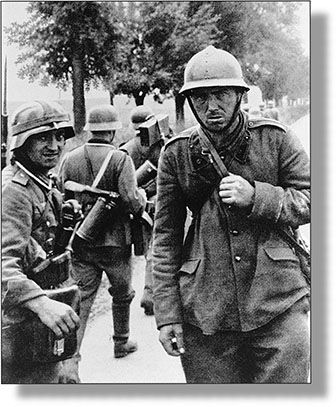
THE FACE OF DEFEAT. A FRENCH PRISONER IS LED AWAY BY HIS GERMAN CAPTORS. THE SPEED OF THE GERMAN VICTORY IN FRANCE BELIES THE COURAGE DISPLAYED BY THE FRENCH IN RESISTING THE INVADER.

FREE FRENCH SOLDIERS TRAIN IN SOUTHERN ENGLAND FOR THEIR HOMELAND’S EVENTUAL LIBERATION FROM THE NAZIS.
DE GAULLE AND THE FREE FRENCH
As the French Government collapsed and Marshal Petain took it upon himself to make peace with the Germans, Brigadier-General Charles de Gaulle escaped to Britain. On 18 June, he began the task of organising French resistance to the Nazis. Speaking on BBC radio from London, he rejected outright the verdict of the battlefield, declaring: ‘This war has not been decided by the battle of France. This is a world war.’
De Gaulle’s defiance of the Germans was spirited but seemed to have little hope of bearing fruit as the whole of the French Empire at first rejected his call against the collaborationist Petain. Later, while French territories in north Africa – Algeria, Tunisia, Morocco – remained loyal to Vichy, further-flung territories, such as Cameroon in west Africa, switched allegiance to de Gaulle and the Free French. Above all, de Gaulle had sown the seeds of the Free French movement, which the British recognised as the legitimate government of France 10 days after de Gaulle’s broadcast, on 28 June.
Over the ensuing years, with both British and American help, de Gaulle was able to keep an organised French fighting force in the field, and eventually led them in triumph through liberated Paris in 1944.

BRITISH TROOPS SNATCH A FEW MOMENTS REST AS THEY RETREAT THROUGH FRANCE IN THE SUMMER OF 1940. UNLIKE THEIR FATHERS 20 YEARS EARLIER, THESE TOMMIES WERE GIVEN NO CHANCE TO DIG IN AND FIGHT.
Two days before Leopold’s surrender, the Royal Navy began ferrying British troops from Dunkirk back to England. The disastrous defeat suffered by the Allies in France was softened only by the success of the Royal Navy, and the hundreds of civilian vessels – the ‘little ships’ – which volunteered their help in carrying the British troops home. From there, with the help of the vast and unconquered British Empire, they could carry on the fight against Nazism. But this deliverance was made possible only by the bravery of the Belgian Army in the days before its collapse and by the fierce resistance offered the Germans by the French 1st Army at Lille. The vigour of the RAF also counted for a great deal and so did the daring of the Royal Navy, the tenacious fighting spirit of the British Expeditionary Force and, most ironically, a serious miscalculation on the part of Adolf Hitler.
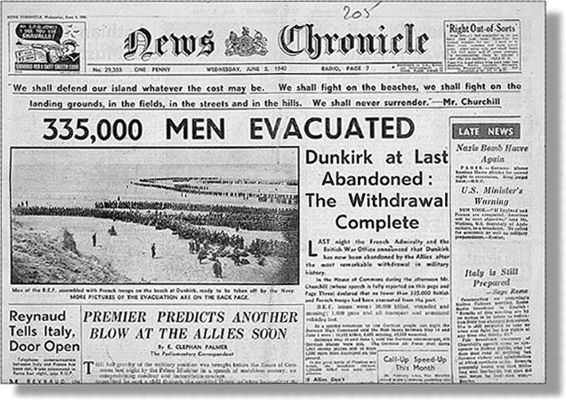
THE BRITISH TABLOID PAPER THE NEWS CHRONICLE LENDS ITS HAND TO ONE THE MOST SENSATIONAL PIECES OF POLITICAL ‘SPIN’ IN HISTORY. AIDED BY CHURCHILL’S TRULY INSPIRATIONAL CALL TO ARMS UNDER THE MAST HEAD, THE PAPER BEGINS TURNING THE BRITISH EXPEDITIONARY FORCE’S ABSOLUTE DEFEAT IN FRANCE INTO THE ‘MIRACLE’ OF THE DUNKIRK EVACUATION.
With the British Expeditionary Force surrounded, the Belgians on the verge of capitulation and the French Army in total disarray, the Germans had their opponents at their mercy, with a string of successes behind them hardly ever matched in the history of warfare. Yet, at this juncture on 26 May, Hitler ordered his panzer divisions to halt. They remained halted for two days, but even then did not resume their assaults for another eight days. This was to prove a fatal mistake and one that may have ultimately cost Hitler the war, but the reasoning behind it seemed rational enough at the time.
The French were furious and Reynaud quickly labelled Leopold a traitor. The king was hardly that, since, unlike Haakon of Norway and Wilhelmina of the Netherlands, he had decided to stay with his people and bear the pain of German occupation with them
Hitler knew he needed to preserve the majority of his armour for the coming assault on Paris, and the Chief of the Luftwaffe, the flamboyant Hermann Göring, vainly assured his Führer that his air force could prevent any evacuation by the British. At this time, of course, the Luftwaffe had not yet encountered an air force anywhere near its equal. What neither Hitler nor Göring realised, therefore, was that the RAF was going to be the first such force to give as good as – if not better than – it got. The RAF possessed a fighting spirit the Germans had not yet encountered.

GERMAN SOLDIERS ENTER THE FIERCELY BURNING TOWN OF ROUEN.
In days, Hitler’s forces were crossing the Seine and rapidly approaching Paris. The French, unable to halt or even slow down the German advance, declared Paris an open city in the hope of saving it from the fighting and consequent destruction
Operation Dynamo, the code name given to the evacuation of Dunkirk, was carried out under the direction of Vice-Admiral Ramsay. It was a truly perilous mission. The Royal Navy was forced to engage ships in extremely shallow waters while under ferocious attack from the Luftwaffe, but then the stakes could not have been higher. Estimates varied concerning how many men the Royal Navy could successfully retrieve and return to England, but the figure, officials believed, would not rise above 50,000. It was a gross underestimation. Miraculously, or so it appeared, between 26 May and 3 June 1940, a total of 338,226 British and French troops were taken safely across the Channel. Of these, over 100,000 were French, but all of them returned to France more or less at once, where they continued with ever-increasing vigour to challenge the German advance, even though this was by now a hopeless task.
THE FALL OF FRANCE
The German tanks began to roll forward once more on 5 June. The new Allied front, named the Weygand Line after its French creator, was hastily put into place and although the military strategy behind Weygand’s final roll of the dice was sound, he did not have the resources to put it into proper effect.

THE 6TH AND 7TH RIFLE REGIMENTS AND THE 7TH MOTOR CYCLE REGIMENT OF ROMMEL’S 7TH PANZER DIVISION ADVANCE ACROSS THE FIELDS OF FRANCE. THEIR COMMANDER WAS TO NOTE WITH SURPRISE THAT AS THE FRENCH NEARED EVER CLOSER TO DEFEAT THEIR RESISTANCE CONTINUED TO STIFFEN.
The Belgians, the Dutch and, to a large extent, the British were all out of the fighting, and the French Army itself had lost one-third of its strength. Despite desperate French pleas, Churchill, after grim warnings from the head of the RAF, Air Marshal Sir Hugh Dowding, was not willing to commit any more RAF aircraft to the fight against the Germans in case the defence of Britain was compromised. In days, Hitler’s forces were crossing the Seine and rapidly approaching Paris. The French, unable to halt or even slow down the German advance, declared Paris an open city in the hope of saving it from the fighting and consequent destruction.

PARISIANS WATCH WITH SHAME AS HITLER’S VICTORIOUS FORCES ENTER THE FRENCH CAPITAL. CHURCHILL HAD HOPED THE FRENCH WOULD MAKE THE GERMANS FIGHT FOR THE CAPITAL AS STREET-FIGHTING COULD BE RELIED ON TO ABSORB MASSES OF GERMAN MEN AND MATERIEL. BUT IN ORDER TO SAVE THE CITY FROM DESTRUCTION, THE FRENCH ARMY DECIDED TO EVACUATE THE CAPITAL. WITHOUT A FIGHT.

SOLDIER TURNED TOURIST. A GERMAN OFFICER ROOTS OUT BARGAINS IN A PARISIAN SECONDHAND BOOKSTALL, RIGHT UNDER THE SHADOW OF NOTRE DAME.
Under the strain of the German victories and the French collapse, which now seemed inevitable, the alliance betwen Britain and France was falling apart. As the German forces approached the French capital, leading figures in the French Government began to accept the idea that France would have to sign a separate peace treaty with Germany, even though this was contrary to their alliance with the British. Churchill hoped to combat French defeatism by attempting to draw the USA into the fighting on the Allied side. He hoped this would keep the French in the war, but American President Roosevelt would not play ball: the USA, he told Churchill, was going to remain neutral. On 16 June, Churchill even suggested a Franco–British Union that would effectively make the two countries into one, with common citizenship. The French would have none of that. They had been traditional enemies with Britain for seven centuries before coming together for mutual defence against Germany with the Entente Cordiale of 1904. Some residual enmity remained and, in 1940, the French were not about to sink their identity into that of an ex-foe who was, in their view, proposing to leave them to their fate.

ON THE ROAD. REFUGEES SALVAGE WHAT FEW BELONGINGS THEY CAN AS THEY TAKE TO THE ROAD, NORTHERN FRANCE, JUNE 1940.
Meanwhile, German soldiers had already marched into Paris in triumph, on 14 June, watched by numbed crowds in which many were shedding bitter tears of grief and humiliation. But, dreadful as this was, it was only the culmination of a fearful week for the French. On 10 June, the French Government had fled Paris, and on the same day, Hitler’s ally Benito Mussolini brought Italy into the war on the Nazi side. Mussolini had repeatedly told Hitler that Italy would be unable to embark on a major European conflict until 1943, but Mussolini was afraid that unless he entered the fray now, he would never realise his dream of setting up a new Roman Empire and turning the whole Mediterranean into an ‘Italian lake’. Mussolini was also convinced that Hitler was well on the way to winning the war; and the winning side was the place to be.
Next day, with the Norwegian surrender on 11 June, Norway became the seventh country to capitulate to the Nazis. But the eighth would soon follow.

MARSHAL PETAIN (LEFT) SHAKES HANDS WITH HITLER (RIGHT) AND INITIATES A FOUR-YEAR PERIOD OF COLLABORATION WITH NAZI GERMANY.
With most of his cabinet unwilling to continue the fight, Reynaud resigned and, on 17 June, Philippe Petain opened peace negotiations with the Germans. By 22 June, the peace terms had been agreed and France was, for the moment, out of the fight. The aged Petain imagined that he was retrieving some honour for France, but the peace terms barely allowed France to continue as a sovereign state. She was, however, allowed to keep her overseas colonies, and acquired, in the south, a nominally French government under Petain, while the north was to remain under German occupation. Petain set up his headquarters in the spa town of Vichy, which gave his government its name, and embarked on a policy of collaboration with the Nazi conquerors in the north.

HITLER STANDS IN THE RAILWAY CARRIAGE IN THE COMPIÈGNE FOREST, WHERE GERMANY SIGNED THE ARMISTICE THAT ENDED THE FIRST WORLD WAR. HERE, IN HITLER’S PRESENCE, THE GERMAN GENERAL KIETEL READ THE HUMILIATING CONDITIONS OF THE FRENCH SURRENDER IN 1940 TO THE GATHERED DELEGATES OF THE FRENCH GOVERNMENT.

THE AMERICA FIRST COMMITTEE WAS SET UP AFTER THE FALL OF FRANCE WITH THE EXPRESS PURPOSE OF KEEPING THE US NEUTRAL.
THE USA AND THE FALL OF FRANCE
Both the American public and politicians alike had been little more than spectators in the European war since its outbreak and the defeat of France by the Nazis. Although it aroused American sympathy, it did little to persuade them to enter the war on the Allied side. The USA had had little desire to repeat the experience of the First World War. President Roosevelt closely identified himself with the Allied cause but his hands were tied by the Neutrality Acts passed by an isolationist Congress and pacifist public in 1936 and he could do little to help the British and French democracies as they struggled first to contain Hitler and then to avoid destruction on the battlefield. Despite his desire to see the Allies defeat Hitler, Roosevelt was a consummate politician who realised there was no desire on the part of the American people to involve themselves in another European war. This lack of action on the part of the USA led to the rather acid comment by Chamberlain that ‘It is always best and safest to count on nothing from the Americans but words.’ The Fall of France, however, led to a change of attitude. Churchill pleaded with Roosevelt to declare war on the Germans days before the French surrender. The president refused but he did agree to send 500,000 rifles, 80,000 machine-guns, 130,000,000 rounds of ammunition, 900 75mm field guns and 1,000,000 shells to the British. It was a brave act. These resources constituted a large part of the supplies the USA had reserved for her own defence and as France fell under the rule of the Nazis, Britain’s future as an independent power was by no means secure. As Hitler began his preparations for the invasion of Britain many Americans expressed grave concern that they could soon find the weapons they had so recently given to Britain being used against them.

A NAZI PROPAGANDA POSTER THAT READS: ‘YOU HAVE THE KEY TO THE CAMPS. FRENCH WORKERS YOU CAN FREE THE PRISONERS BY WORKING IN GERMANY.’ IF THE FRENCH DIDN’T WORK FOR THE NAZIS, THEIR COMRADES HELD CAPTIVE IN GERMANY WOULD NEVER BE RETURNED.
For all De Gaulle’s passion and his talk of resistance, the sombre fact remained that his homeland was now prostrate before her conqueror and Britain was left to face the might and fury of Nazi Germany alone

HITLER VISITED THE FRENCH CAPITAL THE DAY AFTER THE ARMISTICE AGREEMENT WAS SIGNED. HE LEFT THE CITY SAYING ‘I AM GRATEFUL TO FATE TO HAVE SEEN THIS TOWN WHOSE AURA HAS ALWAYS PREOCCUPIED ME.’
Collaboration was, however, passionately rejected by a young and till then unknown French commander, Brigadier-General Charles de Gaulle. De Gaulle had made a dramatic escape from France by jumping into a moving aircraft as it taxied for take-off bound for England. He totally refused to accept the French defeat as final. On 18 June, in a seminal radio broadcast from London, de Gaulle pledged to keep the flame of French resistance alive and invited all who could to join his Free French forces. Britain had now given sanctuary to yet another exile, and for all De Gaulle’s passion and his talk of resistance, the sombre fact remained that his homeland was now prostrate before her conqueror and Britain was left to face the might and fury of Nazi Germany alone.