
CHAPTER 5

THE DOCKS IN LONDON’S EAST END BURN, CASTING A
HUGE PALL OF SMOKE OVER TOWER BRIDGE AND THE TOWER
OF LONDON. WITH THE BATTLE FOR FRANCE OVER, THE
BATTLE OF BRITAIN WAS SOON IN FULL SWING.
OPERATION SEALION
With the French out of the war, the British, together with their Empire, were left to fight the Nazis alone. This plight would last for exactly one year, and during that time, the outcome of hostilities and the future of the entire world hung on whether or not Britain’s ability to resist the Nazis.

WHAT DID YOU DO IN THE WAR MUMMY? MRS T. CHARLESWORTH WORKED IN MUNITIONS, WHERE SHE USED A LATHE TO FASHION 17-POUNDER GUN CHAMBERS. BRITAIN CONSCRIPTED WOMEN INTO THE WAR EFFORT, A STEP TAKEN BY NEITHER GERMANY NOR THE USA.
The days after the Fall of France were therefore crucial to British morale. While the growing spirit of defiance, which Winston Churchill was starting to personify, was taking hold in the minds of many civilians, there were still those in high places who had come to believe that making peace with Hitler was the only sensible option. Their number included former prime minister Neville Chamberlain, the incumbent Foreign Secretary, Lord Halifax, and David Lloyd George, who had been Liberal prime minister during the First World War. They reasoned that with France under occupation and the Americans still holding back, Britain was unlikely to fight the war to a successful conclusion. Peace, therefore, seemed the only recourse. This same attitude lingered in the minds of some of those men of the British Expeditionary Force who had barely managed to return from France after the Wehrmacht had driven them, in many cases quite literally, into the sea. After this shattering experience, some were convinced that Britain could not fight on against such a deadly and determined foe. Besides, they believed, Britain had very little with which to fight Hitler. The British Expeditionary Force had destroyed all its heavy equipment during the retreat from France. Everything, from trucks and tanks to Bren gun carriers, had been smashed or left behind. Army units presently being formed in Britain had little equipment more lethal than heavy machine-guns. Surely then, the argument went, if the Germans invaded Britain, they could cut through what remained of the British Army like a knife through butter.

THE SPITFIRE. THE SPEARHEAD OF BRITAIN’S LAST-DITCH FIGHT AGAINST NAZI INVASION.
SPITFIRE
The Supermarine Spitfire is credited by many, whether justly or not, as the plane that won the Battle of Britain, although the less glamorous Hawker Hurricane actually shot down more German aircraft. The Spitfire, however, is remembered with greater affection. Everything about this aircraft seemed romantic, from its aerodynamic shape, to the brave young men who flew it in 1940, to the self-sacrifice of the designer R.J. Mitchell, who worked himself to death to produce it. It was an incredibly agile plane for its day and its 1030hp Rolls Royce Merlin engine gave it a top speed of over 360mph, not far from the practical limit for propeller-driven aircraft during the war. Armed with eight Browning 303mm machine-guns, it was more than capable of wreaking destruction on the slow-moving German bombers that got in its way. In 1940, it made up about one-third of Fighter Command’s frontline strength during the Battle of Britain, the rest being made up by the Hurricane. In all, the Spitfire ran to 16 different variants.
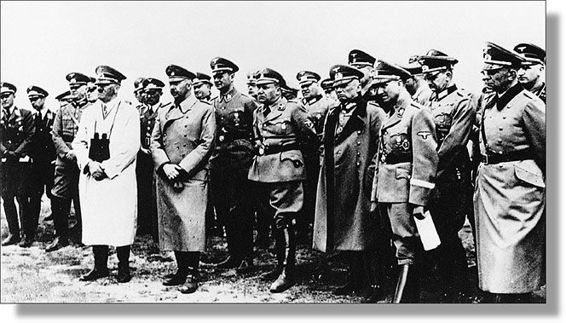
HITLER AND HIS STAFF LOOK OUT ACROSS THE CHANNEL COAST TO ENGLAND. ONCE FRANCE HAD SURRENDERED IN LATE JUNE, HITLER HOPED TO INVADE BRITAIN BY SEPTEMBER. IT WAS TO PROVE AN IMPOSSIBLE TASK.
Some outside observers were also convinced that Britain’s chances of survival were slim. Joseph Kennedy, the American ambassador to Britain, told President Roosevelt that the country’s defeat was imminent. Hitler, too, thought the British were beaten but were simply too foolish to recognise it. However, the British demonstrated their ‘foolishness’ when His Majesty’s government ignored Hitler’s peace overtures. As far as the Führer was concerned, there would be no second chance. On 16 July 1940, therefore, he ordered preparations for the invasion of Britain, code-named Operation Sealion.

MEN OF THE SS VERFUGUNSTRUPPE LOAD ARTILLERY ON TO AN INVASION BARGE IN PREPARATION FOR THE ‘INVASION OF BRITAIN’, SUMMER 1940. WITHOUT WINNING AIR SUPREMACY, THESE MEN AND THEIR SHIPS WOULD PROVE SITTING DUCKS ONCE IN THE CHANNEL. WHILE THE RAF HELD OUT, BRITAIN WAS SAFE.
OPERATION SEALION

Although the situation was desperate, there remained one vital defence: the English Channel, which more than once in the past had saved the British from invasion. This strip of water might be narrow, but its weather patterns were unpredictable and as a barrier it was backed by two further obstacles – the Royal Air Force and the Royal Navy. There was no hope that an invasion would be successful unless Germany could smash the RAF and win control of the skies over England, then neutralise the Navy. These defences had to be broken down first, and Hitler gave the job to his deputy, the Commander-in-Chief of the Luftwaffe, Hermann Göring.
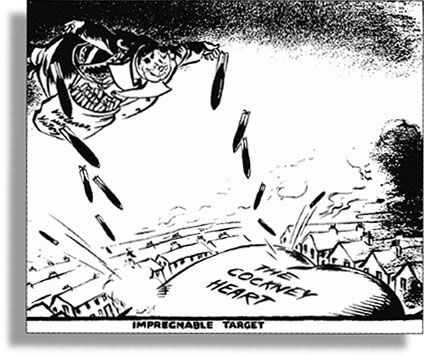
THE ‘COCKNEY HEART’: LONDON EVENING STANDARD CARTOON.
The German Army and Navy were not keen on Hitler’s plans, however. The Kriegsmarine had not yet recovered from the mauling it had suffered during the invasion of Norway and the army lacked the necessary resources to mount a full-scale invasion. The vainglorious Göring, though, was confident that he could crush the British. His confidence, if overweening, seemed well founded. Until now, Göring’s Luftwaffe had carried all before it, proving itself the vital spearhead for the Wehrmacht’s assaults on Poland, Norway and western Europe. Now, Göring believed, the Luftwaffe could step out from the supporting cast and carve out a strategic role of its own, one that no air force had ever before achieved: the destruction of an opponent without the interference of either army or navy, a triumph all their own.
This was easier said than done. Right from the start, the Luftwaffe was engaged in a race against time. As the first skirmishes of the air war began over the English Channel in mid-July, Göring had only two months to seize supremacy in the air over Britain before 15 September, the date that Hitler had set for the completion of the invasion preparations.
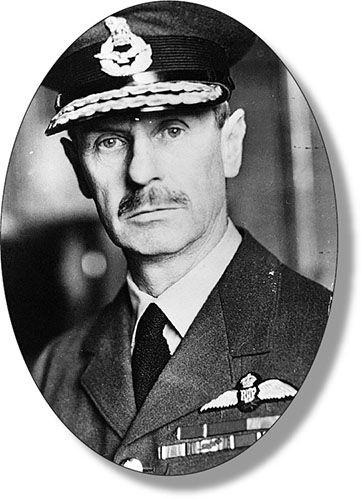
SIR HUGH DOWDING, THE QUIET, SEVERE AND BRILLIANT HEAD OF RAF FIGHTER COMMAND, AND THE MAN BEHIND BRITAIN’S AIR DEFENCES THROUGHOUT THE BATTLE OF BRITAIN.
The Luftwaffe had to overcome serious setbacks if it were to succeed. As its previous role had confined it to supporting attacks by the army, it lacked a heavy bomber with which to inflict fatal damage on the British defences and war industry. Furthermore, the British would have the advantage of fighting over their own home territory, giving them longer flying time over the combat zone. If they were shot down and survived, British pilots could bail out and fight again another day. But Luftwaffe pilots in the same position would become prisoners of war.

EYES ON THE SKIES. DURING THE SUMMER OF 1940, DOGFIGHTS BETWEEN THE RAF AND THE LUFTWAFFE REPLACED CRICKET AS THE NATION’S MOST POPULAR SUMMER SPORT.
However, even more fatefully, the Luftwaffe also lacked a clear overall strategy with which to deliver a knockout blow to Britain. The priorities and objectives of the German High Command shifted constantly during the battle, from targeting shipping, to striking at aerodromes and factories, until finally settling on heavy bombing of civilians in London. This was a truly fatal mistake. Destroying the RAF on the ground was what the Luftwaffe really needed to do. Instead, they attempted to break civilian morale and so terrify the British into submission. But Londoners’ nerve never broke. If anything, the bombing increased their will to resist.

THE MESSERSCHMITT BF109 – THE SPITFIRE’S DUELLING PARTNER.
MESSERSCHMITT BF 109E
The Messerschmitt Bf 109 was the Spitfire’s chief opponent during the Battle of Britain. It was, in fact, the most frequently manufactured German fighter of the war. As a fighter, the Me-109 was at least the equal of the Spitfire, but it suffered from several key limitations, including problems with wing design and a cockpit that gave pilots poor visibility. Most crucially for the dogfights that took place over southern England during the summer of 1940, the Me-109 had a poor range that severely curtailed its flying time over enemy territory. Its main role during the battle was to escort the Heinkel 111s and the Dornier bombers. For this task, it was euipped with two 7.92mm machine guns and 2x20mm cannon. The Me-109’s 1100hp Daimler Benz engine gave it a top speed of 354mph.
In addition, the Luftwaffe’s change-and-change-about tactics gave the British vital breathing spaces. The island nation may have appeared to the Nazis to be a sitting target – a view that was to some extent shared by the British people. However, the British were resolved to survive. As for their enemies, the built-in drawbacks of fighting a long-range battle were amplified by the Nazis’ many strategic mistakes. Whatever advantage they may have had, they effectively threw away.
Nevertheless, the danger in which Britain stood in the summer of 1940 – a beautiful, clear, warm summer ideal for uninterrupted aerial combat – could hardly have been more grave.

CHILDREN FILL SAND BAGS AS A DEFENCE AGAINST GERMAN AIR ATTACK. THE BLITZ WAS NO RESPECTER OF AGE.
The man given the demanding and awesome task of organising Britain’s air defences was Air Chief Marshal Sir Hugh Dowding, Commander-in-Chief of RAF Fighter Command. No one was better suited to it. Dowding, who was as reserved as Göring was vain and boastful, had spent the previous four years preparing Britain’s air defences for just such an eventuality. Using the latest technology, Britain had installed a chain of radar stations running along the coast from Orkney in the far north down to Cornwall in the extreme south-west. The radar stations, along with the men and women of the Observation Corps, would track enemy planes as they approached their targets. The waiting squadrons of Spitfires and Hurricanes could then be ‘scrambled’ to intercept the invaders. Radar also gave Dowding the ability to husband his scarce resources carefully. This advantage was to prove vital as the German attack pushed Britain’s precious reserves of pilots to the very limit.

YOUNG BOY SCOUTS HELP TO STRETCH BRITAIN’S LIMITED RESOURCES AS FAR AS POSSIBLE. BRITAIN EXISTED IN A STATE OF SIEGE FOR MUCH OF THE WAR, AND BY COLLECTING WASTE PAPER FOR SALVAGE THESE SCOUTS WERE HELPING TO FREE UP SPACE IN THE ATLANTIC CONVOYS FOR ESSENTIAL WAR MATERIALS.
Britain was fortunate, too, in possessing the latest fighter technology in the shape of the Hawker Hurricane and the Supermarine Spitfire. The Spitfire’s designer, R.J. Mitchell, had virtually sacrificed his life to prepare a fighter that could, and would, one day have to challenge the Luftwaffe in the struggle for Britain’s survival. Though he was suffering from cancer, Mitchell defied doctor’s orders to work on the Spitfire, which he developed from the seaplane that had won Britain the Schneider Trophy outright in 1931. Mitchell, sadly, never lived to see the Spitfire’s finest hour in the Battle of Britain. He died, at the age of 42, in 1937.
It was 1939 before the Spitfires and the Hurricanes started arriving with the RAF in appreciable numbers. However, the RAF had suffered severe losses both during the Battle of France and while defending the British Expeditionary Force on the exposed beaches of Dunkirk. Winston Churchill, realising that the future of Britain depended on there being sufficient numbers of fighters to repel the Nazis, gave the job of marshalling aircraft production to Lord Beaverbrook, the maverick Canadian newspaper publisher. Under Beaver-brook’s eccentric management, housewives were encouraged to part with their aluminium pots and pans to make fighter aircraft. The results were mixed, and not always crucial to the war effort, but Dowding never lacked planes and British production vastly outstripped that of the Germans. In fact, Dowding had more planes at his disposal after the Battle of Britain than before it. However, the really critical shortfall was the scarce supply of trained and experienced pilots.
The date, 13 August 1940, was codenamed ‘Adlertag’, Eagle Day. For the next week, German fighters – the Messerschmitt Bf 109s and the slightly less manoeuvrable Me 110s, along with Dornier and Heinkel bombers – attempted to batter the RAF into submission
THE BATTLE OF BRITAIN

After concentrating his opening shots on British shipping in the Channel, Göring turned his attention to the destruction of Fighter Command. With an arrogance typical of the man, he intended to deliver the RAF a single, overwhelming knockout blow. The date, 13 August 1940, was code-named ‘Adlertag’, Eagle Day. For the next week, German fighters – the Messerschmitt Bf 109s and the slightly less manoeuvrable Me 110s, along with Dornier and Heinkel bombers – attempted to batter the RAF into submission. Although the combat proved indecisive, the RAF gave better than it got and forced Göring to change tack. Dowding, anxious to conserve RAF strength, was not allowing his fighters to attack their German counterparts head on. Instead, he instructed them to attack the more vulnerable German bombers. Seeing this, Göring decided to pick targets the British would definitely have to defend. He chose the RAF aerodromes.

RESCUE WORKERS PULL THE INJURED FROM THE RUBBLE OF WHAT HAD BEEN, ONLY MINUTES EARLIER, THEIR HOMES. LONDON TOOK A BEATING DURING THE BLITZ YET, REMARKABLY, DESPITE THE INTENSE PRESSURE OF NIGHTLY BOMBING RAIDS, OFFICIALLY RECORDED INCIDENCES OF MENTAL ILLNESS FELL – AS DID THOSE FOR SUICIDE.
To meet the emergency, new pilot training was cut from six months to six weeks. These young men had, in many cases, never fired guns in anger before setting out to do battle…and by the beginning of August, when the full fury of battle was approaching, only half of Dowding’s pilots had actually been in combat
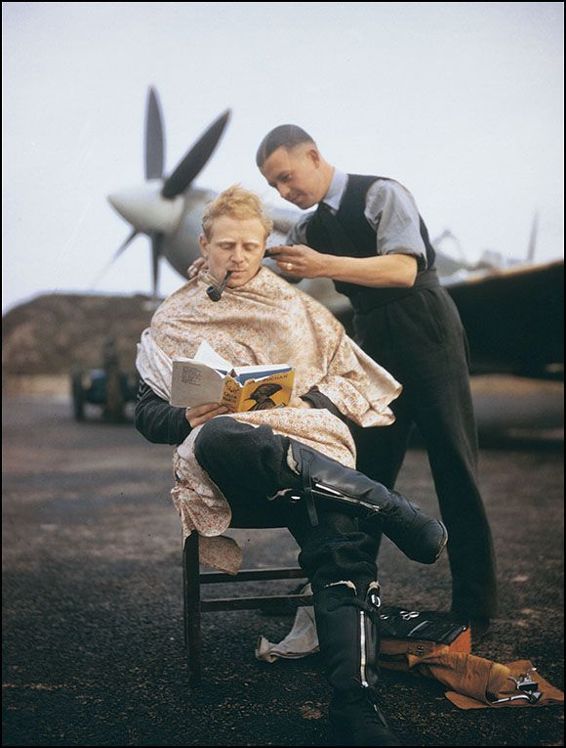
AN RAF FIGHTER PILOT TAKES THE WELCOME OPPORTUNITY FOR A HAIRCUT, A SMOKE AND A SHAVE IN BETWEEN SORTIES DURING THE HEAT OF THE BATTLE OF BRITAIN.
It was between 24 August and 6 September that the Germans came closest to victory. Though Dowding’s frontline strength never fell below some 600 planes during this fortnight, he was, despite all his care, losing more of them than could be replaced, and his most experienced pilots were either exhausted or dead. To meet the emergency, new pilot training was cut from six months to six weeks. These young men had, in many cases, never fired guns in anger before setting out to do battle. Some had very little experience of flying Hurricanes at all, and by the beginning of August, when the full fury of battle was approaching, only half of Dowding’s pilots had actually been in combat.
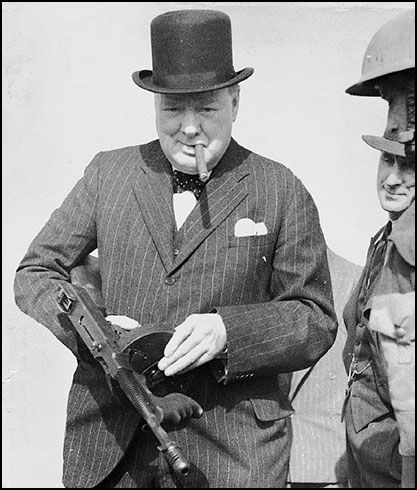
CHURCHILL DISPLAYS LIONHEARTED DEFIANCE IN THE FACE OF THE NAZI THREAT.
WINSTON CHURCHILL
Winston Churchill, who was 64 when he became prime minister on 10 May 1940, on the same day Nazi forces invaded western Europe, had had a long and varied political career that began when he first entered Parliament in 1900. First Lord of the Admiralty in 1911–15, he became chancellor of the exchequer for the period 1924 to 1929. Afterwards, though, he spent 10 years in the political wilderness, labelled as a warmonger for his perpetual warning against the menace of Nazi Germany. Churchill returned to the Cabinet as First Lord of the Admiralty once again at the outbreak of war in 1939. When he was appointed prime minister, coming to power when Britain faced the greatest emergency in its history, Churchill said that he felt his whole long life had been preparing him for this one great challenge. A great war leader, though less effective afterwards in peacetime, it was under Churchill’s passionate, committed leadership that the British developed the will to fight on against Hitler in 1940, when any rational analysis of their plight would have counselled surrender. But Churchill was not a rational politician. He was romantic and emotional, with a devotion to democracy and the British Empire to sustain his unshakeable belief in Britain’s ultimate triumph, however black and fearful the future might seem. His greatest gift, apart from the energy he displayed in prosecuting the war, was his ability to communicate this confidence and optimism in speeches that have since rivalled Shakespeare for their quotability. Churchill’s stirring rhetoric, written out in the form of blank verse, touched a chord in the British people and inspired them to mammoth efforts. He helped both to define and inspire the fighting confidence they needed to survive their finest, but also their darkest, hour as the beleaguered island fought on alone against the Nazis for a whole year after the Fall of France.
The new type of warfare that characterised the aerial battle of Britain was carried out at unprecedented speeds. The Spitfire had a top speed of over 360mph and demanded pilots of the highest quality. They had to have exceptionally keen eyesight as well as lightning-quick reactions. Most successful ‘kills’ of enemy aircraft happened at extremely close range, often less than 100 metres, and ammunition was available only in very short bursts. The Spitfire, for instance, carried enough for a mere 14 seconds of firing. The German Bf 109, however, had even less. Both planes were frequently in the air for little over an hour at a time. After flying from bases in France, the Bf 109 had not much more than 30 minutes combat time over southern England, and pilots from both sides could expect to make several sorties a day. The strain was almost unbearable. Some pilots would return unhurt to base after being shot down, only to be put at once into a new plane to carry on the fight.
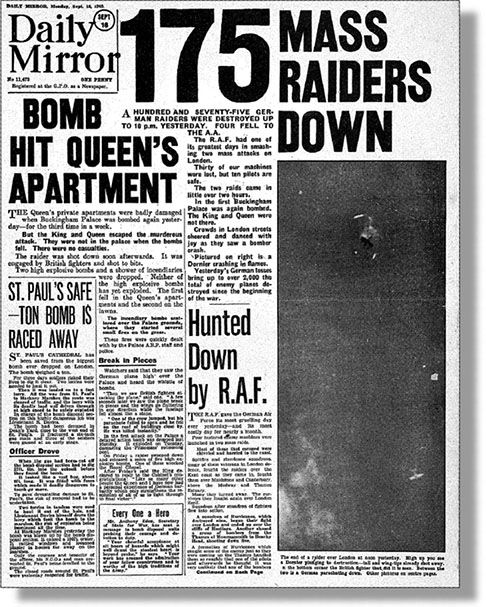
THE DAILY MIRROR ON 16 SEPTEMBER 1940. THE FRONT-PAGE SPLASH, PROCLAIMING ‘BOMB HIT QUEEN’S APARTMENT’, DISPLAYS THE LEVELLING EFFECT OF THE BLITZ IN GRAPHIC FASHION.
After a while, the Spitfire and Messerschmitt Me 109 acquired a legendary reputation as latterday knights jousting in the air much as medieval warriors had once challenged each other in the lists. The pilots, who included a large number of Poles, were heroes every one, young men who one moment sat nonchalantly in armchairs on the sun-drenched airfields, reading newspapers, playing cards, telling jokes, and the next were leaping for their cockpits and roaring off to do battle. However, the pilots on both sides never forgot their grim purpose, survival for one, victory for the other. Neither did the people who watched their ‘dogfights’ from fields and streets in southern England. In the extraordinarily clear and sunny summer of 1940, they knew that, as they watched the rivals wheel, manoeuvre and fire high up in the brilliant skies above, they were watching their fate being worked out.
Göring, naturally, was impatient. He was keen for the battle to reach a conclusion and though his tactics seemed to be paying off, he was not getting the results he wanted fast enough. Over-optimistic German intelligence reports had encouraged Göring to believe that the RAF was at breaking point and had far fewer planes than was actually the case. Consequently, Göring was convinced that just one more push would finish off the British, so he changed target yet again.
On 7 September, hundreds of German bombers, with their fighter escorts, headed for London, and while Fighter Command stood by to defend their vital airfields, German bombs fell almost unchallenged on the capital. The battle of London had begun.
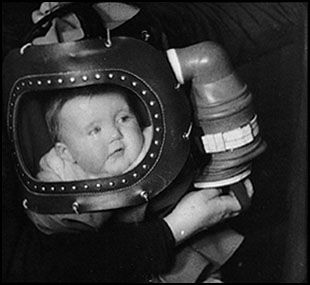
BETTER SAFE THAN SORRY. A BABY FITS SNUGLY INSIDE ITS ALL-ENCOMPASSING GAS MASK.
On that bright, sunny Sunday afternoon, the Germans made a beeline for London’s docks. They did not stop coming until the early hours of Monday morning. The first wave opened up with incendiary bombs, providing a beacon of burning buildings for the bombers that followed. The whole of London possessed only 92 anti-aircraft guns with which to meet the crisis, and as Fighter Command had been wrong-footed by the Germans’ change of target, the city was virtually undefended. The docks around Tower Bridge and the residential areas of London’s East End became one terrible, all-consuming bonfire. Over 400 Londoners were killed during this, the first night of ‘the Blitz’. The blaze in the docks was so fierce that one fire officer told his superior to ‘send all the bloody pumps you’ve got – the whole bloody world’s on fire’. For the next 76 nights, bar one, London was bombed over and over again.
London’s East End became one terrible, all-consuming bonfire. Over 400 Londoners were killed during this, the first night of ‘the Blitz’. The blaze in the docks was so fierce that one fire officer told his superior to ‘send all the bloody pumps you’ve got – the whole bloody world’s on fire’
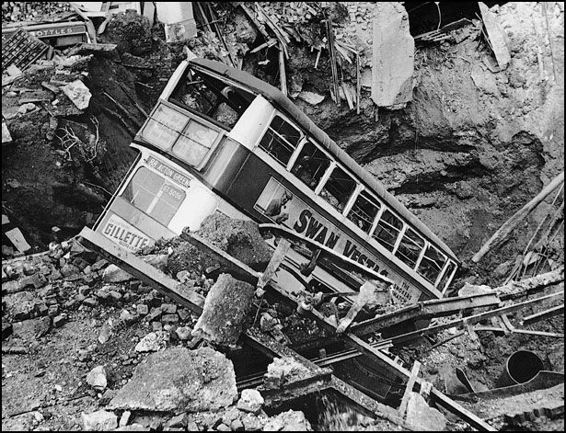
A DOUBLE-DECKER LONDON BUS FALLS INTO THE CRATER LEFT BY A DIRECT HIT ON THE UNDERGROUND TUBE LINE IN BALHAM, SOUTH LONDON. MANY LONDONERS WERE SHELTERING IN THE TUNNELS UNDERNEATH. THERE WERE OVER 600 CASUALTIES.
The following Sunday, 15 September, saw the climax of the Battle of Britain. That day, according to the BBC, 185 Luftwaffe aircraft were shot down over London. That day, too, Winston Churchill was watching the German attacks being plotted on maps at RAF Fighter Group 11 at Uxbridge, Middlesex, 15 miles west–north-west of London. During the fighting over London and southern England, Churchill watched with mounting tension as all the available RAF units were committed to the battle. Eventually, he knew, there would be no squadrons left in reserve. Yet, despite pushing the RAF to the very edge, the Luftwaffe again suffered the heavier losses and, more importantly, they were shocked to see that the RAF could still put formidable numbers of planes in the air. It was becoming increasingly apparent to the Germans that the RAF was not finished at all and that their intelligence reports had been crucially wrong.
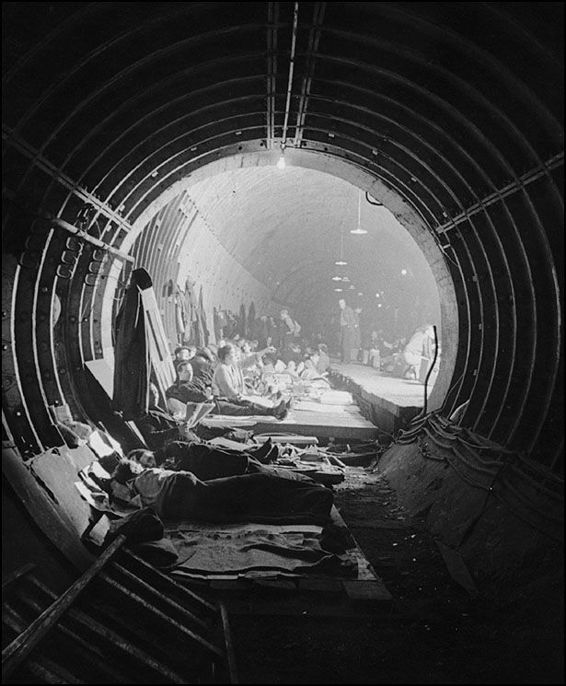
LONDONERS TAKE SHELTER IN THE CAPITAL’S SUBWAY SYSTEM. THE UNDERGROUND HAD ORIGINALLY BEEN DESIGNATED AS ‘STRICTLY NO ADMITTANCE’ DURING AIR RAIDS. BUT, AFTER PRESSURE FROM THE CITY’S INHABITANTS, THE TUBE WAS OPENED UP DURING RAIDS DESPITE FEARS FROM THE AUTHORITIES THAT SOME MAY NEVER RETURN TO THE SURFACE.
Even worse, as far as the Germans were concerned, was what all this meant: Göring had failed in his attempt to gain control of the skies over England. Without that vital supremacy, there was no point in carrying on. On 17 September, therefore, Hitler postponed the invasion of Britain ‘indefinitely’.
Even so, the Germans had by no means finished raiding Britain and, though the Luftwaffe could always be sure of a defiant reception by the RAF in daytime, by night their bombers were able to operate in much greater safety.
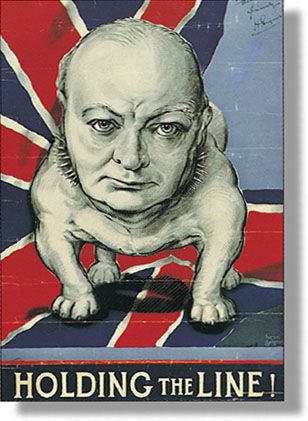
CHURCHILL PERSONIFIES THE BRITISH ‘BULLDOG SPIRIT’. WHATEVER THE COST, BRITAIN WAS NOT GOING TO ROLL OVER FOR THE NAZIS.
THE BLITZ
Britain had suffered bombing raids by Zeppelins during the First World War, but the experience, though terrifying and unprecedented, had been limited. The Blitz, however, brought civilians right into the front line in a way never before experienced in the whole of British history. Bombing raids on British towns and cities meant that the battlefield had now intruded into the very homes of ordinary civilians. The one place in which people had always been able to feel safe was no longer secure. But they were not entirely helpless. In their struggle against the Luftwaffe, the public could count on, or indeed join, one of the many networks of interlocking civilian organisations that had been established during the run-up to war to deal with German air attacks.
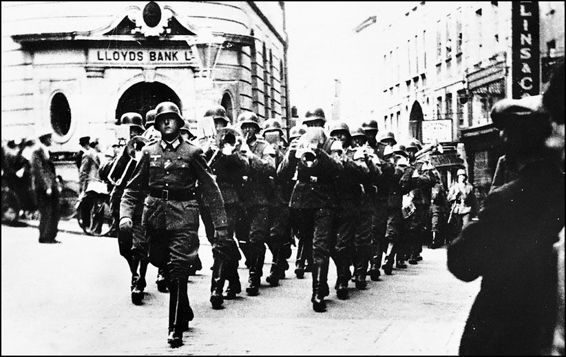
A TASTE OF THINGS TO COME? GERMAN SOLDIERS MARCH IN THE CHANNEL ISLANDS, THE ONLY PIECE OF BRITISH TERRITORY TO BE OCCUPIED BY THE NAZIS DURING THE WAR. THE ISLANDS, CLOSER TO FRANCE THAN BRITAIN, REMAINED IN GERMAN HANDS UNTIL VE DAY, AFTER BEING ‘DEMILITARISED’ BY THE BRITISH DURING THE FALL OF FRANCE.
Air raid wardens – both men and women – were given the responsibility of enforcing the blackout and reporting hits in their areas, while firemen tackled the blazes as heavy rescue squads attempted to dig civilians from the rubble. First-aid posts and shelters for those made homeless by the bombs were organised, as were daredevil teams from the Royal Engineers who dealt with the removal and destruction of unexploded bombs.
The Blitz proved the sternest of tests for the British people. They were not invariably cheery and smiling, as has often been depicted. They suffered fear and depression. Their nerves could be shot to shreds. But overall, and despite often woeful preparations by certain local authorities and the inadequate resources of central government, the people proved equal to the challenge. Providing air raid shelters was often a problem, though. Over two million Anderson shelters, strong, above-ground structures designed to house a family during raids, had been distributed free of charge by the time of the first big nighttime raids. In addition to Andersons and the Morrison shelters that were sunk into garden lawns, larger public shelters were erected in many streets. Some people, however, never used them and chose to remain in their own homes. In London, the underground subway was used as a deep shelter. This was never in government plans. The people just moved in and many regularly slept on the platforms in the bunks that were afterwards installed. Many, sadly, emerged next morning to find their streets or their houses a mess of rubble and smoke, with wardens picking over the ruins in the hope of finding survivors. The space beneath sturdy railway bridges also served as shelters, but there were drawbacks: the sanitation in the underground and in some of the larger public shelters was poor. It was also, occasionally, the cause of some fear that the morals of the young were being corrupted by spending the night in close company with members of the opposite sex.

A MEMBER OF THE BRITISH INDIAN ARMY DESERTS TO JOIN UP WITH THE JAPANESE-SPONSORED INDIAN NATIONAL ARMY.
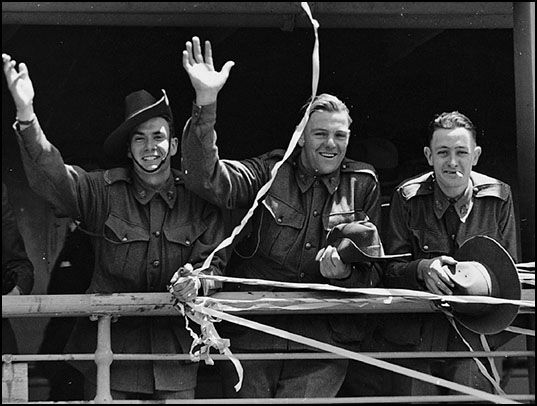
MEMBERS OF THE AUSTRALIAN AND NEW ZEALAND ARMY CORPS LEAVE MELBOURNE AND SET SAIL TO JOIN IN THE EMPIRE’S WAR EFFORT.
THE BRITISH EMPIRE
The British Empire, now long gone, was the mightiest overseas empire the world has ever known. At its zenith, at the end of the 19th century, Britain ruled over one quarter of the world’s surface and one quarter of its population. It was said, with truth, that the ‘sun never set’ on the British Empire because its territories were so far-flung across the globe.
Though past its heyday, the Empire was still a formidable proposition during the Second World War. Despite lacking allies after the Fall of France on 22 June 1940, until the German invasion of Russia on 22 June 1941, Britain was able to draw on the support, manpower and resources of this huge empire. There was also the advantage that most Empire territories were well beyond the reach of Nazi Germany or the other ‘Axis’ powers, Italy and Japan. That meant that factory production in, for example, New Zealand, was completely safe from attack, and Canada, where pilots were trained, was likewise far from danger.
When Britain declared war on 3 September 1939, Canada, Australia and New Zealand followed immediately, and after some hesitation – and by only one vote – so too did South Africa. These were the self-ruling dominions of the Empire and they had also followed Britain into war in 1914. However, their attitude by 1939 had changed somewhat. The dominions were keen to maintain as much independence of action from Britain as possible. In Australia, for instance, memories of the appalling fate of thousands of ANZAC troops at Gallipoli in 1915, and the belief that they had been sacrificed for the sake of the much more valued British soldiers, were still fresh enough for caution.
India, where the British Raj had united the continent and flourished after 1757, was in a different category. This ‘jewel in the crown of the empire’ was Britain’s largest colony and was brought into the war by the British Viceroy, the second Marquess of Linlithgow. His failure to consult the Indians, whose leaders Mahatma Gandhi and Pandit Nehru were imprisoned during the war along with their families, caused a great deal of bitterness and resentment.
Many of the pilots who fought in the Battle of Britain were Canadian, and Australian troops fought with distinction in the Middle East, Asia and the Pacific. The Indian Army bore the brunt of the fighting against the Japanese in Burma. The same applied to the Ghurkas from Nepal, even though Nepal was not part of the Empire.
The Empire gave Britain far more punch than it could possibly have had on its own, but the war placed it under an intolerable strain. Defeats at the hands of the Japanese in Singapore in 1942 and the political exigencies of the war in India allowed subject peoples to see the British as vulnerable and not so mighty as they may have formerly believed. This helped to advance already existing movements aiming at independence. The Indian Congress Party, in fact, had been working for freedom since 1880, and, perhaps appropriately, India, with Pakistan, was the first to be granted independence, on 15 August 1947. This was the first of many breakaways, although the old empire later evolved into the British Commonwealth, many of whose members are former colonies.
Although London was the main focus for the Blitz, many ports and centres of industry across the nation were also hit; among them were Southampton, Portsmouth, Birmingham, Derby, Sheffield, Liverpool, Manchester, Clydebank and Glasgow. However, by far the most notorious raid on a British provincial town took place on the night of 14 November 1940.
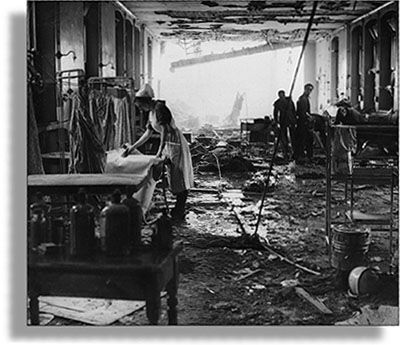
THIS HOSPITAL IN LONDON WAS HIT THREE TIMES, FINALLY FORCING THE PATIENTS TO BE EVACUATED. MANY OF BRITAIN’S RED CROSS VOLUNTEERS HAD BEEN CIVILIANS ONLY MONTHS EARLIER. THEY WERE TO RECEIVE THEIR BAPTISM OF FIRE IN THE AUTUMN AND WINTER OF 1940.
That night, over 500 German bombers made their way to the industrial centre of Coventry. Their targets were the many industrial, armaments and aero-engine plants situated around the town. One German news agency boasted that the raid was the ‘most severe…in the whole history of war’. Over 500 people were killed and war production was badly slowed for many months. The entire heart of medieval Coventry, including its beautiful 14th-century cathedral, was gutted. In a town almost laid waste, thousands became homeless overnight. The raid had the proportions of an atrocity and gave the language a new verb: ‘to coventrate’, or destroy totally.
This massive concentration of German bombers on one town came close to breaking local morale. Coventry was not a large place, and everyone could claim to know at least one of the many victims. Businesses were destroyed, phone lines were decimated, transport services were all but useless and rationing had to be abandoned. But the Germans failed to follow up their success on the next night. Instead, they turned their attention elsewhere, and despite all the destruction and suffering Coventry endured, no lasting damage was done to the British war effort.
Even so, the mindless decimation and loss of life at Coventry stunned the British people. Worse, though, was the fact that as the war in the air grew ever more sophisticated, the losses suffered at Coventry, horrific as they were, later paled into insignificance. And not only in Britain. The RAF, too, wreaked carnage and ruin, at Dresden, where, in 1945, over 100,000 Germans were killed by squadrons sent by Air Marshal Sir Arthur ‘Bomber’ Harris, who believed the war could be won simply by bombing Germany to extinction.

THE MORRISON SHELTER. NAMED AFTER HOME SECRETARY HERBERT MORRISON, THIS INDOOR SHELTER WAS DESIGNED TO PROVIDE PROTECTION FROM BOMBS FOR THE WHOLE FAMILY. THE WIRE MESH ON THE SIDES WAS REINFORCED BY A STEEL PLATE ON THE TOP OF THE STRUCTURE.
Fortunately, the Blitz was finite, and the time came when Londoners and others no longer greeted night-time with fear and trepidation, wondering whether they, or their families and their homes would still be there in the morning. The Blitz was nearing its end by the early summer of 1941, the reason being that Hitler had picked other victims. It was then that he began to look once more to the conquest of Soviet Russia.
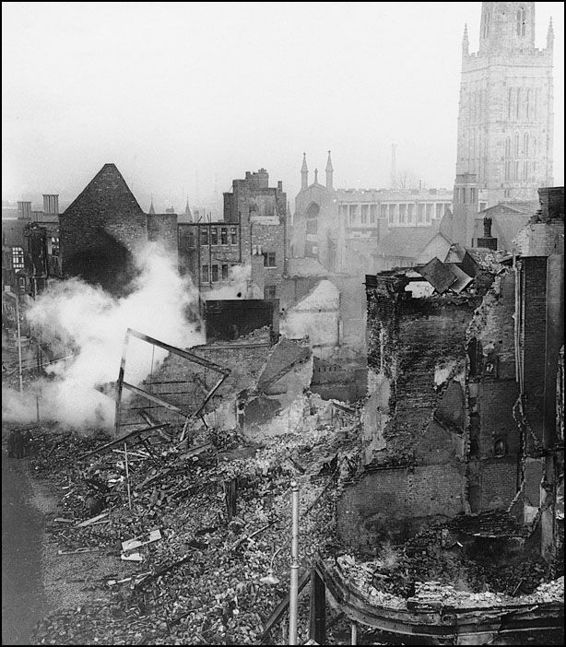
AFTERMATH. COVENTRY EMERGES INTO THE DAYLIGHT AFTER A NIGHT THAT WITNESSED THE MOST SUSTAINED AIR RAID OF THE BLITZ. OVER 400 GERMAN BOMBERS EMPTIED THEIR BOMB BAYS, DESTROYING THE CITY AND LEAVING 500 DEAD.
Fortunately, the Blitz was finite, and the time came when Londoners and others no longer greeted night-time with fear and trepidation, wondering whether they, or their families and their homes would still be there in the morning