
CHAPTER 7

THE WEHRMACHT IN ACTION TWO WEEKS BEFORE THE LAUNCH
OF OPERATION BARBAROSSA, HITLER’S ATTEMPT AT THE
CONQUEST AND TOTAL SUBJUGATION OF THE PEOPLES OF
THE SOVIET UNION.
OPERATION BARBAROSSA
In the early hours of Sunday, 22 June 1941, a frantic radio message was received by the Soviet Army command in Moscow. Troops along the Soviet Union’s western border were reporting: ‘We are being fired on. What do we do?’ Germany had launched the invasion of the Soviet Union, and the two greatest armies in Europe were about to confront each other in savage combat.

THE DEMORALISED FACES OF SOVIET POWS. BRAVE BUT POORLY EQUIPPED, THE BELEAGUERED RED ARMY COULD PUT UP LITTLE EFFECTIVE RESISTANCE.
As early as December 1940, Adolf Hitler had told his generals his plan for Operation Barbarossa, which was ‘to crush Soviet Russia in a rapid campaign’. With the failure of the invasion of Britain, he told them, Germany would instead look east to the vast spaces beyond the Soviet border. Not only would victory over the Soviet Union secure further Lebensraum – living space – for the expansionist Volksreich, the German peoples, it would also provide the German military machine with almost unlimited new resources. Following the capture of the industrial Don Valley and the oilfields of the Caucasus in the south, Germany would soon be ready to launch a new offensive against Britain.

GERMAN COMMANDER-IN-CHIEF, FIELD MARSHALL VON RUNDSTEDT (LEFT), WATCHES MILITARY MANOEUVRES DURING FINAL REHEARSALS FOR THE INVASION OF THE SOVIET UNION. HITLER WAS CONVINCED THAT THE SUPERIOR MILITARY STRENGTH OF THE THIRD REICH WOULD CRUSH THE INFERIOR RUSSIANS WITHIN THREE MONTHS.
OPERATION BARBAROSSA
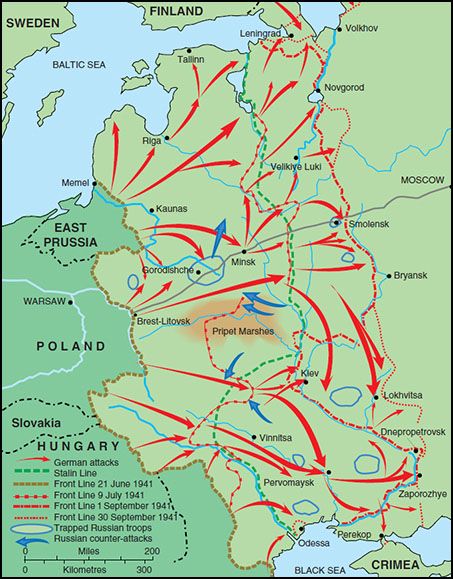

WITHIN HOURS OF THE COMMENCEMENT OF BARBAROSSA, THE SOVIET DEFENCES WERE CUT TO PIECES BY GERMAN PANZER DIVISIONS. BY COMPARISON, THE 20,000 SOVIET TANKS WERE HOPELESSLY OUT OF DATE AND COMPLETELY OUT-MANOEUVRED.
Barbarossa was not universally supported by the German army command. Many pointed out the dangers of fighting a war on two fronts, especially if Britain decided to mount its own invasion in the west. Hitler, however, maintained that blitzkrieg in Russia would produce victory in three months at most. The Russians, he was convinced, were an inferior race incapable of resisting superior German military might. Like the rest of Europe, they would crumble before the onslaught.
By dawn on the morning of 22 June, the massive scale of the German invasion force had become clear. ‘When Barbarossa opens,’ Hitler had told his generals, ‘the world will hold its breath.’ Some three million men, over 3000 tanks and 2000 planes were soon pouring into Soviet territory. They were divided into three separate army groups: Army Group ‘North’ was to head north-west, for the Baltic states and Leningrad; Army Group ‘South’ was to move southwards to the Crimea, securing the agriculturally rich Ukraine, the Don Valley and the Caucasus on the way; and Army Group ‘Centre’, led by the panzer tanks of General Heinz Guderian, would head directly for Moscow, the Soviet capital. They would be supported by Romanian forces advancing from the south, as well as by Italian, Croatian, Hungarian and Slovakian divisions. The Finns, too, would be advancing from the north, hoping to use the German invasion as a means of retrieving their losses in the war with Russia in 1939–40. All in all, this was the largest invasion force the world had yet seen, and it had taken the Soviet Union completely by surprise.
Since January 1941, the Soviet Union had been supplying food, fuel and materials to Germany as an extension of the Nazi–Soviet pact signed in 1939. The last shipment, in fact, had been delivered on the evening of 21 June. Long before then, though, Soviet Intelligence had suspected a German attack, but the Soviet dictator, Josef Stalin, had rejected their recent reports that an invasion was imminent. Despite the evidence of German troop concentrations along the Soviet border, Stalin refused to believe that Hitler was about to break their treaty. As a result, his forces were almost totally unprepared to face the Nazi blitzkrieg. Within the first few hours, the Luftwaffe destroyed over 2000 Soviet planes, most of them before they had even left the ground. The city of Brest-Litovsk, site of the treaty that had ended Russian involvement in the First World War, fell before the day was out. Racing across the Russian countryside, German panzers cut the Soviet defences to pieces.
At this juncture, the Red Army could put up little effective resistance. Despite being able to call on some 10 million men, it was woefully disorganised and communications between divisions were poor. Even the initial order to fire back at the invaders had, reportedly, taken over four hours to reach the front line. Mobility was also a problem, especially in the face of the highly mobile Nazi armour. By comparison, the Soviet Union’s 20,000 tanks were hopelessly outdated, and the pilots of their 7500 planes were poorly trained. Much of the blame for these problems lay with the savage purge of the military that Stalin himself had ordered in 1936–8. It also accounted for the Russians’ initial reverses in Finland. Most of the Red Army’s best and most experienced officers had been executed on trumped up charges of treason, inflicting lasting damage on the army’s command structure.
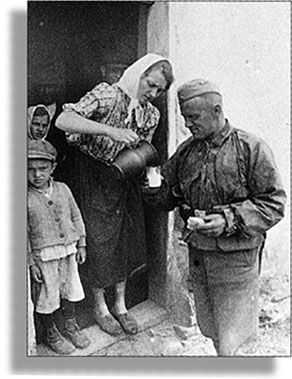
IN MANY PARTS OF THE SOVIET UNION THE INVADING AXIS FORCES WERE GREETED AS LIBERATORS BY PEOPLE WHO HAD ALREADY SUFFERED TERRIBLY UNDER STALINISM. HERE, A MEMBER OF THE SS VIKING DIVISION RECEIVES A WARM WELCOME IN THE UKRAINE.
Even so, the Red Army troops were hardy and courageous. Their devotion to Mother Russia had all the force of a deep emotional attachment, and death was a small price to pay for preserving her. Without any clear strategy, though, the Russians simply threw everything they had against the invading Nazis. They sustained horrendous losses. Reports described tank brigades queueing up to go into battle, only to be wiped out in hours.

SS SOLDIERS IN A VILLAGE IN THE KURSK REGION. THROUGHOUT THE RUSSIAN COUNTRYSIDE THE SS EMBARKED ON A CAMPAIGN OF TERROR, TORTURING AND KILLING MORE THAN THREE MILLION MEMBERS OF A RACE OF PEOPLE THEY CONSIDERED ‘SUB-HUMAN’.
By contrast, the German blitzkrieg seemed unstoppable. Within less than a week, the Wehrmacht had captured more than 100,000 Russians and over 1000 tanks. Minsk, capital of Belarus, was on the brink of falling. In the north, the Wehrmacht had already swept through the Baltic states and was heading for Leningrad. On the morning of 3 July, the Soviet people turned on their radios to hear a sombre Stalin as he addressed the nation. It was the first time he had done so in over three years. Stalin told his people: ‘Our country has entered into a life and death struggle with its most wicked enemy.’ The situation was desperate, he admitted, and demanded the complete mobilisation of every available resource that could be used against the enemy. This was to be ‘a patriotic war of liberation’, and the Soviet people could afford to give no quarter. Where the Red Army was defeated, ordinary people should take up arms and wage guerrilla warfare in their place. If forced to retreat, they were to adopt a ‘scorched earth’ policy, burning, destroying and wrecking their own homes and property to deny the Nazis ‘a single kilogram of grain or a single litre of petrol’.
Much of the blame for these problems lay with the savage purge of the military that Stalin himself had ordered in 1936–8. It also accounted for the Russians’ initial reverses in Finland. Most of the Red Army’s best and most experienced officers had been executed on trumped up charges of treason, inflicting lasting damage on the army’s command structure

ALTHOUGH RED ARMY SOLDIERS HAD ONLY OUTDATED TANKS AND LITTLE HEAVY ARTILLERY, THEY DID HAVE ON THEIR SIDE THE VAST RUSSIAN INTERIOR, A GREAT DEAL OF WHICH WAS ALMOST IMPASSABLE. HERE A SOVIET UNIT IMPROVISES A RIVER CROSSING.

ALTHOUGH RESPONSIBLE FOR TERRIBLE CRIMES AGAINST HIS OWN PEOPLE IN PEACETIME, STALIN PROVED TO BE AN INSPIRING WARTIME LEADER.
JOSEF STALIN
The real name of Josef Stalin – the assumed name meant ‘Man of Steel’ – was Dzhugasvili. A devious and cunning Georgian, Stalin had been ruler of the Soviet Union since the death of Vladimir Ilych Lenin, leader of the Bolshevik revolution, in 1924. In the 17 years between then and the Nazi invasion in 1941, he had turned the backward, largely peasant-based Soviet Union into an industrial superpower by imposing a series of harsh Five Year Plans for economic development. To this end, the Russian people were denied virtually everything that made for a comfortable life.
In order to secure his position against those he suspected of being enemies of the state, Stalin had conducted a campaign of terror in which millions of citizens were executed or were hauled off to die in Siberian labour camps.
Although he was a sworn enemy of both Nazism and Germany, Stalin had agreed to the signing of the Nazi–Soviet pact in 1939 as a cynical ploy to prevent Germany from attacking the Soviet Union. Hitler’s own motives had not been dissimilar.
When the ploy failed and Hitler invaded, Stalin was forced to turn for assistance to the British and US governments. His ideological distance from them was even greater than it was from the Nazis, and the feeling was mutual. Both the British and the Americans, who were not yet in the war when Russia was invaded, loathed communism as a threat to democratic freedom. Nevertheless, what mattered was the defeat of Hitler, and so the uneasy alliance held for as long as that took. If Anglo–American friendship with Stalin barely outlived the war, it was inevitable, but the ‘marriage’ served to save Russia and the world before the divorce became absolute.
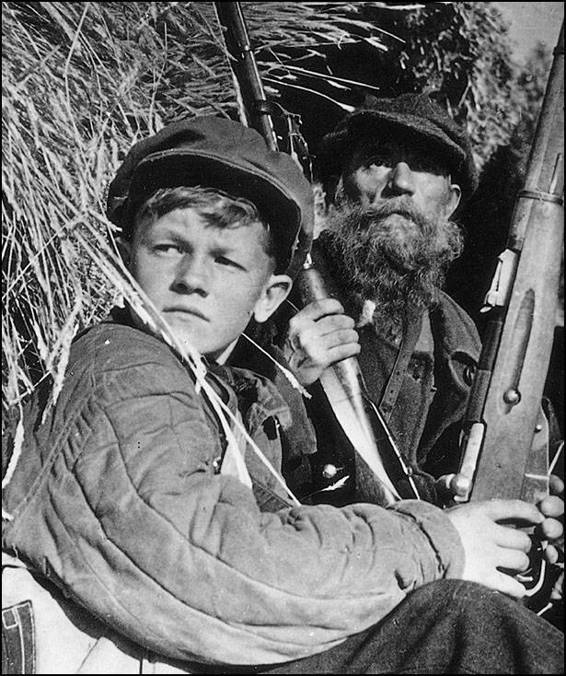
AS WELL AS ENGAGING AXIS TROOPS IN COMBAT, PARTISANS LIKE THIS BOY CARRIED OUT ACTS OF SABOTAGE AND PASSED INFORMATION ABOUT ENEMY MOVEMENTS BACK TO THE RED ARMY.
The speech electrified the Russians, and was to prove an inspiration to resistance groups across Europe. But was it too late? Prime Minister Winston Churchill, though a fervent anti-communist, had pledged support for Stalin and the Soviet Union. The two countries now had a common enemy, Churchill explained, adding that ‘if Hell declared war on Hitler, I would at least give the Devil a favourable mention in the House of Commons’. Churchill, however, was not alone in his distaste for Stalin and the communist creed. In many parts of the Soviet Union, the invading German armies had actually been welcomed as liberators. Millions had suffered during the Stalinist terror of the 1930s and longed for an end to the Moscow government. In the southern Soviet Union, Georgians – ironically, Stalin’s home state – as well as Armenians and other ethnic groups traditionally opposed to Soviet rule were recruited into the German war effort. In the Baltic states of Latvia and Lithuania, only recently absorbed into the Soviet Union against their will, new SS divisions were formed to fight alongside the German Army. Many ethnic Russians had looked forward to the downfall of the communist regime, and if this was the way it would happen, they wanted to help.

EVERY RUSSIAN CITIZEN WAS NEEDED TO DEFEND THE MOTHERLAND, AS THIS GROUP OF WOMEN VOLUNTEERS SHOWS. DURING THE DEFENCE OF MOSCOW WOMEN SOMETIMES MADE UP 75 PER CENT OF THOSE FIGHTING TO PRESERVE THE CAPITAL.
Special mobile police units, the Einsatzgruppen, were attached to the advancing armies with the sole responsibility of rounding up Jews and communists for deportation or summary execution. In one operation at Kiev, 33,000 Jews were shot dead
Little did they realise that they were, in fact, offering themselves for slavery and sacrifice. The consequences of the Nazi plan to ‘conquer, rule and exploit’ the Soviet Union soon became clear, however, as captured peasants and prisoners of war alike were forced to work for the Nazis. The treatment they received at the hands of the Nazi occupiers was atrocious. Heinrich Himmler, head of the SS, once said that he was not interested in how many thousand Russian women died digging an anti-tank ditch, as long as the ditch was dug. Special mobile police units, the Einsatzgruppen, were attached to the advancing armies with the sole responsibility of rounding up Jews and communists for deportation or summary execution. In one operation at Kiev, 33,000 Jews were shot dead. Others were transported back to labour camps in Germany as the first stage in clearing western Russia for settlement by ‘pure Aryans’. This plan had been worked out as far back as 1935, when Hitler had set up a Race and Settlement Office to co-ordinate German expansion in the east. Now, he spoke of the need to ‘Europeanise’ Russia, a process that was to be carried out with ‘no remorse’. The German people, Hitler explained, were ‘absolutely without obligation’ as far as their treatment of the Slavic Untermensch were concerned. ‘Slav’ after all meant ‘slave’ and slaves they would be. The only responsibility the invaders had towards the subdued population would be to ‘let them know just enough to understand our highway signs, so that they won’t get themselves run over by our vehicles’.
Throughout the summer of 1941, the German advance continued across the Soviet Union at an astonishing rate. By the end of September, the German Army had taken the Ukrainian capital of Kiev and in the north seemed poised to crush Leningrad, the birthplace of the Bolshevik revolution of 1917. In the south, most of the Crimea had fallen. Over half of the Red Army had been either killed or captured and Soviet tank numbers had been reduced to less than 1000. It was surely only a matter of time before Moscow itself fell and the Russians surrendered. Nazi Germany was on the verge of its greatest victory, or so the Germans felt able to persuade themselves.
On the face of it, the Russian cause certainly seemed hopeless. The face of it, however, was deceptive. Despite their appalling losses, the Russian spirit remained unbroken. Russia had long been an excessively hard, demanding country. The rule of the tsars had always been severe, and the communist government that succeeded it had proved not much better. Russia was not a place for soft living and was without even the minimal comforts thought to be essential in the West. Suffering and deprivation were everyday experiences that toughened the ordinary Russian beyond the norm. It was no coincidence that of all those who fought against the Nazis, Russia was the only country that recruited women into its frontline fighting forces. In the circumstances of 1941, it was fortunate that this was so. It came naturally to the Russians to fight back, and to the death.
Now, Hitler spoke of the need to ‘Europeanise’ Russia, a process that was to be carried out with ‘no remorse’. The German people, Hitler explained, were ‘absolutely without obligation’ as far as their treatment of the Slavic Untermensch were concerned. ‘Slav’ after all meant ‘slave’ and slaves they would be
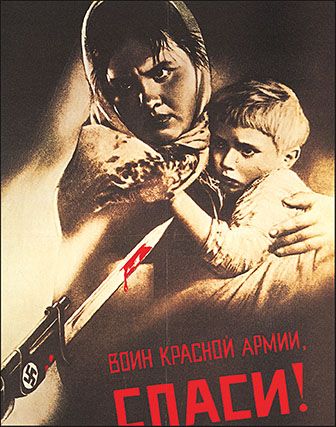
A SOVIET PROPAGANDA POSTER BARELY COMES CLOSE TO DEPICTING THE HORRORS OF ‘MASTER PLAN EAST’.
MASTER PLAN EAST
Drawn up months before the German invasion of the Soviet Union, the ‘Master Plan East’ formulated by the SS was the culmination of Nazi hatred for their supposedly inferior Slavic neighbours. The document for the Plan laid out the long-term German arrangements for the conquered Soviet people and the future of the Russian nations. It called for the extermination of at least 30 million Russians, to take place before German citizens could move in and settle what was left of their country. The Soviet Union was then to be divided into agricultural ‘provinces’ ultimately ruled by the head of the SS, Heinrich Himmler himself. While attempting to carry this plan to its conclusion, Himmler’s SS was responsible for the murder of millions of Soviet citizens.
Consequently, in the towns and villages, Stalin’s call for resistance had been readily answered by newly formed Partisan Brigades, who waged a guerrilla war against the invaders by planting bombs, sabotaging equipment and destroying bridges and telephone lines. The Red Army itself continued to fight with a bravery, and a savagery, that both impressed and terrified the Germans. The troops seemed to have a total disregard for the huge numbers of men they were losing to the enemy’s superior firepower. As one German commander noted: ‘The Russians’ behaviour in action is simply incomprehensible.’ Nevertheless, they succeeded in slowing the German advance, and soon the Soviet people would have a new ally and a familiar one: the remorseless, bone-freezing Russian winter. By the time Hitler’s three months to victory was up, autumn had already arrived. From then on, it got worse, much worse.
The rule of the tsars had always been severe, and the communist government that succeeded it had proved not much better. Russia was not a place for soft living and was without even the minimal comforts thought to be essential in the West. Suffering and deprivation were everyday experiences
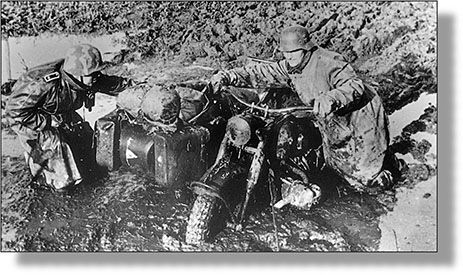
WEHRMACHT SOLDIERS STRUGGLE IN THE MUD BROUGHT BY THE AUTUMN RAINS. SOON, ‘GENERAL WINTER’ WOULD TURN OUT TO BE ONE OF THE GERMAN ARMY’S MOST POWERFUL ADVERSARIES.
THE SAVAGE WINTER
The first driving rains began to fall in early October. Within days, road and fields had become impassable as the German war machine found itself bogged down in mud. For almost a month, the movement of tanks and artillery was completely stalled by the wretched conditions, as commanders waited for a frost to harden the ground. The delay proved disastrous. With the arrival of the first snows at the beginning of November, the temperature began to plummet. The same climate that had defeated Napoleon’s invasion of Russia in 1812 was about to be visited on the German Army. Convinced that the Russian campaign would be over in three months, as Hitler had planned, the German military had made no preparations for fighting a winter war. The German Army was unprepared for the severity of the conditions it now faced, and as the temperature dropped to minus 20 and minus 30 degrees, tanks and lorries started breaking down. Weapons and artillery jammed; batteries froze solid, rendering radio equipment useless. The Luftwaffe was grounded, cutting off supplies and support to the front. And the men, who had not been issued with winter clothing, began to freeze to death.

WOMEN IN A SOVIET ORDNANCE FACTORY WORK ROUND THE CLOCK TO PROVIDE AMMUNITION FOR THE FRONT.
Thin leather boots and gloves were no defence against the relentless cold. During December 1941, one panzer division reported that it was losing five times as many men to frostbite as were dying in combat. Supplies of fuel ran out as tank crews kept their engines running all night rather than risk trying, but failing, to restart them in the morning. Others simply burned petrol to keep warm. The Russians, meanwhile, seemed immune to the freezing temperatures. Not only were they accustomed to such conditions, they were far better equipped to deal with them, having learned their lesson in Finland in 1939–40. As well as winter clothing, they had anti-freeze for their tanks and winter oil for their guns. German officers reported seeing Russian soldiers capture weapons that their own units had abandoned as useless, oil them, and then turn them on their previous owners. Even the ponies they used to haul their artillery were better suited to the climate than their German counterparts, which were dying in droves. All of a sudden, the rules of warfare seemed to have been turned on their head.

THE SOVIETS ALSO UNDERSTOOD THE POWER OF PROPAGANDA WHEN IT CAME TO THE DEFENCE OF THE MOTHERLAND
The effect on German morale was shattering. Field Marshal von Bock reported back to Hitler that his men were on the verge of mutiny. For the first time, troops who had been told they were invincible members of a master race had started to entertain the possibility of defeat. They were supposed to be fighting a glorious war for Lebensraum, not freezing to death 200 miles from Moscow. They had been led to believe that the Russians were subhuman Untermensch and ignorant peasants who would put up little or no resistance. Had not Hitler promised that the Soviet people would fold quickly after the initial German advance? Had he not told his men that ‘you only have to kick in the door and the whole rotten structure will come crashing down’? Stalin was supposed to have surrendered by September, but he was still in the Kremlin, refusing to flee, despite the enemy’s close approach. In the north, Leningrad was still holding out against the German onslaught. The Red Army had at last begun to organise and marshal its tremendous resources, and they were also starting to throw new equipment against the invaders: the new T-34 tanks, for instance, which were both better armoured and more manoeuvrable than the German panzers.

A WOMAN FROM A SOVIET VILLAGE LIBERATED BY THE RED ARMY CLINGS TO ONE OF HER SAVIOURS. THE COMING OF WINTER SAW THE BEGINNING OF THE RUSSIAN FIGHT-BACK, AS THE HARSH WEATHER DECIMATED GERMAN MORALE.
Had not Hitler promised that the Soviet people would fold quickly after the initial German advance? Had he not told his men that ‘you only have to kick in the door and the whole rotten structure will come crashing down’? Stalin was supposed to have surrendered by September, but he was still in the Kremlin

HITLER IN PRISON IN LANDSBERG JAIL, WHERE HE DEVELOPED HIS RACIST THEORIES IN THE BOOK MEIN KAMPF.
HITLER’S CONSPIRACY THEORIES
Although Hitler spoke of the need to invade the Soviet Union to secure Lebensraum and new resources for the German people, his reasons for launching Operation Barbarossa ran much deeper. As he wrote in his book, Mein Kampf (1925–1927), – ‘My Struggle’ – Hitler believed that Germany had been betrayed at the end of the First World War by a conspiracy of Jews and communist Bolsheviks, who had come close to ruining his adopted country. Hitler was determined to destroy utterly the source of what he called ‘Jewish Bolshevism’, and along with the attempted extermination of the Jewish people, this meant the total destruction of the communist Soviet Union.
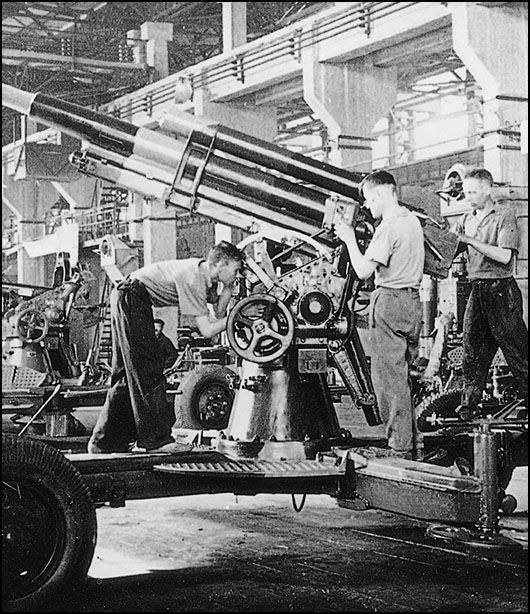
RUSSIAN WORKERS ASSEMBLE AN ANTI-AIRCRAFT GUN IN A NEWLY CONSTRUCTED WEAPONS FACTORY IN THE URALS.
THE MOVEMENT OF FACTORIES EAST OF THE URALS
Throughout the summer of 1941, the Soviets experienced a ‘second industrial revolution’ as the German war machine rolled across Soviet Russia. From Leningrad to the Crimea steel and chemical works, oil refineries, power stations and tank factories were being dismantled screw by screw and transported to the relative safety of the vast Russian interior. Over 2000 factories vital to the war effort were taken apart and, along with equipment, material and workers, loaded onto trains bound for the far side of the distant Ural mountains. There they were reassembled and were ready to restart production within days. Over 80 per cent of all war-related Soviet industry was moved east in this way in a matter of weeks, a mammoth undertaking.
At Sverdlovsk in the Urals one witness described how locals were given two weeks to build a factory from scratch after being told that new equipment was on its way from the west. Armed with spades and pick-axes they set to work on a patch of empty ground:
students, typists, accountants, shop assistants, housewives, artists, teachers…In the light of arc-lamps people hacked at the earth all night. They blew up the stones and the frozen earth, and they laid the foundations…people’s hands and feet were swollen with frostbite, but they did not leave work. Hundreds of trucks kept rolling up with building materials…on the twelfth day, into the new buildings with their glass roofs, the machinery, covered with hoar-frost, began to arrive. Braziers were kept alight to unfreeze the machines…two days later the war factory began production.
(Quotes taken from first person account quoted in The Year of Stalingrad by Alexander Werth. Hamilton, 1946)
The effect of the reversal of Nazi fortunes, their first appreciable defeat on land, had been felt around the world. The idea began to filter through that the Germans were not as invincible as their early successes had made them appear. Faced with a really resolute foe…they, too, could taste defeat
Meanwhile, Soviet factories were beginning to pour out equipment, planes and guns as fast as the Germans could destroy them. They were supported by supplies from Great Britain and the USA, both of whom had now pledged assistance to the Soviet Union. Across the Soviet Union, women were reporting for work on production lines to turn out everything from sheet steel to artillery pieces. Others had actually gone to the front as doctors, surgeons and Red Cross volunteers. Some 800,000 women joined up for combat duty in the Red Army. Others joined the air force. Industries vital to the war effort were being literally dismantled and transported east to the safety of the Ural mountains, Kazakhstan and central Asia. As the German army advanced on Moscow, over one million people and 500 factories simply upped and moved out of enemy reach.
The crunch was to come in early December, as the German forces reached the outskirts of Moscow. For months, the Luftwaffe had been bombing the city in an attempt to weaken and demoralise the inhabitants. Now, led by Marshal Georgi Zhukov, who had already mounted a defence of Leningrad, the Red Army launched its first major counterattack. In December, from Kalinin in the north to Rostov in the south, Soviet troops moved against the demoralised Germans. Despite direct orders from Hitler that they stand and fight, the Germans were forced into retreat. The success of the Soviet offensive, though limited, was nevertheless astounding for an army that had lost almost four million men in the previous few months. Crucial was the arrival at the front of 20 divisions of crack winter troops from Siberia. These 250,000 highly trained men, used to defending the arctic Russo–Japanese border, repeatedly cut through the German lines. They had become available for action in the west only after a timely discovery by a spy, Richard Sorge, that Japan had no plans to attack the Soviet Union.

THE CITIZENS OF MOSCOW DIG ANTI-TANK TRENCHES TO DEFEND THEIR CITY AGAINST THE ADVANCING GERMAN FORCES. MOBILISED BY MARSHALL GEORGI ZHUKOV, 250,000 ORDINARY PEOPLE WERE CALLED UP TO DEFEND MOSCOW.
Apart from the mortifying shock to their master race ego, the retreat cost the lives of 100,000 German troops before they managed to halt the Soviet advance. By this time, though the Red Army had made few decisive territorial gains, the effect of the reversal of Nazi fortunes, their first appreciable defeat on land, had been felt around the world. The idea began to filter through that the Germans were not as invincible as their early successes had made them appear. Faced with a really resolute foe, like the British or the Russians, they, too, could taste defeat. Even more pertinently in this context, Moscow had been saved from Nazi clutches, even if it might be for only a short while.
Outraged, Adolf Hitler ordered his troops to hold their positions and forbade any further withdrawal. He then sacked Guderian and a number of his other most important generals before appointing himself commander-in-chief of the German armed forces. From now on, the man who had never risen above the rank of corporal would run the war himself. In the long run, there was no more disastrous decision that Hitler could have made.