
CHAPTER 8

THE USS WEST VIRGINIA AND THE USS TENNESSEE LIE ABLAZE
AFTER THE JAPANESE SURPRISE STRIKE AGAINST PEARL HARBOR,
7 DECEMBER 1941. FOLLOWING JAPAN’S STRIKE ON PEARL
HARBOR THE USA ENTERED THE WAR ON THE ALLIED SIDE
AND THE NOW GLOBAL CONFLICT WAS TO SPREAD THROUGOUT
THE VAST REACHES OF THE PACIFIC.
THE ‘ARSENAL OF DEMOCRACY’ UNDER ATTACK
At 7.02 a.m. on Sunday, 7 December 1941, Private Joseph Lockhard, on duty at the US naval base at Pearl Harbor on Oahu island, Hawaii, was surprised to find a massive blip on his radar screen. Something large was approaching Pearl Harbor from the north. It was 137 miles away and closing. Excited by the largest signal the new radar equipment had yet picked up, Lockhard reported it to his superior, Lieutenant Kermit Tyler. Tyler, placing little faith in radar, a new-fangled piece of equipment as far as he was concerned, told Lockhard to ignore it and took no further action. Tyler was in any case expecting a flight of B-17 bombers to land on Oahu, so the freak signal could easily be put down to their approach. Even so, Lockhard continued to track the signal until he lost it as it neared Hawaii, where it broke up. His shift over, Lockhard and his partner, Private Elliott, left for breakfast. The meal was not to be uninterrupted.

THE US NAVAL BASE AT PEARL HARBOR, HAWAII. AS THE USA AND JAPAN MOVED CLOSER TO WAR THE US NAVY BEGAN TO MAKE PREPARATIONS AGAINST SURPRISE ATTACKS ON ITS PACIFIC BASES. BUT NO ONE IN THE NAVY DEPARTMENT EXPECTED THE HAMMER BLOW TO FALL ON PEARL HARBOR.
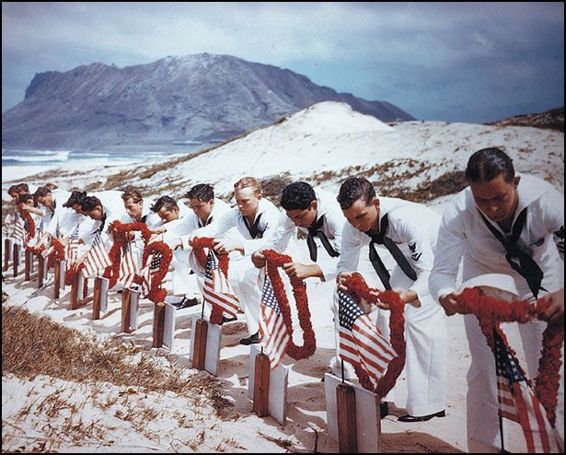
US SAILORS OF THE NAS KANEOHE HONOUR THEIR DEAD COMRADES WITH A TRADITIONAL HAWAIIAN CEREMONY, PLACING WREATHS OVER THEIR TOMBSTONES. OVER 2400 SOLDIERS AND CIVILIANS WERE KILLED DURING THE JAPANESE ATTACK ON PEARL HARBOR.
At 7.55 a.m., the first wave of Japanese bombers hit Pearl Harbor. Admiral Isoruku Yamamoto, Commander-in-Chief of the Imperial Japanese Navy, had chosen the perfect time to launch his surprise attack. It was Sunday morning, the quietest time of the week. Few officers were at their posts. Many of the marines in the base were in the mess hall sitting down to breakfast, while the band on the USS Nevada was striking up ‘The Stars and Stripes’. The band continued to play as 183 Japanese aircraft – 49 bombers, 51 dive bombers, 40 torpedo bombers and 43 Zero fighters – began their assault on the Hickham and Wheeler airfields and on ‘battleship row’, Ford Island, where the cream of the US Navy was basking in the bright Pacific sunlight.
THE ATTACK ON PEARL HARBOR
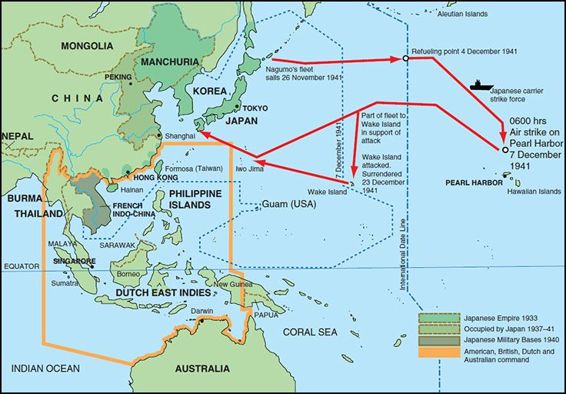
The unseen, unsuspected voyage from Japan had been a masterpiece of strategy and deception. Using a circuitous route and strict radio silence, Yamamoto had managed to send a task force of six aircraft carriers, two battleships, with cruisers and destroyers in support, across the 3400 miles of ocean that separated Hawaii from Japan, and he had done so in total secrecy. The fleet was under the command of Vice-Admiral Chuichi Nagumo, who was given the task of destroying the US fleet at anchor. The fleet had to be knocked out if the Japanese Army and Navy were to proceed with their planned conquest of the British and Dutch colonies in South-East Asia and US possessions in the Pacific, and in their place construct the ‘Greater South-East Asia Co-Prosperity Sphere’. This was the equivalent of Hitler’s Lebensraum in Europe, as the Japanese looked outward from their cramped, poorly resourced islands to the plump, rich prizes across the ocean.
Although Japan and the USA had been moving closer and closer to war over the previous months, the surprise was complete. Many of the US fighters on Oahu were unfuelled and parked close together on the airfields, perfect targets for the Japanese bombers.
Admiral Isoruku Yamamoto, Commander-in-Chief of the Imperial Japanese Navy, had chosen the perfect time to launch his surprise attack. It was Sunday morning, the quietest time of the week. Few officers were at their posts. Many of the marines in the base were sitting down to breakfast

PRESIDENT ROOSEVELT SIGNS THE US DECLARATION OF WAR AGAINST JAPAN.
FRANKLIN DELANO ROOSEVELT
During the 1930s, Franklin Delano Roosevelt, who was first elected president of the USA in 1932, watched with increasing concern as Nazi Germany and Fascist Italy moved closer and closer to war with the world’s democracies. Roosevelt’s own sympathies lay with the British and the French in their stuggle to deal with Nazi aggression, but he was a consummate politician and a genuine democrat who would never take the USA into war without the backing of the majority of his people. This majority was not, at first, forthcoming.
In 1939, most Americans were on the side of the Allies, who were, after all, fighting for the triumph of the democracy to which the Americans were themselves devoted. But this did not yet amount to a willingness to go to war on their behalf, largely due to America’s isolationist tradition, which had been a strong influence ever since the Monroe Doctrine of non-involvement in European affairs was issued in 1823. American experience in the First World War was one of bitter disillusionment. Consequently, there was no eagerness to repeat the experience. In the presidential election of 1940, in which Roosevelt stood for a third term as president, he had pledged that the USA would not enter the war. Roosevelt was, however, keen to aid the Allies.
Although isolationism and anti-war sentiments ham-strung him, he did his best to find a way round the problem. He extended as much US aid to the British as was possible. By 1941, the USA was doing much to finance the British war effort and the US Navy, despite its non-combatant status, was taking greater and greater risks safeguarding Allied convoys in the Atlantic. Despite several German attacks on US ships, Roosevelt still refused to bring the USA into the war, until, that is, the events of 7 December 1941 brought about a complete change of heart.
The attack on Pearl Harbor left Roosevelt no choice but to declare war on the Japanese Empire, and the American people, outraged at this cynical stroke of bad faith, backed him up.
It was evident, though, that the main peril to the future of the world lay in Europe, where Hitler had created a continent-wide empire. This was why the Pacific theatre was made subordinate to Europe. Throughout the war, however, Roosevelt remained true to the anti-imperialist traditions of the USA and was careful not to involve US troops in operations intended to preserve the British Empire.
Anti-aircraft positions were unarmed and unmanned and the American sailors watching the approaching torpedo bombers assumed they were US aircraft on a practice exercise. By the time the first wave left Hickham and Wheeler fields and ‘battleship row’, all three locations were a mass of burgeoning flame and twisted wreckage.
At 8.50 a.m., the second wave of the Japanese attack tore across the skies above Oahu. By this time, of course, the Americans were wide awake and put up an impressive flak barrage. But it was not enough to stop disaster from continuing to unfold. By the time the Japanese planes had finished, over 2000 US servicemen had been killed, nearly 200 planes had been destroyed and, most crucially, six battleships had been sunk, including the USS Arizona, which lost over one thousand crewmen. A further two battleships were damaged. Three cruisers and three destroyers were sunk. At a stroke, it appeared, Japan had gained naval superiority in the Pacific, for the loss of only 29 planes. There had been no declaration of war.
As the second wave of planes arrived back on their carriers, Nagumo had to decide whether or not to make a third strike. If he were to send his planes in a third time, he could ensure the destruction of the harbour facilities and their oil reserves, so making the base unusable for several months or even years. But, by now, the Americans would be ready and waiting for them, so Nagumo erred on the side of caution and decided instead to withdraw. He had no knowledge of where the rest of the US fleet was, and, fearing a surprise attack, decided it was wiser to conserve his carriers than to risk them with a third strike. After all, they would be needed as the Japanese began reaching out across the Pacific, which they were determined to transform into a new Japanese empire. It was fortunate for the Americans that Nagumo failed to launch that third strike. It was luckier still that he failed to locate the vital US aircraft carriers that had not been in harbour at Oahu that morning.
These carriers did not simply escape to fight another day. In the Pacific conflict that followed the sneak attack on Pearl Harbor, carrier warfare was to be the lynchpin of US naval operations as groups of US vessels, like the posses of the old West, ranged the ocean picking off their Japanese victims while remaining near invincible themselves by blasting a barrage of firepower at any aircraft or ship that dared to challenge them.
Pearl Harbor, however, was only the most famous, or rather infamous, strike in an ocean-wide campaign that was astounding in its ambition and extent. All the more so for an island nation that had only one-tenth the industrial capacity of the foe it so impudently assaulted on Oahu. The government of General Hideki Tojo aimed at nothing less than the destruction of the British, French and Dutch empires in the East as well as the American Commonwealth of the Philippines. The rule of the white man would then be replaced by the Co-Prosperity Sphere, which would see Asia ruled by the Asians. The Japanese believed they had a divine mission to lead Asia into this new era. Furthermore, they had convinced themselves that the Americans had pushed them into war by their apparent determination to crush the Japanese economy and prevent it from expanding as it was ‘destined’ to do. The war, the Japanese argued, had been undertaken for the purposes of ‘self-preservation’.
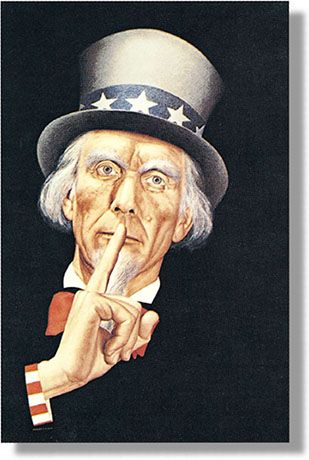
UNCLE SAM ASKS AMERICANS TO BE SECURITY CONSCIOUS. STRICT PRECAUTIONS WERE TAKEN AGAINST SPIES AND SABOTEURS, WHICH, UNFORTUNATELY, SOMETIMES LED TO THE INNOCENT BEING IMPRISONED – JAPANESE AMERICANS FOR INSTANCE – SIMPLY BECAUSE OF THEIR RACIAL ORIGINS.
Less than a century earlier, Japan had been a medieval state, cut off from the world by the Isolation Decree of 1636. The purpose of this was, mainly, to keep out the insidious influence of Christian missionaries, but it did not mean that the leaders of Japan were unaware of the way the outside world was progressing as their country rejected contact from outside. When the American Commodore Matthew Perry arrived in Kyoto harbour in 1853, with a steamship belching fire, ordinary people, who did not even know what an ocean-going sailing ship was, thought the world had come to an end. In a way, it had. Perry came to demand that the Japanese end their isolation and open up their ports to foreign trade. The rulers of Japan were no fools and realised that their medieval number was up. If they did not agree voluntarily, they would be forced to do so, as their neighbour, China, had been forced only a few years before.

POSTERS, TOP TO BOTTOM: A POSTER COMMEMORATING THE DEAD OF PEARL HARBOR, ISSUED EARLY 1942.
ROSIE THE RIVETER CALLS AMERICAN WOMEN ONTO THE FACTORY FLOOR.
HER MALE COUNTERPART URGES AMERICA’S YOUTH TO JOIN THE ELITE UNITED STATES MARINE CORPS.
PATRIOTIC AMERICANS ARE URGED TO STRETCH RESOURCES AND ‘CAN ALL YOU CAN’.
AMERICAN WORKERS ARE WARNED OF THE NEED TO BE SECURITY CONSCIOUS – YOU NEVER KNOW WHO’S LISTENING!
Subsequently, after 1867, Japan began to modernise and did so at such a phenomenal rate that the process took one-tenth of the time it had taken in Europe. Unfortunately, along with modern technology, financial systems and other appurtenances of the modern world, the Japanese also acquired a modern appetite for overseas conquest and before long decided to expand out of their cramped home islands. In particular, the Japanese, lacking sufficient raw materials for industry, cast covetous eyes on other Asian territories where these vital supplies were plentiful. Malaya, a British possession, and the Dutch East Indies (Indonesia) were particular treasure troves, rich in oil, rubber and tin.
Until 1940, the Japanese had focused their main overseas expansion on China, where they had been successfully occupying the richest parts of the country since 1931. In 1932, they even set up a puppet state in Manchukuo, with the last Chinese emperor, Pu Yi, as its ruler.
However, Hitler’s successes in Europe turned Japanese attention to the European colonies in Asia, which, in the case of the French and Dutch were now ‘orphans’ with their mother countries under occupation. The ‘fall’ of Britain, which once seemed likely, also put the British colonies on the Japanese acquisition list. Even after the RAF won the Battle of Britain and it was clear that the British were going to survive, it seemed evident that the inevitable life-or-death struggle with the Nazis would prevent the British from stretching their resources in order to put up a stiff fight in the East as well.

IN STRICT ADHERENCE TO THE CODE OF BUSHIDO, TWO JAPANESE SOLDIERS COMMIT ‘HARA-KIRI’ RATHER THAN FACE THE SHAME OF BEING TAKEN ALIVE.
BUSHIDO
The ferocious militarism displayed by Japanese soldiers throughout the war had its roots in the ancient Samurai code of Bushido, or ‘The Way of the Warrior’. Under this code, Japanese soldiers pledged undying loyalty to their Emperor, Hirohito, and the honour of Japan. According to Bushido, death was preferable to capture, and if a Japanese soldier was caught in the act of surrender, he was liable to the death penalty. Strict implementation of the code often led to suicidal resistance to the Allies, in such moves as the Banzai charge. This occurred when all ammunition was exhausted and Japanese troops would charge with bayonets, inflicting horrible injuries on their enemies and on themselves. Those who survived the Banzai charge, or those present at a defeat, were expected to commit suicide and often did so.
The practice, popularly known as ‘hara kiri’, was more correctly termed ‘seppuku’ and involved self-disembowelling, one of the most painful of deaths. Traditionally, a swordsman stood by ready to behead the suicide.
Bushido and adherence to it led to many cultural misunderstandings between Westerners and the Japanese, particularly when it came to the treatment of prisoners of war. The Japanese were routinely brutal to prisoners, because they had allowed themselves to be captured. In Japanese eyes, they were therefore despicable. The Allies, however, strictly implemented the Hague Convention and the decent treatment of prisoners it required. This included those Japanese who themselves became prisoners of war, and survived. This was quite incomprehensible to the Japanese, however, and rather than acknowledge it as a sign of civilised behaviour, they concluded that the Allies were weak.

THE SEATTLE DAILY TIMES FRONT PAGE SPLASH ON THE DAY AFTER PEARL HARBOR. IN A PIECE OF TYPICAL WARTIME CENSORSHIP THE FULL EXTENT OF THE DESTRUCTION OF THE US NAVY WAS KEPT FROM THE AMERICAN PEOPLE. THE AUTHORITIES FEARED THAT REVEALING THE TRUTH MIGHT SAP THE AMERICAN WILL TO FIGHT.
The Japanese, therefore, began to cast covetous eyes on Hong Kong, Singapore, Malaya, the Dutch East Indies, French Indochina and other colonial territories. Even before Pearl Harbor, in July 1941 the Japanese had been pressurising the French in Indochina, and had wrung bases out of them for their own forces. Next, on 26 July 1941, the Japanese moved into Thailand and Cambodia and seized Saigon.
Long before that, though, US President Roosevelt had become increasingly alarmed about Japanese ambitions in the Pacific. If they were to prey on European possessions in Asia, they would inevitably, also, have to seize the strategically placed Philippine Islands, which had come under US rule after the Spanish–American War of 1898.
In September, 1940, the Japanese joined the Triple Alliance with Germany and Italy, so expanding the group known as the Axis powers. This was an extremely ominous move. Roosevelt responded with trade sanctions against Japan, a weapon to which she was especially vulnerable. Relations between the two nations continued to deteriorate from then on, and a crucial turn was taken with the USA’s response to Japanese aggression in French Indochina. The USA implemented an oil embargo and froze Japanese assets in the USA, an action in which the British and Dutch joined.
The countdown to war had begun. Japan’s own oil reserves would last not much longer than a year, which made taking possession of the Dutch East Indies essential if the country was not to grind to a halt. Talks opened between Japan and the USA, but the two sides never really neared a compromise. The Japanese had decided by September 1941 that if the talks with the Americans were not successful by the beginning of December at the latest, they would have no choice but to go to war. As the talks continued to falter, war seemed more and more likely, and in mid-November Nagumo’s fleet set sail for Pearl Harbor.
After the attack of 7 December 1941, which took place while Japanese envoys were still engaged in talks in Washington, an enraged President Roosevelt declared war over what he termed ‘a day that will live in infamy’. The occasion was of such grave import that the president, who had been paralysed by an attack of polio in 1921, was wearing his heavy metal callipers so that he could stand up to make the announcement. In Germany, Adolf Hitler declared war on the USA. In Britain, Winston Churchill was relieved. The USA, the ‘arsenal of democracy’ and the mightiest industrial power in the world, was in the war at long last. However, for Isoruku Yamamoto, it was a sombre moment. After Pearl Harbor, he had commented: ‘I fear that all we have done is to waken a sleeping tiger.’ As he had feared, the tiger was now wide awake.
MALAYA
While Pearl Harbor burned and the Americans there reeled at the shock of the sneak attack, the Japanese 25th Army under Lieutenant General Yamashita crossed into Thailand and pressed on to the British colony of Malaya. Yamashita was planning to fight his way down the 600 miles of the Malayan peninsula to capture the British naval base at Singapore, a key stronghold of the British Empire in the Far East. With Singapore in Japanese hands, British strength in the Pacific would be broken. Meanwhile, Japanese bombers launched attacks on Hong Kong and the Philippines.
The Japanese, in fact, were regarded contemptuously, as bow-legged little yellow men who could only ape their European ‘betters’… when one British official in Singapore was told the Japanese had landed, he told his military opposite number to ‘push the little men off’
Things went wrong for the British in Malaya from the outset. Confusion prevented them from launching the long-prepared counter-attack, code-named Matador, against the Japanese. Within days of the enemy landings at Dingora, Patani and Kota Bharu, the British were beginning a retreat that would not stop until they reached Singapore and the sea.
The British were singularly complacent about the threat to their empire posed by the Japanese, whom they totally underrated as fighting force. The Japanese, in fact, were regarded contemptuously, as bow-legged little yellow men who could only ape their European ‘betters’ and were unable to manoeuvre aircraft in the air because their slit eyes obscured their vision. In fact, some of the most celebrated air aces of the war were Japanese, including Saburo Sakai, who, among other feats, used to fly his plane close to stalling speed to conserve fuel. Nevertheless, the dismissive view of the Japanese was so prevalent at the start of the war in the Pacific that when one British official in Singapore was told the Japanese had landed, he told his military opposite number to ‘push the little men off’.
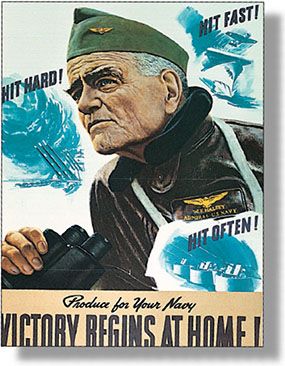
A US NAVY POSTER URGES GREATER PRODUCTIVITY TO SECURE A SPEEDY VICTORY.
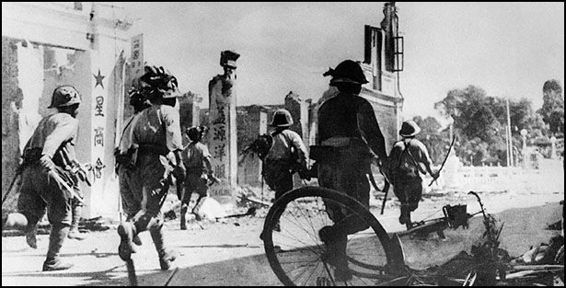
YAMASHITA’S MEN BEGIN THEIR CHARGE IN PENANG, WHERE THEY WERE TO ENJOY YET ANOTHER DAZZLING VICTORY. JAPANESE TROOPS IN MALAYA CONSISTENTLY TOOK THE INITIATIVE WHILE BRITISH AND EMPIRE FORCES FELL VICTIM TO THEIR SWIFT AND SKILFUL ATTACKS. YAMASHITA’S MEN HASTENED THEIR ADVANCE DOWN THE MALAY PENINSULA WITH BIKES, SOME OF WHICH CAN BE SEEN IN THE FOREGROUND.
However, the Japanese in Malaya proved themselves better led, better trained and better equipped than the British. Yamashita was so confident of victory that he elected not to take all the troops available to him on his Malayan campaign. With only 60,000 men, he was outnumbered by the British, Indian, Malay and Australian troops that the British Commander in Malaya, Lieutenant-General Sir Arthur Percival, had at his disposal. But Yamashita, who quickly captured forward British airfields, had air superiority throughout the campaign. It was a crucial advantage for the Japanese and it cost the British dearly.
THE FALL OF THE PHILIPPINES

Winston Churchill was not unaware that the Japanese had designs on Britain’s empire. In order to discourage them from attacking Malaya, he dispatched the battleship Prince of Wales and the cruiser Repulse to Singapore. They arrived just in time to attempt the destruction of the Japanese invasion force landing in northern Malaya. Admiral Sir Tom Phillips sent his two warships north from Singapore, but they were soon spotted by the Japanese, and Phillips, seeing that the element of surprise was lost, turned for home. He never got there. Phillips’s position was extremely perilous. His ships had no air support and were crucially vulnerable to attack from dive- or torpedo-bombers. Before he could reach his base, misleading signals sent him off on a wild goose chase to stop a nonexistent Japanese ship near his current position. It was then that the warships were again spotted by the Japanese, in the Gulf of Siam. On 10 December 1941, assaulted by Japanese bombers, the two ships were sunk and over 800 men were lost. Among them was Admiral Phillips. Churchill described the disaster as ‘the most direct shock’ he received during the whole of the war. British power in the Far East was in tatters.
Less than two months later, on 1 February 1942, the British had surrendered the whole of the Malayan peninsula and had withdrawn to the island fortress of Singapore. The Japanese had outflanked the British down the whole length of the peninsula. Using their superior mobility, the Japanese ran behind British positions and attacked them from the rear. Many of the British forces were inexperienced, especially the Indian brigades, some of whom had never seen a tank before, since the British had no tanks for defence in the entire territory. Once the British had begun to retreat, they found it hard to stop, though military communiqués, employing the euphemisms of ‘warspeak’, reported that their forces had once again ‘successfully disengaged the enemy’.
On 10 December 1941, assaulted by Japanese bombers, the two ships, the Prince of Wales and Repulse, were sunk and over 800 men were lost. Among them was Admiral Phillips. Churchill described the disaster as ‘the most direct shock’ he received during the whole of the war
The Japanese crossed the Straits of Johor, which separated Singapore from the mainland, on 8 February. This, if anything, was even more of a ‘direct shock’. The British had presumed that the tangled jungle country made Singapore impossible to assault from the landward side. Yet, the Japanese achieved the seemingly impossible and a week later, on 15 February, Singapore was in Japanese hands and Lieutenant-General Percival, who had risen from the ranks to the Malaya Command, was a picture of misery and shame as he yielded to his conquerors. Well might he look grim and grey-faced. Percival had just presided over the greatest military defeat in British history. Over 60,000 men were taken prisoner, half of them Indians. Many of these were recruited into the Japanese-sponsored Indian National Army set up by the Indian nationalist Subhas Chandra Bose for the purpose of driving the British out of the sub-continent.
The British had experienced a series of crushing defeats in the Far East within a few weeks. Hong Kong, Malaya and Singapore had fallen. They were also hard pressed in Burma, where the Japanese were hoping to force the closure of the Burma road, the only supply route into Nationalist China. If Burma were to fall, then the Japanese would be at the eastern gates of India, the ‘jewel in the crown’ of the British Empire.
But the British were not the only ones involved. The Australians, seeing the collapse of Singapore and sensing their own danger, began looking to the Americans to stop the Japanese. The Americans, though, were having problems of their own.
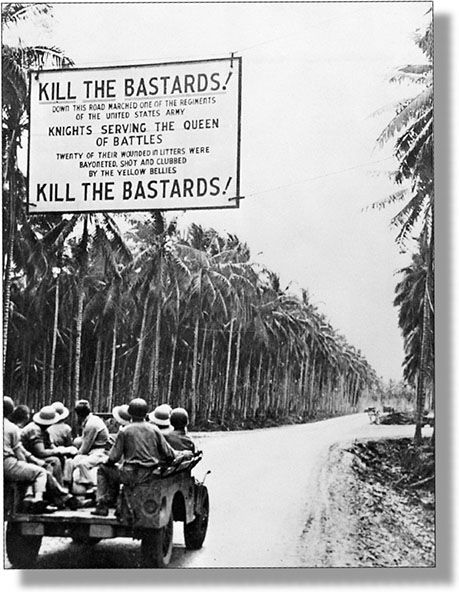
AFTER STUBBORN RESISTANCE BY THE ALLIES, THE PHILIPPINES FINALLY FELL IN MARCH 1942. IT WAS NOT, HOWEVER, UNTIL THE SECOND WORLD WAR FINALLY ENDED THAT THE FEROCIOUS BRUTALITY METED OUT TO ALLIED POWS WAS REVEALED. THE UNEQUIVOCAL SENTIMENTS EXPRESSED HERE LEAVE NO DOUBT AS TO THE SENSE OF AMERICAN OUTRAGE.
THE PHILIPPINES
The full-scale Japanese invasion of the Philippines began on 22 December 1941. By then, General Douglas MacArthur, the Commander of the US forces, had already had half of his air force destroyed on the ground due to a hesitant reaction, on his part, to the bombing of Pearl Harbor. The little air support left for US naval forces in the Philippines effectively neutralised them. The Japanese troops landed swiftly and made their approach towards the capital, Manila.
MacArthur declined the invitation to defend the city, and instead skilfully withdrew to strong defensive positions in the Bataan peninsula and the island fortress of Corregidor. Here, the Americans were to endure several months of savage and bitter fighting. MacArthur had managed to salvage few rations for his force of over 60,000 Filipino and 15,000 US troops. This shortfall was to have serious consequences.
The ‘battling bastards of Bataan’, as the Americans became known, held off the Japanese advance for several months, but they were to suffer horribly from tropical diseases whose impact was made worse by the Americans’ lack of food and medical supplies. Despite pleas from MacArthur, Washington was unable to sent reinforcements to his hard-pressed men. The ‘Europe first’ strategy agreed with the British after the US declaration of war meant that all available US resources were being concentrated on the defeat of Hitler. The Pacific theatre, though closer to home, had to take second place.
Hundreds of Wainwright’s weakened men were to die from the harsh treatment they received as Japanese prisoners of war. This brutality sprang largely from the Japanese Samurai military code of Bushido, which made being taken prisoner a disgrace worse than death

THE RISING SUN FLIES OVER THE PHILIPPINES. JAPANESE TROOPS CELEBRATE THEIR HARD-WON VICTORY IN AMERICA’S FORMER COLONY. BUT OF ALL THE TERRITORIES THE JAPANESE OCCUPIED, THE LOCAL FILIPINOS PUT UP THE STIFFEST GUERRILLA RESISTANCE TO THEIR NEW MASTERS.

EMPIRE DOWN. PERCIVAL SURRENDERS TO YAMASHITA IN SINGAPORE, FORMALLY ACKNOWLEDGING THE BIGGEST MILITARY DISASTER IN BRITISH HISTORY.
THE FALL OF SINGAPORE, 15 FEBRUARY 1942
The capture of Singapore by the Japanese is still regarded, over 50 years later, as the British Army’s single most crushing defeat. The island naval base had been built between the two world wars and had developed a reputation as a rock-like fortress. It was considered so resilient to enemy attack that it was nicknamed ‘the Gibraltar of the East’ after the Rock in the Mediterranean with an age-old history of survival in the face of attack.
Yet, Singapore was taken by outnumbered Japanese soldiers after only a week’s fighting. Its loss was one of the events that led to the dismantling of the British Empire after the war. The fact that the British had been beaten so soundly and were unable to rise to the challenge of Japanese attack in Asia was a fatal blow to British prestige in the East.
In British plans, any attack on Singapore was bound to come from the sea, which explained the big naval guns that were installed there. They were useless, however, when the Japanese approached instead by land. In addition, British forces had been spread far too thinly to resist the invaders. Within days, Singapore’s water supply had been seized, provoking desertions and unrest among the island’s Malay and Chinese inhabitants. Days later, on 15 February 1942, Lieutenant-General Sir Arthur Percival surrendered to the Japanese, confirming what Winston Churchill called the ‘worst disaster and biggest capitulation in British history’.
As the dire situation became desperate, MacArthur was ordered to quit the Philippines on 11 March 1942 and regroup in Australia. Before departing, MacArthur pledged to the Filipino people: ‘I will return.’ The only US forces in the island chain were now left under the command of Major-General Jonathan Wainwright, who continued stubborn resistance on Bataan until 9 April. The fortress of Corregidor held out until hunger, constant air raids and a landing of Japanese troops made further resistance untenable by 6 May. Hundreds of Wainwright’s weakened men were to die from the harsh treatment they received as Japanese prisoners of war. This brutality sprang largely from the Japanese Samurai military code of Bushido, which made being taken prisoner a disgrace worse than death. Consequently, the Japanese had no consideration at all for those so shamed. This was how the forced march to prison camps made by the defenders of Bataan became notorious after the war as the ‘death march’.
Before the final collapse of resistance in the Philippines, the Japanese were able to begin their thrust to the south and begin the capture of the oilfields in the Dutch East Indies. In December 1941 and January 1942, Japanese landings began securing these prize resources. Resistance was offered by what remained of the Allied forces in the Pacific but, though brave, it was futile. The combined remnants of the US, British, Dutch and Australian (ABDA) navies made a final bid to halt the Japanese in the Battle of the Java Sea, but they failed. The Japanese defeated the allies, and their Dutch commander, Rear-Admiral Karel Doorman, went down with his ship. Resistance in the Dutch East Indies ceased on 8 March and, consequently, 100,000 Allied soldiers were to spend the rest of the war in the unspeakable conditions of Japanese captivity.

THE DESPAIR OF DEFEAT. THESE US SOLDIERS HAVE JUST BEEN TAKEN CAPTIVE BY THE JAPANESE IN BATAAN AFTER PUTTING UP A STIFF FIGHT FOR OVER 100 DAYS. THEY ARE ABOUT TO BEGIN A 100KM JOURNEY ON FOOT TO THE PRISONER OF WAR CAMPS PREPARED FOR THEM IN SAN FERNANDO. THE TREK WAS A TORTUOUS ONE. THE SOLDIERS, ALREADY WEAK FROM MALNUTRITION, WERE BEATEN AND CLUBBED BY THEIR CAPTORS.

TWO WOMEN, ONE AMERICAN AND ONE DUTCH, DO THEIR BEST TO ADD A FEW TOUCHES OF HOME COMFORT TO THE LESS THAN IDEAL CONDITIONS OF A JAPANESE WOMEN’S PRISON CAMP.
BATTLE OF THE CORAL SEA, 4–8 MAY 1942
The Japanese continued their progress south, building an air base at Guadalcanal in the Solomon Islands, another British colony. They hoped to move on to capture Port Moresby in Papua New Guinea, for a base there would put Australia within striking distance of Japanese bombers. The Allies learned of Japan’s intentions, and their determination to stop their advance led to the first-ever battle between two carrier fleets, fought entirely in the air. The two fleets never sighted each other. Although the battle was effectively a draw, the Japanese had the better of the fighting, sinking the US carrier Lexington and damaging theYorktown. While the US planes damaged two Japanese carriers, they sank none. But for the first time since Pearl Harbor, the Japanese advance had been checked. Port Moresby remained out of reach and Australia, for the time being, was safe.

THE PILOTS OF A FIGHTER CREW OF THE USS LEXINGTON ARE BRIEFED BEFORE GOING INTO ACTION. THE LEXINGTON WAS SUNK BY THE JAPANESE IN THE BATTLE OF THE CORAL SEA.
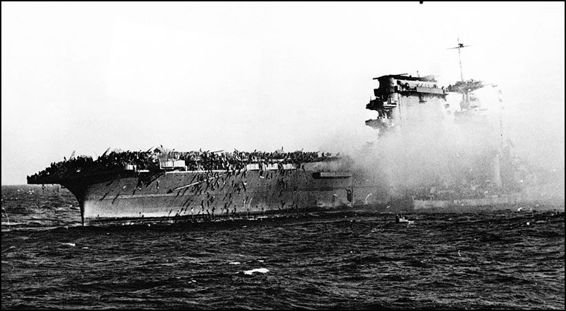
FIGHTER SQUAD 16 OF THE USS LEXINGTON RECEIVES THE GAME-PLAN BEFORE TAKING TO THE SKIES TO HUNT OUT THE JAPANESE FLEET DURING THE BATTLE OF THE CORAL SEA. TORPEDO PLANES AND BOMBERS LATER SANK HER.