
Geography
The Korean peninsula has been described as a ‘natural state’, geographically self-contained and with a culture entirely different to that of its neighbours. It is roughly 400 miles north to south, and 120 miles across at its narrowest. It is mostly rugged terrain, with the Taebaek mountain chain running down its centre making east–west communications difficult. The northern border with Manchuria (part of China) is defined by two rivers, the Yalu to the west and the Tumen to the east. The Primorsky Krai region of eastern Russia shares a thirty-mile border with Korea’s northeast corner as well. The important Russian port of Vladivostok is some 100 miles further to the northeast. Japan lies only 100 miles off the southeast coast. These three powerful neighbours have jockeyed for influence in the region for hundreds of years. To a degree, Korea has been caught in the middle of this rivalry.
The climate may best be described as hostile. The summers are hot and dry, the winters terribly cold. Between the two, spring rains can turn much of the landscape to mud.
In 1950, transport links were primitive, with very few roads or railways and only two major ports. These were at Pusan on the southeast tip and Inchon, serving the capital city of Seoul, midway up the west coast. They would become crucial during the war.

The Taebaek Mountains (Image by G43)
Culture
The Korean language, food and mindset are unlike those of China or Japan. Such distinctions took shape through geographical isolation. From pre-history, the peninsula was relatively self-contained. Linguistically, for instance, Korean is generally accepted to be a unique language, completely unrelated to those of its neighbours. Most scholars regard the overlap with Japanese as a later phenomenon brought about through contact. Although food is based on rice, vegetables and fish, the cooking styles are not those of northern China. The same is true of religion (with a strong Shamanistic tradition), architecture, music and dance.
Once Korea’s history became dominated by neighbouring states, however, this cultural purity began to be diluted and cross-pollinated. For example, spoken Korean (and its precursor dialects) was first transposed into the Chinese Hanja script. The culture, therefore, reflects the geography and supports the idea of Korea as a ‘natural state’. For these reasons, despite a difficult history and continuing division, this is a region with a strong national identity, maintained in the face of frequent conquest.
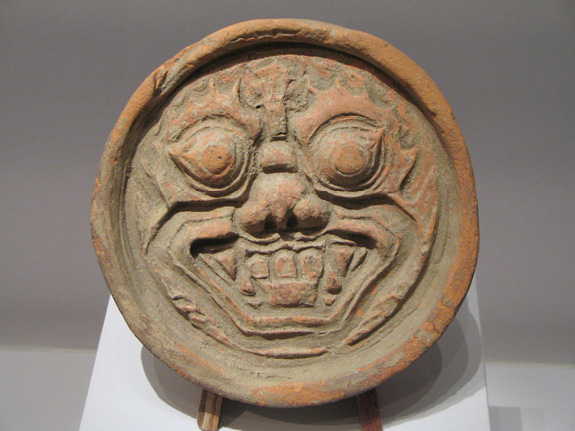
Korean end-roof tile from 5th or 6th century (Image by pressapochista)
A History of Conflict
Korea was repeatedly invaded by China from about 200 BC. In 1219 it was the turn of the Mongols, with Genghis Khan leading the first of four large incursions by these fierce nomadic warriors. By the sixteenth century, Japan had emerged as a powerful regional player and it too sought the conquest of the peninsula. The result was devastation, widespread slaughter, economic and agricultural collapse. Little surprise, then, that by the early nineteenth century, Korea had become something of a hermit nation, anxious to minimize contact with outside cultures.
Under the Joseon dynasty this policy worked for a time, with a period of relative tranquillity and prosperity. Chinese suzerainty was formally acknowledged, but without onerous conditions. The growing imperial ambitions of Japan and Russia, however, combined with their superior technology and large armed forces, would shortly undermine this wish to be left alone.
In 1876 the Joseons signed an overtly exploitative treaty with Japan, granting her significant trading rights. Six years later, in what for a time proved a shrewd piece of diplomacy, Korea signed a treaty with the United States. Brokered by China, this deal helped to offset the influence of the Japanese, who were already basing troops in Korea. Tensions were high, as China and Japan controlled different factions within the weak Korean government. In 1885, both China and Japan agreed to withdraw all of their forces from the peninsula. Yet when in 1894 the Korean emperor requested Chinese assistance in putting down a rebellion, Japan used this as a pretext to send an expeditionary force of her own. This resulted in the First Sino-Japanese War.
Within nine months China had capitulated and Japan’s influence in Korea became even stronger. Now though, she found she had another major power competing for influence in the region: Russia. As early as 1896 at the coronation of Tsar Nicholas II, the Japanese had proposed the formal division of Korea, into zones of Russian and Japanese ‘influence’. Foreshadowing things to come, a dividing line was suggested along the 38th Parallel. The Russians were interested in the area for strategic reasons. They had no warm water port on the Pacific Ocean. The large Russian naval base at Vladivostok froze during the winter. Port Arthur in Chinese Manchuria was different – it remained open. It was an excellent natural harbour and fortress and, indeed, had been briefly seized by Japan. Direct military threats from Britain and France had eventually forced her to return it to China.
The Korean peninsula lies between Vladivostok and Port Arthur. The Russians leased Port Arthur from China in 1898 and built a railway connecting it to Harbin in China and thence Vladivostok, running along the northern border of Korea. The components were in place for increasing rivalry with Japan.
After years of fruitless negotiation, Japan attacked Russia in 1904 and inflicted a devastating defeat on the Tsar’s armies and fleet. She now emerged as the dominant military power in the region. A corollary of that was the eventual full colonization of Korea. It was the USA, also an emerging power during this period, that oversaw the 1905 Treaty of Portsmouth which facilitated this. In exchange, President Theodore Roosevelt is alleged to have secured tacit Japanese acceptance of US dominance in the Philippines. Article Two of the treaty explicitly recognized that Japan had ‘paramount political, military and economical interests’ in Korea. That same year, the Japanese forced Korea to accept a ‘Protectorate Treaty’, followed in 1911 by the ‘Japan-Korea Annexation Treaty’. These were not signed by the Korean emperor, but their dubious legal standing did not prevent Japan from taking complete control.
Japanese rule in Korea was brutal and totalitarian. In essence, the ambition was to eradicate the Korean culture and supplant it with Japan’s own, extending to language, the legal system and religion. The animosities which this regime was to engender would last way beyond the Second World War. Between 1941 and 1945, Japan ruthlessly exploited its colony for raw materials as well as men and women, forced to serve as soldiers and prostitutes for the Imperial Japanese Army. As the war drew to a close and Japan’s imminent defeat became inevitable, the Allied powers turned to consider the break-up of her empire.
After the Second World War: Two Koreas Emerge
As the Second World War drew to a close, the Allies turned their attention to the future status of those areas which had been under Axis control. Between 1945 and the outbreak of the Korean War in June 1950, Korea would be divided into two. By 1950 there was a Russian-dominated Communist North Korea and a US-dominated quasi-democratic South Korea.
It was the Americans who proposed the division of the peninsula into two, along the 38th Parallel. North of this line would become a Russian-controlled zone, with the Americans occupying the south. There is nothing particularly special about the 38th Parallel, other than it being an internationally recognized line on the map. It happens to run across the waist of Korea and the Americans noticed that if it were used in this way, the southern zone would include the capital city of Seoul, and both of the country’s major ports.
Such a slicing up of the map by the great powers was commonplace at the time. Little real account was taken of the interests or aspirations of the local inhabitants. From an American perspective this was a bold proposal, in that the Russians were likely to emerge as the more powerful player in the region. Russia had undertaken to attack Japan within three months of the defeat of Nazi Germany. The obvious means of doing this would be to invade Japanese-occupied Manchuria, including Port Arthur and the Chinese border with Korea. They could then move south into Korea. This is what transpired. Other allied forces in Asia (chiefly American and British) were thinly spread. It would be months before any kind of garrison could be sent to the south of Korea.
Despite the obvious weakness of the American position, the Russians accepted the 38th Parallel proposal at the Potsdam conference. Their chief focus was on Europe and they may have imagined that in due course, the whole of Korea would fall to them.
Therefore, as two Koreas began to emerge from the dust of the Second World War, they did so against the backdrop of the nascent Cold War. With considerable justification, Churchill described an ‘Iron Curtain’ falling across Europe. In Eastern Europe, democratic sensibilities were ignored and brutal Communist regimes imposed at the behest of Moscow. In 1948 the Russians had come close to provoking a Third World War by blockading West Berlin. The Chinese Civil War had reached its climax in 1949, with the establishment of Mao Zedong’s government in Beijing and the rump of Chiang Kai-shek’s Nationalists confined to the island of Taiwan (Formosa).
In American public life and within President Harry S. Truman’s Administration, there was a tendency to view such developments as a monolithic and malevolent conspiracy, driven by Moscow. There was a widely held view, for example, that the West had ‘lost China’ through a lack of political and military resolve. This may seem an over-simplification to the modern reader. Yet given the appeasement which had allowed fascism to gain such a grip on Europe, it was understandable. Communism did seem to be on the march, and it was trampling human rights and democracy underfoot. Sentiments in Western Europe, even among governments with socialist agendas, were not so different from the US point of view.
For all of these tensions, the Russians stuck to their side of the deal when occupying northern Korea in 1945. Although weeks ahead of the Americans, their forces remained north of the 38th. There was a notional commitment from both parties to seek a solution for the entire peninsula, thereby creating a united Korea. However, in both the Russian and American zones, it was not long before each party was pursuing policies designed to preclude the opposing ideology from taking hold.
In the North between 1945 and 1950, the Russians built a totalitarian Communist regime under Kim Il Sung, formally declaring the Democratic People’s Republic of Korea in 1948. The measures introduced included land reform and a semblance of worker control; corruption was largely eliminated. These were popular policies. It would, therefore, be wrong to suggest that the new regime was devoid of support. Kim had fought the Japanese in Manchuria during the 1930s and then spent five years studying in the Soviet Union, before returning to his country of origin in 1945. Although he was never simply a Soviet puppet, by 1945 Kim was much closer to Stalin’s regime than he was Mao’s. Kim was still only 38 when the Korean War broke out.
In the South, US General John Hodge headed a somewhat inept military administration which relied on former Japanese collaborators – notably their brutal police force – and repressed any left-leaning political activists. At the same time, Syngman Rhee became the Americans’ favoured contender for political leadership. Rhee had spent much of his life in exile in the United States. He was a highly educated Christian, with decades of experience in Korea’s volatile political history. This included imprisonment by the Japanese and advising at the Treaty of Portsmouth negotiations in 1905. By 1945 he was already 70 years old. Virulently anti-Communist, Rhee was elected the first President of South Korea in July 1948.
While Rhee and Kim manoeuvred themselves into power between 1945 and 1948, there were parallel efforts by the USA, Russia and the United Nations to reach some kind of agreement which would unify the country. The Moscow Conference of Foreign Ministers in December 1945 had agreed to establish a joint US-USSR Commission for the government of Korea. Largely ineffectual, the Commission at least served to prevent open conflict between the Americans and Russians in Korea. In the South, Rhee’s ‘Democratic Council’ opposed the Commission’s timetable for independence and provoked riots and strikes. Eventually the Americans took the Korean problem back to the UN General Assembly, which called for elections across Korea. The Russians rejected this proposal and the two elections which brought Rhee to power in the summer of 1948 were confined to the US zone. In May, Rhee’s party secured control of the National Assembly. In July, he won a personal mandate when elected directly to the South Korean presidency. These were followed by one party ‘elections’ in the North later that year.
By 1949, both the USA and Russia had withdrawn their military forces from the peninsula. Korea was split into two hostile mini-states, each beholden to its super-power. The rhetoric between them was heated, with claim and counterclaim. Rhee and Kim were Nationalists – both sought dominance over the whole of Korea. Neither recognized the legitimacy of the other. Border incidents and guerilla attacks in the South became commonplace. The scene was set for war.