
June 1950: The Surprise Attack
The Korean War began just before dawn, on Sunday, 25 June 1950. Taken completely by surprise, and outclassed in every respect, South Korean forces were pushed rapidly back. Within days, however, the United Nations had intervened on behalf of the South. The first UN ground troops, an American unit, would meet the North Koreans on 5 July.
The war began early that Sunday when, four or five miles north of the 38th Parallel, Russian-built Katyusha rocket batteries lit up the sky with a blistering barrage. T34 tanks rolled forwards, accompanied by swarms of North Korean infantry.
It was immediately clear that this was a well-planned, full-scale invasion. The South Koreans had no tanks or heavy artillery, and but a handful of obsolescent aircraft. Their infantry formations were under strength, with divisional organization only notional. Arrayed against them were ten fully equipped North Korean divisions trained in the Soviet tactical doctrine. Thousands of the North Korean troops were combat veterans, recently returned from fighting under Mao’s command during the Chinese Civil War.
They were supported by independent tank battalions and a small but capable tactical air force. In these early clashes, there really was no contest. In most cases the South Korean units disintegrated, clogging roads that were already swarming with refugees. A series of North Korean columns raced towards Seoul, down the centre of the country and along the eastern coast as well.
To General Douglas MacArthur, woken with the news only hours after the first North Korean assault, this seemed an obvious Russian move designed to test Western resolve. MacArthur headed the American Far Eastern Command, with his headquarters in Tokyo. Until now, his preoccupation since the end of the Second World War had been the rebuilding of Japan, of which he was in effect emperor. The North Korean attack would quickly change those priorities. When President Truman was told the news on what was still Saturday evening back in the USA, his instincts told him the same thing: this was a Russian gambit.
From the opening hours of the Korean War, therefore, the American attitude was to look for a conspiracy emanating from Moscow. This strategic stance would colour much of the policy towards the Korean situation over the next three years. Millions of words have since been written on the role played by Russia and, indeed, China in the North Korean attack. Given the secrecy of those regimes, and notwithstanding the volume of information made available since the collapse of the Soviet Union, historians remain divided as to the extent of Russian or Chinese culpability.
Some things are indisputable. The North Korean Army had been supplied with large amounts of Soviet military hardware, making it a much stronger force than its southern counterpart. Crucially, the armour meant that this was an army capable of offensive operations – unlike Rhee’s. Soviet instructors had been seconded to North Korean units since 1948. Kim was close to the Russians, having spent several years there. He had visited Moscow and Beijing earlier in 1950. It is stretching credulity to imagine that the possibility of invasion was not mentioned. Chinese railways would be needed to maintain the North Korean logistical effort, and, in particular, any resupply from Russia. It is, therefore, difficult to imagine that either China or Russia was entirely in the dark prior to the North Korean assault.
That is some way from asserting, however, that the attack was ordered by Moscow, Beijing, or both. Perhaps the most that can be said is that while it is possible that Kim initiated the attack under direct instructions from Moscow, it is more likely that Stalin’s headquarters at the Kremlin was simply content that it should go ahead.
Russia and/or China may have been willing to take a gamble with Korea at this level – to offer support without full-scale involvement. The Truman Administration was after all emitting confusing political signals during these critical months of the Cold War. Although secretly resolved to confront Communist aggression robustly, a speech by Secretary of State Dean Acheson in January 1950 seemed to concede that Korea was not a vital American interest.
Yet China was in no position to entertain war with the United States. Mao had only recently secured power in Beijing and was much more interested in finishing the war against Chiang Kai-shek in Taiwan than he was in new adventures to the north. Chiang’s KMT (Kuomintang) Nationalist forces were now confined to this large island and Mao hoped to invade it. This would eliminate final opposition to Communist rule in China, putting a definitive end to the Civil War there.
Although Moscow had exploded an atomic device in 1949, it was in no position to risk a nuclear confrontation which, in 1950, it would have lost. But if the United States was ambivalent about Rhee’s regime in South Korea, then why not let their ally Kim Il Sung see what he could achieve?
This kind of speculation must have been academic to the South Korean troops thrown into the line across the 38th Parallel in June 1950. Such was their routing, that of the 100,000 men notionally under arms on 25 June, about 80 per cent were unaccounted for after the first week. Rhee himself fled the capital with his key ministers on the 27th. By the 29th, the city had fallen. The bridge across the Han river was choked with refugees as families fled Kim’s troops. South Korean Army vehicles barged through in their panic. The elderly or infirm were run over, some falling into the water. Children lost their parents – sometimes for ever.
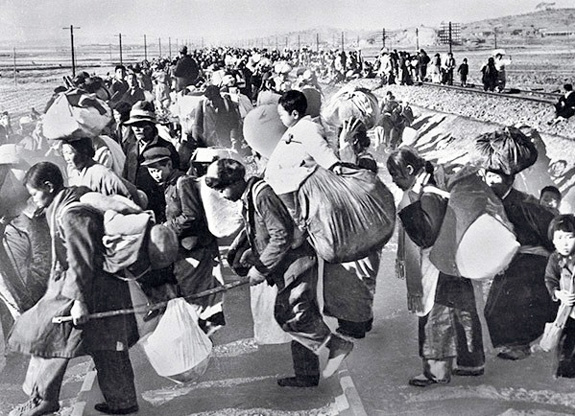
South Korean refugees flee the invasion in 1950 (Image by US Defense Department)
The North Korean drive was organized into four fighting columns. Two of them converged on Seoul, one cleared the Ongjin peninsula to the extreme west, and one pushed down the east coast, supported by a small-scale amphibious assault. After the fall of the capital, these were consolidated into two – an eastern and a western thrust.
About thirty miles south of Seoul lies the small town of Osan, spanning the main route south. On the morning of 5 July 1950, elements of the North Korean 4th division advanced towards the town from the north. As they did so they came under fire from infantry and artillery. After a sharp firefight, during which the defenders attempted to knock out several tanks using antiquated bazookas, the attacking North Koreans enveloped the position and the defence collapsed. The poorly disciplined troops scattered, many of them falling prisoner to the advancing Communists, others making their way south in dribs and drabs. Before too long, it dawned on the North Korean commanders that the battalion they had steamrollered consisted of American troops.
They were members of ‘Task Force Smith’: infantry of the US Army. Smith’s five hundred or so troops had not acquitted themselves particularly well. This is perhaps understandable when one considers that they were under-equipped and poorly trained. The first foreign troops to arrive in the Korean theatre, they had been in the country for only four days, hurriedly moved north and put into the first blocking position available. MacArthur’s Far Eastern Command, of which they formed a part, was in poor shape. Starved of men and equipment, they were accustomed to the soft life of garrison duty in Japan. In contrast, Task Force Smith had been outnumbered and outfought by a competent opponent with excellent equipment, training and motivation. If this was to be representative of the American response, then the North Koreans had little to worry about.
Fortunately for South Korea, Task Force Smith represented a lot more than MacArthur’s run-down garrison troops. Already, US Air Force planes were beginning to make their presence felt in the skies above the battlefield. The 7th Fleet had orders to cordon off Taiwan, as well as support operations in Korea. In less than two weeks, the Korean War had spiralled beyond Kim Il Sung’s hopes of a swift and decisive local war.
For the poorly equipped Task Force Smith also represented the initial ground contingent of the UN forces. The Americans were responding to a call to arms from the UN Security Council and had made their troops available on that basis. In the absence of an appointed overall UN commander, MacArthur took on leadership responsibility.
A United Nations War
At the international level, events moved very quickly following the North Korean attack of 25 June. That same day, the UN Security Council passed Resolution 82, condemning the North Korean onslaught. By the 27th, Resolution 83 had been passed, calling on all member states to provide military assistance to resist the invasion. Truman immediately ordered American air and naval assets into the theatre and that ground troops should be despatched as quickly as possible. Task Force Smith would be the first of these. Meanwhile, American diplomats set about assembling a coalition of nations willing to support this first real test of UN collective security.
The United Nations, a new organization, was keen to demonstrate the strength of its solidarity. It had been established in 1945 at the instigation of the Allied victors of the Second World War. Importantly, its architects were anxious to avoid the perceived weaknesses of the League of Nations, its forerunner. With far fewer members than today (and most broadly supportive of what might be termed an ‘American-led agenda’) there was the strong sense that the United Nations must not be allowed to fail. The catastrophe of the Second World War was fresh in people’s minds. It was felt that had Hitler been challenged earlier, rather than appeased by the League, then much of the suffering could have been avoided. Attitudes to collective security in the face of breaches of international order were a lot more robust than tends to be the case today.
The senior body responsible for global security at the United Nations was the Security Council. Permanent membership included what at the time were still known as the five ‘great powers’ (Britain, France, the USA, Russia and China), each of whom had a veto. The chairmanship rotated, as did the membership of other states. There were ten of these, elected on a regional basis and without veto rights. The Security Council, therefore, had a total of fifteen members, five of them permanent. UN Security Council resolutions were supposed to be mandatory, unlike those of the larger General Assembly, which included all UN member states. In practice, the veto system meant that it was very difficult for the Security Council to take controversial decisions – or, indeed, to reverse them.
In terms of technical process, Russia had boycotted the Security Council. She was not represented at these crucial meetings and, therefore, had no opportunity to veto the proposed resolutions. The reason for the boycott was a dispute about the Security Council’s refusal to officially recognize Mao’s Communist regime in China. Nationalist China, now no more than a mini-state located on the island of Taiwan, continued to hold China’s seat. With some justification, the Russians maintained that the seat should be given to Mao’s Communist regime, as the real government – benign or not – of almost all of modern China. In terms of realpolitik it is hard to exaggerate the blunder that this stance represented for Russia. Had they been present, presumably they would have vetoed the motions and the Korean War might have taken a very different course.
There are those who argue that this is evidence of Russia’s innocence in the matter of the Korean War. The same argument has it that she made a fuss about China in order to strengthen Mao’s dependence on Moscow. Whatever the case may be, Russia was back on the Security Council by August – this time in the chair. For the remainder of the conflict the Council became deadlocked (in the manner that has become increasingly familiar since). This would also mean that Russia could not reverse what was now established Security Council policy: this was to be a UN war.
The UN Coalition Builds
As MacArthur’s American forces struggled to contain the Communist offensive in South Korea, the remaining members of the United Nations considered their positions in response to Resolution 83. During those fateful days of late June and early July, a US diplomatic effort through the United Nations would build a broad coalition, which would finally see military support from sixteen other nations.
Britain immediately sent her Far Eastern Fleet, including two aircraft carriers, to operate in support of the US Navy. Two infantry brigades were eventually to follow. France, already heavily committed in North Africa and Indo-China, sent an infantry battalion. There were also contingents from Turkey, Belgium, Canada, Australia, New Zealand and others. In total, seventeen nations were to contribute combat units of one form or another.
By far the biggest contingent, from the war’s very outset, was from the USA. This was perhaps inevitable, given the global situation in 1950. Although the USA had emerged from the Second World War with a booming economy, many nations had not. The ‘old’ great powers, whatever their aspirations, were not the players they had been only five years earlier. Britain, for example, struggled to find sufficient troops to equip her expeditionary force. At least she was to pay for her own soldiers. In the case of many of the smaller countries, it was so important for the USA – and indeed for the infant United Nations – to demonstrate broad support for the war, that the USA paid a daily rate for each soldier sent.
Some countries, uneasy about the despatch of actual fighting troops, instead sent medical or other support. A famous example was the Indian parachute field hospital, which actually took part in an American combat jump in March 1951. All support was gratefully received, if only for the message it conveyed about collective security. Those nations which made such a commitment are recorded in Appendix 3. Less welcome were the many promises of support which came to nothing.
There was one important offer of immediate military assistance which Truman rejected. Chiang Kai-shek had suggested the despatch of 30,000 Nationalist Chinese troops from Taiwan. For MacArthur, this was potentially a game-changing proposal, which could have a huge impact on the desperate fighting now underway. Chiang’s troops would have quadrupled existing UN ground forces at a stroke. For the President though, this was a double-edged sword. To allow the participation of Nationalist China would be to broaden the conflict and invite Communist Chinese or even Russian intervention. At this time, although Russian equipped, the attackers consisted entirely of North Korean troops. Truman wanted to keep it that way; he did not want a world war. It was an early example of the restraint which was to characterize both sides’ conduct of the war.
Within a week then, the Korean War had become a United Nations war. This was testimony to the diplomatic skills of the Truman Administration, the stance taken by Russia at the United Nations, and the often underrated internationalism of those states which chose to spend their blood in defence of another. It was equally clear, though, that the UN project in Korea would be led by the USA. It was the Americans who had led the debates at the Security Council and built the coalition. Of necessity, theirs had been the first foreign troops in theatre; and theirs would be the major contribution throughout the conflict. All of these factors, coupled with the overriding sense of emergency in July 1950 and the sheer practicalities involved, pointed to an American overall commander. The UN Secretary General’s proposal of a committee to run the war was swept aside. MacArthur was appointed to command all UN forces by Truman on 7 July and the seeds of some of the United Nations’s most contentious problems thereby sown.
In theory, MacArthur had four infantry divisions available to him in Japan. These were understrength units, though, and their tactical competence was highly questionable. Furthermore, he had no means of shipping them en masse to the front, as it would take time to assemble the naval transport required. There was also the delicate question of identifying who would take over the occupation role they had undertaken in Japan. In this there was little real choice – and the use of Japanese police and security agencies hastened her return to full normality as a sovereign state.
As for the infantry, troops were shipped to Korea as the transport became available, during July and August. Most arrived in battalion strength and were committed wherever the latest crisis might be. General Walton Walker commanded in Korea itself, establishing the American 8th Army – in reality a weak army corps. MacArthur, save for a publicity-based visit lasting less than a day, preferred to exercise command from Tokyo.
At the same time, the US Congress approved a special war budget of $11b and American Army and Marine divisions began assembling across the USA. For the Marines, in particular, Korea was to become a make-or-break campaign. During the period of disarmament which had preceded the war, their numbers had been cut drastically. The idea that the Marine Corps’ role should be confined to small shipboard defence parties had gained currency. Korea might rekindle the concept of the large amphibious operations and expeditionary warfare which the Marines had perfected during the Second World War.
The Korean War was to spur overall rearmament in the USA, as well as in countries such as Britain. There was a sense that the Russians had been found out – proved guilty – and that the West now needed to be on its guard. Above all, the fear was of a sudden Soviet attack in Europe. This notion, that Western Europe lay vulnerable to Russia’s tank armies massed on the Elbe, was a key factor in Truman’s thinking and an obvious major concern for Britain and France. All of the debate on the UN side about escalation in Korea was coloured by this lurking dread.