
Chapter Two
The Kornilov rebellion, the first act of the White versus Red civil war, failed because it had no popular base. It failed because telegraph operators immediately alerted soldiers’ committees and soviets to what was going on; activists would then demand access to the telegraph network and if that access was refused, violent action would ensue. When the test came, Kornilov’s supporters were reduced to a mere handful and soviets, commissars and soldiers, acting in unison, defended the revolution with an impressive display of power. Yet within two months the first shots in a different civil war would be fired. The impressive display of popular unity which defeated Kornilov would be torn asunder, and Bolshevik and SR forces would be spoiling to fight each other for control over the destiny of the Russian Revolution. At the same time, the majority of Russia’s socialists would work to smother that fighting, to seek a compromise and prevent at all costs the outbreak of a Red versus Green civil war.
Although in retrospect the Kornilov rebellion was a thoroughly botched affair, it had a profound effect on the development of the Russian Revolution. Despite all the efforts of liberal politicians to distance themselves from the plotters, in the popular imagination the liberals had been as committed to counter-revolution as the generals. After the Kornilov rebellion, what was known at the time as ‘democracy’, i.e. all those who owned no property and had thus been effectively disenfranchized under the ancien régime, turned against the idea of continuing a coalition government with the liberals; property-owners should henceforth be excluded from government.
The most important group to be affected in this way were the soldiers. After the Kornilov rebellion, soldiers no longer trusted their officers and wanted an end to the war. After the Kornilov rebellion, there was constant pressure to re-elect soldiers’ committees, to replace pro-war Mensheviks or SRs with anti-war Bolsheviks. This change in stance of the soldiers was of major importance, for it distinguished the political atmosphere of the autumn from the ill-fated Bolshevik demonstrations of July. In July, indeed even earlier, working-class members of the Petrograd Soviet had voted in favour of ending the coalition with the ‘bourgeois parties’ and forming a soviet government; it was the soldiers’ representatives who prevented this resolution being passed. In September, however, in the immediate aftermath of Kornilov’s rebellion, both the Petrograd and Moscow Soviets supported a Bolshevik resolution calling for a soviet government and the key change was that on this occasion the soldiers joined with the workers in making this demand. The Kornilov rebellion launched a second revolution in Russia, a revolution in which democracy demanded a soviet government.
In this context the chances of a civil war erupting, particularly a civil war between White counter-revolutionary generals like Kornilov and the parties represented in the soviet, were minimal. But a civil war ‘within democracy’, a civil war between extreme and moderate socialists, Bolsheviks and SRs, Reds and Greens, an unthinkable civil war of this sort was a possibility, since socialists disagreed about the best way forward for the Russian Revolution. Kerensky wanted to form a third coalition government; a majority of socialists, Bolsheviks, Mensheviks and SRs wanted to form a government from those parties represented in the soviet; and Lenin wanted to form a Bolshevik government. In this three cornered fight, there were those quite prepared to resort to arms.
The Politics of Coalition
After the collapse of the Kornilov rebellion Russia was faced with two clear choices: counter-revolution was no longer on the agenda, but should the government be a coalition, between liberals and the socialists, or should it be a ‘democratic coalition’ composed only of those parties represented in the soviet. The impetus for a democratic coalition was almost irresistible in the atmosphere of a second revolution experienced in the aftermath of Kornilov’s rebellion. Such was the popular anger against the liberals that the Menshevik and SR delegations to the soviet voted to reject any future collaboration with the liberal Kadet Party. Even Lenin was persuaded, momentarily, of the enormous prospects opened up by such a democratic coalition. When on 1 September Petrograd was swept by rumours that the SR leader V.M. Chernov was about to head a new government which would include Bolsheviks in charge of key ministries, Lenin wrote the essay On Compromises in which he supported the idea of the SRs and the Mensheviks forming a government responsible to the soviet. The Bolsheviks, he suggested, could not accept portfolios in such a government, but neither would they campaign against it until the Constituent Assembly elections were held.1
A similar proposal was simultaneously put to the Petrograd Soviet by the leader of the Bolshevik delegation L.B. Kamenev. As, during the crisis days of 31 August to 2 September, the soviet debated the future of the government, Kamenev called for an end to the present coalition and the formation of a government of workers and peasants; this would not be a soviet government as such, since not all sections of the working population were represented in the soviets, but a democratic government to include representatives of the trades unions and local councils as well. This Bolshevik call was endorsed by the Petrograd Soviet on 1 September, but such was the degree of agreement between the socialist parties at this moment that this resolution was not substantially different from the Menshevik policy of an all-socialist ministry responsible to the so-called Democratic Conference, an organization summoned by the soviet in response to the new political situation created by the Kornilov rebellion.2
The soviet had called the Democratic Conference as a counter-weight to the Moscow State Conference which had served as such a focal point for Kornilov’s machinations. In the new political climate a forum was clearly needed for Russian democracy, but the Petrograd Soviet, while providing a potent forum for factory workers and soldiers, had no peasant representation nor any representation from the other soviets throughout Russia, and thus could not claim to represent fully the broad mass of non-property-owners. Summoning a Democratic Conference caused socialist politicians few problems; debate focused on what powers this institution should have. When it opened on 14 September, Kamenev spoke out for a policy clearly acceptable to many SRs and Mensheviks: ‘the only way out is this,’ he said, ‘power must not be a coalition [with the Kadets]; power must pass into the hands of democracy, not to the Soviet of Workers’ and Soldiers’ Deputies, but into the hands of democracy which is quite fully represented here today; the government must be formed here’.3 The degree of support for such a proposal was seen when the presidium of the Democratic Conference voted sixty for and fifty against the proposal for a socialist ministry, supported but not joined by the Bolsheviks, to govern until the Second Congress of Soviets met in October, when the situation could be reviewed.4
The intervening two weeks between the collapse of Kornilov’s rebellion and the summoning of the Democratic Conference had given Kerensky time to manoeuvre and martial those forces which favoured a new coalition government. During the Democratic Conference backstage deals and contradictory votes enabled Kerensky to impose his own agenda on the proceedings. It was eventually decided that the government would remain a coalition, excluding only those liberals who had openly sided with Kornilov, and would not be responsible to the Democratic Conference; indeed, it would be responsible to no specific organization but would instead listen to the views of a new body to be called the Preparliament. Unlike the Democratic Conference summoned by the soviet, Kerensky’s proposed Preparliament would represent both democracy and the property-owning bourgeois classes. While this would clearly make the Preparliament more fully representative of the Russian population than the Democratic Conference, it ignored the new popular mood of a second revolution: it seemed a device designed artificially to restore property-owners to a position of influence when their attitude during the Kornilov rebellion had deprived them of that privilege; the Preparliament seemed designed to stop the second revolution and restore the pre-Kornilov status quo.5
Understandably, Kerensky’s triumph at the Democratic Conference and his success in winning support for a Preparliament breathed new life into the idea of a coalition and he was finally able to form his Third Coalition Government. This infuriated the proponents of a democratic coalition: the Bolsheviks were understandably very angry; but equally the Menshevik Central Committee was unhappy with these changes in which its original principle of a government responsible to the Democratic Conference had been surrendered. Even more dramatically unhappy was the SR leader Chernov who ceased to attend the SR Central Committee and announced his intention of boycotting the Preparliament in protest at his party’s decision on 24 September to endorse continued SR participation in Kerensky’s Third Coalition.6
The SRs had already suffered one split at the end of April 1917 at the time of the street demonstrations in Petrograd when the extreme right of the party had disassociated itself from the party daily Delo naroda and founded a rival paper Volya naroda. This venture was edited by the pro-war moderate Argunov, whose name had featured in some of Kornilov’s fantasy governments, and was funded by the former populist and ‘Grandmother of the Russian Revolution’ E.K. Breshko-Breshkovskaya. Its editorial board included S.S. Maslov, P.A. Sorokin, and V.I. Lebedev, appointed Navy Minister in August 1917: all would become active participants in the Red versus Green civil war of 1918. This group remained in the party, but was increasingly willing to collaborate with the Popular Socialist Party. By the autumn of 1917 Chernov, who stood at the centre, was finding it increasingly difficult to keep control of a party, some of whose members were outspoken supporters of Kerensky - himself an SR - while others were bitterly hostile towards him. After Kornilov’s rebellion, the left of the party was determined to form a democratic coalition government and break with Kerensky. By the time of the Democratic Conference politicians like L.A. Kalegaev, V.A. Karelin and P.P. Proshyan were no longer prepared to abide by Central Committee instructions concerning tactics. These Left SRs were well on the way to becoming a separate party, and it was to exacerbate the clear divisions within the SR Party, and indeed the Menshevik Party, between a stated policy of support for a democratic coalition and the presence of their leaders in a Third Coalition Government which persuaded Kamenev that the Bolsheviks should take an active part in the Preparliament; it could, he believed, be used to discredit Kerensky and eventually bring his government down.
Kerensky’s Third Coalition Government was indeed built on very shaky foundations. The crucial role in frustrating those wanting to use the Democratic Conference to establish a democratic coalition had been played by right-wing SRs and Popular Socialists active in the co-operative movement. Since the defeat of the 1905 Revolution many Popular Socialists and some like-minded SRs, tired of revolutionary politics, had turned to co-operation as a means of bringing practical help to the peasants. By 1917 these co-operatives were well established and the biggest single vote at the Democratic Conference in favour of the principle of renewing the coalition came from the co-operative societies.7 The co-operatives were, therefore, the key group in any attempt by Kerensky to build a political base within the Preparliament and their representatives were rewarded with several posts in the Third Coalition Government. However, those most active in support of Kerensky within the Preparliament were not the representatives of the co-operative societies, but the left-wing members of the Kadet Party. The Kornilov rebellion had forced many leading Kadets, like Milyukov, to flee Petrograd. Those who remained tended to be on the left of the party, and resolved to use the Preparliament as a last redoubt from which to fight the Bolshevik menace.
Although the Kadets devoted considerable energy to trying to firm up a pro-coalition grouping within the Preparliament - a special party liaison group of Nabokov, Shingarev and M.S. Adzhemov met daily to co-ordinate strategy: Adzhemov was responsible for drafting most of the statutes governing the activities of the Preparliament - their strategy remained problematical. They needed to win the Popular Socialists, who were closely allied to the co-operative societies, away from the idea of a democratic coalition. However, at their congress on 26 September 1917 the Popular Socialists discussed their tactics for the forthcoming Constituent Assembly elections, and, far from building on an alliance with the Kadets, they voted against a proposal for improved links with the Kadets and insisted that alliances could only be formed with other socialist groups. More worryingly for the Kadets, at an emergency congress on 4 October the co-operative societies also rejected the idea of joint candidates with non-socialist groups.8
When Kerensky’s Preparliament opened on 7 October under the chairmanship of the Right SR N.D. Avksentiev the pro-coalition grouping did begin to function, strengthened on 13–14 October when a second Meeting of Public Figures met in Moscow and resolved that it was ‘not only permissable but desirable to associate with the Popular Socialist group’; the 10th Kadet Party Congress equally voted in favour of continuing to build the coalition. However, this unity did not survive the transition from abstract rhetoric to practical politics. On 10 October the Preparliament began to debate the fighting capacity of the army. With the aim of building a coalition, the Popular Socialist leader N.V. Chaikovskii, a peasant socialist since the 1870s and chief representative of the co-operative societies, drafted a programme for the coalition on 18 October which succeeded in uniting Popular Socialists, the co-operative societies, the Peasants’ Union, Plekhanov’s Unity group, with representatives of industry, the cossacks, the Public Figures and the Kadets in supporting the government; but this victory was transitory - although passed on a show of hands by five votes, a recount deprived the coalition of its first and only triumph.9
Indeed, this coalition was soon disintegrating. The key figure in this process was Kerensky’s new Defence Minister General A.I. Verkhovskii, a man whose political views were close to those of the Popular Socialists. To the growing anger of the Kadets, and increasing alarm of Kerensky, he argued that the only way forward for Russia was to come to terms with democracy and recognize the key demands of the democratic coalition, or as he expressed it ‘finding grounds for a compromise with the Bolsheviks’. He had been in conflict with Kerensky almost from the moment of his appointment. As early as 5 September he confided in his diary that Kerensky would have to go and that the government controlled little more than the Winter Palace. By 25 September he concluded that all the old political leaders had had their day. By 30 September he was convinced that the only way the masses, and by implication the Bolsheviks, could be persuaded to work for the defence of the country was for a peace proposal to be advanced by the Allies and for the Germans to reject it: ‘only then would we create a volunteer army truly up to the task’. Verkhovskii succeeded in persuading the socialist members of the Third Coalition Government, including Kerensky, to agree that his proposal should be put to the Inter-Allied Conference due to be held in Paris at the end of October. However, the Foreign Minister M.I. Tereshchenko, who was to represent Russia at the conference, could not be persuaded, and neither could the Kadet Party with which he was associated. As a consequence, Verkhovskii resigned on 19 October, a resignation caused by disagreements within the coalition.10
The hopes of the coalition finally foundered on 24 October. Since 6 October the Commander of the Petrograd Military District had been under orders to prepare the troops of the Petrograd garrison for transfer to the front, since a German attack seemed imminent. The soldiers concerned reacted with fury, and to prevent this transfer happening the Petrograd Soviet, with a Bolshevik majority since the vote of 1 September, established a Military Revolutionary Committee (MRC) on 16 October. By 21 October the government and the MRC were at loggerheads and the MRC informed the Petrograd Military District that henceforth soldiers would only obey orders countersigned by the MRC; to ensure this happened the MRC would appoint its own commissars to military units. Then, when on 23 October its commissars were in place, the MRC announced that these commissars had the right to veto all military orders. Faced with what was tantamount to mutiny, the government announced on 24 October that criminal proceedings against the MRC would begin and moved to close down those Bolshevik newspapers supporting the MRC and its commissars. Against this background the Preparliament gathered later on 24 October to debate a motion of no confidence in the government’s handling of the situation.11 As in the Preparliament the Kadets gathered the forces of the coalition for a resolution in defence of the government, they were faced with the abstention of the co-operative leaders; if their abstentions had been added to the votes rallied by the Kadets, the vote of no confidence would have been defeated by five votes and the government might have survived. As it was, the Preparliament passed a vote of no confidence in Kerensky’s government.12
Back in September, during the backstage intrigue which had surrounded proceedings at the Democratic Conference, a form of words had been adopted to describe the precise relationship between the Preparliament and the government. It was agreed that ‘power must belong to a government which had the trust of the Preparliament’: since Kerensky’s government no longer had that trust, it had effectively been sacked by the vote of 24 October. In passing this vote of no confidence, the Preparliament also called for action on the most important issues of the day: land had to be transferred to the land committees, and peace talks had to begin at once in consultation with the Allies. Not surprisingly, the left wing of the Menshevik Party and the Left SRs began to revive talk of forming a government responsible to the Democratic Conference; a so-called ‘Revolutionary Convention’ would be formed by expelling the propertied classes from the Preparliament.13
Kerensky’s Third Coalition Government collapsed on 24 October. There was no objective danger of this leading to civil war, since Kerensky had simply lost the authority to govern by rejecting the ever more vociferous calls for a democratic coalition government and insisting on the need to retain a liberal–socialist coalition. When even the Popular Socialists rejected such a coalition, Kerensky’s fate was sealed. Just what would replace Kerensky’s coalition was uncertain, but whatever government was formed, it would have to come to terms with the delegates to the Second Congress of Soviets, gathering in Petrograd at that very moment. The congress was due to open on 25 October, but before it did so Lenin and his supporters in the Bolshevik Party had seized power in a coup executed during the night of 24–25 October.
Lenin and the Bolshevik Seizure of Power
That the successful campaign to discredit the Third Coalition Government and overthrow it within the parliamentary atmosphere of the Preparliament did not result in the formation of a democratic coalition was the fault of the Bolshevik Party. Ever since Kerensky had taken the decision to call the Preparliament, the Bolshevik Party had been torn apart by an internal factional dispute on the issue of how best to achieve its aims. The soviet delegation, the parliamentary wing of the party as it were, led by Kamenev, was convinced that the government’s hold over the Preparliament was so shaky that the Bolsheviks could easily lead the opposition to it; when it fell, as inevitably it would, the Bolsheviks would become the dominant group in a new democratic coalition government, which would prepare the way for the party emerging as the dominant force in the Constituent Assembly. Lenin’s wing of the party took a very different view.
If Kamenev was a pragmatist, obsessed with the sort of day-to-day petty politicking and horse-trading which could bring the party possibly to absolute power, but certainly to the position of power broker, and that without a drop of blood being shed, Lenin was the dogmatic theoretician. Divorced from practical politics since July when a warrant had been issued for his arrest as a German agent who had instigated the July Days demonstrations, Lenin had immersed himself in political theory. His main work was State and Revolution, a volume in which he drew repeated parallels between his view of Russia in 1917 and the Paris Commune of 1871, and in which he stressed the lessons which needed to be drawn from such parallels if a new society were to be constructed. For Marx and Engels the Paris Commune had been ‘the civil war in France’ and the heroic attempt of workers’ Paris to construct a new society in the teeth of opposition not only from the external enemy, Prussia, but also opposition from the rest of France. Lenin was convinced that a Petrograd Commune could succeed in the changed circumstances of 1917. Developments within capitalism since 1871 had created an interrelated economy of imperial states in which Russia served as the weak link in the chain: the Petrograd Commune would not be isolated as the Paris Commune had been, since the revolution in Russia would soon spread throughout Europe as imperialist economies collapsed one after another. For Lenin the opportunity to construct Marxian socialism was being presented to the Bolsheviks, if they would only broaden their horizons and stop looking no further forward than the next meeting of the Preparliament or how to ensure they emerged as the biggest single party after the Constituent Assembly elections.
The prospect of constructing the first Marxist state in history, of acting as the agent of history itself in opening up a whole new socialist epoch, justified for Lenin the most undemocratic of actions. With the right coalition visibly losing power by the minute, it was essential from his perspective that power did not get transferred to a democratic coalition, no matter how large the Bolshevik representation within it. Such a government could only address the democratic issues of peace, land and worker participation in industry; it would not address the agenda of world socialism. Lenin therefore wanted power before such a government could be formed, and this meant seizing power before the unpopular Third Coalition Government actually collapsed, not after it had collapsed. From Lenin’s point if view, it would be a disaster for the Second Congress of Soviets, planned for mid-October, to meet and endorse the idea of a democratic coalition government. Lenin needed to pretend he was seizing power from the unpopular ‘bourgeois’ right coalition, when in reality he would be depriving of power a democratic coalition of socialists not yet formed.
In private Lenin made no secret of his plans. On 30 August, in a Letter to the Central Committee, he urged Bolsheviks to be careful in their propaganda not to talk about seizing power too openly: ‘we must speak about [taking power] as little as possible in agitation (remembering very well that even tomorrow events may put us in power and then we will not let it go)’.14 Although at the same time, on 1 September, he wrote in On Compromises of the possibility of forming a democratic coalition in the aftermath of the Kornilov affair, he added as a postscript on 3 September that the moment for compromise might even have passed already, and within days he had changed his mind completely.15 In The Russian Revolution and the Civil War, written on 8–9 September 1917, Lenin mapped out two possible scenarios for the Russian Revolution, one a continuation of the theme of coalition aired in On Compromises, and the other a bold call for civil war. Of the coalition tactic he wrote:
if there is an absolutely undisputed lesson of the revolution, one fully proven by the facts, it is that only an alliance of the Bolsheviks with the Mensheviks and the SRs, only an immediate transfer of power to the soviets would make civil war in Russia impossible … A peaceful development of the revolution is possible and probable if all power is transferred to the soviets. The struggle of parties for power within the soviets may proceed peacefully, if the soviets are made fully democratic.
The other tactic of insurrection and ‘a civil war in its highest and most decisive form’ was equally possible, for ‘we have learned much since the Paris Commune and would not repeat its fatal errors’.16
In Lenin’s mind, which of the tactics to be pursued depended on the Mensheviks and the SRs. If the Mensheviks and the SRs remained stubbornly loyal to an alliance with the liberals, and the masses moved over to the Bolsheviks, the tactic of civil war should be followed. There was no suggestion in Lenin’s writing that the civil war option could harm the revolution or that the peaceful transfer of power was in any way more desirable. By mid-September, with support for the Bolsheviks clearly growing and the Menshevik and SR leaderships beginning to waver in their opposition to a coalition as the Democratic Conference approached, Lenin dropped the idea of a transfer of power through soviet democracy and opted clearly for civil war. His letters to the Central Committee, Bolsheviks Must Take Power and Marxism and Insurrection, written on 12–14 September, argued that the Mensheviks and SRs had rejected a compromise: ‘it would be a great mistake to think that our offer of a compromise had not yet been rejected and that the Democratic Conference may still accept it …’. Compromise had been rejected and the way forward for the Bolsheviks was insurrection, an insurrection which would start a civil war.17
The problem for Lenin was that his obsessive desire to implement an experiment in social engineering on an unprecedented scale was not shared by the whole of his party. Lenin’s letters to the Central Committee of mid-September were ignored; only one copy was kept and activists were instructed to prevent any demonstrations in factories or barracks. As Lenin became increasingly angry at the way the Central Committee immersed itself in the parliamentary life of the Democratic Conference and ignored the appeal for direct action, he began to contact like-minded spirits, talking always of the prospects for worldwide revolution, and always stressing that power should be seized before the Second Congress of Soviets met. The party nevertheless continued to develop its parliamentary tactic. Ignoring Lenin’s wish that the Preparliament be boycotted, the Central Committee decided that its own vote on the matter on 21 September had been so close (nine to eight), that the final decision should be left to a joint meeting of the Central Committee and the party’s delegation to the Democratic Conference; this voted 77 to 50 to participate. As a result, two days later the Central Committee was discussing its attitude to the question of forming a ‘ministry of similar parties’, or a socialist coalition.
Under constant pressure from Lenin, the Central Committee began to reconsider its stance. On 24 September it decided to reduce the importance of parliamentary tactics by making activity in the Preparliament secondary to its other work; but that work was not defined as preparing for an insurrection before the Congress of Soviets met, as Lenin wished, but as the formation at the Second Congress of Soviets of a democratic coalition government. It took Lenin’s threat of resignation on 29 September to make the Central Committee change its stance, and then only on the question of the Preparliament. On 3 October the Central Committee asked Lenin to move nearer to Petrograd, and on 5 October it was agreed to stage a demonstrative walk-out from the Preparliament. Yet even then Lenin had not got his way completely. On 10 October, as the Preparliament began its crucial debate on the state of the army, the Central Committee passed a resolution which talked of the revolution entering the era of insurrection, but no date for an insurrection was set, and certainly no date before the Second Congress of Soviets.
The Bolshevik Central Committee was split and had reached a form of stasis. Although Kamenev’s papers in favour of parliamentary tactics were rejected, the Central Committee’s support for insurrection remained rhetorical and Lenin’s view that power had to be seized before the Second Congress of Soviets met was never endorsed. Thus on 16 October when an expanded session of the Central Committee sought to resolve the issue, the final resolution simply reaffirmed the imprecise decision of 10 October. Kamenev noted with ill-concealed glee that despite the opprobrium heaped upon him, the party was no longer talking, if it ever had been, of an insurrection before the Second Congress of Soviets. In fact, the general tenor of the 16 October discussion was that the mood of the masses was against an insurrection, and certainly would not support one led by the Bolshevik Party as Lenin wanted. The masses would, many delegates noted, only follow the lead of the Petrograd Soviet, or one of its sub-committees like the Military Revolutionary Committee, if it called on them to defend the gains of the revolution.18
Thus the Bolsheviks stumbled into insurrection. The garrison crisis prompted the Petrograd Soviet to establish its MRC on 16 October, a committee dominated by the Bolsheviks. It moved from open confrontation with the government towards a direct challenge to the government on 24 October, an event which prompted the Preparliament to deprive the Third Coalition Government of its moral authority to govern. The delegates gathering for the Second Congress of Soviets then began to prepare to announce the formation of a new democratic coalition, a government of the socialist parties represented in the soviets. At the very last minute Lenin could snatch victory from the jaws of defeat if he could persuade the Bolshevik Party that the MRC, which already effectively controlled the city’s garrison, should seize power on behalf of the party - thus his frantic message of 24 October as he sought to convene the Bolshevik Central Committee.
I am writing these lines on the evening of the 24th. In fact it is now absolutely clear that to delay the uprising would be fatal. With all my might I urge comrades to realize that everything now hangs by a thread; that we are confronted by problems which are not to be solved by conferences or congresses … We must at all costs, this very evening, this very night, arrest the government … We must not wait! We may lose everything! … Under no circumstances should power be left in the hands of Kerensky and Co. until the 25th; the matter must be decided without fail this very evening …19
Sometime during the early hours of 25 October the Central Committee met and adopted Lenin’s course. A full 24 hours after the MRC’s confrontation with the government had begun, and less than twelve hours before the Second Congress of Soviets opened, Lenin finally persuaded his colleagues that they should make the most of the military advantage they had, and achieve his long-held objective of seizing power before the Second Congress of Soviets opened. Events had indeed ‘put the Bolsheviks in power’, and Lenin, true to his letter of 30 August, was determined not to let it go, even though the path he had adopted – of preventing power from being peacefully transferred from a right coalition to a democratic coalition – risked the danger of civil war within democracy. Lenin had succeeded in seizing power not from the bourgeoisie and the liberals, but from democracy, and its dominant voice, the SR Party.
The Railway Workers’ Union Talks
As Lenin directed operations from the Bolshevik Party headquarters at Smolny, and Kerensky made his escape from the Winter Palace under siege by Lenin’s forces, the moderate socialists continued to work for the constitutional transfer of power from Kerensky to a new government. On the afternoon of 24 October the Menshevik delegation to the Second Congress of Soviets met to draw up tactics and resolved that a complete reconstruction of power was essential and that a democratic coalition government had to be formed. While condemning the Bolsheviks’ mutinous activities within the MRC, they blamed Kerensky’s Third Coalition Government for provoking it and, as rumours of fighting came in, ruled out any attempt to use force against the Bolshevik insurgents. The same day the SR-controlled Petrograd City Council called for the formation of a democratic coalition government. Then, when the Second Congress of Soviets opened on the afternoon of 25 October, the Menshevik proposal that a coalition socialist government be formed as the only way of peacefully resolving the crisis was passed unanimously.20
The next day the Mensheviks again tried to work for reconciliation. In protest at Lenin’s action the SRs, led by M. Ya Gendelman and joined by some right-wing Mensheviks, decided to walk out of the Second Congress of Soviets and establish a rival body which they called the Committee for the Salvation of the Revolution and the Motherland (CSRM). On 26 October the Menshevik leader Yu O. Martov sought to open talks between those socialists who had walked out of the Second Congress of Soviets, and those who had stayed behind; the aim of the talks was to establish a democratic coalition government of Bolsheviks, Mensheviks and SRs. Within the Second Congress of Soviets a similar proposal was advanced by the left-wing members of the SR Party21 who at this time formally resolved to establish themselves as a separate party: they, unlike the SR Party proper did not walk out of the Second Congress of Soviets, but recognized its legitimacy. The cause of reconciliation was then taken up dramatically by the leadership of the Railway Workers’ Union. The Railway Workers’ Union wanted to stop what appeared to be the nascent civil war between the Bolsheviks and the SRs, a Red versus Green civil war within the democratic camp. On arriving in the capital on 26 October, the Railway Workers’ Union executive’s delegation to the Second Congress of Soviets immediately adopted the stance the union would pursue throughout the following week: it told fellow delegates that, as it was then constituted, the congress was an unrepresentative body; the Bolsheviks had split the democratic front. The Railway Workers’ Union therefore opposed the seizure of power by one party, called for a revolutionary government to be made responsible to revolutionary democracy, and announced that until that moment had come it would supervise all railway movements. After talks with both the Bolsheviks and the CSRM, it refined these demands into the neutrality statement issued on 28 October: this called for the formation of a government composed of all socialist parties from Bolsheviks to Popular Socialists, inclusive of both these, which would be responsible to a legislative body representing revolutionary democracy and would hold power until the Constituent Assembly met. A strike would be called if any force were used against members of the union seeking to implement this policy. Negotiations with the aim of establishing such a democratic socialist government were to begin at once.22
From the start those Bolsheviks not involved in the armed insurrection accepted the programme of the Railway Workers’ Union. On 28 October D.B. Ryazanov, who had opposed insurrection in the Bolshevik Central Committee, acted as an intermediary between the MRC and the Railway Workers’ Union, and invited a delegation to talks later that evening; at these talks Kamenev stated that the Bolshevik Party endorsed the Railway Workers’ Union programme. In its report to its Moscow headquarters the next day, the Railway Workers’ Union could state: ‘the Bolsheviks are making concessions and have accepted our programme. The Committee of Salvation [CSRM] is irreconcilable, but we will exert pressure on it …’. The Railway Workers’ Union already believed it had the support not only of right-wing ‘parliamentary’ Bolsheviks, but all the other leftist groups, the Menshevik Internationalists, the Social Democrat Internationalists, the Left SRs, the Polish and Jewish socialist groups, plus some centrist SRs and the Council of Trade Unions.23
The chances of the Railway Workers’ Union succeeding in its mission were greatly improved by the difficulties being experienced by those SRs and right-wing Mensheviks who had walked out of the Second Congress of Soviets to establish the CSRM; they now had to ask themselves if by so doing they wanted to re-establish a Kerensky-style coalition with the liberals. The liberals threw in their lot with the CSRM only to find no-one really wanted them. Although the CSRM had adopted the name ‘motherland’ at the insistence of the liberals, their influence ended there; those liberals who attended the CSRM did so as members of the city council and the Preparliament, not as members of the Kadet Party which was not represented on the CSRM executive. The divisions in the CSRM were noted by the British ambassador Sir George Buchanan who recorded that while some wanted a socialist government which would ‘rely on the support of the Kadets’, others were ‘in favour of adopting the Bolshevik programme with regard to peace and the land’.24
These divisions within the CSRM camp were echoed in the question mark that hung over the future of Kerensky. Planning to overthrow the Bolsheviks by force and thus pour fuel on the simmering Red–Green civil war, he had fled Petrograd in search of loyal troops. He had little luck. Leaving at 11.00 a.m. on the morning of 25 October, he went to Pskov, the headquarters of the Northern Army, where he found few loyal troops. Only the Third Cavalry Regiment, a cossack regiment led by General Krasnov, was prepared to rally to his side; thus on 27 October Krasnov and Kerensky moved back towards Petrogad to base themselves at Gatchina. There they were joined by Chief Army Commissar V.B. Stankevich, who left Petrograd on the 26th with news that the CSRM had drawn up plans for an insurrection to be co-ordinated with Krasnov’s advance. When Stankevich returned to Petrograd on 28 October he learned that little support for Kerensky remained. From the start the CSRM had been split over whether or not to insist on the restoration of Kerensky, and therefore a liberal–socialist coalition, or accept that Kerensky was a spent force and settle for a socialist administration, but preferably one excluding the Bolsheviks.
After talks with the Railway Workers’ Union on 28 October, the CSRM came down in favour of abandoning Kerensky and supporting the idea of a socialist government. Although it wanted the Bolsheviks to be excluded from this government - something the Railway Workers’ Union would not accept – this socialist government would give land to the peasants and establish peace without annexations, a stance also adopted by the SR Central Committee on the 28th.25 In these talks the CSRM representatives, the Menshevik Skobelev and the SR V.M. Zenzinov rejected the idea of a liberal–socialist coalition and were scathing about Kerensky: Skobelev not only said Kerensky ‘would not form part of any combination of ministers proposed by us’, but added that if Kerensky refused to transfer power to a new socialist administration based on the CSRM, the CSRM would ‘use all permissible methods to fight him, just as they were fighting the Bolsheviks’.26
However, the extent of the divisions within the CSRM can be seen from the fact that, despite what Skobelev and Zenzinov said, other Mensheviks and the co-operative leaders saw the main purpose of the CSRM as being to restore the Kerensky government; the SR Military Commission, put at the disposal of the CSRM, was already in touch with the officers’ training corps, known as the Junkers, and even such Kornilovite officers as Colonel Finberg, leader of the Union of Military Duty. It was they who, unbeknown to many of the CSRM leaders, planned to stage an insurrection as Krasnov’s troops reached the capital, and Stankevich’s news on the 28th that these troops were at Gatchina led them to hasten their preparations. Unfortunately for them, in the early hours of 29 October, the Bolsheviks arrested a CSRM courier taking a message to the Junker officer school about how their proposed insurrection could be co-ordinated with that of the advancing cossacks; unnerved by this arrest, the Junkers began their insurrection prematurely as dawn broke on the 29th and by midday had been easily outgunned.27
This outbreak of fighting infuriated the Railway Workers’ Union. It occurred the day after the Railway Workers’ Union had been promised the CSBJVL would attend talks aimed at establishing a democratic socialist government. To prevent further double-dealing the Railway Workers’ Union issued an ultimatum on 29 October. ‘Democracy’, the Railway Workers’ Union argued, ‘could not decide its internal disagreements by blood and iron’, the only victor should this happen would be counter-revolution. The union would therefore organize a strike to:
bring pressure to bear on the madmen who at this moment, out of personal interest, do not want to compromise. Instead of striving for a compromise, the right part of democracy [CSRM] … put to the Bolsheviks the impossible demand of total capitulation, quite unconcerned for the consequences.28
Meanwhile the Bolsheviks continued to be ready to compromise. On the afternoon of 29 October the Central Committee debated the issue of broadening the government as the Railway Workers’ Union had asked, including the proposal that the Popular Socialists be included in the government and that Lenin and Trotsky be dropped as ministers. Neither of these points of detail was agreed, but the principle of broadening the government was approved by all present, and Kamenev and fellow Central Committee member G. Ya Sokolnikov were delegated to attend the talks.29 In his opening statement to the Railway Workers’ Union Conference on the evening of the 29th, Kamenev made clear that he favoured a government composed of all parties represented in the soviet. Sokolnikov, sent as a counter-weight to the ‘soft’ Kamenev, could also sound conciliatory; he reminded delegates that in mid-September the Bolsheviks had proposed an all-socialist government to the Democratic Conference, and would even now be quite willing to transfer power to the Constituent Assembly as soon as it met.
The divisions among members of the CSRM were as clear as ever on the 29th. Its official viewpoint was put to the Railway Workers’ Union talks by one of its Menshevik members; but the most vociferous in opposing the position adopted by the Railway Workers’ Union was Gendelman, the SR Central Committee member who had led the walk-out from the Second Congress of Soviets. His rejection of the inclusion of Bolsheviks in the government, and his refusal even to sit down together with them, included the declaration that ‘even in the democratic camp there are moments when it is necessary to decide an argument with weapons’. This apparent call to arms caused a furore; he was not supported by the representative of the Union of Municipal Employees, a leading force in the CSRM, while F.I. Dan, for the Mensheviks, said he had no interest in using force against the Bolsheviks. He suggested that the easiest way to struggle against the Bolsheviks was to include them in government: ‘everyone would prefer it if the Bolsheviks were inside rather than outside the government’, he said.
Most of the delegates to the talks favoured a solution on the lines adopted by the Railway Workers’ Union, with the Left SRs and the Mensheviks putting forward positive proposals. Martov, for the Mensheviks, was the more articulate, stressing the importance of policies over personalities and reminding those present that in the last hour of its existence, the Preparliament had united around the basic programme of a future socialist government: the demand for talks about an immediate peace; the transfer of land to the land committees; and the calling of the Constituent Assembly. This programme was put forward ‘by life itself’: an interim government committed to this programme should be responsible not only to the soviets but to all organizations elected by universal suffrage, he concluded.30
Nevertheless the CSRM was still unwilling to back down on the question of Bolshevik membership of the government. A commission comprising one Menshevik, one SR, a representative of the city council, three Bolsheviks (Kamenev, Ryazanov and Sokolnikov), with a chairman from the Railway Workers’ Union met all night but made no progress. By 7.30 a.m. on the 30th a second session of talks merely heard a repeat of the previous opening statements. Pressure for an agreement was increased, however, by the arrival of a delegation of workers from one of Petrograd’s biggest industrial plants, the Obukhov factory. They demanded to know what was delaying an agreement among the socialist parties, and endorsed the Railway Workers’ Union programme saying: ‘we’ll drop your Lenin, Trotsky and Kerensky into the same hole in the ice if workers’ blood is spilt for your dirty business’.31
Thus, when on the evening of 30 October the talks returned to the question of a future government, the Mensheviks and SRs were far readier to be conciliatory. The SR V.N. Filipovskii was clearly embarrassed by the Junker rising, which he roundly condemned, insisting that as a member of the CSRM he had known nothing about it. Another SR representative announced that while the party could not join a government ‘which originated from the Bolshevik coup’, it would be prepared to support a government ‘of individuals’. While Kamenev expressed some reservations about the principle of this, he stressed that he had no interest in quibbling about the number and status of various government posts. Like Martov, he argued that it was the programme and the representative body that were the most important issues.32 The Mensheviks were even more conciliatory. Dan softened his attitude throughout the session: at first he made clear that while he favoured Bolshevik participation, he knew it would never be acceptable to the Popular Socialists whose participation in government he considered absolutely essential; later he made it clear that while he would never join a government which included the Bolsheviks, he and his party would be able to support such a government.33
With this degree of agreement among the various factions, they decided to set up a commission to establish the personnel of the new government and the nature of the democratic representative body to which it should be responsible until the Constituent Assembly could be summoned. The work of this commission continued the conciliatory tone. That evening, the 30th, a resolution condemning civil war and terror was drawn up and agreed, and it was established that the core of the new representative body would be the soviet with additional representatives from the trades unions and the city council.34 This was endorsed by the SR Central Committee on 31 October when it dropped its demand for the recall of the Preparliament. The same day the Menshevik Central Committee formally endorsed the Railway Workers’ Union call for a socialist government to include the Bolsheviks.35 Even the tricky question of who was to be a minister in the new government caused few problems. The Menshevik, SR and Petrograd City Council representatives vetoed the participation of Lenin and Trotsky, while the Bolsheviks vetoed Kerensky and Avksentiev. The Bolshevik representatives, however, did not insist on Lenin’s candidacy, and despite some concern that the Allies might have reservations, the SR leader Chernov was agreed as the most likely candidate for Prime Minister. The Menshevik Skobelev was rejected as Minister of Foreign Affairs in favour of the Bolshevik historian M.N. Pokrovskii, but Verkhovskii, Minister of Defence in the Third Coalition Government until his resignation, was to be given the same job in this all-socialist administration, with an SR as Minister of Agriculture, the Bolshevik L.B. Krasin as Minister of Industry and the Bolshevik A.I. Rykov as Minister of the Interior. By the end of 31 October the personnel of the government had been agreed.36
The conciliatory stance of the CSRM was not unconnected with events on Pulkovo Heights on 30–31 October where the first set-piece battle of the Red versus Green civil war had just taken place outside Petrograd. In order to reassess the situation after his visit to Petrograd on the 28th, the CSRM’s contact person with Kerensky, Army Commissar Stankevich had returned to Gatchina, and with the help of Savinkov who was also present persuaded Kerensky that an effort should be made to tight; meanwhile time could be bought by feigning to agree to the call by the Railway Workers’ Union for a cease-fire. Even so, the prospects for a successful attack were not good. General Krasnov had already been told by his cossacks that unless there was infantry support, they were unwilling to fight, and Savinkov’s tour of surrounding units had yielded no volunteers to join the fray. Although Krasnov had a large quantity of arms – one armoured car, one armoured train and several airplanes – he had only 1,000 men. Thus as Krasnov’s troops approached Pulkovo Heights on 30 October to be met by Bolshevik Red Guards led by the Left SR Lieutenant-Colonel M.A. Muraviev,37 morale was already low. Muraviev had mustered between 8–10,000 men, haphazardly dug in and lightly armed – in fact many were unarmed – but with sufficient fire-power from their machine gun positions on the high ground to prevent the cossack advance. Krasnov hoped to induce panic by one devastating cavalry charge: when that failed, the battle degenerated into desultory exchanges of fire until, at the end of the day, the cossacks retreated to Gatchina.
The next day, 31 October, Red sailors led by the charismatic Bolshevik commander P.E. Dybenko approached Gatchina and began fraternizing with the cossacks, offering them free passage to their homes on the river Don. By midday on the 31st Krasnov had resolved that all was lost, and decided to encourage his troops to reach an accord with Dybenko. Later that day the French military attache General Henri Niessel arrived; in a final bid to organize a last ditch stand Kerensky and Krasnov urged him to put foreign troops at their disposal, but Niessel ignored this request. In the growing confusion Kerensky donned a disguise and slipped away from Gatchina - to return to the life of an underground revolutionary. He did so just in time for at 1 a.m. on 1 November Dybenko and the cossack soldiers signed an armistice agreeing to Kerensky’s arrest and allowing free passage to the Don not only for the cossack rank and file but for Krasnov as well; the battle was well and truly over. But this agreement was premised on the understanding that a coalition socialist government would be formed, based on the agreement being worked out by the Railway Workers’ Union.38
Those in the CSRM on the right of the Menshevik and SR parties, who wanted to fight the Bolsheviks and were unhappy with the decision of their party leaderships to talk to the Bolsheviks, found they quite literally had nowhere to turn. A vociferous minority of right socialists rejected the decisions of their central committees to support the Railway Workers’ Union and set off for GHQ hoping to find there forces more willing to fight; but the situation there was not as they anticipated. As they arrived, on 1 November, the All-Army Committee, the organization which stood at the apex of the nationwide hierarchy of soldiers’ committees, announced that it too would participate in the talks organized by the Railway Workers’ Union. This was a dramatic change of line, since the All-Army Committee had at first been cool towards the overtures of the Railway Workers’ Union. Thus on 29 October the president of the All-Army Committee had contacted the War Ministry in Petrograd and made clear that it actively supported the CSBJVL and ‘hoped it had enough real force at its disposal’; it would send additional troops when it could. Then on 30 October the All-Army Committee sought to get around the Railway Workers’ Union ban on troop movements by asking that an exception be made, in return for which the Railway Workers’ Union would be represented on any future government established, ‘to combat anarchy and counter-revolution’.39
However, the army rank and file was steadily turning against the willingness of the All-Army Committee to sponsor a Red versus Green civil war. On 30 October the Railway Workers’ Union negotiations received a telegram of support from the military organizations in the War Ministry; army representatives attended the session of talks held on the 30th; on 31 October a delegation from the Petrograd garrison arrived at the talks to declare support for the Railway Workers’ Union programme; and on 1 November representatives from the army and fleet arrived to express support.40 To hasten these changes a Railway Workers’ Union delegation visited GHQ and soon succeeded in softening the bellicose line of the All-Army Committee. On 31 October the delegation rejected the idea that troops be sent to Kerensky ‘to equalize the forces on both sides’, and then asked to address a full meeting of the All-Army Committee. This meeting was also attended by the SRs Chernov, Verkhovskii and Gots, and at it Chernov made a speech in which he distanced himself from the programme of the CSRM; after much debate, the All-Army Committee adopted the Railway Workers’ Union programme in the form of this resolution:
in the name of immediately liquidating the crisis, the successful struggle against anarchy and the growing danger from the right, and also the preservation of calm and unity at the front, the All-Army Committee supports the formation of a democratic coalition government from the Popular Socialists to the Bolsheviks inclusive on the programme: 1. to call the Constituent Assembly on time, 2. an immediate peace agreement, and 3. the land fund to be given to the land committees.
On 2 November a Railway Workers’ Union representative accompanied two members of the All-Army Committee to Petrograd to attend the talks aimed at finalizing the membership of the socialist coalition government.41
With the Railway Workers’ Union talks on forming a socialist coalition government due to reconvene on 2 November, the prospects for agreement were remarkably good. The attempt by right-wing SRs and Mensheviks to respond to Lenin’s coup by unleashing a Red versus Green civil war had petered out, and in the various commissions established by the Railway Workers’ Union agreement had been reached on both the composition of a future government and the nature of the representative body to which it would be responsible until the Constituent Assembly met. A negotiated settlement really did appear to be underway, so long as the conciliatory Bolsheviks like Kamenev and Ryazanov remained in positions of authority. That, however, was precisely the problem. Once Krasnov’s cossacks had melted away, Lenin could afford to resume what amounted to a civil war within the Bolshevik Party.
Lenin Wrecks the Railway Workers’ Union Talks
The Railway Workers’ Union talks were aimed at preventing a Red versus Green civil war between Bolsheviks and SRs by forming a coalition socialist government. They failed not because agreement was not an objective possibility, but because conciliatory Bolsheviks like Ryazanov and Kamenev did not remain in positions of authority in the Bolshevik Party. At the very moment when agreement could have been reached, their authority was already clearly under question and what delayed final agreement on 2 November was the continued absence of these key figures from the Railway Workers’ Union talks. On 31 October, as soon as the situation at Pulkovo Heights looked more stable, it became clear that Lenin and Trotsky, who had since the early hours of 25 October exercised their authority through the military power of the Petrograd Soviet’s Military Revolutionary Committee (MRC), would reject the proposed agreement. Urgent talks were held that day between the Railway Workers’ Union and the Bolshevik leaders. In a telegraph debate, held because the telephones were not working, the Railway Workers’ Union quizzed both Trotsky and Ryazanov about what was going on. Trotsky was extremely forthright: the Bolsheviks had always supported the idea of a socialist coalition on the basis of a defined programme, and still did today, but ‘we consider the process of talks cannot paralyse our struggle against the counter-revolutionary troops of Kerensky’. Talks with democratic organizations were one thing, he said, ‘but we will allow no talks with the Kornilov brigade’.42
This outburst by Trotsky summed up the divisions between the Lenin-Trotsky wing of the Bolshevik Party and the conciliators like Kamenev. Lenin insisted on branding his enemies within the democratic camp as Kornilovites when, in reality, there was absolutely no evidence on which to base this assertion. No generals had rallied to Kerensky; the All-Army Committee supported the Railway Workers’ Union; those involved in the Kornilov rebellion would soon be escaping to the Don, not to help Kerensky: Trotsky’s remarks were simply guilt by association.43 In turning the MRC into an insurrectionary body, Lenin and Trotsky had created an instrument of arbitrary power responsible to no representative organization. Under the catch-all justification of ‘preventing counter-revolution’, the MRC had developed a powerful momentum of its own and on 27–28 October at the very first session of the Soviet Executive elected at the Second Congress of Soviets, the soviet parliament as it were, the subject for debate was the excesses of the MRC, in this case the closure of newspapers and the threat by print workers to strike if more closures occurred. As early as 28 October the Railway Workers’ Union had to send several delegations to intercede with the MRC to get its own members released from arrest.44
At the first session of the Railway Workers’ Union talks, Dan had made much of the behaviour of the MRC: the Bolshevik revolution was not a revolution at all but a military coup carried out by a disorganized soldier mob, he said. It was a conspiracy against democracy, and as such its first victims were fellow democrats, for all the anti-bourgeois rhetoric. The bourgeoisie had not been touched, he went on, ‘but there are few here who can say that terror will not be turned on them in the near future’. This use of terror surfaced as an issue once again on the 30th when the other Menshevik spokesman Martov opened the evening session by protesting at Lenin’s plans to arrest the SR leaders Gots and Avksentiev, and Dan protested at the closure of his party’s newspaper offices.45
Having opted for civil war and against soviet democracy by staging the October insurrection, Lenin and Trotsky were determined not to be dragged back down the democratic road. When the Railway Workers’ Union summoned Ryazanov to the telegraph on 31 October to comment on Trotsky’s outburst about ‘Kornilovites’, he explained that the Bolshevik Central Committee and the Soviet Executive were both about to meet and he hoped to be able to give them ‘a final answer’ on the Bolsheviks’ attitude to the proposed agreement in two hours time.46 Thus began the row within the Bolshevik leadership that was to culminate on 4 November in the resignation of all conciliatory Bolsheviks from the government and the Central Committee in protest at a coup staged by Lenin against his own party.
The Bolshevik Central Committee held few properly minuted sessions at this time. At its session on 31 October, for which no minutes have survived, the idea of a compromise political settlement was endorsed. Immediately afterwards, however, on 1 November Lenin passed a resolution suggesting that any attempt at further talks could only be made ‘to expose the unviability of this attempt for the last time and to put a conclusive end to further negotiations’. Kamenev responded by ‘an incredible effort’ in organizing an expanded session of the Central Committee later on 1 November and getting this decision reversed. At this expanded session Kamenev outlined the proposed agreement, and, despite criticism from several members that he had exceeded his brief in even allowing discussion of a government not headed by Lenin – and angry outbursts from Lenin himself about the Railway Workers’ Union being ‘Kornilovite’, how it had been wrong to talk to the Railway Workers’ Union in the first place since it was not an organization represented on the soviet, and how talks should only serve as a cover for military operations – the majority of those present voted in favour of the talks continuing and an enlarged government being formed on the basis of the following ultimatum: that the decrees on peace and land should be endorsed, and that those appointed to the government should support the programme of workers’ control, action to resolve the food situation, the struggle against counter-revolution, and the Soviet Executive as the basic source of governmental authority.47
Lenin responded at once. He summoned a further session of the Central Committee on 2 November, no longer with the additional members present, and passed a resolution which insisted that there ‘could be no repudiation of the purely Bolshevik government without betraying the slogan Soviet power’ and effectively demanding an end to the talks. This hard-line stance, however, was not to the liking of the more conciliatory Bolshevik group in the Soviet Executive, then debating a parliamentary question put by Ryazanov on the subject of arbitrary arrests; the tactics of arbitrary rule versus conciliation were thus neatly juxtaposed. Asked in the Soviet Executive by the Left SRs to drop their obstructionist stance in the Railway Workers’ Union talks, the Bolshevik spokesman G.E. Zinoviev, an ally of Kamenev, made clear that the Bolshevik soviet delegation had not yet had a chance to discuss the Central Committee’s statement drawn up by Lenin. After a lengthy delay in the proceedings, the Bolshevik delegation ignored Lenin’s resolution and voted for a proposal which was endorsed by the Soviet Executive and then taken the next day to the final session of the Railway Workers’ Union talks. Thus the Railway Workers’ Union talks, due to reopen on the 2nd, were first postponed until the evening of the 2nd and then until the 3rd.48
Table 1 Proposed Composition of a Temporary Representative Body
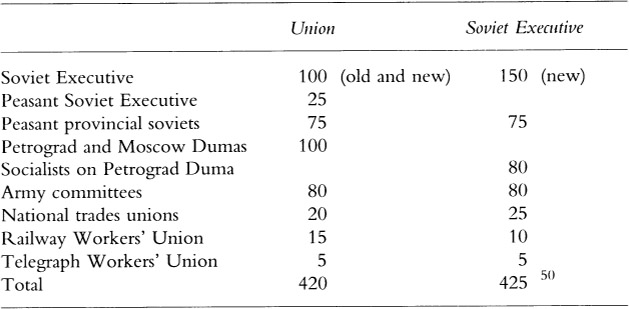
Although the SR Central Committee pulled out of the talks on 2 November because it found the Soviet Executive proposal unacceptable,49 the chances of compromise were still good since the proposal endorsed by the Soviet Executive was very close to that agreed by delegates to the Railway Workers’ Union talks on the 1st (see Table 1). The one major area of difference affected the seats allocated to the Soviet Executive. The Railway Workers’ Union insisted that the Soviet Executive elected at the Second Congress of Soviets was unrepresentative because it had been elected after the walk-out by the SRs and some Mensheviks at the time the CSRM was established; therefore representation from the executive elected at the First Congress of Soviets had to be sought in compensation. Some Bolsheviks argued that this might reduce their representation to as little as 150, and therefore insisted that, rather than solving the problem by looking to the First Congress of Soviets, the SRs and Mensheviks should simply return to the Soviet Executive elected at the Second Congress of Soviets and seek representation through it. However, this Bolshevik estimate of 150 was based on a very pessimistic assessment, especially given the radicalization of the army committees and preparations then underway for a Peasant Soviet Congress where the Left SRs expected to do well. All the other issues, even the question of representation from the town councils, as Trotsky made clear,51 were not of major importance. In fact any government which emerged from these proposals advanced by the Railway Workers’ Union would be dominated by the Bolsheviks and would therefore agree to the Soviet Executive’s proposal that the Bolsheviks should control the ministries of labour, internal affairs and foreign affairs. Even accepting the Bolsheviks’ worst prognostications, there were sufficient similarities between the Soviet Executive and Railway Workers’ Union proposals for serious negotiations to resume.
It was all the more likely that any composite version of the Soviet Executive and Railway Workers’ Union proposals would have been closer to the soviet than the Railway Workers’ Union version because of an incident which occurred at the opening of the 3 November session of the Railway Workers’ Union talks. The negotiations were lobbied by workers from the Putilov and Aleksandrovskii factories, two of the biggest in Petrograd. After a general call for agreement between the parties, the formation of a coalition socialist government and an end to civil war, the detail of the resolution adopted at the Putilov plant meeting of 2 November was closer to the soviet than the Railway Workers’ Union proposal. In particular it called for the Second Congress of Soviets, expanded by delegates from a future Peasant Soviet Congress, to be the sole source of government power, and wanted no representation at all for any organizations like the town councils not represented in the soviet. The Putilov resolution was scarcely any different from the proposals outlined by Kamenev and the more conciliatory Bolsheviks.52
What ruined the prospects for agreement between the soviet and the Railway Workers’ Union were the continuing activities of the MRC and the determination of Lenin and Trotsky that the Bolsheviks should rule alone. When the Railway Workers’ Union talks finally reopened on 3 November, instead of discussion centring on how to reconcile the soviet proposal read out by Ryazanov with the Railway Workers’ Union proposal read out by the Left SR representative, the issue of arbitrary rule and arrests was again raised. By continuing to rule by arbitrary terror Lenin had succeeded in changing the agenda of the Railway Workers’ Union talks. Compromise remained illusory so long as the conciliatory Bolsheviks were associated with the actions of Lenin and Trotsky. Thus the Menshevik R.R. Abramovich made clear that ‘an agreement can be reached if there is an end to the terror’, but the state of siege had to be lifted, political prisoners freed, and the limitations on press freedom removed. He detailed how throughout the Railway Workers’ Union talks the MRC had continued to arrest people, and then put down five conditions for the Mensheviks’ further participation in the talks. His stance was endorsed by Martov, and by the Left SRs. Abramovich concluded by asking whether the Bolshevik Central Committee and the Soviet Executive were prepared to accept that, as soon as agreement had been reached on reconciling the soviet and Railway Workers’ Union resolutions, Lenin’s government would issue a decree ending terror and lifting the state of siege.
By 3 November the Bolshevik Central Committee had removed Kamenev as its representative at the Railway Workers’ Union talks and replaced him with Stalin; he was in no mood to compromise. He responded to Abramovich’s request for an end to terror with the enigmatic rejection: ‘nobody can guarantee that the troops standing at Gatchina will not advance on Petrograd’, which ignored the fact that there were no longer any counter-revolutionary troops in Gatchina. It was Sokolnikov, however, who dropped the bombshell for the Railway Workers’ Union negotiators. He made clear that, whatever impression Kamenev may have given on 2 November, the Bolshevik Central Committee still had to agree whether the Railway Workers’ Union and soviet proposals were close enough to be reconciled and asked for an adjournment until the next day.53 The Railway Workers’ Union talks ended at 2 a.m. on the morning of 4th when it became clear the Bolsheviks were not going to agree to any compromise. The same day ten leading moderate Bolsheviks decided to resign en masse from Lenin’s government, and one other associated himself with this move without resigning.
The essence of Kamenev’s challenge to Lenin and the rest of the Central Committee was whether it was worth risking total isolation from other democratic groups for the sake of retaining a stranglehold on the Soviet Executive. Lenin clearly thought it was, for on the very day of the last session of the Railway Workers’ Union talks, he personally interviewed every member of the Central Committee to get them to give their signed support to his ‘ultimatum of the majority [of the Central Committee] to the minority’; this demanded total loyalty to Lenin’s line and endorsement of the decision taken on 2 November even though it contradicted the decision of the expanded Central Committee session on 1 November.54 As a leading conciliatory Bolshevik A. Lozovsky told a meeting of the Bolshevik group in the Soviet Executive on 4 November:
I cannot remain silent in the name of party discipline when I feel with every fibre of my being that the Central Committee’s tactics are leading to the isolation of the proletariat, to civil war among working people, and to the defeat of the great revolution … I cannot suppress in the name of party discipline [my knowledge of] the sullen discontent of the working masses, who fought for soviet power [only to discover] by some incomprehensible manoeuvre that power is wholly Bolshevik.55
Yet what prompted the resignation of the conciliatory Bolsheviks from Lenin’s government was not just the wrecking of the Railway Workers’ Union talks, not just the manner in which this was accomplished, but Lenin and Trotsky’s open defence of arbitrary rule. On 4 November Lenin and Trotsky appeared at the Soviet Executive not simply to justify one incident of arbitrary rule, in this case the closure of the ‘bourgeois press’, but to institutionalize arbitrary rule. They came to explain that the Soviet Executive, this soviet parliament, was not a ‘bourgeois parliament’ and therefore had only a very vague and general brief to oversee the government which could issue decrees in its own name as often as it liked. Lenin’s final remark summed up his attitude: ‘you call us extremists, but you are nothing other than apologists for parliamentary obstruction’. When, on Lenin’s urging, the Soviet Executive agreed to accept that it, the soviet parliament, could not prevent the soviet government ruling by decree, the conciliatory Bolsheviks resigned; if the soviet parliament was to have no power, the debate as to who should be represented in any broadened soviet parliament had become simply irrelevant.56
The conciliatory Bolsheviks who resigned from Lenin’s government justified their action by saying that all workers and soldiers wanted ‘a speedy end to the bloodshed between the different sections of democracy’ – in other words the nascent civil war between Bolsheviks and SRs, Reds and Greens. In their resignation statement they highlighted the question of arbitrary rule once again, in language the Menshevik Martov would have welcomed. They insisted that it was essential to form a government of all parties in the soviet: ‘a purely Bolshevik government has no choice but to maintain itself by political terror’.57 Arbitrary rule by decree, ‘military’ style discipline within the party, these hallmarks of a civil war mentality were essential parts of Bolshevik rule after 4 November, a date in many ways far more crucial than 25 October, the date of the October insurrection: it opened up the prospect of a civil war within democracy, something far more dramatic than the struggle between Russian democracy and Russian property previewed in Kornilov’s rebellion. Lenin’s only defence was that his was arbitrary rule with a mission, as one of his most lucid critics noted. Maxim Gorky wrote on 10 November 1917:
Lenin … considers himself justified in performing with the Russian people a cruel experiment which is doomed to failure beforehand. The people, worn out and impoverished by war, have already paid for this experiment with thousands of lives and will be compelled to pay with tens of thousands, and this will deprive the nation of its leadership for a long time to come. This inevitable tragedy does not disturb Lenin, the slave of dogma.58
The collapse of Kornilov’s rebellion had removed the danger of one civil war in Russia, a White versus Red civil war. As Lenin had himself noted, the transfer of power to a coalition socialist administration could have taken place quite peacefully. Such a coalition government would have addressed the great social issues of bread, peace and land, but it would not have engaged in an experiment predicated on one man’s, Lenin’s, interpretation of how the imperialist economy had evolved in the years since Marx’s death. Every arbitrary act Lenin justified on the grounds that he was building socialism and that the new socialist epoch had begun. To this end Lenin launched his civil war within democracy, a Red versus Green civil war of Bolsheviks against SRs, at times even a civil war within the Bolshevik Party. Lenin acted on the understanding that the other imperial states of Europe were about to implode as Russia had done. Within weeks he was having to readjust his policies as international imperialism reacted in ways he had not expected.
Notes
1. For the rumours of a Chernov led government, see P.N. Milyukov, The Russian Revolution (Gulf Breeze 1984), p. 14; V.I. Lenin, Collected Works (Moscow 1960), vol. 25, p. 306.
2. A. Rabinowitch, The Bolsheviks Come to Power (New York 1978), p. 160.
3. R.P. Browder and A.F. Kerensky, The Russian Provisional Government: Documents (Stanford 1961), p. 1682.
4. Milyukov, Russian Revolution, p. 47.
5. D.V. Oznobishin, ‘Burzhyaznaya diktatura v poiskakh parlamentskogo prikritiya’ Istoricheskie zapiski 93, p. 132.
6. V.M. Chernov, Pered bitrey (New York 1953), p. 345.
7. Oznobishin, ‘Burzhyaznaya’, p. 116.
8. Oznobishin, ‘Burzhyaznaya’, p. 135; N.F. Slavin, ‘Krizis vlasti v sentyabre 1917g. i obrazonvanie Vremennogo So veta Republiki (Predparlament)’ Istoricheskie zapiski 56, p. 54; Milyukov, Russian Revolution, pp. 73–6.
9. Browder and Kerensky, Documents, pp. 1752, 1759; Milyukov, Russian Revolution, p. 130.
10. A.I. Verkhovskii, Rossiya na Golgofe (Petrograd 1918), pp. 116–22, 125–34.
11. These events are fully covered in Rabino witch, Bolsheviks.
12. A. Tyrkova-Williams, From Liberty to Brest Litovsk (London 1919), p. 245.
13. L.G. Murashev, ‘“Odnorodno-sotsialisticheskoe” pravitel’stvo v anti-sovetskikh planakh men’shevikov v dni oktyabrskogo vooruzhennogo vosstaniya v Petrograde’ Uchennye zapiski kafedr obshchestvennykh nauk vuzov Leningrada: Istoriya KPSS (Leningrad 1990), p. 54; Milyukov, Russian Revolution, p. 184. These talks are dismissed as legend by S.P. Melgunov in The Bolshevik Seizure of Power (Oxford 1972), p. 58.
14. Lenin, Collected Works vol. 25, p. 263.
15. Lenin, Collected Works vol. 25, p. 310.
16. Lenin, Collected Works vol. 26, pp. 36–9. Although this article was published on 29 September, it was written earlier, see Institute of Marxism-Leninism, V.I. Lenin: Biograficheskaya khronika (Moscow 1974) vol. 5, p. 11.
17. Lenin, Collected Works vol. 26, p. 24.
18. For the votes of the Bolshevik Central Committee concerning the Preparliament and the insurrection, see The Bolsheviks and the October Revolution: Central Committee Minutes of the RSDLP(b) (London 1974), p. 67 et seq. (hereafter Minutes). The crisis within the Bolshevik Central Committee at this time, and the absence of any party resolution to seize power before the Second Congress of Soviets, can be explored more fully in this author’s computer assisted learning package The Bolshevik Seizure of Power, produced for the HiDES Project, University of Southampton.
19. Lenin, Collected Works vol. 26, p. 234.
20. Murashev, ‘Odnorodnoe’, p. 52; R.V. Daniels, The Conscience of the Revolution (Harvard 1960), p. 64.
21. Murashev, ‘Odnorodnoe’, p. 57.
22. P. Vompe, Dni oktyabr’skoi revolyutsii i zheleznodorozhnikov (Moscow 1924), pp. 16–18; A. Tanyaev, Ocherki dvizheniya zheleznodorozhnikov v revolyutsii 1917g. (Moscow 1925), p. 138.
23. The State Archive of the Russian Federation in Moscow (GARF) has the surviving records of the Railway Workers’ Union talks in fond 5498 opis 1. These comprise stenographic records of the sessions held on 29 October, 30 October and 3 November (ed. khr. 58, 67 and 74), plus records of telegraph conversations between the Railway Workers’ Union representatives in Petrograd and the headquarters in Moscow (ed. khr. 78). There is also a diary kept during the talks by an anonymous participant (ed. khr. 56). When consulted in 1990 only a poor quality microfilm made in the 1950s was available. For the attitude of the Bolsheviks and the groups supporting the Railway Workers’ Union, see 5498.1.78, the reports dated 28 October and 29 October.
24. N.G. Dumova, Kadetskaya kontrrevolyutsiya i ee razgrom (Moscow 1982), p. 25; V.D. Medlin and S.L. Parsons (eds), V.D. Nabokov and the Russian Provisional Government (Yale 1976), p. 165; G. Buchanan, My Mission to Russia and Other Diplomatic Memories (London 1923) vol. 2, p. 210.
25. A detailed insight into the activities of the CSRM can be found in the telegrams sent to the British Foreign Office by Sir George Buchanan, the ambassador in Petrograd. See the Public Record Office files FO 371.2999.247 and .278. For the attitude of the SRs, see V.V. Komin, Istoriya pomeshchikh, burzhuaznykh i melko-burzhuaznykh partii v Rossii (Kalinin 1970), p. 109.
26. GARF 5498.1.78, report dated 28 October; 5498.1.56, entry for 28 October.
27. L. Lande, ‘The Mensheviks in 1917’, in L. Haimson (ed.), The Mensheviks: from the Revolution of 1917 to the Second World War (Chicago 1974), p. 49; O.H. Radkey, The Sickle under the Hammer (Columbia 1963), pp. 19, 30, 37.
28. Tanyaev, Ocherki, p. 151.
29. Minutes, p. 127.
30. GARF 5498.1.58, protocols of session held on 29 October.
31. GARF 5498.1.58, protocols of morning session 30 October; 5498.1.56, diary entry for 30 October. There is some confusion as to quite when this workers’ delegation arrived. The, diary dates it as the 29th, but in his memoirs, the delegate to the talks from the Petrograd City Council dated the incident as 3.00 a.m. on 30 October. A diary written after a night’s sleep from 29–30 October would consider events the previous day to have occurred on the 29th, even if strictly speaking the author was describing an event which took place in the early hours of the 30th, see J. Bunyan and H.H. Fisher, The Bolshevik Revolution: Documents and Materials (Stanford 1961), p. 167.
32. GARF 5498.1.67, protocols of the evening session 30 October; Radkey, Sickle, p. 66.
33. Vompe, Dni, pp. 34–7.
34. GARF 5498.1.78, report dated 30 October.
35. Radkey, Sickle, p. 67; V. Brovkin, The Mensheviks After October (Cornell 1987), p. 23.
36. Bunyan and Fisher, Documents, p. 192; GARF 5498.1.78, report dated 1 November.
37. Muraviev had a colourful career, as this book will show. According to the leading SR Central Committee member A.R. Gots, despite this enthusiasm for supporting the Bolsheviks, Muraviev had a day or two earlier asked the SR Central Committee if he could be empowered to use force against the Bolsheviks, in view of the MRC’s challenge to the government’s authority. See M. Jensen, The SR Party After October 1917: Documents from the PSR Archives (Amsterdam 1989), p. 128.
38. This account is taken from A.K. Wildman, The End of the Russian Imperial Army (Princeton 1980) vol. 2, p. 304 et seq. Lenin was furious about Dybenko’s action and wanted to have him court-martialled.
39. Vompe, Dni, p. 44.
40. GARF 5498.1.74, protocols of evening session of 30 October; 5498.1.56, diary entry 31 October; Vompe, Dni, p. 34.
41. Vompe, Dni, pp. 44–7.
42. GARF 5498.1.78, report by Malitskii dated 30 October; 5498.1.78, transcript of conversation dated 31 October.
43. The suggestion that a ‘second Kornilov campaign’ was underway in October 1917 was an invention of Lenin and Trotsky which blighted the work of a generation of Soviet historians. It is rebutted in detail in this author’s ‘Before the fighting started’ Revolutionary Russia vol. 4 (1991), p. 232.
44. J.L.H. Keep (ed.), The Debate on Soviet Power: the Minutes of VTsIK, Second Convocation (Oxford 1979), p. 42; GARF 5498.1.56, diary entry for 28 October.
45. GARF 5498.1.74, protocols of session 29 October; 5498.1.74, protocols of evening session 30 October. According to Martov, Trotsky had threatened to shoot five ‘counter-revolutionaries’ for every ‘revolutionary’ shot.
46. GARF 5498.1.78, transcript of conversation dated 31 October.
47. Minutes, p. 135. This resolution should be read in conjunction with those on p. 136 and p. 141. The suggestion on p. 135 that the ultimatum had to be accepted within two hours was not as threatening as it sounded, since the Soviet Executive was already in session and support for the Bolsheviks’ programme, as opposed to support for Lenin’s government, was widespread. These issues are explored more fully in this author’s Bolshevik Seizure of Power.
48. Minutes, p. 139; Keep, Debate, pp. 59–63; GARF 5498.1.56, diary entry 3 November.
49. V. Vladimirova, God sluzhby sotsialistov kapitalistam (Moscow 1927), p. 48; Brovkin, Mensheviks, p. 27. The Menshevik conditions were the inclusion of all democratic groups in a representative body; the freeing of all political prisoners; and end to terror and the restoration of the freedoms of press, strike and assembly; a cease fire; and the transfer of army units to local government control to keep order and combat looting.
50. Tanyaev, Ocherki, p. 157. Keep (Debate, p. 62) gives fifty not eighty for the number of socialists on Petrograd City Council.
51. Trotsky, unlike Lenin, was quite happy to have representatives from city councils, so long as fresh elections were held, see Minutes, p. 129.
52. GARF 5498.1.74, protocols of session 3 November.
53. GARF 5498.1.67, protocols of session 3 November.
54. Minutes, p. 300.
55. Bunyan and Fisher, Documents, p. 206.
56. Keep, Debate, p. 85. This was not an isolated remark. In the same debate Lenin said: ‘in order to exercise control over the government’s policy it is quite sufficient for the Soviet Executive to have the right to remove ministers. The new government could not have coped with all the obstacles which stood in its path if it had observed all formalities …’. In a similar vein Trotsky added: ‘our Soviet parliament differs from others in that it does not contain representatives of antagonistic classes. Our government … has no place for conventional parliamentary machinery’.
57. Minutes, p. 142.
58. M. Gorky, Untimely Thoughts (New York 1968), p. 88.