
Chapter 10
The war had ruined ordinary life for all people – more than 30 million men and women were called to the colours, millions more were evacuated. Only the mail service might help the people of this vast country to not lose each other Indeed, for the soldiers, the mail service became the thread that linked them with their past, giving them hope for the future. Consequently, as the volume of correspondence increased, there was a shortage of envelopes and postcards. And so, from 1942, so-called ‘triangulars’ began to come from the front line – sheets of paper folded in a special way with the message on the inside and the address on the outside. Letters from the front were routed as follows: a postal unit collected envelopes, ‘triangulars’ or postcards from a makeshift mailbox, or directly from the soldiers themselves. The collected messages would then be taken to a field post office, wherein they would be date-stamped and packed into bags, which would be sent to a field mail depot. From there the correspondence would go in railroad wagons to all corners of the country The examination of correspondence by military censors at the field post offices was an integral part of mail processing. Letters containing descriptions of suffering or critical comments would not be forwarded, and political officers would then run an educational conversation with their authors. Sentences containing information on unit numbers and names of settlements were meticulously crossed out. Of course, soldiers invented many methods to let their kinfolk know where they were. A scout, Vladimir Boukhenko, remembers:
My elder brother had graduated from an artillery school and met the war as a lieutenant in Moldavia. We corresponded with him on a regular basis, but hadn't seen each other since 1939. Of course, we pretty much wanted to see each other; but how could we know where our units were in action? After all, the censors had been deleting any geographical names. Then he'd set such a puzzle for me in his letter: ‘We are now near the city with a name whose first part is loved by half the world, and whose second part by the whole world.’ We guessed that it was Kherson [ ‘kher’ – a slang word for ‘penis’ and ‘son’ meaning ‘sleep’ – trans.] [...] Thus we understood that we were fighting not far from each other Then I wrote him in the next letter: ‘Our Mum lives on the same street, but in block 8, apartment 27,’ and in the next letter explained that the block number was the Army number and the apartment number the Division number

An answer to a letter from home.
Letters from girls, addressed ‘To a Soldier of the Red Army’ often arrived at the front, sometimes containing photos. A tank platoon commander, Vasily Bryukhov, remembers:
Since people were barely literate back then, tank crewmen asked me to write letters for them. I never refused and enthusiastically described the real and imaginary feats of a hero: ‘I am sitting and writing to you, and imagining how beautiful you are – as the goggles of my gas mask are lit by a flare.’ Of course, with my transfer to another platoon or company such correspondence quickly ceased.
In 1942 an infantryman, Semyon Kogan, received a small parcel:
There was a small tobacco pouch with an embroidered inscription: ‘To a dear fighting man of the Red Army’, a pair of warm wool socks and a letter: ‘Hello, Comrade Kogan! I don‘t know your first name and therefore address you somewhat officially. On top of that I don't know you in person. But I know only one thing, that you fight against German Fascism, that you stand for our happiness, our freedom! And I decided to write you – a fighting man of our Motherland! My greetings may reach you when you are in combat, but having come out of it you will read it and remember us girls, who don't forget for a second about our dear frontliners. Be aware that our every step, our every thought are linked with you fighting comrades. And for now I am sending you a warm greeting and expect a reply. Signed: Taya Shitzgal.’ Then not only I, but several other men, wrote her letters. We understood that her letter, the pouch and the warm socks were not only for me – that was a gift for all of us frontliners. I’ve kept this letter all my life, sixty-six years so far
At the end of the war a different kind of correspondence began to arrive on the home front – parcels containing war trophies. Soldiers were allowed to send 5 kilograms a month, officers 10 kilograms. Commonly, clothes, lengths of fabric or leather and footwear were sent – stuff the ruined country was short of. An artillery scout, Lev Shamis, remembers:
Soldiers were allowed to send home 5-kilo parcels, and I sent only two of these. One arrived home, but in the other one, someone had replaced all my stuff with threadbare rags . . .

A Red Army soldier writes a letter sitting in his slit trench. In front of him, two F-I ‘Limonka’ hand grenades.
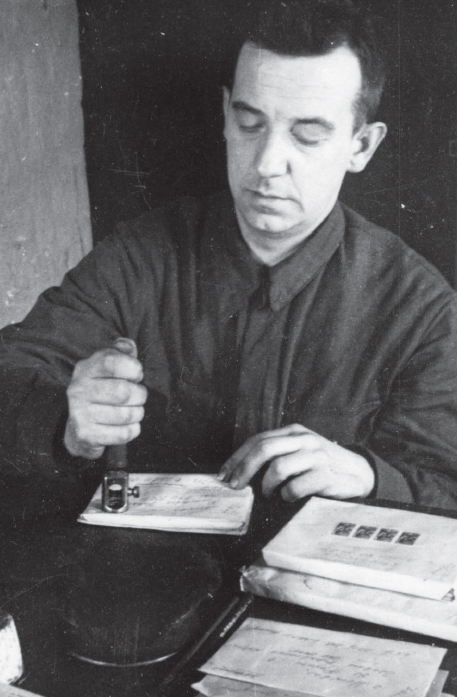
Hand-postmarking of letters at the field post office (Western Front, 1942).
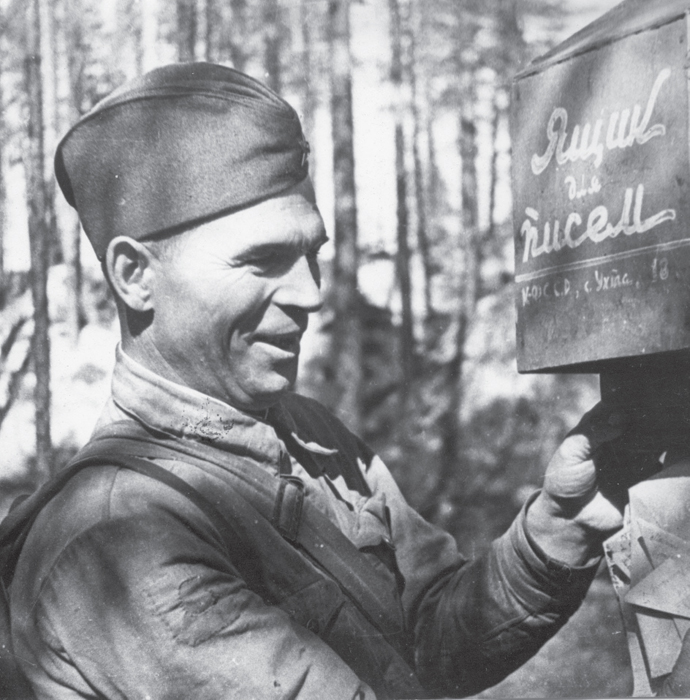
Mail collection. Judging by the inscription on the letterbox – ‘KFSSR, v. Uhta, 13’ – we can suppose the photo was taken at the Karelian Front. It seems that soldiers took the letterbox with them and used it on the front line for collection of letters.

A postman brings letters to a rifle unit.
Reading letters from home was often the only possible way for soldiers to have some amusement.
