
Chapter 2
A team of draftees would get their papers and head for a training camp, where they would undergo basic military instruction, or, as it was termed back then, ‘Young Red Army soldier's course’. The course lasted three months and most veterans recall it with horror, Ilya Sokolov found himself at the Chebarkoul camp in the South Urals:
A freight train stopped in a pine forest. The snow was knee-deep. A lame starshina [i.e. sergeant major – trans.] lined us up and marched us deep inside the forest. After 4 kilometres we saw smoke ahead, coming from dugouts. Each one was intended for 250 men. On both sides of the central passage were double bunks built of unshaved planks. A stove for heating stood at the end of the dugout. No mattresses, blankets or pillows were issued. We broke off brushwood and plaited rags into mattresses to sleep on. I slept on such a bed for three months. Reveille was at six in the morning. We would run out, wash with snow, get a piece of sticky mass called ‘bread’, and march in formation 5 kilometres to the drill ground with full combat kit (rifle, gas mask, ammo, backpack). They drilled us to shoot, taught us the basics of hand-to-hand and bayonet fighting. Having got fed up with crawling in the snow, we would return to the regiment for lunch. The tucker was disgusting! A bowl of greenish water with a couple of floating cabbage leaves and a ration of raw bread. Sometimes we were given rotten fish with a ladle of kasha [i.e. porridge or gruel – trans.] – and that was a feast for us [...]. Many guys had weakened so badly on this feed, they were transferred to the ‘feeble’ battalion, where they were fed up and given a yeast drink. Even sturdy Siberians couldn't cope with the hunger. Local guys began to defect. They would be caught. Every week we'd be lined up by the dugouts for show trials. A travelling court martial would come around and we watched as the deserters from the regiment were sentenced to death and executed on the spot [...]. Occasionally, someone was lucky enough to be sent to a penal company instead of getting capital punishment. The three months in the drill regiment seemed like three years [...]. At last, at the beginning of June 1943, we had a banya [i.e. steam bath – trans.] for the first time and were given a new uniform, plus boots with new puttees. We received backpacks with a flask, mess tin, mug, spoon, and dry rations for three days, which we ate straight away. Then we boarded a train and headed for the front.

Training for antitank warfare, Leningrad 1941. The instructor holds a bundle of four RGD-33 antipersonnel grenades – it was recommended to throw such a bundle under the tracks of German tanks.
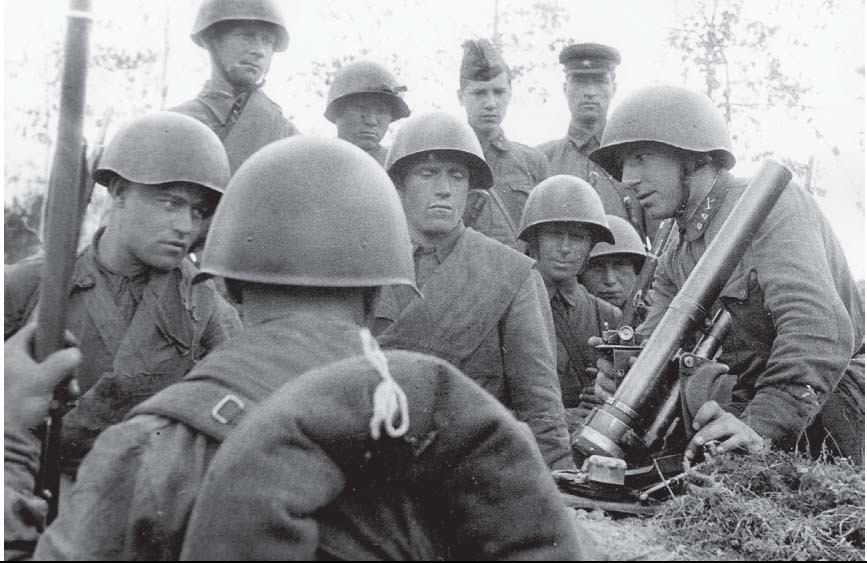
An artillery lieutenant of the 23rd Guards Rifle Division (26th Army) trains his men to operate the 50mm company mortar, model 1941.
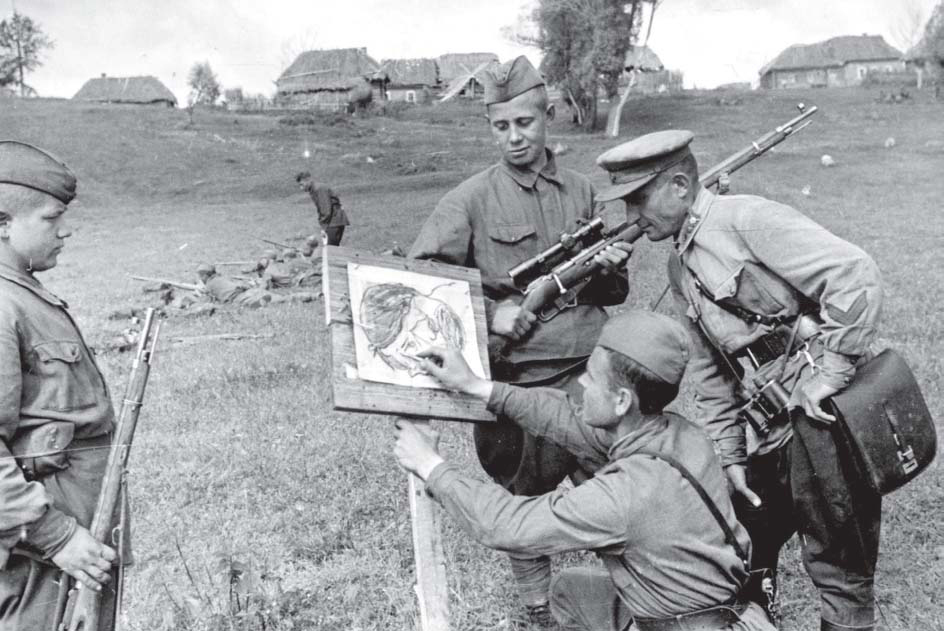
Training snipers – a portrait of Hitler serves as the target. In the hands of the soldier you can see a Mosin rifle (model 1898/1930) fitted with a ‘PE’ telescopic sight.
The situation in military schools was noticeably different and officer cadets were better fed. Training lasted twelve hours a day: eight hours of theory and practice plus four hours of independent self-training under the guidance of a teacher. After six months of this accelerated drilling, cadets received the rank of lieutenant or junior lieutenant and were sent to the front. According to Vasily Bryukhov, who graduated from the Stalingrad Tank School in the spring of 1943, the Principal dismissed graduates with the following words: ‘Well, boys, we understand that you've run through the programme quickly. You have not perfected your knowledge but you'll finalize it in action.’ This approach to training was typical for infantry as well as tank and aviation schools. An airman, Ivan Gaidayenko – who was retrained during the war from an SB bomber pilot into an 1-16 fighter pilot – remembers:
I said to the instructor: ‘Show me how to run the dogfight. After all, I'm from a bomber, I've never learned aerobatics.’ He says: ‘First, aerobatics are banned; second, when you're in a dogfight you have to put your plane into a spin – if you can't do that you'll be downed.’
Experienced commanders used any opportunity – such as a lull between engagements – to increase the skills of their subordinates. A scout, Leonid Knyazik, remembers:
We were taught to crawl noiselessly, to overcome barbed-wire entanglements. We were shown how to ‘take out a sentry’. I have to say that, if you were assigned to be a ‘German sentry’ during drilling, it wasn't a very pleasant experience ...

Rehearsing an attack – infantrymen follow a T-60 light tank.

An attack in mounted formation – the Red Army used cavalry as mobile infantry.
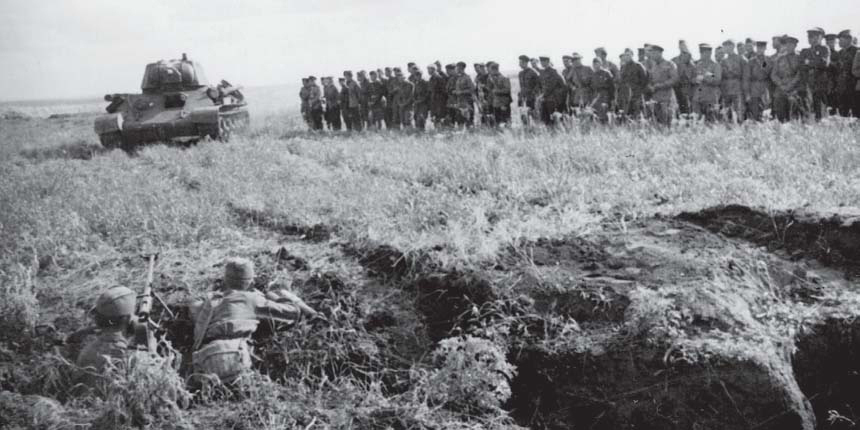
Rolling by a tank. The crew of a PTRD anti-tank rifle must let the T-34 tank drive over them, before throwing grenades into it.
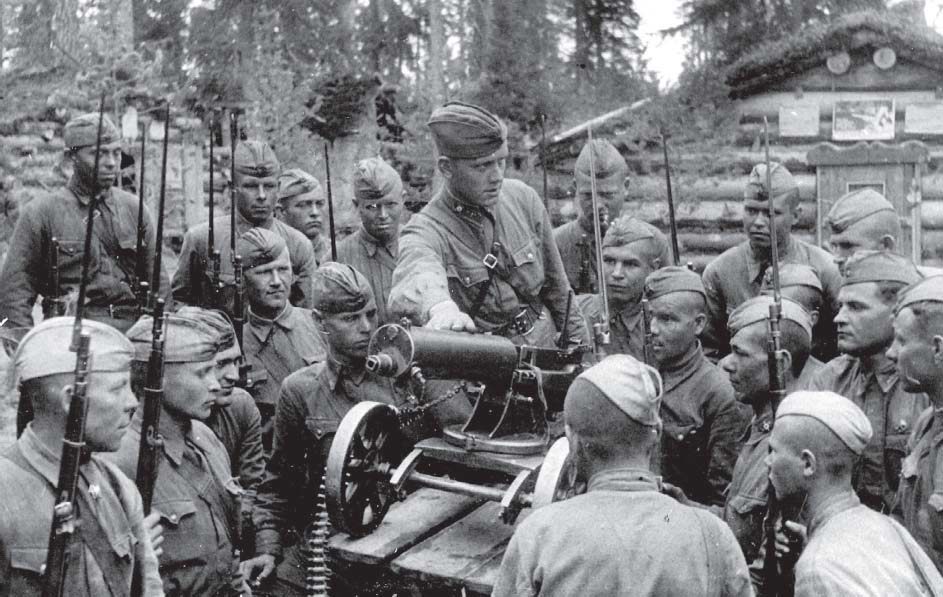
A lieutenant instructs his men on the construction of the Maxim machine gun.
Study of the British Valentine tank. Often there were no translated instructions for vehicles supplied via Lend-Lease, so soldiers and their commanders had to master them by trial and error.


A sergeant conducts a lesson for making individual rifle trenches. He wears a model 1936 helmet (as does the soldier standing second from the left), the others wear the model 1940.
An experienced pilot – apparently the squadron commander or his deputy – explains the nuances of the Il-2 single-seater ground-attack plane to new pilots (7th Air Army).


Soldiers convalescing from wounds recover physical strength training in hand-to-hand combat. On the horizontal bar of the ‘cross’ is an inscription: ‘Therapeutic physical training is the main method of treatment for the whole organism.’