
PART IV
Antebellum South Carolinians who would control Upper South apologists faced the classic extremist’s problem in a democracy: how to command a non-extreme mainstream. The classic democratic answer, persuade those less fervent, offered these zealots too little satisfaction. Carolina intransigents were usually too far out to convince a southern majority.
Coercive tactics offered little more chance of success. Lynching, the only extralegal form of coercing whites that was considered at all legitimate in this despots’ democracy, became illegitimate if mobs marauded on other folks’ turf. That left geographically isolated ultras only one point of leverage over far-off moderates. A majority in one southern state, by disobeying national laws, could force an armed showdown. Indecisive moderates would be forced to shoot rather than talk.
Still, resentful southern moderates might aim their guns at precipitous rebels rather than at national law enforcers. Did Carolinians dare take the chance?
CHAPTER 12
Disagreement between South Carolina extremists and Chesapeake Bay moderates emerged more sharply than ever in 1832. While western Virginians demanded expulsion of black slaves, partly to establish white egalitarianism, South Carolinians demanded a veto by a national minority, partly to perpetuate slaveholding elitism. In the Nullification Controversy, John C. Calhoun’s state went to the brink, seeking to stop King Numbers from destroying old-fashioned slaveholders. Then, just when South Carolina’s eighteenth-century world view seemed destined to carry the Old Order out of nineteenth-century democracy, the state’s oligarchs stepped back. They became republicans who were willing to compromise.
The pattern of charge and retreat in the Nullification Controversy would remain antebellum South Carolina’s signature. Seldom has so geographically concentrated a revolutionary fringe group been so early committed to revolution. Seldom have such committed revolutionaries been so chary about rebellion. These extremists were long unable to sustain the historical role they cherished, unable to capture the identity they craved. They were like T. S. Eliot’s Hollow Men, groping “between the idea and the reality,… between the conception and the creation,… between the desire and the spasm”—until finally, holding their breath, they precipitated a rebellion others had to encourage them to begin.1
1
Why were South Carolina squires more extreme than other Southerners—and why so much sooner? Why were these arch-extremists so frightened of extremism—even so late? Few questions about Civil War causation are more important. None require subtler answers. At times, South Carolina masters flashed signs of uncertainty, fear, inferiority complex—the stridency of false posturing. The next moment, the same people emitted signals of cockiness, fearlessness, felt superiority—the rhetoric of true believers. Outsiders, intrigued by this schizophrenic sphinx, were wise to be puzzled about where Carolina’s confidence ended and doubt began.
Posterity can be more certain what made for both confidence and doubt. No other southern regime was so committed to eighteenth-century elitist principles or so resistant to nineteenth-century egalitarian republicanism. South Carolina’s balance of despotism and democracy, tipping unusually far toward old-fashioned imperiousness, gave its masters strong confidence in contained, hierarchial dominance and special contempt for sprawling, leveling “mobocracies.”
Still, even those Old English fogies could not escape the influence of the American nineteenth century. The resulting Carolinians saw themselves partly as fine fellows, but partly, too, as foolish hypocrites. Even in South Carolina, patriarchs could not maintain cocksure certainty without being dismayingly conscious of belonging to another world. Somewhere between the cockiness and the dismay stood a snob not quite at ease with his own snobbishness.
2
Carolina snobbishness began and remained most rampant in the malarial-infested coastal swamps. No extensively settled southern habitat was so forbidding to white migrants. Yet at least until the heyday of Louisiana sugar fields in the 1850s, no region offered such fabulous fortunes to whites who dared to come. Nowhere in the South were alternatives so stark. Either a few rich whites would continue to force many slaves to develop this deadly El Dorado, or the miasmic swamps would become too inhuman for development.
The area’s peculiar wetlands at first attracted a peculiar settler. Compared with emigrants to the Chesapeake, early Carolinians came not from England, with its lack of a slaveholding establishment, but from Barbados, with its consolidated slave regime. Wealthy Latin American types came prepared to press an especially large black population on the only area of coastal America geographically repellant to a large white population.
Carolina slaveholders still needed a tropical crop fit for slaveholding labor. Carolina’s coastal slop, too far north for Latin America’s sugar and coffee, was too mucky for the Chesapeake’s tobacco. Slavery could not be viable in the swamps until whites found an alternative.
Historians’ guess is that slaves taught slaveholders what to grow. Bondsmen, having cultivated rice in Africa, knew that swamps laced with tidal streams would sustain the golden grain. Cuffee was apparently here exhilarated professor and Massa obliging student.2
How latter-day celebrants of black creativity do miss the irony in celebrating this black contribution to American inventiveness. How blacks did pay for what whites learned. Payments began with the inch-by-inch clearing of overgrown jungles. Isolated specks of turf, once cleared, had to be irrigated. Slaves slipped and slid in the muck, digging deep parallel canals from the river through the clearing. Shallower, perpendicular ditches connected canals. Along river beds, across new canals, black laborers fashioned dams and sluices. Masters could then boss the tide, flooding fields so rice could sprout, draining water off so slaves could weed.
Because rice fields were so expensive to develop, rice plantations cost several times more than settled turf elsewhere in North America. Posh acres, once expensively developed, became almost worthless without expensive slaves. Vulnerable sluices and dams had to be incessantly repaired. Thick soils had to be constantly weeded. Golden grains had to be quickly harvested. Compared with tobacco and cotton black belts, rice swamps, even after development, never attracted as many yeomen nonslaveholders.3
Nor were as many poor whites available to work as tenants or day laborers on rich men’s estates. Even after being cleared, Carolina swamps remained sickly, largely because malarial mosquitoes remained omnipresent. Blacks alone could be forced to risk what relatively few whites would chance.
Slaves could be risked because black bodies were less susceptible to malaria’s killing fever. Africans often had special blood cells, making them specially vulnerable to sickle cell anemia as well as specially able to fight malaria. Slaves usually caught swamp fevers, then usually survived the raging temperatures. The “only” danger tended to be a frightful convalescence and a debilitated physical system for months or years thereafter.4
Because rice cultivation demanded many laborers and the sickly habitat repelled many whites, the region developed an unusually black population. In 1830, lowcountry inhabitants were 85% slaves. Many sorts of blackness surrounded Carolina’s unusually isolated and especially outnumbered white fraction. Elsewhere in the South, plantation areas were cleared to the edge of the horizon. Farmers could usually see endless white men’s properties. Here, clearings tended to end at each developed property. Owners could usually see only surrounding jungles. Elsewhere, bright blue rivers connected planters to the world. Here, unconnected swamp pools were blackest black. Elsewhere, black slaves, barely if at all outnumbering whites, talked with white men’s drawls. Here, massive quantities of blacks, comparatively isolated from whites, characteristically employed Gullah linguistic traits. Here a planter wrote that “I am actually so startled at the sight of a white face that I avoid my own … in the glass in the morning.” No planter elsewhere in North America could have written that incredible sentence.5
The black jungle infiltrated all aspects of white thought. In coastal Virginia, Thomas Dew speculated about selling blacks south and attracting white migrants. South Carolinians conceived that without slaves to risk the miasma, Carolina swamps would revert to wilderness. In North Maryland, many masters did not fear to free Afro-Americans, who retained relatively little African culture. In coastal Carolina, whites feared that Afro-Americans short on American acculturization, if freed, would Africanize the lowlands. In other parts of the Lower South, slaveholders expanded on endless terrain. In wetland South Carolina, planters sought to retain bits of clearing.
Or, to be more accurate, South Carolina’s gentlemen dreamed of vacations from confined jungles. Whites sought to make such a financial windfall as to flee during the murderous malaria season. In the middle of the eighteenth century, absenteeism became widely attainable. Planters gained decent profits from the golden grain. They then secured supplemental treasure. British merchants craved indigo, a putrid dye turning dull cloth lush blue. Planters discovered that hills above flooded swamps could spawn the unseemly stuff. Slaves, when not needed in rice fields, could be forced up above to endure the stench, double Massa’s profits, and help finance Massa’s vacation.
By 1760, South Carolina absentees had become perhaps the richest American entrepreneurs and the only ones often not directing their enterprises.6 Even a semi-competent overseer who brought in three-quarter crops mined enough treasure to support planters’ vacations. If no resourceful overseer could be found, a decent overseer could be shared. Such white supervisors checked in with black drivers periodically. Other planters dispensed with this mock white supervision. Such masters appointed a black driver to be Massa from the time malarial mosquitos first attacked in April to the time frost killed off the bugs in October.
Thus did a class unusually independent of their plantations become unusually dependent on slaves. Thus did a region 85% black when whites were most resident become 98% black when white businesses were most active. No other North American black belt was remotely this black—a spur to South Carolina whites’ special ferocity. No other southern rulers were such idle aristocrats—a source of Carolina’s oligarchic hauteur. Few slaveholders had larger fortunes at risk in improved land values and in huge slave gangs—the crassest source of South Carolina’s peculiar extremism. Perhaps most important of all, no other southern leaders saw such stark alternatives. Either slavery would enable masters to frolic beyond killing fevers, or emancipation, gentlemen feared, would force whites to flee a slaughtering unprecedented even in this deadly area.7
3
With all the world a possible semi-annual residence, South Carolina’s newly rich gentry often settled a few dozen miles from home. In Charleston, they found a relatively healthy mecca. Not until the heyday of Natchez, Mississippi, in the late antebellum era would residents so scornful of urban entrepreneurship so dominate a southern city. Not even Natchezites, who directed nearby cotton plantation enterprises, scorned enterprise itself. Charleston was as close to an anti-entrepreneurial city as any enterprising city could be.8
The very setting of lowcountry planters’ urban paradise seemed alien to enterprise. Charleston was not situated on Carolina’s largest streams: not on the Savannah or the Santee or the Great Pee Dee, long rivers flowing down from the expanding upcountry and from other swelling southern states. Charleston instead guarded the point where little rivers serving only the contracting low-country met the sea. The Ashley and Cooper rivers, prime avenues of the rice aristocracy and free of the “contamination” of touching another state, form a narrow peninsula where they condescend to enter the Atlantic Ocean. The spit of land sandwiched between expiring rivers looks like a tongue stuck out at the world. At the tip of the tongue, where North America gives out, Charlestonians filled in the sea to form a lovely city park. At this so-called Battery, lower- and middle-class Charlestonians could glimpse gentlemen and ladies gazing England’s way.
Squires shunned other contacts with commoners. Long, broad, largely business streets ran down the length of the Charleston tongue. Short, narrow, largely residential avenues ran from river to river across the width. An insular illusion resulted. Out on planters’ urban porches, all light, air, and cooling breeze seemed emanating from Carolina’s exclusive Ashley and Cooper rivers.
Charleston’s imposing front doors, cut in walls apparently high and antiquated enough for English castles, provided another revealing illusion. The apparent house door provided access only to the garden, invisible from the street. To reach a gentleman’s presence, one had to follow the exquisitely ruffled slave past the street door, across the secluded garden, inside the real house door, and up steep stairs to the regal drawing room. Charleston’s trick doors, a means of making exclusiveness seem more extreme, contrasted with Monticello’s trick windows, a means of making the exclusive seem more egalitarian. The Charleston gentry’s houses echoed Hugh Legare’s classic pronouncement: “The politics of the immortal Jefferson. Pish!”9
Everything about the Charleston visible out of doors seemed to wish a pish and a plague on more Americans than Mr. Jefferson. Ever-present brick walls, stuccoed and stylishly colored every tint in the rainbow, together with omnipresent piazzas, those gracious two-layered balconies turning icy shoulders to cobblestone streets, reverberated with memories of West Indian potentates. Intricate lacy ironwork guarding balconies, together with massive iron gates sealing off gardens, hinted at barriers guarding ancient French princes. The dominant Adams-style architecture, with its sweeping bay windows and rococo carved doors, made the clock seem to stop at late eighteenth-century England. The two dominating steeples, hallmark of St. Phillip’s and St. Michael’s churches, made the heavens seem monopolized by an Episcopalian God.
Anything English seemed holy in this province. Streets were named King and Queen. Poets worshipped Dryden and Pope. John Locke drafted an early state constitution. St. Michael’s Church looked as if designed by Sir Christopher Wren.
Away from the masses, inside rich men’s mansions, furnishings the more celebrated English genius. In every significant late colonial American city except Charleston, furniture makers carved their Chippendale case pieces with an American twist. The most widespread American deviation from English designs yielded what posterity calls the highboy. That elegant tower of mahogany rises sleekly on tall, curved legs to banks of drawers, then rises over the drawers to a curved top. This earliest rendition of an American style expressed Revolutionaries’ aristocratic ideal: style without ostentation, power without heavyhandedness, soaring sophistication lightly and delicately deployed.
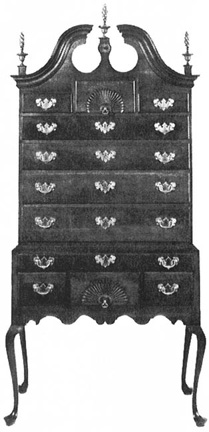
A classic American-style “Highboy,” made in New England. Courtesy, Israel Sack Inc., New York City.
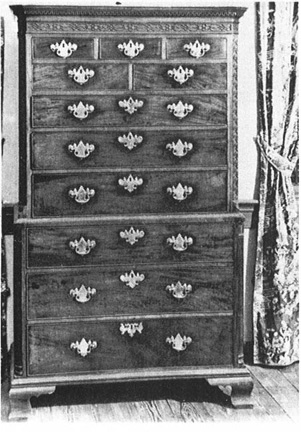
A classic English-style “Tallboy,” made in Charleston. Courtesy, The Charleston Museum, Charleston, South Carolina.
The contemporaneous English high chest, which posterity calls a tallboy, employs a different aesthetic to announce a different aristocracy. The tallboy is massive, heavy, imposing, meant to sink rectangularly, not soar curvaceously. Rich Englishmen’s favorite chest, with its squat feet and its drawers descending close to the ground and its heavily-carved moldings on the squared-off top, epitomized an aristocracy weightily commanding.
Among American cabinetmakers, only Charleston craftsmen failed to make fully developed American highboys. In America, only Charleston cabinetmakers turned out English-style tallboys. The very furniture containing Massa’s London-made shirts declared that at the moment of their economic ascendancy, these rulers aspired to be English-like commanders.10
An English visitor who dined with these “Englishmen” found that aspiration in every scrap of food and conversation. The voyager feasted on a saddle of mutton, served on English china. He heard that South Carolina’s legislature was like the British Houses of Lords and Commons. He listened to sneers about boorish pols governing in Washington. “There never can be a good government,” he was assured, “if it is not administered by gentlemen.” He was also treated to contempt for money-making and money-grubbing. “The greatest absurdity in the world,” ran the sneer, “is a ‘Liverpool gentleman.’” When Carolina gentlemen imbibed too much champagne and claret cobblers, their hyperbole could veer toward re-embracing the Empire and reclaiming a king. They wished to be seen as returned expatriates, back in London with English identity intact after a tour of duty in the provinces.11
Or rather, they affected airs of tarrying in the metropolis only for horse races and social seasons before resuming residence in the English countryside. During the late heyday of the Anglo-American connection, twice as many South Carolinians as all other North Americans combined had secured educations in England’s schools. From that and other sojourns in London, and from reading agrarians such as Bollingbroke, Charleston squires came to consciousness of what they took to be an English country squire’s persona and world view. By nullification times, that consciousness was seventy years old, plenty of time for an aristocracy to mature into comfortable confidence in its own identity.
Throughout the antebellum period, much of the talk in Charleston’s drawing rooms aimed at demonstrating that seasoned provincials ran their affairs like London cosmopolitans. Just as English lords disdained frantic hustle, so absentee planters avoided gauche exertion. Just as English gentlemen lived off land rents which their staff collected from tenants, so the rice gentry lived off crops which their overseers gleaned from slaves. Just as English titans sometimes forgave rents and debts of poorer tenants in poorer times, so patriarchal masters aided less affluent neighbors and provided for slaves. Just as grateful tenants elected disinterested squires to Parliament, so patriarchal masters expected deferential yeomen to call them to the state legislature.
Charlestonians sometimes saw themselves as out-Englishing the English. In 1832, British lords gave in a trifle to majoritarian democracy in the English Reform Bill. At almost the same instant, Carolina gentlemen vetoed majority action in the Nullification Controversy. Charleston gentlemen would preserve not the compromised Englishness of the nineteenth century but Old World republicanism as it used to exist before the American Revolution.
4
Before Charleston could command a Carolina march backward, the more progressive portion of the state would have to relish retreat and confinement. Nothing had been confined, in the late eighteenth century, about the sprawling backcountry above coastal swamps. South Carolina’s seaboard gentlemen, compared with Virginia Tidewater planters, felt less inclination to spread past the coast. The Virginia Piedmont and Tidewater quickly became Siamese twins of eastern Virginia because Tidewater farmers could use Piedmont soil to pursue the same tobacco endeavors. Backcountry South Carolina, in contrast, long offered would-be English country gentlemen an alien frontier. No rice cultivation would prosper above the swamps. With lowcountry patricians usually uninterested in migrating, backcountry Carolina settlers, like Trans-Allegheny Virginia settlers, came largely from Scotch Irish and other ethnic sorts streaming down from western foothills.
Newcomers found more opportunities for slaveholding than existed in the Virginia Trans-Allegheny. The backcountry above the swamp offered fertile land for indigo, tobacco, and grain plantations. By the late eighteenth century a mixed small slaveholder/yeoman nonslaveholder society had developed that resembled the Virginia Valley’s. Like Valley squires, backcountry Carolina slaveholders disliked coastal snobs for being heavyhanded, ostentatious, overly English. At the turn of the nineteenth century, the New South inside Old South Carolina demanded an egalitarian constitution for white men.12
This demand collided with the state’s sacrosanct eighteenth-century legislative malapportionment. Rice districts, with their tiny white population and small fraction of the state’s landed area, controlled both houses of the state legislature. Substantial property qualifications for voting and higher property qualifications for legislative service ensured that commoners would not interfere with their betters. The best men, in legislature assembled, elected the rest of the government.
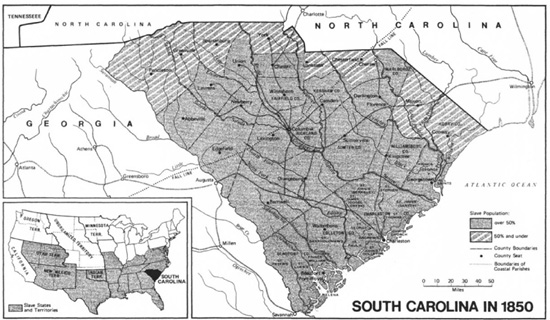
The backcountry’s crusade for an egalitarian version of slaveholder republicanism briefly threatened to make South Carolina, rather than Virginia, the battleground between Old and New Souths. But this conflict over egalitarianism swiftly turned into a consensus on elitism. After 1794, Eli Whitney’s cotton gin helped turn the backcountry population from alien to ally. Upland Carolina, because it was the Lower South area geographically closest to the Atlantic, was the first to experience cotton mania. Slaves by the tens of thousands were pushed onto the red clay. Almost all of South Carolina soon became a black belt. In 1790, about five-sixths of the state’s slaves had lived in the lowcountry. By 1830, over three-fourths of them toiled in the upcountry. Two-thirds of Carolina counties then contained over 40% slaves and only two possessed under 30%. The twin exceptions, each with a not-so-unblack 23% blacks, approximated the average of Middle South states. It was as if eastern Virginia aristocrats had wiped out the Trans-Allegheny and only had to control the compromising Valley. No other southern elite faced so weak a pressure to compromise with nonslaveholding egalitarians.
When slaves first spread over all of South Carolina, different black belts in different geographic settings made for different upper classes. At the beginning of the nineteenth century, upcountry planters, expanding over seemingly limitless acres, exuded that coarseness so typical of new societies and so ridiculed in Charleston drawing rooms. Brawling, gambling, whoring, contemptuous of culture and bent on amassing millions, cotton upstarts were as much like rice patricians as hustling young tycoons are like fading grandfathers.
Geographical factors quickly aged the adolescent.13 South Carolina’s large place in pre-Civil War annals belies its small size. Worldwide demand for cotton was huge. Virgin soil to the Southwest was farflung. South Carolinians’ exhaustive cotton cultivation soon corrupted the upcountry’s red clay. Carolinians then spilled beyond the state. Migrants deserted acres choked with broomsedge and briar. Ex-South Carolinians also left behind planters soberly aware of Carolina’s limits. By 1830, those who stayed in Mother Carolina characteristically no longer tilled virgin lands. Instead, stay-at-homes struggled to save debilitated acres. The upcountry cotton planter who was surrounded by deserted plantations, like the lowcountry rice planter who was surrounded by impenetrable swamps, would have to make confinement a virtue.
Carolina cotton magnates sometimes stayed behind because lowcountry virtues seemed newly attractive. In Carolina, New and Old South types were not an isolating thousand miles apart, as would be the case with imperialistic New Orleans and anti-imperialistic Charleston. Upcountry and lowcountry gentries went to South Carolina College together, ruled in the same state legislature, traveled to the same summer resorts, married and buried each other. Those interactions soon led to a meeting of minds. The upcountry upstart, when shunning another crass start in the “vulgar” Southwest, often self-consciously voted for old ways. He too would become an English country gentleman. He too would sneer at the cotton boobacracy. The man once on the make, now proud to understand that life must transcend mere greed, would live for culture and horses and consolidating the regime. “I did not wish,” sniffed James Hammond, “to remove from my native state and carry a family into the semi-barbarous west.”14
The cotton revolution spawned one more enclave of reaction. Sea islands along the coast proved fertile for a luxury sort of silky fiber called, appropriately, sea island cotton. The crop added a third staple and a third group of “English country gentlemen” to the Carolina contingent.15
A decade into the nineteenth century, clashes over legislative representation seemed no longer worth pursuing. Lowcountry gentlemen increasingly felt upcountry tycoons could be trusted. Upcountry entrepreneurs increasingly felt lowcountry gentlemen would use Slavepower admirably. The result was the so-called Compromise of 1808—so called because the upper crust compromised so little. The settlement was called a compromise because the minority lowcountry almost controlled the Senate, while the majority upcountry thoroughly dominated the House.
But this quid pro quo compromised nothing of aristocratic sway, since aristocrats controlled upcountry and lowcountry both. Not even the body rewriting or reratifying the Constitution was popular. The gentlemen’s legislature simply called itself into special session. Patricians then apportioned each county’s share of House seats half on the basis of taxes paid, half on the basis of white population: the very “mixed” basis for Slavepower control which Benjamin Watkins Leigh would fail to push through the Virginia Convention of 1829. A tougher version of the federal three-fifths clause was alive and well in the Federal Union’s imminent nemesis, South Carolina.
In 1810, in another compromise changing next to nothing, the Carolina legislature extended suffrage to all adult white males. The gentry retained the highest North American property restrictions for office holders. In no other southern legislature in the 1850s did slaveholders occupy a majority of seats. In no other American state in 1860 did the legislature elect the governor, all judges, and presidential electors.
A governor could not interfere with his legislative selectors. The state’s chief executive, more a figurehead than the English king, could neither appoint subordinate officials nor veto legislative law.16 The Carolina legislature, having out-Englished the English in establishing “parliamentary” power, copied every thread of English parliamentary costumes when garbing presiding officials. The speaker of the Carolina House, alias Speaker of the House of Commons, carried in a duplicate of the English mace. According to immemorial custom, Carolina legislative activity, like the English, began in late autumn and halted before Christmas, so lords could holiday on their acres.17
Immemorial custom also usually kept electioneering from Americanizing this “English Parliament,” except in the newest, least enslaved western portions of the upcountry. Nothing could be more anti-English than Carolina’s giving all adult white males the vote. But nothing was more un-American than Carolina’s leaders’ unofficially restraining voters from making legislative policy. Elsewhere in nineteenth-century North America, campaigning and electioneering, when combined with universal white suffrage, gave the masses indirect legislative power. Rival candidates, by wooing voters with rival programs, asked citizens to set policy.
But everywhere in the lowcountry and most places in the upcountry, the gentry continued to insist on the Anglo-American, eighteenth-century orthodoxy that independent gentlemen should filter poorer folks’ opinions. Few campaigned in South Carolina. No two-party system existed. Few platforms were announced. Commoners usually voted for gentlemen’s unopposed nominee. Gentlemen then made decisions for the state before their God and the mace.18
William Porcher Mile’s noncampaign, on the occasion of his being anointed the lowcountry’s leading lord of the 1850s, exemplifies how campaigning was usually eschewed. Miles, scion of an important lowcountry family and a college teacher who pounded old verities at young gentlemen, was called to Charleston’s seat in Congress in 1855. Outside Carolina, and at upper extensions of Carolina itself, candidates would have earned voters’ call by expounding and gesticulating, promising and pandering.
Miles earned his call by fleeing from lowcountry voters. Upon hearing that a murderous epidemic afflicted Norfolk, Virginia, the professor dashed north to nurse the sick. His spontaneous gesture of “duty regardless of selfish outside consideration” led “the whole body of substantial propertyholders” to nominate him for Congress.”19
Voters still had to ratify the elite’s choice. Miles was instructed to eschew “any part” in canvassing. He should “remain in Norfolk until your appointed time for return—then come back to your Professorship and go to College as usual.”20
Until the Civil War, the professor who “campaigned” by nursing elsewhere went back to Congress per usual. His congressional positions were erratic. Other Charlestonians were his superior in “points of culture.” But chummy lords who had known him since “Sunday School days” knew him to be superior in “independence, justice, courtesy, unwearying sense of duty.” Those qualities mattered most when country gentlemen decided which of their own the crowd should elect.21
By the middle of the nineteenth century, in the middle of the most rampantly democratic (for whites) nation in the world, white South Carolinians could rightly brag about as aristocratic a government as ever took a democratic form. The South Carolina “legislature,” exulted James Hammond, “has all power. The Executive has none. The people have none beyond electing members of the legislature, a power very negligently exercised from time immemorial.” “The people,” added James Hamilton, Jr., “expect that their leader in whose … public spirit they have confidence will think for them—and that they will be prepared to act as their leaders think.”22
White commoners joining black slaves in acting as Massa thinks—how that formula did defuse the clash between aristocratic slavery and egalitarian republicanism. South Carolina, the state most responsible for making a southern nation, was the exception disproving the rule that herrenvolk democracy was the key to southern nationalism. In South Carolina, gentlemen usually reigned according to the principle of slavery: that the best should direct and bestow civic virtue from above. Everywhere else in the nineteenth-century South, including in eastern Virginia realms where elitism remained highly valued, eighteenth-century formulas had to be clipped and compromised. In oldest Carolina, and in much of Carolina newly old too, the country squire, alias English country gentleman, confidently rejoiced that at least in one state, the rich and talented could veto King Numbers.23
5
Still, the more one observed the Carolina gentry, the more such bravado seemed forced. Beyond the confidence lay echoes of sham—shame too. Carolinians were especially ashamed about their declining economic power. Charleston epitomized waning upper-class wealth. A low-lying black cloud, physically and metaphorically, hung over the city. From afar, the mysterious darkening above, even more than front doors alias reserve walls shielding gentlemen from the streets, hinted at the mood of this place.
The discolored stain hovered over the most vigorous spot in nineteenth-century South Carolina—and the place where gentlemen’s vigor was most impaired. Charleston contained the wildest open-air retail market in North America. Several city squares were crammed with enticing produce, screaming hawkers, shoving crowds. Up close, the black shadow above turned out to be Charleston’s flock of turkey buzzards. Vultures periodically dove down to snatch discards. The fowl then planted themselves like lords owning the turf.
Only Charleston’s retailers battled the black birds. Battlers were themselves usually black. Negresses and so-called “unkies” reigned over the stalls. Black women sucked on huge pipes. Their hair was wrapped in multi-colored bandannas. Their men, kicking and hollering, drove black buzzards inch by inch out of white customers’ way.
Beginning in the second decade of the nineteenth century, customers grew pickier about proffered fares. Prized hares and wild turkeys and she-crabs were a little too contemptuously disdained. Imperfect morsels discounted for quick sale were a little too impetuously snatched up. Wallets unfolded to pay for bargains were a little too lacking in padding.
Scant white dollars intensified retailers’ competition. Many competitors were free blacks. They strove to be richer than whites in the capital of the realm dedicated to enslaving blacks. Other marketplace princes were slaves. They strove to disprove their owners’ claim that “inferior” blacks needed a master. With whites’ scarce cash draining into blacks’ pockets and blacks’ successful merchandising mocking whites’ racist assumptions, gentlemen were doubly paying for holding themselves above scummy marketeering.
Potential costs escalated every Saturday at dusk, when country slaves descended on the city. Black boatmen bore Massa’s produce for black retailers to sell. After anchoring crafts, country slaves moved towards the city market, immense loads balanced somehow on their heads. Shuffling along, their skin blackest black, their Gullah chants soaring, they almost seemed retainers of some God alien to this place.
Once, in a long night of terror never forgotten between the Ashley and the Cooper, Saturday night invaders had been called Denmark Vesey’s soldiers. Perhaps the most frightening rumor amidst Charleston’s Vesey Insurrection Scare of 1822 was that the rebel chieftain had traveled through the lowcountry, recruiting blacks who weekly paddled into white men’s city. What an ambush these Cuffees could have staged, if anti-Cuffees they had indeed become.
The rumor was never confirmed. Planters continued to trust “their people” with their cargo. Masters claimed never to think that this largest concentration of the least Americanized blacks would take advantage of the most vulnerable slave city outside Haiti.
Their action indicated otherwise. Ever after Denmark Vesey, bells in St. Michael’s belfrey sounded at 9:15 p.m., warning blacks to depart the streets until daylight. A hundred white cavalrymen nightly enforced the curfew. They made local gentlemen a little less dependent on independent blacks.
The theme of precarious independence could not be kept outside Charleston drawing rooms. Tales of fraying fortunes dominated mid-nineteenth-century Charleston gossip. The financial foundation for high living had obviously turned shaky sometime after the American Revolution. The swirl of chatter included tales of Nathaniel Russell going bankrupt building a free-flying spiral staircase, of Jimmy Hamilton’s son becoming a common clerk, of Widow Heywood emptying the bottle amidst seedy splendor. The lowcounty’s prime crops, moving a little slower than formerly off East Bay wharves, also hinted at a substructure gone soft. Carolina’s lovely long-grained rice and lacy long-staple cotton were fashionable estates’ appropriate products. Elegant staples also yearly patched up many a precarious fortune. But such luxury yield could not compare with crude cotton in producing economic expansion. Next to raucous New Orleans and galloping St. Louis, fastidious Charleston was frozen at a standstill.24
Lowcountry planters had lost the materialistic bases of being English country gentlemen the moment they quit the British Empire. In Carolina’s most prosperous colonial days, English indigo bounties, when added to rice profits, had created a business profitable enough to require little management. But by departing the Empire, Carolina’s “Englishmen” forfeited the English bounty, lost the prop making indigo planting profitable, and thus undercut their way of sending heirs to London schools.
Removal of the indigo crutch revealed the artificial economic foundation of Carolinians’ claim to be English country gentlemen. English country landlords, unlike slaveowners emulating them, could afford not to work. English lands could yield no more than tenants’ rents. Most rents were fixed for tenants’ lifetime.
In contrast, the rice planter, with no prefixed annual income, could ignore business management only so long as plantation income soared without his direction. Rice cultivation before indigo had rarely been a wildly soaring business. Rice plantations after indigo could rarely be more than decently profitable—and only if decently managed.
Well-managed rice plantations were more stable than other southern enterprises. Rice soil, compared with cotton and tobacco acres, wore out less often. Flooding rivers usually replenished marsh muds. When soils ran chalky, clay applications usually renewed fertility. Nor did any world-wide rice glut develop, akin to cotton or tobacco gluts. Rice prices were more stable than prices for any other southern staple.
On a badly run plantation, however, rice yields could drop disastrously. The enterprise’s tricky schedule and equipment demanded entrepreneurial expertise even more than did tobacco or cotton cultivation. Duplicitous blacks had to work hard on key hoeing and cultivating days. Cuffees, pretend or otherwise, had to keep intricate dams and sluices ready for key moments when fields had to be flooded or drained. Some expert had to calibrate precisely when to hold back or welcome the tides.
After indigo, rice planters were wise to be their own calibrators. Responsible overseers in uninhabitable swamps, unlike responsive English rent collectors, remained hard to hire. The few responsible overseers, more than the multitude of responsible English accountants, could reasonably aspire to enter the ruling class. Frugal white hirelings could buy up ruined estates of dissolute spenders. If post-English Empire Carolinians persisted in copying English landlords, they would trade places with overseers they should have been overseeing.
Nineteenth-century heirs destroyed their remaining chance to live like eighteenth-century English gentlemen by repealing the legal foundation of the English aristocracy. Nothing better shows how the American democratic world infected these “English” squires than Carolina’s abolition of primogeniture and entail after the American Revolution. Legal preservation of entire ancestral estates, with eldest sons inheriting everything, seemed undemocratic in even this most aristocratic part of America. As a result, fortunes were “separated into lesser parcels, distributed among numerous families,” with each given “but a bare maintenance if properly economized.”25
Bare maintenance and proper economy required that Carolina slaveowners become not English but Virginia country gentlemen. Even in plusher days, Virginia’s finest had only been absentees when residing in the White House or some such temporary locale of aristocratic duty. After 1824, with the nation no longer calling for their dynasty, with primogeniture and entail no longer preserving estates whole, and with the world not paying high prices for tobacco, Virginia gentlemen had to become entrepreneurial homebodies. By economizing, fertilizing, diversifying, they clung to shreds of ancestral estates.
Carolina coastal squires often scorned Virginia-style clinging. Absenteeism, rooted in both dread of swamp disease and love of Charleston idling, remained treasured. “Our ancestors,” lamented Francis D. Quash in 1831, are our “worst enemies.” Our generation, “rocked in the cradle of wealth,” underfinanced after “divisions of property,” faces “the grim visage of bankruptcy.” Yet capital and time are “withheld” from shrinking estates “to answer the exactions of the ghosts of departed city joys.” Carolina’s young men,” added another city observer, are “too apt to be above” business, “which their false pride tells them is not gentlemenlike.” These “lavish” spenders gave in “to idleness and dissipation.” The “evil” was “progressing to an alarming degree.”26
William Heyward was an alarming case. His eighteenth-century father, Judge Heyward, had spent the productive growing season on the Charleston party scene and the nonproductive winter season on his Georgetown rice estate. In 1808, an observer found the nineteenth-century heir still in Charleston in December, long after the killing frost. Billy Heyward was “lounging away his mornings,” and “drinking away his afternoons.” The young sport seemed “not satisfied himself with his mode of existence.” He planned to go to his plantation “in a few days to see how things are going on there.” But “he confessed to me that he hated to have anything to do with negroes.”27
A half-century later, Robert F. W. Allston, Georgetown’s most prominent rice planter, reported the result of Heyward’s distaste for management and taste for dissipation. Mrs. Heyward had recently died of alcoholism. An ex-overseer owned Billy Heyward’s fine mansion and 40,000 acres. Weeds “covered up” old orange and lemon and olive groves. “Pride and vanity” had demolished “princely wealth and splendor.”
Allston was “filled with melancholy reflections at the decay of families…. Here are two Cuthberts who have run through everything left to them and are now loafers spunging on anybody who will suffer them.” There were the Hazards, the son a suicide, the old man’s estate now owned by an ex-overseer. So too, “the residence of poor Ben Allston is burned down and planted over—there is nothing of him or his left.”28
At the other end of the swamp, near the Georgia border, Charles Manigault reported equally little left of an ancient gentry. In the 1830s and 1840s, he had seen 40 to 50 plantations sold, on which an “ordinary practical man,” exercising “prudence & industry &… self denial & economy” could prosper. Instead, “for want of this prudence… all the old families who formerly owned these plantations have disappeared,… while overseers & aliens to our climate & to our society take possession of the soil.” Manigault had bought his plantation from an overseer; his two neighbors were ex-overseers; and another ex-overseer owned the plantation across the river.29
Manigault’s and Allston’s swamps, locale of much anti-entrepreneurial fastidiousness, had become the site of entrepreneurial mobility. This least American area may have been America’s best example of spent capitalists falling and raw capitalists rising. All the great aristocratic names at the time of the Revolution of 1776—Lowndes, Rutledges, Pinckneys, et al.—were nowhere to be found leading the Revolution of 1860. Instead, names so Yankee as Robert Barnwell Smith (he changed his last name to the wonderfully Carolinian Rhett) led the old order out of the new century.
Old families who saved estates by practicing Yankee virtues were not heroes of this anti-Yankee culture. Charles Manigault, for example, when missed in chattering Charleston, could be found “jogging off in the old sulky & my bobtailed horse, travelling to the Savannah River, putting my horse up at a log hut in the pine barren, then footing it thru a two mile swamp and crossing in a canoe to my Island plantation.” There he spent “the best years of my life clearing its swamp.”30 By resourceful management, he made around 8% a year. The profit was decent enough to indicate how resourceful overseers could rise. An 8% margin was also slim enough to indicate why unresourceful absentees failed.
For his pains, Manigault experienced his family’s contempt for being too capitalistic. His friends twitted him for crediting his prosperity to Yankee exertion instead of ancient inheritance. But Manigault could stridently answer (and he was revealingly strident about it) that without money-grubbing exertion, heirs would trade places with overseers.
Robert F. W. Allston was also mocked for capitalistic crudity instead of praised for capitalistic success. Allston too made around 8% a year on rice by cherishing “habits of thorough investigation.” He believed even daughters “ought to learn some trade.” While he was proudly acquiring “the reputation of a man of business” by improving “my paternal estate,” his wife was off in the “wicked” city, where he feared his children would “acquire habits” of “luxury.” He preferred they acquire habits “of Dr. Franklin.”31
Benjamin Franklin indeed! Allston’s wife ridiculed his “Poor Richard” practicalities. Allston writhed at her ridicule, just as Manigault winced at his family’s displeasure. No lowcountry scion of an old family could escape unease, whether he saved estates by becoming a managerial capitalist or lost his inheritance by shunning management. Either way, his was the pain of an old order unable to afford Old English values.
6
Carolina upcountry cotton planters faced similar problems for different reasons. Since absenteeism had never been rife in the more healthy upcountry, expenses of second homes and consequences of non-entrepreneurial idling seldom occurred above the swamps. But upcountry managers suffered other economic troubles. Planters whose slaves worked tired soil ended up with straggly crops of cotton, especially compared with lush yields oozing from fresh Alabama or Mississippi acres. When world-wide cotton markets turned down, as happened in 1826–32 and 1837–49, poor yields piled atop poor prices bankrupted many an upcountry planter. When cotton prices shot up, as they did briefly in the mid-1830s and extensively in the late 1850s, times were better in Carolina but not as flush as in Alabama.32
Economic stagnation in the upcountry, with its tired cotton fields, and economic squeeze in the lowcountry, with its gentry living too high on inheritances too divided, led to a mass exodus from Carolina for the virgin West. Few migrants came to replace those leaving. By 1860, 96.6% of South Carolinians were Carolina-born, a degree of insularity unheard of elsewhere in the highly insular Old South. Yet 42% of those born in Carolina lived elsewhere, another incredible Old South number.33
The little world limping behind could crab all it pleased about vulgarians who deserted it. But these “eighteenth-century Englishmen” were sufficiently nineteenth-century Americans to suspect that those who failed to grow would sink. With the adventurous half of Old Carolina voting with their feet for expanding America while the contemptuous half stagnated in ancient rice parishes and aging cotton districts, how could those remaining summon the energy, much less the power, to save the Old South and lead the New? That question by itself made these gentlemen desperate enough to be revolutionaries—and made them wonder if they could sustain any revolution at all.