
CHAPTER 13
Economic historians, Marxist and otherwise, have recently emphasized that materialistic factors generate cultural factors that take on causal power of their own. So too, cultural imperatives join economic imperatives to create political imperatives. Particularly in antebellum Charleston, where an important cultural renaissance occurred simultaneously with important political strivings, the politics bore on the culture and the culture helps explain the politics.
Carolinians thought themselves culturally special for three related reasons. Because they were of the oldest South, they supposedly took more patriarchal care of “their people” than did southwestern upstarts. Because they outdid other Old South gentries in recreating Old English customs and politics, they were allegedly truer English country gentlemen. Because absenteeism maximized opportunity for nonmateralistic concerns, they were supposedly creative intellectuals. These three claims led to soaring senses of self-worth—and invited gentlemen’s suspicion that they were not as worthy as claimed.
1
South Carolinians’ first claim to superiority, their allegedly especially patriarchal treatment of slaves, was both true and false. Paternalism was especially plausible inside Charleston homes, for household servants were easiest to consider part of a DomesticInstitution. Nowhere in the South were domestic servants more separated from agrarian toil than in the weeks and months when Massa and household slaves shared Charleston town houses, far away from field hands.
But those field hands, particularly on large and impersonal plantations, belied notions of paternalism and domesticity. Carolinians who thrust blacks into miasmic jungles used up “their people” at a pace unthinkable on healthy frontiers. Only this deadly North American region rivaled “exploitative” Latin Americans in sometimes killing off slaves as fast or faster than slaves reproduced themselves. Sensitivity on the subject led to endless attempts to prove what swamp lords knew to be false: that blacks partially immune from malaria were totally safe in a deadly habitat.
Swamp environs precluded other essentials for a paternalistic regime. Lowcountry patriarchs, because absent so many months, could not influence blacks culturally as extensively as could resident planters elsewhere. Because swamp slaves retained peculiarly persistent African linguistic traits and customs, they seemed less part of an American family. The Carolina lowcountry, having opened its African slave trade latest and Americanized its Gullah-speaking blacks least, having the largest relative percentage of absentee planters and big plantations, was the North American regime most like impersonal Latin America.
Swamp planters were likely of two types. Neither type exemplified paternalism. The classic lowcountry tycoons were absentee heirs of old families, hiring agents to force Gullah-speaking workers to endure swamp fevers. But often owners were ex-overseers and hard-driving swamp managers, nouveau southwestern style.
No Mississippian battled blacks more resolutely than did poor men newly arrived as masters in supposedly patriarchal South Carolina. My first year of planting, confessed that ultimate arrivé, James Hammond, required a “severity which cost me infinite pain and gained a name which I detest of all others to subdue” my slaves. The detested name, perhaps “nigger-driver” and assuredly not “paternalist,” remained appropriate for many years. James Kirk, a successfully climbing ex-overseer, told a visitor that “if he lives 10 or 15 yrs. longer,” his slaves would “gain ascendency over him…. [He] is sensible they are gaining on him: confesses whips in a passion & half the time unjustly.” There was a man with attitudes that a South Carolinian was not supposed to have.1
Those 9:15 curfew bells in Charleston also rang out of a strained sensibility. The subsequent patrol pounding the streets announced that domestic slavery did not seem domestically safe. Fathers do not muster armed guard against “boys.” These patriarchs sensed they needed protection against “family friends.” That armed protection, nightly greater in Charleston than elsewhere in the Old South, made Charleston’s allegedly greater paternalism more than a little suspect.
2
The Carolina gentlemen’s performances as English country gentlemen were as true and as strained as postures of patriarchal slaveholders. Like their counterparts in England, they were supposed to relish the outdoors. They indeed loved sports. But when the climes beckoned them out of doors, they were often in Charleston. In the stuffy city, they were outside mostly on secluded porches, where they regaled each other with stories of sport they played on their departed plantations.
They loved English-style riding. Foxhunting was a favorite recreation. Race week in Charleston, like race week in London, was their supreme moment of sport. But few coastal squires kept hunters and fewer owned race horses. They knew that hunts could hardly penetrate the tangled lowcountry brush. They knew that a handful of upcountry outdoorsmen owned most of the Carolina race horses. Lowcountry “Englishmen”’s sport, when showed off to bewildered English visitors, consisted of black gangs dressed up in coat and cravat and panting like hounds as they rowed off to chase that lowcountry water monster, the devilfish.2
English?
Again, these “transplanted Englishmen” had supposedly consolidated North America’s only House of Parliament. Their state regime came closer to that ideal than any other in the United States. But their not-altogether-English state constitution gave all white men the vote. Their state also contained one threatening area not happy with their English-style House of Commons. Semi-mountainous western regions of Carolina sustained a largely nonslaveholder culture restive about the Compromise of 1808. These folks periodically urged that a one-white-man, one-vote reapportionment should undermine coastal “rotten-boroughs.”
Democratic America intruded even more when Carolinians participated in federal politics. John C. Calhoun, Mr. South Carolina, periodically plunged into the “digusting” two-party system. The upcountry’s James L. Orr, South Carolina’s most ascendent politician after Calhoun died, frequently urged South Carolinians to save themselves inside the “vulgar” National Democratic Party. With Orr, of all people, threatening to replace Calhoun as Mr. South Carolina, Carolina was threatening to join, of all things, the American nineteenth century.3
3
Because absentee slaveholders suspected they were neither altogether paternalistic nor sufficiently English country gentlemen, they craved their own cultural identity. That imperative created the critical Carolina pretense: that slaves freed slaveholders to develop a high culture. The posture had a large reality. The South Carolina lowcountry in general and its queen city, Charleston, in particular, sustained a revealing antebellum cultural renaissance. No other southern center, urban or otherwise, demonstrated such intellectual vitality until long after the Civil War.
Carolina’s downturn of economic production ironically generated and helped define this cultural upsurge. The Old Charleston of the Age of American Revolution, a locale ripe with materialistic prosperity, had concentrated on material ornaments. Wealthy urbanites had supported superb architects, resourceful stucco molders, stylish cabinetmakers. As the decaying Charleston of the nineteenth century emerged, the economy declined, artistry with materials slowed, and creativity with words soared. At the very time the booming Southwest was draining away lowcountrymen, Charlestonians were expanding their beloved Library Society, establishing their own college, creating their own medical school, founding their own literary journals and publishing millions of words on local fauna and national history, parochial diseases and universal theologies, law and classics, politics and social structure. Whatever else Charleston gentlemen cut back on, their consumption of paper and ink knew no limits.4
This conjunction of a rise in verbal creativity and a decline in economic power produced among intellectuals a certain refined despair. The unlovely world outside was not listening to the fraying old city with its newly lovely literature; and smallish Charleston contained too few intellectuals, especially compared with New York or Boston or Philadelphia, to generate enough patrons at home to satisfy its new literati.
The best way to seek wider audiences was to leave Charleston. For a city obsessed with stopping its drain of dollars and people to the philistine world outside, Charleston generated a surprising number of cultivated exiles, as well as an inclination in those who stayed to write obsessively about expatriation. Of those who could neither bear to leave nor bear to stop writing about departing, the greatest was William Gilmore Simms, leader of the Charleston Renaissance. Of those who departed and used their cultural distance to bring Carolina assumptions to the richest artistic achievement, the most remarkable was Washington Allston.5
Allston, who bore one of the lowcountry’s most prominent names, became the leading American painter of his turn-of-the-nineteenth-century generation. He would make any list of the top ten American painters of any generation and should top any ranking of the most creative Carolinians. Hence the importance of Allston’s decision to create elsewhere. The painter, like many American artists, early deserted his ancestral area to study in the North and Europe. Most great American painters came home again. Allston returned to sell off his inheritance, thereby gaining the wherewithal to leave forever. All his canvases were painted far away from the South and in the early nineteenth century, before Southerners established regional identity.
His dominant style was of the cosmopolitan world he entered, with only traces of the province he deserted. His greatest paintings were often in the mainstream Anglo-American, late eighteenth-century tradition of art as recreation of historic events. All great American painters of the period adopted the art-as-history conception, often to recreate epic American Revolutionary scenes. Allston, who had retreated from South Carolina, also retreated so far from American patriotic concerns as to paint only epic Bible scenes when working in the historic genre. Allston’s renditions of sacred history usually have nothing recognizably Carolinian about them.
Nor do Allston’s landscapes, his other favorite mode of painting, usually betray Carolina roots. His nature paintings were an early development of what would come to be the dominant mid-nineteenth-century American art tradition. Mid-nineteenth-century American landscapes characteristically convey nature as sleeping beauty. Lush valleys lead to majestic mountains and blood-red twilight skies. Only a blasted tree trunk in the foreground hints at nature’s fury. In the rest of the canvas, nature’s beneficence usually transcends the casualty.6
We have come to call this usually smiling landscape tradition the Hudson River School. But Washington Allston perfected the genre in the earliest nineteenth century, over thirty years before Thomas Cole or Thomas Doughty or Asher Durand or Frederick Church painted the Hudson River. Allston’s nature scenes are usually lushly beneficent. His Landscape with a Lake (1804) has what would come to be the obligatory blasted tree trunk in the foreground. Tragedy fleetingly acknowledged, the landscape ascends a path up the picture, through healthy trees to a luminous lake, to sublime mountains, to happy skies. So too Allston’s gorgeous Moonlit Landscape (1819) conveys a luminously lit natural paradise. The canvas exudes that fascination with clean, rich light which would define, a generation later, the American Luminist Tradition.
Allston’s precociously early American landscapes, like later American nature canvases, tend to have the defects of their virtues. They usually capture nature’s peak moments of luminosity. They characteristically miss the ferocity when black clouds block the clean light.
But the fascination of Washington Allston as precursor of the imminent American landscape school is that, unlike most successors, he occasionally reversed the emphasis. As history painter, this South Carolina exile had been far enough outside the American mainstream to escape painting the American Revolution. So too, as nature painter, this product of malevolent swamps was far enough outside the American consensus to reject, occasionally, American conceptions of benevolent nature.
Allston vividly remembered his “favorite” childhood “amusement,” drawing “little landscapes about the roots of an old tree.” Such lowcountry “delights would sometimes give way to a stronger love for the wild and the marvelous.” The future artist “delighted in being terrified by the tales of witches and hags, which the Negroes used to tell.” With “much pleasure I recalled these feelings on my return to Carolina; especially on revisiting a gigantic wild grapevine in the woods, which had been the favorite swing of one of these witches.”7
Washington Allston’s darkest landscapes are full of this mood in these jungles, where towering trees usually block the sunlight and eerie blackness looms. Allston’s greatest canvas in the darker vein, Elijah in the Desert (1817–18), contains the obligatory blasted tree. But this time the savaged growth stands front and center, as if ready for revenge. The tree’s two grotesque arms reach towards a violent sky. A black raven, who looks much like Charleston’s turkey buzzards, clutches a limb, while another hovers closer. Allston’s dark fowl, bearing food, can alone nurture the isolated white Elijah, who lies helplessly beneath the forbidding tree.
The theme of whites at the mercy of blackness is also conveyed in Allston’s under-appreciated Ship in a Squall (before 1837). This frightening work features alarming black skies and waters which surround a solitary white ship, rendered in chalk. The besieged ship on the soulless sea seems reminiscent of Allston’s homeland, with its huge concentrations of blacks and the isolated planter startled to see a white face in the mirror. Allston, the Carolinian as American who foreshadowed the coming American school of painting, could not have better conveyed a world grimly, dangerously outside the American consensus. For a fleeting moment, the Carolina insider who deserted to become an American insider exquisitely expressed his world’s special identity.
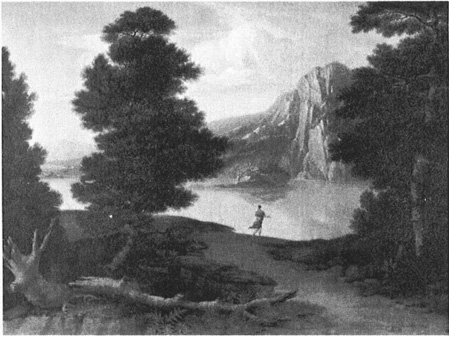
Washington Allston’s “Landscape with a Lake.” Courtesy, Museum of Fine Arts, Boston, Gift of Mr. and Mrs. Maxim Karolik.
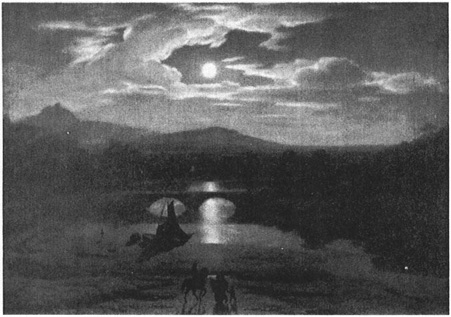
Allston’s “Moonlit Landscape.” Courtesy, Museum of Fine Arts, Boston, Gift of William Sturgis Bigelow.
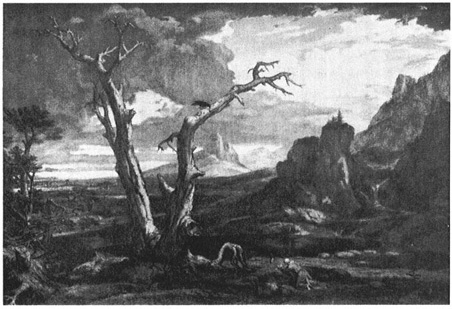
Allston’s “Elijah in the Desert.” Courtesy, Museum of Fine Arts, Boston, Gift of Mrs. Samuel Hooper and Miss Alice Hooper.
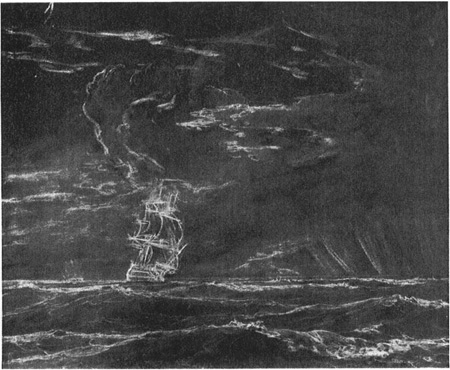
Allston’s “Ship in a Squall.” Courtesy, Fogg Art Museum, Harvard University, Cambridge, Massachusetts, Washington Allston Trust.
But art historians have only dimly recognized Allston’s Jekyll and Hyde development of the American landscape tradition. They have even more dimly seen the relationship between Allston’s divided vision and a soul slightly too Carolinian to be undividedly American. Such latter-day dimness has a long tradition. Charleston barely noticed Allston.
4
While Washington Allston was the insider who happily left, carrying away liberating perspectives on the world outside, William Gilmore Simms was the semi-outsider who traumatically stayed, trapped with an anti-exile’s stereotypes about glories within and horrors without. Simms, the Old South’s greatest novelist, was one-man proof that a Charleston Renaissance paralleled the American Renaissance. His best works sought to turn rejection of mainstream American themes into great American fiction. His trouble was that the very Carolina orthodoxies which inspired a dissenting angle on the American Renaissance stymied full artistic exploration of the deviant counterculture.
The lowcountry’s stimulating, narrowing cants captured the future novelist’s imagination amidst a real-life scene few novelists could make realistic. The shocking event, occurring when young Simms was an impressionable 12-year-old, climaxed a traumatic upbringing. William Gilmore had been only two when his mother, offspring of an old Carolina family, died. Simm’s father, an emigrant from Ireland who had temporarily flourished in Charleston mercantile circles, lost fortune and wife about the same time. Père Simms, crushed, emigrated again, this time to the southwestern frontier. The adventurer left William Gilmore with the boy’s maternal grandmother.
A decade later, Simms’s father, arrived back in Charleston, determined to summon his son to the wilds. The grandmother would not surrender “her” boy. The father sought to capture the twelve-year-old on the street. William Gilmore, rolling and kicking over the Charleston cobblestones, shrieked that he would not go. Sympathetic Charlestonians gathered. They tore the lad from the outlander’s grasp. They insisted that a Charleston judge decide whether the frontier could swallow up another of Charleston’s offspring. The judge let the youngster decide. The future novelist opted for Charleston, as would his every novel.
A decade later, Simms reaffirmed his decision. He visited his father for several months in Mississippi. The elder Simms, who had left Charleston penniless and had made himself a frontier titan, promised his son fame and fortune if he would stay out West. Young Simms refused. “Return to Charleston!” exclaimed the father. “Your talents … will there be poured out like water on the sands. Charleston! I know it only as a place of tombs.”8
Simms came back determined to make Charleston’s tombs an inspiration. Charleston’s would-be inspirer cherished the historical novel, or the romance, as he preferred to call it. For Simms, as for the later and greater southern novelist, William Faulkner, the past was not dead. It was not even past. Simms declared “history” to be “the most lovely” and “the most legitimate daughter of heaven,” for through her “the past lives to the counselling and direction of the future.”9
Simms pronounced historical romancers more important than political actors in directing Carolina backwards toward reactionary glory. “The statesman” would die and become “dust.” But “the glorious record of the past, preserved to the future, only by the interposition of creative art… still speaks.”10This determination to be Carolina’s hero invited frustration. Simms often groused that Charlestonians lionized him too little.11 The city’s not-so-many intellectuals in fact praised him much. But his tomb, as his father had predicted, would never outshadow others in politically obsessed Charleston.
The oft-embittered Simms oft complained that he would have been better off in cosmopolitan New York or even in the Wild West. But he stayed on in the decaying province. His endeavor to be the first Charleston writer who supported his family and inspired his culture through scribbling ultimately yielded a soaring pile of 65 books, including essays, dramas, poetry, histories, biographies, geographies, and especially the over two dozen novels. His private library was the largest in Carolina; his literary contacts with New York City pundits exceeded any Southerner’s; his calls for an American literature were as compelling as any Yankee’s; he edited literary journals of national importance. Could Old South intellectuals write anything more interesting than proslavery pamphlets? Let us consider the intriguing Simms, who wrote 150 pages of pro-slavery propaganda and 20,000 pages of just about everything else.
Simms placed his fictional characters in a curious setting for an author so dead-set against the wilderness. His protagonists almost always departed civilization for adventures amidst the lawless. His was a variation on the dominant American theme of an old civilization moving out onto untamed nature.
Simms’s rendition was indeed a variation, for he reversed the usual American outcome. Northern writers often made the individual divorced from community, severed from familial origins out in space, the American seer. To New England Transcendentalists such as Ralph Waldo Emerson and Henry David Thoreau, sublimity was best found alone and apart, with feet trailing in the dewy grass.
Transcendentalists’ major Yankee literary opponents, Herman Melville and Nathaniel Hawthorne, retorted that nature can be more terrible than dewy grass. Melville’s white whale in Moby-Dick, whatever else the enigma may represent, shows that nature, when sought monomaniacally, will destroy the exile from civilization. Ishmael, the only whale-seeker who declares himself but temporarily at sea, is the only pilgrim who returns safely to land.
So too, Hawthorne’s Hester Prynne, heroine of The Scarlet Letter, ultimately lives on the edge of both forest and town. Although unrepentant about her impassioned adultery in the wilderness, she willingly wears the scarlet “A” decreed by civilization. Emersonian opponents thus honored quests for meaning beyond the settlement while also insisting that a total severing from civilization has costs. The northern novelist who came closer to minimizing the costs, James Fenimore Cooper, made his frontier heroes, variously called Hawkeye or Leatherstocking or Natty Bumpo, into uncivilized natural men, alias that new hero, The American.12
Simms thought Cooper created dubious heroes. “We admire” Cooper’s natural frontiersmen, sniffed Simms, but “love them we do not.” The South Carolinian criticized Natty Bumpo’s inventor for failing “to hit the true line that divides the simplicity of nature from the puerility of ignorance.” Cooper mistook backwoodsmen’s “burly defiance … for the calm, manly tone of gentlemanly independence.”13
Simms’s so-called Border Tales, his frontier romances closest to Cooper’s, revolve around gentlemen of manly independence who dangerously wander into burly domains. Where other writers of the American Renaissance saw flight from civilization as the route toward discovery, Simms painted life on frontiers as nasty, brutish, and short. Cutthroats, fleeing disappointments or disasters back east, abounded. Better sorts, misplaced inside lawless and cultureless wastelands, only learned how to battle better against bandits. Personal growth demanded rejecting the uncouth West and returning to the cultivated seaboard.14
The stance especially slashed at that most irresponsible Carolina aristocrat, the one who deserted Carolina. In Richard Hurdis, for example, Richard is the restless, hot-tempered, young Carolina blade who, when disappointed in love, wishes a ‘“better place’” out West. “‘Better place!’” explodes Richard Hurdis’s mother. Your ancestral home is “‘good enough.’” The matriarch turns out to be right. A frontier “reported to be rich as cream” reduces “Mississippi-mad” pioneers to “the savage feebleness of the Indians.”
The only redeeming character amidst the “license of the wilderness” is Colonel Grafton, an old friend of the Hurdis family, who has imposed a speck of order on disorderly frontiers. Grafton is one of the responsible older aristocrats Simms constantly pits against irresponsible young gentlemen. With Grafton’s help, Richard Hurdis learns responsibility by routing outlaws. Hurdis completes the lesson by returning to his ancestral estate.15
Simms’s better known Revolutionary War romances and his most famous volume, The Yamassee, resemble the Border Tales in being set outside civilization. Whether fighting Indians in the early eighteenth century in The Yamassee or battling Englishmen later in the century in such Revolutionary War historical romances as The Partisan, responsible Carolina squires bring order to the Carolina backcountry. The difference from the Border Tales is that upper-class duty here demands temporary exile from cultivated parishes. During a war of revolution, squires must move out to turn revolutionary chaos into structured hierarchy. They then must return to reassume hierarchical responsibility in the parishes.
Again and again Simms pits the wise, even-tempered patriarch against the selfish, hot-tempered squire. The Partisan’s hero is Major Robert Singleton, Singleton being Simms’s mother’s family name, a patriarch “finely intelligent and tolerably handsome.” Singleton, under the command of Carolina’s Swamp Fox, the famous guerrilla warrior, Francis Marion, would transform a necessary revolution and a necessary guerrilla strategy of fighting into a mechanism for ordering a wilderness. Singleton’s antithesis is his uncle, Colonial Walton, “a gentlemen in every sense of the word,” who irresponsibly prefers luxuries on his plantation to temporary obligation in the wilds.16
So too in The Y amassee, the hero is Governor Charles Craven, alias Gabriel Harrison, who comes out from civilization to tame Indians. Harrison’s antithesis is Hugh Grayson, an overly fiery and dissolute aristocrat, who for a time boorishly helps contribute to the frontier chaos Harrison would control. Just as Colonel Grafton eventually educates Richard Hurdis in patriarchal duty, so Harrison eventually lifts up Grayson and Singleton elevates Walton. The ever wise and newly wise patriarchs make the wilds a little less wild and then go home again.17
Simms’s development of the nature/civilization theme makes one bow in James Fenimore Cooper’s direction. Usually, wise upper-class types teach dissolute aristocrats how to be crafty in nature and responsible upon returning home. Occasionally, however, a classless natural product of the forest, à la Cooper’s Natty Bumpo, becomes the agent of upper-class uplift. In the Border Tale Guy Rivers, for example, Mark Forrester, a “natural noble” of the forest, deflates the pomposity and guides the obligations of the hot-tempered young squire Ralph Colleton, who has unfortunately exiled himself from a lowcountry parish “famous for its wealth, lofty pride, polished manners, and nobel and considerate hospitality.” So too, the frontier scout Thumbscrew Witherspoon elevates the fiery young gentleman, Ernest Mellichampe, in the Revolutionary War romance, Mellichampe.18 But compared with Cooper’s frequent uncivilized redeemers, these figures are not very uncivilized (they are usually vaguely related to uncivil civilized sorts they help civilize) and never the ultimate heroes (they usually are killed off too early to see those they have uplifted triumph and return). No man with a dialect can be William Gilmore Simms’s hero. A Carolinian speaking the King’s English must save patriarchal Carolina.
Simms’s endless vote for civilized parishes served personal, parochial, and cosmopolitan needs. The obligation to come home again justified that screaming future novelist, who had made a scene on the streets rather than be hauled off to papa’s wilds. Simms’s Border Tales in particular also filled the Carolina imperative, at a time of destructive depopulation and dissolute idling, of calling upon the Carolina aristocrat to stay home, set to work, and summon the energy to lead the uncivil South. So too, Simms’s Revolutionary War romances, celebrations of hierarchical order amidst disorderly guerrilla combat, served nineteenth-century Carolina’s quest for a slaveholders’ revolution aimed at reactionary conservation.
Best of all, Simms’s tales turned provincial need into sophisticated reformulation of the American Renaissance. An American literature, as Simms wrote it, did not glorify escape from civilization in the New World wilderness. Simms instead made the American mission a reassertion of cultivation, hierarchy, and order in defiance of dangerously close, fearfully seductive wilds. This definition of Carolina identity offered as promising a slant on Emerson’s dewy optimism and Cooper’s Natty Bumpo as did Melville’s or Hawthorne’s perspectives.
Unfortunately, Simms’s novelistic inventions were not up to the potential of his message. The problem lay not in the inventor’s literary skills. Simms at his best was a superb crafter of sentences, deviser of characters, imaginer of scenes and—rare talent—concocter of humor. His defect was a tendency to stereotype characters, thereby bringing frontier melodrama to full absurdity.
Behind this tendency lay a worried South Carolinian’s stereotyped inclination to see Southerners outside as uncouth barbarians and gentlemen within as either heroes or betrayers. Simms’s frontier villains are irredeemably malign. His aristocrats are either calm, sensible, responsible—in a word, sublime—or wild spenders, fiery in temperament, erratic in judgment—in a word, betrayers. Shove these good guys and bad guys into the full trappings of the hair-raising, gun-toting, rescue and murder, Walter Scott-James Fenimore Cooper romance and you have, let us be kind, a certain amiable preposterousness.
Simms is not amiable when his stereotypes pass beyond white men to portray other races and the other sex. The defect is rampant in The Yamassee, unfortunately Simms’s most widely read novel nowadays. This melodramatic tearjerker revolves around Indians in the Carolina backcountry, on the warpath against encroaching whites. When the “higher race” circumscribes red men’s hunting grounds, inferiors, raging at dependency, strike back. The “best thing” whites “can do for them is to send them as far as possible from communion with our people.”19
Simms’s whites allegedly do better by blacks. Slaves seldom appear in Simms’s many novels about planters temporarily away from plantations. The few slaves who accompany patriarchs to the wilds are always adoring body servants. These ultra-Cuffees repeatedly stage what Simms obviously thought was an affecting renunciation scene. Renouncing offers of freedom, they pronounce themselves happily enslaved.
In The Yamassee, Simms used his stock renunciation scene to reemphasize why racial inferiors without patriarchal protectors necessarily become hapless barbarians. After routing Indian savages, the hero, Gilbert Harrison, offers manumission to his ultraloyal bodyservant, Hector. “‘I give you your freedom, old fellow. Here is money, too, and in Charleston you shall have a house to live in for yourself.’ ‘No maussa; I can’t go; I can’t be free,’” replied the negro. “‘You want Hector for eat acorn wid de hogs, and take de swamp wid de Injin?’” Inferiors deprived of a superior must “‘git drunk and lie in de ditch…. You come in de morning, Hector dead.’” Better to adore maussa than to be a dead Injin.20
Adoring white belles are no less hapless in The Yamassee. Such helpless white angels abound in almost all Simms’s tales. The stock weak beauty this time is Beth Mathews, who stages a stock Simms fainting scene before a rattle snake. “She sees him approach,” the reptile’s neck “arched beautifully like that of a wild horse,” his “huge jaws unclosing almost directly above her, the long tubulated fang, charged with venom, protruding from the cavernous mouth—and sees no more!” The senseless lass does not see a lad slaughter the reptile just in time or see the snake “throw himself over with a single convulsion, and, a moment after, lay dead besides the utterly unconscious maiden.”21
Such melodramatic stereotyping of ladies and blacks helps explain why a writer so immovably against moving out of lowcountry South Carolina was artistically compelled to create scenes of exile. If Simms had set his stories inside settled parishes or plantations or the Big House, he would have had to move females and slaves into the center of his narrative. One-dimensional dependents as stars of the story would have ensured sappy novels, as almost always occurred in antebellum southern domestic fiction.
In contrast, Simm’s tales of white males seeking aristocratic identity and hierarchical order on a relatively homeless and villian-infested frontier, for all the stereotyping of good guys and bad, relegated still more stereotypic loving Cuffees and docile ladies to the background. Moreover, males’ camaraderie in the army camp created in itself a community of strong characters, lovingly together in their mission, separately ranked in their army stations. The campfire hierarchy, with its aristocratic elegance on top and its animal energy below, had the vitality to rout outlaws and civilize savages. In contrast, the ideal domestic hierarchy at home, with cultivated gentlemen bossing sugary-sweet belles and sycophant darkies, had elegance without energy-precisely decaying Charleston’s problem in its age of literary flowering. No wonder William Gilmore Simms, while forever sending patriarchs back home with frontier mission accomplished, almost always kept homecomings offstage.
Almost always. The problem of how returning patriarchs applied wilderness lessons to parish life could not be forever ignored, not by an author so committed to literature as mechanism of patriarchal uplift. This anti-expatriate’s urge to center a fiction on return from expatriation became overwhelming after publication of Harriet Beecher Stowe’s Uncle Tom’s Cabin. Mrs. Stowe attacked the elegant southern plantation especially for its inelegant vulnerability to expatriation. Refined gentlemen without cash, Stowe made clear, had to sell slaves down river to pay for refinements, even if the price was Uncle Tom’s smashed home.
Simms rushed his novelistic answer into print almost as fast as Mrs. Stowe’s chapters appeared.22 Despite the haste and the problems a domestic scenario posed to an author who had avoided his most obvious subject, Simms’s new fiction was by far his best novel. Its virtues indicate that Mrs. Stowe had catalyzed the production of a fable long simmering in the fablist’s consciousness.
Woodcraft features Captain Porgy, easily Simms’s finest male character, who comes home from the Revolutionary War to cavort with the Widow Eveleigh, easily Simms’s finest female character. Porgy and the Widow are allied against slave snatchers, who have stolen their bondsmen during the Revolutionary War. One hardscrabble thief is a nonslaveholder squatting on Eveleigh’s land. Another richer villian has a mortgage on Porgy’s land, a debt incurred because Porgy had been a dissolute prewar aristocrat. The Captain returns to his delapidated plantation much reformed but almost penniless; like Harriet Beecher Stowe’s planters of genteel poverty, he may have to sell his black friends, even if he can wrest them from thieves. In Woodcraft’s main action, Porgy and Eveleigh rescue their slaves and each other from villains, stall off the sheriff, hound the mortgage-holder into suicide by exposing his crimes, and ultimately decide whether they can live happily together as man and wife.
Simms’s readers have had the delight of meeting Captain, sometimes Lieutenant, Porgy before. In the Carolina novelist’s Revolutionary War series, as in William Faulkner’s Yoknapatawpha saga, some characters reappear in various volumes. Porgy’s reappearances are always welcome. This gargantuan warrior with the colossal belly and zesty taste for Shakespeare has the traditional fat man’s virtue: great good humor. His capers are usually worth a chuckle and sometimes productive of guffaws, whether he is crying for help to hoist himself onto his feet or slurping his lowcountry feast of alerta and lagarta, alias frogs’ legs and baby alligators.
Porgy is yet another of Simms’s once-decadent, now-reformed aristocrats. But the fat humorist stands alone in having some former vices mixed up with considerable new virtue. He is too irredeemably huge and greedy to become some chaste exemplar of morality regained. Simms calls him an epicurean. But Porgy is never too finicky to chomp. He never saw a third course he could refuse. ‘“By St. Bacchus,’” he bellows, “‘I must drink—I must eat—I must be guilty of some fleshly indulgence.’”23 He fights like blazes for the cause, then filches some poor compatriot’s blanket for his snooze. He is the reformed sinner as reborn overeater and thus that unprecedented Simms character—the well-rounded—no, widely rounded—hero.
Porgy’s escapades often turn Simms’s melodramatic absurdities into believable comedy. In one pre-Woodcraft moment of battle, the immense fellow demoralizes his opponent by laying on him. “‘Your faith may move mountains,’” the fat man says to the flattened fellow below.”‘But your surrender only shall remove me.’” “‘Can’t someone relieve me from this elephant,’” gasped the half-strangled victim. “‘Elephant,’” roared Porgy. I’ll have at you with, what else, “‘my grinders.’” Porgy, after being mercifully removed before he could sink his teeth, complains that the enemy “‘called me an elephant! Me! Me an elephant.’ ‘He had need to do so,’” replies Porgy’s commander.24
Such incidents, like all Porgy’s appearances before Woodcraft, are sadly brief. In Woodcraft, Porgy happily dominates the text. In the most delightfully outrageous scene, Porgy and camp followers demoralize the deputy sheriff by shaving off the law enforcer’s beard. As lather routs law, Porgy warns the wielder of the razor not to “‘cut off his nose…. This class of animals seldom have much to spare; and the loss of such a member would really disfigure the face terribly.’”25
Simms’s melodramatic skirmishes work better in Woodcraft not only because Porgy is a more human hero but also because villains are more believable. This time, the author cannot fall back on the cant that men outside civilization, and especially inferior races, incline toward barbarism. The scene is at last inside civilized parish life, which must generate its own malignity. To Simms’s credit, even though he was writing an answer to Uncle Tom’s Cabin, he rooted his evil men in flaws of his best society.26 Just as the pre-Revolutionary War Porgy was the Carolina planter as dissolute wastrel, so the slave-stealing nonslaveholder is the resentful neighbor as steaming plebeian. Although squatting for free on the Widow Eveleigh’s land and the object of her cheery charity, the ragged villain resents her and her class’s wealthy condescension. He would steal slaves who call him, though a white man, trashy “buckrah.”
The jealous squatter’s boss in criminality, the mortgage-holding, nouveauriche capitalist, is no less believable. In Simms’s South Carolina, new men were snapping up estates of dissolute old families. Simms grieved with every snap. Restless, cultureless, rootless souls like his father might seize everything vital from genteel souls like his grandmother. Cosmopolitan gentlemen such as Porgy have to summon dynamism about more than eating. Otherwise, contemptible money-grubbers above and corrosive beggars below will consume gentlemen’s estates like so many sandwiches.
The Widow Eveleigh, who summons more consistent energy than does the sporadically heroic Porgy, is as much an improvement over Simms’s previous ladies as Woodcraft’s villains are improvements over previous frontier scoundrels. Nothing about this high-toned battler suggests pale angels who faint before rattlesnakes. She is intelligent and brave, as manly as any man. She is a surprising creation for an author who has written over two dozen novels, preaching that everything, especially docile ladies, must be frozen in hierarchical niches.
The very act of writing a domestic novel, one suspects, forced Simms to transcend Charleston’s stereotypic, angelic lady, whose passivity would deaden the tale. Charleston’s reality served Simms’s literary needs better than did the cardboard myth. Ladies in Simms’s lowcountry were willful in the household, if not as fully as in the ideal Yankee home, still too powerfully for haughty southern patriarchs’ comfort. Simms knew all about tensions in houses such as Robert R. F. W. Allston’s and Thomas Chaplin’s. Much of the plot of Woodcraft concerns whether an independently powerful lady such as Eveleigh and an independently powerful patriarch such as Porgy should marry at all. With the creation of such a lady, Simms at last broke free from at least one lowcountry cant.
He could not go farther, which meant he could not go far enough. Porgy’s homecoming, especially as an answer to Uncle Tom’s Cabin, involves not just saving the hearth and chosing a lady but also ruling slaves. Here Simms fell back on his worst stereotypes. Once again one of those please-don’t-free-me-Massa scenes epitomizes Simms’s rendition of Cuffee. Porgy’s favorite slave Tom (who is, of course, the fat patriarch’s cook!) announces that “‘I no guine to be free no way yo kin fix it; so, maussa, don’t you bodder me wid dis nonsense t’ing ’bout free papers.’” A “‘free nigger,’” as Tom puts it, “‘no hab any body for’” finding him food; ‘“he’s a d—n pretickilar great big fool, for let he maussa off from keep ’em.’”27
No slave in Woodcraft lets Porgy off from keeping ’em. When Massa leaves for war, darkies run off and hide from the patriarch’s enemies. They race adoringly back when he returns, screaming, “‘De Lord be praise, maussa, you come home at las’!’” Thereafter, announces Simms, “the negroes, glad once more to find themselves” with home, and “provisions, and the protection of a white man,” slaved “with a hearty will and cheerfulness which have amply made up for lost time.” Anyone who finds that incredible, says the novelist, does not “know what a Carolina plantation is—one of the old school—one of ancient settlement—where father and son, for successive generations, have grown up, indissolubly mingled with the proprietor and his children for a hundred years.”28
Simms knew better. At the very time he wrote this orthodox pablum, his best friend, James Hammond, was befouling a marriage by indulging in particularly rank miscegenation, a license Simms loathed and had publicly pronounced disgustingly common.29 The responsible patriarch had to avoid temptation, while blending terrorizing and cajoling with a subtle hand. Simms, the writer who would teach his class its duty, could write realistically about every aspect of patriarchal obligations, save the most important duty.
Simms proceeded to do the next best thing: He relegated cardboard slaves to the sidelines. With the Domestic Institution usually offstage, this novel about return to responsible domesticity usually centers on the Widow’s and Porgy’s campaign to save Porgy’s home and slaves from villains. That objective accomplished, the domestic problem involves whether hero and heroine should marry. Here again, Simms’s unorthodoxy could only go so far. The fiercely independent woman could be imagined—but not imagined happily wed. The Widow turns down Porgy “‘because I have a certain spice of independence in my temper,’” while you “‘have a certain imperative mood which would make you very despotic, should you meet with resistance.’” Porgy, who had been attracted to but also repelled by women “‘quite too masculine,’” gladly accepts her diagnosis. He is also just as glad when another possible wife, this time quite too feminine, chooses someone else.30
With slaves offstage and Porgy’s home without a lady, the expatriate returned happily settles for an alternative domestic institution. He resurrects his home away from home. He renews campfire camaraderie. His permanent family will be his male retinue of wilderness warriors.
This bizarre conclusion is revealingly appropriate. From the beginning of the novel, Porgy laments that his flight toward responsibility in the backcountry is over, that he may not be successfully responsible back home. From the beginning of his career, Simms had written about the civilized man learning to be responsibly civil in the wilds. He had thus avoided problems of writing a domestic novel within Charleston’s domestic stereotypes. When this anti-expatriate finally wrote about the expatriate returned, the domestic problem was finessed. Skills at woodcraft rescue slaves from the villains, stall off the sheriff, and ultimately supply a model of the ideal domestic home. A house not for children or for slaves but for woodcrafters is saved.
This conclusion can lead to no new beginnings. Parish civilization has been ennobled without noble men and women joining; no noble heirs can follow. “Charleston,” the father had said long ago, “I know it only as a place of tombs.” His anti-expatriate son, having at last written something other than fables about temporary expatriation, left returned expatriates with nothing ahead but the grave. Woodcraft’s climax eerily echoes the tortured elegy of yet another South Carolina expatriate intellectual, the essayist and classicist Hugh Swinton Legaŕe: “We are (I am sure) the last of the race of South Carolina; I see nothing before us but decay and downfall.”31
Still, the father had been wrong that in decaying Charleston, Simms’s talents would “be poured out like water on the sands.” Simms vividly rendered everything that made Carolina dangerously important: its ache for energy to save its elegance, its fright about and disgust for a New South that was depopulating the Old, its urge for and apprehension about a nonrevolutionary revolution, its determination to model an anti-egalitarian future on an aristocratic past.32
A failed literary effort is also worth remembering when its very failures occur after interesting struggles and for important reasons. In Woodcraft, his supreme effort to evade hometown rigidities and home-exaggerated melodrama, Simms was almost himself the desperate woodsman, dodging obstacles he never before had evaded, until the lowcountry brush became too thick for a loyal son to handle. If he finally was trapped into stereotype and had to settle for sterility, his downfall illuminated that elegant despair at the core of a cultural moment he could not be dragged away from personifying.
5
Posterity enjoys Mary Boykin Chesnut’s diary more than William Gilmore Simms’s novels. Chesnut’s journal of the Civil War years is less stereotyped than anything Simms or any other antebellum Carolina male wrote—a fitting accomplishment for a female who had her hates for patriarchal stereotypes. But the Chesnut diary, if the apex of Carolina literary achievements, also illuminates the limits of that achievement. Mrs. Chesnut strikes fleetingly, then retreats. She describes supremely, then spreads trivia. She announces bold position, then settles for pampered indolence. She could have been reviewing her book when lampooning Carolina masters. “Our planters,” she observes, are “impulsive but hard to keep moving. They are wonderful for a spurt.” They then “like to rest.”33
Mary Chesnut did not live to publish her fitful diary. A decade and more after her death, editors found the manuscript and published part of it. The published segment was long thought to be Chesnut’s diary as she wrote it during the Civil War. The historian C. Vann Woodward has recently taught us, however, that the published diary was actually a rewrite of a Civil War journal. In the 1870s, and again in the 1880s, Chesnut reworked her diary of the 1860s. She aspired to bring people alive, to make events vital, to give us after the fact a Civil War epic.34
While Simms chose the form of the Sir Walter Scott epic romance, Chesnut chose the mode of the drawing-room drama. For a frustrated female novelist in the nineteenth century, tea party tales came naturally. The greatest women novelists, such as Jane Austen and George Eliot, were turning sagas of barbs and surprises in the drawing room into witty and ironic recreations.
Mary Chesnut’s experience lent credence to Jane Austen’s settings. This South Carolina belle, offspring of one wealthy upcountry clan, had married into another. Her husband, James Chesnut, Jr., was United States senator from South Carolina at the time of secession. While the husband drove ahead in politics and grew richer driving slaves, he expected his petticoated belle to be queen of his parlor. Because of her husband’s position, the wife had access to tea parties in Charleston when Civil War broke out and to Mrs. Jefferson Davis’s salons during the war. To this good fortune in being at the right parties at the right times, Chesnut added an Austen-Eliot understanding of partygoers’ ironic foibles. A superb capacity to spin a phrase, when added to personal experience with materials of a great literary convention, gave Chesnut every chance to fashion a drawing-room epic.
Chesnut draws readers straight into upper-class parlors, with “so many pleasant people, so much good talk … talk, talk, talk, a la Carolina du Sud.” The gentle folk eat “goods the Gods provide,” from “English grouse” to “venison from the west” to “salmon from the Lakes.” Feasters are so “well bred, nobody disagreeable, nobody unkind, all clever, some remarkably so.” Ladies, even married ones, flirt with other ladies’ husbands. Husbands, even nonflirters, speculate on whose wife is most fetching. Latest rumors on whose child might have been born a trifle quick after nuptials are eagerly pursued. Latest information on which belle will choose which cavalier is hungrily consumed. Mary Chesnut’s is “such a busy, happy life—so many friends,… so clever, so charming.”35Chesnut’s merry aristocrats usually have all the stereotypic beatitude of Simms’s good guys—and of Allston’s most harmless landscapes.
Still, Chesnut’s best scenes can be sublime, precisely because the diarist, unlike Simms but like Allston, sometimes squarely faces the most dismal message of her materials. Just beyond “such beautiful grounds,… such delightful dinners, such pleasant drives, such jolly talks” lies “this horrid war” which “poisons everything.” Ugly battlefront news pours in on ladies pouring tea, tidings of arms annihilated, legs lost, brains battered. “Those poor boys of between 18 and 20 years of age,” cringes Chesnut, “—Haynes, Trezevants, Taylors, Rhetts, etc., etc.—they are washed away, literally, in a tide of blood. There is nothing to show they were ever on earth.”36
Chesnut’s sustained contrast of gossipy chatter and grotesque war, however, highlights her inability to sustain a viewpoint on the bloodletting culture. For a sentence, a paragraph, a page, the Carolina belle exposes upper-class foundations with a sensitivity worthy of Jane Austen and an honesty Simms could not muster. She then lapses for pages into celebration of the society she has just savaged.
A couple of times, for example, Mary Chesnut reveals her so-called friends, family slaves, to be perhaps not so friendly. Her darkies go on serving as if oblivious to the war outside. They apparently care nothing about whether General Sherman will bring freedom. But their mistress occasionally wonders what lies behind the “shiny black mask.”37 Simms’s novels never hint that Cuffeeness might be a façade.
Chesnut could not, however, sustain an epic built on slaveowners not knowing what they most had to know. Like William Gilmore Simms, she needed to believe that Cuffees’ cheery docility was no mask. So Mary Chesnut’s slaves characteristically emerge as true-blue serviles—and less interesting than on the couple of occasions when the writer calls blacks “sphinxs.”38
Again, for three wonderful pages, Chesnut’s journal recreates a slave insurrection. Her description of slaves’ slaying of her cousin, Mary Witherspoon, is as vivid a vignette as any episode in Herman Melville’s Benito Cereno. Mrs. Witherspoon, like the master in Melville’s masterful tale of slave insurrection, emerges as the permissive slaveholder who could not believe pampered servants would murder. When the overly permissive lady suddenly removes privileges, Cuffees lash back, slaughtering Missus in her bed. Mrs. Witherspoon’s corpse is found the next day, her white face and neck “black and blue,” her sheets and nightgown saturated with gore. “We ought to be grateful that any of us is alive,” cringes the spinner of this “bloody story that haunts me night and day.”39
Then, as swiftly as it came, the cringing vanishes. Mary Chesnut regains her nerve. She announces that she will “go down on the plantation tomorrow and stay there,” even without a “white person in twenty miles.” Why should she trust blacks she just called “horrid brutes—savages, monsters”? Because “my Molly and half a dozen others that I know [emphasis hers]—and all the rest I believe [emphasis mine]—would keep me as safe as I should be in the Tower of London.”40 Betwixt that know and that believe lay the patriarchal charade. But the great theme, never seen in a Simms novel, vanishes from Chesnut’s pages as if Mary Witherspoon had never appeared.
Again, Chesnut’s occasional passages on slavery’s immorality rival anything in antislavery literature. She particularly comes down hard, momentarily, on miscegenation. She suspects her father-in-law of fathering several whitish blacks. “God forgive us,” she winces, “but ours is a monstrous system.”41 Simms thought miscegenation was monstrous too—but the monster never appears in his novels.
The horror drops off Chesnut’s pages too quickly. Delight in slavery’s benefits replaces outrage at slavery’s travesties. “Those old gray-haired darkies and their automatic noiseless perfection of training,” praises the lady, “one does miss that sort of thing. Your own servants think for you, they know your ways and your wants”; they assure “all responsibility” for your “ease and well being.”42 No proslavery writer—not even William Gilmore Simms—said it better.
Again, in several marvelous passages, Mrs. Chesnut sounds faintly like a modern feminist ripping at patriarchal dictators. She writhes under Mr. Chesnut’s orders. He demands that she play the empty-headed charmer. He forces her to live in places she finds grotesquely uncharming. “No slave,” she storms, is as enslaved “as a wife.”43 Simms’s Widow Eveleigh could have written that.
But just as Chesnut, occasional hater of slavery, was too implicated in slave-holding mentalities to be much a part of antislavery, so the diarist who occasionally blasted women’s place was too implicated in male-made ideologies to be confused with Eveleigh. Mary Chesnut, loather of phony pedestals, made herself the wittiest gossiper and charmer in her diary. The Widow Eveleigh, because fearing just such an empty fate, refused the imperious Porgy.
And then again, in one fine passage, Chesnut denounces as ridiculous all her wifely chatter. “Flirtation,” she scoffs, “the business of society,” is but “playing at lovemaking. It begins in vanity—it ends in vanity. It is spurred on by idleness and a want of any other excitement.” It seems to burn fingers but breaks no hearts. “Each party in a flirtation has secured a sympathetic listener to whom they can talk of themselves.” They can brag incessantly to someone “who for the time admires them exclusively…. It is a pleasant but very foolish game—and so to bed.”44
This ironic theme is worthy of Jane Austen: a tea party society lovingly depicted, only to be relentlessly revealed as deceptive and worse. But Mary Chesnut lacked the relentlessly ironic point of view of a Jane Austen. Mary Chesnut’s diary reveals her getting up the next day, to give her life over again to the not very pleasant game she had fleetingly despised.
When drawing other characters, as in presentation of her viewpoint, Chesnut displays finer ability to render subtleties in a paragraph than to sustain insight throughout a book. Her few lines on her aging father-in-law, for example, are a glorious snapshot of the southern patriarch. She describes old man Chesnut as “partly patriarch, partly grand seigneur,” wholly “a splendid wreck.” Blinded now physically, he had long been blinded spiritually by his chauvinism, his materialism, his arrogance. The aging dictator does not “believe anybody,” will not “trust anybody,” would never “leave me alone in his wine cellar.” Underneath his “smooth exterior” lies “the grip of a tyrant whose will has never been crossed.”
Mary Chesnut adds that “in this house” reside “three very distinct” tyrants—“three generations of gentlemen, each utterly different from the other—father, son, grandson.”45 Here is a theme of family declension worthy of the novelist’s extended portraiture. With such material and with honesty about miscegenation, William Faulkner would transcend William Gilmore Simms’s achievement.
Mary Chesnut, however, could do no more than announce the road past Simms. Her conception requires three generations of characters to become ever more clearly different as tragedy drives towards resolution. But her old man Chesnut, marvelously introduced, never progresses beyond the introduction. The aging tyrant’s son, Mary Chesnut’s husband, wanders in and out of the diary, vague except for a male tyranny akin to the old man’s. The third generation emerges vaguer still. The only relentlessly clear Chesnut is Mary Chesnut’s wandering self.
Characters who play bit parts are even more faceless. Gentlefolk step in and out of Mary Chesnut’s parlors, their names dropped, backgrounds mysterious, missions obscure. So too, when telling of her reading, Chesnut rarely describes how books are molding her vision. She instead constantly drops in unidentified textual fragments. Between bit characters left to be identified and bit quotes left to be given a context, Chesnut’s revision, to be wholly intelligible, demands C. Vann Woodward’s twentieth-century editorial annotation.
In another of her occasional superb phrases, Chesnut describes South Carolinians as all too “ready to begin a fight—but then, we flap our wings and crow so.”46 Her revised journal does flap and crow so. The fleeting abolitionist must swallow antislavery and enjoy slaveholding. The not very feminist female must swallow feminism and tensely tolerate her man. The would-be heroine must preside over a tea party not worthy of heroes. The would-be novelist must leave behind a revised journal, with people and phrases strewn around as if in an unrevised diary. In addition to its brilliant moments, Chesnut’s revised journal is valuable for inadvertently displaying a writer imprisoned in nervous dissatisfaction.
A comparison of Washington Allston, William Gilmore Simms, and Mary Boykin Chesnut is instructive on the Carolina cultural predicament. Simms, working within South Carolina in the slaveholder’s era, had more trouble transcending orthodoxy. Allston and Chesnut, when removed from antebellum Carolina, better escaped stereotypical artistry. Allston left for the North and Europe. Chesnut’s revision occurred two decades after emancipation.
Even at a distance, neither relentlessly explored Carolina’s cultural identity. Allston’s several dark and gloomy paintings, so different from his hundreds of un-Carolinian oeuvres, remind one of Chesnut’s occasional relentless probings, so different from her hundreds of pages of restless commonplaces. Slaveholders’ world, supposedly freeing master to be creative, usually so buried artists under cultural stereotype as to stymie creativity. Nonstereotyped art almost required exile, in the manner of Washington Allston. Then the Carolina genius could brilliantly throw perspective on other worlds and other traditions.
6
Chesnut’s frustration with creativity unfulfilled no less hung over Carolina’s male essayists. Gentlemen, like the lady on the pedestal, could climb up to rarified drawing rooms and consume rare roasts and exchange rich witticisms. But they could only talk talk talk about what had already been said. “We are,” despaired Charleston’s most cosmopolitan dandy, “the dullest, dreariest … middle class respectables that … ever disappointed their stomachs over a French bill of fare.”47
Middle class! No wonder Carolina’s aristocratic pretenses sounded suspect to Carolinians themselves. Nowhere were suspicions more evident than in the Charleston Renaissance’s climactic endeavor. Russell’s Magazine, begun with high hopes in the mid-’50s, had everything South Carolina society could muster on its side. The sheet was published out of John Russell’s emporium, Charleston’s finest book store. Its contributors included William Gilmore Simms, Carolina’s storyteller, and Paul Hamilton Hayne and Henry Timrod, her poets. Russell’s editor sought a climax of Carolina creativity.48
Russell’s became instead an orgy of self-flagellation. Hidden amidst heavy articles and dreary poems are gems of lamentation. Simms and Timrod were at their best on how badly the South received Simms. Timrod proclaimed Carolinians “a provincial and not a highly cultivated people.” Carolina’s poet despaired “of ever seeing within our borders a literature of such depth and comprehensiveness as will ensure it the respect of other countries.” Charleston cultivation, Timrod added, consisted of “amateur critics,” dedicated to “truism” gleaned “from the rubbish of seventy years agone, and above all to persuade each other that together they constitute a society not much inferior to that in which figured Burke and Johnson, Goldsmith and Sir Joshua.”49
We cannot escape cultural inferiority, declared the lowcountry’s Frederick Porcher in Russell’s most stunning essays, not while “the drag of provincialism” is “forever clinging to our wheels.”50 Porcher portrayed a country life given over to idleness and “ennui.” Trips to Charleston comprised a search for something positive “to think of on my return to solitude.”
Porcher accused “many” compatriots of “mourning in secret over the dismal future which awaits us.” He lamented “that many of our people are giving cause to our northern enemies to suspect that we are really afraid”: afraid of slave insurrection, afraid of economic collapse, afraid of abolitionist attack. Porcher deplored bad managing planters, who both denounced abolitionists the most and displayed the worst southern weakness. “A bad planter is a common nuisance. His negroes are disorderly, ill-cared for, discontented, and rebellious; his estate is unproductive, his character degenerates; and the lower he finds himself falling, the more loudly does he call on the memory of his illustrious ancestors.”
Ineffective owners blamed the mess on overseers. Nonsense. Good generals demand good lieutenants. “Look inwards. If your overseer is a sloth, depend upon it, you are a ninny.” With entrepreneurial ninnies abounding in South Carolina, Porcher wondered “what will become of our country” (i.e. his state!). What will transpire after “all the bad planters are broken?… We are degenerating. We are becoming daily more and more closely bound to the North” and thus “more a dependent province.”
Cultural provincialism, continued Porcher, augments economic provincialism. “Southern thought finds no utterance among us; nay, is suspiciously received.” We vacation in the North, educate children in the North, import teachers and books from the North. “Our whole fabric of society is based upon slave institutions, and yet our conventional language is drawn from scenes totally at variance.” Thus when Northerners urge that “all of life is an unceasing struggle after more” and that “to stand still is to die,” we tend to agree. Judging ourselves by their standards, we regard “with something like humiliation our own shortcomings.” A Northerner attributes our lack of progress “to the blighting effects of slavery. We are not sure that he is wrong.”
Provincials of an alien metropolis, concluded Porcher, are inevitably distastefully defensive. “Our peculiarities … have to be defended, excused, ridiculed, pardoned.” The independent gentleman should be patient, considerate, forebearing. We instead sound impatient, inconsiderate, overbearing when “perpetually aiming to square” outsiders’ “impracticable philosophy” with our practical institution. We can never have “repose,” we will ever be “dependents and inferiors,” we will always be unhappy until we can make our own world.
7
Frederick Porcher‘s unhappiness, so much like Mary Chesnut’s, was not with an economy, not even with a culture, but ultimately with a personality—with whether the South Carolinian was a worthwhile creature. That concern about self-worth was the most depressing cloud hanging over Mrs. Chesnut’s drawing rooms. Gentlemen supposed to be unrumpled and unruffled felt themselves to be too much on edge, too much prone to lose tempers against outsiders and, worse, against each other. Carolinians who stood for calm command stamped and shrieked when attacked, stormed and stammered when insulted.
They sounded like the old man despairing that he could never again be all that he was. Our ancestors, William Henry Trescot told the South Carolina Historical Society in 1859, were serene, balanced, courteous. The prototype was William Lowndes—confident, calm, no vanity, no noise, in harmony with himself and with others.
Trescot had “not the heart to say we have lost” those “types of characters.” But “I fear we are in great danger of losing” them. The constant necessity of “egotistical vindication … has fretted the calm old temper, irritated that once famous courtesy, and unbalanced that generous impartiality.” We are becoming notorious for “fierce impatience,” for “rude and unnatural arrogance.” for “petulant suspicion” and “noisy boastfulness.”51
Francis Pickens, South Carolina’s governor during secession, also deplored the end of “those pure and simple days” when “manners and character,” when “honor and elegance,” when “whatever was lofty and intellectual commanded the admiration of South Carolina.” Where once the gentry was all “joyous laugh” and “noble and disinterested friendship,” now “political shuffling and management” and “mean devotion to money” drag us down. “May God in his mercy avert it!!” May South Carolinians, through revolution, regain themselves.52
8
There spoke the side of the South Carolina personality despairing over a fall from a romanticized old grace. That failing side of Carolina character, because more complicated, requires lengthier explanation than the simple soaring side. But South Carolinians would never have been such haughty revolutionaries without their scorn for lessers’ failures. They were sick about their weaknesses and desperate about their doubts not least because they believed that their encrusted aristocratic hauteur could alone reconcile slavery and republicanism.
They half-suspected they were partly phony Old Englishmen at the mercy of the nouveau century. They half-believed they were stalwart old republicans providentially destined to force mobocracy backward. They were half-cocky about consolidating the old. They half-despaired about battling the new. Somewhere in the swings between one of the most debilitating inferiority complexes in nineteenth-century America and one of the most soaring superiority complexes any ruling class will ever develop lay that appalling eccentric, the South Carolina would-be revolutionary.
Revolution, revolution, revolution, how the beloved word did delight the tongue. With revolution, the fraction of the oldest South still considering slavery indispensable might control Chesapeake Bay apologists. By leading a revolution, the bit of the Lower South hemorrhaging away folk might channel southwestern migrants’ energy. Through revolution, Carolina might halt its decline, ascend to new leadership, bring its slipping synthesis between English and American values to aristocratic stability.
But revolution, revolution, revolution, how these reactionaries were terrified of that word. Revolution stood for disastrous civil war unless all those other Southerners they despised and who despised them came to their rescue. Revolution stood for black “barbarians” “Africanizing” the swamps. Revolution stood for Denmark Vesey and Rola Bennett raping and massacring inside Mrs. Chesnut’s drawing rooms. Revolution stood for white nonslaveholders streaming down from the mountains to tear up the Constitution of 1808. Revolution stood for rebels as hopelessly at the mercy of the elements as Washington Allston’s helpless Elijah. Unless these would-be revolutionaries carried off William Gilmore Simms’s sort of nonrevolutionary revolution, they were finished, whether they revolted or not.
They were the least likely revolutionaries. They were the Southerners most likely to revolt. Their most important peculiarity, the final summing up of everything goading and debilitating them, was the anxiety of the gambler terrified of his obsession. They were proud sagging gentlemen desperate for a wild fling—and desperate never to dare anything wild at all.