
CHAPTER 15
After Calhoun’s and Jackson’s Jefferson Day toasts, egalitarian and elitist conceptions of slaveholder republicanism seemed headed for an instant showdown. Confrontation was, however, long delayed and quickly defused. Throughout the crisis, a nervous Mr. Nullifier showed again and again how that very nervousness helped make him Mr. South Carolina.
1
Long after Southern Jacksonians’ majoritarian strategy seemed to Calhoun to fail in mid-1830, he blamed Jacksonians, not a majoritarian strategy. A revamped states’ rights majority, he believed, could still render minority veto unnecessary. His hopes centered on important Southern Jacksonians beyond South Carolina who also thought the President dismayingly slow to assault nationalistic tariffs. Restive Southern Jacksonians included Senators John Tyler and Littleton Walker Tazewell of Virginia, George Poindexter of Mississippi, Gabriel Moore of Alabama, Felix Grundy and Hugh Lawson White of Tennessee, George Bibb of Kentucky, and U.S. Attorney General John M. Berrien of Georgia. By attacking protective duties and hiding minority veto, Calhoun sought to rally these powerful gentlemen into a purified new states’ rights party. The new coalition might even support him for the presidency. Jackson would then end up the Southerner without a party.1
Calhoun’s strategy sounds hallucinatory to a posterity aware that Jackson and anti-Jackson parties were consolidating a two-party system, not splitting into some third alternative. Hindsight here blocks understanding of why such an alternative seemed more creditable then. Calhoun and states’ rights fellows had experienced much political reorganization. The Federalist Party had dissolved. The Republican Party had split into Adams and Jackson camps. Calhoun correctly foresaw that Southern Jacksonians’ restiveness augured some reorganization. He had potential sympathizers to court, if Carolina advocates of minority veto would let him seek a new majority.
His most important Carolinian lieutenants would not. Leaders such as James Hamilton, Jr., and George McDuffie believed that Martin Van Buren’s victory over Calhoun demonstrated majoritarianism to be hopeless.2 The northern majority would never lower the tariff. No states’ rights majority would rally behind a true Southerner or pure southern principle, unless forced to it. Even states’ righters chary about Jackson would be unreliable unless they were bludgeoned away from Jackson’s world view. Democracy for whites, despotism for blacks was an inadequate formula for teaching a slaveholding minority to be on guard against white majorities. Masters must possess a veto on a mob mastering them.
In the spring of 1830, so Carolina’s more extreme spirits conceived, Jackson’s color line was becoming not a fortress but a sieve. Southerners were pushing egalitarian creeds past white men’s issues to attack black slavery. The chief culprit was Congressman Charles Fenton Mercer of Loudon County, located in northernmost Piedmont Virginia. With western Maryland on one flank and the Valley of Virginia over the mountains to the west, northerly Loudon County was a classic compromising eastern Virginia area. The county, with 16% of its blacks manumitted, had helped lead efforts to democratize Virginia’s constitution in the 1820s. Its representatives would seek state removal of blacks in the Virginia Slavery Debate of 1832.
Loudon’s Congressman Charles Mercer, a sometime slaveholder, shared his county’s heresies. A founding father of the American Colonization Society, Mercer bragged in 1818 that our “state has taken the lead” in wiping from “our institutions the only ‘blot’ which stains them.” In April of 1830, the month of Jackson’s Jefferson Day toast, Charles Mercer introduced the American Colonization Society’s bill, asking Congress for $50,000 per year for colonizing blacks.3
For a tense fortnight in the spring of 1830, South Carolinians feared that Congress would adopt this diffusion scheme. Yet another time, Carolinians threatened disunion. The Mercer bill was tabled. But the episode re-emphasized that Carolina’s vulnerability extended beyond Forty Bale robbers. “The tariff,” explained John C. Calhoun to a northern friend in the wake of Mercer’s effort, “is the occasion, rather than the real cause of the present unhappy state of things.” Slaveholders might “in the end be forced to rebel, or submit” to have slavery exhausted “by Colonization and other schemes.” This “more alarms the thinking than all other causes.”4
These “other causes” were alarming too. Cotton prices were heading towards a seventh straight year of under ten cents a pound. Carolinians were fleeing to the Southwest ever faster. Carolina had to awaken the South not tomorrow but now, lest the tariff rob the only wide-awake southern watchmen of even “the physical ability to act.”5
As Nullifiers explained their strategy for awakening slaveholders elsewhere, once extremists took their stand and demanded surrender or war, southern moderates would have to choose between making “common cause with South Carolina” or putting “her down in violence.” Then moderates “would from necessity if … not from feeling take their stations at our side.” United States Senator William Preston put it well: “The slavery question will be the real issue…. Will Louisiana cling to her sugar and give up her negroes?”6
Carolina opponents of nullification, calling themselves Unionists, answered that the planter in the White House would cling to white men’s majority rule without dreaming of giving up his blacks. In a confrontation situation, Andrew Jackson, hero of the southern white majority, would rally the South by enforcing majoritarian law. South Carolina would be alone against the universe in crying that the minority must veto the majority.
Nullifiers could not get past Carolina Unionists’ scary prophesy of a tiny state exposed and isolated, not in 1830 with the prestigious Calhoun still hiding in his study, not when seeking to rally Carolina squires uneasy about disorder. Nullifiers needed a two-thirds legislative majority, according to South Carolina’s constitution, to call a convention. Extremists instead secured only a simple majority of legislative seats, and even that only by equivocating on nullification. For this auspicious first time, South Carolina gentlemen had seen the need to gamble with confrontation tactics, had weighed the danger, and had backed away.7
Between 1830 and 1832, events made Carolina’s more audacious politicians determined to march forward. In his annual message of December 1831, President Jackson finally declared for a reformed tariff, “to relieve the people from unnecessary taxation.” He also continued to call for “equal justice” for “the merchant as well as the manufacturer.”
The resulting Tariff of 1832 continued what Carolinians considered unequal protection. True, Congress reduced the average 50% duties of the Tariff of 1828 to an average of 25%, the Tariff of 1816’s level. Jackson claimed the reform would “annihilate the Nullifiers as they will be left without any pretext of Complaint.” To Carolinians, however, the new tariff annihilated reform by continuing 50% protection of the largest northern industries—woolens, cottons, and iron. While many Jacksonian states’ righters elsewhere in the South agreed, more Southerners, like the slaveholder in the White House, either praised the compromise or grumbled mildly.8
Slavery debates in 1832, like the Tariff of 1832, exemplified, according to Carolinians’ special viewpoint, a section unable to see mild trouble as potentially major. In 1831, William Lloyd Garrison commenced his antislavery newspaper, The Liberator. Garrison promised that “I will not equivocate” and “I will be heard.” In late 1831, after Nat Turner aroused some unexpected listeners, the Virginia legislature’s slavery debate proved that Charles Mercer’s brand of colonization talk was omnipresent. Any responsible master class, as Carolinians measured responsibility, would have gagged debate and hunkered down to saving slavery. Instead, the Virginia master class, largest in the South, indecisively speculated about terminating bondage. Meanwhile, western nonslaveholders decisively attacked slavery out of resentment that they had been denied white men’s egalitarianism. In the largest slavery state, egalitarian sentiment was passing beyond Jackson’s color line, to corrode commitment to racial slavery among patricians and especially plebeians.
James Hamilton, Jr., governor of South Carolina during Nullifiers’ 1832 campaign, nicely summed up Old Carolina’s dismay. Old Virginia’s suicidal folly, wrote Hamilton, showed that the South was “infested” with “Yankee influence.” The slavocracy had become such a colony of the North, materially because of the tariff, morally because of democratic doubts about slavery, that the enemy had possession of the southern “press,… pulpit, trade and … institutions of education.” Virginia’s slavery debate, concluded Hamilton, “is nothing to what we shall see if we do not stand manfully at the Safety Valve of Nullification.”9
At the congressional session of 1832, Henry Clay’s colonization proposal reemphasized the need for Hamilton’s safety valve. In the year of nullification, federal revenues, by outpacing expenditures and debt repayment, were inspiring visions of a debt-free government with an annual surplus. Most southern slaveholders preferred to end surpluses by lowering tariffs. Henry Clay, Kentucky planter, would instead keep protective duties high and distribute the spoils.
Clay’s Distribution Plan, proposed in the senator’s oration of June 20,1832, would transfer the federal surplus to state coffers. The size of each state’s share would be based largely on federal numbers, meaning that slaves would count three-fifths in swelling southern whites’ new cash. While laying down “no compulsions,” Clay prayed that Southerners would give “special consideration” to using their specially large share for colonization/emancipation.10
That was not Unconditional Perpetualists’ favorite use of their prized three-fifths clause. Nor were Carolinians happy about Clay’s use of southern states’ righters’ best arguments to sustain his colonization heresy. Virginia conservatives in the late Virginia Slavery Debate had called legislative deportation of blacks beyond the state’s resources. Clay would supply federal resources. Virginia states’ righters had declared each state must decide on colonization/emancipation. Agreed, said the Kentucky nationalist; here’s hoping you decide to use your new funds to fulfill your colonization wishes. As for South Carolina’s warning that Upper South states had better not—well, isn’t each state supposed to decide for itself?
With Clay’s Distribution Plan the latest attempt to rally an American and southern majority for a lily-white nation, Hamilton was the more determined to rally a Carolina majority for patriarchal veto. The popular little governor orchestrated an unprecedented state-wide campaign for mass support. Carolina’s citizens, heretofore expected to defer to their betters’ decisions, were now begged to decide for nullification. Hamilton wanted no repeat of the electorate’s shudder of 1830. In 1832, he meant to win a two-thirds’ state majority for nullifying national majorities.
Hamilton aimed at blessed relief from Forty Bale robbers and more blessing still. Protectionists called a protective tariff constitutional because Congress had authority to further the “general welfare.” Colonizationists claimed that “general welfare” also authorized national removal of blacks. A South Carolina state convention, assuming its Calhoun-prescribed role as limitless constitution-maker judging limited law-makers, could declare that Congress had never been given unlimited power to pursue the “general welfare.” The convention would therefore declare protective tariffs null and void in the state.
Everything Carolinians loathed about nineteenth-century America would then be negated. “The same doctrines ‘of the general welfare’ which enable the general government to tax our industry,” explained Hamilton, would enable the federal government to establish “colonization offices in our State, to give the bounties for emancipation here, and transportation to Liberia afterwards. The last question follows our giving up” nullification of the tariff “as inevitably as light flows from the sun.” But termination of federal hands on blacks would follow successful nullification of the tariff as inevitably as day follows night. Once South Carolina won the principle that one state dominated by one elite could veto any national law, the Forty Bale robber would be routed, a potential northern-Upper South majority for federal colonizing of blacks aborted, patriarchal republicanism resurrected, King Numbers dethroned, elitist domination consolidated over masses white and black.11
Slavery’s consolidation would here shrewdly be achieved by avoiding the slavery issue, a matter which southern apologists considered no issue yet at all or else a problem to be solved by diffusing blacks away. Instead, the ostensible issue would be a tariff which most Southerners considered too high. Nullification of high federal revenues would also lessen federal resources and power, an objective in line with the South’s limited government, strict constitutional construction Jacksonianism. Above all else, most states’ rights Southerners, while finding nullification reprehensible, believed that withdrawal of consent to be governed was states’ rights stuff. If Jackson coercively enforced a nullified tariff, secession would ensue. Then the South would be forced to see South Carolina brethren as crazy but states’ rights brothers.
2
Hamilton’s determined activism endangered Calhoun’s continued stalling. The Vice President, still convinced that national parties would imminently be reorganized, still wished to delay minority veto and build his own majority coalition. He had agreed to write a state paper on state veto in 1828 only if his authorship was kept secret. He had stayed invisible during Nullifiers’ abortive effort in 1830. As late as mid-1831, he hoped “to occupy a silent & retired position.” He “saw many and powerful reasons why as much time should be afforded as was possible before the state & the Union should be called on to take sides finally.” He could only “regret to be forced” out of hiding.12
Hotheads had had enough of a hidden Nullifier. Campaigners, particularly James Hamilton, Jr., needed Calhoun’s help. Newspaper writers, particularly in Thomas Cooper’s Columbia, demanded to know “If Mr. Calhoun … will go … with South Carolina.” If not, South Carolina would repudiate Mr. South Carolina.13 Facing those demands, Calhoun could not longer hide from his own doctrine. In his famous Fort Hill Letter of August 1831, the philosopher of Fort Hill confessed the secret that many politicians long since had guessed. He announced for minority veto of majority law.14
The Calhoun who found it “impossible” to keep Carolina “quiet” in 1831 was again in character when raising his voice to stop rather than create revolution. A Carolina radicalism “too deep to be controlled” could, he hoped, at least be “in some degree directed.” He would direct the movement towards saving Constitution and Union. He would make a revolutionary remedy designed to avoid revolution the hallmark of Carolina’s first confrontation crisis.15
3
Once out of the study, Calhoun became James Hamilton’s key agitator. Vice President Calhoun in 1832 lent legitimacy to a remedy too many Carolinians had considered too risky in 1830. Neither Thomas Cooper with his “calculate the value of the Union” utterance nor George McDuffie with his diatribes at Forty Bale robbers was the man for this hour. Rather, the Vice President of the United States, with his abstract assurances that state veto was constitutional and peaceful, could best bring nervous squires to the barricades.
In early October 1832, Nullifiers won the necessary two-thirds’ legislative majority to call a convention. The tally showed that black belts overwhelmingly dominated South Carolina and that Nullifiers, somewhat less overwhelmingly, prevailed in black belts. Nullifiers won 18 of the 21 Carolina counties with over 40% slaves, including all five counties 65% or more enslaved. On the other hand, Unionists secured an even split of the eight counties under 40% enslaved and won whopping majorities in three of the four counties under 33% enslaved. Nullification tended to be weakest in the least enslaved, most hilly section of the upper upcountry, the same area where secessionists would lose most decisively in 1851.
The generalization that Nullifiers won by usually carrying the state’s black-belt areas obscures the equally significant truth that Nullifiers lost a good third of the state’s most enslaved neighborhoods. Black-belt neighborhoods lost were no different than enslaved neighborhoods won in terms of black concentrations or mortgages foreclosed or population departed. Often Nullifier and Unionist neighborhoods were not only exactly the same but right next to each other.
The critical variable in each neighborhood was the opinion of local magnates. Black-belt South Carolina, at this moment when commoners were for the first time asked to decide a vital issue at the polls, remained a highly deferential society. Planters being deferred to correctly saw nullification as a highly debatable solution to upper-class problems. On the one hand, nullification’s many wealthy opponents considered defiance of Jackson’s majoritarianism a disastrous way to leave Carolina elitist republicans isolated and powerless in the egalitarian republican South. On the other hand, nullification’s many wealthy proponents considered a planter veto on mass rule the salutary way to make Carolina’s aristocracy the leader of a safe master class. State veto won because more squires thought the remedy promising than thought it counterproductive and because Carolina’s nonslaveholder-dominated areas were too slim to exploit a fracture in the ruling class.
In Virginia in 1829 and 1832, in contrast, nonslaveholder-controlled regions were so huge that a split in the slaveholder class paralyzed the regime. The contrast re-emphasized a key reason why the Carolina establishment was always in the vanguard of southern extremist action: nowhere else were slaveholders so numerous in so many of a state’s neighborhoods. Still, the dangerous quantity of Nullifiers’ upper-class opponents and the excessive popularity of Calhoun’s nonrevolutionary case for a revolutionary remedy showed the edginess of these gentlemen as they voted for their first gamble. That apprehensive beginning augured a faltering finale calculated to make Nullifiers more shaky still.16
4
Two weeks after the October state election, a special session of the Carolina legislature called a state convention. Three weeks later, in mid-November 1832, this so-called Nullification Convention declared the Tariffs of 1828 and 1832 unconstitutional. After February 1, 1833, proclaimed the Convention, “it shall not be lawful … to enforce payment of duties within the state.” Federal enforcement of unlawful law would be “inconsistent with the longer continuance of South Carolina in the Union.”17 With those words, the South Carolina ruling class precipitated its first confrontation crisis.
Confrontation crises are of two sorts, depending on whether confrontationists do or do not offer non-negotiable demands. In the first, most potentially revolutionary sort of confrontation, extremists insist that no concessions will solve the crisis. The establishment must either let rebels depart or coerce them back. The secession crisis of 1860–1 was this intractable sort of showdown. The nullification crisis epitomized the second, potentially more malleable sort of confrontation situation. In 1832–3, Nullifiers promised to reaffirm Union, assuming Congress met the state’s non-negotiable demand for a non-protective tariff.
Confrontation situations are chess games between confrontationists and the government, with moderates the ultimate referee. In the second sort of confrontation crisis, the game usually revolves around the non-negotiable demands. If moderates consider confrontationists’ demands unfair, the government will prevail. If the government resists demands which moderates consider fair, confrontationists may win. Yet confrontationists must have iron nerves along with fair demands. They must not negotiate away non-negotiable demands prematurely, lest they lose their chance to transform the negotiating system.
A chess game over non-negotiable demands can easily degenerate into maneuvers over who will fire the first shot. When that happens, government and extremists again compete to show moderates that the other side is morally compromised. Checkmate is secured when one side is maneuvered into aggressively commencing armed combat. “My life upon it,” James Hamilton, Jr., privately promised in February 1833, “if a conflict does occur,” the federal government “strikes the first blow.”18
Andrew Jackson might seem just the warrior to bluster into a first shot. Jackson’s tirades all over Washington during the nullification winter assuredly lent impressions of an impulsive slayer. “I will hang the first man of them I can get my hands on to the first tree I can find,” he was reported to be raging in late 1832. Senator Robert Y. Hayne of South Carolina told Jackson’s old friend, Senator Thomas Hart Benton of Missouri, that “I don’t believe he would really hang anybody.” Hayne nervously added, “Do you?” “I tell you, Hayne,” answered Benton, “when Jackson begins to talk about hanging, they can look out for the ropes.”19
But those who saw Jackson as conducting government by temper tantrum missed the secret of his killing force. In his every confrontation, the tempestuous Westerner had been the iciest plotter. For all his image as a hothead, Jackson usually fired the second shot. He allowed the enemy to spend initial fury. He then cut aggressors down. He won the Battle of New Orleans that way, and the Bank War, and his most famous duel. The counterpunching warrior now plotted to turn the brainy Calhoun into the provocative assaulter.
Calhoun called minority veto necessary because the permanent majority would never lower the tariff. Jackson’s first strategic impulse was to prove that majoritarian politics would yield a low tariff. The tariff had been eased downward in the spring of 1832. In December 1832, Jackson asked Congress to slice duties further.
Jackson’s detractors charged that the President, by picking this moment to cave in on low tariffs, had surrendered to minority blackmail. Jackson-haters were right about the timing of the President’s conversion. Jackson would not have urged tariff reform only months after declaring the Tariff of 1832 adequate reform unless South Carolina had precipitated a crisis.
But the larger truth was that Carolina confrontationists pointed Jackson in the proper Jacksonian direction. The Old Hero had never bothered much about tariffs. Other issues—banks, Indians, the Corrupt Bargain of 1824—had seemed more worthy of his attention. But once South Carolinians pushed nationalistic tariffs to the center of states’ rights consciousness, Jackson could no longer prevaricate. National governmental intervention to raise prices, create jobs, and foster industrial development were superb policies for an anti-Jackson nationalist coalition, strong in urban areas and strongest in New England, America’s most industrialized region. The policy made less sense for a states’ rights coalition, strong in agrarian areas and overpowering in the Deep South, America’s least industrialized area.
Jackson’s majority bloc, his southern agrarian wing, had long been restive about Jackson’s indifference to tariffs. These Jacksonians now did not want to shoot fellow Southerners who sought the right reform, even if reformers deployed the wrong remedy. Granted, became the standard southern line, South Carolinians were insane. But instead of shooting lunatics, why not slay the out rageous law driving them mad? “No law oppressive in its character,” declared Senator Bedford Brown of North Carolina, “should be executed by interposition of military power, until every pacific measure” has been tried. The obvious pacifism for a states’ rights majority was a new tariff. Jackson, by endorsing the obvious, made Carolina hotheads the more disreputable if they spewed bullets before Congress decided on now highly negotiable demands.20
Jackson also maneuvered to make Nullifiers’ first shot especially dishonorable. At the beginning of the crisis, the President plotted to manipulate Nullifiers into shooting down fellow South Carolinians. Jackson would deputize Carolina opponents of nullification to enforce federal laws. Only after Carolina insiders had been killed would Jackson bring in “outsiders.”21
Carolina Unionists, however, refused to be sacrificial lambs. They rejected Jackson’s suggestion that they should impotently wait to be shot. The General’s army, not civilians’ bodies, would have to dare Nullifiers to fire first.
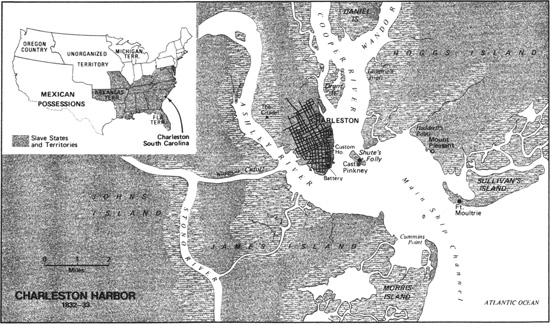
Jackson’s more viable strategy was to move law enforcement beyond range of South Carolina’s firepower. He instructed federal customs officials to move from Charleston, where Nullifiers massed guns, to Fort Moultrie, where federal installations were consolidated. Moultrie, on a sea island some five miles over the waters from Charleston’s Battery, guarded approaches from the Atlantic Ocean to Charleston harbor.
Jackson instructed revenue cutters at sea to enforce the tariff before a ship bearing imported goods passed Fort Moultrie’s cannons. Unless duties were paid, cargo would be locked inside the fort’s stone walls. South Carolina, lacking a navy, would be hard-pressed to nullify. Should Nullifiers somehow fit out a gunboat to sail forth and assault a United States navy vessel, Carolinians would be outrageous aggressors and laughably inadequate attackers too.
Nullifiers’ attempt to escape Jackson’s trap bore the look of comic failure. James Hamilton, Jr., now ex-governor but still extremists’ prime strategist, sent some of his rice to Havana in exchange for sugar. He would not, he announced, pay duties on the sweets. He would allow his goods to be confiscated. But should the state decide to enforce nullification, his fellows “would go even to the death with him for his sugar.”
Federal officials intercepted the vessel bearing “Sugar Jimmy”‘s sugar. They tucked the sweet stuff away in Fort Moultrie. The dashing Mr. Hamilton had nary a ship to transport gentlemen to their death for his sugar.
“Sugar Jimmy”‘s lost sugar symbolized how shrewdly the President had schemed. By moving to lower the already lower Tariff of 1832, and by ensuring that nullification required provocative, pitiful assault on a navy, Jackson sought to make his southern supporters think South Carolinians too irresponsible to support.
5
One presidential strategy, however, reduced the Nullifiers’ isolation. Many states’ righters beyond Carolina, while repudiating Nullifiers’ notion of living under a government and vetoing its laws, affirmed each state’s right to secede and form another government. Southern states’ righters especially believed erring slaveholding brothers must be allowed peacefully to leave the Union.
The southern President went out of his way to attack that southern position. In his Nullification Proclamation of December 10, 1832, Jackson called secession a “revolutionary act,” to “be morally justified by the extremity of oppression.” A tariff about to be changed was hardly extreme oppression. Nor was a morally justified revolution a legally justified act. Governors, “by the law of self-defence,” could repress “an attempt, by force of arms, to destroy a government.” He would save majoritarian Union from traitorous minorities, whether law-breakers called themselves Nullifiers or Disunionists.22
New York’s Martin Van Buren, Jackson’s heir apparent, sought to dissuade the commander-in-chief from chasing a theoretical battle with states’ rights constituents. “The present is not a season,” urged the ever-practical Van Buren, for “abstract propositions.” “Performance of your duty” required only putting down state veto. If that duty alone were performed, Jackson’s southern wing would applaud. Southerners “disclaim indignantly the right of a state to resist the execution of the laws, whilst she is in the Union.” But broadening the issue to include a state’s right to leave the Union “is likely to bring you in collision” with our supporters, especially in “Virginia.”23
“No, my friend,” answered Jackson, “the crisis must now be met.” Nullifiers had threatened that secession would follow nullification. Both monstrosities must be destroyed. With the exception of a few “nullifiers and politicians,” Jackson considered Virginia “true to the core.”24
The Virginia legislature pleased Jackson by sending an official commissioner to Carolina, charged with arranging an honorable retreat for the Nullifiers. The commissioner was the most Carolinian of Virginians, Benjamin Watkins Leigh. Leigh limped around Charleston, his club foot reminiscent of the crippled McDuffie and Cooper, his old manners and old-fashioned costumes those of the fading South. This same Leigh had led the Old Order in the Virginia Convention of 1829. He had then insisted that the propertied elite must possess a veto on King Numbers.
Now the old reactionary told South Carolina fossils they had no constitutional right to veto the national mob. Bulwarks against mobocracy, had been, alas, left out of the national Constitution. At the very least, South Carolina should suspend minority veto while Congress considered majority redress. With a Virginian so sympathetic to the Carolina world view calling that view misguided beyond the state, Jackson was right that he had confrontationists potentially cornered.25
But Van Buren was right that Jackson’s attack on secession could allow Carolina out of the corner. The Virginia legislature, even while sending Leigh to stop South Carolina from nullifying, affirmed that any state could legally secede. Virginia’s United States senator, future President John Tyler, was sufficiently outraged at Jackson’s anti-secessionism to consider seceding from Jackson’s party. Tyler was not alone. Many Southern Jacksonians believed that a party prepared to fire rifles at a seceding state was no states’ rights party at all. Before nullification, Calhoun had been futilely trying to separate these very states’ righters from Jackson. Now Jackson, by injecting anti-secessionism into opposition to nullification, was making Calhoun less futile.26
Southern restiveness with a not-enough-states’-rights Jackson was illustrated in an early senatorial confrontation on Jackson’s so-called Force Bill. That bill, reflecting Jackson’s strategy, authorized new ways to enforce the tariff, without force if possible and with more federal troops if necessary. Fifteen of the 24 senators from slaveholding states voted unsuccessfully to table discussion of possible military coercion. The roll call revealed a South split in its usual way. Thirteen of 16 Deep and Middle South senators voted to table the Force Bill. Only two of eight Border South senators concurred.27
The vote signaled that in the more southern South, support for Jackson was none too hard. While Southrons applauded Jackson’s insistence that states’ rights did not justify nullification, they squirmed at Jackson’s notion that states’ rights did not justify secession. Their selective cheering could land them in Calhoun’s camp, if war broke out over secession rather than nullification. Wishing to avoid that debacle, they sought to lower the tariff before state veto led to disunion.
6
The soft nature of Jackson’s southern support gave confrontationists room to maneuver. They had to allow Congress time to meet non-negotiable demands. But if their demands were fair and if other Southerners considered a lesser settlement unfair, slaveholders might oppose a war against secessionists.
Possibilities and dangers in the situation put Carolina’s nerves and Calhoun’s statecraft to revealing test. Never again in John C. Calhoun’s career would the so-called Father of Secession be in the middle of a confrontation situation. Never again would his actions speak so loudly about the true nature of his—and his state’s—confrontationism. In January 1833, South Carolina’s leader, now resigned from the vice presidency to become Carolina’s senator, sent colleagues back home a secret communication, pleading for retreat.
The letter brought back memories of 1831, when Cooper and Hamilton had marched beyond what Calhoun considered prudent extremism. He had then come out of his study, he had told his friends, to steer Carolina towards redress within the Union. Now in early 1833, he told warriors back home that secession, “the most fatal of all steps,” should occur only “in the last extremity.” The South, he predicted, could prevail in the Union. Enforcement of nullification should be postponed at least a year.28
Only briefly in 1831 had Carolina’s reluctant revolutionaries moved ahead of their cautious leader. Only too obviously had they needed his soothing legalism to win the uncomfortably close state election of 1832. Only too eagerly in early 1833 were worried leaders ready to concur that minority veto must be postponed. Using as their excuse Benjamin Watkins Leigh’s plea that South Carolina give the majoritarian system time to work, Nullifiers suspended nullification. The tariff could be enforced at least until the lame-duck Congress decided whether to lower the duties.
Calhoun, again revealing what kind of confrontationist he was, worked feverishly in Washington to turn temporary reprieve from confrontation into surrender of non-negotiable demands. His concessions to protectionists contrasted revealingly with Jackson’s anti-protectionist solution. The Jackson administration threw its support behind the so-called Verplanck Bill, which would have sliced 50% rates to 20% in two years, well within South Carolina’s non-negotiable demands.29
In early 1833, the Senate Committee of the Whole was considering Verplanck’s initiative. Senatorial rules made closure of debate difficult in that committee. The lame-duck session of Congress would end on March 4, 1833. Congress would not come back into session until December 1833. Yankees who wished to save 50% protective tariffs could thus likely talk 20% duties to death until at least the end of the year.
The Jackson administration’s stymied Verplanck Bill, together with Southern Jacksonians’ dislike for a Jackson who would stymie secession, left Nullifiers with an obviously promising confrontation strategy, a strategy they revealingly lacked the nerve to try. Bolder confrontationists might have offered to mass behind the Verplanck Bill. If our united efforts can produce your moderate President’s 20% tariffs, such extremists might have promised Southern Jacksonians, we will drop extremism. But if you allow the protectionist minority to nullify your majority party’s wishes, you must allow our minority to withdraw its consent to be robbed.
That never-used strategy, to speculate a little further about this history which did not happen, would likely have produced no quick settlement. The congressional session would probably have ended with Yankee protectionists still talking Verplanck’s 20% duties to death. Southern Jacksonians would likely have asked one more chance to pass the Verplanck Bill, at the next Congress nine months hence.
A shrewd confrontationist might have granted this final test. The result might have been a continued protectionist filibuster in the Senate Committee of the Whole in 1833–4 and an increased southern fury at a stalemated establishment. If stalemate had persisted long enough, the distance between southern extremists and moderates might have dramatically shrunk.
In the more likely scenario in 1833–4, an exasperated majority would finally have voted to close the debate and to enact Verplanck’s 20% rates. Confrontationists would then have earned respect by delaying long enough so that moderates could secure the non-negotiable demand. Confrontationists, having also enhanced their own self-respect, would then have been prepared for the next confrontation crisis—and the next set of non-negotiable demands moderates might not have been able to secure.
We cannot know if confrontationists could have emerged so triumphantly. We do know that Mr. South Carolina and followers proved unable to test the obvious possibility. Calhoun instead compromised so swiftly and thoroughly, and with such sighs of relief from constituents, that Carolina’s memories of nullification became a 30-year shudder.
Calhoun’s instrument for aborting nullification was an alliance with the southern hero least like himself. Instead of issuing non-negotiable demands for the Verplanck Bill’s 20% tariffs within two years, Calhoun negotiated with the archprotectionist, Kentucky’s Henry Clay, towards a Compromise Tariff massively more protectionist than the Jacksonian proposal. Calhoun, Clay, and their lieutenants hammered out the anti-Jackson alternative at secret meetings during early weeks of 1833. At the beginning of talks, Calhoun proposed, with reluctance, that protective tariffs last five years, three more than the Verplanck Bill proposed. Clay demanded nine. Calhoun acquiesced. Calhoun wished ultimate reduction to 15%. Clay demanded 20%. Calhoun surrendered. Calhoun desired a formula for a low valuation of the import to be taxed. Clay’s agent demanded a valuation formula calculated to raise tariff proceeds some 10% over the ostensible rates. Calhoun stormed about the bitter pill, then swallowed. At every stage of negotiations, the “Father of Secession” caved in, lest secession ensue.
Final terms of the Calhoun-Clay compromise revealed that Clay had compromised protectionism only in the distant future. The bill left 50% rates unchanged throughout 1833. On the first day of 1834, duties in excess of 20% would be lowered one-tenth of the excess (not, let it be noted, the larger reduction of one-tenth of the whole rate). That new rate of 47% would prevail throughout 1834 and 1835. Similar one-tenth reductions of the excess over 20% would take place biannually, making the rate 44% in 1836 and 1837, 41% in 1838 and 1839, and 38% in 1840 and 1841. Finally and at long last ten years hence, in two big cuts at the beginning and in the middle of 1842, rates would be sliced to 20%—where the Jackson administration’s Verplanck Bill would have had them in two years!
Or, to be more accurate, Clay’s reductions would descend to Verplanck’s level, if protectionists failed to take advantage of their 10-year reprieve. Clay called the final 1842 reductions as sacrosanct as a constitutional provision. But some Congress a decade hence, his protectionist allies hoped, might revise settlements once called holy.30 That hope would be fulfilled. The July 1, 1842, reduction to 20% would not last out the year. A Whig majority, in the Tariff of 1842, would hoist rates back up to the 35% level. Henry Clay, the Great Compromiser, had compromised protection remarkably little.
Clay compromised not at all on a matter Calhoun considered vital: the constitutionality of protection. Carolina went to the brink to secure not just low tariffs but the principle that any general welfare legislation, whether protection of industries or colonization of blacks, was unconstitutional. But unconstitutional laws cannot be legally enforced for ten years. Clay’s “compromise,” by enforcing general welfare legislation for a decade, nullified Nullifiers’ larger constitutional purposes.
If constitutionally Calhoun had secured nothing, economically he had perpetuated the highest tariffs ever to be charged in antebellum America, throughout the worst cotton depression his constituents would ever suffer. Carolinians had breathed defiance partly because the tariff robbed them, so they thought, of 40 bales per 100. Such thievery, so they believed, would imminently sap their resistance by demolishing their finances. For nine more years, in the settlement bearing Calhoun’s stamp of approval, the robbery would continue at or above the Forty Bale rate, while cotton prices would remain debilitatingly low.
Once the Clay-Calhoun settlement reached the Senate floor, the Great Compromiser could do no more for the Compromise Tariff than nudge his supporters out of its way. Clay’s fellow protectionists grudgingly agreed not to filibuster but bitterly refused to favor the bill.
Calhoun’s fellow Southerners were less bitter about his compromising. If Mr. South Carolina preferred Clay’s watery medicine to Verplanck’s bracing stuff, how was a moderate to argue? Southern members of the House voted for the settlement, 84–4. Northern Jacksonians split evenly, making northern anti-Jacksonians’ unanimous opposition irrelevant. The new tariff passed the House 119–85 and the Senate 29–16. A similar coalition of almost all the Southerners and enough northern states’ righters had passed the Missouri Compromise.31
Before adjourning, Congress also passed the so-called Force Bill. Majorities of both parties and both sections drew together to bolster Andrew Jackson’s authority to collect the duties peaceably if he could, forcibly if South Carolina fired a shot.
7
On March 1, 1833, Congress finalized passage of the Compromise Tariff and the Force Bill. On March 4, Calhoun commenced a race towards home. The weather was frightful: one of those winter storms, half-rain, half-snow, which makes an Upper South world but half-southern into one long Yankee iceland. Calhoun braved the shivery journey in an open mailcart, his craft skidding through slick mud. Calhoun endured it out of concern that his negotiations might not satisfy hotheads in South Carolina. Once again he remembered the bad times of 1831, when allies had judged him too cautious. Unless he arrived in Columbia before the Nullification Convention reconvened, he feared, Carolinians might yet secede over the non-negotiable.
The shivering traveler arrived in time, only to find that his ordeal in the ice had been needless. A few intractable secessionists such as Thomas Cooper aside, Carolina’s zeal had turned as frigid as the northern weather. Few back home had even muttered while their favorite confrontationist compromised and compromised in Washington. Fewer now dared to whisper that his compromising confrontationism had produced much less than Verplanck’s uncompromising rates had offered. The fright of standing alone in 1833 had driven confrontationists back to Calhoun’s caution of 1831. Throughout the nullification crisis, his every worry had been his world’s.
In mid-March 1833, the Nullification Convention, calling the Compromise Tariff “honorable,” rescinded its ban on collecting duties. The convention then futilely nullified the now-irrelevant Force Act. Delegates called the settlement “cause for congratulation.” An attempt to make that read “congratulation and triumph” was hooted down.32
Hooting was in order. Minority veto was finished. The majority would rule as long as Union endured. Jackson’s majority, with a nudge from Calhoun’s minority, had proved safe on the tariff. But on the subject of whether white apologists should diffuse away black slaves, the minority of Unconditional Perpetualists feared they might not be safe from northern—and Upper South—Conditional Termination majorities.
“Let Gentlemen not be deceived,” Robert Barnwell Rhett warned the Nullification Convention as South Carolina dropped nullification forever. “It is not the Tariff—not Internal Improvement—nor yet the Force Bill, which constitutes the great evil.” Your “northern brethren,” aye, “the whole world are in arms against your institutions.” A majority defining its own constitutional limits had every power. “Until this Government is made a limited Government… there is no liberty—no security for the South.”33
“Nullification is dead,” rejoiced President Andrew Jackson in 1833, but Nullifiers “intend to blow up a storm on the subject of the slavery question.” Despite knowing Northerners have no antislavery views, Calhoun and fellow fanatics “will try to arouse the southern people on this false tale…. These men would do any act to destroy the Union.”34
Calhoun merely a Union-breaker, the early slavery issue merely Calhoun’s demagogical fiction: how revealingly the President did misconceive Calhoun and the Carolina gentlemen who momentarily forced their reluctant leader to go ahead with confrontation politics. The President was one of the shrewdest American politicians. His problem was that the gap within the southern ruling class remained so enormous that the great middle possessed not the foggiest notion what drove their own extreme.35
That sort of gulf between extremists and moderates makes confrontation politics always a gamble—and always a necessity to committed agitators. South Carolinians learned in nullification times how much daring that gamble takes. Their fortitude proved not up to requirements. Then how could faltering confrontationists scare moderates away from compromise mentalities? With nullification in ruins, the only confrontation strategy still available was secession, a gamble demanding even more gall than nullification. Carolina gentlemen had emerged from their first confrontation crisis drifting as badly as were those they would control, those slaveholding apologists up north in the South.