
CHAPTER 14
Without unpopular initiators, “popular revolutions” usually do not happen. Extreme spirits must strike first because “the people” seldom spontaneously revolt. Tom, Dick, and Harry characteristically prefer small comforts to defying firepower. Nor do the wealthy and powerful often seek out a war which, if lost, must terminate wealth, power, perhaps life itself.
Widespread revolution usually grows out of a narrow faction’s seizure of a building, a town, or whatever. The aggressors issue non-negotiable demands. Such demands, if unmet, can lead to bullets. Non-extremists, who would have compromised much to avoid war, are reduced to uncompromising choice. They must decide whether to join or shoot their own zealots.
“Popular revolution,” because the populace must be partially goaded to it, requires a delicate dialect between initiators and stragglers. Ultras must be different enough from moderates to believe that compromise politics will destroy everything worthwhile. Moderates must also be close enough to extremists to believe that shooting down zealots will slay too much of value. When moderates are too alienated from extremists, rebellion will be abortive. But when sluggards support revolutionaries, the revolution may become a historic occasion. Historians may even dub it a “spontaneous popular uprising.”
Witness the movement towards southern revolution. Secession might never have occurred—and certainly not in 1860–1—if a majority of white Southerners “spontaneously” had had to revolt. Revolution could thrive only when extremists mustered the right nerve to gamble at the right time on confrontation politics. The search for that time and nerve came down to dialogues within South Carolina and between South Carolinians and other Southerners. These dialogues, ultimately productive of “popular revolution,” had a long history. They began with South Carolinians’ uneasiness about precipitating and relief at escaping their first confrontation situation: the so-called Nullification Controversy of 1832–3.
1
Throughout the 1820s, the fury necessary to dare a confrontation had been swelling in South Carolina. The Missouri Controversy and the Panic of 1819 ushered in the decade. These simultaneous crises magnified each other’s horror. The North’s attack on the Slavepower and the economic depression’s blow to southern planters together made Carolinians feel besieged from all sides.
In the 1820s, proof multiplied that the Missouri Controversy foretold a movement of conscience throughout the nation and beyond. The Denmark Vesey Conspiracy of 1822 brought the North’s speeches on Missouri home to slaves’ cabins. The Ohio Resolutions of 1824 and the American Colonization Society petition of 1827 moved Conditional Termination into national politics. The movement to end slavery in the British West Indies made antislavery a trans-Atlantic phenomenon.
These trends early intersected to provoke South Carolina’s first nullification of federal law.1 Free black sailors, when their ships docked in Charleston, could visit the city’s blacks. Apparently, some black foreigners, especially from Santo Domingo, encouraged Vesey conspirators in early 1822. Monday Gell, one of Denmark Vesey’s prime lieutenants, confessed trying to contact the Santo Domingo government through black seamen.
In late 1822, the Carolina legislature enacted a cordon sanitaire. Black sailors were ordered jailed while their vessels docked in Charleston. When enforcement of this law lapsed, the South Carolina Association, a voluntary organization of wealthy Carolinians, insisted that foreign seamen be jailed, as the law prescribed.
Resulting imprisonments violated treaties between England and America, which gave sailors of both countries free access to each other’s ports. England protested to American Secretary of State John Quincy Adams, who protested to South Carolina Governor John Wilson. Almost simultaneously, United States Supreme Court Justice William Johnson, himself a Carolinian, issued a federal circuit decision, declaring that Carolina’s seaman law violated the national Constitution.
South Carolinians defiantly continued to jail black seamen. The “duty to guard against insubordination or insurrection,” declared the Carolina Senate, is “paramount to all laws, all treaties, all constitutions.” A nullification crisis would have erupted then and there if national authorities had enforced Judge William Johnson’s nullified decision. Instead, federal enforcers declined to make a “federal case” out of such a potentially Union-shattering situation. Extremists thus learned that minority veto could bring external saboteurs and internal “traitors” to heel on slavery-related matters.
Carolina victors felt too threatened to gloat over their successful nullification. Continued control required strength and confidence. The banking Panic of 1819 and the ensuing economic depression made Carolinians feel weak and vulnerable.
South Carolinians suffered more than most Americans from the aftermath of the 1819 fiscal crisis. No debtor, North or South, enjoyed the many post-panic years of contracted currency, scarce new financing, and low prices for staples, especially cotton. But in the Chesapeake, hard times, a renewed story, demanded renewal of old strategies. Lower tobacco prices called for more mixed farming and more exchanges of foodstuffs within self-sufficient neighborhoods. While neighborhood barter raised little cash, little coin was necessary. A half-century of bad times had not inspired speculative mortgages. Retrenchment and living off the land are the farmer’s friend, so long as no banker demands payoff in dollars.2
In new southwestern cotton belts, problems with paying newly swollen mortgages created demand for both lower federal taxes and a reformed banking system. Still, frontiersmen’s problems were less acute and their political protests less desperate than in Carolina. Virgin land gave hard-pressed Southwesterners more leverage to forestall foreclosure. Higher yields on virgin acres could compensate for lower cotton prices.
Mortgage-ridden South Carolinians, raising cotton on debilitated soil, could less well fight back. As for Carolina rice planters, who received only slightly lower prices for their staples, they could not always withstand even light adverse pressure. The cycle of high living and poor management could spiral towards disaster when anything more went wrong. For the most financially troubled absentees, too much went wrong at the turn of the 1820s when coastal hurricanes wiped out several crops.3
As the 1820s progressed, escalating numbers of Carolinians, some in the low-country and many more in the upcountry, lost their land and/or moved to fresher southwestern turf. Some 56,000 whites left in the 1820s, and another 30,000 blacks were sold or taken away. Another 76,000 whites departed in the 1830s, with 57,000 blacks also leaving. A state with a little over 500,000 inhibitants lost over 200,000 slaves and capitalists in a terrible 20-year span.4
As Carolina rulers saw it, high federal protective tariffs added the final, fatal blow to their aging world’s waning vitality. An alien ruling class, with a very different concern about economic vitality, demanded those tariffs. New England manufacturers feared that in a free international market, more advanced British manufacturers could forever undersell less productive American industrialists. But a high American tariff on imported goods would force importers to charge higher prices for non-American products. Then American manufacturers could undersell the foreign competition. Before long, claimed pro-tariff polemicists, American industry would boom, American jobs would increase, American productivity would soar, and American-made goods would cost less than English products had ever fetched.
Hard-pressed South Carolina planters found this long-run argument irrelevant. In the short run, they claimed, higher tariffs forced agriculturalists to pay ruinous prices for manufactured goods. Worse, argued cotton planters who were going broke in upcountry South Carolina, high tariffs devastated demand for raw cotton.
According to this enticingly simplistic theory, a 40% tariff on cotton finished goods led to a 40% higher price to consumers. With Americans having less money to spend after the Panic of 1819, so the argument went, 40% higher prices meant 40% less American sales. Forty percent less manufactured cotton cloth sold allegedly meant that cotton manufacturers purchased 40% less raw cotton, giving planters 40% less income.
Q.E.D.—supposedly. No matter that American consumers had to buy blankets and clothing, necessities all, whatever the price. No matter that English manufacturers hardly sold only to American consumers. You Carolinians are still “as persuaded as if you saw it,” an opponent of radical action against the tariff lamented to constituents, “that the manufacturer actually invades your barns, and plunders you of 40 out of every 100 bales that you produce.”5
This so-called Forty Bale theory turned high tariffs into vivid scapegoats. Neither excessive production on the Southwest’s fresh soil nor inadequate yields on Carolina’s exhausted turf caused the state’s alarming decline and depopulation. Rather, the progressively higher tariffs of 1816,1824, and 1828 hammered cotton prices down from a yearly average of 18 cents per pound in 1810–19 to 12 cents in 1820–9 and on down to 9 cents in 1830–2.
George McDuffie, a previously obscure congressman from Carolina’s cotton-producing upcountry, turned himself into a folk hero by naming and popularizing the Forty Bale theory. McDuffie personified a world 40% disfigured. The anti-tariff agitator’s appearance dated from the time when a bullet exploded against his spine in a duel. His body was left a mass of jangled nerves. Most of the time, he brooded by himself, hood pulled around him like a shroud, his frown forbidding even friends to approach.
But when he rose to denounce Carolina’s enemies, his frame came alive with outrage. He shrieked. He kicked. He thumped. He spat. He seemed a revivalist in a death struggle with Satan. It was as if the monster tariff, not some malign bullet, had consigned the wounded congressman and limping constituents to an invalidism beyond enduring.6
Only the upcountry’s other treasured cripple seemed more fanatical than McDuffie. Thomas Cooper, the hunched-over old man who was president of South Carolina College in Columbia, should have borne the title Professor of Revolution. He was the only Carolina revolutionary not reluctant at all, perhaps because he was the only antebellum Carolina leader not Carolina born and raised. Thomas Cooper had not come of age inside a conservative Atlantic seaboard civilization, in years when planters strove to keep the American Revolution unrevolutionary. Rather, Cooper had grown up in France, in years when zealots sought to escalate the French Revolution. Cooper had spent a stormy career in and out of jails on both sides of the Atlantic. He had come to crusty old Carolina, apparently the wrong place for a reckless hothead, at the right time, when tariff and colonization crises were simultaneously occurring. As head of the college and teacher of the senior class in moral philosophy, the experienced revolutionary could educate cautious young heirs into becoming gambling young rebels.7
This émigré from France first announced to the American nation that a revolution was brewing down South which might rival the French. We shall, he told an excited Columbia crowd in 1827, soon have “to calculate the value of the Union, and ask of what use to us is this most unequal alliance.” The little old agitator stomped around the podium in the manner of McDuffie, bent over, hump back protruding, stabbing the Forty Bale robber with his bayonet of a cane. His historic “calculate the value” speech announced that crippled victims of Forty Bale robbers would calculate the cost of mobocracy.
By 1827, costs of being slave to King Numbers had come to seem exorbitant. Tariffs supposedly robbed and depopulated Mother Carolina. Congressional antislavery speeches allegedly stole the state’s domestic peace. Fanatics disguised as African colonizationists would lull Southerners to sleep and diffuse away slaves. Not southwestern competition or exhausted soil or swollen mortgages caused gentlemen’s vulnerability. Rather, a permanent majority was taxing away their capacity to endure.
In 1828, the so-called Tariff of Abominations tightened the majority’s grasp. The tax on imported goods, set at around 25% in the Tariff of 1816 and raised to around 33% in the Tariff of 1824, now soared to 50%. This majority tyranny, many Carolinians thought, indicated that more than Justice William Johnson’s liberation of black seamen must be nullified. Independent gentlemen needed permanent protection against King Numbers.
2
In 1828, the South Carolina legislature asked the state’s best constitutional theorist, the Vice President of the United States, to explain how and why a state could nullify federal law. John C. Calhoun agreed, on condition that his involvement be kept secret. A year after Thomas Cooper informed the nation that South Carolina was calculating the value of the Union, the Carolina legislature, by endorsing Calhoun’s anonymously written Exposition and Protest, announced that the state was calculating a nullification of national laws.8
Calhoun’s argument for state veto stretched normal states’ rights constitutional ideology to an abnormal extreme. All states’ righters assumed that congressional majorities possessed only powers explicitly named in the Constitution. No constitutional clause specifically gave congressional majorities power to protect industry through taxes on imports or to use taxes to colonize and/or free slaves.
Nationalists found constitutional authority in Congress’s power “to promote the general welfare.” The Founding Fathers, so this expansive broad construction interpretation of the Constitution went, knew constitution-makers could not explicitly enumerate every object of law. Therefore, law-makers received broad mandate to pass anything in the “general welfare.”
States’ righters answered that a majority, if able to do anything under the guise of the general welfare, could do everything. Moreover, if the Founding Fathers meant the general welfare clause to authorize everything, they would have specifically enumerated nothing. States’ righters usually depended on the Supreme Court to nullify unconstitutional “general welfare” legislation.
Carolina extremists scoffed at that remedy. The majority’s President appointed the Court. The majority’s Senate approved the appointment. Some restraint on majority tyranny, a majority-controlled court!
Most states’ righters called legal secession the remedy, should courts fail to declare general welfare edicts unlawful. State conventions, as limitless constitution-makers, had preceded and created the merely law-making, law-enforcing, and law-judging national agency, alias the federal government. Constitution-makers could legally, peacefully, and morally withdraw from a limited agency which no longer remained within constitutional limits. The people, in unlimited constitution-making state convention assembled, had the right to transfer their state’s consent to be governed to another limited agency.
Calhoun transformed this state’s rights argument for legally changing lawmakers into a rationale for legally negating the law. The Vice President of the United States ridiculed other Americans’ notion that the Supreme Court, highest judicial branch of a mere agency, had unlimited power to interpret the Constitution. A branch of a limited agency would then become unlimited constitution-maker. Calhoun urged instead that all branches of the limited agency, whether law-making or law-enforcing or law-judging, must bow when a state convention, as limitless constitution-maker, declared a law null and void because based on powers never granted.
Only other constitution-makers, continued Calhoun, could overrule one constitution-maker’s judgement about what powers had been granted. One judge’s restraining order can always be appealed to the full bench. After a state convention, acting as preliminary judge, declared it never had granted a power to the federal agency, three-fourths of the entire court, meaning three-fourths of other constitution-making state conventions, could grant the power by constitutional amendment. The overruled state convention could then refuse to consent to the newly revised Constitution. Legal secession could follow legal nullification.
But nullification, Calhoun claimed, remained the best hope to avert secession. Every major social interest in American society could control at least one state. If every state had to concur, all interests would concur—a concurrent majority, as Calhoun called it. A concurrent majority of all was by definition a disinterested government, continually possessing every minority’s consent.
But a numerical majority preying on a numerical minority was interested tyranny. Numerical mobocracy would lead victimized minorities to withdraw their consent to be governed. Anarchy would ensue. Only nullification would save consent and, in the saving, prevent disaster.
Calhoun’s critics answered that nullification would paralyze government and guarantee anarchy. If all states had to agree for the general government to do anything, the central authority could do nothing. Calhoun responded that nullification would paralyze not good government but bad politicians. State veto would kill federal taxes not fair to all, meaning most taxes. With excessive taxation ended, patronage-hungry politicians would lose interest in federal office. All interests, knowing a concurrent majority could pass only disinterested laws, would select disinterested representatives. Disinterested quest for the welfare of all would lead to compromise, beneficence, wisdom. America would retreat from the civic corruption of nineteenth-century spoilsmen to the civic virtue of eighteenth-century patriarchs.
The same old-fashioned assumptions lay behind Calhoun’s answer to another criticism of his theory: that by protecting white slaveholders from majority attack, he would consolidate black enslavement. Calhoun rejoiced in that charge. He hoped state nullification would stop the federal government from overturning the social hierarchy. Blacks had no right to a freedom that would Africanize America. Property-less whites had no right to tax away gentlemen’s property. The upper class had every right to veto the lower. Good paternalists must provide good government for all races.9
Calhoun’s theory was a Carolina gem. It sought to stop the American slide towards mobocratic egalitarianism by resurrecting patriarchal direction. It sought to stop new tariffs from gutting an aging fragment of the ruling class by insisting that one state’s rulers could negate everyone else. It sought to stop some future northern majority from abolishing slavery by giving the southern minority power to veto Yankee fanaticism. It sought to stop some future southern majority from passing colonization alias emancipation by giving Unconditional Perpetualists a veto over Conditional Terminators. It gave patriarchs drawn towards and scared of revolution a nonrevolutionary way to revitalize American Revolutionaries’ version of republicanism. Above all else, by shrewdly reducing confrontation politics to a court issuing a judgement, John C. Calhoun touched the most sensitive nerve of his class so lightly as to become Mr. South Carolina forevermore.
3
Calhoun’s actions were long as soothing as his theory. For three years after devising nullification, Calhoun sought to halt the remedy and hide his complicity in it. Instead of pushing minority veto, he sought to rally a numerical majority, thereby implicitly denying that minority veto was necessary.
Calhoun would spend the rest of his life confusing everyone, not least himself, by playing the majoritarian/anti-majoritarian game both ways. Never did he pursue alien strategies more obviously than in 1828. At the very time he was secretly dispatching his first nullification state paper, denouncing majority rule, he was also vice presidential candidate on an all-southern national ticket, seeking to win majority control.
The national presidential election of 1828 pitted Calhoun’s running mate, Tennessee’s Andrew Jackson, a large slaveholder who had erratically favored states’ rights, against Massachusetts’s John Quincy Adams, a closet abolitionist who had consistently favored a nationalistic regime. Jackson’s opponent seemed to epitomize whatever antislavery tendency existed in the North. Before becoming President, John Quincy Adams had been the Secretary of State who, in the early 1820s, had called Carolina’s Negro seamen law unconstitutional. During his 1824–8 presidency, the New Englander had proposed sending an American delegation to the Panama Congress of 1826. That gathering of American nations would have included, if the President had had his way, the United States and Haiti at the same conference table. That indirect recognition of a slave insurrectionists’ nation was aborted only because Adams’s diplomats failed to arrive at the conference on time.10
Adams’s economic nationalism proved less abortive. The President envisioned large national taxes financing large national projects. Heavy taxation, in this pre-income-tax age, meant high tariffs on imports. The Tariff of Abominations of 1828, while bearing much Jacksonian input, carried Adams’s signature and seemed symbolic of his policy. The President stood for a national government loaded with funds and looking for projects.
Where Adams rivaled his Secretary of State, Kentucky’s Henry Clay, for the honor of most powerful nationalist in American life, Andrew Jackson, slayer of Indians and redcoats too, was the American popular idol after he won the Battle of New Orleans in 1815. Jackson, like Calhoun, was a slaveholder and a sometimes opponent of too much national government. With Calhoun second in command in a hopefully states’ rights Jackson movement and Jackson in the lead in the nation’s affections, South Carolina might triumph in no more extreme way than leading the numerical majority.
Calhoun here deployed the non-extremist strategy he would come back to and reject, come back to and reject, several times over his erratically extremist career. The case for consistent Carolina extremism was that no national majority, not even the southern-led Jackson coalition, would sufficiently protect slaveholding minorities. Calhoun sometimes thought that. But the South Carolinian also sometimes believed Jacksonians could save the South, especially if Calhoun became the Jacksonians’ next President.
At these moments, Calhoun’s strategy was no different than that of other Southern Jacksonians. Old Hickory’s southern sympathizers believed they would give Jackson more votes than could the more nationalistic North. As a majority of the Jackson party, Southerners could wring concessions from their outnumbered northern allies. As the majority party within the nation, the Jackson coalition could force prosouthern legislation upon the anti-Jackson minority.
The election results of 1828 furthered southern hope of commanding the mainstream. Jackson, if ruled by those who primarily elected him President, would reign for the South. While Andrew Jackson won a slight 52.7% popular plurality north of slavery, John Quincy Adams won the free labor states’ nod in the Electoral College, 74–73. The most anti-southern section of the North was the most anti-Jackson. John Quincy Adams swept all but one of New England’s 51 electoral votes and 68.2% of its popular ballots.
Jackson negated Adams’s northern Electoral College majority by securing all but nine of the South’s 114 electoral votes and two-thirds of its popular votes. The deeper into the South, the more lopsided was Jackson’s landslide. Jackson swept 86.3% of the Lower South’s popular votes, 70.7% of the Middle South’s, and 54.5% of the Border South’s.
These electoral statistics illuminated how a southern minority might indeed command. The South possessed but 40% of the nation’s electoral votes—seemingly a hopelessly minority share. Jackson secured 68% of the nation’s electoral votes—obviously a potently effective share. And Southerners supplied 59% of Jackson’s electoral votes—apparently enough to use his majority coalition to secure their minority triumph.
4
Jackson’s disproportionately southern power base made the slaveholding Vice President seem the legitimate heir of the slaveholding President, assuming both Southerners held the same vision of southernness. Calhoun’s and Jackson’s many similarities lent that hope. Both worked slave gangs on early cotton frontiers. Calhoun, son of an upcountry cotton planter and representative of western Carolina, was the first dominant Carolina politician not from the Atlantic Coast. Jackson, son of a western wanderer and hero of the Middle South frontier, was the first non-seaboard politician to win the national presidency. Both leaders were of Scotch Irish descent. No leader of such descent had previously predominated in South Carolina or presided in the White House.11
Both Southerners came to dominance as wartime nationalists. While Calhoun gained fame as a pre-War of 1812 War Hawk, Jackson secured popularity by winning the great battle of the war. Both Southerners, distressed by American wartime weakness, favored somewhat stronger national government after the war. Calhoun shored up the national army as Secretary of War, while Jackson used part of that army to go after Florida Indians allegedly conspiring with the English.
Both were disillusioned with nationalistic buildup after foreign dangers dissolved and economic disasters struck. In the 1820s, with hard times afflicting planters in both Tennessee and South Carolina, they coalesced against Adams. Having traveled parallel paths from the frontier slavocracy to leadership in a South-induced national administration, these two members of the southern ruling class might perpetuate their class’s world view—if their class shared a world view.
5
Their class did not. The commonplace conception that Jackson and Calhoun fought over tea party punctilio obscures the planters’ showdown that did occur. For Jackson and Calhoun, the shared fact of slaveholding was not enough. Their conceptions of masters’ right to rule and their method of ruling were as distant as South Carolina was from Tennessee.
The conflict between their views centered on different reconciliations of slavery and republicanism. Jackson, race-obsessed authoritarian, believed upper-class control must end at the color line. In the style of the new Southwest, he aimed at institutionalizing classic herrenvolk democracy: both the complete equality of white men and the absolute superiority of whites over non-whites. His was the new-style American egalitarian republicanism: all whites are superior, no white is dependent, presumptuous elites spread civic vice.
Calhoun, while no less a racist, still believed the best men must govern all races. In the manner of the aging Southeast, he aimed at consolidating classic elitist republicanism: the rule of independent patriarchs in Washington, on plantations, everywhere humans lived. His was the old-style American republicanism: independent gentlemen must impose civil virtue from above, lest demagogues delude dependents below.
The difference between their versions of republicanism began where they grew up, on different slaveholding frontiers. Calhoun’s father was an established planter in the late eighteenth-century South Carolina backcountry. The elder Calhoun, like many patriarchs in the newly-old section, came to share coastal squires’ assumptions. Père Calhoun’s belief that independent gentlemen must save civic virtue was the republican mentality which would, in 1808, bring western and eastern Carolina gentries to concur on an aristocratic state constitution.
Jackson’s father, in contrast, wandered over Virginia frontiers. The elder Jackson’s habitat was mountains removed from established elites. Père Jackson’s hatred of aristocratic power was the sort which would, in 1829, bring western Virginians to war against elitist republicanism.
John C. Calhoun received an education fit for an imperial ruler. He was taught Federalist verities in old New England, at Connecticut’s Yale College and at Litchfield Law School. Andrew Jackson, in contrast, taught himself to conquer egalitarian frontiers. He read law in spare moments in frontier offices.
Their brides were as different as their educations. Jackson came to the characteristic frontier alliance with his unpresuming matron, the undereducated, pipe-smoking Aunt Rachel. Calhoun made the appropriate upcountry marriage with a regal lowcountry heiress, the refined, haughty Floride Calhoun. Mr. and Mrs. Jackson found Mrs. Calhoun’s imperiousness towards other whites insufferable.
Andrew Jackson had captured American and especially southern imaginations because he personified racially selective imperiousness. He first came to national and to southern prominence as the racist who controlled Indians. He no more would spare the gun to gain hegemony over reds than he would spare the lash to consolidate control of blacks. Contrary to legend, Andrew Jackson did not believe the best Indian was a dead Indian. This American soldier who deported whole tribes adopted and raised an Indian son. This President who removed Indians from white lands sent missionaries onto reservations to raise red inferiors towards white standards. This slaveholder who made a fortune exploiting black laborers dismissed overly exploitative overseers. Jackson would live up to the white man’s paternalistic burden, by teaching lesser races if he could, by brandishing the pistol if he must.12
Governing white men involved neither pistols nor paternalism. Jackson’s was the typical southwestern inclination to avoid any hint that whites were “niggers.” To be recipient of operation uplift, even if the uplifter was a Great White Father, was to be inferior. Jackson would allow no one to patronize him. Nor would he govern as if any adult white male needed a father. By personifying the New South’s racially selective egalitarianism, Jackson made himself the most important Southerner after Jefferson—and the natural enemy of all Southerners, such as Calhoun, who thought that in the new century no less than in the old, Jefferson’s natural aristocracy must command whites as well as blacks.
6
The difference between the President and Vice President was there for all to see—and remains for visitors still to experience—at their two homes. Calhoun’s Fort Hill and Jackson’s Hermitage were the two most famous southern estates after Jefferson’s Monticello. The three, taken together, sum up wither this class was tending. Monticello’s fake windows evoke the eighteenth-century patriarch who would camouflage pretensions from nineteenth-century egalitarians. Nothing, in contrast, seems camouflaged about Jackson’s and Calhoun’s elaborate Greek-style mansions. Both white façades epitomized white men who forced black men to raise white cotton.
But two contrasting out-buildings gave away the difference between Jackson and Calhoun—and the divergent paths their Souths took from Monticello. Both the Tennessean and the Carolinian maintained lesser structures near sumptuous dwellings. Jackson’s ex-log cabin was symbol of the egalitarian ascending. Calhoun’s white clapboard office was headquarters for the elitist presiding.
Calhoun loved to come home to the detached office, with its columned portico out front. Here, alone and apart, the isolated patriarch born to wealth and power wrote the famous state papers on why King Numbers was a fright. At Jackson’s Hermitage, in contrast, a frontiersman worshipful of King Numbers maintained no special cubicle. Jackson’s former house was a record of everyman growing richer.
When first developing his sprawling Hermitage plantation, Jackson had lived in a log cabin. As he became more affluent, the cabin became part of a conglomerate. Breezeways connected the original dwelling to other cabins; and the whole affair was covered with white boards. The hybrid house looked like lower-class huts stitched into an upper-middle-class residence.
As Jackson grew still richer, he started over on a new dwelling. Once again, step by step, the building’s growth kept pace with the owner’s ascension. Eventually, the classic patriarch’s white mansion emerged.
But the Hermitage’s proud owner loved to show visitors the connected log cabins where he had lived when he was poorer but the same fine fellow. Andrew Jackson relished a soldier’s memories of humble marches over exhausting frontiers. He cherished the image of himself clambering down from Duke, his famed bright bay, to hobble on bleeding feet, shoulder to shoulder with fellow whites. His former house bore homage to the less-than-equal who became more-than-equal but who still retained the persona of the leader no better or worse than other whites.
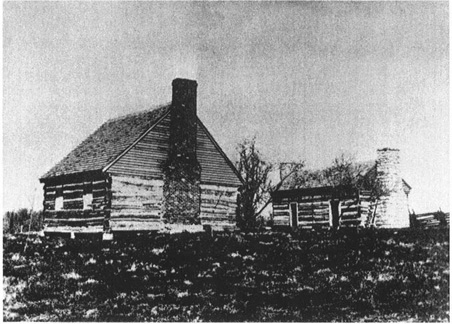
Two of Jackson’s original log cabins, shorn by time of their subsequently added middle-class trappings, as they appeared in a photograph of the 1890s. Courtesy, Ladies’ Hermitage Association, Hermitage, Tennessee.
The impact of Jackson’s presence and personality was as different from Calhoun’s as the abstracted philosopher’s office was from the ex-yeoman’s abandoned cabins. Both planters had Scotch Irishmen’s long, narrow faces and out-doorsmen’s long, vigorous strides. But Jackson’s statuesqueness was more earthy, more physically threatening. He gloried in passionate intuitions. His temper tantrums were notorious. He was ever thundering that BY THE ETERNAL he would hang them.
One legendary duel epitomized why he was known as gritty everyman. Jackson decided to dare his opponent to kill him with the one shot allowed. After the bullet had missed or entered Jackson’s body, Old Hickory planned to measure his man and gun him down. The opponent’s bullet ripped into Jackson’s chest. Old Hickory, jamming one hand into the gaping wound, cooly aimed, fired, killed. “I should have hit him if he had shot me through the brain,” gasped this creature of mud and blood as he staggered off the field.13
When Jackson came to the nation’s capital in the early 1820s as United States senator and aspirant for the White House, the Washington establishment expected some mud-splattered warrior. Ladies and gentlemen found instead that Jackson’s upper-class manner was impeccable. He had learned to ape wealthy gentlemen without learning to be arrogant. He deployed no seer’s superiority. His conversation was no soliloquy. Others would write his state papers. His genius (weakness?) was his faith that his intuitions paralleled the instincts of whites living in log cabins, whether clapboarded over or not.
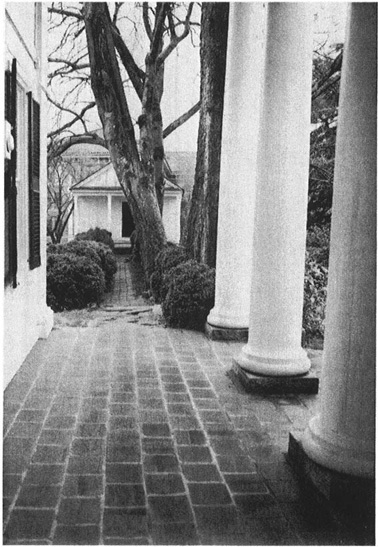
Calhoun’s columned study building, as seen from the columned porch of his Fort Hill mansion. Courtesy, Clemson University, Clemson, South Carolina.
Calhoun, in contrast, came across as egghead beyond everyman. Calhoun’s eyes, as blazing as Jackson’s, were ever seeking some new abstraction to deconstruct, not some new insulter to shoot. Calhoun’s body, as untouched as Jackson’s was scarred, never graced battlefields or dueling grounds. Calhoun was never known to lose his temper. His language, as elevated as Jackson’s was earthy, was shorn of epithets, chiseled clean and clear. In an age of romantically exuberant oratory, his speeches had no elaborate sentimentality. His logic threatened no man’s life. The terror of Calhoun was his shattering mind. He seized onto careless commonplaces, squeezing them in that vise of a mentality, turning living creeds into arcane absurdities.
The abstractionist so comfortable in the isolated study was no lion of the drawing room. He never was known to tell a joke. No one called him Johnny Calhoun. He never indulged in the gossipy banter Mary Boykin Chesnut would make the stuff of Carolina culture. He had no small talk, only large principle. To be his partner at the feasting table was to experience a sermon against numerical mobocracy which threatened to outlast all six courses and cigars and brandy too.
Calhoun’s fellow rulers liked or loathed him on the basis of whether he clarified or collapsed their conceptions. To a Nullifier who sat at his feet in the little office apart, he seemed the best professor. “What a mind he has,” marveled James Hammond. He makes “everything as clear as a sunbeam. No one alive is equal to him in powers of analysis and profound philosophical reasonings.” On the other hand, to a majoritarian scornful of the elitist’s negations, he seemed an inhuman abstractionist. Henry Clay described Calhoun as “careworn, with furrowed brow, haggard and intensely gazing, looking as if he were dissecting the last abstraction which sprung from metaphysician’s brain, and muttering to himself, in half-uttered tones, ‘This is indeed a real crisis.’”14
7
President-elect Jackson marched on Washington, D.C., determined to solve his notion of real crisis: that governors thought themselves better than the governed. Jackson correctly saw that the republican ideal, as defined by the Founding Fathers, still survived in Washington a quarter-century beyond the eighteenth century. Philosopher statesmen in cabinet assembled still laid down policy for the electorate. Congressional leaders in special caucus still nominated the past leader of the cabinet to be the next President of the Union. James Monroe, Madison’s Secretary of State as Madison had been Jefferson’s, was the last President to turn the White House over to his Secretary of State, John Quincy Adams. Monroe was also the last President to wear knee britches and powdered wigs.
Although Calhoun donned other costumes, he relished the script. His years in Monroe’s cabinet as Secretary of War between 1817 and 1825 spanned his most comfortable time in Washington politics. Secretary of State John Quincy Adams would later scorn Calhoun as a sectional zealot. But the Massachusetts leader praised Calhoun during the Monroe years as “above all sectional and factious prejudices more than any other statesman of this Union.”15 Calhoun could be a-southern because South Carolina’s imminent sectional anguish had not yet spoiled the state’s patriotic nationalism. Nor had the nation’s imminent egalitarian style of republicanism yet clashed with South Carolina’s elitist inclinations. Mr. Calhoun, cabinet member, was a philosopher among patriarchs. He set policy for national whites as he set assignments for Carolina blacks.
Andrew Jackson’s first challenge to elitist rule centrally involved Calhoun. The Secretary of War felt the typical patrician’s discomfort in 1819 when General Jackson, with everyman’s typical brashness, barged into Spanish Florida to shoot Indians. Jackson had been instructed to pacify the frontier. The general interpreted pacification to mean deterring red men from spilling white men’s blood, even if Indians’ blood stained another nation’s turf.
In Washington, national law and order seemed dependent on precise treaties separating reds and whites, Europeans and Americans. Civil control over the military seemed dependent on boundary makers in government telling brawlers in the field if and when they could violate international boundaries. As Secretary of War, John C. Calhoun especially believed the refined cabinet, not a raw duelist, should decide when to wage warfare. When Calhoun complained in the secrecy of James Monroe’s cabinet about the “lawless” general, he reflected patriarchs’ fear that popular heroes would seize control in the name of the mob.
Jackson came to know about Calhoun’s secret attack. But for once, the warrior declined to return fire. He instead campaigned for President in 1824.
The results turned Jackson from a seeker after egalitarianism to a zealot bent on revenge. Jackson won a plurality of popular presidential votes but not a popular or Electoral College majority. The House of Representatives had to decide. The people’s hero expected the people’s congressmen to ratify the popular choice. Instead, Henry Clay, whose Kentucky constituents had voted for Jackson, threw Kentucky’s congressional votes, and thus the presidency, to Secretary of State Adams. President-elect Adams named Clay to be Secretary of State. Clay thus assumed the office which for a quarter-century had led to the White House. Jackson, charging Corrupt Bargain, vowed that the next time, the people would triumph.
In his campaign of 1828, Old Hickory was the first successful presidential candidate with a popular nickname. His lieutenants, especially Martin Van Buren of New York, developed new electioneering techniques. Campaigners blasted Adams as the last President who would spend the people’s dollars on pool tables and other aristocratic amusements. In the subsequent inaugural address and even more clearly in his first annual message, the new President announced an end to government by experts. Any “plain and simple” man, declared Jackson, could administer any office. Offices would go to popular politicians who would make sure “that the majority is to govern.” After Jackson’s inauguration, the happy masses raucously celebrated in their favorite democrat’s new White House.16
History does not record what South Carolina’s favorite elitist had to say about the people climbing in windows and stepping on couches to glimpse the people’s President. But during the very period when Old Hickory’s campaigners had deliberately whipped up the majority, Calhoun had been in that private study, secretly composing his first formal lecture on majority malevolence, The Exposition and Protest of 1828. Where Jackson publicly proclaimed that lieutenants who rallied the people deserved the spoils, Calhoun privately whispered that demagogues who roused the people destroyed civic virtue. Minority veto must dry up the spoils and bring patriarchs back to power.
Six months into Jackson’s presidency, Calhoun privately wrote that “the choice of the chief magistrate will finally be placed at the disposition of the executive power itself, through a corrupt system to be founded on the abuse of the power and patronage of the government.” The “morbid moneyed action of the Government,” Calhoun declared four years later, has created a “powerful, active, and mercenary corp of expectants,” and at their head, the President, “on whose will the disposition of the patronage … depends.” This “irresponsible and despotic power” will perpetuate itself, first by “controlling the Presidential election, through the patronage of the Government; and finally, as the virtue and patriotism of the people decay, by the introduction and open establishment of the hereditary principle.”17
Calhoun’s focus on party politicians as cause of popular decay perfectly expressed the new form of South Carolina’s old republicanism. Carolina elitists made their bow to the new egalitarian age by early awarding all white men the vote. But they guarded against mobocratic consequences by gerrymandering their state legislature against numerical majorities, by preserving property qualifications for the legislature, and by giving legislators power to elect everyone else. Above all else, they would maintain patriarchal decision by keeping permanent parties out of Carolina and by usually avoiding state-wide electioneering campaigns.
Calhoun’s rhetoric against national party electioneering said it all: eighteenth-century elitist republicanism could be safe from nineteenth-century universal suffrage only if patricians could prevent spoilsmen from rousing the rabble. Jackson’s spoils system language answered perfectly: nineteenth-century egalitarianism could be safe from anti-egalitarian snobs only if the people’s favorite politicians could rally the majority. Calhoun would nullify the very meaning of the Revolution of 1828 by establishing patriarchal veto of deluded majorities. Jackson’s defiant response, that the majority must nullify deluded patriarchs, placed a ruler from Tennessee and a ruler from South Carolina at war over the essentials of slaveholder republicanism.18
8
The Jackson-Calhoun clash over legislative goals, while less severe than the conflict over egalitarian republicanism, also indicated the gulf between South Carolinian and southwestern ruling classes. Most Southerners west of Carolina did not elect Jackson primarily to pass laws South Carolinians—or posterity—think of as southern. Only later would most Southern Jacksonians make the party primarily an anti-tariff or proslavery instrument. In the beginning, to South Carolina’s distress, most Southwesterners considered banks and Indians, not tariffs or abolitionists, thesouthern enemies.
Expanding southwestern entrepreneurs, unlike their contracting Carolina counterparts, worried most that Indians were barring the expansion of slavery. For slaveholding frontiersmen, higher cotton yields could offset lower cotton prices. Virgin lands led to higher yields. But the largest and most powerful Indian tribes resided on virgin southwestern frontiers. Jackson, America’s most notorious Indian fighter, seemed the proper leader to remove the Creek, Cherokee, and Choctaw nations. Old Hickory as President did just that, moving southwestern Indians to reservations across the Mississippi.19
South Carolinians who deliberately chose Carolina over the frontier had no taste for such adventurism. They had neither fresh acres left to develop nor Indians left to remove. They would stop protective tariffs from ruining them.
During the early years of his presidency, the Southwest’s favorite Indian remover rarely thought about tariffs and never thought about them in southern terms. Jackson’s perspective on tariffs left him confused and confusing. On the one hand, as a states’ righter, he distrusted national interventionism and high taxes.
On the other hand, as America’s soldier, he knew American industry must supply the nation’s army. As a southwestern planter, he believed South-easterners exaggerated the tariff’s pernicious impact. As a small government man, he believed import taxes usefully provided revenue to retire the national debt. So Jackson went both ways in his presidential messages. In the scarce sentences he devoted to this (to him) tangential subject, he called for protective tariffs and lower duties.20
The President cared far more about a matter Carolinians considered as trifling as removing Indians beyond the Mississippi.21 Jackson assaulted the National Bank with the same egalitarian rhetoric Calhoun found insidiously dangerous, and Southwesterners cherished, in his spoils system pronouncements. The President thought that Nicholas Biddle, head of the United States Bank, personified the un-American notion that an unelected expert must govern for the people. The Tennessee egalitarian disliked Biddle’s endeavor to use a government-chartered bank to control the people’s money. Biddle’s control from above made slaves of whites.
Calhoun thought this war on Biddle overdone. The South Carolinian saw nothing southern to be gained in demolition of an aristocratic banker. He wished the anti-elitist in the White House would care more about repealing those Forty Bale taxes ruining the Carolina elite.
Jackson and Calhoun first came to public blows not over Indians or banks or tariffs or nullification but over the sexual purity of a woman. That tiff over a female, however, personified their clashing masculine views. The lady in question, one Peggy Timberlake Eaton, was thought in some quarters no lady. She was widely rumored to be a Washington harlot when married to a naval purser named Timberlake in the 1820s. Her favorite Washingtonian was Jackson’s favorite Tennessean, John Eaton. Eaton subsequently made Peggy his wife. Jackson made the bridegroom his Secretary of War. The President demanded that his inner circle make the bride welcome. Peggy, announced the President, was “chaste as a virgin.”
The new President was in mourning over his own lady. Charges during the 1828 presidential election that Rachel Jackson had not been lady-like before marrying Jackson had apparently hastened her death. During that election, partisan Adams newspapers had reminded readers that Mrs. Rachel Jackson had lived with the general before securing a divorce from a frontier ne’er-do-well. The Jacksons, who had inadvertently married before Rachel’s divorce became final, believed themselves victims of vicious slander. Aunt Rachel, ailing anyway, took to her bed. She did not live to see her hero inaugurated. Now Jackson would not abide smears on another woman’s reputation.
Martin Van Buren of New York, crafty bachelor, paid court to Mrs. Eaton. Calhoun of Old Carolina, hapless husband, watched his wife snub Peggy. And that is why, as some historians would have it, the mourning Old Hero scorned his slaveholding Vice President and made the nonslaveholding New Yorker his successor.
That superficial explanation of Martin Van Buren’s ascendancy misses even at a superficial level the gulf in sexual morals between Charleston and Nashville. Whatever Andrew Jackson did or did not do while Aunt Rachel was still married to an absconding husband, and whatever John Eaton did or did not do while Peggy Timberlake pranced around Washington, both made things right after the fact, as Southwesterners defined Tightness. Both married the lady.
Both considered eastern criticism of their affairs to be contempt for commoners’ morals. The contemptuous Floride Bonneau Calhoun epitomized the Old East’s cutting outrage. In Charleston, a lady left no appearances to be made right after the fact. Mrs. Calhoun, by noticing the scarlet woman, would sanction boorish immorality. She would prostitute Charleston’s wish to nullify the American mob’s vulgarity.
Jackson knew Mrs. Calhoun’s scorn was part and parcel of Mr. Calhoun’s nullifications. Floride’s contempt for Peggy Eaton’s (and for Aunt Rachel’s?) kind of morality paralleled Secretary of War Calhoun’s scorn for Jackson’s frontier lawlessness. Old Hickory had long since learned of Secretary of War Calhoun’s “secret” attack on the invasion of Florida.
More important, Jackson knew all about Calhoun’s “secret” support of nullification. The President knew that just as Floride Calhoun considered Peggy Eaton (and Aunt Rachel?) too boorish to notice, so John C. Calhoun considered white commoners too vulnerable to demagoguery. The President also knew that his Vice President scoffed at fervor for removing Indians and for destroying elitist bankers. Jackson, master of the color line, would not have bestowed the presidential succession on an elitist who would nullify a white majority, even if the Nullifier’s wife had pronounced Peggy Eaton a virgin.
At a famous Jefferson Day Dinner on April 13, 1830, the President cut through petticoat politics to the heart of the matter. Glaring at Calhoun, he toasted “Our Federal Union: It Must be Preserved.” Calhoun answered “The Union, Next to Our Liberties the Most Dear.” With these words, war was declared within the slaveholding class between herrenvolk and anti-herrenvolk regimes.