
Revolution
The balance of power will continue to fluctuate, and the prosperity of our own or the neighbouring kingdoms may be alternately exalted and depressed; but these partial events cannot essentially injure our general state of happiness… In peace, the progress of knowledge and industry is accelerated by the emulation of so many active rivals; in war, the European forces are exercised by temperate and undecisive contests.
Edward Gibbon, 17821
From this moment until that in which our enemies shall have been driven from the territory of the Republic, all Frenchmen are permanently requisitioned for service in the armies. The young men shall fight; the married men shall forge weapons and transport supplies; the women will make tents and clothes and serve in hospitals… The public buildings shall be turned into barracks, the public squares into munition factories… All firearms of suitable calibre shall be turned over to the troops… All saddle horses shall be seized for the cavalry; all draft horses not employed in cultivation will draw the artillery and supply wagons.
Decree of the National Convention, Paris, 17932
The idyllic world described by Gibbon had less than a decade to run when he wrote those words – and it was never that idyllic for the great majority of the population. At some level Europe’s absolute monarchs understood that there was a great deal of resentment, even anger, in the ‘lower orders’ of society, and that they should not exploit the military resources of their kingdoms to the full in war because doing so could unleash social and political forces that would threaten their thrones. Only limited wars were safe. But ideas about equality and democracy were the common currency of late 18th-century thought, and even as Gibbon wrote, the first revolution based on those ideas was triumphing in the new United States.
Mass Armies
In 1789 the revolution arrived in France, then by far the richest and most populous country in Europe. All the other monarchies of Europe rightly saw this as a mortal threat, and launched their armies against France to stamp out the revolution. In France, the National Convention responded by declaring conscription, and by New Year’s Day 1794 the French armies numbered about 770,000 men.3 The wars of mass armies that ensued ravaged Europe for the next two decades.
The French Revolution, with its principles of liberty and equality, first stimulated and then exploited a fervent nationalism that made conscription acceptable. The enthusiastic soldiers of the ‘nation in arms’ had the loyalty and the initiative to fight in more open and mobile formations, and they were so numerous that they often just overwhelmed the regular troops of the old regimes.
Since the new French armies were much less likely to desert, they could live off the land: if there was no bread, they could dig in the fields for potatoes. They could therefore cut loose from the magazines and supply trains of former days and move much faster and farther: a hundred miles was no longer their maximum practical range. They could also be turned loose to pursue and destroy a retreating enemy without fear that they would all desert, so battles rarely ended in draws any more. As Karl von Clausewitz, a Prussian officer who first saw action against the revolutionary forces at the age of twelve in 1793, put it, ‘the colossal weight of the whole French people, unhinged by political fanaticism, came crashing down on us.’4

Emperor Napoleon 1 of France reviewing the Grenadiers of the Imperial Guard on 1 June 1811 in Paris
Not much was said about the democratic ideals of the revolution after Napoleon made himself emperor in 1804: the war’s aim was now simply to establish French domination over all of Europe. And yet Napoleon managed to keep going for another ten years of almost constant war, feeding French nationalism on a constant diet of military victories and resorting to compulsion whenever necessary. Between 1804 and 1813 he drafted 2.4 million men into the army, fewer than half of whom returned home at the end of the empire. ‘Troops are made to get killed,’ he once said, although as time went by the conscripts became less willing. By 1810, 80 percent of the annual quota of French conscripts failed to appear voluntarily.5
War was still very expensive, but the highly centralised government that had been created by the revolutionary regime could get more out of the economy than the old French monarchy had ever dared to demand. The new state-owned arms factories benefited from strict controls on prices and wages. Equipment, food, and horses were simply requisitioned, with payment made later at government-set prices, or never. And in the early days, as the conquests began to accumulate, so much money was coming in from abroad that for a time the wars actually paid for themselves.

The monarchies that were fighting the French had a much harder task, because they had to match the size of the revolutionary armies but they did not dare to introduce universal conscription. They had to pay all their troops the going rate for regular soldiers, which put a huge burden on their treasuries. Indeed Britain, which had to subsidise most of the others, was obliged to introduce the world’s first income tax in 1799 to meet its commitments.
It still wasn’t enough: Napoleon and his marshals kept winning most of the battles – partly because he was a brilliant commander, but also because he had an almost inexhaustible supply of cannon-fodder. Nor could the assorted kings, princes and dukes save their thrones by collaborating with Napoleon. From the start the French revolutionary armies replaced monarchies with republican regimes (carefully chosen to be pro-French) in the countries they conquered. Napoleon went even further, annexing entire kingdoms or turning them into satellites with his own relatives or French field marshals as their rulers. If the monarchs of Europe wanted to keep their thrones, they would have to take the risk of arming their own people. In the end, some of them did.
Mass Media
No great technological change took place in the late 18th and early 19th centuries, and there was no sudden surge of new wealth. The smooth-bore muskets carried by the infantry were the same as they had been for several generations, and so were the ships-of-the-line. The real transformation was political, not military: for the first time ever, mass societies had found a way to ditch their autocratic rulers and revive the old human principle of equality.
In less than fifteen years, popular revolutions overthrew the monarchs first in the British colonies in America (population three million), and then in France, the biggest state in Europe (population thirty million). These were the first large states whose official values were closer to those of our hunter-gatherer ancestors than to the hierarchy of the ant-hill. Why did it happen now, and why among the Europeans rather than in the Islamic empires or in China?
The answer is almost certainly the invention of the first mass medium: print. The printing press was originally a Chinese invention, as was movable type, but printing had a much bigger impact in Western countries for several reasons, the main one probably being differing levels of literacy. In the West, the Reformation had made paramount the individual’s relationship with God, and the reading and understanding of God’s word in the Bible, super-charging the drive towards literacy. Under the Ottomans and in China, however, reading and writing remained for far longer the province of a specific class. As late as 1900, only 10% of the Chinese population was literate; in 1935, only 15% of Turkish people could read. The potential audience was just not there. Whereas the male literacy rate in England in 1700 was 40% – and in New England it was 70% [5a].
There were few newspapers as yet, but books and pamphlets were everywhere. Ten million books were printed in Europe in the 15th century, but 200 million in the 16th, half a billion in the 17th, and a billion in the 18th.6 Tom Paine’s 49-page pamphlet Common Sense, published in 1776 in Philadelphia, advocated the establishment of an independent, democratic republic founded on egalitarian principles in the United States: ‘We have it in our power to begin the world over again.’ It sold 120,000 copies in the Thirteen Colonies in three months, and may have been read by half the population. The point, of course, is that they could read.
Common Sense
What was really happening, as literacy rates rose and printed books became widely available, was that the ability to hold a discussion among equals about ends and means, the fundamental basis for decision-making in hunter-gatherer societies, was being restored to their distant descendants in Western mass societies. It was still impossible for millions of people to gather in the same place and hold a sensible debate, but books could present and discuss ideas for their consideration, and those ideas could come to animate entire mass societies. A new, far more diffuse version of Boehm’s ‘reverse dominance hierarchy’ could make egalitarian values compatible even with mass societies.
And that’s what happened. Once mass societies cracked the problem of numbers and regained the ability to discuss their affairs and make decisions collectively, the pyramidal structure of power and privilege in civilised states – never popular with most people – was no longer an unavoidable necessity. Societies could become self-directing – democratic, in other words – and as soon as that became possible, people remembered that they had always preferred equality to hierarchy. The revolutions began, and although many were crushed, they kept coming. Today a significant portion of the world’s population lives in societies that are more or less democratic, and almost all the others pretend to be.
The revival of the principle of equality did not automatically make its beneficiaries peaceful, as the example of revolutionary France clearly demonstrates – but then, our hunter-gatherer ancestors were not exactly peaceful either. It opened up some interesting new possibilities if democracy ever became the dominant political form on the planet, but that lay far in the future. At the time, unfortunately, the main effect of popular revolution was to show European states how to exploit pseudo-egalitarianism, better known as nationalism, and get whole populations involved in waging war.
Nationalism Ascendant
Once Napoleon had declared himself Emperor of the French, it became safer for the countries he attacked to arm their own people. The revolution was over, and the French armies were no longer liberators, just foreigners attacking the motherland. The surviving kings had climbed the learning curve and now understood that they could exploit the nascent national feelings of their own people to mobilize resistance against the French. In Spain, for example, which was occupied by French troops for half a decade, civilian resistance fighters began waging a nationalist guerrilla (‘little war’) in the name of the exiled king. Backed by Wellington’s British army based in Portugal, they killed as many French soldiers over the years as died in Napoleon’s catastrophic Russian campaign.
When Napoleon, having temporarily subdued every other country on the continent, finally invaded Russia in 1812 with 440,000 men, Russian nationalism was mobilised to similar effect. The campaign is known in Russian history as the ‘Great Patriotic War’, and the fighting was made more pitiless by a national antagonism that had simply not existed back in the time of limited wars and professional armies. At the battle of Borodino, the Russians’ last stand before Moscow, described in the two eyewitness accounts below, they lost thirty-five thousand men, and the French, thirty thousand.
When we reached the crest of the ravine, we were riddled with grapeshot from the battery [in front of us] and several others flanking it, but nothing stopped us. Despite my wounded leg I did as well as my [men] in jumping out of the way of round-shot which ricocheted into our ranks. Whole files, half platoons even, went down under the enemy’s fire, and left huge gaps… A Russian line tried to stop us, but at thirty yards’ range we fired a volley and passed through. Then we dashed towards the redoubt and clambered through the embrasures. I went in just after a piece had been discharged. The Russian gunners received us with handspikes and rammers, and we fought them hand to hand. They were redoubtable opponents. A great many Frenchmen fell into rifle pits, jumbled up with the Russians already occupying them.
Capt. Charles François, 30th Regiment7
It was horrible to see that enormous mass of riddled soldiers. French and Russians were cast together, and there were many wounded men who were incapable of moving and lay in that wild chaos intermingled with the bodies of horses and the wreckage of shattered cannon.
Field Marshal Prince Michael Barclay de Tolly, Russian Minister of War and Commander-in-Chief, 1810–18158
Napoleon won all the battles, including Borodino, and even occupied Moscow, but the Russians would not accept that they were beaten. On the orders of De Tolly, they destroyed their own crops and food stocks rather than leave them to the French, and Napoleon was eventually forced to retreat in the dead of winter through lack of supplies. Only a few thousand of the French made it out of Russia alive.
Enter the Prussians
By calling up the class of 1814 a year early and cancelling all exemptions from the draft, Napoleon managed to come up with one last large army in the spring of 1813, but even France was now running out of manpower. Some of the new recruits got as little as one week’s training before being thrown into battle. Even more seriously, the Prussians finally brought in conscription. There was no kingdom in Europe more autocratic, more riddled with class privileges and inequalities, than Prussia, but the law of 1813 made all male Prussians liable for three years’ service in the regular army upon reaching twenty, followed by two years in the active reserve and fourteen years in the Landwehr (territorial army).9

The retreat of Napoleon’s Grande Armée from Russia in 1812, by Johann Klein
At the opening of the new war against Napoleon, the Prussian army reformers created a new decoration for bravery that broke all the rules of Prussian society by being open equally to peasants, bourgeoisie, and nobles: the Order of the Iron Cross. Their decree stated:
In the present great catastrophe in which everything is at stake for the Nation, the vigorous spirit which elevates the Nation so high deserves to be honoured and perpetuated by some quite peculiar monuments. That the perseverance by which the Nation endured the irresistible evils of an iron age did not shrink to timidity is proved by the high courage which now animates every breast and which could survive only because it was based on religion and true loyalty to King and Country.10

Certificate of Iron Cross 2nd class for Edgar Wintrath, October 1918
The reformers were gambling that a combination of patriotism and compulsion would make conscription work even without the revolutionary ideal of the equality of all citizens, that men would be seduced by the promise of an equality in battle that they were denied in their ordinary lives. They turned out to be right.
‘Get me a national army,’ Marshal Blücher had begged the Prussian reformers, and in 1813 he had one: the Landwehr battalions of conscripts tripled the size of his army and played a major part in the two decisive defeats of Napoleon in the Battle of the Nations at Leipzig in 1813 and at Waterloo in 1815.
The Landwehr battalions were so-so at first, but after they had tasted plenty of powder, they did as well as the battalions of the Line.
Marshal Blücher11
The battles of the Revolutionary and Napoleonic wars were larger on average than those of the 18th century, but they were fundamentally the same sort of battle and the weapons were virtually identical. The great change was in the number of battles. In classical times or in the Thirty Years’ War, there might be three or four battles in a year, and encounters where the opposing armies exceeded a 100,000 men in total were rare. During the period 1792–1814 there were 49 such battles, and smaller but still major battles occurred on average more than once a week on one or another of the several fronts where campaigns were in progress.12 At least four million people were killed, and the great majority of them were soldiers – a figure quite unprecedented in history. Yet European society did not break down under the strain. The European states had developed the wealth, the organisational techniques, and the methods of motivation needed to fight mass wars with a degree of popular participation that no other civilised society had ever achieved.

Calm Before the Storm
He who uses force unsparingly, without reference against the bloodshed involved, must obtain a superiority if his adversary uses less vigour in its application… To introduce into a philosophy of war a principle of moderation would be an absurdity. War is an act of violence pushed to its utmost bounds.
Karl von Clausewitz, 181913
Karl von Clausewitz was a Prussian veteran of the Napoleonic wars whose writings on the theory of war became gospel for succeeding generations of soldiers. But one form of restriction on the scale of violence did survive for most of the 19th century: by and large, civilians were spared the worst horrors of war.
There were three reasons for this. First, the industrial production of weapons and equipment was still much less important than the role of the masses of soldiers themselves. Secondly, the armies lacked weapons that could reach the enemy’s centres of production in any case. And finally, the soldiers were genuinely reluctant to turn their weapons against civilians. Unfortunately, when the first two conditions changed, the last proved to be no obstacle.
For forty years after the defeat of Napoleon’s comeback attempt at Waterloo in 1815, there was peace between the major European states. There was a huge conservative reaction against the excesses of the French Revolution, and among the dangerous innovations generally discarded was the mass army based on conscription; most of Europe went back to small, professional armies. But by the time the spate of mid-century wars arrived in 1854–70, every major power in Europe except Britain, protected by its navy, had reintroduced conscription – and by this time new technology was beginning to filter into war.
American Civil War
The greatest of the mid-century wars was not fought in Europe at all. It was the American Civil War, in which 622,000 American soldiers died – more than in both world wars, Korea, Vietnam, Afghanistan and Iraq – out of a population only one-tenth as big as it is now. Both sides soon resorted to conscription, and the resulting armies were huge. The US Army enlisted almost two million men during the four years of the war, and the Confederates, almost a million, out of a total population of only 31 million. And one-fifth of those who enlisted, died.
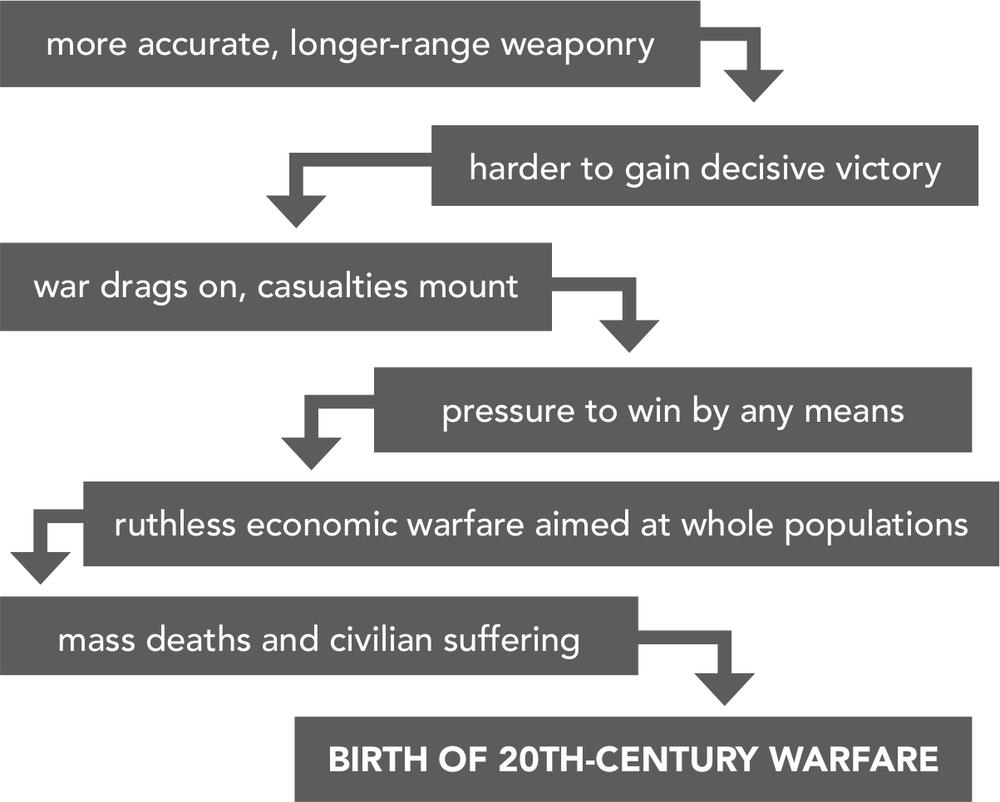
During the previous decade, new rifled muskets had come into general use, effectively quintupling the range at which the average infantryman could hit his opponent, and within months, defending infantry were taking shelter behind natural obstacles whenever possible. In practice, the range at which infantry opened fire didn’t change much from the days of smoothbore muskets: the average opening range of engagement was only 127 yards. But accuracy had improved greatly, and most soldiers were taking aimed shots. A great many of them hit their targets.14
The infantry’s new habit of taking cover whenever possible set the course of battles like Second Manassas in August 1862, when Stonewall Jackson’s Virginians lined up behind the shelter of a railway cutting to receive the attack of three times as many Northern infantry. At the height of the attack, some Northern officer rode forward through the black powder smoke, well ahead of his troops, and reached the lip of the railway cutting miraculously untouched. For a few seconds he paused there, sword in hand, as useless as he was brave. Some of the Southern soldiers just below him began to yell out, ‘Don’t kill him! Don’t kill him!’ But within seconds both he and his horse were shot down by less romantic men.
I had taken part in two great battles, and heard the bullets whistle both days, and yet I had scarcely seen a Rebel save killed, wounded or prisoners. I remember even line officers, who were at the battle of Chancellorsville, said: ‘Why, we never saw any Rebels where we were; only smoke and bushes, and lots of our men tumbling about,’ and now I appreciate this most fully… Put a man in a hole, and a good battery on a hill behind him, and he will beat off three times his number even if he is not a very good soldier.
Col. Theodore Lyman, 186916
Along with the muzzle-loading single-shot rifles that produced such havoc at Second Manassas, the forerunners of practically every modern weapon were used in the American Civil War. There were breech-loading, magazine-fed rifles like the seven-shot Henry repeater, early hand-cranked machine guns like the Gatling gun, rifled breech-loading cannons, submarines, ironclad warships, and even a primitive form of aerial reconnaissance using hot-air balloons. The extensive American railway network allowed troops to be moved quickly over long distances – Civil War battles were the first in history in which the infantry did not get there entirely on foot – and the telegraph let generals coordinate the movements of large forces spread out over a wide area.
In a sense, the Civil War happened just in time. Had it been delayed another ten or fifteen years, most of those new weapons would have been available in large numbers and reliable models, and it would have looked like World War I. As it was, they were mostly rare or unreliable. The artillery was particularly ineffective, having not a much greater range than the infantry’s rifled muskets. Out of 144,000 American soldiers whose cause of death is known, 108,000 were killed by rifle bullets, and only 12,500 by shell fragments and 7,000 by swords and bayonets.
Twenty years later, when field artillery could fire accurately for over a mile and shell bursts could produce a thousand fragments lethal at a radius of twenty feet, the figures would have been very different. Even without modem artillery, Civil War battlefields took on an ominously modern aspect by the end: in the lines around Petersburg in 1865, the field entrenchments grew so elaborate – complete with dugouts, wire entanglements, and listening posts – that they foreshadowed the trenches of World War I.

Soldiers in the trenches before battle at Petersburg, Virginia, 1865
The Civil War also demonstrated how hard it would be in future to gain a decisive victory even against a relatively weak opponent. The North effectively outnumbered the South four-to-one in military manpower (since the Confederacy did not draw on its large black slave population for soldiers) and at least six-to-one in industrial resources. In the year before the Southern states seceded, the North produced 94 percent of the united country’s steel, 97 percent of its coal, and 97 percent of its firearms.17 Yet it took four years of high-intensity war to bring the South to its knees.
It also took ruthless economic warfare. From the start, the North clamped a tight blockade on the South to strangle its overseas trade. By the end General William Tecumseh Sherman (whom the Confederate president, Jefferson Davis, called the ‘Attila [the Hun] of the American Continent’) was deliberately devastating huge areas of the deep South. ‘We are not only fighting hostile armies but a hostile people,’ said Sherman, ‘and must make old and young, rich and poor, feel the hard hand of war.’18
To those who protested that his ‘scorched earth’ methods were immoral, Sherman simply replied: ‘If the people raise a howl against my barbarity and cruelty, I will answer that war is war… If they want peace, they and their relatives must stop the war.’19 He was born before his time.
Notes
1. Edward Gibbon, The Decline and Fall of the Roman Empire (New York: The Modern Library, 1932).
2. Maj. Gen. J.F.C. Fuller, The Conduct of War, 1789–1961 (London: Eyre and Spottiswoode, 1961), 32.
3. R.D. Challener, The French Theory of the Nation in Arms, 1866–1939 (New York: Russell and Russell, 1965), 3; Alfred Vagts, A History of Militarism, rev. ed., (New York: Meridian, 1959), 108–11.
4. Vagts, op. cit., 114; Karl von Clausewitz, On War, eds. and trs. Michael Howard and Peter Paret (Princeton, New Jersey: Princeton University Press, 1976).
5. Vagts, op.cit., 126–37; John Gooch, Armies in Europe (London: Routledge and Kegan Paul, 1980), 39.
5a. David Mitch, ‘Education and Skill of the British Labour Force,’ in Roderick Floud and Paul Johnson, eds., The Cambridge Economic History of Modern Britain, Vol. I: Industrialisation, 1700–1860, Cambridge: Cambridge University Press, 2004. p. 344.
6. Eltjo Buringh and Jan Luiten van Zanden, ‘Charting the ‘Rise of the West’ Manuscripts and Printed Books in Europe, A Long-Term Perspective from the Sixth through Eighteenth Centuries’, The Journal of Economic History, Vol. 69, No. 2 (2009), 409–445.
7. Anthony Brett-James, 1812: Eyewitness Accounts of Napoleon’s Defeat in Russia (London: Macmillan, 1967), 127.
8. Christopher Duffy, Borodino and the War of 1812 (London: Seeley Service, 1972), 135.
9. David Chandler, The Campaigns of Napoleon (New York: Macmillan, 1966), 668; Gooch, op. cit., 39–41.
10. Vagts, op. cit., 143–44.
11. Ibid., 140.
12. Edward Meade Earle, ed., Makers of Modern Strategy, (New York: Atheneum, 1966), 57.
13. Karl von Clausewitz, On War, tr. Col. J.J. Graham (London: Trubner, 1873), I, 4.
14. Paddy Griffith, Battle Tactics of the Civil War (New Haven, CT: Yale University Press, 1987), 144–50.
15. Frank E. Vandiver, Mighty Stonewall (New York: McGraw-Hill, 1957), 366.
16. Col. Theodore Lyman, Meade’s Headquarters, 1863–1865 (Boston, Massachusetts: Massachusetts Historical Society, 1922), 101, 224.
17. Mark Grimsley, ‘Surviving Military Revolution: The US Civil War,’ in Knox and Williamson Murray, eds. The Dynamics of Military Revolution, 1300–2050, (Cambridge: Cambridge University Press), 2001, 84.
18. Frederick Henry Dyer, A Compendium of The War of the Rebellion, New York: T. Yoseloff, 1959.
19. Personal Memoirs of General W. T. Sherman, Bloomington, Indiana: Indiana University Press, 1957, II, 111.