
The Continuous Front
At first there will be increased slaughter – increased slaughter on so terrible a scale as to render it impossible to get troops to push the battle to a decisive issue. They will try to, thinking that they are fighting under the old conditions, and they will learn such a lesson that they will abandon the attempt forever. Then… we shall have… a long period of continually increasing strain upon the resources of the combatants… Everybody will be entrenched in the next war.
I. S. Bloch, 18971
These predictions about the next great war, published in Russian in 1897 by Ivan Bloch, a Warsaw banker and ardent pacifist, were logically unassailable. The great powers would call up millions of soldiers and rush them to the frontiers by rail when war came. Given the firepower now available to each man, eventual stalemate was inevitable: the defensive was far stronger than the offensive. But professional soldiers didn’t take Bloch’s work seriously, and every army attacked simultaneously in 1914, convinced that a quick series of decisive battles would settle the war within six months.
The First World War was not about trade or overseas colonies or stopping some would-be conqueror. Nobody wanted or was planning for a war in 1914. Wars between two neighbouring countries often have specific, more or less rational causes; multi-player alliance systems, from Yanomamo villages to 20th-century European great powers, can stumble into system-wide wars quite unintentionally.
France feared Germany because its population and industry were growing faster, so it made an alliance with Russia, on the far side of Germany. Germany felt encircled and made an alliance with Austria-Hungary, which wanted German backing because it was competing with Russia for bits of territory in the Balkans. And Britain made an ‘entente’ (almost an alliance) with France and Russia because it also felt threatened by the rise of Germany. This was all just prudent contingency planning, not rabid aggression – but if anybody got into a fight, even with some country outside the alliance system (as Austria-Hungary did with Serbia in 1914), it might easily pull all the members of both alliances into a great war.
It did exactly that, in just over one month, because the whole system was on a hair-trigger. It should not have been, but the prevailing (although mistaken) belief was that decisive, war-ending battles would happen fast, so the first countries to mobilise and to attack would have a huge advantage. In fact the principal artefacts that ended the war of movement and drove the soldier of the First World War down into the trenches – bolt-action repeating rifles, air- and water-cooled machine-guns, quick-firing and long-range artillery, barbed wire and the like – were already present in embryo on American Civil War battlefields and in fully mature versions by the Russo-Japanese War of 1904–5, but both of those precedents were largely ignored because they took place outside of Europe. Despite Bloch’s warning, few soldiers had any idea what they were getting into when they went off to war in 1914.
We listen for an eternity to the iron sledgehammers beating on our trench. Percussion and time fuses, 105’s, 150’s, 210’s – all the calibres. Amid this tempest of ruin we instantly recognize the shell that is coming to bury us. As soon as we pick out its dismal howl, we look at each other in agony. All curled and shrivelled up we crouch under the very weight of its breath, helmets clang together; we stagger about like drunks. The beams tremble, a cloud of choking smoke fills the dugout, the candles go out.
French veteran2
The German army grew sixfold in the first two weeks of August, 1914 as reservists joined their regiments. By mid-August trains had delivered 1,485,000 German soldiers to the borders with France and Belgium. The French, Austrians and Russians performed similar miracles of organisation – but by October the armies had all ground to a halt.
Machine weapons – quick-firing artillery and machine-guns firing 600 bullets a minute – filled the air with a lethal steel sleet. Anybody trying to move above ground was almost certain to be hit. Killing had been mechanised and men became the prisoners of machines, trapped below ground level in the proliferating trenches.
By early 1915 the military authorities were starting to understand that they faced a completely new strategic problem: the continuous front. There were no enemy flanks that you could get around, just two trench systems stretching 475 miles from the English Channel to the border of neutral Switzerland. The front lines were usually a few hundred yards apart, but in some places less than a hundred.
The continuous front was the result of simple mathematics. Firepower grew by leaps and bounds in the latter half of the 19th century, enabling infantrymen to control much more frontage. They didn’t need to be shoulder to shoulder any more: by the time of the South African War in 1899, with rifles that could deliver ten shots a minute at a thousand yards, the Boers were finding that they could stop British frontal attacks with only one rifleman every three yards.3
Multiply the width of the front that an individual infantryman could now hold by the millions of men who would be available in a European war, and the continuous front was inevitable. Armies could now spread out to fill all the space available, and so they did – not only in France, but across the vast distances of Russia, and later across northern Italy, northern Greece, north-eastern Turkey, Mesopotamia (Iraq) and Palestine.
For the men in the trenches, it was a new kind of war. Apart from during sieges, armies had previously been in contact with the enemy for only a few days each year. Now the soldiers were in the trenches, within shouting distance of the enemy, all the time. Each day they faced the risk of being killed, and each day they endured the misery of living in a ditch.
Constantly having your feet in this gruel-like muck caused a complaint which became known as ‘trench foot’. There were dozens of amputation cases in the regiment.
British veteran
Rats bother you; rats eat you if you get wounded and nobody can look after you. It was a dirty lousy place to live, with all the corruption that is known to mankind.
British veteran
A War of Artillery
The continuous front meant that no movement was possible until you had broken through the enemy lines facing you – and every attack had to be a frontal attack. The generals quickly found out that their infantry would be slaughtered if they tried to advance unaided; the only way to break through was to eliminate the enemy’s firepower by smashing the enemy’s trenches and gun positions with shellfire before the attack. So the trench war became a war of artillery.
Over half the casualties were now caused by shellfire, and shell production could not keep up with demand. Pre-war French planning had assumed the army would use around 10,000 75-mm. shells a day; by 1915 France was producing 200,000 a day and still not keeping up with demand. The nineteen-day British bombardment that began third Battle of Ypres in 1917 used 4.3 million shells weighing 107,000 tons, a year’s production for 55,000 workers.4
Still they couldn’t get a real breakthrough. The bombardment would destroy most of the enemy’s machine-guns in the firstline trenches, but enough defenders always survived to make the advance a slow and costly business. Even if the attacking infantry managed to capture the enemy’s first-line trenches in just one day, that gave the enemy’s reserves enough time to man a whole new trench system just to the rear. For more than three years, no offensive shifted the Western Front by as much as ten miles.
… the ruddy clouds of brick-dust hang over the shelled villages by day and at night the eastern horizon roars and bubbles with light. And everywhere in these desolate places I see the faces and figures of enslaved men, the marching columns pearl-hued with chalky dust on the sweat of their heavy drab clothes; the files of carrying parties laden and staggering in the flickering moonlight of gunfire; the ‘waves’ of assaulting troops lying silent and pale on the tapelines of the jumping-off places.
I crouch with them while the steel glacier rushing by just overhead scrapes away every syllable, every fragment of a message bawled in my ear… I go forward with them… up and down across ground like a huge ruined honeycomb, and my wave melts away, and the second wave comes up, and also melts away, and then the third wave merges into the ruins of the first and second, and after a while the fourth blunders into the remnants of the others, and we begin to run forward to catch up with the barrage, gasping and sweating, in bunches, anyhow, every bit of the months of drill and rehearsal forgotten.
We come to wire that is uncut, and beyond we see grey coal-scuttle helmets bobbing about… and the loud crackling of machine-guns changes as to a screeching of steam being blown off by a hundred engines and soon no one is left standing. An hour later our guns are ‘back on the first objective,’ and the brigade, with all its hopes and beliefs, has found its grave on northern slopes of the Somme battlefield.5
Henry Williamson, The Wet Flanders Plain
New weapons like poison gas only increased the casualties without breaking the deadlock, and the war became a simple matter of attrition. In the battle of the Somme in 1916, the British captured forty-five square miles in a five-month battle at a cost of 415,000 men – over 8,000 men for each useless square mile – but the Germans were compelled to sacrifice men and equipment at a similar rate. Since Britain, France and Russia had twice the population of Germany and its allies, the likelihood was that sufficient battles on that scale should eventually give them the upper hand (although nobody ever said this out loud).

Civilians
The war of attrition involved not only soldiers but civilians. As fit young men vanished into the armies – France put 20 percent of its entire population into uniform and Germany 18 percent – the civilian economy was effectively conscripted too. Labour and raw materials were allocated not by the market but by government orders, and rationing was imposed on food and scarce consumer goods. Millions of women became factory workers for the first time to replace the men who had gone off to war. People began to use the new phrase ‘home front’ because the role of munitions workers, and of manufacturing more generally, was as important to victory as the soldiers in the trenches. But all ‘fronts’ can be attacked – and they duly were.

Female munitions workers operating lathes in a British shell factory
The economic war was fought mostly at sea: both sides immediately imposed blockades on the other’s seaborne trade. The British stopped all ships bound for German ports, and in the last two years of the war undernourishment caused an excess of 800,000 civilian deaths in Germany over the peacetime mortality rate.6 The Germans, with a smaller navy, resorted to submarines to cut Britain off from its overseas suppliers of food and raw materials. The U-boats sank 15 million tons of shipping during the war but they never managed to staunch the flow of supplies, and Germany’s policy of ‘unrestricted’ submarine warfare, announced in January 1917, brought the United States into the war against it. That more than made up for the Allied loss of Russian troops when the Bolshevik revolution took Russia out of the war later that year – and the losses of ships bound for Britain plummeted after the Royal Navy revived the time-honoured convoy system in September 1917.
There was, however, now another way of attacking the enemy’s economy: go after the factories and the war-workers directly. Only twelve years after the Wright Brothers made the first powered flight, Germany already possessed aircraft able to fly hundreds of miles and drop bombs on enemy cities: the zeppelins. Inevitably, it used them.
The idea was to equip from twelve to twenty Zeppelins and drill their crews to function as a co-ordinated task force. Each ship would carry about 300 fire bombs. They would attack simultaneously at night. Hence, as many as six thousand bombs would be rained upon [London] at once… When asked for my technical opinion, morality aside, I agreed it was definitely workable.
Capt. Ernst Lehman, German Army Zeppelin Service7

Zeppelins are unlikely poster boys for the British recruitment drive, 1915.

The wreck of a Zeppelin L33 in Essex, one of two brought down on the night of 23/24 September 1916.
The first major air raid on London came in September 1915, when Zeppelin L-15 dropped 15 highexplosive bombs and 50-odd incendiaries on London at night and caused 17 casualties. Later raids involved more zeppelins and two-and three-engined bombers, but only four thousand British civilians were killed or injured in the whole war. Nevertheless, the raids were the precedent for Rotterdam, for Dresden, for Hiroshima, for all the cities that were destroyed from the air in the 20th century – and for the strategy of nuclear deterrence too. After 1915, everybody was a legitimate target.

Landships
Panic spread like an electric current, passing from man to man along the trench. As the churning tracks reared overhead the bravest men clambered above ground to launch suicidal counter-attacks, hurling grenades onto the tanks’ roofs or shooting and stabbing at any vision slit within reach. They were shot down or crushed, while others threw up their hands in terrified surrender or bolted down the communication trenches towards the second line.
German infantryman’s first encounter with a tank, 19168
The solution to the problem posed by the trenches occurred to a British staff officer, Col. E. D. Swinton, only a month or two after the trenches appeared in late 1914. What was needed, obviously, was a vehicle armoured against machine-gun bullets and carrying its own guns, which could roll over shell holes, barbed wire, and trenches on caterpillar tracks. The earliest production models of the ‘landships,’ as they were first called, reached the Western Front in late 1916, but they didn’t go into battle in really large numbers until the battle of Cambrai in November 1917, where 476 were committed.

The first official photograph taken of a tank going into action, at the Battle of Flers-Courcelette on 15 September 1916. The tank is a Mark I.
At Cambrai, also for the first time, there was a complete fire-plan for artillery to engage the German defences simultaneously all the way back to the furthest reserve positions, and the 150 batteries of guns to reinforce the sector arrived secretly. In order to achieve complete surprise, these extra guns did not open fire in the usual way to ‘register’ their targets (that is, fire a few rounds and see if the shells are landing in the right places). Instead, they depended entirely on aerial reconnaissance, accurate mapping and ballistic calculations, and all one thousand guns opened fire at the same time on the morning of the attacks. It was the first large-scale use of ‘predicted fire’, and with the help of the tanks and 289 aircraft used as artillery spotters, ground-attack aircraft and bombers, the attack almost broke through the German lines completely. Only a very rapid and ferocious German counter-attack closed the breach.
The tanks and predicted fire at Cambrai enabled the British army to advance six miles in six hours, at a cost of four thousand dead and wounded. Earlier the same year, at the Third Battle of Ypres, the British had taken three months to advance a similar distance, and they lost a quarter of a million men doing it. After that the trench stalemate was over, for the Germans had just solved the break-through problem in the same way, though with less reliance on tanks. Beginning with an offensive at Riga on the Russian front in September 1917, a Germany artillery officer named Col. Georg Bruchmueller had independently devised a similar formula for surprise and rapid penetration: massive amounts of indirect and predicted artillery fire with no warning beforehand, and infantry ‘storm-troops’ who by-passed enemy strong-points and just kept moving ever deeper into the defended zone, spreading confusion and dismay, and ultimately driving the enemy into a major retreat.
German tanks never matched the British in numbers or quality, but it was Germany that took the offensive in the spring of 1918 (after three years on the defensive), in an all-out gamble to win the war before large numbers of American troops arrived in France. At Arras in March 1918, 6,608 German guns fired 3.2 million rounds on the first day of the offensive – and the Germans gained more ground in two weeks than the Allies had taken in all their offensives during the whole war. Further fast-moving offensives followed and the Allies nearly lost the war in the spring of 1918, but the Germans failed to reach either Paris or the Channel coast – and they suffered a million casualties between March and July of 1918.9
After that, the Allies went over to the offensive, mainly using British, Canadian and Australian troops to spearhead the attacks, and showed the same ability to gain ground. The plans for 1919, had the war continued, called for a force of several thousand tanks closely supported by aircraft to smash through the enemy’s front, with infantry following closely in armoured personnel carriers, but that was not necessary. By November 1918 the German army was collapsing, the navy had mutinied, and Berlin asked for an armistice.

German boy soldiers in WWI
Tremendous Victory, Bad Peace?
Why was the peace treaty that followed so extreme, with ‘war guilt’ clauses and huge reparations and entire empires dismantled? Why did the peace last only twenty years?
The national rivalries, military fears and territorial disputes that had caused World War I were not more important than those that caused the Seven Years’ War a century and a half before. In that earlier style of war, though, small professional armies had fought each other offstage while civilians everywhere largely ignored it. Eventually the losers would hand over a few bits of territory to the winners and peace would return. A hundred thousand soldiers would be dead but the people who mattered didn’t care about them much, and no regime fell.
The conflict of 1914–1918 on the other hand, was the first total war, and the governments of Europe discovered to their dismay that it was almost impossible to stop short of total victory for one side and total surrender for the other. When sixty million men have been conscripted into the armies and almost half of them have been either killed (eight million) or wounded (twenty million), and when people’s willingness to bear these huge losses has been kept up in every country by hate propaganda that paints the war as a moral crusade against absolute evil – then governments cannot just sort out the petty Balkan quarrel that triggered it, swap around a few colonies, and send the surviving soldiers home.
Total war meant victory also had to be total: the survival of not just the government but the entire regime depended on it. Even when governments could see military collapse or social revolution looming, they refused to consider a compromise peace. The collapses and revolutions duly came.
Collapse and Revolution
The Russian army was the first to collapse, in early 1917, and near-starvation at home brought the (first) Russian revolution in March 1917. In April, half the divisions of the French army mutinied after another forlorn offensive, and nearly 25,000 men faced court-martials after order was restored. In May, 400,000 Italian troops simply fled the battlefield at Caporetto. Even in Britain, political stability was no longer a certainty: later that month the Chief of the Imperial General Staff in London wrote to Gen. Sir Douglas Haig, the commander of the British army in France: ‘I am afraid there is no getting away from the fact that there is some unrest in the country now as a result partly of the Russian revolution.’10
All the empires on the losing side – German, Russian, Austrian and Ottoman – were destroyed by the war, and the latter three were chopped up into more than a dozen new countries and territories. About half the people of Europe, the Middle East, and Africa found themselves living under a radically different regime or even as the citizens of a different country. The totalitarian controls that had been imposed during the war continued in peacetime in the new Soviet Union, and were brought back later by fascist regimes in Italy and Germany. And the losers were so unhappy about the peace settlement that the fighting resumed after only two decades.
Blitzkrieg
Confronted with an unprecedented military problem, the soldiers of the First World War had solved the trench stalemate, and the professionals in every country debated how best to exploit tanks to restore mobility to warfare. In the early years of the Second World War (1939–41) it seemed as if the Germans, at least, had come up with the right answer.
‘Blitzkrieg’ (lightning war) operated by using a highly mobile force of tanks, infantry and artillery, all on tracks or wheels, to break through the enemy’s defences on a narrow front. Ground-attack aircraft (Stukas) gave close support, and the essence of the operation was speed. Don’t get held up by enemy strong-points; just go around them and keep moving. You should be through the heavily defended zone in hours, and then the armoured column pushes on at high speed, spreading chaos behind the enemy’s front and overrunning his higher command posts and communications far behind the front. In theory, and usually in practice in the early days of Blitzkrieg, the enemy front will then collapse when the troops holding it realise that they have been cut off from their own headquarters and supplies.
The German Blitzkrieg destroyed the entire Polish army in three weeks in 1939 at a cost of only 8,000 German dead. The following spring in France it was even more successful: the French and British had more and better tanks, but the Germans’ superior tactics enabled them to conquer the Low Countries and France in only six weeks. Long wars of attrition seemed to be a thing of the past, but it wasn’t so simple. The tanks were setting the continuous front in motion, and civilians not troops in trenches were its main victims.
The Return of Attrition
By the middle of the war, when German forces were fighting deep inside the Soviet Union, attrition was back. The Russians had learned to deal with Blitzkrieg by making the defended zone many miles deep, with successive belts of trenches, minefields, bunkers, gun positions, and tank traps that would slow down the armoured spearheads and eventually wear them away. Tanks had evened the odds again, in the sense that they restored the power of the offensive and made breakthroughs possible, but they did not abolish the continuous front. Sometimes there would be a successful breakthrough, but even if there was, the whole enemy front would generally retreat some dozens or hundreds of miles and then stabilise again.
The armies of the Western allies got off lightly, because they had no – or relatively few – troops fighting on the ground in continental Europe (much of which was occupied by the Germans) between May 1940 and June 1944, but on the Eastern Front the losses were enormous. The Russians, for example, built around 100,000 tanks, 100,000 aircraft, and 175,000 artillery pieces during the war, of which at least two-thirds were destroyed in the fighting, but fully mobilised industrial societies could absorb enormous punishment and still keep going. The Germans ended up with two-thirds of all men between the ages of eighteen and forty-five in the armed forces and lost three and a half million military dead,11 but their army was still fighting in April 1945 when the two fronts facing the Soviet advance from the east and the Anglo-American advance from the west were practically back-to-back down the middle of a devastated Germany.
Civilians and the Continuous Front

Springfield Union headline at the start of Operation Barbarossa
And high though the military casualties were, civilian losses were even worse. As continuous fronts ground across whole countries, they destroyed almost everything in their path.
Guts splattered across the rubble and sprayed from one dying man onto another; tightly riveted machines ripped like the belly of a cow which has just been sliced open, flaming and groaning; trees broken into tiny fragments; gaping windows pouring out torrents of billowing dust, dispersing into oblivion all that remains of a comfortable parlour… the cries of officers and non-coms, trying to shout across the cataclysm to regroup their sections and companies. That is how we took part in the German advance, being called through the noise and dust, following the clouds churned up by our tanks to the northern outskirts of Belgorod…
The burnt-out ruins of Belgorod fell into the hands of [our surviving troops] on the second evening… We had been ordered to reduce the pockets of resistance in the ashes of a suburb called Deptreotka, if I remember correctly. When we reached the end of our sweep, we collapsed at the bottom of a large crater and stared at each other for a long time in dazed silence. None of us could speak… The air still roared and shook and smelled of burning… By the fourth or fifth evening, we had gone through Belgorod without even knowing it.
Guy Sajer, an Alsatian conscript in the German army12
German troops had first reached Belgorod, a city of 34,000 people in southern Russia, in October 1941, three months after the invasion began, but on that ocassion the city was lucky. There were two days of fighting, but most of the buildings and most of the citizens survived. Soviet troops liberated it in March 1943 as the front moved back west after the German Sixth Army was destroyed at Stalingrad. Once again Belgorod got away virtually unharmed: the Germans were retreating so fast that they didn’t have time to destroy it.
Sajer’s description above relates to the third invasion, in July 1943, when Belgorod was retaken by the Gross Deutschland Division in the Battle of Kursk, the last great German offensive of the war. Six thousand tanks, thirty thousand guns and two million men fought along a front of hundreds of miles. The German armoured spearheads were finally halted by the deep Russian defences, and the Soviet counterattack liberated Belgorod again in mid-August. This time the Germans attempted to hold it, and street-fighting killed 3,000 soldiers within the city limits. By the time the battle was over, only 140 of Belgorod’s 34,000 people were left alive in the ruins. The rest were refugees, conscripts, or dead.
Belgorod had no military importance, but the front moved across it four times and practically obliterated it. The same thing happened to thousands of other towns and villages in Europe: World War II killed at least twice as many soldiers as World War I, but it also killed almost twice as many civilians as soldiers. On average the countries from Germany eastward, where the fighting was most intense and prolonged, lost about 10 percent of their populations. Wars involving big regular armies in continuous fronts have been quite scarce since 1945, but on the few occasions when they fought in continuous fronts in densely populated countries (the Korean War, for example), civilian casualties have been just as high.
Strategic Bombardment
The disintegration of nations in the last war was brought about by the actions of the armies in the field. [In the future] it will be accomplished directly by… aerial forces… War will be waged essentially against the unarmed populations of the cities and great industrial centres… A complete breakdown of the social order cannot but take place in a country subjected to this kind of merciless pounding… It will be an inhuman, atrocious performance, but these are the facts.
Gen. Giulio Douhet. 192113
At least 97 percent of the seventy million people who were killed in World War II were not killed by air raids on cities, and bombing did not win the war against Germany. But that was only because the technology was not up to it yet; the will to do it was certainly there.
‘Strategic bombardment’ – destroying the enemy’s homeland – is the natural weapon of total war. Its most influential advocate was an Italian general called Giulio Douhet, who had proposed an independent Italian bombing force of five hundred multi-engine aircraft as early as 1915. His greatest influence, however, was in Britain and the United States, technologically oriented countries that would rather spend money than lives in war. The principal American bomber of World War II, the B-17, was flight-tested in 1935, and the Royal Air Force’s four-engined bombers were designed in the same year.
The German blitz on British cities between September 1940 and May 1941 killed 40,000 civilians, but that was only one in a thousand of the population. (The British had expected fourteen times as many casualties, and had made plans for mass graves.) The short-range, twin-engine German bombers had been designed for battlefield use, and were simply not up to the job.
British bombers were bigger and longer-range, but strong German air defences forced them to bomb at night so they rarely hit their designated targets (factories, railway stations, etc.). In early 1942, Air Marshal Sir Arthur Harris took over Bomber Command, and dropped the pretence that the bombing had any more precise objective than the German civilian population. The new policy conformed entirely with the ideas first expressed by Douhet.
The ‘mass bombing’ strategy that Harris launched with the thousand-bomber raid on Cologne in April 1942 killed 593,000 German civilians and destroyed 3.3 million homes in the following three years, but it wasn’t really cost-effective. Up to one third of British manpower and industrial resources was devoted to supporting Bomber Command in the latter years of the war, and 55,000 British and Canadian aircrew were killed. In the worst period (March 1943-February 1944) only 16% of crews survived a 30-mission tour.14 And only very rarely did their efforts have the full effect Harris intended.
In the north German city of Hamburg, on a clear, dry summer night on 28 July 1943, the unusually tight concentration of British bombs in a densely populated working-class district created something new: a firestorm. It covered four square miles, with an air temperature at the centre of 800ºc and convection winds blowing inward with hurricane force. One survivor compared the noise of the firestorm to ‘an old organ in a church when someone is playing all the notes at once.’ Nobody who stayed in the underground shelters survived; they were cremated or died of carbon monoxide poisoning. Those who went up into the streets, on the other hand, could be swept by the wind into the heart of the firestorm.

Ruined residential and commercial buildings in Hamburg after British Operation Gomorrah, 1943
Mother wrapped me in wet sheets, kissed me, and said, ‘Run!’ I hesitated at the door: In front of me I could see only fire – everything red, like the door to a furnace. An intense heat struck me. A burning beam fell in front of my feet. I shied back but then, when I was ready to jump over it, it was whirled away by a ghostly hand. The sheets around me acted as sails and I had the feeling that I was being carried away by the storm. I reached the front of a five-storey building… which… had been bombed and burned out in a previous raid and there was not much in it for the fire to get hold of. Someone came out, grabbed me in their arms, and pulled me into the doorway.
Traute Koch, fifteen in 194315
Twenty thousand people died in Hamburg in two hours. If the RAF could have done that every time, the war would have ended in six months, but on only one more occasion, at Dresden in 1945, were all the conditions right for a firestorm. The usual consequences were far less impressive. On average, a single British bomber sortie with a seven-man crew killed three Germans, maybe one of whom was a factory worker – and after an average of fourteen missions, the bomber crew themselves would be dead or, if they were very lucky, prisoners. Moreover, since there was usually enough time between raids on any given city to repair some of the damage: German war production actually continued to rise until late 1944. The theory of strategic bombardment was sound, but the practice was a very expensive aerial equivalent of trench warfare.
German war production was actually hit at least as hard by American bombers that flew by day and aimed at specific industrial targets, although the US Eighth Air Force also suffered huge casualties. But in the war against Japan, where US air force used huge B-29 bombers, more ‘British’ tactics and the air defences were poor, American casualties were low and the firestorms were more frequent. Soon after Dresden, on 9 March 1945, Gen. Curtis E. LeMay ordered the first mass low-level night raid on Tokyo, using incendiary bombs. ‘The area attacked was… four miles by three… with 103,000 inhabitants to the square mile… 267,171 buildings were destroyed –about one-fourth of the total in Tokyo – and 1,008,000 persons were rendered homeless. In some of the smaller canals the water was actually boiling.’16
By 1945, strategic bombardment in Japan was actually producing the long-predicted results: ‘The Twentieth [US] Air Force was destroying cities at…[a] cost to Japan [that] was fifty times the cost to us,’ reported Gen. ‘Hap’ Arnold, head of the US Army Air Force.17 But it wasn’t enough to force a surrender. A full-scale invasion of the Japanese home islands, costing millions more lives, would still have been necessary, if an almost magical American weapon had not broken the spell imposed on the Japanese government by total war.
‘Death, the Destroyer of Worlds’
I saw a perfectly outlined city, clear in every detail, coming in. The city was roughly about four miles in diameter: by that time we were at our bombing altitude of thirty-two thousand feet. The navigator came up – looking over my shoulder he said: ‘Yes, that’s Hiroshima, there’s no doubt about it.’ We were so well on the target that the bombardier says: ‘I can’t do anything, there’s nothing to do.’ He says: ‘It’s just sitting there.’
Col. Paul Tibbetts, Enola Gay pilot
The Manhattan Project to produce a US atomic bomb was launched in June 1942 after warnings from refugee scientists that Germany was working on one. It wasn’t, in fact, but the British were certainly thinking about it (they and the Canadians both contributed to the Manhattan Project after 1942), and both the Russians and the Japanese had rudimentary nuclear weapons programs by 1944.18 And although Germany never took that road, it was developing the ancestors of the cruise missiles (10,500 V-1 ‘flying bombs’ launched against Britain in 1944) and the long-range ballistic missiles (1,115 V-2 missiles on London) that are the main ways of delivering nuclear weapons today. Terrified that the enemy would get them first, most of the relevant scientists everywhere smothered their misgivings and agreed to work on these projects.
Even so, by the time the Manhattan Project scientists moved to the New Mexico desert to test the first atomic bomb in July 1945, some were having second thoughts. Germany was defeated and nobody thought Japan was close to being able to make its own bomb. But it was too late to change their minds. At 5.50 in the morning of 16 July, the test went off perfectly, and they saw what they had done. Despite all their calculations, they were stunned.
We knew the world would not be the same. A few people laughed. A few people cried. Most people were silent. I remembered a line from the Hindu scripture – the Bhagavad-gita. Vishnu is trying to persuade the prince that he should do his duty and to impress him, takes on his multi-armed form and says, ‘Now I am become Death, the destroyer of worlds.’ I suppose we all felt that, one way or another.
Robert Oppenheimer, leader of the scientific team at Los Alamos
At the time, the military really saw the atomic bomb as just a more cost-effective way of performing a task that was already a central part of strategy: destroying cities. At a total cost of $2 billion, it was far cheaper than Bomber Command or the Eighth Air Force, and more reliable to boot. On 6 August 1945, Colonel Tibbetts’ crew dropped the weapon on Hiroshima, and seventy thousand people were killed in less than five minutes by a single aircraft carrying a single bomb. Afterwards, he said, ‘I couldn’t see any city down there, but what I saw was a tremendous area covered by – the only way I could describe it is – a boiling black mass.’
It was as if the sun had crashed and exploded. Yellow fireballs were splashing down. [Afterward, on the riverbank], there were so many injured people that there was almost no room to walk. This was only a mile from where the bomb fell. People’s clothes had been blown off and their bodies burned by the heat rays. They looked as if they had strips of rags hanging from them. They had water blisters which had already burst, and their skins hung in tatters. I saw people whose intestines were hanging out of their bodies. Some had lost their eyes. Some had their backs torn open so you could see their backbones inside. They were all asking for water.
Mrs. Ochi
If I were given a similar situation in which this country was at war, risking its future, the circumstances being as they were at that time, I don’t think I would hesitate one minute to do it over.
Col. Paul Tibbetts
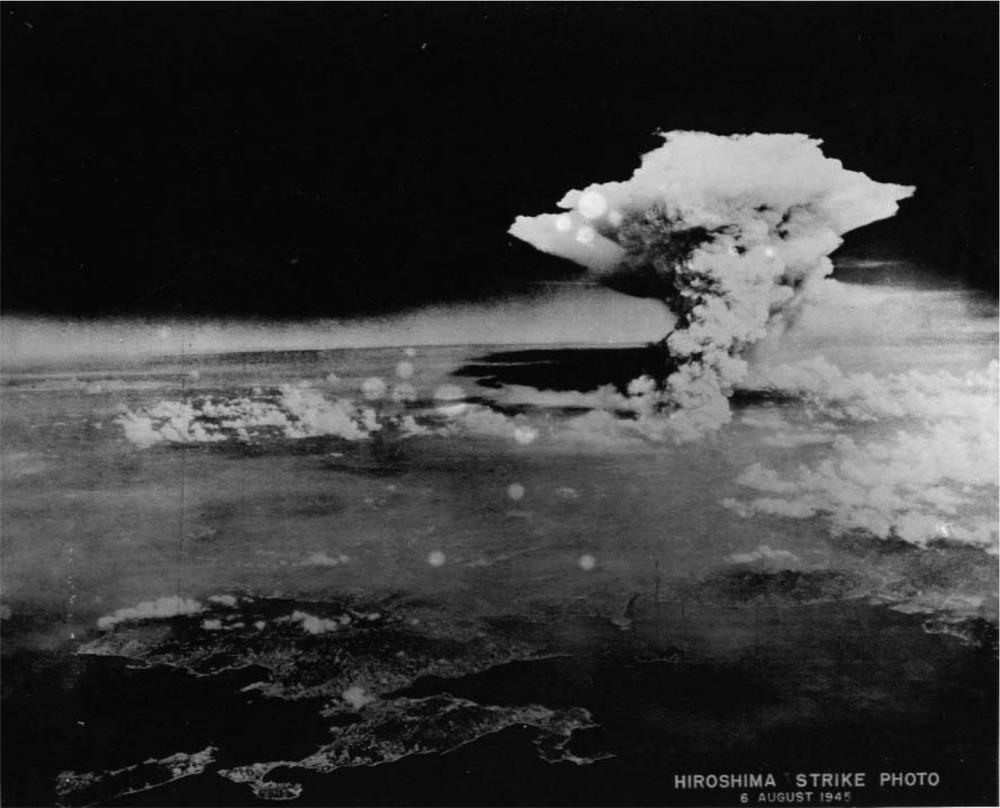
Firestorm cloud over Hiroshima, near local noon, August 6th 1945
A Huge Problem
Col. Tibbetts notwithstanding, great-power war is clearly nearing the end of the road. Small countries and non-state groups can still achieve some of their political goals through organised violence, but the great powers will literally be destroyed by it if they cannot break the habit.
Two perhaps small consolations: first, they have never before managed to abstain from fighting each other for so long. And secondly, as a result of the two world wars, a majority of people everywhere have ceased to see war as glorious, and have instead come to see it as a huge problem.
Notes
1. I. S. Bloch, The War of the Future in Its Technical, Economic and Political Relations. English translation by W. T. Stead entitled Is War Impossible?, 1899.
2. Jacques d’Arnoux, ‘Paroles d’un revenant’, in Lieut.-Col. J. Armengaud, ed., L’ atmosphere du Champ de Bataille, Paris: Lavauzelle, 1940, 118–19.
3. J. E C. Fuller, The Second World War; 1939–1945: A Strategic and Tactical History, New York: Duell, Sloan and Pearce, 1949, 140.
4. Ibid., 170; Keegan, op. cit., 309.
5. Henry Williamson, The Wet Flanders Plain, London: Beaumont Press, 14–16. Williamson was nineteen years old during the Battle of the Somme.
6. Arthur Bryant, Unfinished Victory, London: Macmillan, 1940, 8.
7. Aaron Norman, The Great Air War, New York: Macmillan, 1968, 353.
8. Bryan Perret, A History of Blitzkrieg, London: Robert Hale, 1983, 21.
9. Jonathan B.A. Bailey, ‘The Birth of Modern Warfare’, in Knox and Murray, op. cit., 142–45.
10. Sir William Robertson, Soldiers and Statesmen, London: Cassell, 1926, I, 313.
11. Theodore Ropp, War in the Modern World, rev. ed., New York: Collier, 1962, 321, 344.
12. Guy Sajer, The Forgotten Soldier, London: Sphere, 1977, 228–30.
13. Giulio Douhet, The Command of the Air, London: Faber & Faber, 1943, 18–19.
14. Max Hastings, Bomber Command, London: Pan Books, 1979, 129.
15. Martin Middlebrook, The Battle of Hamburg, Allan Lane: London, 1980, 264–67.
16. Craven and Cate, US Army Air Forces, Chicago: University of Chicago Press, 1948, vol. 5, 615–17.
17. H. H. Arnold, Report… to the Secretary of War; 12 November 1945, Washington: Government Printing Office, 1945, 35.
18. Leonard Bickel, The Story of Uranium: The Deadly Element, London: Macmillan, 1979, 78–79, 198–99, 274–76.