
Cultural Lag

I’m not saying we wouldn’t get our hair mussed, Mister President, but I do say not more than ten or twenty million dead depending on the breaks.
General ‘Buck’ Turgidson (George C. Scott) in Stanley
Kubrick’s 1963 film Dr. Strangelove; or, How I Learned to
Stop Worrying and Love the Bomb.
Kubrick intended General Turgidson as a caricature of General Curtis E. LeMay, long-serving commander of the US Air Force’s Strategic Air Command (SAC), who really did want a nuclear war. ‘LeMay believed that ultimately we’re going to have to confront these people with nuclear weapons, and by God, we’d better do it when we have greater superiority than we will have in the future,’ explained former US defence secretary Robert S. McNamara in the 2003 documentary film ‘Fog of War’. For LeMay, nuclear weapons had not changed anything fundamental: he thought that a seventeen-to-one US ‘advantage’ over the Soviet Union in the number of nuclear weapons (in the early 1960s) was a useful strategic asset. He was a victim of cultural lag.
The most dangerous part of the Cold War was the early years, when men like LeMay still occupied positions of power. They were gradually succeeded by people who grasped the basic concept of deterrence, and the world became a somewhat safer place – but it remains a seriously dangerous place.
Nuclear weapons have dominated strategic thinking in the great powers for 75 years, yet we know practically nothing about how they would actually work in war when used in large numbers. Two quite small ones were dropped on Japanese cities in 1945, and none have been used in war since. It means that strategists discussing nuclear war are like virgins discussing sex: they have theories and even doctrines about nuclear war, but they do not know how it would work, except that it would be very bad. They are equally uncertain about the psychological effects, the electromagnetic effects, and the climate effects. But all the useful evidence we have comes from the forty-five-year confrontation between the United States and the Soviet Union (1945–1990) that is known as the Cold War.
The writer… is not for the moment concerned about who will win the next war in which atomic bombs are used. Thus far the chief purpose of our military establishment has been to win wars. From now on its chief purpose must be to avert them. It can have almost no other useful purpose.
Bernard Brodie, 19461
Bernard Brodie had just joined the Institute of International Studies at Yale University when the first atomic bomb fell on Hiroshima. Much of the American academic community fantasised about creating a ‘world government’ to prevent nuclear war, but Brodie and a small group of colleagues who knew that wasn’t going to happen had begun working out the rules for survival in a world of stubbornly independent nation-states armed with nuclear weapons. In two conferences in September and November 1945, and in innumerable private arguments, they created the theory of nuclear deterrence – complete, definitive, and beyond argument.
‘Everything about the atomic bomb is overshadowed by the fact that it exists and that its destructive power is fantastically great,’ Brodie wrote. There could be no effective defence against atomic weapons, since all defence in aerial warfare works by attrition, and if only a small number of nuclear weapons got through, the destruction would be utterly unacceptable. On their single best day, British defences against V-1 cruise missiles aimed at London in 1944 shot down 97 out of 101. But, he pointed out, if the four exceptions had been atomic bombs, ‘London survivors would not have considered the record good.’
Moreover, there was a limited number of targets in any country, mostly cities, that were worth using a nuclear weapon on, and the destruction of those targets would effectively amount to the destruction of the society. Beyond a certain point, therefore, the relative numbers of nuclear weapons possessed by each side did not matter: ‘If 2,000 bombs in the hands of either party is enough to destroy entirely the economy of the other, the fact that one side has 6,000 and the other 2,000 will be of relatively small significance.’2
The only sane military policy was therefore deterrence. Actually using nuclear weapons to attack a nuclear-armed enemy was pointless, since each side ‘must fear retaliation, [and] the fact that it destroys the opponent’s cities some hours or even days before its own are destroyed may avail it little…’ The main goal of military preparations in peacetime should be to ensure that a country’s nuclear weapons systems will survive a nuclear attack, by dispersing them, hiding them and/or digging them in. The only source of safety against a nuclear attack is a guaranteed ability to retaliate with nuclear weapons.3

There was nothing important left to add. By February 1946, Bernard Brodie and his colleagues had defined the terms on which the peace might be kept in a nuclear-armed world until, someday, the international system that breeds war could somehow be changed. But nobody in power was listening to this little band of young civilians who dared to make policy proposals on military affairs.
To be fair, the US government didn’t have to take Brodie’s advice in 1946. It was still a conventionally armed world with just one nuclear power, the United States, so deterrence was a one-way street. Indeed, the US government and its European allies saw the American nuclear monopoly as a cheap solution to the West’s military security problems. As the United States and the Soviet Union drifted from being wartime allies into a postwar confrontation, the Russians built up their conventional forces in Europe, but the US just built more and more atomic bombs. When the Russians tested their own atomic bomb in 1949, the US doubled down and developed far more powerful hydrogen bombs (thermonuclear weapons). Right through the 1950s the United States had at least a ten-to-one lead over the Soviet Union in nuclear weapons, and it said publicly and repeatedly that it would use nuclear weapons first, directly on Soviet cities, in response to any unacceptable Soviet act.
Basically, American nuclear policy has been a stated policy of war-fighting with nuclear weapons from the beginning.
Robert McNamara, US secretary of defence, 1961–684
US Secretary of State John Foster Dulles formally enshrined this policy in the doctrine of ‘massive retaliation’ in a speech of January 1954, announcing that the United States would ‘depend primarily upon a great capacity to retaliate, instantly, by means and at places of our own choosing.’ Retaliate with the massive use of American nuclear weapons on the Soviet homeland, that is, in response to any Soviet military operation, even a non-nuclear one, that threatened American interests anywhere in the world.

It was the exact opposite of the policy of ‘minimum deterrence’ advocated by Bernard Brodie and his colleagues, many of whom were now working as civilian defence analysts at the RAND (Research and Development Corporation) think tank in Santa Monica, California, which was founded and supported by the US Air Force. They were rightly convinced that once the Soviet Union achieved the ability to deliver a quite limited number of thermonuclear weapons on US cities, it simply wouldn’t matter that America had a lot more of them, and in 1957 they were afraid that the Russians were nearing that goal. So they persuaded their superiors to warn General LeMay, still running Strategic Air Command, that the growing Soviet bomber fleet might ‘Pearl Harbor’ SAC on the ground.
LeMay wasn’t at all worried. He simply replied that US reconnaissance planes were flying secret missions over Soviet territory twenty-four hours a day.
If I see the Russians are amassing their planes for an attack, I’m going to knock the shit out of them before they take off the ground. I don’t care [if it’s not national policy]. It’s my policy. That’s what I’m going to do.
Gen. Curtis LeMay5
There is no reason to doubt that LeMay would have done a thorough job – nor that he would have finished the job by destroying most Soviet cities at the same time, since this sort of thing is bound to leave a grudge and no one would want the Russians coming back later for revenge. It is not clear whether he would have apologised if (a) it subsequently became clear that his intelligence people had misinterpreted Soviet movements and they weren’t really planning an attack after all, or (b) the whole world went dark and cold.
As the 1950s neared their end, however, the civilian authorities in Washington were getting anxious about the implications of US strategy. As President Dwight Eisenhower said in 1957, ‘You can’t have this kind of war. There just aren’t enough bulldozers to scrape the bodies off the streets.’6 One year later, John Foster Dulles went to the Pentagon and formally told the Joint Chiefs of Staff that he was abandoning the policy of massive retaliation.7
However, the Eisenhower administration also rejected any suggestion that it should build up US conventional forces in order to fight the wars that it no longer thought could be deterred by massive retaliation. Eisenhower simply ignored SAC’s blatant manipulation of intelligence reports to predict a looming ‘bomber gap’ in the Soviet favour from 1955 to 1957, and then an equally mythical ‘missile gap’ from 1957 to 1960. A former career soldier, wise in the ways of the armed services, Eisenhower knew that LeMay was just trying to blackmail him into giving SAC more bombers and missiles. He saw no likely major war on the horizon and simply refused to embark on any kind of crash program to build up further a military establishment that was already terrifying enough to the Soviets for any practical purposes. After all, by 1960 the US had six or seven thousand thermonuclear bombs, all of them dozens of times more powerful than the Hiroshima-scale bombs.8
Proliferation
No country without an atom bomb could properly consider itself independent.
Charles de Gaulle, President of France, 19689
During the frantic wartime drive to develop atomic bombs before (so they feared) the Germans got them, Britain and Canada had voluntarily merged their considerable resources of scientific talent, technology and uranium ore with the US-based Manhattan Project, but there had been no agreement about sharing the actual nuclear weapons that emerged from that project. Naturally, the US government had no intention of sharing them – which produced markedly different responses in the other two countries. Canada, despite the significant part it had played in the war, had no pretensions to a global military role, so it decided virtually without debate that nuclear weapons were irrelevant to its security. Britain looked at the Soviet army sitting in the middle of Germany, less than 400 miles away, and concluded that it urgently needed nuclear weapons of its own in case things went wrong.
France reached exactly the same conclusion and launched its own nuclear weapons program. Once the Chinese Communist regime fell out with Moscow in the late 1950s, it too launched a nuclear weapons program designed to deter a Soviet nuclear attack – and in every case, these were ‘minimum deterrent’ forces. None of these nations had the ability to place a nuclear weapon on every missile silo and small town in the Soviet Union, as the United States had, but they did not think it necessary.
The French spoke of being able to ‘tear an arm off the Soviet bear.’ The British had an explicit ‘Moscow criterion’ for their nuclear forces: so long as Britain could obliterate Moscow, they calculated, the Russians would probably not use nuclear weapons against British targets. But both countries also privately saw their nukes as a way of ensuring that Washington’s nerve did not fail in the face of a Soviet conventional attack in Europe. Despite all America’s promises of ‘massive retaliation’, it might decide on the day to let western Europe go under rather than launch a nuclear war in which American cities would also burn. Independent British and French nuclear forces guaranteed that that wouldn’t happen. To ensure that their missiles couldn’t be eliminated in a surprise first strike, both countries also emulated the American example and sent some of their missiles out to sea in submarines.
During the 1980s, both Britain and France embarked on an expansion of their nuclear forces, giving them the ability to destroy close to a thousand targets each. China, while showing more restraint on the numbers issue, sent some of its nuclear missiles out to sea in submarines as soon as possible, as a policy of minimum deterrence dictates. Israel, whose first nuclear weapons were probably built in the mid-1960s, did not put any of them into submarines until much later, because it had no reason to fear that it might lose its weapons to an Arab surprise attack. No Arab country then or now possesses nuclear weapons, so Israel was free to pursue an undeclared strategy of ‘massive retaliation’: all Arab states knew that an Israeli military defeat in a conventional war could trigger the use of Israeli nuclear weapons. Anecdotal evidence strongly suggests that Israel was actively preparing to use its nuclear weapons during the first few panic-stricken days of its 1973 war with Egypt and Syria.
The signature of the Nuclear Non-Proliferation Treaty of 1968, in which the five declared nuclear weapons powers agreed not to transfer their weapons to other countries, and over a hundred other countries agreed not to develop nuclear weapons themselves, put an end to this twenty-year period during which the number of countries possessing nuclear weapons jumped from one to six. Israel just kept quiet about it, and thirty years passed before another country openly went nuclear.
The Fallacy of Limited Nuclear War
I thought they were the most dangerous, depraved, essentially monstrous people. They really had constructed a doomsday machine.
Daniel Ellsberg, 1961
When the Kennedy administration came to office in 1961 (much helped electorally by the ‘missile gap’ myth), it brought a whole group of analysts from RAND to the Department of Defence. One of them, Daniel Ellsberg, was shown the first Single Integrated Operational Plan (SIOP), which allocated targets for nuclear weapons among all the various branches of the US armed forces. He was shocked: SAC’s only war plan was to launch all US nuclear weapons at once against every city and significant military target in the Soviet Union and China, and most of those in eastern Europe as well. Nothing would be held back for a second strike, there was no way to leave China and the Soviet-occupied ‘satellite’ countries in eastern Europe out, even if they were not involved – and the strike would kill between 360 and 425 million people, more than one-tenth of the world’s population at the time. Since every branch of the US armed forces wanted to get its own nukes on Moscow, the Soviet capital would be hit by 170 different atomic and hydrogen bombs.10
Robert McNamara, Kennedy’s secretary of defence, had the same SIOP briefing as Ellsberg and was similarly appalled, but SAC had foreseen that and came up with a new idea less offensive to civilian sensibilities. In the Air Force’s new scenario, the United States, unable to stop a Soviet attack in western Europe with conventional forces, strikes at Soviet bomber fields, missile sites and submarine pens with nuclear weapons, but avoids hitting Soviet cities and holds part of its force in reserve. The Soviets strike back but avoid attacking US cities. Since the United States launched first, it wins the ‘counterforce’ exchange and then tells the Soviets to surrender or it will pick off their cities one by one. Moscow surrenders, and the total cost of the war is ‘only’ three million American lives and five million Soviet lives.
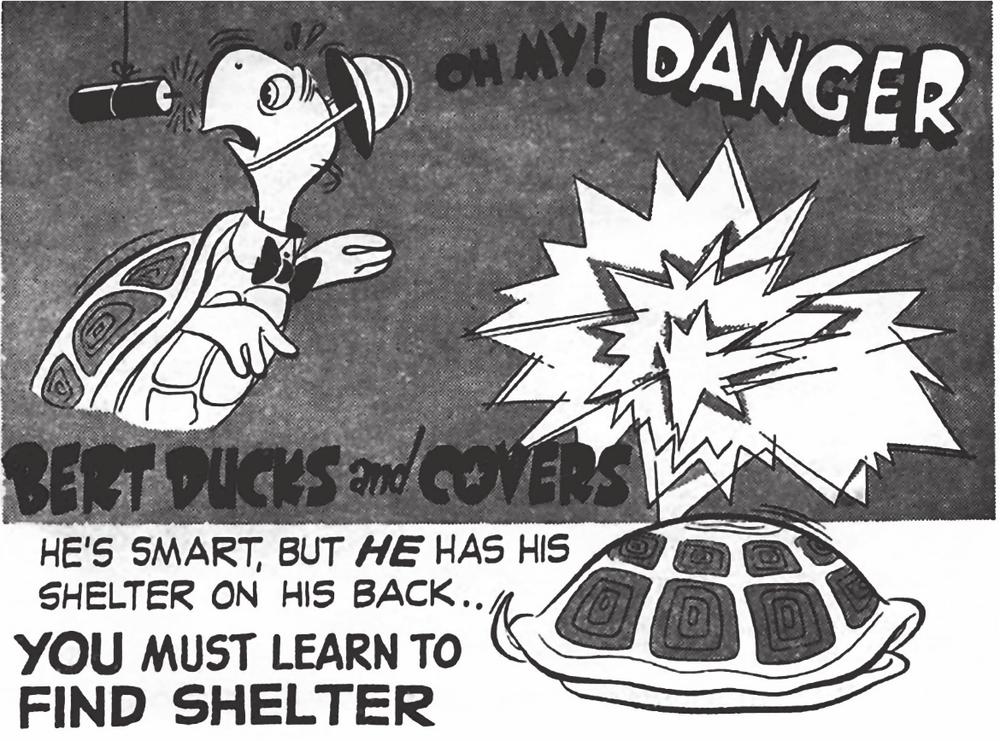
Theatrical release poster for ‘Duck and Cover’, dir. Anthony Rizzo, 1952
McNamara was sucked in by this ‘counterforce’ strategy, which sounded significantly less crazy than the existing SIOP, and told SAC to go ahead and develop a doctrine that ‘would permit controlled response and negotiating pauses’ in the event of thermonuclear war. By the end of the year, the revised US strategic plan, SIOP-63, allowed the commander to reprogram the targets of American missiles on short notice and to fire them singly or in small numbers (rather than in minimum batches of fifty). It became theoretically possible for the United States to fight a ‘limited’, no-cities nuclear war – if the Russians agreed.11 McNamara didn’t really trust this strategy – he privately advised both President Kennedy and President Johnson that they should never use nuclear weapons first under any circumstances – but officially the new SIOP assumed that restraint and rationality could prevail even after nuclear weapons began to explode over the homelands. Events soon demonstrated how far removed that was from reality.
Cuban Missile Crisis

Nuclear warhead bunker under construction in San Cristobal, Cuba, 23 October 1962
In late 1961 the Soviet leader, Nikita Khrushchev, realised that the new American reconnaissance satellites had exposed his claim to possess a large Inter Continental Ballistic Missile force as a mere bluff. Feeling embarrassed and vulnerable, he took the gamble in 1962 of secretly deploying shorter-range missiles on the territory of his new ally, Cuba, in order to put American cities within range of a substantial Soviet missile force and thus close the strategic gap.
The US discovered the missiles, and the Cuban Missile Crisis erupted. The United States declared a blockade of Cuba, and began preparations for an invasion if Khrushchev didn’t withdraw his missiles. And faced with a real crisis, nobody paid the least attention to the idea of a ‘counterforce’ or limited nuclear war.
The Soviet side was much weaker, but at least a few of Khrushchev’s bombers and missiles would get through to devastate American cities no matter what the United States did. Instead, everybody fled back to the relative sanity of Brodie’s original deterrent formula. On 22 October Kennedy declared that the United States would regard ‘any nuclear missile launched from Cuba against any nation in the Western Hemisphere as an attack by the Soviet Union on the United States requiring a full retaliatory response upon the Soviet Union [emphasis added].’12
But there was still some time left, President Kennedy believed, for American intelligence sources were telling him that the Soviet missiles in Cuba still lacked their nuclear warheads. Kennedy therefore concentrated on intercepting Soviet ships that might be carrying the warheads to Cuba, while pushing ahead with the plan to invade the island if Moscow did not back down. And after a terrifying thirteen days, Moscow did back down. Khrushchev sent a letter to Kennedy offering to withdraw the Soviet missiles from Cuba in return for an American promise not to invade the island and to withdraw similar American missiles from Turkey a few months later.
Nobody on the American side realised at the time just how close they had come to a nuclear war. If Khrushchev had not sent his proposal for a compromise, the US invasion of Cuba would probably have gone ahead, but everybody in Washington assumed that there would be at least a few more steps in the dance before nuclear weapons were actually used. Thirty years later, Robert McNamara found out that everybody in Washington had been dead wrong.
It wasn’t until January, 1992, in a meeting chaired by Fidel Castro in Havana, Cuba, that I learned that 162 nuclear warheads including 90 tactical warheads were on the island at this critical moment of the crisis. I couldn’t believe what I was hearing, and… I said, ‘… Mr President [Castro], I have three questions to you. Number one, did you know the nuclear warheads were there? Number two, if you did, would you have recommended to Khrushchev in the face of a US attack that he use them? Number three, if he used them, what would have happened to Cuba?’
He said, ‘Number one, I knew they were there. Number two… I did recommend to Khrushchev that they be used. Number three, what would have happened to Cuba? It would have been totally destroyed.’
That’s how close we were… and he went on to say, ‘Mr McNamara, if you and President Kennedy had been in a similar situation, that’s what you would have done.’ I said, ‘Mr President, I hope to God we would not have done it. Pull the temple down on our own heads? My God!’
Robert McNamara, from The Fog of War13
Threatening to pull the temple down on your own head and everybody else’s is the very essence of nuclear deterrence, but there is a measure of reassurance to be had from these events. The Cuban crisis demonstrated that the penalties for miscalculation in a nuclear confrontation are so huge that political leaders become extremely cautious and conservative in their actions; people do recognize the difference between simulation and reality.
On the other hand, it also demonstrated that intelligence will always be imperfect and that seemingly rational decisions may actually be fatal. If the United States had invaded Cuba to deal with the missiles before they were operational (as it thought), its Marines would have been obliterated on the beaches by tactical nuclear missiles launched by local Soviet commanders who had been pre-authorised to act without reference back to Moscow, and World War III would have begun. President Kennedy later estimated that the chance of the Cuban crisis ending in a nuclear war was one in three.14
The Cuban Missile Crisis ought to have ended for good the notion of a limited nuclear war in American strategic circles: nobody seriously considered ‘signalling their resolve’ with a few selective nuclear strikes when they were immersed in a real crisis. Nevertheless, the next twenty years of American nuclear war policy were largely dominated by the continuing split between the believers who wanted to make nuclear weapons usable in limited wars and those who had finally lost the faith.

Engineers or Soldiers?
By the early 1980s US doctrine for fighting a nuclear war had become a structure of such baroque and self-referential complexity that it had only a distant relationship with the real world. It was almost as separated from reality as the missile crews who sat the long watches underground in their reinforced concrete command bunkers.
Q. How would you feel if you ever had to do it for real?
A. Well, we’re trained so highly in our recurrent training that we take every month… that if we actually had to launch the missiles, it would be an almost automatic thing.
Q. You wouldn’t be thinking about it at the time?
A. There wouldn’t be time for any reflection until after we turned the keys…
Q. Would there be reflection then, do you think?
A. I should think so, yes.
Conversation with Minuteman ICBM crew commander, Whiteman Air Force Base, 1982

Minuteman crew member during ‘personnel reliability’ testing
As late as 1945 the bomber crews could see the cities burning beneath them (though not the people), but a Minuteman launch crew never sees its targets, which are 6,000 miles away. The young man quoted above wore a label on his pocket that said ‘combat crew,’ and he would probably have been killed if there had been an ‘exchange’ of nuclear-tipped ballistic missiles, but he was not a warrior. His job, in practice, closely resembled that of the duty engineer at a nuclear power plant, and he passed the long hours of his watch working on a correspondence course for an MBA. Not a lot like your average infantryman – but then nuclear war is not really a military enterprise in any recognizable sense.
Star Wars
By the early 1980s, the five nuclear powers had accumulated a total of over 2,500 land-based ballistic missiles, well over a thousand submarine-launched ballistic missiles, and thousands of aircraft capable of carrying nuclear bombs, plus land-, sea- and air-launched cruise missiles and a wide range of ‘battlefield’ nuclear weapons. There were more than 50,000 nuclear warheads in the world – and then President Ronald Reagan introduced the concept of the Strategic Defense Initiative (‘Star Wars’).

The promoters of Star Wars never believed that it could completely shield the United States from a nuclear attack, for Bernard Brodie’s 1946 observation remained true: all air (and space) defence operates on the principle of attrition, which means that some portion of the attacking weapons will always get through. If they are nuclear weapons, even a very small fraction is too many. But space-based US defences might eventually be able to cope with a ragged retaliatory strike if the Soviet Union had already been devastated by a largely successful American first strike.
President Reagan himself never realised what the people who sold him on the Star Wars concept were really after. It wasn’t blanket national protection against nuclear attack, but a partial defence for the missile fields and other strategic installations from which the United States might one day try to wage and win a limited nuclear war. It was the same old game they had been playing for twenty years, but they appealed to his genuine aversion to nuclear weapons, and he fell for it because of his longing for a magical release from the threat of nuclear war. The Russian leadership understood very well what Reagan’s secretary of defence, Caspar Weinberger, and the Cold Warriors around him were up to, and they were not happy about it.
On the face of it, laymen may find it even attractive as [President Reagan] speaks about what seem to be defensive measures… In fact the strategic offensive forces of the United States will continue to be developed and upgraded at full tilt [with the aim] of acquiring a first nuclear strike capability… [It is] a bid to disarm the Soviet Union.
Soviet leader Yuri Andropov, 198315
End of Evil Empire
The Cold War never quite turned hot. Promising changes began in the Soviet Union after the death of long-ruling dictator Leonid Brezhnev in 1982, and by 1985 a radical reformer called Mikhail Gorbachev came to power. Ronald Reagan’s desire to end the threat of nuclear war was equally genuine, and at the Reykjavik summit in 1986 he horrified his advisors by proposing that both countries get rid of all their ballistic missiles. Basing nuclear deterrence only on relatively slow-moving bombers and cruise missiles would make the world a safer place, he argued.
That particular initiative was shot down by both men’s advisers, but on Gorbachev’s first visit to the US in 1987, the two men signed the Intermediate Nuclear Forces treaty, ending the panic over the introduction of a new generation of nuclear missiles in Europe. By the time Reagan visited Moscow in June, 1988, he declared that ‘of course’ the Cold War was over, and that his ‘evil empire’ talk was from ‘another time.’ Even before the fall of the Berlin Wall in the following year, the United States and the Soviet Union had ceased to be strategic adversaries.

Reagan and Gorbachev meet for the first time in Geneva, November 1985
So the first long military confrontation between two nuclear-armed powers ended peacefully, but it offered no guarantees for the future. It could have been just forty years of dumb luck, for it came close to the actual use of nuclear weapons several times, and new technologies continually unleashed new instabilities into the system.
Moreover, only at the very end did everyone find out what would have happened if all those weapons had ever been used.
Nuclear Winter
We have, by slow and imperceptible steps, been constructing a Doomsday Machine. Until recently and then, only by accident – no one even noticed. And we have distributed its triggers all over the Northern Hemisphere.
Carl Sagan16
In 1971 a small group of scientists who had gathered to analyse Mariner 9’s observations of Mars found that the entire planet was covered by an immense dust storm that lasted three months. With nothing better to do, they passed the time by calculating how such a long-lasting dust cloud would alter conditions on the Martian surface. Answer: it would lower the ground temperature drastically.
The dust storm was still raging, so they then examined meteorological records to see if exploding volcanoes here on Earth (which boost relatively small amounts of dust into the upper atmosphere) produced similar effects. Every time a major volcano has gone off, they found, there has been a small drop in the average global temperature lasting a year or more.
This was interesting – and the surface of Mars was still obscured – so they went on to examine the consequences of stray asteroids colliding with the earth and blasting vast quantities of dust into the atmosphere. That had happened numerous times in the long past and there was evidence that at least one of these collisions resulted in temporary but huge climate changes that caused mass extinctions of living things.
Then the dust storm on Mars ended, they analysed Mariner 9’s data, and they went their separate ways. But they stayed in touch (they called themselves the TTAPS, after the first letters of their last names) and kept working on the new problem they had stumbled on. Twelve years later, in 1983, they published their results.
A major nuclear exchange, the TTAPS group concluded, would cover at least the northern hemisphere, and perhaps the entire planet, with a pall of smoke and dust that would plunge the surface into virtual darkness for up to six months. In the continental interiors, the surface temperature would drop by up to 40 degrees C (below the freezing point in any season) for a similar period. And when enough of the dust and soot particles drifted down from the stratosphere to let the sun’s light back in, the destruction of the ozone layer by thermonuclear fireballs would let two or three times as much ultraviolet light reach the surface, causing blindness or lethal sunburn in exposed humans.17
Everybody already knew that a major nuclear war would instantly kill several hundred million people in the NATO and Warsaw Pact countries and destroy most of the world’s industry and its artistic, scientific, and architectural heritage. Fallout and the disruption of northern hemisphere agriculture would cause hundreds of millions more deaths from famine and disease in the aftermath. But the prospect of a ‘nuclear winter’ was much worse.
Now we knew that the cold and the dark would persist worldwide for half a year after a major nuclear war, killing off entire species of animals and plants already weakened by high doses of radioactivity – and that when the gloom finally cleared, ultraviolet radiation, starvation, and disease would account for many others. In April 1983, a symposium of forty distinguished biologists concluded:
Species extinction could be expected for most tropical plants and animals, and for most terrestrial vertebrates of north temperate regions, a large number of plants, and numerous freshwater and some marine organisms… It is clear that the ecosystem effects alone resulting from a large-scale thermonuclear war could be enough to destroy the current civilization in at least the Northern Hemisphere. Coupled with the direct casualties of perhaps two billion people, the combined intermediate and long-term effects of nuclear war suggest that eventually there might be no human survivors in the Northern Hemisphere…
In almost any realistic case involving nuclear exchanges between the superpowers, global environmental changes sufficient to cause an extinction event equal to or more severe than that at the close of the Cretaceous when the dinosaurs and many other species died out are likely. In that event, the possibility of the extinction of Homo Sapiens cannot be excluded.
Paul R. Ehrlich et al., ‘The Long-Term Biological Consequences of Nuclear War’, Science, vol. 222
How many nuclear weapons would be needed to produce these effects? It depends what kind of war you are fighting. If it’s the sort of ‘limited’ nuclear war, beloved of the theorists, where each side only attacks the other side’s airfields, missile silos, etc., and avoids cities, quite a lot. It would take up to two or three thousand high-yield ground-bursts to produce a nuclear winter. But the total nuclear weapons stockpile of the United States and the Soviet Union in the mid-1980s was about thirteen thousand megatons, which was ample to fight that kind of war.
The threshold is much lower for a war in which cities are hit, because the millions of tons of soot given off by burning cities would be a very powerful screening agent. As few as one hundred one-megaton airbursts over one hundred cities could be too much19. Even India and Pakistan are approaching that threshold, and it is unrealistic to imagine that cities would really be spared in a nuclear war: too many of the vital leadership, command and control, and industrial targets are embedded in them. Cities would be struck, and they would burn.
There was a great deal of research done on ‘nuclear winter’ in the later 1980s, and the hypothesis held up despite major official efforts to discredit it. In 1990 the TTAPS group summarised the research in Science20, and reported that ‘the basic physics of nuclear winter has been reaffirmed through several authoritative international technical assessments and numerous individual scientific investigations.’ Little further research has been done on nuclear winter since 1990, due to the sudden loss of interest in the subject of nuclear war after the collapse of the Soviet Union. It’s as though the nuclear weapons themselves had been abolished. But they have not.
Our Way of Thinking
It is now three-quarters of a century since any great power has directly fought any other, the longest interlude between such events since the emergence of the modern state system in the mid-1600s. But no great power has renounced war as an instrument of policy, and war between great powers, in our technological era, probably means nuclear war. There will be new confrontations between the great powers in the decades and centuries to come, and they will doubtless involve the same sorts of doctrinal mismatch, cultural misunderstanding, and technological hubris that marked the first one.
We have arrived at the dilemma that has lain in wait for us from the start: war is deeply ingrained in our culture, but it is lethally incompatible with an advanced technological civilisation. Albert Einstein saw it clearly in 1945: ‘Everything has changed, except our way of thinking.’

‘Everything has changed except our way of thinking’ Albert Einstein
Notes
1. Bernard Brodie, ed., The Absolute Weapon: Atomic Power and World Order: New York: Harcourt Brace, 1946, 76.
2. Fred Kaplan, The Wizards of Armageddon, New York: Simon & Schuster, 1983, 26–32.
3. Ibid.
4. Gregg Herken, Counsels of War, New York: Knopf, 1985, 306.
5. Kaplan, op. cit., 133–34.
6. Herken, op. cit., 116.
7. Gerard C. Smith, Doubletalk: The Story of the First Strategic Arms Limitation Talks, Garden City, N.Y.: Doubleday, 1980, 10–11.
8. Desmond Ball, ‘Targeting for Strategic Deterrence,’ Adelphi Papers, No. 185 (summer 1983), London: International Institute for Strategic Studies, 40.
9. New York Times, 12 May 1968.
10. Herken, op. cit., 143–45; Ball, op. cit., 10.
11. Kaplan, op. cit., 242–43, 272–73, 278–80; Herken, op. cit., 51, 145; Ball, op. cit., 10–11.
12. Robert F. Kennedy, Thirteen Days: A Memoir of the Cuban Missile Crisis, New York: Norton, 1968, 156.
13. From The Fog of War
14. See ‘The Cuban Missile Crisis, 1962: A Political Perspective After Forty Years,’ in The National Security Archive of The George Washington University (website) at http://www.gwu.edu/~nsarchiv/nsa/cuba_mis_cri/
15. McGeorge Bundy, George F. Kennan, Robert S. McNamara and Gerard Smith, ‘The President’s Choice; Star Wars or Arms Control,’ Foreign Affairs 63, no. 2 (Winter 1984–85), 271.
16. Carl Sagan, ‘Nuclear War and Climatic Catastrophe: Some Policy Implications,’ Foreign Affairs, Winter 1983/84, 285.
17. Turco, R.P., Toon, A.B., Ackerman, T.P., Pollack, J.B., Sagan, C. [TTAPS], ‘Nuclear Winter: Global Consequences of Multiple Nuclear Explosions’, Science, Vol. 222 (1983), 1283–1297; and Turco, R.P., Toon, A.B., Ackerman, T.P., Pollack, J.B., Sagan, C. [TTAPS], ‘The Climatic Effects of Nuclear War’, Scientific American, Vol. 251, No. 2 (Aug.1984), 33–43.
18. Paul R. Ehrlich et al., ‘The Long-Term Biological Consequences of Nuclear War,’ Science, vol. 222, no. 4630 (December 1983), 1293–1300.
19. Sagan, op. cit., 276; Turco et al., op. cit., 38.
20. Science, Vol. 247 (1990), 166–76.