
Immediately after the war interviews were conducted with Luftwaffe personnel who had experience of the tactical and operational realities of engaging in combat using the JU-87. These fascinating interviews are reproduced here as they produce an absorbing insight into the reality of the fighter bomber formations in combat.
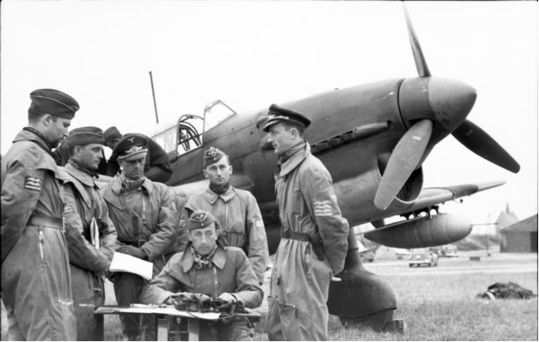
Pilots receive a final briefing before take off during the battle for France 1940.
Organization of ground attack units
By Generalmajor Hitschhold at Latimer House, England, 20 October 1945.
A. Aircraft.
Day ground attack units were organized into Geschwaders of three Gruppen. Each Gruppe had three Staffeln. Each Staffel had 12 aircraft. If it had been possible to enlarge the size of ground attack units, no new Gruppen would have been added, but instead the number of aircraft and pilots in each Staffel would have been raised to 16.
The existing organization of the units would thereby have been better used. By a slight additional increase in servicing personnel, so the required operational readiness standards could have been maintained. Furthermore, this enlargement would have been necessary on operational grounds.
Weak formations no longer achieved much success in the face of increasing defense, like stronger formations could have. A strong formation was helped by its very appearance and could fight longer and more effectively.
A further increase of the unit strength would have been impractical.
Quick operational turn-around would not have been attainable. Take-off and landing of formations would have lasted too long. This would, with the short endurance of German ground attack aircraft, have reduced penetration and time in combat so much that the units could not have been used to full advantage.
Geschwader and Gruppe staffs had six ground attack aircraft, so that each could put its own Schwarm up in combat and did not need to draw any pilots from any of the Staffeln.
Anti-tank ground attack units had usually about 16-20 a/c and pilots. During 1944 there were independent anti-tank Staffeln in SG 1,2,3, and 77, being the 10th Staffel in each Geschwader. Four other Staffeln were combined into an anti-tank Gruppe. The High Command thus planned to use this one Gruppe almost together for main efforts. With the other 10th Staffeln, they planned to have at least one anti-tank Staffel available on all sectors of the Russian front.
This one anti-tank Gruppe, IV/Pz. S.G.9, was however usually committed in Staffel strength on various parts of the Eastern Front and was seldom used together. In order to score at least halfway effective victories over tank forces, it was necessary that these Staffeln had at least 16 aircraft each.
The following reorganization of anti-tank ground attack units was in process of completion at the end of the war.
With the conversion of the anti-tank units to the F.W.190, three purely anti-tank Gruppen were to be formed with three Staffeln each. In addition, the third Staffel of every regular ground attack Gruppe was to become an anti-tank Staffel. The use of one or two anti-tank Gruppen en masse in an area of main effort was expected to produce good and lasting success.
All anti-tank Staffeln were organized so that parts of the Staffel could use bombs to suppress ground defenses, so that the Staffeln were not bound down by the necessity of relying on other units to suppress air defenses. In the 10th Staffeln of the various Geschwader, outfitted with Ju.87 with 2 x 37mm cannon, one third to one fourth of the aircraft were bomb carrying (the normal version of the Ju.87). The Henschel 129 carried, in addition to its cannon, a 50kg bomb under each wing. Thus, even the Hs 129 units could combat ground defenses independently.
The FW 190 anti-tank aircraft were equipped at first with 12 Panzerschreck (Tank-terror) RP. The rockets were fired in threes from mounts fitted to a wing bomb rack. Later the FW 190 were fitted with 12 Panzerblitz (Tank lightning) RPs. Then the bomb racks had to be taken off each wing and a special rack for 6 Panzerblitz RP built under each wing. The FW 190 anti-tank aircraft could always carry along a bomb under the fuselage and instead of the Panzerschreck rack, bombs could be carried on the wing bomb racks.
Night ground attack Staffeln in the east had 20 aircraft. Two or three Staffeln were combined into a Gruppe. Since no effective night fighter defense existed on the Eastern Front, all types of aircraft could be used. The missions were usually by single ships or small formations.
The quality and performance of the night ground attack units were not up to standard as far as pilots were concerned. Concentrating the night attack Staffeln of each Gruppe onto one airfield was necessary in part because of the inadequate signals net. It was planned, after improving of the quality of the pilots, the state of training, and the serviceability of aircraft, to increase the number of aircraft to 20 per Staffel and to operate each Gruppe from a group of two or three airfields in a small area.
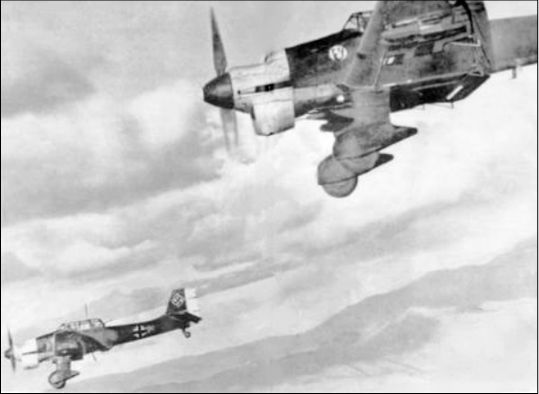
Two German Junkers Ju 87B Stuka dive bombers. From the yellow noses and rudders, this photo was probably taken during the 1941 Balkans campaign.
B. Pilots.
The supply of new pilots for day ground attack operations was good. Those pilots not entirely suitable were detected in time in the schools or in the OTUs. It proved to be very profitable for CO’s of primary schools who had themselves been ground attack pilots to have influence on the selection of men for ground attack forces. By skilled instruction, the good pilots could be inspired with a love of ground attack work so they would volunteer for that branch. The shoving off of poor pilots with the designation of ‘suitable for ground attack work’ was thereby avoided.
But the supply of new pilots alone could not cover the needs of operational units. School units simply did not get sufficient pupils for the ground attack force. Therefore the pilots from other branches had to be grabbed. In general only the pilots relieved from other branches were available. Fighter pilots who had been relieved because of lack of suitability and achievement failed just as badly in the ground attack arm. Only those fighter pilots who were relieved because of altitude trouble and who were otherwise good became good ground attack pilots. Reconnaissance units continually made available surplus officer pilots but only pilots from SE reconnaissance units were of use. These pilots in general proved good in ground attack operations, since they brought with them as a result of their reconnaissance experience a tactical understanding of ground attack missions.
Former bomber pilots did not usually prove good ground attack pilots. Even the conversion from TE aircraft to the FW 190 proved difficult. They lacked the practical eye for recognizing targets in the air and on the ground, and the necessary maneuverability for flying formations. Their main advantages lay in their good operational morale and willingness and in their stubborn determination to go ahead at any cost. Usually they were shot down the first time in air combat.
The ideal number of officers for a Staffel was, besides the Staffel CO, three or four young pilots who were mainly used as Schwarm leaders. The rest of the pilots were NCOs. In the last months of the war, these figures were rarely reached because of the bad officer supply situation, which caused serious difficulties.
The pilots of night ground attack units which were not outfitted with the FW 190 were worthless, unsuited for day fighter or day ground attack operations. The night ground attack units were supplied with relieved pilots so far as they had no character deficiencies, some from transport units and some from liaison units. Since enough of these pilots were available, the need could be covered after careful selection. These pilots who could not measure up to the new operational requirements when their units converted from the Ju.87 to the FW 190 usually became good night ground attack pilots. Finally old instructors from primary schools proved very good night ground attack pilots, those who were too old to be used for day fighter or day ground attack work. The FW 190 night ground attack pilots had to be well trained, good quality pilots, and replacements could not be made from surpluses of not fully capable pilots.
The quality of officers in night ground attack units was decidedly worse than that of day ground attack units, because many old officers who had long been on staff work were used in the night units. The Staffel COs had to be very good officers, however.
For anti-tank units, good pilots who had a good knack for gunnery and liked anti-tank work were chosen.
C. Various Staff Positions.
Schwarm CO’s:
Schwarm leaders needed to have sufficient experience in formation flying, in recognition of ground situations, and in recognition of targets on the ground and in the air. He had to have much tactical knowledge to be able to lead a Schwarm on missions.
Staffel COs:
Officers were appointed as Staffel COs only when they had had enough combat experience and when they had proved themselves capable. Thus it was often the case that young officers were used as Staffel COs while in the same Gruppe several old officers were merely used as ordinary pilots and Schwarm leaders.
Gruppe and Geschwader COs:
These were recruited from among old proved and tried Staffel and Gruppe COs. In the ground attack force, the matter was handled as far as possible according to the following principles: a Staffel CO or Gruppe CO who was in line for promotion to a higher position was withdrawn from operations from six months to one year. He was used during this period as Gruppe or Geschwader CO in a training unit. Here he had an opportunity under direction of a Geschwader or Division CO to get acquainted with his new position. When he later took over his operational unit, he brought with him, especially administratively, the necessary knowledge for his new job. Furthermore he could thereby rest up for more missions and make available the latest front experience for the training units. This planned scheme was not always possible to carry through because of the lack of officers for the usual command positions. Officers who were no longer available for operations were put into good positions at the pilots school and officers schools and could from there still help out the ground attack arm by influencing the giving over of good recruits to the ground attack arm.
Technical Officers:
At the beginning of the War, the TOs (technical officers) were always flying officers who in part had been at special T.O. courses. It was then regarded as essential that every formation leader should have some knowledge of technical matters and that the prerequisites for this knowledge were courses and some experience as technical officer. In most cases it was so that the TOs didn’t like to stay off missions, flew along too often, and worried too little about their chief job. The inadequate number of flying officers led to the situation that flying officers were no longer trained as TO and could not be used long enough as TOs to gain experience. The use of old chief mechanics and grounded officer pilots, the latter after a short technical course, proved to be very good. Only to this is attributable the high serviceability of ground attack units (70%).
Adjutant:
It was really planned that only flying officers could serve as adjutants. Activity as adjutant was for every officer a good basis to later become a Gruppe CO. Because of the high rate of loss of officers, the adjutants’ jobs could not any longer regularly be filled with flying officers. For this purpose, grounded officer pilots or suitable reserve officer pilots or suitable reserve officers were used.
Operations and Intelligence Officers:
Experienced officer pilots, who were grounded, or suitable reserve officers were used as operations and intelligence officers. Former reconnaissance pilots were found best suited for intelligence work. For ground attack units, intelligence officers were first introduced toward the end of 1944. In the west, intelligence officers were necessary for Geschwader and Gruppe Staffs. On the Eastern Front one intelligence officer sufficed for one Geschwader. It proved to have been a mistake to have omitted intelligence work in the units.
Meteorologists:
There were only weather men at the individual night ground attack Gruppen, where they were very important. They were superfluous with the day ground attack units. It sufficed for day units to have the weather reports and forecasts reported from higher headquarters, since missions rarely went more than 150 kilometers anyway.
D. Maintenance Personnel.
Strength of maintenance personnel was usually the same as that in Fighter units. The only differences were that there were more bomb personnel and less ordinary ordnance personnel. The strength of technical personnel was so set that the unit could send off an Advance Unit (Vorkomando). This unit was able to prepare a new airfield for the unit and, with the aid of the other key personnel which would come in with the unit’s aircraft, to perform maintenance on the aircraft for operational serviceability. The use of women in Ground Attack units was never carried through, although orders to that effect were given out.
E. Equipping with Technical Equipment.
Outfitting with technical equipment was kept down to a minimum, usually just like fighter units. Since oxygen was rarely ever needed for ground attack operations, oxygen equipment was at a bare minimum. On the other hand proportionally more bomb loading equipment was on hand for bombing up. The equipping of Ground Attack Units was in general so carried through that operations could be flown without dependence on any ground units at all.
F. Equipping with Signals Apparatus and Signals Personnel.
Telephone equipment was supplied so that the unit could have a telephone net connecting all operations rooms, dispersal areas, dwellings, and radio stations. The radio telephones often improvised by the units themselves proved good. They gave good connection between the HQ and dispersal areas, and there were no wires to be damaged. When an airfield was newly occupied, the radio telephones furnished adequate connection until wires were laid down. Its range was sufficient for the normal distance from Hq to dispersal areas. Teletypewriters were available only for Geschwader Hqs. On some occasions independently operating Gruppen were assigned teletypwriter operators by Geschwader HQ. Within the Geschwader, no teletypewriter traffic took place.
The Geschwader staffs were so equipped with radio that they could hook into the command net of the next higher command and also conduct a field order system within their own Geschwader. The Gruppen were correspondingly radio equipped in order to complete this system. The Geschwader and Gruppen both had radio telephone stations. Only the Gruppen had the Tornado radio beacons. At the end of the war, all Ground Attack units (with the exception of some few night unit, were equipped with the FuG 16 (The GAF VHF radio telephone sender transmitter, for air and ground).
A part of the night ground attack units, especially those in the west, and in Italy, were equipped with Egon control procedure personnel. The actual assigning of these personnel to the units proved to be a good idea.
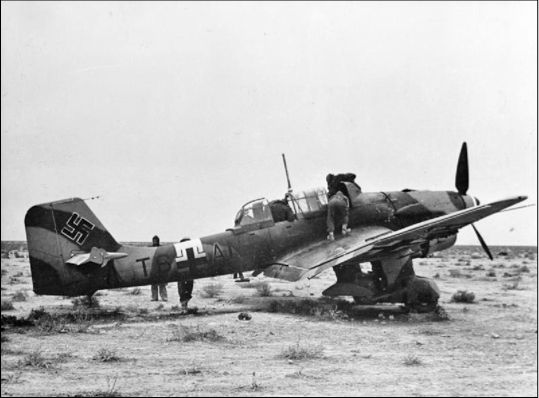
British troops swarm over a captured Ju 87B in North Africa 1941.
G. Mobility and Transfer Organization.
In advance and in retreats the ground attack units lay closer to the front than any other flying units, because of the short ranges of ground attack aircraft and because of the desire to keep high the number of sorties flown by cutting down on the distance flown. In wars of movement, transfers were quite usual. Ground attack units were transferred sometimes on the ground and sometimes in transport aircraft. Complete mobility of the ground personnel and equipment was insured by giving them enough trucks. All ground equipment except that of the motorized repair platoon could be transferred by air. Therefore the ground attack units had in addition to the motorized repair platoon, a flying repair platoon, with equipment that could easily be loaded into transport aircraft. Because of the small amount of air transport space allotted to the various commands, the flying units were allowed only enough space to transport their key personnel. Since these transfers often took place over long distances and were usually intended by the high commands only to last for a few days, the result was that the flying units often had to carry on operations with only their key personnel and serviceability accordingly dropped greatly.
The demand of two transport aircraft for every Gruppe was recognized as justified but could nevertheless not be fulfilled because of the general lack of transport aircraft.
The equipping of ground attack units was in general such that they could with their own personnel and equipment without any support from ground units, except the bringing of bombs and fuel to the airfields, guarantee full serviceability and at the same time maintain an advance or rear party at some other airfield. For transfers over long distances, external tanks had to be given to ground attack units to keep them from having to make constant intermediate landings.
Principles for the control of operations of ground attack units
By Generalmajor Hitschhold at Latimer House, England, 2 October 1945.
The purpose of operations of air force units in the tactical area is to help the army in combat in every possible way. For this purpose, reconnaissance aircraft, fighters, bombers, and ground attack formations are used. Of these formations the ground attack units are the ones which attack enemy ground troops as their chief mission. They are best suited to help the army, especially in the area around the front and in attacks against small but important targets. For their operations, certain principles of command and control have been developed out of experience and are explained below:
I. Requirements for successful ground attack operations.
(a) According to the fighter strength of the enemy, at least air superiority and, better still, control of the air (air supremacy) must be won by friendly fighter forces. If continuous air superiority cannot be achieved, then at least air superiority for the duration of ground attack operations must be insured by the furnishing of adequate fighter strength to support these operations. Otherwise the ground attack operations will not bring about their usual complete success.
(b) Only when signals facilities are adequate is quick support of the army insured. Close co-operation with the army must therefore be made possible by use of the necessary signals organizations and their dependable work. The army and air force listening services must be capable of rapid evaluation of intercepted enemy signals. The same map material with same scales must be used by the army and by the commands and units of the air force, and, when possible, photo maps with practical grids and designation of important points should be used.
(c) Basically only those targets are to be attacked which the army cannot strike or only strike with medium and heavy artillery.
(d) The command organizations of the army must establish a priority list from the great number of demands for support which they desire fulfilled. Operations which are not absolutely necessary must be struck off by the army headquarters themselves. The final decision if and where the attack will take place concerns in all cases, however, the responsible Luftwaffe headquarters. If an attack is to be conducted, it should be done with large forces in order to make sure that it will succeed.
Operations by weak forces are a waste. They bring decisive success at no one point and in the final analysis are ‘morale operations’ which are only justified in a few cases.
(e) Of great significance for a proper and practical control of ground attack operations is the continuous surveying of the tactical area by reconnaissance aircraft. These have to supply ground attack units with necessary targeting material. If such continuous reconnaissance is not possible, the ground attack arm becomes at best a form of mobile long range artillery, and is degraded to a branch of the army, which combats only targets found by ground reconnaissance. Its many-sided operational possibilities would be so employed only to a small extent.
(f) Since German ground attack units possessed a short penetrating range, about 150km., their operational airfields had accordingly to be placed near the front. This close movement to the front -as far as enemy air defense permitted it brought the following advantages: the number of ground attack missions could be raised because of the short flights in and out and the practical duration of the flight over the battle area was not appreciably cut down by the small amount of fuel carried in the aircraft. Furthermore, the signals communications between the fighting troops on the ground, the commands of the army and air force, and the airfields of the units themselves were shorter and therefore more dependable.
Behind advances, suitable emergency landing fields had to be prepared as quickly as possible. At the time of transfer of flying units a sufficient A.A. protection ready for action was needed because of the great danger of strafing attacks. Adequate supplies, especially of bombs and bomb containers, also had to be provided.
II. Operational possibilities.
Ground attack units attacked chiefly the following targets:
(a) Ground troops in assembly areas, in positions, moving, in march, and during loading and unloading.
(b) Heavy weapons, MG, artillery, rocket, cannon, A.A. and RR artillery.
(c) Vehicles of all kinds, especially tanks.
(d) Field fortifications.
(e) Headquarters, houses and settlements.
(f) Bridges, especially military bridges.
(g) Airfields, aircraft on the ground, and in the air.
(h) RR installations, RR trains, especially locomotives.
(i) Shipping targets.
The choice of suitable bombs was mainly the job of the unit itself, but the command organizations had to keep a watch over it and sometimes interfere. This matter is touched upon in the following paragraphs:
(a) Against ground troops:
Ground troops in open country and in positions which offer no cover against air attacks were effectively bombed with small fragmentation bombs of 1, 2, 4, and 10 kilograms, in large containers if possible. Less effective were the 50 and 70kg. fragmentation bombs, even with projecting fuses to make them explode above the ground. These latter bombs had to be used often because of the supplies on hand. Their small effectiveness was continually confirmed, while the smaller bombs dropped in large containers had a bomb carpet effect and still considerable destructive power. A special belting of ammunition -loading the rounds in belts was not used. The belting usually was: 2 HE, one HE incendiary, followed by 2 armor-piercing incendiary or ordinary armor piercing.
(b) Against heavy weapons:
These targets were bombed to destroy personnel with the same bombs used under (a) above. If the cannon stood in the open, without cover (being transported or simply dispersed), then the 50, 70, and 250 kg. fragmentation bombs, all with projecting fuses, are suitable. Strafing attacks were flown against the personnel and the lighter weapons, but they were useless against heavy apparatus. On the other hand, Russian rocket batteries mounted on trucks were destroyed with the greatest effectiveness by strafing attacks. Armored trains and rail-road guns were only successfully bombed with heavy bombs of 250kg. or more.
(c) Vehicles:
Horse drawn and motor vehicles were bombed with 1-70kg. bombs. The same goes for lightly armored vehicles. Tanks could be destroyed with 3, 3.7, and 7.5 cm. cannon, with hollow charge RP, and with 4kg. hollow charge bombs. Bombing with 50-500kg. bombs was not successful because the tanks presented too small a target. Destruction with such bombs was only accomplished if the bomb hit within 15 feet of the tank.
(d) Field fortifications:
Field fortifications of all types could only be attacked with heavy bombs of 250 kg. or more. Attacks on modern prepared fortifications brought no success.
(e) Headquarters:
Parts of towns and houses where headquarters or troops were quartered were attacked with bombs of 250 kg. or larger. Wooden houses, especially with straw roofs, were most practically ignited with incendiary ammunition.
(f) Bridges:
Bridge destruction was a difficult job and usually brought little success. Stone or concrete bridges were only damageable with direct hits from heavy bombs and then only temporarily. Complete collapsing of such a bridge was almost impossible.
Steel bridges were most invulnerable, because the blast effect usually dissipated through the steel work. Only in cases of some lucky hits was the destruction of such bridges possible.
Military bridges were attacked with a mixture of 10-500 kg. bombs. Even so, only temporary interruption of traffic was achieved. Repairs were especially easy for pontoon bridges, if a continuous observation and bombing of the repair work was not possible.
In certain tactical situations, like pursuits, last escape routes out of surrounded areas, flank threats, and bringing up of reserves, the bombing of bridges was of decisive importance and had to be carried on without regard to the success to be expected.
(g) Attacks on airfields:
These served as indirect support for the army. The main point of such attacks was the destruction of dispersed aircraft, which were bombed with small bombs of from 1 to 10 kg. Fixed installations were attacked only at the beginning of the war, because as a result of the ensuing dispersal such attacks were usually uneconomical.
(h) Railroad bombing:
This was a worthy target for ground attack units, especially during the movement of troops in the tactical area. Main points of attack were tracks in and out of stations, and easily blocked sections like bridges and cuts. Attacks on open stretches of track and on unoccupied stations brought no lasting effect. Most practical for these purposes were bombs of 250 kg. and more. Trains in motion were wrecked with heavy bombs and the troops streaming out of them were strafed and bombed with small fragmentation bombs.
Special locomotive-busting missions were especially satisfactory in areas where repair facilities were meager. For destruction of the locomotives, hits with cannon of 3 cm. caliber or greater or with RPs sufficed. Hits with smaller weapons or with bomb fragments only damaged the locomotives, but even this was evidently a great handicap in areas lacking repair facilities.
III. Cooperation of Air Force and Navy:
The principles set out for the cooperation of army and air force are also valid for the cooperation of the navy and the air force. The holding of air superiority and availability of sufficient signals communications are decisive for success of missions. On operations where the friendly shipping force expected contact with enemy air power, special ground attack control headquarters were set up on ships. Similarly the navy coastal commands on shore were assigned liaison and control parties from the ground attack arm.
For attacks on ships, usually the larger ships were attacked because their larger size and poor maneuverability made hits easier to score. Still, only hits by bombs of 250kg. or over would sink them. Smaller ships, like motor torpedo boats, were attacked with cannon or RP. Small fragmentation bombs were also effective, but the possibilities of hitting were small.
IV. Defensive Situations:
Attacks are flown as concentrated attacks on enemy assembly areas, artillery and tank concentrations. Rolling attacks are flown mainly after the beginning of an enemy attack against tanks, artillery and reserve troops, and also against attack spearheads to rob them of their impetus. These attacks are as far as possible continued at night by ground attack units, especially with 2 kg. fragmentation bombs against troop concentrations in defiles.
V. Retreat and Defense against Enemy Breakthroughs:
During disengaging movements and in retreats the enemy is combatted with rolling attacks to gain time and space for friendly troops and to give them back their battle initiative.
For tank breakthrough, the main effort in defense is the use of anti-tank units against tank columns. Rolling attacks were flown against spearheads (which in most fluid situations had to be sought out by the units in the air), against supply columns and choke points around defiles, like bridges, river crossings, etc.
At night the night ground attack units combatted the enemy in rolling attacks in heavily occupied towns or woods, and also supply lines in defiles.
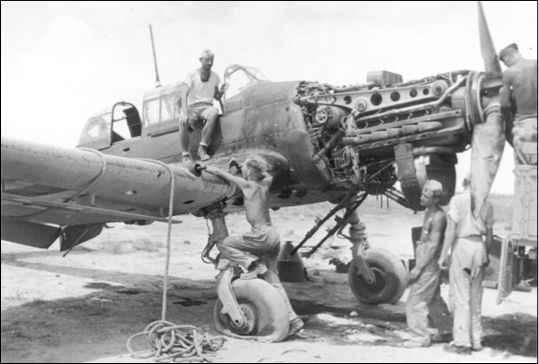
A Stuka in North Africa gets a complete overhaul in a less than perfect environment. Dust was the ever present enemy in North Arfrica.
Ground attack operations
By Generalmajor Hitschhold at Latimer House, England, 5 October 1945.
Command Principles for Operations of Day Ground Attack Units.
Weather and terrain conditions were factors to be taken into account in operations of ground attack units.
Operational minima for weather were considered:
Ceiling 4500 feet for missions over the front and 6000 feet ceiling for missions deep into the tactical area. In all cases A.A. defenses were to be taken into consideration.
In crises ground attack units operated in worse conditions, with a minimum ceiling for front missions of 600-900 feet.
A first principle was that the size of the formation was dependent on the weather. The worse the weather, the smaller the formations, in order not to restrict the maneuverability of the formation. In extremely poor weather flights were restricted to very small formations of especially experienced pilots.
For bad weather operations radar control was planned and provided. The ground attack units were vectored over the clouds or between cloud layers to the vicinity of the target, but they were to carry on the attack themselves independently after going down through the clouds and sighting the earth. (In general, ground attack units attack only targets which they can actually see and recognize.)
Terrain conditions are important for locating targets. Open country makes the finding of targets easy, while obscure country, like wooded areas, makes target locating harder. In very difficult country and in wooded areas, ground attack operations are to be discouraged, because the success to be expected bears no relation to the effort required and the attack can be entirely ineffective. From the command standpoint the following types of ground attack missions are distinguishable:
a) concentrated attack
b) rolling attack
c) free sweep attack
a) Concentrated attack:
For the conduct of a concentrated attack, ground attack units were combined. They were operated at a determined time against clearly defined targets. The time for beginning and ending the attack was ordered to the minute. Forces used were apportioned according to the size and type of the target.
Concentrated attacks were primarily flown in direct support of the army, usually just before the beginning of a ground offensive (like infantry preparation) as a surprise measure. Therefore the duration and time of the attack was determined by the army. Concentrated attacks were flown with bombs and with strafing by ground attack units. The mission was to destroy the enemy or to injure his morale so that after that the ground troops would have little or no defense to contend with.
This was only possible when the Army, immediately after the concentrated attack from the air, took advantage of its effect by launching an attack of its own. Similarly such concentrated attacks make easier the disengaging movements of friendly troops.
Secondly, concentrated attacks were ordered not for direct army support, but as indirect support against special targets which appeared, like heavily occupied airfields, RR stations, troops unloading, and so on. An attack carried through with the element of surprise increased the effect considerably.
From the command side, concentrated attacks were carefully thought out and planned using target photos and photo maps on which the smallest targets were recognizable as well as large scale maps and other necessary documents. Of special importance was the choice of bombs and fuses. Even though this was primarily the business of the flying units themselves, it was worthwhile in some cases that the command organizations insured that the right measures were taken, so that a carefully prepared attack did not become a fiasco because of bad choice of bombs and fuses.
b) Rolling attack:
Rolling attacks serve as continuous support for ground operations in progress. The targets to be attacked were clearly ordered, or small target areas were determined, in which every recognized enemy was to be destroyed. For this purpose, formations of Staffel size or larger were used. In these rolling attacks it was sought by the quickest possible use of formations to paralyze every movement of enemy troops against friendly troops and to destroy every enemy concentration of forces. The time of attack was therefore not strictly laid down. Short operational readiness, short time of flight into the battle area, and occasionally the diversion of a formation already in the air were possibilities for rapid conduct of missions. Only at the beginning of a ground offensive could the times of attacks be closely fixed. Bomb loading was usually finished before the operational order was received and was according to the types of targets expected. The decisive goal was to destroy the enemy as quickly as possible, before he had the chance, by dispersing and camouflage, to protect himself against air attack or to become effective against friendly troops.
c) Free Sweep attacks:
Free sweep attacks were usually carried out in the course of flowing ground combat. The objectives of free sweep attacks were broad and bold, like continuous support of a tank spearhead or flank cover for a break through wedge. In practice free sweep attacks were a kind of hunting of individual targets, which was to accomplish a suppression of the enemy and at the same time insure a continual watch over the enemy. If, in the course of the engagement, stronger enemy forces appeared on the ground which could only be successfully combatted with more air forces, additional forces were thrown into the free sweep attack.
Free sweep attacks were flown by small units (Rotte up to Staffel) which was only possible in cases of friendly air superiority. By close cooperation with ground attack control stations or by control from forward headquarters the immediate combatting of enemy targets which appeared and the keeping down of enemy resistance were possible.
The choice of targets always remains up to the formation leader. The formation leader must have good tactical knowledge in order to attack at the right place on the battlefield. By good cooperation with the ground attack control stations, the conduct of his mission was made much easier. Bomb loading was usually mixed according to the types of targets expected.
Operational Principles of Anti-Tank Ground Attack Operations.
Missions for anti-tank units were flown only on special centers of resistance on the front, and long rest periods repeatedly arose for them. Anti-tank flying units with their special weapons were used against tanks and armored vehicles which had broken through. For use against tank assembly areas they were not suitable, because these areas were usually heavily protected with A.A. In pursuit, their use against parts of split up tank units was good.
For operations of anti-tank units, ground and air defense were specially considered, but weather conditions were of less importance. Even in very bad weather with very low ceiling anti-tank units could carry out effective and successful raids.
Because of the mobility of tanks, finding them in a short space of time was often hard. Especially in fluid situations, exact reports and locations about the appearance of tanks were seldom available. The operations of antitank units therefore usually took place like a free sweep attack, in which the aircraft first had to find the tanks in a large target area. Therefore, training in recognition of tanks was especially important for the anti-tank flyers.
Operational Possibilities for Ground Attack Units in Various Phases of Ground Combat Movements.
1. Preparation for an attack.
2. Attack.
3. Breakthrough and pursuit.
4. Defense.
5. Retreat and defense against enemy breakthroughs.
1. Preparations for Attack:
For preparation of a large ground offensive, ground attack units were employed in a planned manner against such targets as were found by aerial reconnaissance and which could considerably hinder the attack planned. In case the army offensive was to be a surprise, the operations of ground attack units must be omitted in order not to attract the enemy’s attention too soon.
Such attacks launched in support of a planned offensive were usually flown against targets deep in the tactical zone, such as, for example, heavy artillery, important bridges, enemy supply organizations. Attacks against air force installations belong in this class.
At night, to ease friendly preparations and deployments for attack, rolling missions could be flown against enemy artillery, and at the same time the noise of friendly tanks moving up into position could be drowned out. Furthermore, enemy supply centers, like RR stations and villages, could be attacked in concentrated attacks, especially if the A.A. defense by day were too strong.
2) Attacks:
Immediately before the beginning of an attack, missions were flown against everything which could hinder the friendly advance directly. Targets were the enemy troops in the field and other fortifications, strong points, heavy weapons, headquarters, and signals facilities. At the dropping of the last bombs on the forward enemy positions, the friendly troops began their attack.
Directly after the beginning of the attack and during the progress of the attack the following missions took place:
a) Rolling attacks against determined targets, especially effective enemy artillery and reserves coming up.
b) Free sweep missions against all such targets as might hinder the fluid continuance of the battle. Such targets were MG nests, new enemy artillery positions, single tanks, and so on. Purpose of such attacks was to hold down the enemy and to destroy pockets of resistance so that friendly forces could continually go forward. Movement on the battlefield must be made impossible for the enemy. At the same time, the flanks of friendly attacking forces were covered.
At night, concentrated attacks could be flown by night attack units against the enemy assembly areas which were recognized by day reconnaissance. Friendly ground operations at night could well be continually supported by night attack units in cooperation with ground control stations, the aircraft flying in Rotten or Schwärme.
3) Break-through and Pursuit:
In break-throughs and in pursuit of enemy forces, the rolling attack was more important. Especially retreating troop columns, strong points still holding out, approaching reserves, and massed troops at defiles were good targets. The more the battle became one of pursuit, the more the free sweep attack took precedence. In such cases the retreating enemy was attacked especially in restricted areas, where his retreat reached a bottle neck. All other targets which held up the pursuit or threatened from the flanks were destroyed.
In such situations, the anti-tank flying units had a great number of successful missions, because the enemy tank forces were split up, the A.A. defense was weakened, and furthermore, enemy air opposition was weakened because of the necessity of the retreat of enemy airfields.
At night the main effort was made against recognized forward or rearward movements simply to harrass the enemy.
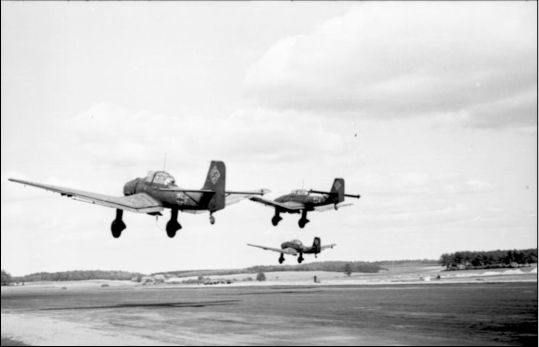
Three Stuka dive bombers taking off for the front during the campaign in Poland; September 1939.
Ground attack tactics
By Generalmajor Hitschhold at Kaufbeuren, Germany, and Latimer House, England, 20 September-4 October 1945.
1. Chief Missions of Ground Attack Units in Operations.
Basically it is to be recognized that German ground attack units possessed the ability to attack pin point targets. Special medium bomber units for the support of the Army were lacking in the GAF, therefore the twin engined bombers intended for strategic bombing were used for this purpose, although from the beginning of 1943 most of these bomber units did engage in strategic bombing. Since then, the operations of medium bombers were almost completely lacking over German battle areas. Medium bombers are able to combat area targets for the support of the Army. A ground force attack must consist of units which can combat area targets as well as forces which can bomb and strafe pinpoint targets.
On the German side, the chief missions and targets of ground attack units were:
A:- For support of the Army.
(1) Fighting troops on the ground, troops in positions, and troops on the march.
(2) Material - medium and heavy weapons, MG nests, anti-tank guns, artillery, rocket guns, A.A. Guns, tanks and tank columns.
(3) Transport - Horse-drawn vehicles, locomotives, railroad, shipping, trucks.
(4) Signal facilities - radio stations, wire communications (by attacks on entries and exits to villages) bridges, ferries, troops in villages, houses, and troops in woods.
B:- coastal Area - ships and water vehicles of all kinds, warships, landing places, etc.
C:- Air combat -destruction of enemy aircraft in the air and on the ground.
2. Types of Missions and Attacks.
a. Day Attacks
b. Anti-Tank Missions
c. Night Attacks
Day attacks as follows:
Ground attack missions were usually carried out in Gruppe, Staffel, Schwarm or Rotte strength. Only in exceptional cases where great forces were massed did attacks in Geschwader strength take place. In the Fall of 1943 seven Gruppen had the F.W. 190 and the other 14 or 15 had the Ju.87 Stukas. By the end of the war all but one of these Ju.87 Stuka units had been converted to the F.W.190.
Radio control from the ground (Egon Procedure) was planned for the units but was not to be introduced until a time several months after the war actually ended. It was planned to use the Egon Procedure to lead the aircraft to the target in bad weather only. After being led directly to the target, they then conducted the attack after sighting the ground.
Ground attack units conducted their attacks as dive (80-60°), shallow glide (50-20°) or low level attacks.
Armament of the F.W.190 ground attack model was 2 x MG 151 2 cm. and 2 x MG 131 13mm., one 500kg. bomb rack under the fuselage, and 4 x 50kg racks under wings.
The choice of the mode of attack (dive, shallow dive, or low level) was dependent on the enemy’s anti-aircraft and fighter defense, weather, and the type of ammunition and bombs to be used. If the enemy anti-aircraft and fighter defenses were disregarded, the most successful modes of attack were the shallow dive for dropping bombs and the low level attack for strafing. Very often it was the job of the ground attack pilot to seek out the most important targets over the battlefield, and some of these targets were very well camouflaged. This forced him to fly at altitudes from which only a direct shallow dive or low level attack was possible. The shallow dive attack brought about the best possibility of hitting, and the type of bomb and fuse determined the dropping altitude. This was especially true with the type of bomb container from which a great number of small bombs were strewn (cluster bomb units) and which required a certain dispersion to be effective. (For ground attack aircraft like the Ju.87 and other aircraft with computing bomb sights, the dive attack is the most practical.)
If the anti-aircraft fire could be kept down or nullified, the ground attacks were flown as shallow dives or as low level attacks. It was often necessary to use part of the unit to hold down the anti-aircraft fire with a suitable bomb load (containers with 1kg. anti-personnel bombs), in order that the greater part of the formation could carry through an effective attack with as little interference as possible from ground defenses. If the suppression of the antiaircraft fire was not possible, dive attacks had to be flown. (It repeatedly proved good to have friendly artillery keep down enemy anti-aircraft fire, when ground attack units were attacking targets near the front line.) If the anti-aircraft fire was too strong, a massed, closed-up dive attack had to be carried out in formation. In this manner the anti-aircraft gunners had only a short time to combat the attack and could not concentrate their fire on individual targets. Approach altitude and the beginning of the attack dive were, if possible, so arranged that they lay outside the effective range of the antiaircraft fire.
Escort for Ground Attack Units.
Besides anti-aircraft defense, fighter defense rendered difficult the conduct and effectiveness of ground attack missions. It was proved on the Western Front and in Italy that ground attack missions were impossible when the attacking side did not have air superiority, at least over the battle area during the time of the attack. Otherwise the losses of the ground attack aircraft were too high in relation to what was accomplished. The ground attack pilots had to be able to carry out attacks unmenaced by enemy fighters. If fighter opposition was absent, the ground attack unit could carry out their attacks very much opened up and dispersed in the air, but if fighter opposition was present, the ground attack formation had to be kept closed up over the battle area.
On the Eastern Front it was usually sufficient if part of the ground attack formation took over the fighter escort for the rest of the mission. It was even possible to use bomb-carrying F.W.190’s as fighter escort. This was done in the following way: at the beginning of the attack, one part of the formation stayed at altitude and furnished fighter cover. This part was then relieved by another part of the formation which had already dropped its bombs. The top cover then went down to conduct its own ground attacks. In case of contact with the enemy, bombs had to be jettisoned, with fuses armed if over enemy territory.
If the enemy had air superiority, fighter escort furnished by regular fighter units was advisable. Strong fighter opposition forces the ground attack formation to make greatly concentrated mass attacks (usually with approach at great altitude for a dive attack, or on occasion a low level attack with the element of surprise). Effective strafing attacks could not then be flown, because the effectiveness of the ground attack units was thus already cut in half. The most effective weapons of the ground attack F.W.190 were its 2 cm. cannon MG 151 and its heavy MG 131 13 mm. Bombs were less effective.
It was the goal of every ground attack mission to combat the enemy to the last round of ammunition, to destroy all recognizable targets on the ground, and then by a prolonged stay over the battlefield to render impossible every movement of the enemy. (This opportunity was to be utilized by the army for attacks, redeployment, retreat, etc.)
The weather in part decides the type of mission to be flown by ground attack units and also the size of the formations, i.e. the worse the weather, the smaller the formation. A minimum ceiling of 6000-8000 feet is required for dive bombing attacks. Shallow dive attacks can be flown with a ceiling of 1500 feet and low level attacks with still lower ceilings. Attacks under low ceilings usually result in higher losses, because the anti-aircraft fire cannot be adequately combatted and because the ground attack aircraft are too easily sighted by enemy aircraft.
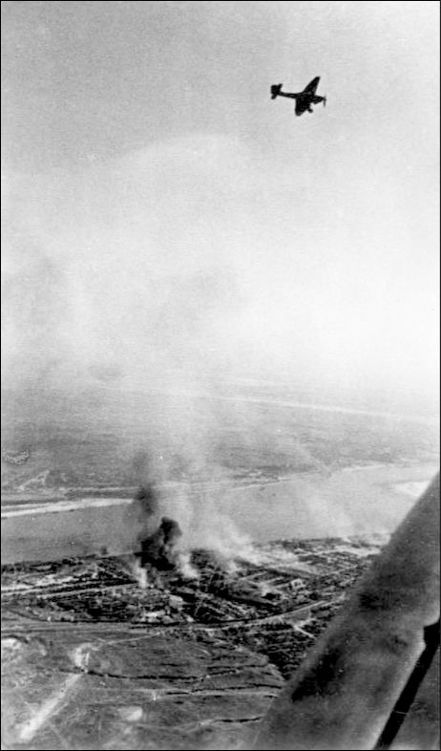
A Stuka pictured during the opening aerial bombardment of Stalingrad 1942.
Anti-Tank Missions.
It was necessary to use special anti-tank ground attack units against modern tank formations. In cases of lucky tank break-throughs, the army was often not in a position to throw in enough of its own tanks or anti-tank guns to stop the advance. In the Spring and Autumn in Russia, the ground was so muddy and roads so bad that moving tanks for defense against enemy tank break throughs was so slow that the only possibility of combatting them was to use these special anti-tank ground attack units.
It was apparent that ordinary ground attack units were not able to destroy enough tanks with their guns, cannons and bombs, but the special anti-tank units with armour piercing cannon and special anti-tank rockets were very successful. Anti-tank aircraft were the Henschel 129 with the MK 101 3cm., later the MK 103 3cm.; the Ju.87 Stuka with 2 x 37mm. cannon, and the usual F.W.190 ground attack model with rocket tubes fixed to its bomb racks.
These aircraft were successfully used against tanks which had broken through on the battlefield or all the way into rear areas. The missions against tank assembly areas were a great mistake because these were always protected with many anti-aircraft guns and resulted in high losses compared to completely unimportant accomplishments. For attacks on tank assembly areas it was better to use formations which carried a great number of containers of 4 kg. hollow charge armour piercing bombs, which can be dropped from halfway outside the effective anti-aircraft fire. Enemy tanks which have broken into friendly troop areas can only be safely combatted by special antitank ground attack units, without endangering friendly troops.
Troop columns which have broken through can be defeated if the antitank units fight the tanks and the regular ground attack units attack the more thinly armoured vehicles which follow the tanks. In good weather, tank break-throughs were, however, protected with a strong fighter cover. The beating down of this fighter cover was a pre-requisite for a successful employment of anti-tank ground-attack units. If bad weather was used for tank break-throughs the anti-tank units can fly anyway, since they usually fly in low level attacks.
Next to the neutralizing of the enemy fighter cover, the beating down of anti-aircraft defenses is another condition for the successful use of anti-tank flying units. After a long series of successful missions against tanks, the enemy started to give the tanks anti-aircraft protection and always increased it, and at the end of the war, every nation had some sort of mobile anti-aircraft gun which could protect the tanks. The use of anti-tank units with regular ground attack units to keep down the A.A. fire became necessary. When the ceiling was low so that ground attack units could not effectively act against antiaircraft defenses, the anti-tank units had to be used with the element of surprise and the attack was carried through in the shortest possible time before the anti-aircraft tanks, not ordinarily ready for combat, could unlimber their guns and start to shoot. Experience and practice in immediate recognition of tanks and shooting them up in the first attack brought about good successes without important losses. In the last year of the war, the Russian tank troops had accustomed themselves to the anti-tank flyers and the tanks were well camouflaged wherever possible. At the approach of anti-tank units they immediately sought cover near houses, tree clumps, or hay stacks. Often the tanks could only be found from their tracks and the Russians usually erased these by dragging branches behind the tanks.
Anti-tank units fought in Rotten, Schwärme and, at most, in Staffeln formation. Larger anti-tank units used simultaneously over the battlefield hindered and confused each other. The attacks with armor piercing cannon were conducted like ordinary strafing missions. To ensure hits, the pilots had to approach as close as possible. The best range was 100-150 yards. The gunnery run had to be very even and calm, and the direction of approach was determined by the ground situation and with the 3 cm. and 37 mm. weapons aimed at the vital points of the tanks.
Night Attacks.
The mission of the night ground attack units was to combat or harass the enemy on the front and in rear areas exactly as the day ground attack units did it.
This idea arose from the use of the Russian harassing aircraft, the U-2. At first the German used harassing (Starstaffeln) Staffeln, using normal training aircraft like the Arado 66, Gotha 145, Heinkel 46, and the Bucker 181.
At the end of 1943 German ground attack units in Italy could not operate by day without difficulties and heavy losses because of great Allied air superiority. Some Ju.87 Stukas were used experimentally against the Nettuno (Anzio) bridgehead by night. The employment proved practical. There followed in 1944 the conversion of night ground units to the Ju.87 and the
F.W.190. These units were able when used in sufficient numbers to disturb the enemy continually in the night, to hinder materially night marches, to hold down artillery fire and to hinder attacks. In this way considerable relief could often be given German troops.
The targets for night ground attack missions had to be small area targets; the combatting of point targets (as by day) was only possible to a limited extent. Good targets proved to be firing artillery, lighted transport columns, defiles, bridges, villages, and areas and geographic points of importance recognizable at night as troop concentration areas. Best of all were missions against lighted targets, such as tracks and firing artillery. Dark targets had to be illuminated with flares dropped from the air to the ground or through target markers either dropped or shot from the ground. The lavish use of 2kg. fragmentation bombs (especially early in the night) was good to restrict the enemy’s use of roads during the night.
An effective employment of forces was the rolling attack - a series of hard blows one after another. Such rolling attacks continuing throughout the entire night on the Russian front greatly hindered the preparations of the enemy for attacks on the following day.
Usual tactics of the night ground attack units were dive and shallow dive attacks. Horizontal attacks were conducted only rarely and by very low ceiling, and where large area targets were in question.
Ordinary weather requirements for missions were a ceiling of 3,000-6,000 feet, visibility of 4-5 kilometers. Moonlight made the mission easier because the targets were easier to see. Average anti-aircraft fire could, even by night, be held down effectively by repeated bombing. Strong anti-aircraft fire made the mission harder. Night fighter defense against night ground attacks was not present in the East, but was very effective in Italy. Radar control (Egon) proved good in Italy and in the West and was a great help in combat. A close co-operation with the Army in the battle area would produce great results. This was not achieved, since the continual retreats of the Army made cooperation of Army and Air Force harder and harder. It was proved, however, that night ground attack units, well directed from the ground, though partly equipped with antiquated aircraft, could achieve considerable results and effectively support the Army.