
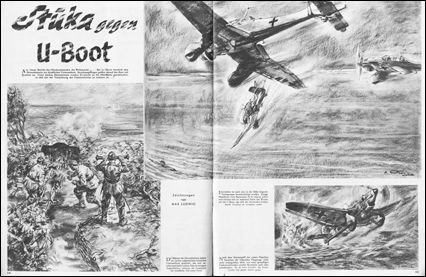
The Stuka formed a very powerful aspect of the German propaganda effort, it was used to bolster morale at home and to project the image of the power of the Luftwaffe abroad. The Stuka was used to reinforce the appearance of invincibility. Even within the Luftwaffe the Stukas, at least in the early years, were harnessed in an attempt to provide proof of the prowess of the Luftwaffe. These articles are taken from the pages of Der Adler, the Luftwaffe’s in-house magazine. They provided a fascinating glimpse from a unique primary source into the world of the Stuka and its pilots, and conveys to the modern reader an idea how they were viewed at the time.
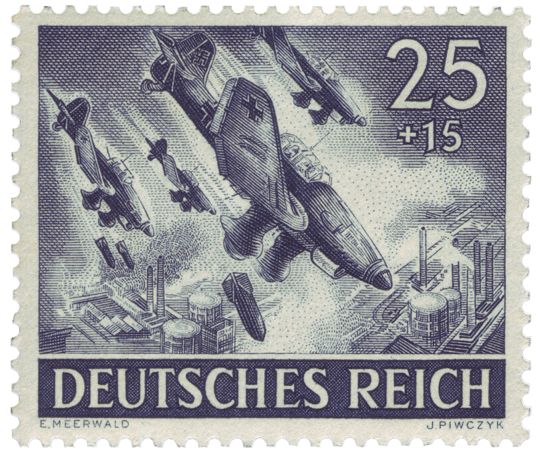
The Stuka legend was being perpetuated even during the war years. This postage stamp drawn by E. Meerwarld is from 1943.
Dive-Bombers in action
A descriptive report from three fronts by Josef Grabler, War Correspondent
Right after the first “storks” had taken off, the crews of the Peltz squadron had an opportunity of seeing the stuff these infantrymen were made of. The General was the first to take off, with an infantryman behind him, and then the whole group of the slow-flight aircraft took off, each carrying besides the pilot a few infantrymen with weapons and ammunition. Suddenly one of the “storks” seems to be in difficulty, it rises from the ground but immediately flops back and the machine takes fire, while the crew jump out. An infantryman from Silesia, burdened with a heavy machine gun, had been seated in that plane. Upon clambering out with his heavy machinegun on his back, he goes up to the next machine just about to take off, as placidly as if nothing had happened, opens the door and lugs out a young fellow, one of his comrades, by the scruff of his neck, takes his place inside with his machine gun and off he goes.
Is this supposed to be war?
The Peltz squadron had to escort the “storks” and protect them with bombs and machine guns, their chief mission being to get rid of any air defense and heavy machine guns by attack from the air. Not long after taking off, Oberleutenant Peltz saw that the “storks” had landed and were standing about in a meadow near a farm. While others, which had meanwhile been overtaken by the speedier dive-bombers, were just landing. Peltz circled round the farm at about 150 ft. And saw the infantrymen beneath him climbing out of the machines and bringing a table out of the farm. Peltz could hardly believe the evidence of his own eyes when a white tablecloth followed and immediately thereafter infantry came out of the farm with a succulent breakfast. That could all be seen quite clearly from the low height at which Peltz was flying. And that is supposed to be the war in the west with all it’s terrors? Indignant cries were heard in his headphones, confirming that his crews had precisely the same notions about that curious conduct of war that he had himself.
The squadron leader flew higher to have a better look about. But far and wide no military objective was to be seen that would have been worth a single round. Only a lone short-distance scout plane, a Henschel Hs 126, greeted the Stuka crews by wobbling in a friendly way. Now Oberleutenant Peltz knew from his experience in the campaign in Poland that these short-range scouts had more than once pointed out worthwhile objectives to the dive-bombers. Conversation was impossible, because the scout had a different frequency. Peltz accordingly nosed up to the scout, who slowly described a curve, while the observer waved. That can only mean one thing: there must be an objective round about after all and sure enough the friendly scout leads them to an airdrome. There is a hangar, which is closed, but no aircraft are to be seen, so that a few rounds are fired in to the hangar, which may perhaps bring something out. But nothing does come out and the squadron flies home. Pilot and wireless operator are disconcerted. It has never before happened that they have brought their bombs back from a road, and it is poor comfort that the other squadrons of the wing had fared no better.
In the afternoon, the squadron started for a like action and once more there was nothing doing. Not a single military objective was to be seen. On their way back they saw the first German vehicles crossing the Luxembourg-Belgian frontier. A gigantic snake of an army rolled over the roads to the west and south-west. Here and there four columns were marching abreast. The Stuka crews broke in to a cold sweat at the thought of an attack by a hostile aircraft on the comrades in the army down below. But nothing at all happened, as far as they could see. But nothing happened, as far as they could see. The fact is hardly credible, but it cannot be disputed that the squadron returned from that mission also with their bombs and ammunition intact. The ground sergeant asked indignantly whether he should lay out bombs in readiness at all. The ground personnel were so disappointed that they were no longer on speaking terms with the crews. That was the second mission on May 10, 1940, the day on which the German army moved out of their winter quarters on the Siegfried line to fight the great battles in Flanders and France. But the poor fellows of the dive-bomber formations, as they laid themselves to rest in the straw, were as disappointed as the disgruntled ground personnel who had run out on them.
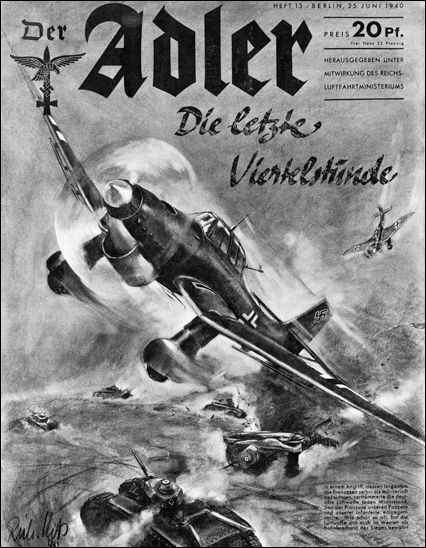
The front cover from the 25th June 1940
The ground personnel disappointed
According to the reports of the situation, the head of the army had already penetrated far into Belgium. Finally, during the forenoon came the order for their new mission, giving as the objective a village where the advanced guard had met with resistance, which the dive-bombers were asked to break down. They flew at 6,600 ft., just as in peace time, and looked for the foe. But nothing was to be seen. They dropped lower to 30 ft. And flew over the village, but there was literally nothing to be seen; it had evidently been evacuated. Not a soul was on the streets and only a few animals were wandering about the fields. On his own responsibility Oberleutenant Peltz flew 30 miles further west. Again there was nothing to be seen. They returned at a low altitude. Finally the head of the army appeared on the fine asphalt road, along which they were flying. Armoured reconnaissance cars and other vehicles had halted at the side of the road; the crews were sitting in the ditch and breakfasted. Here also everything was as in times of peace. Only the ground panels, which showed that the vehicles were German, led to the conclusion that a war was in progress after all.
For the third time the squadrons brought back their bombs with them. The crews climbed indignantly out of their machines, while the ground personnel hardly condescended to look at them. And these guys are supposed to be dive-bomber pilots, their scowls seemed to say. Oberleutenant Peltz examined every one of his men. No one had even seen a single enemy.
Then came an order to attack the fortifications of Neufchatel. These were the first blockhouses since Modlin upon which heavy Stuka bombs were dropped. The squadron was surprised to find no air defense. Here also no enemy was to be seen outside the blockhouses.
The next mission was to attack columns on the roads leading to the fortress of Givet. One roads was allotted to each squadron. That seemed to be a worthwhile target at least; for no one could really have imagined these columns; they simply must be there. Actually however there was not a thing to be seen, the roads were bare. The squadron flew further without the escort of fighter planes until near Givet Oberleutenant Peltz thundered along the road at the head of the crowd, until finally he had enough of it. Flying in a wide arc, he recrossed a wood that they had just flown over and dropped a little bomb into the trees. Then things began to hum! The smoke of the explosion of the bomb had hardly reached the top of the trees before stampeding horses plunged out of the wood, followed by soldiers and more and more soldiers. Well, well, who’d have thought it, said Peltz aloud in to his laryngophone. And then there was a bit of bustle. The squadron hammered as hard as they could in to the wood and into the men and animals down below. Dusting out that wood with the little bomb had well repaid the trouble.
After the German tanks had advanced beyond Bouillon into the open country, they encountered vigorous opposition on the part of the French at a point where a detour was impossible, and the squadron of Oberleutenant Peltz was ordered to clear the way for them. The day was still young and visibility was impeded by ground fog through which only the hill-tops emerged. Gradually however the mist lifted and Oberleutenant Peltz, while flying over a wood, observed the presence of a large number of motor vehicles, but he was unable, in spite of flying low, to make out whether these were hostile tanks or our own, and therefore was unable to order an attack. Upon landing on his return, however, he was met by a report from our tanks that the French were attacking in large force, from which it was evident that the tanks seen had actually been French after all. The squadron accordingly thundered back, after having received instructions to attack the blockhouses at X, should no more tanks be observed on the road between Bouillon and Sedan. Flying at an altitude of about 10,000 ft., the squadron arrived at the point of their presumptive activity. It had meanwhile developed in to a brilliant summer’s day. The road stretched into the distance far below the wings of the dive-bombers and Oberleutenant Peltz dropped to 6,500 ft. And then to 5,000 ft., in order to search the road and its immediate vicinity. Suddenly the cry was raised, “Look out, pursuit planes behind us!”
The warning cry, heard for the first time in the campaign in France, acted like a trumpet call; for the Stuka crews had not hitherto met with hostile planes in the west. But there was not much time for meditation, because the phosphorus filaments were already hissing through the squadron. The air-gunners kept blazing away for all they were worth. The squadron had meanwhile nearly reached Sedan and the fortifications for which their bombs were intended lay far below. In spite of the continuous attacks by pursuit planes, who could only be kept at bay by air gunners, the squadron managed to drop their bombs, but then there was only one thing to be done in the face of the superior numbers of French pursuit planes, and that was to step on the gas and beat it for home. The French followed the squadron for a little while until a French plane was shot down, at which howls of delight were heard in the headphones. It is impossible to say whether their fuel was becoming exhausted, at all events, the joyful fact they thereupon showed the large cockades on the lower surfaces of the wings and sheered off.
Oberleutenant Peltz at last found time to inspect his squadron and found that two machines were missing. That was unfortunately only a bitter confirmation of what he had already seen; during the air fight a Ju 87 had withdrawn with a trail of smoke behind it. Oberleutenant Peltz throttled down to let the squadron pass and was able to ascertain by the marks of the various machines that it must have been Leutenant Haller. At that moment, the squadron was just flying over the German front lines, Peltz saw a tall pillar or smoke rising from the ground. That would not itself have attracted any special attention, because all sorts of things were burning in the neighbourhood, but Oberleutenant Peltz happened to have sighted precisely that smoke, being animated by an indefinite suspicion. He accordingly flew lower, and sure enough, a Ju 87 – Haller’s machine – was ablaze there. In spite of the severe damage to the plane he had after all succeeded in reaching his own side of the lines. Peltz dropped to a low height above the ground and saw Haller, with his face as black as that of a nigger, frantically waving.
The infantry help
Haller appears to be uninjured, but his gunner is lying motionless beside a tree. Help is evidently urgently needed. But how is this to be managed? A bright idea strikes Peltz as he discovers infantry on the march on a small road not far from where the emergency landing had taken place. He climbs a little and writes a note, with his left hand on the control column: “Wounded airman 300 metres west of the road beside burning plane. Needs help.” Placing the note in a message-bag, he dives down again over the infantry, who were dislocating their necks watching the pilot doing funny stunts just overhead. A few feet above the head of the battalion, Peltz lets the message bad with its long coloured streamer flutter down and sees a number of infantrymen running to pick it up. If the wounded man can still be helped at all, his safety is now assured; for a surgeon always accompanies an infantry battalion. While flying after his squadron, now disappearing over the northern horizon, Oberleutenant Peltz reflects that flight leader Oberleutenant Unbehauen is still missing, as far as he has been able to observe. He is unable quite to grasp the fact that something should have happened precisely to that Sunbird, nicknamed Zaratza. Peltz is rather depressed, as he finally lands, at the thought that the very first air combat in the west should have cost him two losses. Two machines are gone. One was that piloted by Leutenant Halle, which he had sighted ablaze on the ground, and the other was that of Oberleutenant Unbehauen, about whose whereabouts he still knows nothing. It is no comfort to hear that the other squadrons of the wing have also suffered losses during the attack by the French pursuit planes.
Peltz is called to the telephone. And who should report himself, but Zaratza the sunbird, radiant as ever!
“Quite right Chief”, he reports, “Landed smoothly on German territory, although with 65 hits. Can you send a “Stork” round at once? Petrick has two gunshot wounds in the abdomen. Landed at such and such a place. If I was able to land with the Ju 87, you can certainly pull it off with the “Stork”.”
“I’ll come along myself right away” replies Oberleutenant Peltz. “In fifteen minutes at the outside you may expect me.”
And then everything must go at top speed.
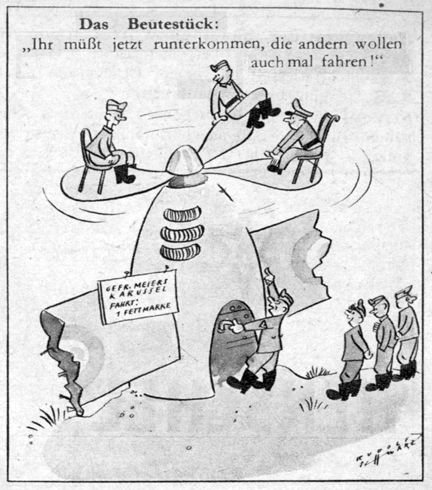
Der Adler featured cartoons on the back cover. This roughly translates as ‘You have to come down now, the others want a turn!”
Man in distress
The “Stork” is already waiting with its engine running, started up by speedy hands; for the personnel had at once understood from fragments of the telephone conversation what had to be done. Oberleutenant Peltz runs to the “Stork”, just as he is, and climbs in. The door is flung to behind him and off he goes. The emergency landing ground, the second that he had occasion to view from the air that day is soon located. A Ju 87 standing in an open field is hardly an object that can easily be overlooked, when the approximate location is known. A picture that presents itself closely resembles that shown by the machine of Leutenant Haller. The radio operator is lying in the grass beside the plane and Zaratza is waving. The resemblance is so strong that the observation subconsciously strikes Oberleutenant Peltz, as he lands, that Zaratza is not black in the face as Haller had been.
Peltz brings the “Stork” to stop a few feet away from the Ju 87 and jumps out. Non-commissioned officer Petrick is lying quiet and pale on his back. He appears to be unconscious, his combination suit is saturated with blood.
“We’ll set him on the middle seat. You take the rear seat Zaratza, and hold him tight. Take a hold.”
The wounded man is cautiously carried the few steps to the “Stork”. Oberleutenant Unbehauen climbs in first, grasps the non-commissioned officer under the arms and helps him in to the plane, while Oberleutenant Peltz lifts his feet. Petrick groans. Finally they manage to lift him on the seat, where he collapses. Zaratza embraces him with his arms from behind and holds his tight.
Within 65 minutes after receiving two bullets, the air gunner Petrick is lying on the operating table. It may be added here that he has meanwhile fully recovered, but the doctors left no doubt on the point that it would have been impossible to save him but for rapid transport to hospital.
At last Oberleutenant Unbehauen finds time to report his experiences from the air to his squadron leader.
“Petrick must have been wounded at the very beginning of the attack by the enemy planes. I see the tracer filaments constantly flitting about the cockpit and hear a cracking and clicking in the engine, but Petrick is not shooting. I yell to him, “Shoot, boy, shoot” and the poor devil actually pulls himself together and shoots off, as I have seen, five drums of ammunition, with which he brought down the French pilot. Then he collapsed. Isn’t it too bad to think that precisely Petrick, who was given the nickname of “Stop-Butt” on account of his waistline, must actually serve to stop a couple of bullets!”
To the front in a taxi-cab
That afternoon Leutenant Migeot arrived in a French taxicab after a more than adventurous journey. He had to make an emergency landing with numerous hits in the engine after the fight with the attack planes. His radio operator was badly wounded and unfortunately died soon after landing. Migeot had no idea where he had come down and did not know whether the territory had already been occupied by our troops, or whether it was still in French hands. But he said to himself, as he told us, that only bluff could help him. Armed with his two guns and that of the dead gunner, he wandered to the nearest farm house and first of all asked for something to eat, because he was very hungry. Then he demanded a car at once, putting on his most martial air. Supported by his two guns he uttered frightful threats in case of treachery. He did not himself believe that he would pull it off, but the incredible happened: a car actually came round in half an hour! The chauffeur first had the articles of war read to him, the two guns lending emphasis to Migeot’s remarks, and then off they went. Migeot told the chauffeur to drive him as quickly as possible to the German lines. And once more the unlikely happened; Leutenant Migeot reached the head of the German infantry without having a brush with French troops. It was then no great distance to the field airdrome.
Shortly afterwards Leutenant Haller also arrived with his hand already in a plaster of Paris dressing; he had sprained it at the emergency landing.
Attack on Chèmery
The breakthrough at Sedan had succeeded. The German tank divisions wheeled to the right and accomplished their historic drive to the sea at Abbeville. The French had made furious exertions to take the tanks in the flank and from the rear; so that the Stuka crews had often to carry out attacks for the relief of the tanks. Once there was an attack on Chèmery, the order expressly stating that French tanks in and around Chèmery were not to be attacked after 12 o’clock, the German staff having calculated that the German tanks would have reached the place by that time. That limitation of the attack in point of time was intended to prevent the dive-bombers from bombing their own tanks. Peltz saw large numbers of tanks on the battlefield near Chèmery, but neither crosses nor cockades were to be made out, owing to the dust that they raised. Peltz made his squadron forma defensive circle round him and diced in order to see whether he had to do with friend or foe. Suddenly the cry was raised, “Pursuit planes coming from the sun!” Peltz zoomed up to his squadron at once and saw the white phosphorous filaments buzzing through the air. A Ju 87 had plainly been hit, and Peltz recognised to his dismay that it was the commander’s plane. He gave orders by radio for the squadron to collect in the airspace above Sedan. The commander’s machine was already smoking and Peltz with this squadron placed himself over and above him as cover. A French Morane zoomed up steeply in front of the wind and thereby got in the way of the concentrated fire of the fixed weapons of the pilots. That French plane simply burst asunder and it’s parts flew in all directions – the engine-cover, metal sheeting, fairings and finally the wings. In the meantime, as the Stuka crews noticed to their joy German pursuit planes had arrived and a Morance was shot to pieces by a German pilot before their eyes in a really wonderful way, that plane also breaking up in to its component parts. The squadron collected over it’s over ground at Sedan, while the commander flew home. It was afterwards found that his gunner, Oberfeldwebel (First Sergeant) Herzog, had been killed by two cannon shots. Major Sigel himself had been lightly grazed on the neck, but the burn fortunately merely caused a painful blister. He reached home safely although his machine had been riddled like a sieve.
“Hold on! Our own tanks!”
The squadron once more advanced on Chèmery, but had hardly reached the battlefield, before the troublesome Moranes once more made their appearance. An air combat took place, this time without incident, and the squadron flew back to collect over Sedan, after which they started a third time for Chèmery.
The little town lies straight ahead on the course. Huge conflagrations are raging and enormous clouds of smoke are ascending in to the sky. Numerous tanks can be seen moving out of the town in the direction of the German lines. That can only be the French. Peltz orders an attack and the squadron dives behind him. He has a group of these tanks exactly sighted in the reflecting sight, and will be pressing the bomb release knob in a few seconds; his bombs will be dropping and his crews behind him will be getting rid of their bombs too! At that very moment he recognises a swastika flag on a tank and immediately gives the order by wireless, “Don’t drop a bomb! Our own tanks!” The order is given and received in a second during the actual nose dive – and not a man of the Peltz squadron drops a bomb! After having gone through three air combats, the crews were still so keenly alert that they received and understood the command of their squadron leader even during the terrific pace of a nose dive. By a hairs breath death did not drop out of the sky on their brothers-in-arms below.
There was a mite of breakage when the dive-bombers finally landed, because several machines had been knocked about quite a bit by the repeated air combats. A Ju 87 performed the craziest exploit of all, a cannon having registered a hit on the oxygen bottle, which had promptly exploded. Simply everything on that machine wobbled while in the air; everything had been torn apart, and the tail unit was hanging practically by the operating rods of the controls alone. The machine dissolved in to its component parts as it landed, but not a man was injured.
The warfare that had played such a great role in Poland began anew. Hostile columns were attacked by bombs and machine-gun fire and the dive-bombers inflicted frightful losses on the enemy. Defence by the enemy attack planes had meanwhile become very feeble, so that our dive-bombers were once more able to fly alone without being escorted by their own fighters and to carry out strafing on their own account. It was sometimes pure target practice. Peltz often caught himself wondering even during a dive whether he should drop a 250 kilo bomb, or whether a 50 kilo bomb would do the trick. Every bomb dropped was observed by one’s comrades and was the object of sharp criticism by wireless. Anyone missing his target had to hear himself abused as “Uhrmacher” (watchmaker), which of course is not intended to convey any aspersion on that worthy guild; it is merely a technical expression used by the dive-bomber crews. After having got rid of their bombs, pilots and gunners would take the crowd on the ground with their machine guns.
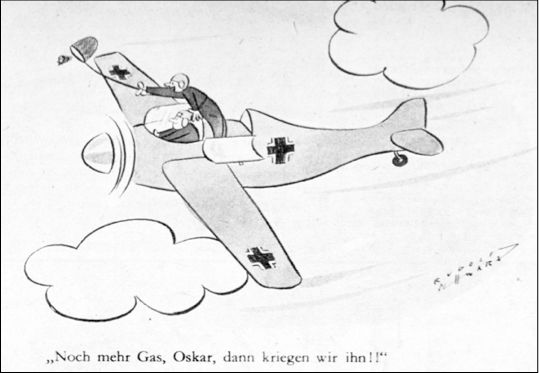
More gas, Oscar, we'll get him!
“Spitfire behind Anna”
The left wing of the German army had meanwhile rolled up the French front in the direction of Calais and the military defences of that town were assigned to the Peltz squadron as new objectives. Even at the very first approach a picture presented itself to his crews which none of them will ever forget. The British island lay bathed in sunshine, as if within touching distance, separated from the Continent merely by a strip of water which looked from that great altitude as if it were merely a stone’s throw across. So that was the island that had started the present war! The island to whose debit all the consequences of the war will be booked. The crews knew that the British were still in Calais and were prepared to drop their bombs on them with especially friendly greetings.
Horizontal bombers had already been at work on Calais before the Stukas and the town was ablaze at several points. Many ships lay in the harbour and in the roads; the enemy was evidently bolting. Clouds of smoke were being driven by the wind towards the south-east, so that the squadron was unable to approach from the land side but had to go out to sea, whereby they got within range of British pursuit planes who came over the water in a few minutes from Dover and Folkestone to lie in wait for their prey. Oberleutenant Peltz was aware of that and had previously informed his pilots and wireless operators of the possibility of attack from that quarter. While flying over the north-east of Calais at an altitude of some 11,500 ft., in order to proceed out to sea he first looked around for hostile planes. It is a mistake to talk of the devil! Like a shot from a gun, evidently swooping down from a great height, a spitfire whizzes past Peltz and makes an elegant curve to get behind him. The British pilot does that so neatly that he is practically directly beneath and behind the tail unit of the squadron leader’s machine after having flown out of the curve. It is unnecessary for half the squadron to yell out “Spitfire behind Anna!” (As the machine of the leader is called); Prltz has already observed that fact with all desirable clarity. Peltz depresses the nose of his ship and thunders earthwards with the expectation that the British pilot will immediately follow suit. After having dived a short distance, Peltz runs out the nose-dive brakes to shaken the speed of the dive, and the British pilot, unable to brake his descent promptly whizzes past him at one side.
“See you again, buddy”, cries Peltz, “Some other time perhaps.” But the British will never find another chance of meeting German dive-bombers again. Peltz has hardly called his friendly parting greeting after him, when another airplane shoots past him like a shadow in the same direction after the British plane. Peltz has just time to recognise the beam crosses in a hazy way. Now there is no need for anxiety. Peltz pulls out his machine and looks down, where the German Messerschmitt is just shooting down the British plane. The whole occurrence from the appearance of the Spitfire until he was shot down was over in a few seconds, and now the bombs of the Ju 87 are hailing on the ships down below in the harbour. It was impossible to observe the details of the hits, everything being wreathed in dense clouds of smoke.
The Inferno of Dunkirk
After the fall of Calais the last strong point left to the British forces was Dunkirk, which became the culmination of the greatest outflanking battle hitherto fought in the present war. The British were pushed further and further back, and found no other way out than to board their ships and clear off. It may be noted in passing that they thereby betrayed their allies, the French to an extent that would never have been credited. The French fought desperately with their backs to the town of Dunkirk against the onslaught of the German troops. The British, on the contrary, withdrew a company here, a battalion there, one after the other from the fighting line, marched them to the harbour and the beach, and there embarked them. It is not so well known that the British adopted a measure to save at least part of their Expeditionary Force, which at any rate has the merit of originality. As soon as it appeared certain that they would not be able to hold their position on the Continent, they mobilized everything on the south-east and south coasts that was capable of floating at all; besides steamers and tugs of every description, they sent off even the tiniest power-boats that could hold only a few men. The whole of that gigantic armada was sent to Dunkirk to save whatever it was still possible to save. It will be readily understood that the mobilization of these craft enabled the British to transport part of their Expeditionary Force back to their island home, because the German troops were unable to reach the town in time to prevent that operation, the British having blown up the sluices and thereby inundated the whole are round about Dunkirk. Under these circumstances, it was only natural that the German Air Corps made a merciless clearance of the British transporter fleet.
In the experience of the dive-bomber crews, Dunkirk represented one of the dramatic climaxes of the whole war up to that time. All hell seemed to have broken loose there. Horizontal and dive-bomber formations uninterruptedly dropped their deadly loads on to the doomed town. It was hardly necessary to take accurate aim over Dunkirk and it was anyhow practically impossible to do so, owing to the dense pall of smoke in which the town was continually enveloped. Every bomb scored a hit, because the allied forces were compelled to collect enormous masses of troops in the town itself, since the free space at disposal was steadily growing less. They simply did not know where to dispose their troops; for in the town of Dunkirk was penned up a whole army that had originally been in occupation of all Flanders and part of Northern France. These troops were now all crowded together in the narrow space of Dunkirk and every house in the town was crammed full of soldiers, as was later revealed. They had erected tents on all the open spaces, and the whole neighbourhood of the town, as far as it was still occupied by the French, was congested with troops and vehicles. The dive-bomber crews made a less agreeable observation over Dunkirk of the same nature as they had already made over Warsaw. The concentration of so many troops naturally lead to the massing of anti-aircraft artillery in a very confined area and countless anti-aircraft guns were firing in and round about Dunkirk.
Third-class ticket for Dunkirk
The blazing oil tanks in the harbour were the chief source of the enormous clouds of dense smoke lying over Dunkirk. When Peltz and his squadron dived, everything was at first black with smoke; nothing was to be seen at all, visibility simply did not exist, and targets could only be dimly made out after having pierced the layer of smoke the bombardment of Dunkirk from the air was so concentrated that a pilot had literally to watch out that he did not get a bomb in the neck from his comrades flying above him. The approach to that last bulwark had long since ceased to be a problem. Even hidden by banks of cloud Dunkirk was not to be missed, because countless numbers of anti-aircraft shell-bursts were to be seen, even above the clouds, at the point where the town ought to lie. Hostile aircraft were hardly ever to be observed over the town and only German planes were to be seen. Oberleutenant Peltz and his squadron attacked Dunkirk eight times altogether. When the squadron took off during those days, the ground personnel merely remarked, “Third-class ticket for Dunkirk, without changing!” It frequently happened during an approach that whole groups of Heinkel horizontal bombers of the He 111 type passed through the dive bombers and the pilots and gunners of the latter could then watch with satisfaction the bombs dropping from all the bomb-wells of these formation.
The British forces at first carried out their evacuation operations practically only under the cover of night. But the ring of the German troops steadily closing in on the town made the situation so acute that they were no longer able to confine themselves to night operations. It was only a matter of a few days until Dunkirk would have to fail, so that the British were compelled to continue their fight by day also. The heavy shipping traffic between Dunkirk and England caused thereby was naturally meat and drink to the dive-bomber crews; for the small point targets, such as presented even by large vessels, were their own exclusive domain. They had hitherto bombed land objectives only ertr now to attack floating targets for the first time. The squadron experienced their greatest day when they flew out to sea, a few days before the fall of Dunkirk, to seek their prey. The squadron flew over the coast at a medium height, left it behind, and the British ships were already to be made out ahead, looking like toys from that altitude.
It must be a big freighter
Oberleutenant Peltz gazes round about. The large numbers of small fry swimming down below are not worthwhile, they can be raked with machine gun fire. A big freighter must provide a target for the heavy bombs. Peltz flies further out over the Channel and soon sees something better afloat out there. As he reaches the ship with his crews, he can make out that it is a vessel of at least 5,000 tons, steering at full speed fort the English shores. That one must be polished off, and with it many a warrior of old England will be sent to Davey Jones’s Locker! Peltz orders his squadron to attack the ship with all bombs. It is very heavily armed with anti-aircraft guns and knows what is awaiting it. The deck is reddened by the flashed from the muzzles of the guns, smaller vessels in the vicinity are firing with light anti-aircraft guns. The transporter starts to zig-zag, before Peltz begins his nose-dive, and the foam in its wake wriggles like a twisted tail. Peltz dives, the steamer comes closer at a terrific rate, growing in size to meet him. Suddenly he sees a gun of larger calibre standing amidships and, while diving, gives the machine just a slight correction by means of the joy-stick, so that the reflecting sight can seize that gun. Another moment and it will be time to drop the bomb. Now for it! The sight is directed with the utmost accuracy on the big gun. According to all human calculation, the bomb must hit it. Peltz pulls out and once more centrifugal force with its giant fist thrusts him back on his seat. But only for a split second and then he lightly banks the machine to such an extent that he can observe his hit. The explosion has already taken place, he never observed the flash. But an enormous black mushroom is shooting up precisely at the point where the gun had just been standing. The heavy bomb had landed amidships. Flashes appear at a number of points on the ship. Several bombs also fall beside and behind it - the work of his comrades. Their machines are diving on the ship from all sides. A hail of bombs takes place. Peltz can see the splinters hissing through the water, the crests of waves spraying over them. As he zooms up, he sees once more a heavy bomb landing in the middle of the deck, shortly followed by another on the quarterdeck. A jet of flame shoots up amidships. Peltz is now far away from the ship attacked, which he can only see is still smoking, but there can be no doubt that it has had enough.
And now the small fry are for it! Motor boats, yachts, and fishing cutters. Craft of every description are swimming about, some with the bow towards England, others to Dunkirk. These provide targets for machine-gun fire, not very different from the way the squadron has had sufficient practice of in Poland and France in low-flying attacks on marching column. These small aircraft also try to escape by zig-zagging, but it doesn’t help much. Hardly one of the crowded boats but smarts under the bursts of fire from the machineguns of pilot and gunner.
During the next attack in the afternoon the crews of the Peltz squadron see that “their” ship has been beached and is still smoking. It must have turned with the last strength at command and dragged itself back to the French coast, where it was run aground. That day brought a proud bag: the wing had sunk four transporters and a destroyer.
The battle in Francey
After the fall of Dunkirk there was a brief interval of rest until June 5, 1940, where the great offensive over the Somme was opened. Once more the dive-bomber crews had the experience of a discussion of their mission of historical importance as they stood round their commander in a tent by candle light. They all consulted their map and noted the objective, a village to the south-east of Amiens, where a high French staff had their headquarters. After discussing the mission Major Sigel spoke a few words, pointing out to his officers that they would be flying out in a few minutes in advance of the greatest offensive of all time.
The hurricane bombardment of the artillery at the front was still thundering over the airdrome as the squadron took off in the dark, in order to be over their objective in the early dawn. Shortly after taking off a sight presented itself to their eyes, such as only their fathers before them had seen during the Great War at the time of the battles of machinery. From one end of the horizon to the other the heavy artillery engaged in pulverising the French positions. It was a solemn impression to experience from that altitude, much as an unconcerned spectator, that tremendous push by the German army. The whole line of the Somme scintillated as if huge electrical discharges were taking place. Further to the south, the impacts could be seen lying close together. Flames were shooting up, wherever one looked. The explosions of the discharges and impacts swallowed up the noise of the engine. The impression made by the magic of fire on the Somme was thus all the more spectral. Oberleutenant Peltz has his squadron altogether although it is still dark, and it had not become much brighter by the time they are a short way off their objective. Peltz looks at the clock. The raid has been timed for 5.05 am. There are still a few minutes to go. He banks in a wide curve, so as not to be above the objective earlier than the time set. Peltz once more looks back to where the artillery duel is proceeding below. It has risen to a hurricane of fury, as can be recognized from the much more increased concentration of fire. Under the overwhelming impression of the scene, the squadron leader almost forgot to approach his objective in time. It is a small place, rather larger than a village, but still not a town. Numerous vehicles are to be seen on the streets and at the outskirts of the place. It seems to be just the right kind of place for a raid, being evidently well occupied and just of the right size that the bombs of his squadron can completely cover it in. The raid goes off smoothly. Every bomb scores a hit and the objective is soon enveloped in clouds of smoke. While on his way back, Peltz sees a machine of another squadron crash in flames. It probably chanced to get in the trajectory of an artillery projectile and received a direct hit. After the capitulation of Paris, the French front began to give way everywhere. When the French troops did offer resistance, the dive-bombers swooped in and made the sparks fly. During the further advance the French mostly arranged rallying positions to the rear, usually by strengthening villages by throwing up field fortifications. After the German infantry had taken a bulldog hold, rarely more than half an hour had elapsed before a dive-bomber formation appeared and completely pulverized the islet of resistance.
French defense by pursuit planes had practically ceased to exist, so that dive-bomber crews were able to take liberties that would have been self-prohibitive, had enemy interceptor planes been about. Conditions were once again as in Poland, where everything that had a propeller had been smashed within a few days. During an attack near Troyes the Peltz squadron pulled off a great coup. The sun had just risen and was breaking through the nocturnal veil of haze that still hung over the ground. Ober lieutenant Peltz was flying in the direction of Troyes at an altitude of 1600 ft. When he discovered an endless column of enemy motor lorries. He broke up the squadron to crack that nut. Once again there was the merry hell down below on that road, as the vehicles crashed in to trees, bucked into the ditch, or exploded under machine gun fire and a hail of bombs. Oberleutenant Peltz was just climbing a little higher in order to get a better view of the effect, when he suddenly saw a gigantic spurt of flame from a group of lorries that stood for a few seconds over the colun and finally reached a height of over 3,000 ft. That had been ammunition – that had!
General von Richthofen was at that time commanding officer of the air corps to which the Peltz squadron belonged. The General was constantly hustling about with a Fieseler “Stork” to keep an eye on weather conditions and to even find objectives. He was rather astonished at first to find machine-gun hits in his machine. The go-ahead action on the part of the commanding officer had its reward not only from a tactical point of view, but the General solved the problem of improving the mechanization of this formations in a way that left nothing to be desired. One fine day, that is to say, he spots during a reconnaissance flight an enormous park of automotive vehicles belonging to the French army, the German advance having proceeded so rapidly that the French had had no time to remove them. After landing, the General promptly tips off his formations by telephone that large numbers of lorries are standing at the place he had reconnoitred and hints that there might be a chance to provide themselves with any vehicles they needed. The Peltz squadron, which could long since have done with a replenishing of their park, does not need to be told twice, but packs off a lorry with a number of drivers to the front, where the party is one of the first to arrive. First come, first served. It was a real drivers paradise, and the men of the Peltz squadron could afford to be finical. They helped themselves only to lorries of eight cylinders and upwards, and of these only the very best makes.
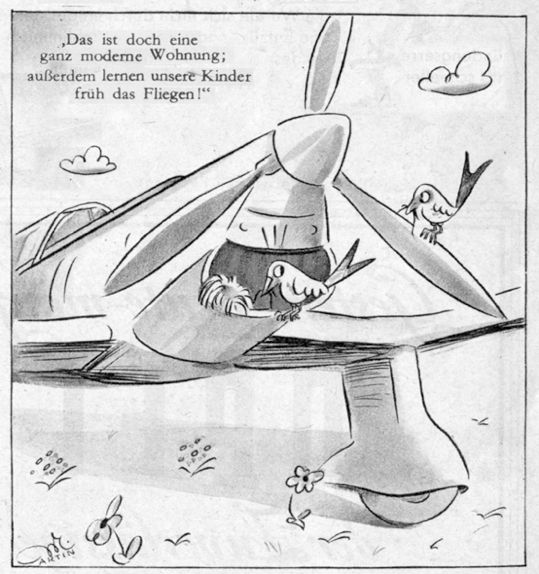
That's a very modern apartment, also the children learn to fly early!
The first attacks on England
Soon there was fresh work. Floating objectives were now assigned to the squadron after it stood the test so remarkably well in attacks on transporters. The next raids were on British convoys attempting to run the blockade of the Channel. These flights over long stretches of sea were a trifle uncomfortable at first, because a dive-bomber pilot has, of course, only one engine; when that cuts out, there is nothing for it but a dip in the “drink” with all its disagreeable consequences. Although the crews were provided with life jackets, they had no yearning for a cold footbath. The anxiety felt about the single engine often led subconsciously to a certain feeling of uneasiness. Did it not just conk? Not a bit of it! The engine is roaring quietly in its sonorous way, as it always roared. Merely imagination playing tricks! After the first dew raids, they had familiarized themselves with flying over the sea, thanks in no inconsiderable extent to the unbounded confidence that the pilots were able to place in the work of their mechanics.
At first there was occasionally a hitch with the convoys and many a bomb missed its target. The British skippers tried a new trick of dodging aimed bombs. When an attack was reported they did not rush off at full speed in zigzag, as hitherto, but in circles. That was very awkward for the dive-bomber crews, until they had found out the arc, and more than once fervent, but unholy Bavarian expressions were to be heard in the headphones. In a short time, however, the squadron had got in its hand and many a proud British steamer was sent to the fishes.
Peltz flew with a large formation in the first attack on England, a raid on London. Unfortunately the raid had to be broken off owing to very bad weather conditions, which made a flight in formation very difficult. During the return flight there was a little misadventure, which in reality was not one. Peltz had been flying back blind and dived through the clouds, when he knew that the French coast lay beneath him , in order to catch a glimpse of the earth. He had barely reached the open and recognized the coastline below, when “Archie” opened a furious fire. Fortunately the machine was not hit, but the crew were hopping mad. That cursed anti-aircraft defense! We’ll show them this time! Arrived home, Peltz at once got on the phone and rang up everyone he could reach to work off his wrath. But he speedily calmed down when he got hold of the officer commanding the anti-aircraft defense, who spoke a few soothing words. “My dear man”, he said, “there’s no great call to get your dander up. We recognized you all right as a German machine, but what you evidently failed to recognize was the Bristol Blenheim behind interceptor behind you, which was evidently out for your scalp. My gunners shot it down not very far behind you.” Peltz vowed never again to bawl out “Archie” – at least until the next time.
The cold season made the raids on England more difficult. Although the machine is almost perfectly equipped against the risk of ice-formation, by means that need not be discussed here, still there was one troublesome feature. Blind flying often seemed to take no end when zooming up to find the open, the clouds appeared to go up all the way up to heaven, and the result was that the windows of the cockpit became covered with ice, thereby eliminating free vision, one of the most vitally essential elements of flying.
Whale hunting
Although the cry of “Interceptor!” is not exactly music in the ears of a bomber pilot, Peltz had perforce developed a method that enabled him to always shake off enemy pursuit planes. When on his way to his objective above the clouds in brilliant sunshine, Spitfires or Hurricanes were almost always sure to turn up. Fortunately these troublesome insects revealed their presence at a great altitude in good time by the white condensation streaks. Then the first thing to be done according to a well tried recipe was to get in to the clouds. Peltz had barely disappeared from view when he changed his course; he flew for a time on the wrong course and then cautiously poked his nose out into the open. The pursuit planes had mostly gone off by then, looking for the enemy on the old course and waiting till he came to the surface again. His crew gave that method of shaking off the British pilots the name of “whale-hunting”, because whalers, like the British pilots, are after a big fish that also doubles under water. There is no fear that British pilots will reap any benefit from the publication of that dodge, because they will have already have noticed for themselves that the German bomber pilot, who again and again destroys precisely their most valuable military objectives, is not to be diverted from his objective. When the faithful Ju 88 was homeward bound and flyng blind, leaving nameless destruction behind it, the gallant crew were accustomed to chant their battle-cry to the well-known tune “Wir haben den Kanal, wir haben den kanal – noch lange nicht voll” (which might be freely interpreted “We have not filled the channel, we have not filled the channel – by a very long way”).
And now the reader is invited to make the acquaintance of that crew, whom there will often be occasion to mention. Besides the pilot and commander, Oberleutenant (Flying Officer) Peltz, there was the bomb-aimer Oberfeldwebel (Sergeant-Major) Rauscher, meanwhile promoted to the position of Leutnant (Pilot Officer) for bravery in the presence of the enemy. The radio operator was Oberfeldwebel (Sergeant-Major) Schönchen, whilst Feldwebel (Sergeant) Klaar acted as rear gunner. All three are of the same hard timber as their commander. Men who would be prepared to fetch the devil’s grandmother out of hell, as all in the day’s work.
German bomber muscles in on a British airdrome
Once more Peltz and his crew are off for England. Over the Channel, the weather was all that could be desired, but the low clouds steadily tail off as they approach their objective. Peltz is till 4,600 ft. up as the last veil of cloud flits by and then the machine is in the open; there is no further protecting mass of cloud in front which is not quite healthy for a lone plane that aims at worrying the British a mite.
Peltz flies a little further at the risk of running up against enemy pursuit planes in that wide open expanse of sky. He must decide quickly. His objective is still far off and it is not to be reached under the present circumstances, so that he must seek a substitute target, because there can be no question of carrying that nice little load of bombs back with him. At the worst, there is always London, but that would be merely a makeshift target that appears to Peltz and his crew to be hardly a fair deal. They are accustomed to better objectives.
The pilot has now left the protecting cloud cover quite a distance behind him, but can detect no worth-while objective for his precious bombs, however much he looks about him in every direction. Suddenly he spots an airplane several miles away over to the left that is travelling away from him and seems to be intending to land. At all events it is plainly descending. But if the pilot is going to land, he will most likely do so on a landing ground. Peltz nudges Oberfeldwebel Rauscher beside him, who has also noticed the plane and is of the same opinion as his commander, without many words passing between them. Airdromes are always worth-while objectives.
Peltz has long since started the slight deviation from his course that brings him on the track of the landing British and in a very short time they have the landing British and in a very short time they have the landing ground before them. There was some landing ground! That was much more than an ordinary kind of landing ground, it was the real thing in airdromes. There was a steady coming and going of aircraft and a number of machines stood in a bunch together, evidently alongside the gas pits, and there were extensive hangers close by. “O Boy!” says Peltz, “Me for that”.
Now a raid on a British airdrome in bright sunshine out of a blue sky is not quite as simple as a matter, as it looks, because the British are accustomed to protect their airdromes by plentiful use of anti-aircraft defense artillery, more especially light weapons, that are rather awkward for any low-flying machine. Oberleutenant Peltz knows all about that and his crew naturally know that too, but they hope to pull it off by acting on their well-tried maxim that can be done by bluff, where bashfulness will not have a look in. Peltz has long since laid his plan, as he descends in a wide turn and manoeuvres himself towards the airdrome. A training course seems to be in progress down below, because aircraft are constantly flying round the airdrome, and Peltz intends to muscle himself in to that traffic as if he belonged to the gang. Peltz has completed his turn and is flying straight for the airdrome; he can even recognize the landing cross ahead. Rauscher says, “Pursuit planes are taking off”, but Peltz only shrugs his shoulders; it is scarcely to be supposed that they are after him because he does not seem to have been noticed yet. Several machines are landing simultaneously and others are whirring in from the left. There are all sorts of types among them, but Peltz has no time to bother about them. His attention is concentrated on the crowd of machines ahead at the gas pits. Suddenly a red streak flits past the front turret. Then again; more and more of them. “They’ve spotted us now!” But the firing stops at once and Peltz sees the reason why; there are too many British machines in the air, so that the anti-aircraft defense can not shoot properly. Rauscher has his hand on the bomb release gear, but Peltz stops him and banks sharply to make an about turn. The approach has failed. It passed very close to the objective so that the bombs would not have exerted their full effect.
“Down with the bombs!”
The numerous British planes in the air appear not to have noticed as yet what is going on. Some land, but others take off, while others are flying round the airdrome, as if nothing had occurred. “That is very nice of these guys”, says Peltz, “because in that way they are preventing their own artillery from firing.” At a very low altitude Peltz approaches the target again in a sharp curve and once more the tracer from the ammunition of the light anti-aircraft guns whistles past. But not a single hit is scored.
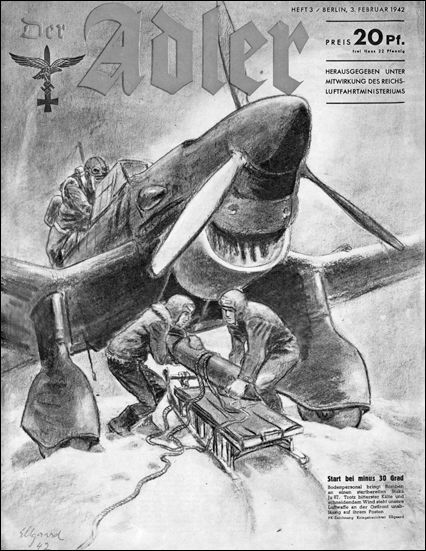
The front cover of ‘Der Adler’ 3rd February 1942
Stukas
Prof. Karl Ritter’s New Film
A field airdrome somewhere in France. A couple of Stukas (dive bombers) ready to take off. Airmen in full outfit with weatherbeaten countenances. Cries and commands on all sides. In reality we are standing on the Ufa lot in Babelsberg, where a new film is struggling into being. A film that is to be a heroic epic of our Air Corps and a monument to inviolable comradeship. It is intended to be a vivid presentation of the struggle and victory of our Airmen in France based on the plain and unadulterated truth. At the present time there is one director in Germany who possesses not only the artistic power, but also the full inner justification for the production of such a film, and that is Prof. Karl Ritter, the pilot of the Great War. He grew u, as few others have done with the beginnings of aviation in Germany, he experienced its smashing after the Great War and its reconstruction under Reich Marshal Hermann Göring, and now he is once more in the fighting line. To be able to fly, and to be allowed to fly, that is the secret pivot of a life unusually prolific in excitement and tense situations.
He began his reminiscences in unadulterated Würzburg dialect by saying. “I am really quite an old eagle. Even as a boy, I was intended for the army and so found myself in barracks, became Fahnenjunker (Aspirant Officer) and lieutenant of engineers. In 1909 I married and became an airman, although that was not such a simple matter as it is today. Whoever wanted to fly had to provide his own machine. I began to build one for myself and, in order to make more rapid progress, applied to my superior officer to have a fitter, a carpenter, and a coach house placed at my disposal. His reply was terse and to the point, “The man’s crazy!” But in the end I got my way and the contraption actually flew. I do not know whether young men of today can appreciate what that meant to me. But I confess that I did not always land in the orthodox way: something always broke, but I cheerfully repaired the damage and started again, until I was finally officially seconded in due form for instruction in aviation. As then, as throughout my whole life, the aim was to learn and to keep on learning. In 1911, I passed my tests as certified pilot on a monoplane of my own construction and received my membership card No.121 of the Fédération Aéronautique Internationale.”
From that day on Leutenant Ritter of the Third Royal Bavarian Battalion of Engineers knew no peace. He devoted all his energy to promoting military aviation in the Bavarian Army and had firmly resolved to be transferred to the Air Corps, when the Great War broke out. He left for the front as officer of engineers, but was soon seconded to the Air Corps, took part in numerous undertakings gained the Iron Cross, Class 1. Aviation did not lose its attraction for him, even after the War. He worked out plans for the organization of sporting aviation and finally became the creator of German Aviation films of the heroic stamp. “Pour le Merite” was the first of these, in which he gave final form to the pride and bitterness of his own experience in the Great War. It was followed by “Legion Condor”, a film of the German volunteers in the Civil War in Spain. Karl Ritter himself, supported by his son, photographed the decisive phases of that war, being often on the move for hours on end from morning to night. He sat for twelve hours in a plane, while hostile anti-aircraft guns banged away at him. Thus arose a faithful picture of the war on foreign soil, of the spirit that animates our airmen, and of the planes that proved to be superior in every respect to the enemy machines. And now a new film is being shot, in which men and dive bombers occupy the centre of interest.
Two unusually bright and vivacious eyes in sharply cut features impress themselves on the listener, as Professor Ritter vividly and tersely describes his new commission. “It is the aim of this film,” he said, “to present the German airman as he really is for the benefit of our own people and also of countries abroad. They are simply young lads, hearty and straightforward, who do their duty unostentatiously as a matter of course without talking about it; human beings with a healthy sense of humour and unquenchable joy in life. Just as they often presented themselves to me on an airdrome in France. Some would be reading, others having a game of cards, others playing music, or otherwise diverting themselves in their own fashion. Then came the order for action and a few seconds later they would be climbing with the same quiet assurance on to their machines, and taking off on a raid. Only those who have actually been present can really have any conception of the stuff that these men are made of, and the physical and intellectual forces that enable them to hold out even in the most trying situations. That is the reason why a film that purports to deal with these men can only be made by one who is himself an airman, just as everyone who knows war only from hearsay must call a halt before portrayal of war itself. Personal experience is essential.” Karl Ritter was once again on the front during the campaign in the West. He points to two Ju 87 dive-bombers before us and proceeds with his description. “These planes belong to the wing to which I was attached in the West. I intended at first to travel about and to visit several field airdromes, but then I decided to remain from start to finish with the same wing. That proved to be the right course. For I had full experience of everything in that way: everyday routine, work, fighting and victory. That reality has entered in to the film, which contains no invented incidents. I was able to document even the most trifling episodes of the scenario by bringing only events that actually occurred. And the scenario by bringing only events that actually occurred. And the characters too are exactly such as are to be met with on every field airdrome. Beside the commander, the paragon leader of his wing, there is the comrade with artistic temperament who cannot do without his piano, even in war, to play Beethoven and Wagner. The dashing Flying Officer, a favourite of fortune in every situation in life, is paralleled by the definitely unlucky fellow who fails at everything. All of them, officers and men, differ altogether in temperament, but all are of one mind when the time for action comes.”
The action of the film covers six weeks of the campaign in France. Stukas thunder over the battlefields in the West and swoop on the enemy, forts are shattered, moles burst asunder, and ships blow up. In spite of that, however, Professor Ritter would prefer not to call the film a “war film”, but rather a “soldier’s film”; for the most important factor of the war it is the man and comradeship. It is not a matter of chance that a dive-bomber wing occupies the foreground of interest. That branch of the service to a great extent determined the course of the campaign in France; it has impressed itself most forcibly on the mind of the German people and throughout the world, and it gives the clearest possible expression to the absolute will of victory.
It is a particular pleasure to watch Professor Ritter at work. The old soldier, as he is, has fused his co-workers into a genuine team – artistes, camera-man, scenic artist, the writer of the scenario, and musicians, they are all members of the “Old Guard” with whom he had shot many successful films. His closest collaborator is his son Heinz, who also made the open-air shots for the Stuka film. “The most difficult problem,” he tells us, was to get diving Stukas before the camera and I have to thank the comradely spirit of the dive-bomber wing that I succeeded at all. Day by day the boys flew as if it were the most natural thing in the world, until the shots were perfect.”
So much at least is certain. This film will meet the ideas of the front-line fighter. It will be a document of soldierly spirit and genuine comradeship, such as only the common struggle can bring forth.