
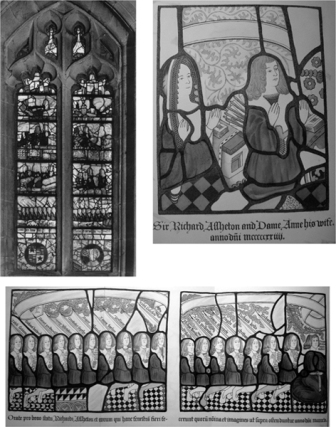
1 Memorial stained glass window to the sixteen locally recruited archers killed during the Flodden Campaign of 1513, in St Leonard's Church, Middleton, Lancashire. This may be England's first war memorial.
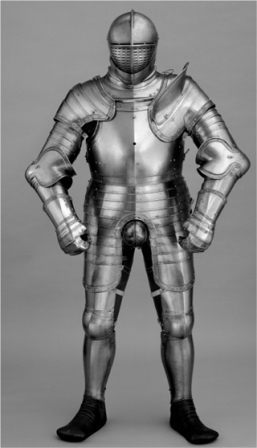
2 Henry VIII's field and jousting armour, 1540. The size of the suit shows the king's bulk, while the codpiece might help explain his marital problems.
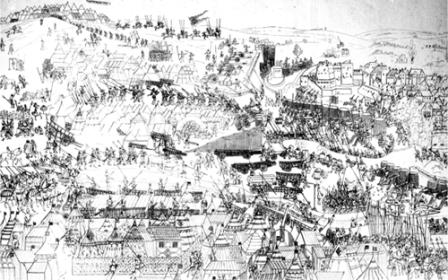
3 Henry VIII at the Siege of Boulogne, 1544. While the king declared his ambition was ‘to exceed the glorious deeds of his ancestors’, this engraving shows how chaotic the face of battle really was.
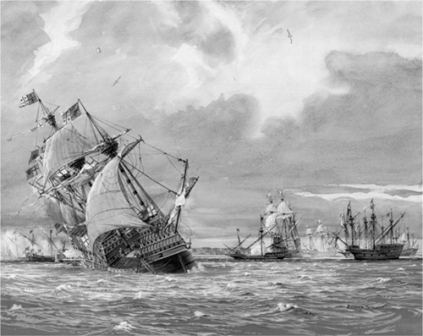
4 Richard Schlecht's painting, The Sinking of the H.M.S. Mary Rose during the French attack on Portsmouth in 1544, shows that the sea is no place for the incompetent.
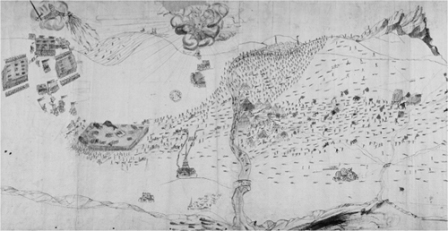
5 John Ramsay's contemporary illustration of the Battle of Pinkie between the English and Scots in 1547 shows a classic ‘panic fear’. Scots soldiers are starting to run from the rear and sides of their formation. Afterwards a victor recalled, ‘nowhere was there any surety of safety.’
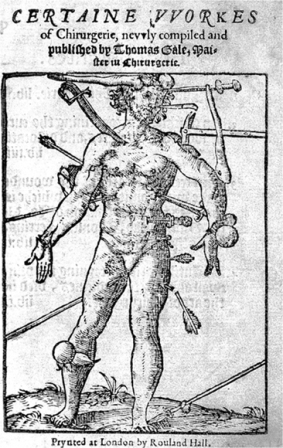
6 ‘A wound man’, illustration from, Certaine workes of Chirurgerie, 1563, by Thomas Gale who served as a doctor in the French wars where he recalled, ‘there was a great rabblement that took upon them to be surgeons. Some were sow gelders, and horse gelders, with tinkers and cobblers.’
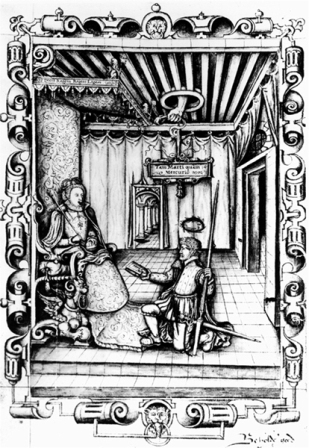
7 The poet, soldier and military historian George Gascoigne (1525–77) presents a manuscript to Elizabeth I. He observed ‘how sweet war is to such as know it not.’ She once told the French Ambassador that soldiers were ‘but thieves and ought to hang’.
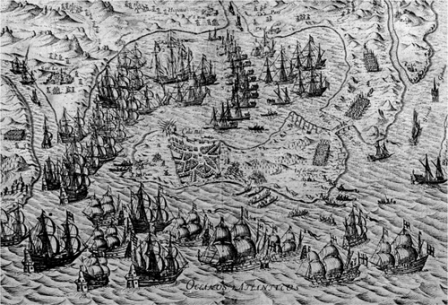
8 The English attack on Cadiz in June 1596 has been described as ‘one of the most efficient acts of war carried out by any Tudor government’.
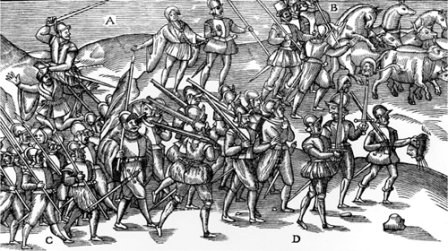
9 English soldiers in Ireland ‘burning and pillaging all the way’, parade in triumph, carrying severed Irish heads and leading a captive by a halter.
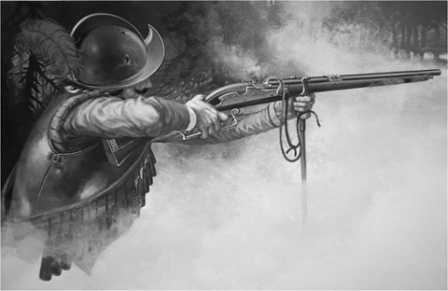
10 Early seventeenth-century matchlock musket with stand; although slow to fire, its heavy ball made an exit wound the size of a dinner plate.
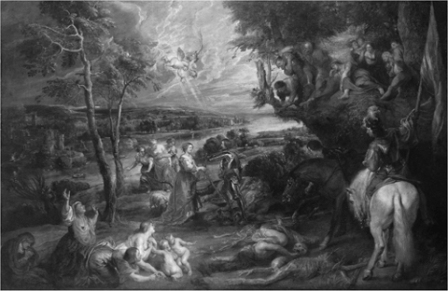
11 Peter Paul Reubens’ painting of St George and the Dragon made the case for peace at a time when Charles I wanted to go to war.
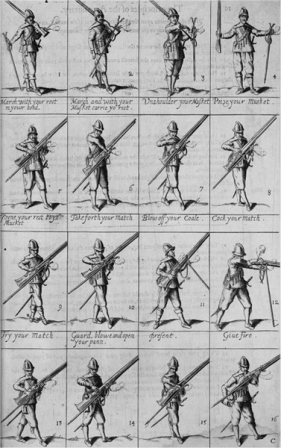
12 An illustrated drill manual from Henry Hexham's The Principles of the Art Militarie, 1637; ‘now we have obtained the handsome skill, by order, method, and by rule to kill.’
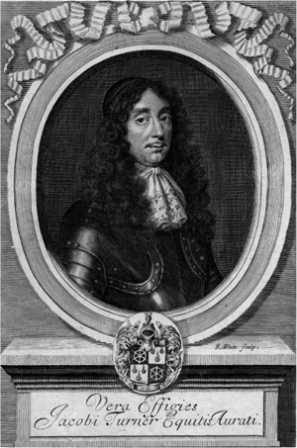
13 Sir James Turner, the Scots mercenary who believed that ‘so long as we serve our master honestly, it is no matter which master we serve.’
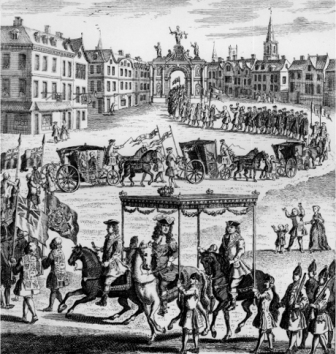
14 Dirck Stoop, Charles II's entry into London, 1660; the king being restored ‘by that very army that had rebelled against him’.
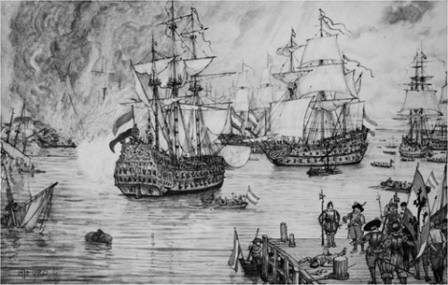
15 The Dutch sack the English naval base at Chatham, 1667. ‘I think the Devil shits Dutchman,’ babbled Sir William Batten, the Surveyor of the Navy.
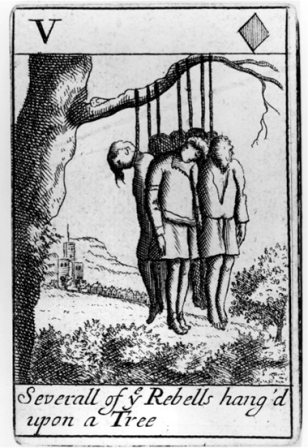
16 Several Rebels hanged from a tree after the Battle of Sedgemoor, 1685, from a set of playing cards.
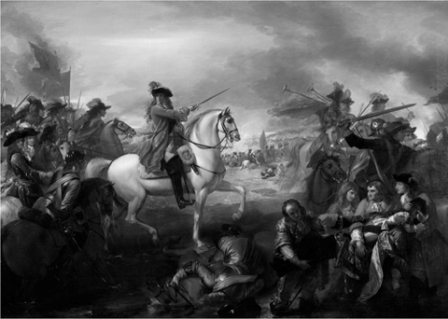
17 Battle of the Boyne, 1 July 1690, painting by Benjamin West. Afterwards a victor boasted, ‘we killed but an abundance of their men, and pursued the rest’.
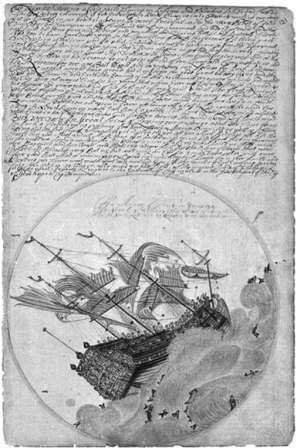
18 The Manner of the ship Sampson in Stress of Weather, by Edward Barlow, the seventeenth-century mariner, from his journal, showing how cruel the sea could be.
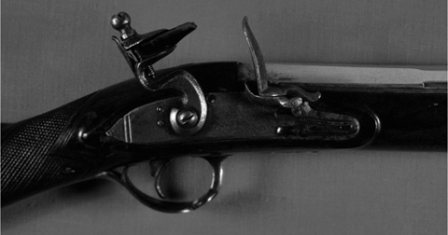
19 ‘Brown Bess’ musket; the standard infantry weapon for over a hundred and fifty years, which inflicted 40 per cent of battle casualties.
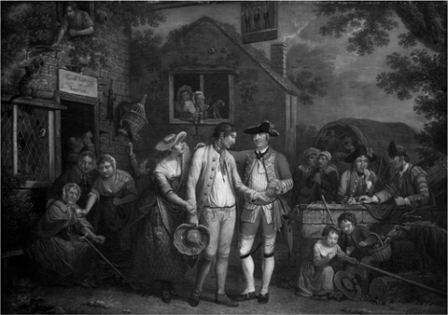
20 The Recruiting Sergeant, painted by John Collet (1725–80). ‘If any gentlemen, soldiers or others have a mind to serve Her Majesty…if any have severe masters…undutiful parents…too little wages…or too much wife, let them repair to the noble Sergeant Kite’.
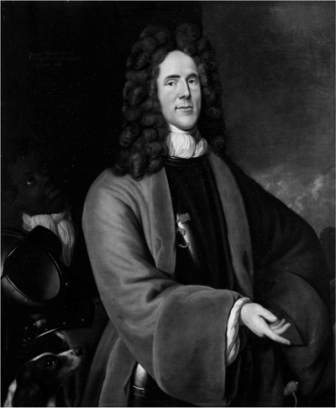
21 Colonel John Blackadder, the Scots soldier who after the Battles of Blenheim and Malplaquet ‘went down into the field of battle, and there got a preaching from the dead.’
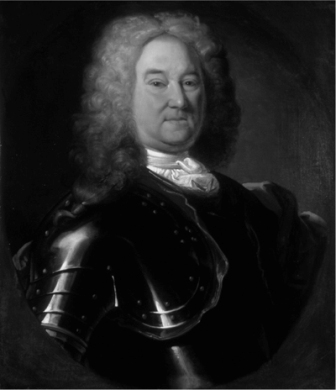
22 Captain Robert Parker, the army officer who fought on the continent and in Ireland, where he recalled ‘the miserable effects of war appeared in a very melancholy manner’.
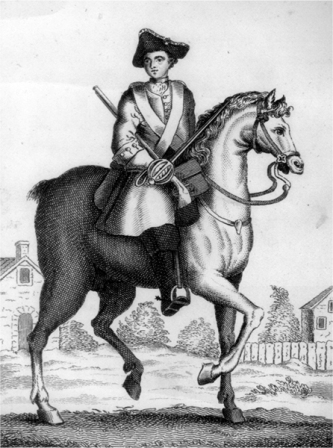
23 Christian Davie, aka Mother Ross, the ‘she-soldier’, who fought during the War of the Spanish Succession. She died an out-pensioner of Chelsea Hospital, being buried with full military honours.
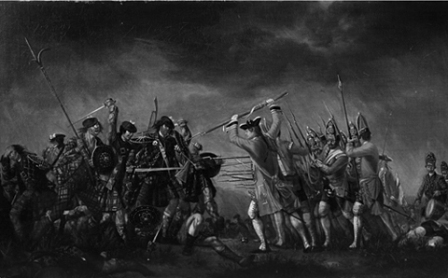
24 The Battle of Culloden, 16 April 1746. ‘I laid about me as I were mad’, recalled a British officer, adding that ‘Our lads fought more like devils than men.’
ACKNOWLEDGEMENTS
Trip no further, pretty sweeting;
Journeys end in lovers meeting
Every wise man's son doth know.
Twelfth Night, II, iii, 24–26
THIS, THE FIRST THING MOST READERS READ AND THE LAST MOST authors draft, is always a pleasure to write, not just because it marks my journey's end, but because it is an opportunity to thank all those who have made my adventure so enjoyable. It is the friendship and kindness of people, some strangers, others lifelong comrades, that make writing books both possible and pleasant.
My journey began in Australia where a visiting fellowship at the Australian Defence Force Academy enabled me to start the basic research. John Reeve was the perfect host, while Peter Dennis, John Coates, Robin Prior and Jeff Grey were especially generous with their time and insights. Early in this project I was able to develop ideas at seminars at the Australian Defence Force Academy, Flinders University, the University of South Australia, Newcastle University, Monash University, the University of Tasmania and the Pacific Coast Conference on British Studies. Closer to home I have been able to run ideas past members of the Triangle Institute for Security Studies, particularly Dick Kohn, Alex Roland, Caroline Pumphrey, Joe Caddell and Joe Hobbs. At North Carolina State University and Duke University my students let me test ideas on them in lectures. The staffs of the Cambridge University Library and North Carolina State University Library were unfailing in their outstanding help. For over a quarter of a century, Wolfson College, Cambridge, has provided a fertile and congenial base for summers’ research in England, a debt that I have tried to recognize in the dedication.
I am grateful to David Trim for reading Chapter 4, saving me from grievous errors and greatly improving my arguments. Joe Slavin did the same for the first four chapters, Ian Gentles read Chapters 7 and 8, Bill Speck Chapters 10 and 12, and John Reeve Chapter 11. Thanks to John Wall and Robert Bearman I was able to discover that the Bard had not served in the militia. Simon Harris, historian and anaesthetist, answered questions about Admiral Sir Cloudesley Shovell and the effects of wounds. Peter Paret and N. A. M. Rodger responded warmly to emails from a complete stranger with the generosity that is the hallmark of the true scholar. Padraig Lenihan provided useful figures on Irish casualties. Tom Hester furnished valuable insights into John Donne. Over the decades I have benefited immeasurably from the friendship and wisdom of Wallace MacCaffrey, the sage of Cambridge University Library's tea room. As always John Morrill was a source of information, strength and encouragement. With him, and Mark Kishlansky and Jonathan Scott, I have enjoyed stimulating discussions about Charles I. With his incomparable knowledge of the British Army, Tony Clayton saved me from many errors. Paul Seaver, Thomas Cogswell, Edith Sylla, John Riddle and Gene Rasor kindly answered email queries. Sarah Hartnell read a final draft. I am grateful to Joanna Bourke for sharing the ordeal of 9/11 with me and my wife. It was a time that reminded us that the evils about which historians write can be all too real. I am grateful to my friend and physician Douglas Hammer both for his care and for many stimulating discussions about writing history. Since retiring in 2006, I have served as a volunteer guide at Fort Macon, North Carolina, where I have enjoyed many enlightening conversations, particularly with Paul Branch and John Rhodes, about the American Civil War, which have illuminated my understanding of the British Civil Wars. Heather McCallum of Yale University Press in London has been both a dear friend and valued editor, who has done much to quell an author's insecurity, while helping me produce (I believe) a far better book. While being finely tooth combed is not the most pleasant of experiences, I am most grateful to Rachael Lonsdale, Tami Halliday and Richard Mason of Yale University Press, and to the outside readers, Peter Gaunt, Mark Stoyle and Mark Fissel, all distinguished historians, for going through drafts of the manuscript so thoroughly. My thanks to Richard Slatta for helping sort out word processing problems. Last—and far from least—my greatest debt is due to my wife Caroline, who has cheerfully read my drafts, accompanied me across many a rainy battlefield, and generally put up with me.
The year starts on 1 January, with the date usually eleven days behind that on the continent. I try to give an individual's rank at the time he is mentioned. Similarly, where possible I have provided mid-twentieth-century regimental names, and not the current ones that are the product of so many—far too many—amalgamations. I have tended to combine reference notes when it is possible to see from the context to what they refer. There is no accepted nomenclature for England, Scotland, Ireland and Wales. Some have suggested the ‘Atlantic Archipelago’, which has the virtue of including the Channel Islands and the Isle of Man, but is awkward. Others talk of ‘The Three Kingdoms’, which excludes Wales and thus offends my Cymmrodorion heritage. To constantly add ‘and Ireland’ to Britain gets a little tedious. To make things even more confusing, when does Britain include Scotland? Before James VI and I's accession in 1603? Before the 1707 Act of Union? What about Henry V's army at Agincourt? Was it an English, an Anglo-Welsh, a British, or even a British and Irish army? Fortunately, Captains Fluellen, MacMorris and Jamy had better things to argue about. Thus I have decided to use ‘Britain’ and ‘British’ to include all three kingdoms and Wales. The New Oxford English Dictionary defines the ‘British Isles’ as including ‘Great Britain and Ireland with all their offshore islands’. For much of the previous three, even four, centuries people happily talked about the British Army and Navy, the British Constitution and the British Empire. Even today Scots, Welsh and Irish scholars read papers at the North American Conference of British Studies and make splendid contributions to H-Albion.
Beaufort, North Carolina;
St David's Day, 2010.
This royal throne of kings, this scepter'd isle
This earth of majesty, this seat of Mars.
Richard II, II, i, 42–43
LONG AGO—FAR LONGER THAN I CARE TO REMEMBER—I FIRST visited Culloden Moor in Scotland. There were four of us, part-time soldiers in Britain's Territorial Army from different infantry regiments, halfway through a selection course for the Special Air Service. We were young, we were incredibly fit, confident in having passed the first half of the selection, apprehensive about the second, a gruelling trial in the Cape Wrath area right at the north-west tip of Scotland. We knew little about what had happened at Culloden, although we knew that what the young men had endured there over two centuries ago was far worse than anything we would encounter. As the Land Rover drove across the dark wet battlefield (which then was far more forested and dismal than it is today), all of us felt a sense of unease—even shame. If any of our regiments had fought at Culloden, they would not have proudly borne the battle honour on their colours, for it is a victory that the British Army does not commemorate: it is one it would prefer to forget. We felt as if the ghosts of the dead Highlanders resented the presence of the uniformed military heirs of those who slew them so callously on 16 April 1746. And thus we climbed back into the Land Rover and drove away.
While there are many reports of supernatural sightings connected with battlefields (including seven at Culloden alone), it would, of course, be absurd to suggest that ghosts really exist, haunting sites where men have been slaughtered long ago.1 Yet there is something special about battlefields. They are places where human beings legitimately kill each other.
Killing
Killing is crucial in three ways. First, it is the central act of war, giving war its uniquely horrible character. Second, killing makes war effective, in the sense that taking lives, for better or worse, decides things: cultures and societies that cannot effectively fight and kill tend not to survive. Third, killing has become a central focus of the study of war, fundamentally changing military history. Thus this book will examine a culture and society, early modern England, and then Britain, that was extremely good at fighting and killing, and in doing so flourished mightily.
Killing is fundamental to war. Leo Tolstoy, the novelist who served in the Russian Army, declared that ‘the reality of war’ was ‘the centrality of killing’. Just before the Third Battle of Murfreesboro (1864), the confederate general Nathan Bedford Forrest observed that ‘war means fighting and fighting means killing’. Professor Paul Fussell, who fought as an American infantryman in the Second World War, described war as ‘a culture dominated by fear, blood and sadism, by irrational action and preposterous (and often ironic) results’. The seventeenth-century poet Samuel Butler put it more pithily: ‘War is a cessation of humanity.’ That gentle poet and pastor, George Herbert, agreed that ‘War is death's feast.’2 Few animals kill members of their own species: none but man does so in large numbers.
Which is the basest creature, Man or Beast?
Birds feed on Birds, Beasts on other prey
But savage man alone does man betray.
Thus observed John Wilmot, earl of Rochester, in 1705. A generation earlier Edward Hyde, earl of Clarendon, wrote that ‘War is a license to kill … it distinguishes not of age or of sex or dignity but exposes all things and passions, sacred and profane to the same contempt and confusion.’3 Jonathan Swift once defined a soldier as ‘a Yahoo hired to kill in cold blood as many of his own species, who have never offended him, as he possibly can’.4
If licensed killing is so terrible, so inhumane, so uncivilized, why then has war, to use Gwynne Dyer's phrase, always been ‘a central institution in human civilization’?5 The answer is that war is decisive, and thus, either through man's nature or through evolution, rewards those who are good at it.
States or societies go to war usually because they believe that it will produce advantageous decisions. Theodore Roosevelt, one of war's bulliest proponents, called it ‘the supreme arbitrament’. John Fletcher, the dramatist and Shakespeare's contemporary, agreed that war was the ‘grand decider’.6 Societies spend huge resources in men, material and money on wars, not only because they perceive there to be great advantages in winning, but because the costs of losing are so horrendous. The vanquished may be killed, their property destroyed, their children abused, their women raped or consigned to concubinage.
But individual men (for war has for long been an overwhelmingly male activity, particularly when it depended on physical strength) fight for complicated, often irrational reasons. Today many would agree with S. L. A. Marshall, the great American military historian, that ‘The starting point of the understanding of war is the understanding of human nature.’7 But what is our nature as humans? Are we, as the Elizabethan portrait painter Sir William Segar observed in 1602, all ‘in some sort disposed to make war’? Was Sigmund Freud right when after the First World War he told Albert Einstein that ‘man has in him an active instinct for hatred and destruction’? That instinct, Freud continued, came from man's libido, his sexual drive being too often expressed in violence that enhanced his sense of self-worth as a man.8 The links between male sexuality and violence are nigh universal, having been charted in some 112 different societies. These links have remained fairly constant over time. Just as US Marine Corps recruiters used to promise ‘to build men’, so Captain Abraham Stanton avowed that as a result of the British Civil Wars, ‘Myriads of men now bear arms that bore nothing but only shapes of men before.’9 Three decades earlier Edward Hyde called Lord Somerset, the duke whom Charles I made a general notwithstanding his complete lack of military experience, ‘a virgin soldier’.10 Freud was, of course, influenced by Charles Darwin, who has added immeasurably to our understanding of human beings and thus of war. The men best fitted for violence were best fitted to survive and hand on their genes: females were, all too often, the victors’ spoils. In other words, evolution rewards aggression.
Herein lies a paradox, for evolution may both destroy and develop societies and civilizations. War, that most unsociable of society's acts, requires strong social bonds and organization to be successful. Young men must be willing to die. Society must approve the killing of its enemies, and must agree that doing so is a legitimate way of solving its problems.11 War—like pornography—both attracts and repels. Many men—more than we would care to admit—actually enjoy war. It would have been ‘a pleasant sight, if a man's skin had not been in hazard,’ thought John Taylor about the fighting in Calais in 1513. Thus Robert E. Lee, the leading confederate general in the American Civil War, rightly observed that ‘It is well that war is so terrible—otherwise we would grow too fond of it.’12
We are also ambivalent towards those who fight our wars. We are fond of those violent men, who armed with the tools of war protect us, and at the same time we are afraid that they may turn upon us. Dr Johnson reflected this paradox. While thinking less of himself for not having been a soldier, he defined ‘Redcoat’ and ‘Tar’ as terms of contempt. Ambivalence can turn to loathing. In 1700 the newspaper the London Spy declared that only two things like a soldier, ‘whores and lice’. Perhaps Thomas Becon, the seventeenth-century Puritan, was unconsciously reflecting Freud's link between violence and sexuality when he railed against soldiers, ‘What whoredom is committed among them! What maid escape unflowered? What wife departeth unpolluted?’13 In peacetime soldiers are, as William Cecil (Lord Burghley), Elizabeth I's adviser, told his son, ‘like chimneys in summer’. In peace it's mostly a case of ‘Tommy, go away!’ But as Rudyard Kipling went on to observe, ‘It's “thank you Mr. Atkins”, when the bands begin to play.’14 Over two centuries earlier, Francis Quarles, the seventeenth-century poet, agreed that attitudes towards soldiers changed between war and peace:15
God and the soldiers we like adore
When on the brink of ruin—not before:
The danger past, both are alike requited,
God is forgotten, and the soldier slighted.
Recently, military historians have come to focus on the centrality of killing and fighting. Michael Howard, who won the Military Cross as an infantry captain in the Second World War before becoming the Chicele Professor of the History of War at Oxford, insists that ‘at the centre of the History of war … is fighting’.16 In the Second World War S. L. A. Marshall borrowed the techniques of time and motion studies from industry to discover what soldiers actually did in combat. Other historians such as Sir John Keegan applied his methods to see what really happened in past battles.17 War is studied in its widest context. While accepting that war has changed, the new military historians have emphasized continuity, particularly of the experience of combat. ‘The essential soldier remains the same,’ argues General Sir John Hackett. Buffy Sainte-Marie, the Canadian folk singer, described ‘The Universal Soldier’:18
He's four foot two, and he's six foot four
He fights with muscles and with spears.
He's all of thirty one and he's only seventeen
Been a soldier for a thousand years.
Much in battle has remained the same. Fear felt no different at Bosworth Field (1485) than it did at Culloden (1746): the pain from wounds was just as agonizing, the anguish of mourning no less intense. Thus this book will use examples from recent times, when records are more comprehensive, to illuminate the experience of early modern Britain when such records are less copious. Take, for example, Edmund Ludlow's symptoms after the Battle of Edgehill (1642), his first taste of combat. He reported that he could not open his mouth to eat, explaining that having been without food for so long he must have forgotten to do so. But such a rationalization is incomprehensible. Humans cannot forget how to eat. His experience only makes sense in the light of reports of similar symptoms from both Normandy and Burma in 1944 of post-combat lockjaw—the result of clenching one's teeth so hard to counter the terror of battle that it was several hours before the victims could open their mouths again.19 So by focusing on the actualities of war, on killing, by examining continuity as well as change, and by using a wide range of sources, the new military historians have transformed the discipline.
And about time too! For a century, at least, British academic historians have had harsh things to say about military history. They deemed it ‘an arcane and disagreeable speciality, like the history of pornography, not to be encouraged in a decent university’.20 For Marxist academics war is incidental—the inevitable, preordained product of economic forces. War does not fit into the Whig view of a restrained, rational, civilized flow of British history: it has no place in the liberal story of peaceful constitutional progress.21 In America most male academics, at least of my generation, remember the Vietnam War as an experience that their graduate deferments enabled them both to avoid and despise. The military, unlike academia, is an authoritarian, hierarchical organization: its values are alien; its function—killing—is repulsive. Such academic attitudes surprised Professor Lawrence Stone, that great cultural and social historian (who served on an aircraft carrier in the Royal Navy during the Second World War); he sardonically observed that it was ‘extraordinary’ that ‘war … should have been so neglected for so long by those who regard themselves as in the forefront of the historical profession’. Sergeant—later Professor and Sir—Geoffrey Elton agreed.22
Of course, the frightfulness of war has discouraged the teaching of its history—a conundrum not shared with, say, Holocaust Studies. But just as teaching about Auschwitz does not justify gas chambers, so the teaching of war does not condone killing. R. H. Tawney, another great British historian, who as a young sergeant saw more than his fair share of killing at the Somme in 1916, called ‘the institution of war the most neglected factor in social development’.23 To be sure, military history has been used, if not abused, particularly by the military, to learn lessons from past wars in order to win future ones: all too often it has been turned into what General J. F. G. Fuller, another giant of the discipline, has called ‘a bloody romance’. But as Karl von Clausewitz, the nineteenth-century Prussian who founded the modern study of war, warned, ‘It is to no purpose, it is even against one's own interests to turn away from the consideration of the real nature of the affair, because the horror of its elements excites repugnance.’24 One of war's victims, Captain Charles Sorley, who was killed at the Battle of Loos in 1915, wanted us to confront that repugnance:25
When you see millions of the mouthless dead
Across your dreams in pale battalions go,
Say not soft things …
Outline: Macro and Micro
In this book I will try not to say soft things, but rather examine the hard reality of how war—which Tolstoy called ‘the vilest thing in life'—affected the history of early modern Britain.26 It did so at two levels that—to borrow a concept from economics—may best be described as the macro and micro. Since the two were intimately linked, instead of dealing with them separately in two parts where they may become truncated, in this book I will try, as far as possible, to merge them with interleaving chapters.
The first impact of war, the macro, is essentially chronological, affecting the state, international relations, the economy, society and institutional development. It reflects the policies of those in power—first the king, and then parliament—being in essence a story.
The opening narrative in Chapter 1 starts on 22 August 1485 with Henry VII's (r. 1485–1509) victory at the Battle of Bosworth Field, which ended the Wars of the Roses and established the stable Tudor dynasty that united England and Wales. His son, Henry VIII (r. 1509–47), tried to recapture the glories of the Hundred Years War by invading France. Chapter 3 deals with the reign of his daughter, Elizabeth (r. 1558–1603), which in many ways set the pattern for future military developments: intervening on the continent to help protect allies; conquering Ireland; initiating imperial ambitions outside Europe; and establishing the foundations of naval hegemony. In essence English military efforts were basically inwardly directed, a characteristic that continued until the Glorious Revolution of 1688. Chapter 5 deals with James I (r. 1603–25), who was loath to fight, and with his son Charles I (r. 1625–49), who got involved in a series of botched military expeditions in the late 1620s. Chapters 7 and 8 describe the British Civil Wars (1642–51) and the Commonwealth (1649–60), a defining moment when violence was as internalized as it was widespread and intense. These wars were both a conflict within England, Scotland, Ireland and Wales, and a contest between the three nations and principality, from which England emerged the undisputed leader. After the execution of Charles I in 1649, Oliver Cromwell used the new British republic's unprecedented military prowess to shift the focus of violence abroad, fighting in the Caribbean and on the continent. Chapter 10 deals with the generation after the restoration of the monarchy in 1660, when Charles II continued the policy of external warfare. He founded a standing army and professionalized the Royal Navy. Chapter 12 shows how the Glorious Revolution of 1688 enabled a number of themes to coalesce, permitting the English to suppress Ireland and conquer most of Scotland, and establish a secure tax base that let them borrow to expand the armed forces rapidly; those who paid the most taxes controlled parliament. The king lost power to a prime minister as the executive shifted from the crown to the House of Commons. With its victories in the Nine Years War (1688–97) and the War of the Spanish Succession (1701–14), Britain became the preeminent world and imperial power that she was to remain for over two centuries. By the Battle of Culloden in 1746 there was no doubt that this process was well and truly completed.
While the macro impact of war changed over time, the micro effect, that on the individual soldier and sailor, tended to be cyclical and constant, and will be treated as such in the thematic chapters. Admittedly the stages of the cycle were not clear-cut: for instance, untrained troops could be thrown into battle, veterans might be subjected to retraining. Neither were the influences on each force distinct. Honour could prompt a man to join in the first place, as well as keep him from running while campaigning or in combat.
The micro cycle of war began, as Chapter 2 reveals, with recruitment and training. Military manuals elucidated the theories and practicalities of combat, which during fighting good leadership made possible. Chapter 4 asks the age-old question ‘Why did men fight?’ Not why did they join to fight, but why they entered into combat and stayed there overcoming their fears. Chapter 6 shows that much of a soldier's or a sailor's time was not spent battling, but in garrison duty or campaigning, in port or cruising, in ‘low-intensity warfare’. Admittedly the latter could be most stressful, for, although exposure to danger was small, it lasted a long time. In contrast, battles and sieges (the subjects of Chapter 9) are examples of high-intensity combat, being usually short, and certainly sharp, bloody and decisive. While Karl von Clausewitz noted ‘Battles decide all,’ sieges could be equally bloody and decisive: drawn out, they could be costly in men and materiel.27 Naval warfare, the subject of Chapter 11, was different from that on land, mainly because the sea was already such a dangerous place, with storms, shipwrecks and diseases, that fighting there only marginally increased one's chances of dying. The price paid by the millions caught up in the micro cycle of war is the theme of Chapter 13. For some it was the supreme one: for many more it was paid in wounds, both mental and physical, with imprisonment, loneliness, the loss of limbs or friends, and even rejection by the civilians for whom they had been fighting. War deprived many women of the opportunity of marriage—thought to be the proper and natural state for females. Women and children had to come to terms with the death of husbands, sons and fathers. Sometimes society tried to help with pensions or veterans’ hospitals, such as Chelsea or Greenwich in London. More often the victims of war were left to their own devices, charity, or friends and family.
The Conclusion provides a very rough estimate of how many people in the British Isles died directly or indirectly as a result of war, and shows that there were three periods of intense hostilities: the last third of Elizabeth I's reign, the British Civil Wars, and the world wars that followed the Glorious Revolution. These were periods of state formation. The chapter also argues that between 1485 and 1746 there was hardly a person in the British Isles unaffected by war. It was an ordeal that all remembered and few wanted to repeat. None who survived combat ever forgot the experience. They wished their children, their posterity—us—to know what they had endured. In 1760, at the age of 83, an anonymous dragoon, the eleven-year veteran of the War of the Spanish Succession, and prisoner of war for two years, told his son why he had spent the past year composing his autobiography: ‘I have writ it that your children's children may see a little of a great deal what their grandfather had gone through.’28