
CHAPTER 1
And let their heirs—God, if thy will be so,
Enrich the time to come with smooth-fac'd peace.
Richard III, IV, iv, 49–50
THE FIRST ARMY TO REACH THE FIELD OF BATTLE IN LEICESTERSHIRE, on 22 August 1485, was Richard III's.1 The king arrayed his forces, nine to ten thousand strong, placing himself in the centre with John Howard, duke of Norfolk's division, to the west, and that of Henry Percy, earl of Northumberland, to the east. About a mile to his south east were the five thousand men, commanded by Thomas Stanley, earl of Derby, whose commitment to Richard's cause was doubtful. Henry Tudor approached from the west with an army five thousand strong. His military record was undistinguished: in 1483 he had tried to land at Poole Harbour, but the local militia drove him back. Two years later, on 7 August 1485, he landed at Milford Haven with two thousand troops, the sweepings of France's jails: a more evil coterie, Philippe de Commynes, a contemporary historian noted, one could not find. For the first ten days after landing in Wales few flocked to join Henry's standard. Eventually recruits trickled in, although his army was considerably out-numbered and out-positioned when it met Richard III's at Bosworth Field.
The battle began early on the morning of 22 August when Norfolk's division charged Henry Tudor's forces.2 Hand to hand, the fighting was brutal:3
At once arrows flew forth on both sides, men swinging with their axes, brandishing their swords, and struggling with each other. Like butchers killing cattle in a slaughterhouse, they massacred each other fearlessly.
In such bloody combat the duke of Norfolk was slain, and his division began to panic. So Richard ordered his reserves under Northumberland to plug the gap. Northumberland refused, saying that he best wait until he knew what Stanley would do. Richard had no doubt as to the answer. The king ordered the immediate execution of Stanley's son (a command that was not obeyed), and personally led eighty of his most faithful followers in a sudden left hook around Norfolk's men to assault Henry Tudor, whose standard he had spotted about a thousand yards away. Why Richard did so we cannot tell. He may have wanted to relieve Norfolk's broken division, to prevent Stanley from intervening, to crush Northumberland's mutiny in the bud, or even out of an hot-tempered wish to punish those he regarded as traitors. It was a reasonable gamble: the rebellion would have collapsed had Richard slain Henry Tudor.
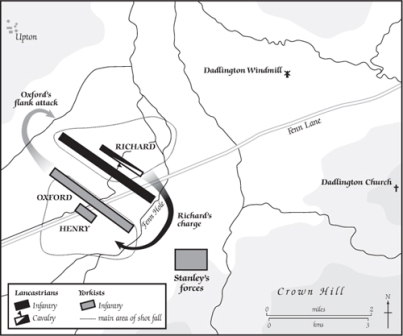
1. Battle of Bosworth Field (22 August 1485).
He nearly did. With his battleax Richard killed William Brandon, Henry's personal standard-bearer. While dispatching Sir John Keyne, a knight renowned for his strength and courage, Richard himself was dismounted. But instead of cravenly begging (as Shakespeare would have us believe) for ‘A horse! A horse! My kingdom for a horse!’ Richard continued to fight on foot. ‘Alone,’ wrote Polydore Vergil, a contemporary historian, until ‘he was killed fighting manfully in the thickest press of his enemies’.4 The king's crown, having fallen off his helmet, was handed to Henry Tudor, who by right of conquest became Henry VII.
In several ways Bosworth Field marks an excellent turning point from medieval to early modern England—and thus a good starting point for this book. Looking back, the battle signalled the end of a military and political system that has been described as feudalism, in which land holding was organized to provide for war, and where war—with religion—became the predominant ethos. It also marked the end of the Wars of the Roses, a generation of violence, where the warlike elements intrinsic to medieval society culminated. Finally, the battle completed the building of the English nation. Looking forward, it heralded the start of 157 years of ‘smooth-fac'd peace’, the next major battle on English soil being Edgehill in 1642.5 Bosworth Field did not produce immediate stability. Henry VII had to suppress several rebellions to keep his crown on his head, while his successors, Henry VIII (r. 1509–47), Edward VI (r. 1547–53), Mary I (r. 1553–58), and Elizabeth I (r. 1558–1603), all had to deal with similar challenges to their authority. But Henry VII's reign produced enough stability to allow his son, Henry VIII, to embark on two initiatives: the Reformation of the Church, which influenced British history for centuries to come, and wars with France that were an attempt to return to the glorious days of the Hundred Years War.
The Medieval Background
Had a soldier who had fought at the Battle of Hastings in 1066 been able to experience to Bosworth Field over four hundred years later, he would have noticed little difference. To be sure the firing of cannon and harquebuses (an early form of musket) would have surprised him, but they were only used in the opening stages of the battle. He might have noted how armour had changed from chain mail to solid body-hugging pieces, but would have been familiar with the infantry melees in which archers provided covering fire. In many ways this is ironic, for the two great military changes of the previous four centuries—the dominance of the heavily armoured knight, and then their destruction by longbowmen—played little part at Bosworth Field.
Militarily, the most important result of the Norman Conquest of 1066 was the growth of feudalism, still a useful, albeit controversial, term. William I (r. 1066–85) divided the land of England amongst his followers and the church, who were known as tenants in chief, keeping about a quarter for himself. When called upon, each tenant in chief had to supply a set number of fully armed knights, usually for forty days a year. They could subdivide their lands to other knights who would serve them whenever the king mobilized his forces. At the bottom of the pyramid were the peasants, Anglo-Saxons who in return for their own strips of land agreed to work a knight's land for so many days a year, and whenever mobilized to serve as his infantry.
For at least two centuries feudalism worked reasonably well. It was the dominant social, judicial, economic and military system not just in England but in western Europe. War, and the warrior ethic, were as deeply ingrained in feudal life as the Church and religion.6 Perhaps the most popular medieval Englishmen were Thomas à Becket, the Archbishop of Canterbury who was murdered in 1170 defending the rights of the Church, and Richard the Lion Heart, who spent all but a year of his ten-year reign (1189–99) overseas, fighting in a crusade to recover the Holy Land. God and war were the most important themes in medieval literature. War was glorious: every knight was brave, or if not (like the coward who befouled his saddle in the twelfth-century poem Chanson de Guillaume) he became a figure of ridicule.7 War was the sport of the Middle Ages—preferably for real in combat, or else in imitation through jousting and the tournament. Indeed, so ubiquitous was war and so powerful and prestigious was the warrior class that Sir Michael Howard argues that the real question ‘is not why there were so many wars, but why there was ever any peace’.8 Between 1066 and 1485 in England there were only two periods of peace longer than thirty years. ‘War was a way of life,’ concluded Garrett Mattingly, ‘an ingrained habit of late feudal society.’9
At first, for those at the top of feudal society it was a fairly safe habit. ‘We are going to have some fun,’ declared Baron Bertrand Du Bon, a French knight as he charged into an affray, pretty confident that he would emerge unharmed. Girded by armour he was secure from poorly armed spear-men, and if dismounted and captured could expect quarter from his fellows. Only four knights were killed and four hundred captured at the Battle of Lincoln in 1141: in contrast two centuries later at Crécy fifteen hundred heavy cavalry were slain.
The longbow produced this change, which was as much a social as it was a military revolution. Six-foot long, made from the heart of ash or yew, the longbow was a formidable weapon that fired a thirty-inch-long arrow tipped with an iron head, which could be needle sharp, or barbed, making it hard to pull out. An archer could fire ten, perhaps twelve, times a minute, producing a hail of arrows. During the sixty seconds or so it took the first wave of ten thousand French cavalry to charge at Agincourt in 1415, the English and Welsh archers could have fired fifty thousand arrows, an average of five per target. Jean Froissart, the contemporary French historian, recalled that the arrows flew ‘so wholly and so thick that it seemed like snow’.10
Unlike snow, arrows did terrible damage: at sixty yards they penetrated armour or three inches of oak; at a hundred yards they decimated the enemy; and at three hundred yards they killed many and wounded even more. Until the introduction of the bolt-action magazine rifle in the late nineteenth century, the longbow was the most effective weapon an infantryman could carry. Unlike the rifle, and its predecessor, the musket, the longbow took years of training to master. Only the strongest could pull an eighty- to a hundred-pound bow.
The heavy cavalry responded to archers by becoming even heavier, wearing up to eighty pounds of armour. This decreased a knight's manoeuvrability in combat, required a stronger, and thus stouter and slower horse, and meant that a dismounted rider would, if stunned, wounded or exhausted, find it hard to regain his feet, becoming highly vulnerable to archers, who could dispatch him with their daggers. Ultimately, a horse could never carry enough armour to protect itself and its rider from arrows.
Longbowmen had other advantages over heavy cavalry, who were usually proud and independent nobles or gentry, lacking discipline, too arrogant to obey uncongenial orders, and loath to cooperate as units. According to the feudal contract they were only expected to serve for forty days a year. Mercenary longbowmen had no such restrictions. Most of them were single, so if killed they left no widows and orphans. They were well trained, dedicated volunteers, who, unlike feudal peasants, were eager for a fight—so long as it ended in pay and plunder. So successful were they that by the end of the fourteenth century there was hardly a household in England and Wales that was not graced by at least one piece of precious continental loot.11
The longbowmen achieved their finest hours during the Hundred Years War. It began in 1337 when Edward III claimed the French throne. He won a resounding victory at Crécy in 1346, as did his son Edward, the Black Prince, at Poitiers ten years later. Even more complete was Henry V's victory at Agincourt. Yet within a generation England had lost all of its French territories (apart from Calais), thanks to Henry V's premature death in 1422, Joan of Arc's charismatic appeal to French nationalism, and the French use of primitive cannon, which negated the lethal impact of the longbow. So by the time of Bosworth Field the two dominant weapons of medieval warfare, the heavy cavalry and longbow, had long passed their prime. Yet the latter still had many proponents. For Roger Ascham (Elizabeth I's childhood tutor), the longbow was a nostalgic symbol of the good old days when the English routinely thrashed the French. In 1549 Bishop Hugh Latimer preached that the longbow was ‘a gift of God that he hath given us to excel all other nations’. He reminisced how his father had diligently taught him as a boy how to shoot with the weapon. Nowadays young men no longer bothered, bemoaned the bishop, preferring instead ‘whoring within towns’.12 The military attractions of the longbow continued for centuries. Charles I thought it should be used in the English Civil War; Ben Franklin urged its adoption during the American Revolution.13
In one sense it was strange that Henry Tudor's army fought and won at Bosworth Field under the flag of the Ddraig goch—the Red Dragon of Wales—and not the red and white cross of St George. The battle marked the conclusion of a process of English nation building. Nation building is a complex business, very different from state formation. The former is a bottom-up process relying on consensus; the latter, a top-down method dependent on coercion, is thus more difficult to achieve. With two disastrous world wars, a fascist dictatorship and countless prime ministers, modern Italy proves this point. Twenty-two years before its unification by force of arms in 1871, Prince Metternich contemptuously observed, ‘Italy is a geographical expression.’ Afterwards its prime minister Massimo D'Azeglio supposedly remarked, ‘We have made Italy. Now we must make Italians.’14
In contrast, the English were made long before the making of England. The first English historian, the Venerable Bede, wrote The Ecclesiastical History of the English People in 731. Historians have debated when England became a nation. With a common language, a common ruler, a common Church, and shared legal systems, argued James Campbell, ‘Late Anglo-Saxon England was a national state.’ Marc Bloch, the French medievalist, agreed that England ‘was a truly unified state much earlier than any continental kingdom’.15 The Norman Conquest of 1066 slowed this process of nation building. Indeed, the violent imposition of an alien elite with their centralized form of government and land holding was more akin to top-down state formation. But after Henry I's victory at Tinchebray in 1106, in which the Anglo-Saxons, namely, the English, helped William I's fourth son, Henry I, conquer Normandy, the process of nation building continued. It was consolidated by events such as the sealing of Magna Carta in 1215; Simon de Montfort's parliament of 1265; the growth of the monarchy; the development of common law and a common Church; a standardized language (as evidenced by Geoffrey Chaucer); and the emergence of a distinct sense of national identity, particularly during the Hundred Years War.16
The Search for Stability
After the Battle of Bosworth Field few in England suspected that the vicious Wars of the Roses had come to an end, and that there would be no more successful rebellions against the crown until the middle of the seventeenth century. Nine months after Bosworth a rebellion broke out in Worcester, led by Francis, Lord Lovell, and Humphrey and Thomas Stafford. Although according to G. R. Elton ‘the rising itself was utterly insignificant’, it did show how readily the insignificant were willing to rise.17 The following year Lambert Simnel reminded Henry VII of the fragility of his position. Probably a joiner from Oxford, Simnel masqueraded as Edward V, the prince whom many believed Richard III had murdered in the Tower. Simnel was persuasive enough to convince Margaret of Burgundy and a group of Irish nobles led by Gerald of Kildare (who admittedly needed little convincing) to have him crowned Edward V in Dublin in May 1487. The following month Simnel landed in Furness, Cumbria, with two thousand German and Irish mercenaries, picking up strength as they marched south. They numbered eight thousand when they met the king's forces, twice as strong, at Stoke in Derbyshire on 16 June 1487. Initially, it seemed that Henry Tudor might be defeated, but his centre under John de Vere, earl of Oxford, not only managed to hang on, but to counter-attack. Withering arrow fire broke the rebels, and in the ensuing rout half of the enemy were killed, many hacked to pieces in a bottle-neck that became known as the Red Gutter. Lambert Simnel was taken prisoner and, as if to say that his rebellion was a trifle, Henry gave him a job as turnspit in the royal kitchens.18
Two years later, in the summer of 1489, a revolt broke out in the north of England in protest against a 10 per cent tax rise. The king sent the earl of Northumberland to placate the rebels, but in June a mob murdered him at Cock Lodge, Yorkshire. By the time the king and his army reached York the rebellion had collapsed, the assassination of Northumberland, a leading nobleman, having alienated the aristocracy and gentry. Realizing that further resistance was futile, many rebels surrendered to the king, with nooses about their necks: while admitting they deserved to be hanged, they begged for mercy. Henry pardoned fifteen hundred of them.19
Undeterred by the possibility of having to work as a skivvy in the royal kitchen, Perkin Warbeck, an impostor from Tournai in the Low Countries, followed Simnel's example by going to Ireland, where he convinced many—who were all too willing to be persuaded—that he was the rightful king of England, being Richard IV, Edward IV's younger son who had supposedly been murdered in the Tower. Warbeck landed near Deal on the Kent coast in July 1495 with six hundred mercenaries. They were a sorry lot, whom Thomas Gainsford, the Tudor soldier and historian, described as ‘bankrupts, sanctuary men, thieves, vagabonds, and divers servants of dishonest rebellion’.20 They were certainly not fighters. With the help of the local militia the mayor of Sandwich repulsed them, killing and executing a third. So Warbeck sailed to Scotland to seek James IV's help. A year later, with fifteen hundred freebooters, James crossed the border into England. After the Scots had plundered enthusiastically, an advancing English army forced them to retreat with equal zeal.
The following year Henry had to confront a serious rebellion based in Cornwall. Prompted by tax increases to pay for the Scots War, and instigated by a blacksmith, Michael Joseph, this started as a popular rising. Fifteen thousand rebels led by James Touchet, baron Audley, marched on London. Henry personally led twenty-five thousand men out of the city, and on 17 June 1497 surrounded the rebel camp at Blackheath. In the ensuing rout perhaps as many as two thousand rebels lost their lives, while the leaders were executed as traitors.21 None of this deterred Warbeck, who after failing to raise soldiers in Ireland landed in the West Country, where eight thousand rallied to his standard. Their attempt to capture Exeter failed. Four hundred were killed, Warbeck was taken prisoner. After twice trying to escape from the Tower he was hanged.
In view of the terrible price paid for failure, and the slim chances of success, one wonders why there were so many rebellions. Often they started as popular movements, but as the Cornish Rebellion, begun by a blacksmith and taken over by a baron, showed, the gentry played a significant part in these uprisings. Many of them believed that if Henry Tudor's rebellion of 1485 could succeed, so might theirs. After all, the king was weak militarily: he only had five hundred permanent troops, the Yeomen of the Guard, his personal bodyguard, plus another thousand stuck in garrisons, and thus had to raise volunteers to deal with emergencies. Since rebellions broke out at the peripheries, such as Cornwall and in the North, far from London and the king's authority, they had time to develop before being confronted by royal forces.
Wales was the exception to this rule. After 1485 no rebellion has ever broken out in the principality, which firmly identified itself with the Tudor dynasty.22 Just as Bosworth Field completed the building of an English nation, so it produced an Anglo-Welsh one, a remarkable achievement considering that the long and bitter rebellion led by Owain Glyndwr had ended but eighty-two years earlier. Before Bosworth Field hundreds of Welshmen joined the colours to fight under the banner of the Red Dragon. Afterwards the principality's elite became Anglicized: many Welshmen flocked to London to further their careers, or went to Jesus College, Oxford, to improve their education, or joined the Yeomen of the Guard to protect their new Welsh king.23
Even though for fourteen years of his twenty-four-year reign Henry Tudor was threatened by some rebellion or conspiracy, he still had time for other military matters.24 In June 1492 he sent fifteen hundred men under Robert, first baron Willoughby, to Cherbourg to stop the marriage of Anne, duchess of Burgundy, to Charles VII. The French easily repulsed the English, and their king wed the duchess. The following October Henry dispatched a huge force of fourteen thousand on two hundred ships to Calais to work with the emperor Maximilian I for the return of lost French territories. When Maximilian signed a peace with the French, England was left in the lurch. Henry's efforts to build up the Royal Navy were a little more effective. Although he inherited eight naval ships, and left his son seven, these were larger and more seaworthy, such as the Regent, a six-hundred-ton vessel, the first English ship with cannon behind gun ports on the lower deck. These guns had been cast at the forge that the king established on the Kent/Sussex border, and were tested on his range at Mile End, east of London.
When Henry died in 1509 he had achieved the goals he had set for himself at Bosworth Field. He died as king in his own bed, the first monarch not to be deposed since 1422, and the first to pass his kingdom to an adult male heir since 1413. By defeating rebellions, incorporating the Welsh, building up trade, and strengthening the crown's income, he restored stability and gave his successor the opportunity to do grand things. And what that successor yearned to do—more than anything else—was to wage glorious war.
‘To exceed the glorious deeds of his ancestors’
Today Henry VIII is best remembered as the larger than life figure of gross proportions and even grosser appetites who brawled, belched and bawded his way through six wives, countless banquets and one reformation. Instantly recognizable, the subject of many films and television series, Henry's waxen image, flanked by those of his six wives, dominates Madam Tussaud's in London, while his portrait is one of the best-selling postcards at London's National Portrait Gallery.25 He also fascinated his contemporaries. ‘The King of England, this Henry, clearly lies,’ fulminated Martin Luther, ‘and with his lies acts more the part of a comic jester than a king.’ The French ambassador called him ‘a sly old fox’.26
Henry never intended to be the much married man, who broke with Rome, established the Church of England, founded the roots of English hegemony and, some would argue, produced a Tudor revolution in government. Instead, he wanted to be remembered as a warrior. ‘Our king is not after gold, or gems, or precious metals, but virtue, glory, immortality,’ boasted William Blount, Lord Mountjoy, the distinguished scholar, to Erasmus in 1509. ‘His ambition,’ King Henry asserted, ‘was not merely to equal, but to exceed the glorious deeds of his ancestors.’27
A craving for honour was at the root of the king's personality.28 Honour is hard to define, and has changed over time. Mainly a male concept, it has a lot to do with a man's self worth as a man. To use John Skelton's phrase, Henry wanted to be ‘Mars's lusty knight’.29 In addition to being a contemporary playwright and poet, Skelton was also known for his wicked wit, which would support the suspicion that the king's public passion for honour and glory could have been a compensation for private doubts about his manhood. When the imperial ambassador hinted in the late 1520s that Henry might not be physically capable of satisfying Anne Boleyn, a woman sixteen years his junior, the King furiously retorted, ‘Am I not a man like other men? Am I not? Am I not?’30 The size of the codpiece on Henry's suite of armour (see ill.2), suggests that Henry did protest too much.
As a young man Henry trained for war, hurling javelins, shooting arrows in the butts, wrestling in the ring and taking part in tournaments. He read all the books on chivalry, such as Sir Thomas Malory's Morte D'Arthur, romances about the Trojan Wars and tales of Charlemagne and Roland, that poured off the recently invented printing presses. He took special delight in showing visitors to Winchester the round table around which Arthur and his knights had supposedly sat. He encouraged John Bourchier, Lord Berners, to translate Jean Froissart's Chronicles of the Hundred Years War, because of ‘the great pleasure that my countrymen of England take in reading the worthy and knightly deeds of their valiant ancestors’.31 Henry, like many a king, was haunted by the achievements of his forebears, once admitting that he wanted to reconquer France in order to eclipse his father's great victory at Bosworth Field.
In 1511, two years after ascending the throne, Henry sent fifteen hundred archers to Cadiz in southern Spain to help Ferdinand II of Aragon fight the Moors of North Africa. On arrival the English troops were informed they were no longer needed, and should go home. So they ‘fell to drinking of hot wines,’ wrote Edward Hall, the contemporary historian, ‘some ran to the stews, some broke hedges, and spoiled orchards, and vineyards, and did many other outrageous deeds.’32 The five thousand men whom Thomas Grey, the marquess of Dorset, led to Aquitaine the following summer were no better. Their mission was to support Ferdinand's invasion of Guienne, but instead Dorset decided to attack Navarre. With nothing to do, the English troopers enthusiastically sampled the local wines, their diet consisting mainly of fruit and garlic. Not surprisingly, dysentery broke out, killing eight hundred. The rest mutinied, and returned home in disgrace.
Henry was so angry with their performance that he decided to lead the next expedition in person. Most of the twenty-four thousand invasion force were longbowmen, the small cavalry, artillery and engineering contingents being mercenaries. After landing at Calais, on 30 June 1513, the king immediately rode to St Nicholas’ Cathedral to dedicate himself to the service of God by claiming that he was fighting a Holy War. He certainly did not fight an uncomfortable one. For three weeks Henry and his retinue, 855 strong, feasted and amused themselves. Eventually on 21 July they set out on campaign, with patrols scouting the countryside—'spoiling and burning all the way,’ a soldier recalled—to make sure the enemy could not approach the king.33 Even if they had, a formidable bodyguard plus a sixty-pound suit of armour protected the royal personage, who spent every night in a warm feather bed, usually inside a portable wooden shed, complete with its own thunderbox.
For most soldiers life was not so comfortable. ‘I assure you never was an army so falsely victualled,’ Sir Edward Howard complained in 1513 about the meager rations.34 In the first eleven days the king's army marched but forty miles. On 16 August they came across a strong French cavalry patrol, which, after a brief skirmish, bolted, leaving behind six standards, a duke, a marquess and a vice admiral. Henry turned this incident, which was promptly dubbed the ‘Battle of the Spurs’, into a second Agincourt. The following day in a letter to Margaret of Savoy, the Regent of the Netherlands, he described the altercation with all the dramatic detail one might expect from a participant. Significantly, Henry failed to mention that he had been a mile away from the action. Henry was, however, present at the Siege of Thérouanne, which fell on 24 August. A month later he captured Tournai, where he spent three weeks celebrating, before returning home to London.
War with France inevitably meant war with Scotland, for as a young member of parliament, Thomas Cromwell, observed in 1523, ‘who that intendeth France to win, with Scotland let him begin.’35 The origins of Anglo-Scots hostilities go back centuries. It has been estimated that between 1286 and 1568 the English invaded Scotland on twenty-two occasions, and reivers in pursuit of plunder raided across the border innumerable times.36 Henry's attack on France in 1513 gave James IV of Scotland the opportunity to invade England. On 9 September his forty-thousand-strong army—the largest Scotland had ever assembled—took up position at Flodden, in Northumberland, on a five-hundred-foot ridge south-east of Coldstream. With more men and heavier artillery James should have won. Having run out of food, the English, about twenty-six thousand strong under the septuagenarian Thomas Howard, earl of Surrey, were obliged to fight. Although outflanked, the earl of Home's division broke the English right. But instead of pursuing the routed enemy, the Scots plundered English corpses, exposing themselves to a charge by Thomas, Lord Dacre's cavalry. Savage hand-to-hand fighting ensued. The battle turned into a bloodbath. While Scots praised their monarch's bravery, claiming that James had personally killed five Englishmen, they damned his leadership. ‘He is courageous, even more than a king should be,’ wrote one contemporary, ruefully adding that 'He is not a good captain, because he begins to fight before he has given his orders.’37 Estimates of the Scots dead range from five to ten thousand (as compared to one thousand to fifteen hundred English). They included James IV, twelve Scots earls, thirteen barons, three bishops and a brace of abbots. Of the seventy recruits from the town of Selkirk, only one returned home alive.38
For the next two decades Henry VIII's reign was relatively peaceful. In 1523 he sent an expeditionary force under Charles Brandon, duke of Suffolk, to France: it got within sixty miles of Paris, but the French refused to fight, and, running out of supplies, the English had to retreat home. The king became increasingly preoccupied with his marital problems; his desire to ‘divorce’ his first wife Catherine and marry his mistress Anne Boleyn led to the break with Rome in 1534. The Reformation dramatically changed the nature of warfare, giving it a religious context that made fighting far more bitter and bloody.
This became immediately apparent. In 1536, two years after parliament ended papal authority in England, the Pilgrimage of Grace broke out in the North. Its causes were complicated and various. Some of the rebels were protesting enclosures of land, which turned tenants off their fields so landlords could use them to graze sheep. Other rebels, notably the powerful Percy family, objected to the growing centralized authority of the crown. For many, perhaps most rebels, religion, especially the closing of the monasteries, which had played an unusually useful charitable role in the North, was the key issue. The rebellion started in Lincolnshire in October. Within five days ten thousand men marched on Lincoln. Three days later they dispersed home peacefully. The Lincolnshire rising prompted a larger and more serious one in Yorkshire. Led by Robert Aske, the pilgrims occupied York, where they reinstated expelled monks and nuns to their houses. On 27 October, with thirty or forty thousand pilgrims in attendance, Aske negotiated a pardon with the king's emissary, the duke of Norfolk. Early the next year the king used an outbreak of rebellion in Cumberland and Westmorland, led by Sir Francis Bigod, as an excuse to cancel his pardon, sending troops under Norfolk back north to execute at least a hundred and fifty of the rebels.39
The growing power of the central government in London, which had helped provoke the Pilgrimage of Grace, was applied to Ireland by Thomas Cromwell, the king's great minister, when he replaced the crown's rather loose medieval lordship with a stronger kingship. Those Irish who resisted were deemed traitors. After the English massacred the fifty-man garrison of Maynooth Castle, who had surrendered in March 1534 on the promise of quarter, the phrase ‘the pardon of Maynooth’ became a euphemism for the cold-blooded murder of prisoners of war. Such gallows humour would not have amused Thomas Fitzgerald, earl of Kildare. Even though he and his five uncles had surrendered on the guarantee of mercy, Henry VIII had them hung, drawn and quartered at Tyburn in 1537.40
For half a dozen years after the Pilgrimage, England remained at peace. Having given time for the Reformation to take hold, and freed from the restraining hand of Thomas Cromwell (whom Henry had callously executed in 1540), the king turned his thoughts again to war. It was as if he were in a midlife crisis striving to regain the virility of youth.41 While he provoked hostilities with Scotland, the king also sought war with France, thus reviving the ‘Auld Alliance’ between Edinburgh and Paris. A rash of border raids broke out in the summer of 1542. That October the duke of Norfolk led an expeditionary force into Scotland, but was readily repulsed. The following month a Scots army of as many as eighteen thousand men under Robert, Lord Maxwell, crossed the border, where on 24 November they came across an English force of three thousand led by Sir Thomas Wharton. What should have been a Scots triumph turned into a tragedy: at Solway Moss, only seven English and twenty Scots lost their lives in battle, but several hundred more Scots drowned while trying to escape, and twelve hundred became prisoners of war.
Securing his northern frontier enabled Henry to continue his preparations for the invasion of France. In mid-June 1544 an advance party under the duke of Norfolk sailed for Calais, where for a month they devoted themselves to rest and recreation. ‘Numbers of shameless prostitutes came at every tide from England,’ fulminated Elis Gruffudd, a disgusted Welsh captain, continuing ‘there was great rejoicing to sin without fear of retribution.’42 The English soldiers also plundered without fear of punishment, taking ‘poor man's hens, chickens, pigs and other provision, and pay nothing for it except,’ declared A Discourse of the Commonweal (1549), ‘to ravish his wife or daughter’.43 The arrival of the king on 14 July put some backbone into his forty-four thousand soldiers. On 19 July they started to besiege Boulogne, a small port twenty miles south-west of Calais, where the king directed the fire of his cannon, and urged his men into battle (see ill.3). Henry had a grand old time. His men were less enthusiastic. Captain Gruffudd noted he ‘never saw Welshmen and Englishmen so bad hearted and so unadventurous’. Another observer recalled that during the siege ‘there was some shooting with the guns and no great hurt on either party’.44 Nonetheless on 18 September Boulogne surrendered, and the king entered the town in great triumph. Twelve days later he was back home, much happier, and far poorer. His men were less happy and even poorer. Captain Gruffudd reported that ‘soldiers coming from Calais and Boulogne were dying along the road from Dover to London and along the roads from London to every quarter of the kingdom.’45
The Founder of the Royal Navy
To send expeditions to France Henry used the first-rate naval force that he created. Several historians have credited him with founding the Royal Navy—an honour he supposedly shares with Alfred the Great. But the navy Alfred helped found consisted basically of floating castles. Broad in the beam, they were unable to sail much into wind, but waddled lubberly downwind. In battle they almost drifted into each other: sailors fought hand to hand, trying to defeat the enemy by boarding. Height was so vital that at the expense of sea-worthiness ships had high castles at either end from which archers could fire down upon the enemy (hence the word ‘forecastle').
During the late fourteenth and early fifteenth centuries shipbuilders developed what Geoffrey Parker, a leading military historian, has called ‘one of the greatest technological achievements of medieval Europe’.46 They constructed long, relatively narrow vessels with three masts that could sail faster (since speed is proportionate to length), and point further into wind, their deep hulls being able to grip the water. Such ships could carry enough stores and cargoes for long voyages. After the invention of hinged gunports, they mounted heavy cannon on their lower decks, lowering their centre of gravity and thus making them more seaworthy. In the 1540s William Levett, rector of Buxted, Sussex, developed a process of casting iron cannon from high-phosphorous ore in vertical moulds barrel up, which allowed impurities to rise to the top, thus strengthening the end of the cannon where the initial explosion took place. At a third of the cost of the old bronze weapons, iron cannon could be fired much faster with a higher muzzle velocity, which enhanced the impact of their rounds. Since cutting a hole in the bow or stern of a vessel dangerously weakened her hull, cannon ports were built into the side. Attempts to widen the ports so cannon could be slewed for and aft were of limited use, so over the next four centuries ships fought broadside to each other.47
These new ships were so expensive that only wealthy states could afford them.48 Having inherited seven ships from his father, Henry built eighteen more in the first six years of his reign, including the Great Harry, a monstrous vessel of over a thousand tons, with 43 heavy and 141 light guns. After peaking at twenty-five ships in 1520, the size of the Royal Navy fell to eleven in 1540, and then increased to thirty-two in 1545, reaching thirty-seven five years later. These were modern vessels, averaging 459 tons.49 Equally important, they were supported by a sophisticated series of bases at Portsmouth, Deptford and Woolwich, which were administered by the Office of Ordnance, founded in 1544, and the Navy Board, established two years later.
While these administrative changes were most important, giving the Royal Navy a permanent bureaucratic foundation, they must be seen in context. Compared to the French or Spanish, the English navy was small. It lacked a blue-water capability since its primary mission was coastal defence and supporting amphibious operations: the first time an English ship sailed south of the equator was in 1555.50 The navy carried troops to France, and supported English invasions of Scotland. But it was not strong enough to be relied upon to defend England from invasion. To complement the navy's coastal defence role Henry spent £375,500 building twenty-four forts stretching from Calais to Berwick, from the Thames around the south coast to Milford Haven, which were ‘larger in scale than anything attempted until the twentieth century’.51
Without doubt the greatest ship Henry built was the Mary Rose (see ill.4). Unlike previous fighting ships, Mary Rose had a high length to width ratio, its length giving it a much faster maximum theoretical sailing speed. Its heavy iron cannon were located low down, lowering the Mary Rose's centre of gravity, enabling her to sail faster in a beam or head wind. This advantage was lost when refits of 1529 and 1536 added an additional upper deck, making her top heavy. Ropes between the cannon and the side of the hull absorbed the recoil when the guns were fired through raised ports, which were supposed to be lowered in heavy seas to keep water out. Open gunports, plus the new higher centre of gravity, proved the Mary Rose's undoing. On 19 July 1545 the French attacked Portsmouth, and the Mary Rose was ordered to make sail to repulse them. As she was making a sudden turn, the top-heavy ship heeled over, and was hit by a sudden gust. It was enough to allow water to flood into the gun ports, whose lids were lashed open in anticipation of action. Discipline broke down. Captain Sir George Carew shouted he had lost control of his crew.52 As the ship rolled, chaos turned into panic, and more water flooded aboard. Guns, cannon balls and stores fell free, worsening the list. Within moments, in front of a horrified crowd that included the king, she capsized, taking as many as seven hundred men to the bottom of the Solent. (There she remained until 11 October 1982, when she was raised to be exhibited in Portsmouth Dockyard as one of the most important ships in the Royal Navy's history.)53
Henry's wars and massive military expenditures left one lasting legacy—a financial one—that showed the king up as ‘a rank amateur with money to burn’.54 It could be argued that Henry's continental wars may have delayed English colonization of America and conquest of Ireland by half a century. Without doubt they cost a great deal in men and money. The king made extensive use of expensive foreign mercenaries—six thousand in 1513 and again in 1522, and ten thousand in 1544. Between 1510 and 1523 Henry summoned seven parliaments, all to vote taxes for war.55 The last request, misleadingly known as the ‘Amicable Grant’, engendered a taxpayer revolt that forced the king to back down. During the French and Scots wars of the 1540s, three-quarters of the aristocracy—virtually all the able-bodied—saw service.56 During the last five years of his life, Henry spent roughly £2 million on war. He raised this gigantic sum by debasing the coinage (which helped produce massive inflation), by selling a third of the land he had confiscated from the monasteries during the Reformation, and by resorting to forced loans and gifts: he ‘borrowed’ church plate, which he promptly melted down for silver coins. ‘God help us,’ exclaimed Sir Thomas Wriothesley, the councillor responsible for raising all this money, ‘it maketh me weary of my life.’57
Edward VI and Mary Tudor
When Henry died in 1547 his two immediate successors, Edward VI and Mary I, were weak monarchs: the first because he was a minor, in whose name regents ruled, the second because she was a women and Catholic, who made a disastrous marriage to King Philip II of Spain.58 If their predecessors, Henry VII and Henry VIII, and their successor, Elizabeth I, were great Tudors, they were the little ones.
Although there was no doubt that the young Edward VI was interested in military matters (his diary being full of reports of battles and plans for fortifications), the responsibility for facing the immediate military challenges to his regime fell to the regent, Edward Seymour, Lord Protector Somerset.59
The first challenge, war with Scotland, came as a result of Henry VIII's overplaying the hand he won at Solway Moss. In what became known as ‘The War of the Rough Wooing’ the king had forced through a marriage treaty between the six-months-old Mary, Queen of Scots, and his three-year-old son, which would turn Scotland into an English puppet. Naturally the Scots resisted. A series of border incursions followed, and the English were defeated at the Battle of Ancrum in 1545. But that did not end hostilities. On 1 September 1547 Lord Protector Somerset led a well-trained English army, between fifteen to nineteen thousand strong, into Scotland. Ten days later at Pinkie, just outside Edinburgh, the English encountered a larger Scottish army of about twenty-two thousand men with plenty of cannon. The Scots descended from a good defensive position near Inveresk, coming into range of the cannon aboard the English fleet off the coast. After an hour or so of bombardment and several cavalry charges, the Scots broke. A contemporary illustration (see ill.5) shows a classic ‘panic fear’ in which men at the sides and back of the infantry formations started to run, precipitating a rout of the rest. For six hours the English chased the Scots until nightfall. Perhaps as many as six thousand were killed. Some drowned in marshes, others simply ran themselves to death, more were slaughtered like cattle. The bloodbath at Pinkie did not end the misery. When the English again invaded Scotland in 1548, Captain John Brande reported, ‘The country is so wasted that there is nothing to destroy.’60
The two rebellions that Edward VI's regime had to face a couple of years later were serious threats.
As its name suggests, the Prayer Book Rebellion that broke out in Devon and Cornwall in the summer of 1549 was a protest against the adoption of a Protestant form of worship and the confiscation of church property. The rebels’ slogan ‘Kill all the gentlemen’ suggests that it was also a social movement. Anyway its leadership was poor and, after the rebels failed to capture Exeter, a royal army under John Russell, earl of Bedford, crushed them, killing four thousand in hot and cold blood.61
The outbreak of the Prayer Book Rebellion was followed by another rising, known after its leader Robert Kett. While Kett's Rebellion was centred in East Anglia, it was part of a wider series of disturbances that affected much of south-east England and the Thames Valley. It began as a protest against enclosures, and within a week fifteen thousand rebels assembled at Mousehold Heath, outside Norwich. At the end of July they took the city. A month later John Dudley, earl of Warwick, led fourteen thousand troops (including a thousand foreign mercenaries) to Norwich, where they routed the rebels, killing three thousand in the process.62
Such monstrous retribution did not deter Wyatt's Rebellion. Led by Sir Thomas Wyatt, the insurrection broke out in Kent in January 1554 to protest Queen Mary's forthcoming marriage to Philip II of Spain, a fellow Catholic, and to replace the queen with her sister, the solidly Protestant Princess Elizabeth. After seizing Rochester, Wyatt's forces marched on the capital, but, unable to cross London Bridge, they moved west, crossing the Thames at Kingston, to enter the city with three thousand men. Wyatt's demands were so excessive that he lost public support. The rebellion fell apart and Wyatt and a hundred of his followers were executed.
For every one of the nearly ten thousand people who died as a result of Tudor rebellions, they were a profound calamity. In comparison the last rebellion of Mary's reign, that of Thomas Stafford in April 1557, was a farce that ended in tragedy. Claiming to be the duke of Buckingham, Stafford landed from French ships at Scarborough, and with thirty men took over the castle declaring that he intended rescuing England from ‘the naughty nation of the Spaniard’ and from her ‘unrightful and unworthy queen’.63 The rebellion was easily crushed, Stafford and twenty-six of his fellow traitors suffered the ultimate fate, but it scared the Privy Council enough to agree with Mary's proposal that England declare war on France to support her husband, Philip II of Spain. A small force left Calais to campaign in northern France, where it engaged in some petty skirmishing, before returning to England. Sensing that Calais was vulnerable, the duke of Guise led his army of twenty thousand foot, four thousand horse and thirty cannon across the frozen marshes that surrounded the enclave. On New Year's Day his forces appeared before the walls. Twelve days later the governor, Thomas Wentworth, surrendered Calais.64
It was a humiliating defeat in which eight hundred English died. Henry Machyn, the London undertaker, confided in his diary that the news was ‘the heaviest tidings to London and to England that ever was heard of’. ‘The loss of Calais,’ lamented George Ferrers, the poet, ‘was such a buffet to England as had not happened in more than a hundred years.’ Mary was so upset that just before she passed away early on the morning of 17 November 1558 she told an attendant, ‘Open my heart … when I am dead and you shall find Calais written there.’65
Early Tudor warfare was a little bit like the Mary Rose: whenever a wind blew up, particularly a French one, it tended to capsize. To be sure Henry VII's victory at Bosworth Field was a profound turning point between medieval and early modern England. It engendered an era of relative peace and stability. Henry used his victory to bring about political and financial reforms, which did much to strengthen his regime while diverting as few of his resources as possible to war. Yet for a long time after Bosworth Field many failed to recognize the growing strength of the Tudor regime. Economic rebellions such as Kett's, religious ones, such as the Prayer Book, xenophobic ones such as Wyatt's, even plain wacky ones such as Stafford's all showed how many underestimated the growing military power of the Tudor state. The same could be said about the Scots who were decimated at Flodden, Solway and Pinkie. But England's victories north of the border capsized: three years after Pinkie every single English soldier had been driven out of Scotland.
Henry VIII was the exception. Whereas his father Henry Tudor wanted peace to consolidate his power, and his children Edward VI and Mary were too weak to wage war effectively on their own, Henry VIII knew few limits. His two great actions, the French wars and the break with Rome, were essentially proactive. He need not have embarked upon either. His wars had a profound effect less in terms of what they achieved than in what they prevented from happening. Had he not spent so much time and treasure in vainglorious attempts to reconquer France, while having to protect his Scottish border, had he not sold off many of the church lands confiscated during the Reformation, Henry would never have needed to call parliaments to raise money to fight future wars, and the crown could well have followed the French or Spanish model by becoming absolutist. Thus Henry's wars may have changed England's constitutional history. Admittedly this is mere speculation; what is undeniable is that for over a century and a half after the Reformation, England's wars were basically religious ones. Ironically, as we will see in the next chapter, religion played little part in persuading men to join the armed forces.