
CHAPTER 10
Immediately after the flight of Kerbogah’s army the citadel of Antioch surrendered. According to the Anonymous its commander offered submission to Raymond of Toulouse, but some South Italians suggested that he accept the banner of Bohemond instead, and so the citadel went to the South Italian leader.1 It was a sour note of division after the great triumph, and it set the tone for a prolonged period of conflict within the crusader army. For Bohemond’s ambition to control Antioch triggered a crisis which was exacerbated by other factors and which had a severe impact upon practical military necessity. Bohemond had made contact with Firuz, the betrayer of Antioch, and in the end the other leaders made him a conditional promise of the city: ‘on condition that if the emperor come to our aid and fulfil all his obligations which he promised, we will return the city to him as it is right to do’.2
Immediately after the defeat of Kerbogah the princes met and sent Hugh of Vermandois to Constantinople, presumably to explain the situation to Alexius and ask for his help. It is interesting that even in the emergency, as Kerbogah’s force approached, the majority of the leaders of the crusade stood by their oath to Alexius, but conditions now conspired to undermine that fidelity. Bohemond never regarded Antioch as anything other than his personal possession. Raymond of Aguilers, who says nothing of Bohemond’s role in the betrayal of the city, reports that he seized the citadel, confirming the story of the quarrel told by the Anonymous, and persuaded all the leaders except Raymond of Toulouse to surrender to him the gates and towers they held along the city wall, with resultant internal strife.3 On 14 July 1098 Bohemond made an agreement with the Genoese and granted a charter conceding extraterritorial privileges in return for promises of support. There was no mention of the rights of the emperor in these documents. In the pact the Genoese promised military support against any who attacked the city: ‘But they will not fight against the count of St Gilles; if he wishes to withdraw we will give him council, if not we will remain neutral’.4
It is evident that Bohemond and the count of Toulouse had become rivals in the matter of Antioch even before the final echoes of the great victory had died away and it was probably partly because of this that on 3 July the leaders decided to delay their journey. As the Anonymous says, it was sensible to delay for the army was tired and the summer was not a good season to continue, though Raymond of Aguilers believed that the enemy, terrified by the defeat of Kerbogah, would have offered little resistance. He was probably appalled by the extraordinary decision to put off the journey until 1 November 1098, a delay of four months. Presumably this was to allow plenty of time for an imperial army to arrive – it had, after all, taken the crusaders themselves nearly four months to march to Antioch from Nicaea. For most of the princes a solution to the quarrel was the priority and the coming of the emperor, or at least substantial imperial forces, would provide that. Its failure to materialise swayed them somewhat to Bohemond’s view, however, and this may well have been hastened by matters of personality. Raymond of Toulouse, for reasons at which we can only guess, was evidently not popular as a man. He had suffered various illnesses during the long siege of Antioch, yet had shouldered a considerable burden. He never seems to have been a distinguished soldier but was certainly reasonably competent. Yet he was later accused of being in the pay of the emperor and this is perhaps the key to understanding his position. At a time when it was bound to be unpopular he espoused the imperial cause and this isolated a man who was already somewhat isolated in the ranks of the leaders by his origins and by his age.
If the princes were anxious to appear to be fair to the emperor, there were plenty of others in the army who must have regarded this delay as a disaster. For the poor, and even many of the knights, a halt in what had become friendly territory which they could not ravage was a disaster. For the moment many of the leaders used the vast plunder of Antioch to take men into their service, but the delay must have caused tension, not least because it seemed to be contrary to the spirit of their whole undertaking the ultimate object of which was the liberation of Jerusalem. With Provençals and South Italian Normans holding strongholds in the city – Count Raymond held the Governor’s Palace and the Bridge Gate – there was a real possibility of violence.5 The question of who held Antioch was clearly tied to the wider question of the Byzantine alliance, hence the mission of Hugh of Vermandois in early July 1098. But soon after he left the crusaders must have heard of Alexius’s encounter with Stephen of Blois on or about 20 June 1098.6
Stephen had fled from the siege of Antioch when Kerbogah approached, but he encountered Alexius at Philomelium. Anna Comnena would have us believe that the emperor was there, ‘ready to march to the aid of the Kelts in the Antioch region’. This, however, must be read in the context of Anna’s work where her account of the crusade and relations with the Franks is dominated by the question of Antioch. She constantly accuses the Franks of being oath-breakers, because of Bohemond’s seizure of the city. Her view is that Alexius kept his word to the Franks, while they broke theirs to him and this is the central thesis of the Alexiad as far as the crusade is concerned. Anna’s version of Alexius’s purposes needs to be seen in that light, and it should be remembered that the crusader army had taken well over two months to march from Antioch-in-Pisida, which is just west of Philomelium, to Antioch. Of course, Alexius had a smaller army and need not have taken the long detour of the main crusader army up to Kayseri, but even so when he met Stephen of Blois on or about 20 June 1098 he was at least three to four weeks march from Antioch (see fig. 2).7Alexius’s movements at this time need to be seen in the light of his general position. According to his daughter, Alexius was at first restrained from rushing to the aid of the Franks at Antioch by the need to defend his western provinces against local emirs, and so sent out a military and naval expedition led by his brother-in-law John Doukas to south-western Asia Minor. Doukas persuaded many enemy outposts to surrender by displaying Tzachas’s daughter, who had been captured at Nicaea, negotiated the surrender of Smyrna and defeated the Turks at Ephesus. He appears to have left his fleet to clear islands like Chios and Rhodes. Doukas pursued the retreating Turks up the Maeandros valley, seizing Sardes, Philadelphia, Laodicea, Lampe and reached Polybotus (modern Bolvadin) near Philomelium on the great road across Asia Minor. Alexius took the field and marched down the Royal Road, perhaps via Dorylaeum to Philomelium where he arrived in mid-June of 1098. This junction of Byzantine forces could hardly have been accidental.8 A glance at the map and the roads shows this to be a sensible plan to profit from the crusade. It was almost certainly with such propects in mind that Alexius and the western princes had made their decisions on the route of the crusade. The loss of Nicaea and the defeat of Kilij Arslan did not destroy Seljuk power in Asia Minor but rolled it back from the western end of the sub-continent. The emirs of western cities like Ephesus and Smyrna were virtually cut off from the support of the Seljuk Sultan, with whom their relations had always been difficult, and Alexius’s campaign in the spring of 1098 with its two axes of advance was intended to follow up this success.9 The Byzantine empire had certainly profited from the victories of the crusader army, just as it had profited from Byzantine support. The question which arises is did Alexius intend to march to their aid as Anna suggests and the crusader chroniclers assumed?
Anna stresses that her father was anxious to provide aid to the Franks in person when at Philomelium he encountered William of Grandmesnil, Stephen of Blois and Peter of Aups, whose presence astonished him. They informed him of the desperate situation in Antioch and this increased his anxiety to proceed despite opposition from his own entourage. However, news came of an impending attack by Ismail, brother of Malik Shah. Alexius was also informed, although Anna does not say by whom, that the Franks were planning to surrender. This story is found also in Matthew of Edessa which perhaps reflects a later distortion of the embassy of Peter the Hermit to Kerbogah on 27 June. Alexius was persuaded to abandon his intentions and to retreat, taking with him large sections of the local population who would otherwise be exposed to the vengeance of the Turks. In the midst of this Anna gives a long diatribe about the impulsiveness and untrustworthiness of the Franks and the account ends with a note that Ismail eventually attacked Paipert in north-eastern Anatolia which was held by Theodore Gabras of Trebizond.10 Amongst the Latin writers two make no mention of the episode at Philomelium: Fulcher, perhaps because of his earlier connection with Stephen, and Raymond of Aguilers perhaps out of regard for the susceptibilities of his master the count of Toulouse. Raymond, however, does mention the desertion of Stephen and later at ‘Akkār comments on the emperor’s untrustworthiness and earlier desertion of the army. The Anonymous says that Stephen and his followers fled and met the emperor at Philomelium, but the centrepiece of his account is a speech by Guy, Bohemond’s half-brother who was in imperial service, which is scornful of Alexius (and so could never have been given) and tends to justify ignoring the rights of the emperor: ‘if the word which we have heard from these scoundrels [Stephen and friends] is true, we and the other Christians will forsake thee and remember thee no more’. He adds that many of the pilgrims with Alexius died in the subsequent retreat.11 Ralph of Caen confirms the presence of Guy and adds that Alexius had an army of 100,000 together with 10,000 Frankish reinforcements but his account is brief and includes nothing of the great speech by Guy. Both Ralph and the Anonymous had evidently heard some reliable information about Philomelium for they confirm Anna’s statement that Alexius devastated the land and evacuated the local population. It is possible that Bauldry’s story of some Franks leaving Philomelium for Antioch has some truth in it and that they were the source for this information.12 Albert of Aachen says that the deserters were Stephen of Blois, William the Carpenter and another William, who must have been William of Grandmesnil, and that they fled by sea and met Alexius at Philomelium where he had 40,000 troops and 40,000 new pilgrims and was accompanied by Tatikios. The emphasis of his account, however, is on the treachery of Stephen and the deserters who insisted that there was no point in Alexius pressing on.13 The Latin sources show no insight into Alexius’s intentions and we are left only with Anna’s observations, written long afterwards and unmistakably self-exculpatory in content. Is it likely that Alexius, who had refused to join the crusaders at Nicaea, would now have been prepared to join them in adversity at distant Antioch, especially as it is quite clear that there was no formal obligation upon him to go? Had he actually promised at any stage to come in person, or had it been a condition of the offer made in the embassy of Hugh of Vermandois to Constantinople as the Anonymous suggests, it would have been mentioned and been conclusive in the arguments at the crusader conference of 1 November 1098. It is far more likely that Alexius was prepared to assist the crusaders if conditions were right – if they were already successful. The march of the imperial forces to Philomelium makes sense in terms of liberating western Anatolia. Philomelium was a long way from Antioch and the likelihood is that Alexius was prepared to proceed eastwards only in the most favourable circumstances and when these were not forthcoming he turned back. It must be said that he had assisted the crusaders enormously during their siege of Antioch with naval aid and supplies. He was prepared to help but not to take serious risks. From his point of view this was sensible for as Anna says, if he ventured to their aid, ‘He might lose Constantinople as well as Antioch’. It was sensible, but in its impact upon the alliance with the crusader army, disastrous. It is unlikely that Alexius’s decision to retreat on or about 20 June could have become known to the crusaders in Antioch, but news of it seems to have emerged in the summer and caused a violent reaction, as witness the letter of the Princes to the west dated 11 September 1098 with its vitriolic attacks on the Greeks and the emperor.14
News of events at Philomelium complicated an already difficult situation for the crusader army. The leaders must have recognised that the Byzantine alliance was now in doubt. They had some hope of an arrangement with the Egyptians, as we have noted. They must have been deeply worried about containing the quarrel between Bohemond and Raymond of Toulouse. There was an evident shortage of manpower which could only be worsened by the attractions of Edessa and the need to garrison Antioch.15 But there is an additional factor which resentment against the Byzantine alliance must have let loose. We tend to see the crusade as a movement with a single standpoint, as an ideological movement. This is partly the consequence of crusader historiography which, at least since the work of Erdmann, has focussed on an exploration of the origins of the crusading movement, of the crusading idea. That there was such an ideological unity is undoubted, but it is only one side of the story, for ideology co-existed with many other and individual standpoints. This was the importance of the death of Adhémar on 1 August 1098. He was the only churchman with the authority, personality and standing to insist on Urban’s intentions being carried out, the only one of the leaders to personify the ideological goal of the expedition – the liberation of Jerusalem. Without him there was no clear leadership for their ultimate intention and purpose – no-one of rank who stood for the pure and unallayed spirit of the crusade.16 On his deathbed he is said to have commended the care of the army to Arnulf who, along with Stephen of Blois’s chaplain Alexander, had also been given legatine powers by Urban II. Raymond of Aguilers later says that the Bishop of Orange took up his mantle but died at Ma‘arra.17 The fact was that none of these men had both the status and personal qualities of Adhémar, hence the moral vacuum left by his death. Into it stepped the visionary Peter Bartholemew who tried to influence the conduct of events through the prestige which he had achieved as the discoverer of the Holy Lance. However, his main influence lay with the Provençals and, from another point of view, he could be seen as acting in the interests of the count of Toulouse.18 There can be no doubt that a desire to liberate Jerusalem was common to all who went on the crusade: this was sharpened amongst the poor and the lesser knights for whom delay was an economic disaster but their anxiety was influential precisely because it was shared by all. However, as we have already remarked, unalloyed idealism is rare and the tendency of human kind to identify individual interest with the greater good a commonplace. Moreover, the erosion of the Byzantine alliance was both a practical check to the crusade – perhaps further imperial help would not be forthcoming, and an ideological blow, for it was a keystone of Urban’s intentions, as we have noted. In such a situation many of the leaders and their more important followers may well have felt justified in exploiting present benefits – the lands they already held around Antioch which we have noted – while awaiting developments. Bohemond’s seizure of Antioch and Baldwin’s capture of Edessa set precedents for personal gain and represented only particularly successful efforts amongst a group of leaders all of whom could enjoy similar, if smaller holdings. The temptations of North Syria were all the greater when we consider the weakness of the army and the prospect of challenging the power of Egypt, whose rulers were in any case seriously considering some kind of agreement. Now the pressure was off the crusaders could look about them, and they found that they were in a particular political culture – a culture of fragmentation and division, which was particularly congenial to feudal princes who had lived all their lives in not dissimilar political circumstances.19
We think of Baldwin as coming to the aid of the Armenians of Edessa against their enemies – this is how the matter is presented by both Fulcher and Albert of Aachen. However, as Albert’s account makes very clear, the reality was that Baldwin was called in by one faction of Edessans in order to use him against Thoros their ruler.20 This is not to say that Baldwin’s force was militarily insignificant in the local context – Fulcher says he took eighty knights, with him, Matthew refers to sixty and Albert to 200. Indeed, ultimately his acceptability was determined by his military prowess for Edessa was beset with enemies.21 Albert tells us that after considerable dispute with Thoros, in which Baldwin demanded recognition as heir to the city and refused to accept merely a position in his service, he took 200 of his own forces, which presumably means Franks, and all the mounted men and foot he could find in the town on an expedition against Balduk of Samosata. They were attacked by Balduk and there were heavy losses amongst the Armenians, though only six westerners were killed. Baldwin then established a garrison in the nearby village of St John in order to harass Samosata. Undoubtedly the military skill of the Franks had impressed the citizens and Baldwin’s continued bravery, best shown in his bold attack on Kerbogah’s forces, was a vital factor in maintaining his régime as was his conciliatory rule and marriage to an Armenian princess.22 But if we think of Armenians simply as a group distinct from Syrians or Turks we have a mistaken perspective. The Armenians were divided into shifting factions focussed around various princes – Gabriel of Melitene was a former lieutenant of Philaretus and claimed to be a Byzantine official, though he was a vassal of Malik Shah.23 This was an area where fragmentation was a norm and had been for more than a century. The decline of Abassid power and the expansion of Byzantium in the late tenth century had moved the Christian/Islamic boundary eastwards, but Antioch was a border outpost after its recapture in 969 and on both sides of the religious divide political structures were fissured. The coming of the Turks did not radically change this situation, for the nomads of Asia Minor did not build a state but were able to defy the Seljuk Sultans. Even Malik Shah at the height of his power was obliged to create a network of competing emirs through whose divisions he could rule. The collapse of the Seljuk domination freed all the particularist forces of the region, and it was into this maelstrom of competing and often tiny entities that the crusaders plunged. Baldwin had confirmed his reputation by the attack on Samosata, but when he gained Edessa its emir, Balduk, handed over the citadel of Samosata and became his condomesticus et familiaris, appealing to him for aid in subduing the rebellious city of Sororghia. The terrorised inhabitants turned to Balduk for protection but Baldwin prepared for a full scale siege, with engines and mangonels and this forced them to surrender, abandoning Balduk who hastened to make his peace. Subsequently Balduk joined Kerbogah’s army but after its defeat is found once more in association with Baldwin.24 It is hardly strange that Baldwin should have adapted so quickly to this culture of fragmentation, for it was very like the feudal world of the principalities of France. The precedents set by Bohemond and Baldwin, and the proposed treaty with the Fatimids produced a change in mood amongst the crusaders which was intensified by the failure of the summer rest to heal the divisions of the army. Godfrey held Tell Bashir, Ravendan and a dominion in the ‘Afrin valley of Baldwin after he fled the plague in Antioch and was closely associated with Robert of Flanders (see fig. 4). He began to expand this and intervened in the affairs of the Armenians, supporting some monks against Bagrat of Cyrrhus and avenging an earlier insult when this Armenian prince had diverted gifts and notably a tent to Bohemond which had been intended for him. A fort was seized and twenty of its defenders were blinded and shortly afterwards another strong place of Kogh Vasil of Kesoun fell. When Ridwan of Aleppo besieged his troublesome vassal the emir of ‘Azāz, a city on the road to Edessa, its emir appealed to Godfrey who with the help of his brother Baldwin, Raymond of Toulouse and Bohemond raised the siege and established cordial relations with this new ally though only after Ridwan had inflicted losses on their stragglers. Tancred seems to have continued to hold Harem and ‘Imm on the Aleppo road.25 When, in January of 1099, the crusader army began its march south treaties and arrangements with Moslem rulers became common. The rulers of Shaizar and Homs were more than anxious to allow the crusaders supplies, even to purchase badly needed horses, and free passage. The ruler of Tripoli’s similar offers were rebuffed as the army attacked his city of ‘Akkār, but ultimately he came to terms, as did Jabala, Acre and other places (see figs. 4 and 16).26 The pervasive influence of the culture of fragmentation affected the crusaders in that summer and autumn of 1098, adding to the delay and ultimately significantly modifying their methods.
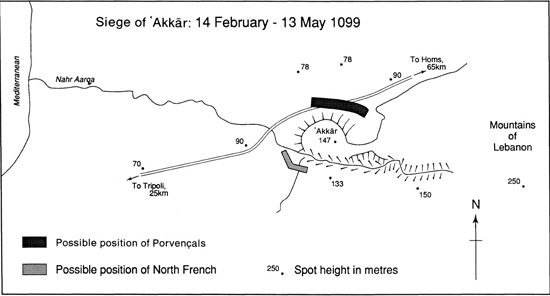
Fig. 15 Siege of ‘Akkār: 14 February–13 May 1099
It is very difficult to understand the attitude of the Islamic world to its invaders in the years of the crusade. The attitude of the nomads of Asia Minor is impenetrable, but we ought to know more than we do of those in the civilised heartlands which the army had now reached. Unfortunately, although our sources are often based on contemporary material they are overlaid by later attitudes and knowledge. The Islamic powers may have seen the coming of the army in terms of the great expeditions which the Byzantine emperors had once been wont to send to the east, but it is difficult to believe that this idea persisted beyond their arrival.27 The spirit of jihad was not entirely dead for there were Volunteers’ in the Islamic armies, certainly in that of Kerbogah and later in the Egyptian army which fought at Ascalon.28 But for the most part the authorities in the cities were untouched by any such spirit. For them the newcomers were another force in the complex middle-east political game and one which was not so different in its nature from others. In this area there were ancient centres of settlement – Antioch, Aleppo, Damascus, Shaizar and the rest which create an appearance of stability. But sweeping around them were much more restless forces – the Bedouin, the Arab tribes, invaders from the steppe, of whom the most recent were the Turks, in the past Byzantine armies. They might be unwelcome, but the risks of confrontation were high – better to pay them off and see what the future has to bring. These cities had a long tradition of neutrality (perhaps opportunism puts it better) in the Seljuk-Fatimid conflict and saw no reason to abandon this.29 As to the crusade’s ultimate objectives, these must have seemed opaque to the Islamic powers. Their attitude is best exemplified by the Kemal ad-Din’s brief dismissal of the fall of Jerusalem, a mere one-line notice of an event which took place in a far-away land, not worth, perhaps, the bones of an Aleppan soldier. Once the major powers of Syria had failed in their policy of confrontation with the Franks before Antioch, accommodation, albeit grudging, became the rule.30
Military activity in that summer and autumn of 1098 was much more purposeful than has usually been recognised. Godfrey and Robert of Flanders were strengthening their hold on an area which they had long dominated. Bohemond left to strengthen his hold on Cilicia, a vital buttress of the emerging Principality of Antioch, though we know nothing of his activities. The problems for a medieval army of resting in friendly territory were clearly illustrated by Albert who reports that after the ‘Azāz campaign knights and nobles in groups of fifty or a hundred, including quite notable people like Drogo of Nesle, Gaston of Béarn, Renaud of Toul and Fulcher of Chartres trailed along to Edessa driven by want. It may have been Baldwin’s generosity to them which provoked an Armenian plot against him. Certainly Balak of Sororghia was concerned by the rising power of Baldwin and tried unsuccessfully to trap him by offering to surrender Amasya. Fulcher of Chartres was given command of Sororghia in order to harass Amasya.31 Albert’s picture of knights in want, trekking out to offer their services in Edessa, supports Raymond of Aguilers’ general picture of a disgruntled and rather dispersed army and forms the background to the discontent which would well up in the winter.
In July 1098 the Provençal knight Raymond Pilet, lord of Alais in the Limousin, led a raid which captured Tell Mannas, the Christian population of which surrendered to him and became his allies. His force was later badly mauled by the garrison of Ma‘arra (see fig. 4).32 Such expeditions by lesser figures may have been much more common than we suppose, for they answered the imperative to feed and support idle troops. As the army lingered in the summer of 1098 such men must have found many opportunities opening up for them. Raymond Pilet was probably back in the service of Raymond of Toulouse when he captured Tortosa in mid-February 1099 and he played a notable role in the siege of Jerusalem.33 It was because of the poor that Raymond of Toulouse joined in the expedition against ‘Azāz in mid-September. But Count Raymond probably had other motives for his attack on Albara, not far from his base at Ruj, later in the month. Ruj formed an important base for the Provençals, and it was surely from there that Raymond Pilet was operating when he seized Tell Mannas to the east of Ma‘arra. Albara and the neighbouring Roman cities of Sirjyla, Deir Sambil and Ba’ouda dominate the Jebel Barisha massif and they are so close to one another that the fate of one must have been the fate of all. The bishop of Albara once held a great dominion in this area, including the important city of Kafartab, and it was probably for this reason that Raymond of Toulouse installed Peter of Narbonne as bishop there. Later, even when he was very short of troops, Raymond would permit a small force to be left to garrison Albara. Most commentary on Peter’s appointment concerns the fact that he was the first latin bishop in the east, which suggests that the Count saw this city as being outside the terms of the agreements with Alexius. However, equally interesting, especially in the light of the later expedition to Ma‘arra, is the fact that the count of Toulouse was building up a powerful bastion in Syria about 100 kilometres south-east of Antioch, whose eventual conquest of Ma‘arra would threaten the roads between Aleppo and the southern cities of Hamah, Homs and Damascus.34 Thus a whole group of nascent Frankish dominions was emerging – Edessa, Antioch, the ‘Afrin valley, Ruj and the Jebel Barisha. With hindsight we know those which would endure, but at the time this was not so evident and the rise of these dominions must have been deeply worrying to many crusaders.
It is against this background that the visions of Peter Bartholomew, acting as spokesman for the rank-and-file and demanding that the crusade press on to Jerusalem, must be seen.35 This is the context of the conference on 1 November 1098 which the leaders had arranged for the resumption of the march to Jerusalem. The conference revealed an army bitterly divided. Raymond of Toulouse would not accept Bohemond’s seizure of Antioch. Raymond of Aguilers says that the other leaders sympathised with Bohemond but were afraid to say so lest they be charged with oath-breaking.36Perhaps they were also mindful of the aid which they had received and might hope to go on receiving from Cyprus. In any case, the stubborn stance of Count Raymond was now a barrier to the obvious solution of giving Bohemond the city, because Raymond held the Palace and the Bridge Gate. Judgment between the two risked open offence to the Byzantines and “alienating the loser – it seemed that they were trapped in the situation. In military terms the failure of a whole contingent to join the march must have seemed to presage disaster. In the end it was popular pressure which forced the leaders to what Raymond of Aguilers, in a striking phrase, calls a ‘discordant peace’ (discordem pacem). The Anonymous does not use the phrase but describes the reality – Bohemond and Raymond were to promise to press on to Jerusalem, but each was free to fortify his position in Antioch.37 The demoralisation of the rank and file of the crusader army who had been left to their own devices through a bitter summer comes out in their cynical view of the parties to the quarrel in which each side is merely out for gain; Count Raymond in the pay of Alexius, Bohemond seeking his own benefit: ‘Let them who wish to have the emperor’s gold have it, and those who wish to have the revenues of Antioch likewise. Let us, however, take up our march with Christ as leader, for whom we have come’.38 This revival of the spirit of the People’s Crusade was generated by the strains of the long summer in Antioch. Albert gives no account of the conference as such, but he tells us that after the count of Toulouse had gone south, the forces of Bohemond, Robert of Flanders and Godfrey lost men who were anxious to press on, and that this eventually forced these leaders, with the exception of Bohemond, to resume the march.39
Fortified by the ‘discordant peace’ the crusader army prepared for its march southwards and the Provençals and the Flemings arrived before Ma‘arra on 27 November 1099 (see fig. 4). Its citizens were defiant, for they had defeated Raymond Pilet’s force during the summer and the city was prepared for a siege which the crusader forces systematically applied. It was neither a large nor an important place and its defences were not strong. The city wall enclosed only some five square kilometres and there may have been a citadel. As it is situated in a flat plain Ma‘arra enjoyed few natural advantages. Only along the south side was there a ditch and since his army is reported as trying to fill it in Raymond of Toulouse evidently attacked from this direction, and the other forces from the north.40 It seems odd that a city of such little importance should have been assaulted. Much more important places would later be bypassed, sometimes after the conclusion of an agreement affording free passage, but sometimes, as in the case of Sidon, without. Perhaps the leaders felt that for reasons of prestige they needed to destroy a city which had defied them once. Perhaps also it suited them to delay for the peace within the army was fragile and Ma‘arra was chosen because it was on the very edge of the Provençal dominion – Albara is only some ten kilometres away. Such a siege would satisfy the opposition within the army and bring them into contact with enemy lands which could be ravaged. This impression is reinforced by the clear evidence that at least one major prince and probably two were not at Ma‘arra. Raymond of Aguilers who was present throughout the siege says that Raymond of Toulouse and Robert of Flanders opened the attack with an assault on 28 November, which failed because they had only two ladders and needed four more. The next day Bohemond arrived and another assault was made without success. He mentions no other princes and adds that Godfrey was not at the siege.41 The Anonymous mentions only Raymond of Toulouse and Bohemond, and as he clearly describes the assault which took place when Bohemond was present it seems likely he was in his army. Robert of Normandy is never mentioned in his account of the siege, but he later states that Robert joined Count Raymond in January 1099 at Kafartab after the meeting at Ruj. Albert of Aachen says that Count Raymond was supported by Robert (but does not tell us which Robert), Tancred and Eustace; his account of events is fairly schematic but it is evident that Godfrey was not present. Ralph of Caen does not mention Bohemond’s participation but says the city was captured by Raymond and Robert of Normandy who is not mentioned by anybody else; perhaps this is a confusion with Robert of Flanders. Fulcher says that Bohemond and Raymond attacked Ma‘arra while the other princes stayed around Antioch.42 Since it is very clear that Godfrey was not at Ma‘arra it is hard to avoid the conclusion that the siege was a stop-gap activity which kept the army occupied but did not represent a serious beginning to the campaign for Jerusalem. Its proximity to Count Raymond’s dominions probably explains much of the suspicion which emerged after its capture.
However, the siege was conducted very vigorously. Raymond of Aguilers says that after arriving on 27 November the forces of Count Raymond and Robert of Flanders launched an assault the following day, and that it failed due to lack of scaling ladders. Bohemond’s force then arrived and a new assault was launched on 29 November involving, on the count’s sector, an effort to fill in a ditch before the wall, and this too failed. The Anonymous evidently arrived with Bohemond’s force for he begins by describing this assault which clearly again depended on vigour and was unsupported by machinery: it was a matter of scaling ladders and raw courage.43 Thereafter Count Raymond began more systematic preparations for an assault on the south wall including the building of a siege tower, but while the Anonymous goes immediately into his account of the final attack, Raymond of Aguilers makes it clear that some time supervened before this was launched on 11 December 1099. According to him Peter Bartholemew had yet another vision – much mocked by Bohemond’s men. There was great hunger in the army, a point supported by Ralph of Caen and by Albert of Aachen who says that during the great siege of Antioch this area had been scoured of food causing many of its people to flee. There certainly may be truth in this last point, but it should be remembered that exactly one year before the army outside Antioch had begun to suffer badly from famine. Obviously seasonal factors were at work and the army needed to extend its foraging range.44 Both accounts make it clear that Bohemond and the count of Toulouse attacked the city from opposite sides and that it was Count Raymond who built and employed a siege-tower, using, according to Albert, wood found in the mountains near Talamria which he seized in a raid.45 This wooden tower was simply pushed up against one of the towers of Ma‘arra once the ditch had been filled in. It had no bridge; those in its top storey, including Evrard the Huntsman and William of Montpellier, cast heavy stones down upon the wall, and so covered undermining operations which were conducted at its base. In the final assault on 11 December the men of Bohemond who used only ladders made no progress on their sector. On the Provencal side the siege tower attracted fire from enemy catapults – the crusaders seem to have built none of these. The defenders also tried unsuccessfully to set fire to it, while Raymond adds that they cast lime and beehives at the crusader force. However, while the enemy defence was preoccupied by the tower, ladders protected with mantlets were brought forward and Geoffrey of Lastours was the first to get onto the wall. Although he and his party were cut off when the ladder broke the enemy were disheartened by progress made on undermining the wall and fell back into the town. The Anonymous says that the breakthrough came as evening fell, and Raymond adds a curious sequel – that the poor in the Provençal army broke in and carried on the fighting by night, so winning much plunder in a ferocious massacre. Bohemond, he says, got a lot of booty thereby arousing jealousy, and the Anonymous says that this was by negotiating a surrender in his sector of the siege.46 The Chronicle of Aleppo confirms that the Franks used a tower and broke through by night when a massacre followed with a very systematic search for loot. However, the Damascus Chronicle says that the crusaders had several times offered the city surrender on terms, about which the citizens had been divided, and that when the city fell there was a terrible sack during which the crusaders broke promises of conditional surrender. Ralph of Caen says that the crusaders debated the question of terms, but those in favour of a massacre won.47 This seems to reflect the confusion on the fall of the city, with Bohemond offering terms at the same time as the Provençal poor broke in and carried out a massacre.
In a military sense the chief interest of the siege of Ma‘arra was the construction of the siege tower. Its function was to dominate the city wall and so to cover mining operations and the placing of ladders.48 The assault was not delivered by troops mounting the tower and passing over a drawbridge onto the walls. The fact that Raymond of Toulouse built it and that his force played the leading role points to his clear emergence as the leading figure in the army. This was not to the liking of Bohemond, who tried to use his possession of part of the city as a bargaining counter to obtain Raymond’s strong-points in Antioch when the latter wanted to give Ma‘arra to Peter, bishop of nearby Albara. This broke down the ‘discordant peace’ which had made the attack on Ma‘arra possible and reopened the great quarrel between Bohemond and Count Raymond. According to Raymond of Aguilers, the bishop of Albara and the rank-and-file petitioned Count Raymond to lead them to Jerusalem, while Bohemond tried first to delay the journey, and then to bring it forward. The Anonymous does not mention these quarrels, but tells us that the army stayed a month and four days at Ma‘arra although food was so short that desperate elements amongst the poor, the Tafurs, resorted to cannibalism.49 Ralph of Caen and Albert support Raymond of Aguilers’s account of starvation and despair in the army after the fall of Ma‘arra, but his is much the most detailed. He says that Bohemond left the army and returned to Antioch whereupon Count Raymond tried to assume the leadership of the crusade by calling a meeting at Rugia and offering money-fiefs to the other leaders. This further delay provoked the poor to attempt to demolish the fortifications of Ma‘arra and in the end Count Raymond was forced to agree to leave for Jerusalem on 13 January 1099, taking in his train Robert of Normandy and Tancred who had evidently accepted the money. As we have noted, during this time the Provençals felt they had been deserted by the Franks and complained that their force was quite small. In preparation for his departure, Raymond of Toulouse led an aggressive raid into enemy territory which brought in welcome plunder for the poor, and thus prepared the army marched south on 13 January 1099.50 His decision to do this was probably reinforced by Bohemond’s seizure of the Provençal strong points in the city after the failure of the Rugia conference. By this time it must have been clear that Count Raymond intended to march south and this enabled Bohemond to use force in Antioch with little fear of retribution.51
The subsequent course of events suggests that the count never intended to march to Jerusalem with his relatively small force. He left Ma‘arra on 13 January barefoot as a pilgrim, but in reality the campaign which followed was never intended as anything more than an extended raid whose continuation was provisional on better conditions, and one which might be made to serve self-interest if all else failed.52 Raymond of Aguilers indicates the small size of the army which travelled with the count. He was accompanied only by Tancred whose force was small, and Robert of Normandy; Robert of Flanders and Godfrey stayed behind at Antioch with Bohemond. They set off inland, marching south via Kafartab to Shaizar, Raphania and Homs, the rulers of which were more than ready to grant them free passage and the right to buy goods, even including vital horses which they were able to obtain in large numbers.53 The willingness to come to terms with Islamic rulers denotes a conjunction of zeal for Jerusalem and a new pragmatic approach to getting there. For those who were eager to reach the Holy City nowhere else much mattered, while the count must have been anxious to avoid taking on any serious major military commitment. These arrangements greatly facilitated the march, although enemy forces did attack the army’s stragglers forcing Raymond of Toulouse to mount a strong rearguard. In late January, as the army turned westwards north of Homs towards the coast, their foragers were attacked by enemy forces based on the Hisn al-Akrad, the later Crac des Chevaliers. The count of Toulouse attacked them forcing them to abandon their flocks and take refuge inside the fortress. Many of his men drove off the animals and the enemy were emboldened by this. Raymond was now dangerously exposed, but he feigned an attack and then withdrew before the two groups of the enemy, one in the castle, the other on the mountain, could join to attack him. Even so he escaped only narrowly and vented his rage on his knights. It was a nice example of the problems of controlling a medieval army. By the next day the enemy had fled and Crac was taken.54 However, there are strong hints of uncertainty about where they were going. Shortly after the departure from Ma‘arra it was suggested that the army should turn towards the coast to attack Jabala. This was probably made as the army approached Hamah (ancient Epiphanea) from where a road leads across the Jebel Ansariye range to Jabala (see fig. 4). We are not told who made this suggestion, but it was attacked by Tancred who spoke in favour of marching on to Jerusalem. Raymond of Aguilers clearly sympathised with this viewpoint and his failure to indicate the proposer suggests the count of Toulouse. Indeed this would make sense, for it is probable that he controlled Laodicea and the acquisition of a neighbouring port would have strengthened his emerging Syrian dominion. The idea was rejected but this same lack of purpose was soon evident again. To the south of the mountains the army debated whether to take the inland route to Damascus, or to turn towards the coast, eventually taking the latter and much less dangerous alternative which had the benefit of giving access to shipping.55 Even then, doubts and hesitations were at work, for at first the count of Toulouse seems to have been of a mind to come to an agreement with Tripoli, and was only persuaded to attack his city of ‘Akkār (Caeserea Libani) by his envoys in the hope of extorting yet more wealth from him.56 Such a policy must have seemed militarily wise for his army numbered only some 6,000–7,000 including not more than 1,000 mounted men, hardly a force with which to challenge the might of the Fatimid Caliphate, which in any case might yet offer terms. For the moment the prosperity of the march from Ma‘arra seems to have quelled agitation in the army. A siege of ‘Akkār might prove highly profitable; it would put pressure on the dissenting leaders, Godfrey de Bouillon and Robert of Flanders whose forces remained aloof at Antioch, while keeping the Provençals reasonably close to friendly Laodicea only about 100 kilometres to the north. Moreover, from the point of view of the count of Toulouse, the acquisition of ‘Akkār would strengthen his Syrian redoubt. The capture of the port of Tortosa by Raymond Pilet and the surrender of Maraclea on terms must have encouraged the crusader army and helped their communications with the north.57
The attitude of Godfrey de Bouillon and Robert of Flanders, whose forces remained with Bohemond at Antioch, is very difficult to understand. They had clearly rejected the leadership of the count of Toulouse and preferred to wait on events. Albert of Aachen, who is usually at pains to present Godfrey as a Christian hero, casts no light on their reasons, but admits that popular pressure built up within their armies in favour of completing the journey to Jerusalem. Their forces and those of Bohemond were eroded by troops leaving them for Count Raymond, and in an assembly on 2 February the two leaders announced their intention of gathering their forces at Laodicea which they reached at the end of February; there Bohemond left them. On 1 March they besieged Jabala – but still held off joining the Provençals. It was only when news came from ‘Akkār of the approach of an enemy army threatening the Provençals that Godfrey and Robert took a tribute from Jabala and rallied to their aid on 14 March 1099. The spirit of unity was strong enough to prevent them standing by while Count Raymond’s force was attacked by the enemy, but it extended little further for they were greatly annoyed to discover that the rumour was false. Albert of Aachen’s story that Count Raymond was bribed by the people of Jabala to draw Godfrey and Robert south probably reflects the bitterness felt amongst the rank and file which enabled Tancred to plant this story. There was great tension between the two contingents: Raymond of Aguilers says that Tancred stirred up discontent, anxious to leave the service of Count Raymond for that of Godfrey and Albert adds that Tancred had quarrelled with Raymond over money. However, Count Raymond was able to reconcile Godfrey by diplomacy and the gift of a horse and so all pursued the siege, although Tancred remained hostile. In fact we later find that Tancred seems to have become the vassal of Godfrey ‘whose knight he was’ by the time of the capture of Jerusalem, and this statement of Albert’s seems to confirm Raymond of Aguilers’ assertion that the young Norman had abandoned Raymond for Godfrey.58 At last a substantial proportion of the crusaders had been brought together in a single army, but they were far from united, and the difficulties of the siege created problems. The junction of the Provençals and the North French was fortuitous and the crusader host remained fissured. It was lucky for them that they were operating in a military vacuum. Even so the sapping effect of these quarrels made itself felt in the siege of ‘Akkār.
The actual siege attracted very little attention in the chronicles. Raymond of Aguilers says that there were many deaths including that of his co-author Pontius of Baladun killed by a stone from an enemy catapult, while Anselm of Ribemont was killed in the same way while repelling an enemy sally. The Anonymous mentions the deaths of Anselm, William the Picard ‘and many others’ but says nothing of the circumstances. He reports the raids conducted by the crusaders which gave them possession of Tortosa and control of Maraclea, then provided booty from el-Bukeia and terrorised Tripoli itself.59 Albert of Aachen describes ‘Akkār as a strong place against which the crusaders constructed catapults, to which the enemy replied in kind, and there is similar information in Ralph of Caen. It was in a duel between these machines that Anselm of Ribemont was killed. Albert and Guibert of Nogent say that the leaders tried to sap the walls of the city, but were foiled by enemy counter-mines.60 The impression we have is of an attack which at first was sharp, causing heavy casualties, but then tapered off. Indeed, it has been suggested that after the arrival of Godfrey and Robert of Flanders no serious attack was launched on the city, but this seems to be a result of the way Fulcher, who was not present, reports the siege.61 In fact too little attention has been paid to the situation of ‘Akkār which was formidable (see fig. 15). It stands on a spur on the lower slopes of Mount Lebanon, projecting due west at a height of 147 metres above sea-level. The modern road across the plain at its foot from Homs to Tripoli runs at 90 metres. The top of the spur is a small plain some 600 metres long and 250 metres wide from which stone columns and masonry project at intervals and around which the remains of walls can clearly be discerned. The sloping flanks of the spur have probably been artificially sharpened, strengthening what is in any case a formidable position. The southern flank of the city is very steep, forming the wall of the gorge of the river ‘Akkār; in spring this would have been in spate, making an impassable barrier. To the north the slope is less steep, though still very sharp, and an attacker can mount the slope to get access to the neck of the spur. It is this feature which truly makes ‘Akkār impregnable. The neck of the spur has been cut into by the river and perhaps by human action as well, so that the eastern approach is almost as high and certainly as steep as any other, and very narrow indeed. Although the neighbouring mountain spurs are actually higher than ‘Akkār, they are so far away as to be of no value to an attacker. The natural strength of its position made it difficult to approach and this probably ruled out the use of a siege-tower. Ralph of Caen says that the army was divided by the river which was crossed by an ancient stone bridge; probably the Provençals attacked from the north while Robert of Normandy and Tancred (and perhaps later Godfrey and Robert of Flanders) attempted to assault from the east. That mining formed part of the assault is evident because Albert says that the army became exhausted by it but we do not know anything of the direction of this attack though common sense would suggest that it was concentrated on the north and east of the city. The steep slopes would have made mining difficult from any direction.62 But the failure before ‘Akkār was, above all, a failure of will resulting from divisions within the crusader army. The army was never defeated – a fact which the emir of Tripoli recognised when he payed them generously to pass on their way south. The siege simply languished while internecine politics were dominant.
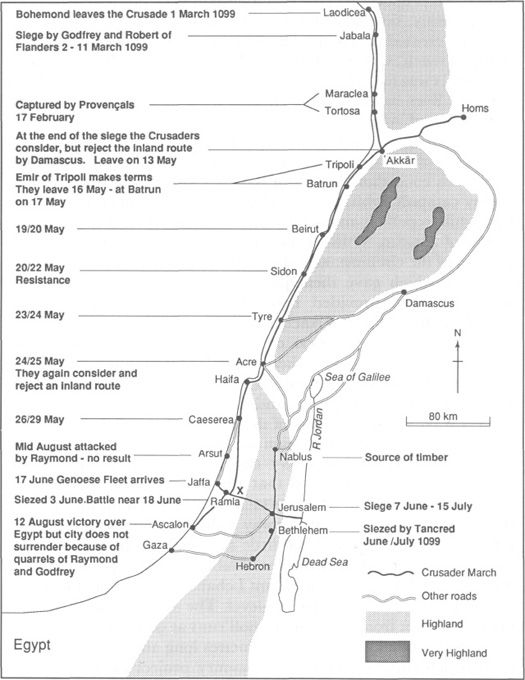
Fig. 16 The march south
The Anonymous and the works which derive from his, and also that of Fulcher of Chartres, provide a very bland account of events but Albert of Aachen and Raymond of Aguilers, from their very different viewpoints give a different picture. Albert says that after Raymond had mollified Godfrey the leaders faced popular pressure resisted by Raymond of Toulouse, to abandon the siege of ‘Akkār and to move on to Jerusalem. Raymond of Aguilers says that the siege was never popular and describes repeated quarrels amongst the leaders after Godfrey came, fanned by Tancred who wished to leave Count Raymond’s service; Albert says that he and Raymond had quarrelled over money.63 In addition, the question of the Holy Lance was raised; Raymond of Aguilers reports a vision of Peter Bartholemew which blatantly supported the case of the count of Toulouse for continuing the siege of Akkār and accused the leaders and members of other armies of offending against God in their faint-heartedness. The visionary had prospered by representing the views of ordinary crusaders, but now his support for Count Raymond was at odds with the popular desire to get to Jerusalem, and this enabled his enemies to attack him and to force a trial by fire. This is widely reported in the sources and though Raymond of Aguilers defends Peter Bartholemew its result was at best inconclusive and must have harmed the prestige of the count of Toulouse.64 The ruler of Tripoli had attempted to buy off the crusaders but the resistance of ‘Akkār encouraged him to resist, so in mid-April a strong raid was mounted on Tripoli with heavy fighting along the line of the aqueduct into the city, resulting in a major crusader success. The more generous terms now forthcoming seem to have further sapped the army’s resolution, and Raymond of Aguilers suggests that the visions of Stephen of Valence and Peter Desiderius encouraged the people to demand a resumption of the march.65 According to Albert of Aachen, Godfrey set himself at the head of the popular clamour to press on to Jerusalem, and when Count Raymond resisted he, Robert of Flanders and Tancred burned their camp and marched to Tripoli, and desertion from within his own army forced Raymond to follow. Raymond of Aguilers presents a strikingly similar picture, but he sets the debate in a different context. According to him it was the arrival of an embassy from the Emperor Alexius in early April of 1099, asking the army to delay until he arrived in June, which triggered off the debate.66 The count wanted to stay and in the meantime press the siege of ‘Akkār whose abandonment, he pointed out, would be a great blow to their prestige, and he expressed great concern that the army on its own would not be strong enough or well enough supplied to take Jerusalem. Other princes poured scorn on Alexius’ offer which they suspected was intended to embroil them in his dispute with Bohemond, and urged the army on, but the count’s influence was strong enough to prevail for a while. Ultimately, Godfrey put himself at the head of the discontent and, on 13 May, marched to Tripoli; he was followed by many in the Provençal army who burned their tents, forcing Count Raymond to follow along to Tripoli where he unsuccessfully pressed for a siege. The leaders then concluded a favourable treaty with Tripoli and the whole army marched south on 16 May 1099. In fact the imperial embassy arrived at ‘Akkār in early April, before Easter as Raymond says, so this points to a long running debate in the army from that time onward. The fact was that in military terms there was little point in the siege of ‘Akkār for it had no special military value and once Godfrey and Robert of Flanders had joined, the army had reached its maximum strength. A number of factors, including the weakness of his army, led the count to attack ‘Akkār in the first place. Once battle was joined, however, and even when Godfrey and Robert of Flanders had come, considerations of ‘face’ and prestige, and perhaps a not unreasonable caution about attacking the Fatimid Caliphate with what remained quite a small army, moved the Provençal leader. And then there was self-interest – his Syrian bastion. We need not see this as totally opposed to his desire to go on to Jerusalem, but it was certainly a factor in his stubborn resistance to popular agitation.67 But the whole rationale of the siege of ‘Akkār collapsed as anxiety within the ranks to press on to Jerusalem arose.
The departure from ‘Akkār marked the end of an era for the First Crusade. They had set out under the rule of a committee of leaders, pre-eminent amongst whom was the Papal Legate, Adhémar of Le Puy. From early 1098 their affairs were increasingly dominated by Bohemond. His desire to hold Antioch precipitated a crisis in their affairs and led to a bitter conflict with the count of Toulouse who stood for the rights of the Emperor Alexius and responded to agitation in the army to continue on to Jerusalem. In the vacuum of authority after the death of Adhémar on 1 August 1098 he associated himself uneasily with the visionary Peter Bartholemew and his clerical associates. In the end this forced him to abandon his position in Antioch and to make a bid for leadership of the crusade. However, he was never able to convince all the other leaders that they should accept him, perhaps because he was an abrasive and domineering personality and without them he lacked the military strength to satisfy the popular enthusiasm for the journey to Jerusalem. Both Bohemond and Raymond of Toulouse, for all their abilities and resources, succeeded only in establishing a transient pre-eminence. Bohemond had great military ability, but he settled at Antioch. Raymond commanded the largest army in the crusader force but his dominance was undermined by events at ‘Akkār. He insisted too stubbornly on persisting with an unpopular siege on the success of which he felt his prestige depended and he was damaged by the death of Peter Bartholomew. Above all, he had long occupied a paradoxical situation: he was apparently the leader who wanted to press on to Jerusalem, yet he seems to have had considerable doubts about the wisdom of attacking it with the limited resources the crusaders controlled: this was part of his reason for awaiting the emperor and it was probably from him that doubts appeared at Ramla.68 This enabled Godfrey to undermine his position without in any way attacking him. But Raymond of Toulouse had served the crusade well. At a crucial time when the army was becoming infected by the political culture of North Syria he was responsive to the basic driving force of the crusade and, however reluctantly at times, he helped to keep the whole enterprise together. He remained important, but he was an isolated figure, and increasingly the crusade reverted to what it had been before, an alliance led by a committee. The long and painful course of events from the defeat of Kerbogah showed that there could be no single command of the army – it had been a crisis of authority and it was one which would infect crusader armies in the centuries to come. But the army now had to confront a third enemy, the Fatimid Caliphate of Egypt (see fig. 3).
1 GF, p. 71.
2 GF, pp. 44–5 and see above, pp. 260–2.
3 RA, pp. 83–4.
4 Hagenmeyer, Kreuzzugsbriefe, pp. 155–6.
5 GF, p. 72.
6 AA, 417–19, says that the crusaders found out about the matter during Kerbogah’s siege, but Hagenmeyer, Chronologie no. 287, thinks that it took Stephen eleven days by land and sea to reach Philomelium on or about 20 June, which makes it unlikely that news of the matter could have got back to Antioch by 28 June.
7 Alexiad, p. 348; France, ‘Anna Comnena’, 22–5; Hagenmeyer, Chronologie Nos. 175, 176.
8 Alexiad, pp. 345–8; Vryonis, Hellenism, pp. 116–17.
9 Vryonis, Hellenism, pp. 115–19 sets this in context.
10 Alexiad, pp. 348–9; Matthew, 41. On Theodore Gabras and his later martyrdom see Vryonis, Hellenism, pp. 360–1.
11 GF, pp. 63–5.
12 GF, p. 65; RC, 658–9; for Bauldry’s story see above, p. 211; the other copyists of the Anonymous, PT, pp. 74–6; HBS, 203–4; RM, 815, add nothing although GN, 200, has a short diatribe about deserters and mentions Hugh of Vermandois. It should be noted that at first the siege of Antioch was incomplete: see above, p. 270.
13 AA, 414–15.
14 Hagenmeyer, Kreuzzusbriefe, pp. 161–65. As Hagenmeyer points out this may well have been written wholly or in part by Bohemond.
15 On the Egyptian embassy and the question of numbers see above, pp. 122–42, 253–4 and below, pp. 325–7.
16 Adhémar’s reputation has been attacked by J. H. and L. L. Hill, ‘Contemporary accounts and the later reputation of Adhémar, bishop of Le Puy’, Medievalia et Humanistica, 9 (1955), 30–8 and defended by J. A. Brundage, ‘Adhémar of Puy, the bishop and his critics’, Speculum, 34 (1959), 201–12. It is evident to the present writer that Adhémar was the fulcrum around which all the forces unleashed during the crusade turned and that he was a figure of the highest importance.
17 RG, p. 673; J. Richard, ‘Quelques textes sur les premiers temps de I’église latine de Jérusalem’, Recueil des Travaux Offerts à M. Clovis Brunel, 2 vols. (Paris, 1955), 2. 420–30 drew attention to the legatine commission of Arnulf and Alexander mentioned by Clarius pp. 184–7; see also B. Hamilton, The Latin Church in the Crusader States. The Secular Church. (London, 1980) p. 13; RA, p. 152.
18 On the general character of the crisis which afflicted the crusade after the defeat of Kerbogah see France, ‘The crisis of the First Crusade, 276–308 and on the role of Peter and the visionaries Morris, ‘Policy and Visions’, and France, ‘Prophet, Priest and Chronicler’.
19 J. A. Forse, ‘The Armenians and the First Crusade’, Journal of Medieval History, 17 (1991), 13–22, emphasises the cultural affinity between Franks and Armenians.
20 ‘He [Thoros] was much afraid for many of the townsmen [of Edessa] hated him’: ‘Anonymous Syriac Chronicle’, p. 70.
21 FC, p. 90: Matthew, 36; AA, 352, on whom see A. A. Beaumont, ‘Albert of Aachen and the county of Edessa’, in L. J. Paetow, ed., The Crusades and Other Historical Essays presented to D. C. Munro (New York, 1928), pp. 101–38; Amouroux-Mourad, Comté d’Edesse, p. 59.
22 AA, 352–4, 397; Matthew, cxiii, where his first wife is named as Arda.
23 Cahen, Turkey, pp. 81–2.
24 AA, 355–7.
25 AA, 441, 436–40; RA, pp. 88–9; Chronicle of Aleppo, 586; RC, 649–50.
26 RA, pp. 103, 107, 111–12, 125, 135–36; GF pp.81, 83–6.
27 A. Maalouf, The Crusades through Arab Eyes (London, 1984), relies heavily on this idea, but his work is to crusader historiography as D. Brown, Bury my Heart at Wounded Knee (London, 1971), is to that of the western expansion of the United States, chiefly concerned with establishing an alternative viewpoint; Sivan, L’Islam et la Croisade, pp. 25–6, points to evidence that, in Syria, the crusaders were at first seen as instruments of the Byzantines. The ‘Anonymous Syriac chronicle’, p. 69, is quite clear that they were allies of Alexius who ‘sent ambassadors to Alexius to prepare to go out with them … Alexius promised to help them in all they needed’, but this was written in the late twelfth century.
28 Aleppo Chronicle, 583. Damascus Chronicle of the Crusades, p. 48. But overall there was little sense of jihad in the Islamic world as Sivan, L’Islam et la Crusade, pp. 21–35 makes clear; on Holy War in the two cultures see M. Canard, ‘La guerre sainte dans le monde islamique et le monde chrétien’, Revue Africaine, 79 (1936), 605–23.
29 Köhler, Allianzen un Verträgen, p. 72.
30 Aleppo Chronicle, 587.
31 AA, 441–5.
32 Aleppo Chronicle, 584; GF, pp. 73–4; Riley-Smith, Idea of Crusading, p. 61 thinks that the Anonymous was in Raymond Pilet’s following at this stage.
33 GF, pp.84, 89; RA, pp. 141–2.
34 RA, pp. 91–2, 104–5; Dussaud, Topographie, pp. 187–8, who tends to see their conquest as part of a plan of advance against Hama; for the capture of Ma‘arra see below, pp. 311–15. The ‘deserted cities’ of the Jebel Barisha are almost intact Roman cities in gradual decay. They were presumably deserted because of the erosion which has stripped the upper reaches of the massif of its soil, but their very existence points to former wealth. They are within sight of one another. This area was later annexed to the Principality of Antioch until it was lost in 1135: Smail, Crusading Warfare, p. 32.
35 France, ‘Prophet, priest and chronicler’.
36 RA, pp. 93–4.
37 RA, p. 94; GF, p. 76.
38 RA, p. 94; Krey, First Crusade, pp. 208–9.
39 AA, 449–50.
40 The location of the city, its topography and the events of the siege have been closely studied by Rogers, Latin Siege Warfare, pp. 106–17, who speaks of the ditch on the southern wall. But Ma’arra is now a sizeable place and has long outgrown its medieval walls. In its north-west corner there is a citadel with a ditch on its southern side, but it is not clear whether this was the site of the city in the eleventh century. The Iranian traveller Naser-e Khosraw, The Book of Travels, tr. W. M. Thackston (New York, 1986), p. 11, visited Ma’arra in 1047 and described it as a walled and prosoperous place with its own cultural life.
41 RA, pp. 94–5, 99.
42 GF, p. 81; AA, 450–1; RC, 674–75, 679; FC, pp. 112–13.
43 RA, PP. 94–5; GF, p. 38.
44 RA, pp. 904–7; RC, 675; AA, 450.
45 GF, p. 79; RA, p. 95; AA, 450.
46 GF, pp. 78–80, is much the clearer of the two accounts but it is supported by RA, pp. 97–8.
47 Aleppo Chronicle, 587; Damascus Chronicle of the Crusades, p. 47; RC, 679.
48 Rogers, Siege warfare, p. 110 thinks there was no drawbridge.
49 RA, pp. 98–100; GF, p. 80; on the Tafurs see above, p. 287, n. 57; M. Rouche, ‘Canniba-lisme sacré chez les croisés populaires’, Y. M. Hilaire ed. in la Réligion Populaire (Paris, 1981), pp. 56–69.
50 RA, pp. 99–102; on the size of the crusader army and the terms of the money-fief and its importance see above, p. 129–30.
51 RA, pp. 125, says that Bohemond drove out the Provençals when he heard that Count Raymond had left Ma‘arra. PT, p. 95 also speaks of a violent expulsion at some stage during the stay at Ma’arra or shortly thereafter, while AA, 448, reports a violent expulsion, but his dating is uncertain. RC, 675 says that Tancred quarrelled with Count Raymond earlier, during the siege of Ma’arra and, returning to Antioch, tricked the Provençal garrisons into surrender; he then explains why the Normans and the South French were enemies and gives a very hostile view of the Lance before returning to the fall of Ma’arra. It is not impossible that RA, who remarks on the affair only in passing, is imprecise on the date. The greatest objection to Ralph’s story is that it was only shortly after the siege of Ma’arra that Tancred took Count Raymond’s pay and swore to serve him even to Jerusalem. However, even Bohemond was called to Rugia, so evidently considerable efforts at reconciliation were made. It is not at all impossible that Bohemond seized Antioch late in the siege of Ma’arra; he would have seen that the temper of the army prevented Count Raymond from returning to Antioch.
52 Though Hill and Hill, Raymond IV, pp. 113–15, suggest that Raymond and the North French agreed to march by different routes and rendez-vous at ‘Akkar. In view of the sequence of events this seems unlikely.
53 On numbers see above, pp. 129–30; RA, pp. 102–3; GF, PP. 81–2.
54 RA, p. 104–6.
55 On the importance of which see above, p. 209–20.
56 RA, pp. 103–7.
57 GF, pp. 834; Hill and Hill, Raymond IV, p. 121.
58 RA, pp. 110–11; GF, p. 84; AA, 454–5, 479.
59 RA, pp. 107–9; GF, pp.85–6.
60 AA, 451–2; RC, 680, 682; GN, 218–19.
61 Hagenmeyer, Chronologie, No. 355.
62 RC, 680, 682; Rogers, Siege Warfare, pp. 118–19 describes the city. For Dijebel ‘Akkar, its general location and history see Dussaud, Topographie, p. 88, and for more detail, ‘Voyages en Syrie, Oct-Nov 1896’, Revue archéologique, (1897) (1), 305–8; M. van Berchem, ‘Notes sur les Croisades’, Journal Asiatique, 1 (1902), 421, 448; Lestrange, Palestine under the Moslems, pp. 80, 390. The present writer was able to visit ‘Akkar in the spring of 1992 and personal observation is the basis of this description.
63 RA, pp. 108, 111–12, 124; AA, 454–6.
64 RA, pp. 112–24; RC, 682; AA, 452; GN, 217–18.
65 RA, p. 124, 128–9, 131–4; GF, pp. 85–6.
66 Lilie, Byzanz, pp. 42–3, suggests that, in the wake of the dispute over Antioch, Alexius was simply trying at all costs to prevent the formation of Frankish lordships, hence, also, his letter to Al-Afdal revealing crusader weakness (RA, p. 110). However, it seems to the present writer that Alexius’s attitudes were somewhat more ambivalent especially in view of his alliance with Raymond of Toulouse, and that his essential purpose was to enlist aid against Bohemond.
67 Hill and Hill, Raymond IV, p. 124, think that the siege of ‘Akkār helped Count Raymond to establish a claim to Tripoli for the future.
68 On Raymond and the imperial embassy see above, pp. 323–3, and for events at Ramla see below, p. 330.