
CHAPTER 11
Just as the crusade was about the leave ‘Akkār in considerable disarray on 13 May 1099, there occurred an event of great importance for the coming campaign. Their ambassadors to Cairo finally returned with proposals from the Fatimid Caliphate. The leaders had first dispatched envoys to the Egyptians from Nicaea in late June 1097 at the suggestion of Alexius and we have seen that some kind of understanding was reached, or at least anticipated, after discussions between the leaders and a Fatimid embassy in February-March 1098 which returned home with a crusader delegation.1According to Ekkehard these Franks were in al-Afdal’s camp before Jerusalem during his siege of the city when he threatened its defenders with his Frankish allies; the Historia Belli Sacri simply says that they spent Easter 1099 in the Holy Sepulchre obviously on friendly terms with their hosts.2 This strongly reinforces the idea that the Egyptians were negotiating seriously. Raymond of Aguilers makes it clear that a partition of land captured from the Seljuks was the basis of discussion, with Jerusalem being allocated to the Franks, and the Historia Belli Sacrisuggests the same kind of arrangement. It is difficult to know how serious the crusaders were in pursuing these negotiations by this time. Things had changed since the ambassadors had been sent in March 1098. The Byzantine alliance was no longer operative and the crusade had become much more focussed on Jerusalem as its sole objective. At the same time, the success in North Syria had made the princes much more hopeful of tangible gain. In these circumstances an arrangement with the Egyptians would have seemed less than attractive to all elements in the army. For his part, al-Afdal was securely in possession of Jerusalem and was pursuing discussions with the Turks of Syria, as Raymond of Aguilers reveals.3 He was in a strong position and was probably well aware of the divisions between the westerners and Alexius from letters sent to him by the Emperor which were later found in his camp after the battle of Ascalon. He would also have been well aware of the cautious policy of Raymond of Toulouse who had barely infringed the Fatimid sphere of influence in attacking the independent-minded ruler of Tripoli. In these circumstances al-Afdal made only a minimal offer to the crusaders, but one which presumably he felt was within the ambit of the discussions. According to Raymond of Aguilers, at Tripoli the Egyptian Embassy proposed only that groups of unarmed crusaders should be allowed to enter the Holy City. The crusaders knew that the Fatimids had profited greatly from their attack in the north to seize Jerusalem and some of the coastal cities of Palestine and this may have contributed to the anger with which they rejected the terms offered. Essentially, however, opinion had moved on since the crusader embassy was sent and what had seemed then a real possibility was now unacceptable, especially in the light of the turmoil in the crusader camp.4 But the negotiations had served the crusaders well. The Egyptians had obviously been expecting an arrangement with the Franks and al-Afdal’s offer was perhaps meant either as a preliminary offer or a delaying tactic. It was a terrible miscalculation for the Fatimids appear to have been unprepared for war. Only after the collapse of the negotiations at Tripoli did the Fatimids begin to make military preparations.5 It was because of this that the crusaders would enjoy a fairly peaceful and easy march south. The Fatimid cities of the coast offered little resistance and, indeed, some concluded arrangements to allow the Franks to pass. What else could they have done in the light of the unpreparedness of their master? For much of the route down what is now the Lebanese coast the army would be confined by the mountains to a narrow and dangerous coastal road. Jaffa’s fortifications were slighted and the city abandoned before the crusaders even approached. The road from Ramla to Jerusalem passes through the Judean Hills which are perfect for harassment but none was experienced (see fig. 16). The signs are that the garrison of Jerusalem was no more than adequate for its task and had to be augmented at the last minute and throughout the siege the scale of enemy harassment was limited. All the indications are that the Fatimids had not made any military preparations against the crusader army.6 The army at Tripoli could never have guessed what a free run lay before it, but what they did know was that time mattered. Once they had rejected the terms offered and resolved to enter Fatimid territory it was only common sense to anticipate an enemy reaction. This explains the extreme haste of the march which contrasts sharply with their earlier pace. The army left Ma‘arra on 13 January 1099 and travelled the 160 kilometres to ‘Akkār by 14 February, some thirty-two days, giving a crude average daily rate of march of only five kilometres. They rested for five days at Shaizar and passed fifteen at Crac, so that the actual average daily rate of march was 13 kilometres. By contrast they left Tripoli on 16 May and took twenty-three days to cover the 360 kilometres to Jerusalem where they encamped on 7 June, a crude average daily rate of fifteen kilometres. During the march they rested only for eight days, giving an average daily rate of 24 kilometres. Between Tripoli and Beirut they seem to have made 40 kilometres per day for two days. Time was against the crusaders and from their point of view the whole campaign was dominated by the need for haste, hence the speed of march and the early assault on Jerusalem. This gamble against time was all the more risky because of the naval situation. The Egyptian fleet was far from dominant in the Mediterranean but it enjoyed a strong position along the Palestinian coast and so, for the first, time the naval supremacy of the crusaders could not be taken for granted.7
The leaders had already consulted with native Christians about the routes to Jerusalem; these are called Syrians by Raymond of Aguilers but they were almost certainly Maronite Christians for he says they lived in the mountains of the Lebanon. They had enjoyed much autonomy under Moslem rule and as warriors would soon command the respect of the Franks. They had indicated three possible routes – inland via Damascus, across the mountains of Lebanon into the Jordan valley or down the coast (see fig. 16). It was probably the possibility of naval aid which lead them to choose the latter route, despite the narrow defiles of the road along the littoral. They were accompanied by the crews of an English fleet whose vessels had all but fallen apart from use but, as we have noted, this was not the only friendly fleet operating in Levantine waters.8 In the treaty with Tripoli its emir promised to facilitate the passage of the crusader army, conversion to Christianity and subordination to the crusader command if they could defeat Egypt, and similar terms were made with Beirut and later Acre which they reached in late May, and probably other cities as well. His attitude was hardly surprising, for he had sought friendship with the crusaders from the very first, and even during the siege of Antioch had allowed them to come to buy food.9 As part of his agreement with the crusader leaders he released 300 prisoners. Even during the siege of Antioch arrangements to release prisoners had been so common that Roger of Barneville had earned a great reputation as a negotiator in such matters.10 According to Albert the emir of Tripoli kept his word and provided them with a guide who took them along the dangerously narrow passages of the coast road via Batrun to Djebail and saw to it that those entrusted with various strongpoints along the route allowed the crusaders to pass. It is possible that he provided Count Raymond with a kind of liaison officer who was later of use at the siege of Jerusalem.11
The cities along the coast were too strongly fortified for the army to have any chance of capturing them and they could count on help from the Egyptian fleet, but they had only garrison troops which could not block their way in the absence of reinforcements from Egypt (see fig. 16). Beirut (19–20 May) and Acre (24–6 May) concluded treaties with the crusaders very much on the model of Tripoli, while Tyre (23–4 May), Haifa and Caeserea offered no resistance. There was some harassment of the Christian army by the inhabitants of Sidon where they stayed 20–2 May and suffered the attentions of poisonous snakes. During the three day halt here the knight Gautier de la Verne was sent off on a foraging expedition but ran into strong enemy forces guarding flocks and was never seen again. All down what is now the Lebanese coast from Tripoli the army was marching along a corniche between the sea and the mountains; as noted this was particularly steep and narrow north of the Dog River near Beirut, but even after this it was confined. It must have been a relief to find the coastal plain opening up north of Acre, where they rested between 24 and 26 May and then celebrated Pentecost with a four-day rest at Caeserea, 26–9 May. In early June the army reached Arsuf where it turned inland towards Ramla but their bold advance down the coast had brought an enormous dividend. The enemy abandoned and destroyed Jaffa, the nearest port to Jerusalem, presumably because they assumed that the crusaders would take it as their base for resupply.12 This is a revelation of how weak the military position of the Fatimids was in Palestine and confirms the impression that they had expected to continue an arrangement with the Franks. On 2 June the army encamped at Wadi Djiudas close to Ramla which the enemy deserted during the night, apparently leaving it in good condition with plenty of food and there the crusaders paused until 6 June, presumably preparing themselves for the ordeal of the siege ahead. The city was a major crossroads and so extremely useful to the crusaders who would later concentrate there in preparation for the battle at Ascalon.13 At Lydda near Ramla, was a famous shrine of St George and in celebration of its easy delivery the crusaders appointed their first bishop, Robert of Rouen. His establishment in the city with a garrison of course served to guard crusader communications with the coast. While they were at Ramla they held a council of leaders. Here a suggestion was made that the army should attack Egypt and thus secure not only Jerusalem but all its rich cities. Raymond of Aguilers, who alone reports this discussion, does not indicate who made the suggestion, but whoever it was feared the problems of besieging Jerusalem in arid Judea. In a strategic sense, of course, to conquer Jerusalem through Egypt anticipated the grand strategy of the thirteenth century. It was presumably the count of Toulouse who suggested the idea for he had once before, in the debate over whether to await the coming of the Emperor Alexius at ‘Akkār, expressed doubts about the ability of the army to capture Jerusalem unaided. Moreover he was probably the only one of the leaders who had the strategic vision to suggest such a scheme though the long negotiations with Egypt had showed clearly the strategic possibilities. However, those who argued that the army was far too small for such a vast undertaking and would not even be able to hold any captured city, were quite right – the vision was far beyond their means.14
The army left Ramla on 6 June and arrived at Qubeiba which was then supposed to be the biblical Emmaus sixteen kilometres west of Jerusalem. That evening Tancred left the army in response to calls for help from the Christians of Bethlehem.15 The army which approached Jerusalem on 7 June 1099 numbered only some 1,200–1,300 knights and 12,000 other armed men, according to Raymond of Aguilers, a small force indeed to take on the Fatimid empire. They were working against time and the leaders were divided amongst themselves by the events of the preceding months. The count of Toulouse moved his camp early in the siege, against the advice of the other princes and despite much hostility in his own army which he only overcame by paying lavishly.16 Gaston of Béarn was an important magnate in Raymond of Toulouse’s army in the early stages of the crusade. During the siege of Jerusalem he was in charge of the building of the siege engines of the North French. Later he was closely associated with Raymond of Toulouse’s enemy Tancred.17 The fact that two Provençals, Galdemar Carpenel and William of Montpellier, are both later found in the service of Godfrey may indicate tensions within the Provençal army.18 Count Raymond’s quarrel with Tancred, who we have seen left his service at ‘Akkār, certainly continued, for we are told that on the eve of the final assault on the city after the procession around it and during the accompanying religious celebrations on 8 July they were reconciled.19 It was the custom of the army that when a crusader took a castle or town his banner flying over it would be respected by the others. Tancred seized Bethlehem and was arraigned by other leaders for it (see fig. 16). Later, after the fall of Jerusalem, he would plunder the Dome of the Rock to the scandal of the faithful which would involve him in a quarrel with the Patriarch.20 His attempt to ransom those of the enemy who took shelter there was frustrated by the blood lust of the Franks who massacred them, much to his annoyance.21 When the leaders censured Tancred in early July for his treatment of Bethlehem another problem arose, for Raymond of Aguilers alleges that its church was so holy that it could not be treated like any temporal possession. Then some of the clergy protested at the idea of choosing a ruler for Jerusalem when that matter was discussed because they regarded it as a special possession of the church. Raymond of Toulouse was clearly associated with this group amongst the clergy. Thus, to the personal rivalries of the leaders was added an ideological quarrel which would have a considerable influence on events after the fall of the city.22 The question of the government of Jerusalem was not raised again until 22 July 1099 when the leaders met to choose a ruler. The election was bitterly contested. Many of the clergy protested that a Patriarch should be elected first as a symbol of the church’s rights. This was rejected, but Count Raymond refused the offer of the kingship and what was offered to Godfrey was something else, the Advocacy of Jerusalem.23 However, the count clearly intended to keep a strong position in Jerusalem for he refused to hand the citadel which had surrendered to him over to Godfrey, and gave way only to considerable pressure from other leaders and much discontent within his own army. Bitter at this, he sulked in company with his ally Robert of Normandy and was even reluctant to believe the news of the landing of the Egyptian army at Ascalon in early August. After the victory he disputed control of Ascalon and Arsuf with Godfrey, and as a result neither city surrendered to the crusaders.24
Throughout the struggle for Jerusalem there would be two Christian armies rather than one, and at no stage was there a single commander. This makes their achievement all the more remarkable. The basic religious motivation of the crusaders reasserted itself and substituted a driving sense of purpose for leadership. It was this spirit which had rallied and triumphed over Kerbogah and then held the crusade together through the second half of 1098 when it had filled a real vacuum in the leadership and direction of events. In Raymond of Aguilers’s chronicle the death of Peter Bartholemew, who had played such a major role in articulating the demands of the mass of the army, is clearly followed by the reappearance of Stephen of Valence and then the emergence of Peter Desiderius in the later stages of the siege of ‘Akkār. It is possible that Raymond has tidied up events somewhat, but the outburst of enthusiasm for the journey which he says accompanied the arrival of Adhémar’s cross in the camp at ‘Akkār is consistent with later manifestations. As they approached Jerusalem many marched on to seize forts and settlements, but Raymond says that some at least approached the city barefoot and penitent as Peter Bartholemew had commanded. Albert describes the joyful emotions and the ceremonial as the army arrived before the city on 7 June 1099 and the Anonymous speaks of their ‘rejoicing and exulting’ at this time.25 In this spirit, the leaders consulted a hermit on the Mount of Olives and launched an almost immediate and fruitless attack on the city on 13 June. Peter Desider-ius had a vision of Adhémar, as a result of which on 8 July the whole army made a solemn procession around the city in the style of Joshua before Jericho in preparation for the great assault which they were preparing. In the final assault on Jerusalem it is alleged that Adhémar was seen in the thick of the fighting while the ultimate catharsis of this overwhelming spirit of righteousness was the terrible massacre which followed the fall of the city when the Anonymous records that ‘our men were wading up to their ankles in enemy blood’.26 The army which encamped before Jerusalem on 7 June 1099 was sadly divided in leadership, but in spirit it was united at this culmination of their quest. Without this they would undoubtedly have failed, for the task which they faced was immense and had to be achieved quickly.
The Christian army was dangerously isolated for the nearest friendly Christian base was Laodicea, (held by the Byzantines over 500 kilometres to the north), and no reinforcement could be expected from them nor from Bohemond, who was consolidating his position at Antioch another eighty kilometres away. Between these Christian bridgeheads in North Syria and Jerusalem was a string of Moslem cities about the fundamental attitudes of which the westerners could have had no illusions, especially after they shot down a carrier pigeon bearing messages from the governor of Acre to Caeserea.27 Even sea communication with the friendly north would be difficult as the fortifications of Jaffa, the nearest port to Jerusalem, had been dismantled by the enemy (see fig. 16).28 Moreover, the crusaders were aware that they were challenging the great power of Egypt, which had seized Jerusalem from the Artukid Turks in August 1098 taking advantage of their defeat of the Turks at Antioch. This had produced doubts about the wisdom of attacking Jerusalem when the army reached Ramla and Albert alleges that the Egyptians were in breach of promises they had made to the crusaders at Antioch.29 Albert of Aachen interrupts his account of the final attack on Jerusalem to report on the interception of messages from the Vizier, al-Afdal, to the garrison of Jerusalem, assuring them that he would come to their relief in fifteen days. According to Albert, deserters from the garrison told the crusader leaders that messengers were passing into the city on the eastern side which was not invested. An ambush was mounted killing one envoy and capturing the other. He was tortured to report his message and then tossed into the city on a mangonel with fatal results.30 The placing of Albert’s story emphasises the simple and obvious fact that the crusaders were engaged in a race against time and feared an attack from Egypt catching them during the siege of Jerusalem. Ascalon was a major Egyptian base on the coast only about eighty kilometres away, and it seems likely that some of those who attacked the crusader army during the siege were from there. So it was evident to all the parties that the issue would be decided quickly for time was against the Christian army. This imperative explains the early and ill-prepared attack on the city on 13 June, only a few days after their arrival.
Jerusalem was a formidable nut to crack. Its defences seem to have been put in order after the fall of the city in 1098 and the Fatimid governor, Iftikhar-ad-Daulah, had a garrison which included negroes, whom Fulcher describes as Ethiopians, and a corps d’élite of 400 cavalry, specially sent from Egypt, which acted as a reserve during the siege. Many of the Christian population had been driven out of the city, for Albert mentions those who had fled to Bethlehem petitioning the crusaders for protection – whereupon Tancred was sent there. The Patriarch of Jerusalem was in Cyprus though the Armenian Catholicus remained in the city for part of the siege. In fact, it is likely that many Christians, and not just women, children and the old as William of Tyre suggests, remained in the city, for there were priests and others to welcome the crusader entry. The Jews stayed and suffered in the crusader sack. Despite these security precautions deserters from within the city informed the leaders of the comings and goings of Egyptian messengers and told Tancred about the plunder in the Dome of the Rock, while it was ‘brothers from within the city’ who warned the army that the fire cast at their towers could only be put out by vinegar.31 The garrison tried to drive off animals and destroy food in the vicinity of the city, but Gaston of Béarn and Tancred captured a lot of stock as they raided ahead of the approaching Christian army. Ralph of Caen speaks of the army tormented by hunger and thirst and virtually in a state of siege, cut off from supply by enemy raiders, but this was at a point late in the siege and as Fulcher remarks, there never seems to have been a desperate food problem. The Anonymous says that the army was short of bread until the arrival of a fleet at Jaffa on 17 June and this may have been a crucial factor in the supply of food. What all the sources complain of most bitterly was the shortage of water. The enemy had poisoned or blocked wells, forcing the crusaders to travel at least three kilometres or more. The threat of enemy ambushes obliged them to form convoys. As a result, water was sold at great cost in the camp and this was the cause of quarrels and dispute. Some was sold with leeches in it, which when swallowed caused swelling of the throat and stomach and ultimately death. The water shortage had direct military effects. Count Raymond’s camp outside the Zion Gate was very close to the walls and was assailed by an enemy fire machine and shortage of water made it difficult to put out the fires. The same problem aided and abetted enemy efforts to burn the ram during the final assault. Only the pool of Siloa provided water in the immediate vicinity of the city and its supply ebbed and flowed and it was, in any case, within bowshot of the walls. The conveying of water seems to have become a major activity of the army during the siege but supply of other goods seems to have been reasonable. Albert reports that while the poor struggled over water the rich had grapes and wine.32
As the crusaders approached Jerusalem many of the knights, like Tancred, went ahead seizing properties. Raymond of Aguilers grumbled about this, but it was essential that they dominate the land around Jerusalem, for hostile raiders were present in force. Some of these may have been based in Jerusalem, which was never completely blockaded, but perhaps others came from Ascalon. On 9 June, Raymond Pilet and Raymond of Turenne attacked 200 Arabs. These raiders were a major problem for, as we have seen, they forced the army to convoy water supplies. The failure of the initial assault on Jerusalem on 13 June was partly due to the lack of wood to build ladders and machines, and a meeting of the leaders two days later agreed that machines would have to be constructed. There was no suitable timber in the general area of Jerusalem and Robert of Flanders was told to provide escorts for timber-cutters who found material near Nablus over fifty kilometres away, whose general area was later raided for supplies by Tancred in the period 10–13 July. Finding wood was a major problem for the army. After the conference on 15 July, Albert says that a Christian Syrian showed them where to find it in the mountains towards Arabia, some ‘four miles’ away. Since Albert’s miles are very fluid and the description vague it is impossible to know where this was. Later the young, old and non-combatants were sent to Bethlehem to gather light branches and twigs for the outer coverings of the assault machines. Ralph of Caen says that Tancred found the wood to build the only scaling ladder used in the initial attack on 13 June, and subsequently found some used by the Egyptians in their siege the year before and hidden in a cave where he sought privacy during a bout of dysentery.33
However, it was undoubtedly the arrival of the fleet of six ships at Jaffa on 17 June which was the key event in providing wood and the skilled labour and technical knowledge with which to manufacture. A major force was gathered to protect the sailors in the undefended port, but even so it was ambushed on its way to the coast on 18 June (see fig. 16). This was the largest encounter during the siege and all the crusaders were chosen from Count Raymond’s army, a reflection perhaps of his close relations with Genoa which had provided four of the six ships. According to the Anonymous 100 knights including Raymond Pilet, Achard of Montmerle and William of Sabran set out, but thirty became separated from the others and were ambushed by 700 Arabs with heavy loss including Achard and some poor foot-soldiers. Raymond Pilet’s forces were sent for and the enemy fled with heavy casualties, leaving 103 horses to be captured. Raymond of Aguilers describes three parties, the first of which led by Galdemar Carpinel, consisted of twenty knights and fifty foot. They fell in with 200 Arabs whom they attacked boldly with knights and archers to the fore, but they were encircled and all but overcome by the enemy whose archery was deadly. Achard was amongst the dead when Raymond Pilet’s force of fifty knights, probably accompanied by the following of William of Sabran, came up and the enemy fled. Albert says that Achard of Montmerle and Gilbert of Trèves were killed when the enemy from Ascalon ambushed a crusader force ravaging near to Ramla; the rest were saved by Baldwin of Le Bourcq’s intervention, and he captured an important enemy ‘knight’ who was executed before the Tower of David. The mention of Achard suggests that this was the same engagement, perhaps conflated with another event, but Albert, like Fulcher and Ralph of Caen, does not mention the fleet.34 The importance of this victory was seen in the sequel. The crusader fleet in Jaffa failed to keep a good lookout and was trapped in the harbour by Egyptian ships. Because the port had no defences the sailors burned their ships (bar one which escaped) and marched to Jerusalem with supplies and wood, a long vulnerable supply train which escaped attack because of the expensive victory the previous day. However, the whole episode had demonstrated the isolation of the crusader force and its vulnerability as it stood before Jerusalem.
The city which the crusaders now confronted was well protected by nature and the works of man (see fig. 17).35 In the later eleventh century the city occupied much the same site as the present Ottoman enceinte set upon a sharp hill rising from south to north amongst the Judean Hills. The valley of Qidron, rising from the direction of the Dead Sea, divides on Jerusalem’s south-eastern flank. To the east the Qidron valley cuts an enormous gash between the city and the Mount of Olives, providing great natural strength in that quarter; towards the north of the city it is called the Valley of Josaphat. Its western extension, the Valley of Hinnon, similarly, but less spectacularly, protects the western flank of the city. In the course of the eleventh century, two rebuilding campaigns on the north and south reduced the fortified area of a city whose economic importance was rapidly declining. By far the most radical was the reconstruction about the end of the first third of the century which excluded the ancient city of David and Mt Zion, and created the present southern aspect. A similar reconstruction about 1063 excluded much of the northern part of the old city. The result of these rebuilding campaigns was, in a military sense, highly unsatisfactory. In the south-west the exclusion of Mount Zion created a level platform some 160 metres wide from fifteen metres east of the southwestern corner of the city to about the same distance east of the Zion Gate, and well over fifty metres deep extending back from the wall to the ancient church of St Mary, from which any attacker could threaten. This is only a small part of the 1.3 kilometres extent of the south wall, and for the rest the land falls steeply away to the east down to the Temple Mount and the walls rise high above the old city of David. But the situation to the north was far more dangerous. The new line of fortification, centred on what is now the Damascus Gate (called in crusader times the St Stephen Gate) is markedly below the brow of the hill which lies well to the north. This gate stands across the Tyropoeon Valley and on its western side the land slopes up sharply to the high point of the defences where the Quadrangular Tower (later known as Tancred’s Tower) marked the northwestern corner of the city. However, at this point the land slopes down very sharply indeed from the north, so that this Tower was an obvious attempt to strengthen a vulnerable point where the slope of the land really would naturally dominate the city wall; in the Ottoman defences it is the site of a major salient.36 To the east of the Damascus Gate the northward rise of the hill is less menacing, and the wall climbs gently from the Tyropoeon valley and then falls away slightly to where the Wadi Zahira enters the enceinte east of what is now Herod’s Gate. In this stretch every effort has been made to use rocky outcrops and rises, but in general the attacker is presented with a less than frightening aspect and a fair choice of attacking points, and can work with a useful downslope. In 1073 the city fell to the Seljuks and an effort was made to address these weaknesses. Outerwalls were either built or rebuilt, though these were probably not continuous and may have formed elongated enclosures. The eastern side of the city, just under one kilometre long, needed little strengthening for it was protected by the Qidron or Josaphat Valley but at the foot of this wall from the Josaphat Gate to the northeastern corner was a moat for here the defences stood on a plateau accessible from the north. This moat continued along the northern side of the city, reinforced by an outer wall, though it is not certain that they were absolutely continuous. The outer wall may have been formed into enclosures, effectively barbicans, while tracing the moat raises difficulties. This double line turned south at the Quadrangular Tower (later called Tancred’s Tower) and covered the western side as far as the citadel by the Jaffa Gate (which the crusaders called the Tower of David), around which the moat connected with the outer system and also isolated it from the city. South of the citadel the land rises steeply to the walls, but from the south-west corner a moat protected the whole southern wall facing Mt Zion as far as the Temple Platform.37 Thus, great trouble had been taken to strengthen the vulnerable area of the Quadrangular Tower, connecting it with the citadel in a triple line of defence, and the one weak point to the south was strengthened. However, the north wall of the city, roughly 1.4 kilometres long, was overlooked by the lie of the land, giving enemy missile firers an advantage and providing an enormously long frontage for the garrison to watch. The size of the garrison is not known. Raymond of Aguilers’s figure of 60,000 is clearly nonsense. Iftikhar-ad-Daulah probably had a core of Egyptian regulars; we know that a number of Jews also served and it was usual for such forces to be augmented by city militias. These, together with the 400 mounted reinforcements sent by the Egyptian Vizir al-Afdal, probably formed a barely adequate garrison for they were not particularly aggressive defenders.38
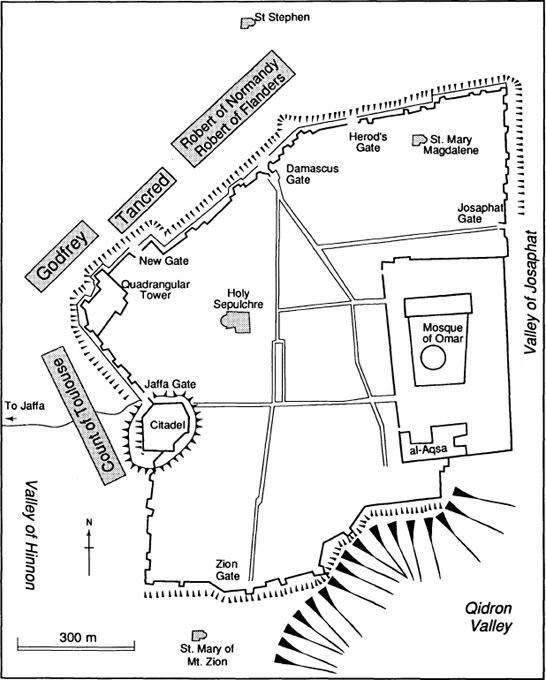
Fig. 17a Jerusalem, initial deployment of the Crusader army. 7–12 June 1099
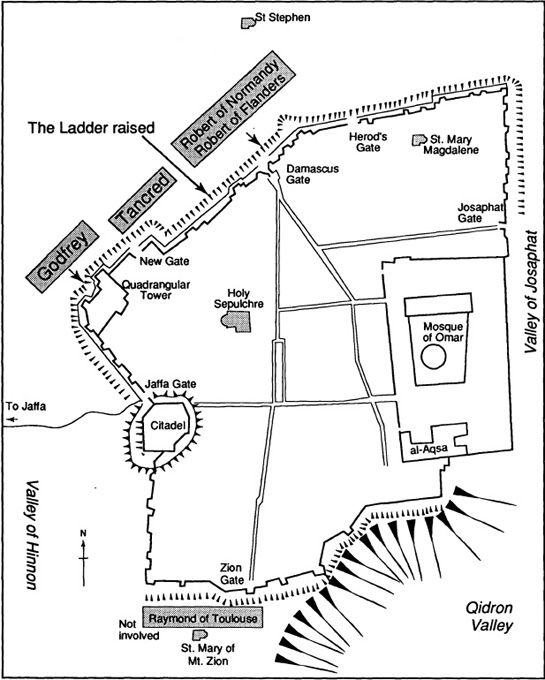
Fig. 17b Jerusalem, the attack of 13 June 1099
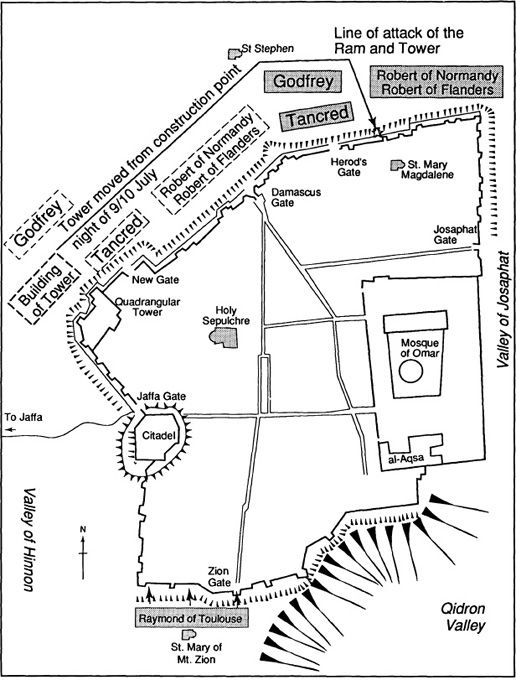
Fig. 17c Jerusalem, final attack of 13–15 July 1099
The crusaders approached Jerusalem from the north-west along the Jaffa road and came to the city on the side where its fortifications are at their most impressive. The Quadrangular Tower and the Citadel by the Jaffa Gate dominated the treble line of defences to the north, while the steep slope up to the walls from the vale of Hinnom made difficult any attack south of the citadel. Albert of Aix describes a rather curious order of siege. Godfrey stood before the Tower of David with Tancred to his left and the count of Toulouse to his right and Robert of Flanders and Hugh of St Pol behind, while Robert of Normandy and Conan of Brittany encamped before the Damascus Gate to the north. It seems unlikely that this was ever an order of siege, for there is a deep topographic confusion in Albert’s account. He presents Godfrey camped outside the Citadel and later tells us that the great siege tower used by Godfrey was built in this very place, when it is certain that it was constructed much further to the north and east. Albert seems to have confused the two great strong-points of the defences, the Citadel and the Quadrangular Tower to the north, in the general vicinity of which Godfrey was definitely to be found a few days after the arrival, on the occasion of the attack of 13 June.39 Ralph of Caen says that Robert of Normandy and Robert of Flanders encamped outside the Damascus Gate (also called the St Stephen Gate) with Tancred to their right; he was on lower ground than they but his position sloped upward to the west where Godfrey took position adjacent to him. The Anonymous confirms this, but does not indicate the relative positions of Godfrey and Tancred, merely making it clear that they were to the west of the two Roberts. Raymond of Aguilers does not mention Tancred but says that Godfrey and the two Roberts faced the northern wall between the St Stephen Gate and the Quadrangular Tower, and adds that Raymond of Toulouse at first set his army adjacent to Godfrey’s, all down the west side of the city. It would seem, therefore, that the initial order of siege was as follows: the two Roberts were directly outside the St Damascus Gate with Tancred to their right and Godfrey beyond him, while the large Provençal army stood along the west face of the city before the Citadel (see fig. 17a).40 The deployment of the Provençal force was unsatisfactory because they stood opposite the most formidable fortifications and the steeply sloping southern sector of the west wall. Very soon after the arrival of the army Count Raymond reconnoitred and decided that Mt Zion was a better place to attack. This decision was challenged by his own men, many of whom remained in the original camp, and the count was obliged to pay to find a garrison for the new position.41 There were good reasons for both the decision and the opposition to it. The west wall was far too strong to attack and the level ground outside the Zion Gate offered better prospects especially as the adoption of that position divided the defence, was close enough to the Citadel to distract its garrison, and, as Albert makes clear, enabled the count to keep some forces on the Mount of Olives and patrols in the valley of Josaphat (see fig. 17a). On the other hand, the new camp was dangerously exposed, placed, as it was, in the space of only some fifty metres between the church of St Mary of Mt Zion and the wall. So close were they to the wall that a machine placed within the Zion Gate was able to set fire to the crusader camp as well as attack machines in the last climax of the siege. But the resistance to the move had other causes, for there appears to have been considerable tension within the Provençal camp which later resulted in his own people rumour-mongering about the Count of Toulouse in order to prevent him from being made ruler of Jerusalem, and it is possible that such factors led Gaston of Béarn to take service with the North French.42 Raymond of Aguilers says that some of the other leaders objected to this redeployment, but they do not seem to have pursued the matter; perhaps after the tensions of the march south such a separation suited all parties.
On 12 June the leaders met and were urged by a local hermit who had already spoken to Tancred to make an immediate attack on the city which God would deliver to them.43 However persuasive he may have been, the leaders had probably resolved on this course of action anyway. Their position was difficult. The army was so small that they could not properly besiege the city when the western and eastern walls were guarded only by pickets. The Provençals probably blockaded no more than 250–300 metres of the long southern wall, while the rest of the army was concentrated in 600 metres, or rather less than half of the north face of the city. If they had attempted to stretch the army further they would have been vulnerable to sallies. Furthermore they feared the imminent arrival of an Egyptian relief force. The main objection to such a coup was the lack of siege equipment, and indeed they were only able to muster a single assault-ladder, so short was the time of preparation and so scarce was wood in the vicinity of Jerusalem. The Anonymous and Raymond of Aguilers say that this attack on 13 June broke through the outer wall and set a siege ladder against the inner before being aborted. Ralph of Caen says that because he had found the wood for the one siege ladder Tancred was able to insist that the attack be against his section of the wall, though he was persuaded that Reybold of Chartres, and not he, should be first up the ladder. In the event, Reybold’s hand was cut off and he was taken back to Tancred’s camp for treatment. It is thus pretty certain that the army attacked the section of the wall just to the east of the Quadrangular Tower besieged by Tancred. Albert says that the crusaders attacked under cover of a ‘tortoise’ of interlocked shields and, in a hail of missiles thrown by both sides, did terrible damage to the outer wall, suffering heavy losses for little achievement. Tudebode adds one detail to the Anonymous’s story; that Reginald, dapifer of Hugh of Liziniac, was lost in this attack.44 Its failure depressed the Christian host and on 15 June the leaders met once more in conference and resolved on a more methodical preparation for the next attack.
They resolved, according to Albert of Aachen, on the building of heavy siege machinery, in the event siege-towers, rams and projectile-throwers. This had the important effect of narrowing the ground of their attack to such points along the wall as were level. On the southern defences this meant the area of Mt Zion alone while even to the north attacking positions would have to be chosen carefully for a tower perilously balanced could be easily cast down by the enemy. Effort was centred on two great wooden towers which were to crush the defences. But this once more brought the army face to face with the problem of lack of wood. As we have seen, this was solved by at least one chance find, by sending out foraging parties under escort and by the arrival of the fleet at Jaffa on 17 June. Their problem was to find heavy structural timber and it was probably in this respect and the provision of skilled labour that the arrival of the fleet was so important. In the event it was Provençal forces which brought back the equipment and men and Count Raymond employed one of the Genoese, William Ricau, to construct his tower.45 In the accounts of the building of the North French tower given by Ralph of Caen and Albert of Aachen, no mention is made of the coming of the ships, while the Anonymous reports their arrival and the fighting which cleared the way for their journey to Jerusalem, but nothing more. The tower built by the northerners was constructed in stages which were scarfed together because they lacked heavy timbers. It was, perhaps, no coincidence that the northerners’ tower sagged badly during the attack, while that of Count Raymond stood up to a ferocious assault until it was burned.46 It would seem as if the army were now divided into two groups, each of which made its own way; earlier the Provençals played no role in the assault of 13 June which, the language of Raymond of Aguilers implies, was a purely North French affair. Count Raymond employed William Ricau as his engineer and set the bishop of Albara in charge of the enemy prisoners and others bringing in wood and supplies; perhaps he enjoyed the help of the emissary from Tripoli in this. The northerners used Gaston of Béarn as their engineer and set Robert of Flanders to ensure supplies. The skilled artisans who worked on Raymond’s tower were paid from his own purse, while those of the North French received their wages from a common fund.47 To attack from different directions was good tactics and this meant that preparations had to be separate but there was considerable friction within the army and this exploded at the meeting of the leaders in early July over the question of Tancred’s seizure of Bethlehem and the governance of the city after its capture as we have noted. However, the actual process of preparation seems to have been very well organised. Raymond reports that Gaston used division of labour to speed up the work and we have already noted the careful preparations amongst the southerners. Shortly after this meeting, an assembly of the people on 6 July decided to organise a solemn procession around Jerusalem in a manner recalling that of Joshua at Jericho. There had been a number of visions during the siege which Raymond of Aguilers mentions, but the procession was commanded in a vision of Adhémar to Peter Desiderius which he revealed to his lord Isidore count of Die and Adhémar’s brother, William Hugh of Monteil, and they seem to have called the assembly, though it was unlikely that they would have done so without the agreement of the princes. The moral effects of such an exercise as a spiritual preparation for the impending assault are evident, but it is to be noted that reconciliation was a major part of the purpose according to Raymond of Aguilers, and Albert says that the occasion was used to patch up friendship between Tancred and Raymond of Toulouse.48 On 8 July the procession duly took place culminating in sermons on the Mount of Olives. The way was clear for the assault on Jerusalem, the final climax of the crusade.
The tempo of preparations was now stepped up with light materials being gathered to be woven into mantlets with the old, young and women lending a hand and each pair of knights was given the task of providing one mantlet or one ladder. A raid on the area around Nablus presumably provided food for the attackers (see fig. 16).49 But the decisive act in this period of preparation came on the night of 9–10 July. The North French had built a tower, ram and other siege equipment in the camp of Godfrey close to the Quadrangular Tower.50 On that night it was dismantled (or perhaps reduced to partially fabricated sections) and moved to a section of the wall almost at the northeastern corner of the city (see fig. 17c). All the forces on the northern edge of the city concentrated there. Raymond of Aguilers tells us that the enemy had anticipated an attack close to the building point and had so strengthened the wall that any attack appeared hopeless. Flat ground, he tells us, gave easy access to the walls in the new position, and its defences had been neglected. The whole erection was transported over a mile, he says with pardonable exaggeration. Ralph of Caen says that the leaders had had this in mind for some time and had deliberately ignored this sector, the weakness of which was known to them, so as to deceive the enemy.51 This may well be true in a sense, for as the siege went on the leaders must have become more and more familiar with the defences, and we know that they received information from informers. Moreover, Raymond of Aguilers makes it clear that the move came as a total surprise to him, again pointing to the divorce between the two sets of attackers. The defenders had watched the construction of the siege equipment with anxiety and ‘built up the city wall and its towers by night’. From what we know of the resistance to the attack later we can envisage the strengthening of the defences with balks of wood, the stockpiling of ammunition and the provision of padding and ropes for use against the attacking machinery. Now these careful preparations had to be improvised in a new position; thus was their discomforture maximised by the dramatic way in which the Schwerpunkt of the attack was changed overnight. According to the Anonymous this new position was towards the eastern end of the northern wall and Raymond’s suggestion that the siege-tower was moved almost a mile (in fact about one kilometre) from the point of construction in Godfrey’s camp by the Quadrangular Tower supports this, as does later medieval tradition.52 Therefore, to find the point of the assault we need to locate an area of flat ground abutting the wall towards its eastern end. This is not easy because the local topography has been fairly radically changed by modern buildings and the development of the Sultan Suleiman Road which skirts the northern defences. However, rocky outcrops eliminate many places and Prawer has favoured the point at which the Wadi Zahira meets the city wall about 100 metres east of Herod’s Gate. Just to the east of this, however, and before the rocky area between the Rockefeller Museum and the wall, there seems to have been a totally flat zone twenty-five to thirty metres wide at a point where the present Ottoman walls have a major salient, and this is the location suggested here (see fig. 17c).53
The French still had to rebuild their machines, fill in a ditch and level off the ground before they could attempt to break down the forewall and bring the siege-tower up to the main line of defence which is why the main assault was not launched till 13 July. However, the value of the surprise stolen by the northerners is very evident, for Count Raymond had no room for any such manoeuvre and his preparations signalled his intentions very clearly for he was forced to spend three days filling in the southern moat: his attack would have a very difficult time indeed. With the ground properly prepared the North French set up the siege-tower, a mighty ram and three mangonels whose fire could clear the walls and launched their assault on Wednesday 13 July. Their systematic tactics now became apparent. As the huge ram manned by large numbers of people was dragged up to the outer wall the enemy lowered bags of straw and ropes and fired off clouds of arrows. The crusaders replied in kind with the three mangonels and lighter weapons. Godfrey used his cross-bow to set fire to the padding protecting the wall. The emplacement of the ram and destruction of the forewall seems to have occupied 13 and much of 14 July, for it was only on that Thursday (the fifth day) that the tower was ready for action and brought up behind it.54 The battle for the forewall was very savage as the enemy tried to burn the ram with every kind of device including Greek fire and the Franks were forced to expend precious water to prevent this. Once the forewall was broken through another problem presented itself. The mighty ram which had opened the breach now blocked the route for the mobile tower aligned behind it. The ram was a very substantial structure and it was mounted either on rollers or wooden wheels – we do not know which. In the circumstances in which it was built it is unlikely to have been well-balanced or free-moving. The sources are not very clear on timing but it seems likely that much of 13 and some of 14 July was spent simply bringing it up to engage the wall. Once it had done its job it was useless for its crew would be horribly exposed to fire from the higher inner wall of the city with its towers which in any case the crusaders probably judged too strong for battering. The inner and outer wall were very close to one another so it could not be dragged through and turned aside. Simply to disengage it would have taken almost as much time as to engage it in the first place, thus spoiling the momentum of the attack. To disengage and then reengage to widen the gap was unthinkable. Moreover, the size of the ram and of the tower which crawled after it meant that they had to be assembled as close as possible to the point of attack. Thus it was that the ram was fired. At this point the constricted nature of the battlefield becomes all too clear, for the enemy who had previously tried to fire the ram now tried unsuccessfully to put out the fire set by the attackers, by throwing water from the wall: ‘Twice was the ram set on fire, twice drowned in water twice was Muhammed defeated, twice was Christ victorious’.55
It would seem that the action at the outer wall took up most of Thursday 14 July, for although he explains how the tower was manned before he describes the firing of the ram, Albert makes it clear that this only approached the wall on the sixth day, Friday 15 July. It towered over the wall – this was its essential function, to overawe the defences and open the way for other kinds of attack by firepower. If the height of the wall at this point was between twelve and fifteen metres, the tower must have been fifteen to seventeen metres, the height of a four-storied house.56 Amongst those in the top storey towering over the defences Godfrey and his brother Eustace commanded; below them in the storey level with the wall, the brothers Ludolf and Engelbert of Tournai were prominent, while those charged with propelling the whole structure huddled and heaved below at ground level. Ralph suggests that some of its crew attacked the wall at its base, and certainly ladders were brought up for it was the function of the tower to cover their erection. However, the business of getting the tower up to the wall proved very difficult. According to Albert the enemy had constructed fourteen mangonels, five of which were deployed against the North French tower and the remainder against that of Count Raymond.57 This fire battered away at the tower as it was inched across to the wall, killing one of Godfrey’s companions with a stone and threatening to destroy the whole thing but its osier covering absorbed much of the shock. Vases of liquid fire were thrown, but this simply poured off the carefully prepared wet hides with which the structure was draped.58 Ralph of Caen produces a vivid and dramatic account of the climax of the action: the tower had to be inched forward two or three times with enormous effort and at one point, one corner, struck by a stone, shattered and the whole structure began to lean and flop. The enemy suspended a beam on ropes slung between two of the towers of the curtain wall. However, the ropes were eventually cut by a blade hastily mounted on a wooden beam, while Robert of Normandy and Tancred deluged the nearest tower and the wall with missiles forcing the defenders off the wall. More ladders were brought up by priests singing hymns and cheering on the troops. Some of those in the assault tower were then able to climb over a tree which was turned to form a bridge over to the wall, and many ladders were erected, and so the crusaders got to close quarters. Albert of Aachen provides a very similar story. On the top stage of the tower where Godfrey stood firing his crossbow was a golden cross which attracted the enemy’s fire. This became so heavy that the crusaders brought in more manpower and did what was evidently not originally intended – they dragged their tower right up to the wall. In this way the projectiles from the enemy mangonels either bounced off the tower back onto the wall and its defenders, or passed over the whole machine. Albert says that because of the buildings within the wall the enemy could not easily redeploy their projectors to correct the range. This is an interesting reflection on the limitations of these high trajectory weapons. Instead the enemy reinforced the garrison of a nearby tower which was draped with mantles, bags of straw and chaff, and ships’ ropes and deluged the Christians with missiles of all kinds – including slings and small mangonels. The wooden tower stood firm before this assault, and so the enemy tried yet again to burn it. This time the garrison brought up a large tree-trunk draped in inflammable material and hung it on a chain between the wall and the Christian tower. This was a considerable undertaking for the large gang necessary for such a task, although they would have had covering fire, would have been deluged by missiles from the Christians. But the fire failed to take hold because, Albert says, the Franks had been advised to use vinegar against it by Christians who had escaped from the city. Eventually the crusaders on the ground seem to have seized the chain, perhaps by hooking it, and a tug-of-war ensued, the result of which was that the tree was torn down and dragged away. Those in the tower were now free to pour fire upon the ramparts and the three Christian mangonels were moved to enhance this. Raymond of Aguilers adds that fire arrows, bound with cotton, fired the defences, driving the enemy from the wall. When it seemed that the enemy were cowed by this failure and the hail of missiles, the brothers Ludolf and Englebert climbed out of the tower and threw down trees across the gap between the tower and the rampart, and so broke into the city.59 Albert and Ralph both say that the besiegers climbed in across tree trunks, while Raymond of Aguilers says that Godfrey cut down the cratem, meaning hurdle or mantlet, which protected the front of the middle and upper stories of the tower and so crossed onto the wall.60 There was no drawbridge on this tower or any other used during the crusade; a hinged bridge with a pulley system would have been very vulnerable, and in any case rather difficult to place at the right height. The tower’s purpose was to dominate the defences allowing the attackers to undermine the walls or (as on this occasion) to mount an attack by ladder. So striking was their deployment that it was noted by almost all the eastern sources which describe the fall of Jerusalem, although there is no suggestion that the writers considered this a novelty in warfare.61
On the other side of the city things were not going so well. Here there could be no surprise for there was no room for changing the point of attack and it was not until the Thursday that the ditch was filled in after a fierce fight in which the enemy made extensive use of fire, sometimes including blazing mallets stuck with nails which fixed in to anything they hit. There is no record of a ram like that of the North French being used; there was no outer wall here. The whole battlefield was extremely constricted; between the Provençal camp around the Church of St Mary of Mount Zion and the wall was some fifty metres, while effectively only about 160 metres of the wall was accessible to attack and this was dominated by the Zion Gate (fig. 17c). But presumably some machinery was brought up to help weaken the defences, for it is difficult to see into what else these fiery projectiles could have lodged. On the morning of 15 July the Provençals brought all their machines forward including petrariae, but they were outnumbered nine or ten to one by those of the enemy whose missiles did considerable destruction; it is interesting that Albert says that the Saracens concentrated nine of their fourteen mangonels against Count Raymond’s assault. Once more, fire was used extensively against the catapults and tower of the attacking force, and the women, who had helped to fill in the ditch, were employed to bring up water. Raymond gives few details, though he does mention that some enemy women tried to put a spell on the Christian machines and were killed along with their children. It was surely at this point that the episode portrayed in the ‘Unknown account’ must have occurred. Within the Zion Gate the enemy had mounted noviter adinuento machinamento which fired flaming balls of fat, resin and pitch coagulated with hair and flax into Count Raymond’s camp causing great fires. This machine was so well protected by mantles and paddings that the crusader missiles made no impact upon it. Ultimately they fastened a three-pronged hook to the end of a great beam, supported by a long chain attached to its upper part, and with this dragged off the protection around the machine which they were then able to destroy with missiles. This hook was then redeployed against other enemy defences but became stuck in a beam where one of the enemy shinned up, presumably to bind it. The enemy then brought up five more machines tormentis causing the Christians to retreat. Raymond of Aguilers supports Albert’s story that by midday the Provençals were seriously considering withdrawal, when encouraging signals from men posted on the Mt of Olives made the southerners renew the attack with ladders and ropes, a manner of attack which appears to confirm Albert’s information that Raymond’s tower was so badly damaged that it had to be withdrawn from the battle and Tudebode’s information that its upper story was shattered and burning.62 It is unfortunate that we do not have more detail on the southern attack, for Raymond of Aguilers does not dwell on the failure of his own people and confusingly runs the descriptions of the two attacks together. However, it is evident that they faced a well-prepared defence while in the north there was a degree of improvisation. Albert may not be absolutely correct in his numbers when he says that nine of fourteen enemy catapults were deployed on the south, but the need to contain the strongly sustained southern thrust must have worried the enemy commanders – especially as it was directed very close to their main centre of resistance. The decision to launch a two-pronged attack may have owed something to divisions in the crusader host, but it was highly effective, not least because of the strange passivity of the garrison. At no point either in the period of intense preparation nor during the assault itself do we hear of determined sallies from the city; it may be that garrison troops had participated in the early raiding on the crusaders, but they launched no spoiling attacks and this is all the odder when it is considered that two sides of the city lay open though both were picketed. Either the garrison felt that it was too small, despite the mobile élite of 400 mounted men specially sent by the Vizir, or they simply expected relief to come much more quickly, or both. Certainly their passivity was an important factor in the crusader victory. Moreover, in view of the general expectation of the arrival of a relief army, the prompt capitulation of the citadel is curious and suggests that their numbers were never great and had been reduced by losses in the fighting to the point where holding it was not practicable.63
Once the crusaders had got onto the rampart the defence collapsed quickly. The garrison was not numerous enough to stand against the crusaders once they had broken in. In the northern sector the crusaders fanned out east and west, the former opening the Josaphat Gate. Albert says that sixteen westerners were killed by plunging horses in the rush to get into the city. In the south, the garrison seem to have withdrawn into the citadel where Iftikhar-ad-Daulah promptly came to an agreement with Count Raymond whereby his men were spared on condition that the citadel was immediately surrendered.64 In a military sense the battle was over and now the massacre began. This notorious event should not be exaggerated. Many Jews survived; we hear of some being captured by Tancred and we know that some were later ransomed, while many Muslim refugees from the city later took refuge at Damascus bringing with them the celebrated Koran of Uthman. The shock expressed by Ibn al-Athir, for example, and his statement that 70,000 were killed, owes something to the later spirit of Jihad and the thirst for vengeance which it engendered.65 However horrible the massacre at Jerusalem, it was not far beyond what common practice of the day meeted out to any place which resisted. In 1057 the entire population of Melitene was slaughtered or enslaved by the Turks whose conquest of Asia Minor was particularly brutal, while in the chaos after Manzikert Greeks and Armenians slaughtered one another.66 Such events were not confined to the Orient; the Conqueror’s ravaging of the Vexin and sack of Mantes in 1087 was of such savagery that some saw his death in the ruins of this city as divine vengeance. In the ‘harrying of the north’ by the Normans, Ordericus believed 100,000 Christians perished and, commenting on William’s role in this ‘brutal slaughter’, remarked that ‘I cannot commend him’. These were exceptional events, but they were not so rare, and represented, as we have noted, only exaggerations of the common currency of war.67 This is the background of military behaviour and we must remember the heightened emotions of an army which had been through terrible trials; as the city fell there were reports of a vision of Adhémar of Le Puy. It is perhaps the rejoicing in the event so notable in Raymond of Aguilers, and the cryptic and cold acceptance of merciless slaughter in the Anonymous which repel us. Even if we can stomach the slaughter on the day as excesses committed in a moment of exaltation, the killing of Tancred’s hostages who had hidden on the roof of the Dome of the Rock the next day is repellent.68 The rapacious greed shown by many, notably Tancred who had been told by defectors of the wealth of the Dome of the Rock seems, to us, at odds with the religious purposes of the expedition, but of course it was not, though the matter caused bad feeling between the leaders. Godfrey’s pious abstention from pillaging appears noble – but of course Tancred was his man and shared the loot with him. Special mention is made of the capture of the 400 horses of the élite mounted force with which al-Afdal had reinforced the garrison, which had been left outside the citadel where their riders had sought refuge for they were very valuable to a host whose horses must by now have been few and exhausted.69 In fact, large numbers of the native population seem to have survived the initial conquest, but three days later, after Tancred had complained about the massacre of his hostages on the Dome of the Rock, the leaders decreed that all prisoners, men, women and children, should be massacred; this second phase of cold-blooded murder was duly carried out and even Albert was appalled by it. But there was reason behind the horror; the Franks had engaged in a race against time and the gamble had succeeded. But now they anticipated the coming of an Egyptian army and it was fear of leaving an enemy in the nest that brought about this atrocious killing.70
The army had seized Jerusalem, but it remained in a perilous position, and things were made worse by the divisions in its ranks. After a preliminary meeting on 17 July to deal with practical matters such as clearing bodies from the city, the occasion on which Albert says that they also ordered the massacre of the remaining Muslim population, the leaders met in solemn conclave on 22 July to consider the future of the city. Some of the clergy demanded that the Patriarch be elected first in recognition of the primacy of the spiritual authority, but the princes refused to heed that and offered the throne to Count Raymond who, probably under clerical influence, refused, disdaining the name of king in Jerusalem. Godfrey de Bouillon was then offered the government of the city as ‘Advocate’, a position which recognised the claims of the church while conceding practical power to the lay authority. When he demanded the surrender of the Tower of David, Raymond of Toulouse refused because he wanted to stay in the city until Easter, and there followed an intrigue with overtones of coercion. Even the Provençals, Raymond of Aguilers says, muttered against their lord for they wanted to return home quickly. This note of division in the crusader army, and in particular of tension between Raymond and Godfrey, can be related to the affair of Tancred’s allegiance which goes back to ‘Akkār, while it is notable that a number of important Provençal leaders like Gaston of Béarn seem to have deserted at this time. The upshot was that Count Raymond lost the citadel; Albert says he was forced to surrender it. Then he went to the Jordan for his devotions, returning only for the election of a Patriarch on 1 August, a post which went to the Norman Arnulf of Choques.71 The whole bad-tempered affair promised a rather sour end to the great expedition. But what is interesting is that nobody seems to have set off for home. The reason is fairly obvious; they were expecting attack from an Egyptian army. Any leader who left at such a point would be open to the shameful charge of having deserted the Holy City and his comrades in the hour of need. In addition, any small force would have feared attack on the long march back to friendly territory in North Syria. Self-preservation, therefore, prompted unity of a tenuous kind, which was just as well for they now faced the gathering forces of a powerful enemy.
The Fatimid Caliphate of Egypt was no longer the great power it had been. A period of economic decline and political instability had been brought to a close with the rise of the Vizir Badr al-Jamali, a Moslem Armenian who was able to consolidate his power in the years 1074–7 and pass it on to his son al-Afdal on his death in 1094. The weakening of the Seljuks after 1094 and the coming of the crusade offered an opportunity for the Egyptians to reassert the control of Palestine and southern Syria which they had lost during the time of trouble to the Seljuks.72 The embassy which the crusaders sent to Egypt on the advice of Alexius Comnenus certainly may have encouraged them to see their coming as a new Byzantine initiative, and this was solidified by the understanding reached with their embassy at Antioch in February-March 1098. In 1097/8 al-Afdal was able to resume control of Sidon and Tyre. The crusaders were well aware that in 1073 the Turks had captured Jerusalem and that it had been reconquered by the Egyptians in August 1098 in the wake of their capture of Antioch. The Egyptians were totally surprised when the crusaders rejected the terms offered at ‘Akkār in early May 1099 of access for small groups to Jerusalem. It is possible that there was some diplomatic contact after the Frankish capture of Jerusalem for Godfrey was informed of the coming of al-Afdal by an unknown messenger73. A recent study of the Fatimid military suggests that they needed a period of two months to raise an army and establish it in Palestine. If we allow some time for the Egyptian Embassy to have returned home after their disappointment in early May, and for the matter to have been discussed at court before a decision, preparation for the expedition which gathered at Ascalon in early August 1099 must have begun only after it was clear that the breach with the Franks was irrevocable (fig. 16).74
The Egyptians had a complex military organisation resembling that of the Baghdad Caliphate. Military administration was the task of the Diwan al-Jayish, while the Diwan al-Nawatib controlled all government salaries and the Diwan al-Iqta looked after the ‘Iqta. Three huge military storehouses, Khizana, were maintained at Cairo, the largest holding 200,000 items ranging from personal equipment to siege weapons. The Caliphal palace was at the heart of a complex of barracks which housed a regular army with a normal strength of some 10,000–15,000, of which 4,000–5,000 were cavalry. Perhaps as many as another 10,000 regulars were housed elsewhere, in the ports of Egypt and Palestine and inland cities like Jerusalem. Like the army of the Baghdad Caliphate this was a composite force, ’a multi-ethnic force with considerable slave component, in which mounted archers were prominent’. An Iranian traveller who passed through Cairo in 1047 reports a grand parade featuring 205,000 troops, Berbers and other North Africans, Turks and Persians, Daylami infantry, Nubians, Bedouins and African negroes amongst them.75 The numbers may be exaggerated but it was from amongst these people that the Fatimid Caliphate recruited. Black Sudanese troops were particularly noted by the crusaders.76 The army was organised in regiments, most of which had a common ethnic base, and subdivided into companies of 100 men. There were roughly equal numbers of cavalry and infantry amongst the regulars. After 1074 the Armenians were a major element in the army, for it was from amongst their ranks that al-Jamali had risen. So numerous were they that Armenian churches were built in Cairo to cater for them and their families. The Berbers and Arabs provided light cavalry.77 But an important element in the force was the heavy cavalry for whom the storehouses kept lamellar armour, chain mail shirts and even armoured horse-coverings which seem to have been very rare in the west at this time. Some of the Africans carried fearful war-flails and others were equipped with shields and javelins. The Armenians were primarily archers and many were mounted. The rise of the Seljuks and the long war with them had led to a reduction of the number of Turks in the Egyptian forces, but they continued to be employed. Manuals of war provided this army with ideas about formation and tactics; it is unfortunate that those surviving date from the thirteenth century when Mameluke practises dominated. However, the tactics of the Egyptians seem to have been built round the deployment of a core of well-equipped infantry supported by strong formations of heavy cavalry who were not unlike the western knights.
Not all the regular troops of Egypt could be available for an expedition abroad, but the fact that al-Afdal himself was to lead the army which gathered at Ascalon suggests that a maximum effort was made on this occasion. It was the usual policy to augment the regular forces with irregulars – Bedouin and Arab light horse, city militias and volunteers. Moslem sources speak of 10,000 infantry dying at Ascalon and 2,700 volunteers, while an overall figure of 20,000 in the army has been mentioned.78 In the light of the military potential of the Fatimid Caliphate and the forces which it later mustered against the crusaders, this would seem to be a reasonable figure though perhaps a little on the large side. This force slowly gathered at Ascalon in the wake of the Frankish conquest of Jerusalem. The crusaders at Jerusalem had little to do but bicker, and Tancred became involved in a quarrel with the Patriarch and was sent with Eustace of Boulogne, on 25 July, to receive the submission of Nablus. However, while there they received news from Godfrey of the coming of enemy forces and so this joint force rode for the coast at Caeserea, then turned south and skirmished with Egyptian forces reaching Ramla on 7 August (see fig. 16). On their information Godfrey, Robert of Flanders and the Patriarch ventured out on 9 August. With them was Arnulf bishop of Martirano who was sent back to Jerusalem to summon help, was captured by the enemy and vanished.79 Albert says that Godfrey, Tancred, Eustace and Robert of Flanders went out looking for the enemy, received news of their gathering at Ascalon, and called Raymond of Toulouse and Robert of Normandy to join them at Ramla in preparation for battle.80 This seems like an abbreviated version of the events described by the Anonymous. The sources suggest that Count Raymond was unwilling at first to join the army. The Anonymous says simply that he wanted to make sure the enemy really were in the field, but Albert says he hesitated out of a desire for vengeance on Godfrey and Raymond of Aguilers speaks of his resentment and determination to go home. With him was Robert of Normandy who perhaps regarded himself as still bound by the promise made at Ruj.81 It was not until their own scouts had seen the enemy that Raymond, bearing the Holy Lance, and Robert left Jerusalem on 10 August and they joined the North French in the plains near Ramla. The next day the army began to advance the forty kilometres to Ascalon and, fearing ambush in this gently rolling countryside, adopted a special formation of nine squadrons in three lines of three which would enable them to face attack on any front. Towards evening on 11 August their scouts seized huge herds of animals gathered to feed the enemy army and captured guards who told them of the enemy’s positions and his intention to attack them in Jerusalem. That night they encamped by a little river which Raymond of Aguilers says was some five leagues from Ascalon. This must be near to the modern Yavne or Yibna which the crusaders later called Ibelin, twenty-five kilometres north of Ascalon. The captured herds assumed a considerable importance in the events which followed, for according to Raymond of Aguilers and Fulcher of Chartres they moved with the army the next morning, suggesting to the enemy that it was far bigger than it actually was. Albert of Aachen confirms this and adds that the Arab governor of Ramla who shortly after converted, warned them that the beasts were left there as a trap so that the Franks would scatter to pillage, and so it was ordered by the Patriarch that none should plunder until victory was won.82
Next morning, 12 August 1099, the army, according to Albert loud in its rejoicing, prepared for battle and resumed its defensive formation so that it could not be ambushed. They were, adds Raymond of Aguilers, only 1,200 knights and 9,000 foot in all.83 Close to Ascalon the land becomes flatter and from about eight kilometres slopes down towards the city; Raymond of Aguilers’s pleasant valley. There they found the enemy encamped just to the north of the city. Ascalon was an ancient city and in the late eleventh century of considerable economic and military importance, for it was the nearest port of the Palestinian littoral to Egypt. Its enceinte was D-shaped with the flat side of the D running almost one kilometre along the coast. In the south the fortifications follow the line of a ridge curving northwards for some one and a half kilometres on top of a huge artificial earthwork which is perhaps as old as the Middle Bronze Age. By the twelfth century, when William of Tyre described it, this was a double wall and he commented on its strength and the number of its towers which later sources estimate at fifty-three. This massive strength enclosed a natural depression, deepest in the south-west where the Sea Gate gave access to the port. To the south was the Gaza Gate and to the north the Jaffa Gate but more important was the Jerusalem Gate in the northeastern sector of the enceinte (see fig. 18).84
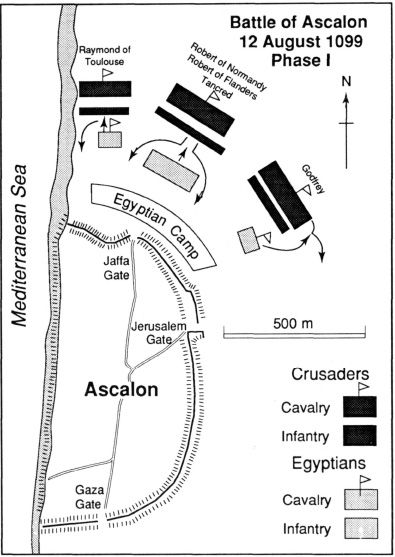
Fig. 18a Battle of Ascalon, 12 August 1099. Phase I
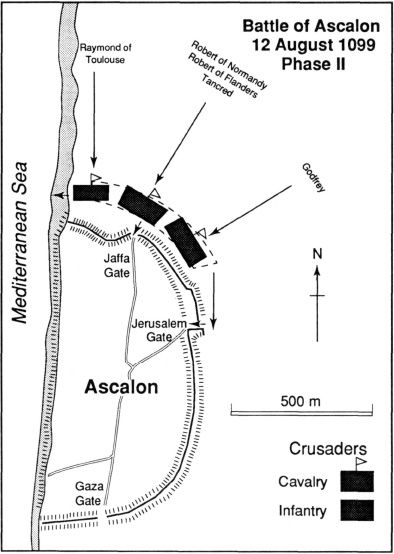
Fig. 18b Battle of Ascalon, 12 August 1099. Phase II
As the crusaders approached the enemy camp they deployed into line of battle, with Raymond of Toulouse on the right by the sea, Godfrey on the left and the others including Robert of Normandy, Robert of Flanders and Tancred, in the centre. The archers and foot were thrown forward of the knights to protect them. Albert of Aix says that Godfrey’s force blockaded the gates of Ascalon to prevent the enemy sallying forth. This probably means that the army was not aligned west-east from the coast but west-south-east, shadowing the curve of the northern wall of the city and so keeping its principal gate in view. The formation of the army reflected all that they had learned about the need to use infantry and cavalry together.85 Raymond of Aguilers gives no real description of the battle, but he says that the enemy stayed in their camp; this is not borne out by other sources and appears to mean that they were there at first. The Anonymous, who gives a mere sketch of events, says that Tancred charged into the midst of the enemy tents and Albert speaks of fighting in the camp. All of this points to the enemy being surprised in their camp and having to fight an improvised battle, and this is certainly Raymond of Aguilers’s understanding, for he says that the enemy were over-confident because they had information that the Franks were few, and believed that those in their proximity were just raiders. In any case, he adds, the enemy had consulted soothsayers who had for the moment advised against an attack. This impression of a surprise is strongly confirmed by the Damascus Chronicle, which says that al-Afdal was still awaiting forces when he was attacked.86 Fulcher of Chartes says, however, that the enemy took the initiative and attacked in a stag-horn formation with infantry forming a solid centre and cavalry on the wings. A group of light Arab cavalry detached itself from the enemy right and swung round into the crusader rear, but they were driven off by Godfrey. Albert gives a vivid description of an enemy attack in the centre to the sound of drums and trumpets. Under a hail of missiles the Azoparts, as the Ethiopians were called, crashed into the crusader line wielding their war-flails which smashed horse and man regardless of armour. They were supported by archers, slingers and spearmen from various races in what seems to have been a savage battle. Albert says that it lasted the greater part of the day, although the impression given by the other sources suggests a much briefer battle, and that as the enemy attack flagged, so the crusaders charged.87 It was evidently this crusader charge into the enemy camp which decided the battle, for it is the main feature of the descriptions. The Anonymous reports that Robert of Normandy charged at and captured the enemy’s standard and after that the enemy melted away, while Fulcher and Raymond of Aguilers say that resistance collapsed once the enemy camp was taken. Albert says that many of the crusaders started to pillage in the camp, and this allowed the enemy to rally and counter-attack until Godfrey came up and drove them off. In the pursuit which followed some of the enemy fled towards the port and were massacred by Count Raymond’s men, while others were simply confused and cut down where they stood, and some who climbed palm trees were shot out of them. A large part of the enemy army tried to take refuge in Ascalon and were crushed in the gate of the city. For their part the crusaders rejoiced in a vast booty (see fig. 18b).88 The army of al-Afdal seems to have been badly surprised by the appearance of the crusaders. He sent forward his infantry, presumably because they took less time to prepare for battle, supported by some light horse. However, Arab sources stress that much of the Fatimid army, and in particular the heavy cavalry, never came to battle. The initial charge of the Fatimid infantry was blunted by the Frankish infantry, then it wavered and was scattered by the Frankish knights who fell upon the enemy’s heavy cavalry which was as yet unready for battle. Fatimid armies could fight very well, and indeed at Ramla on 17 May 1102 would inflict a heavy defeat upon the Franks. On this occasion they were caught by surprise and destroyed by an enemy inferior in numbers.89 Surprise, speed of movement and sheer boldness in attacking a huge enemy force were the causes of the crusader victory. The third enemy had been defeated and the Franks rejoiced in God’s favour with masses in the Holy Sepulchre, to which was given the enemy commander’s silver standard as a token of victory.
The sequel was as sour as that to the triumphant capture of Jerusalem. After the celebrations at Jerusalem Raymond of Toulouse negotiated for the surrender of Ascalon which was completely demoralised as the Arab sources admit. Raymond used Bohemond the converted Turk who is first mentioned during the siege of Antioch. Godfrey was determined that he and not Count Raymond should hold the city, and when the quarrel between the two Frankish leaders became known to the citizens they refused to surrender. Ascalon remained a thorn in the side of the Franks until 1153. Albert accuses Count Raymond of having sabotaged Godfrey’s arrangements for the surrender in a spirit of vengeance. However that may be, such divisions and the passage of time stiffened the resolve of the citizens.90 Shortly after, Raymond of Toulouse attacked Arsuf, but abandoned the siege when he heard that Godfrey was approaching and joined the other leaders who were gathering near Caeserea for the return home. So angry was Godfrey that he was prepared to attack the Provençals, but in the end he was dissuaded, there was a reconciliation and towards the end of August Count Raymond, the two Roberts and their armies left Godfrey and marched north.91 The returning army reached Laodicea where they discovered that Bohemond had enlisted the aid of Daimbert archbishop of Pisa, the new Papal Legate in the east who was supported by a great fleet, in an effort to seize the city from the Greeks In the event Daimbert was persuaded to desist and Bohemond was forced to return to Antioch. Raymond of Toulouse took possession of the citadel of Byzantine Laodicea and the rest of the army sailed for the west on Greek and other ships.92 It was on this sour note of personal ambition and internecine quarrels which had dogged the crusade, but never quite undermined its military effectiveness, that the great adventure ended.
1 See above, pp. 252–3.
2 Ekkehard, pp. 171–2; HBS, pp. 214–15.
3 It is interesting that RA, p. 110, accuses the Egyptians of negotiating with the Turks as well and shows a real knowledge of the importance of the line of descent from the Prophet in the disputes of Islam.
4 RA, pp. 109–10; HBS, pp. 181, 189–90, 212–215; AA, 379, 463; Köhler, Allianzen und Verträge, pp. 67–8 argues that, once al-Afdal knew that Alexius had turned against the crusaders, they lost all credibility in his eyes and hence were made only a very limited offer. However, it seems to the present writer that he would have known, for some time, the kind of people with whom he was dealing and simply overplayed his hand.
5 See below, p. 358.
6 See below, pp. 329–30, 357–61.
7 A. S. Ehrenkreutz, ‘The place of Saladin in the naval history of the Mediterranean sea in the Middle Ages’, Journal of the American Oriental Society, 75 (1955), 100, says that, at this time, Egypt was the ‘strongest naval power in the Mediterranean’ but Y. Lev, ‘The Fatimid navy, Byzantium and the Mediterranean sea 909–1036’, Byzantion, 54 (1984), 220–52, doubts if it was ever so powerful and draws attention to the rise of Byzantine naval power in the early eleventh century. A. R. Lewis, Naval Power and Trade in the Mediterranean, pp. 225–49, sees the late eleventh century as a period of decline. In fact, Byzantine naval power could hardly have been on the increase after 1071 and Alexius’s hold on Cyprus must have been strengthened by friendship with Egypt. M. Lombard, ‘Un problème cartographié, le bois dans la mediterranée musulmane’, Annales Économies, Sociétés, Civilisations, 14 (1959), 54, points out that the Egyptian navy suffered from a shortage of timber because of depletion of resources in North Africa and the Middle East, and had long been importing from Europe. It seems likely that, because of this, they were anxious to hold on to Lebanon with its forested mountains.
8 RA, p. 134; on the Maronites see Hamilton, The Latin Church in the Crusader States, pp. 207–8; on fleets see above pp. 209–20.
9 RA, pp. 107, 117.
10 GF, p. 86; AA, 407–8; I understand that a new book The Laws of War on the Crusades and in the Latin East 1095–1193 by W. G. Zajac will discuss prisoner exchange.
11 GF, p. 86; RA, p. 135; AA, 457–8; J. France, ‘The text of the account of the capture of Jerusalem in the Ripoll manuscript, Bibliothèque nationale latin 5132’, English Historical Review, 103 (1988), 645–6.
12 AA, 458–60; RA, p. 141; FC, p. 115; AA suggests that when they were at Acre they discussed the three possible routes, via Damascus, the Jordan valley or the coast at Acre. The first of these was geographically impossible as a route to Jerusalem by that time. However, it is possible that at Acre they considered the route into the Jezreel Valley and down to Jerusalem via Nablus, and that AA’s informants simply confused this with an earlier discussion in the vicinity of ‘Akkār/Tripoli which, RA says, considered the route via Damascus, on which see above p. 317.
13 I. Roll, ‘The Roman road system in Judaea’, The Jerusalem Cathedra, 3 (1983), 137–61; on the battle of Ascalon see below pp. 360–1.
14 GF, p. 87; RA, pp. 136–7, 125–6; FC, p. 115; AA, 460–1. Köhler, Allianzen und Verträge, p. 68 suggests that this idea of an attack on Egypt arose from the long negotiations conducted with al-Afdal. During his persecution of Christians in 1009/10 the Caliph Al-Hakim bi-Amr Allah (996–1021) ordered the destruction of the shrine of St George as Glaber, pp. 132–5, noted at the time.
15 FC, p. 115; on the approach to Jerusalem see J. Prawer, ‘The Jerusalem the crusaders captured: contribution to the medieval topography of the city,’ in P. Edbury, ed., Crusade and Settlement in the Latin East (Cardiff, 1985), p. 5, who acknowledges his debt to C. Shick, ‘Studien über Strassen- und Eisenbahn Anlagen zwischen Jaffa und Jerusalem’, Mitteilungen aus Justus Perthes geographischer Anstalt von A. Petermann (Gotha, 1867), pp. xiii, 124–32. The ancient road from Ramla passed north-eastwards through the Latrun area on the edge of the Judean hills (where the crusaders later built an important castle) and followed something like the present track between Beit Liqya and Beit I’nan, to approach Jerusalem via Qubeiba and Nabi Samwil. This is well to the north of the dramatic gorges which carry the modern Tel Aviv-Jerusalem road along which the twisted remains of vehicles destroyed in the 1948 war are still to be found. Even so, the hills are pretty forbidding and excellent for ambushes.
16 RA, p. 138; Hill and Hill, Raymond IV, p. 129, doubt the truth of Raymond of Aguilers’ statement.
17 PT, p. 50; RA, pp. 145–6; GF, p. 92.
18 Riley-Smith, Idea of Crusading, p. 79.
19 RA, p. 112; AA, 470.
20 FC, p. 122; AA, 482–83; RC, 699–703.
21 RA, pp. 107, 137, 143; FC, p. 122; GF, pp. 91–2; Nicholson, Tancred, pp. 96–8.
22 J. France, ‘The election and title of Godfrey de Bouillon’, Canadian Journal of History, 18 (1983), 321–30. For a different view of these events see A. V. Murray, ‘The title of Godfrey de Bouillon as ruler of Jerusalem’, Collegium Medievale, 3 (1990), 163–78.
23 France, ‘Election of Godfrey de Bouillon’, 321–30.
24 RA, pp. 152–3, 155; AA, 497–8.
25 RA, pp. 130, 136–7; AA, 463.
26 RA, pp. 139, 143–5, 151; RC, 685; GF, p. 91.
27 RA, pp. 135–6; on carrier pigeons see the extract from Abu-Shama, Kitab al-Ravdatayn in Lewis, Islam from Mohammed to the Capture of Constantinople, 1. 223–4.
28 On relations with the cities, see above, p. 329; France, ‘The capture of Jerusalem’, 640–57; RA, pp. 135–6, 141.
29 Damascus Chronicle of the Crusades, p. 45; Ibn al-Athir, 197; RA, pp. 110, 136–7; AA, 380, 463–4.
30 AA, 473.
31 FC, p. 121; AA, 463, 477; on the Patriarch see above, p. 209; Runicman, 1. 280, n. 1; WT, 373; H. Dajani-Shekeel, ‘Natives and Franks in Palestine’, in M. Gervers and R. J. Bikhazi, eds., Conversion and Continuity: Indigenous Christian Communities in the Islamic Lands (Toronto, 1990), p. 166; S. D. Goitein, ‘Contemporary letters on the capture of Jerusalem by the Crusaders’, Journal of Jewish Studies, 3 (1952), 162–77, ‘Geniza sources from the crusader period: a survey’, in B. Z. Kedar, H. E. Meyer and R. C. Smail, eds., Outremer: Studies in the History of the Crusading Kingdom of Jersualem presented to Joshua Prawer (Jerusalem, 1982), pp. 161–84.
32 As late as the nineteenth century, Jersualem in summer suffered from a terrible water-shortage and families had to exist on one or two goat-skins per week. The Pool of Siloa and its source, the springs of Gihon, remained important for the water supply of the city and the discoverers of Hezekiah’s tunnel noted that the spring sent out only a small continuous flow with a surge at intervals of four to ten hours: M. Gilbert, Jerusalem, Rebirth of a City (1838–98) (London, 1985), pp. 4–5, 152. There is a reference to a late twelfth-century refurbishment of the structure under the Latin Kingdom: M. R. Morgan, La Continuation de Guillaume de Tyr (1184–1197) (Paris, 1982), pp. 22–3; AA, 462–3, 469–470, 472; RC, 691; RA, pp. 139–2; GF, p. 88; FG, pp. 119–20; France, ‘Capture of Jerusalem’, 644–5.
33 RA, pp. 137, 139; GF, pp. 88–9; RC, 690, 688–90; BD, 100; AA, 467–8.
34 GF, pp. 88–9; RA, pp. 141–2; AA, 468–9.
35 The description of Jerusalem which follows is based on that of Prawer, ‘The Jerusalem’, pp. 1–5, whose author ackowledges his debt to earlier researchers such as F. M. Abel, ‘L’état de la cité de Jérusalem au XII siècle’, in G. R. Ashbee, ed., Records of the Pro-Jerusalem Council (London, 1924); C. N. Johns, Palestine of the Crusaders (Jersualem, 1946); M. de Vogüé, Les Églises de la Terre Sainte (Paris, 1860). His careful account has been supplemented by my own observations and differences of view are noted. See also Y. Katzir, The conquests of Jerusalem in 1099 and 1187’, in V. Goss and C. C. Bornstein, eds., The Meeting of Two Worlds (Michigan, 1986), pp. 105–14.
36 As it is, the Ottoman salient is now totally dominated by the bulk of Notre Dame de France fifty metres across HaZanhanim.
37 Prawer, p. 5, believed that there was an outer wall as far as the Zion Gate but he relies here on RA, p. 148, ‘iam fractis antemuralibus et conpleto vallo, citissime murus interior peruaderetur’. The difficulty is that Raymond is describing the two assaults, from Mt Zion and from the North, as if they were one, so that the reference to an outer wall may be to that faced by the northern attack. An earlier mention, p. 139, in connection with the assault of 13 June, also refers to the northern part of the city. The Unknown account has no reference to an outer wall by Mt Zion, while the Anonymous speaks only of the filling in of the ditch and adds: ‘when it was full they took the siege-tower up to the wall’. My conclusion is that the Provençals faced a single wall with a moat outside it.
38 RA, p. 147; AA, 477; Prawer, ‘The Jerusalem’, p. 11; Hamblin, The Fatimid Army during the Crusades, pp. 64–5.
39 AA, 463–4, 468; Prawer, pp. 5–6 and fig. 1 accepts Albert’s account as describing a first stage of the siege; on the building of siege machinery see below pp. 346–8.
40 RC, 687; GF, p. 88; RA, p. 137; Prawer, pp. 5–7 accepts Albert’s description as giving an initial order of siege and places Godfrey east of the two Roberts. The Quadrangular Tower was later called ‘Tancred’s Tower’ but this was not because he had taken position outside it, but because, as RC, 701 makes clear, he later controlled it for a while.
41 RA, p. 138; AA, 463–4; Both mention the move though only Raymond mentions resistance. GF, p. 87 and RC, 687 say that Raymond besieged the city from Mt Zion without mentioning any prior position.
42 France, ‘Capture of Jerusalem’, 644–5; RA, pp. 145–6, 153.
43 RA, p. 139; RC, 685, 688.
44 GF, p. 88; RA, p. 139; RC, 688–9; AA, P. 467; PT, P. 103; Prawer, ‘The Jerusalem’, pp. 7–9, believes that the point of attack can be identified as close to the present New Gate, but this depends on his mistaken notion of where Tancred was, on which see above p. 344, n. 40. I would suggest that the attack was somewhat to the east, on level ground towards the Damascus Gate. See fig. 17b.
45 On William see F. Cardini, ‘Profilo d’un crociato, Guglielno Embriaco’, Archivio Storico Italiano, 136 (1978), 417–18.
46 Rogers, Latin Siege Warfare, p. 133, thinks that a staged tower would probably have been as strong as one built using massive single corner posts, but RC, 692 indicates very clearly that the structure nearly failed. Perhaps the workmanship was not very good.
47 AA, 467–70; RC, 689–91; RA, p. 146; France, ‘Capture of Jerusalem’, 645.
48 RA, pp. 144–5; GF, p. 90; for the reconciliation of Tancred and Raymond see above p. 331; BD, 100–1 says the clergy urged the virtue of dying where Christ had died, on which see H. E. J. Cowdrey, ‘Martyrdom and the First Crusade’, in P. Edbury, ed., Crusade and Settlement in the Latin East (Cardiff, 1985), p. 51.
49 AA, 468; RA, p. 146; for the raid see above, p. 347; Nablus, some fifty-four kilometres north of Jerusalem, seems to have marked the extreme range of their ravaging around Jerusalem.
50 On the location of Godfrey’s camp and the building of the assault tower there see above PP. 343–4, n.40.
51 RA, p. 147; RC, 690; AA, 471.
52 GF, p. 90; RA, p. 147; Prawer, ‘The Jerusalem’, cites the twelfth century Cambrai map.
53 Prawer, p. 11, says quite accurately that the Wadi is evident in the Ratner Garden about one hundred metres east of Herod’s Gate, but then suggests that the attack took place in this area ‘sixty-five metres between the second tower east of Herod’s Gate and the first salient square in the wall beyond it’. In fact between this tower and the salient is only about seventeen metres. The Ottoman salient was probably built to cover just this weak spot, which is where, I believe, the attack took place.
54 AA, 472.
55 AA, 471–2; RC, 691–2; Prawer, ‘The Jerusalem’, p. 10.
56 Prawer, p. 10.
57 For a description of twelfth-century Islamic siege weapons see the extract from al-Tarsusi in Lewis, Islam from Mohammed to the Capture of Constantinople, 1. 218–23.
58 Prawer, ‘The Jerusalem’, p. 10; RC, 691; AA, 474–5.
59 AA, 476–7; RA, p. 150.
60 RA, p. 150; in their translation Hill and Hill, p. 127, suggest the rendering ‘Godfrey lowered the drawbridge which had defended the tower’. However, the circumstantial accounts of Albert and Ralph suggest something improvised, and the sense in Raymond of something which protected the tower in the middle and upper stories suggests to me that Godfrey hacked off some of the reinforcing across the front of the tower, which would necessarily have been given more than the other sides, and so crossed the gap. In this, I follow the suggestion of Prawer, ‘The Jerusalem’, p. 10, n. 52.
61 Ibn al-Athir, 197; Damascus Chronicle of the Crusades, p. 47; Michael, p. 184; Matthew, 45; Bar-Hebraeus, p. 235.
62 France, ‘Capture of Jerusalem’, 644–6; RA, pp. 148–51; AA, 475;, PT, p. 118. This was perhaps Greek fire on which see above p. 162, n. 58.
63 RA, p. 149 says that a knight waved from the Mt of Olives as Godfrey’s force penetrated the city and this is expanded by PT p. 109 and others.
64 AA, 478; RC, 694; RA, pp. 147, gives a figure of 60,000 for the garrison, but this is nonsense, p. 151.
65 Ibn al-Athir, 197; Maalouf, Crusades through Arab Eyes, pp. iii, 50; Goitein, ‘Geniza sources’, pp. 308–11, 313; RC, 696–7.
66 Matthew, 108, 152–4; Bar Hebraeus, pp. 212–13; Michael, p. 158–9.
67 Douglas, William the Conqueror, p. 368; OV, 2. 233; on military ethics in the west see above pp. 41–4.
68 RA, pp. 151–2; GF, p. 91; AA, 482–3.
69 AA, 477, 479, 481–2.
70 AA, 483–4.
71 AA, 485–6; RA, pp. 152–3; GF, p. 92; on the general circumstances see France, ‘Election of Godfrey de Bouillon’; Riley-Smith, ‘The title of Godfrey de Bouillon’, 83–6 inclines to the idea of a kingship as does Murray, ‘Title of Godfrey de Bouillon’ (see above p. 332, n. 22) but it still seems to the present writer that if Godfrey had been made a king the contemporary sources would not have been so evasive in the way they describe him; on Tancred see above pp. 331, 347; on Arnulf see Foreville, ‘Arnoul Malecouronne’.
72 On Egyptian determination to recover control in this area see Köhler, Allianzen und Verträge, pp. 60–2.
73 Encyclopaedia of Islam 1. ‘al-Afdal’, ‘Badr al-Jamali’; AA, 484–5, 490; Ekkehard, 4; Köhler, Allianzen und Verträge, p. 67, points to Islamic evidence of an ambassador sent to the Franks just before the battle of Ascalon on 12 August 1099. On the history of crusader contacts with Egypt see above, pp. 252–3, 325–6; RA, p. 110.
74 Hamblin, Fatimid Army, p. 225, which is the main source for the description of the Egyptian army which follows. See also Lev, Slate and Society in Fatimid Egypt, and his article, ‘Army, regime and society in Fatimid Egypt’, International Journal of Middle East Studies, 19 (1987), 337–66; B. S. Bachrach, ‘African military slaves in the medieval Middle east: Iraq (869–951) and Egypt (868–1171)’, International Journal of Middle Eastern Studies, 13 (1981), 471–95; B. S. Beshir, The Fatamid Caliphate 975–1094, Ph.D thesis, University of London, 1970, ‘Fatamid military organisation’, Der Islam, 55. 1 (1978), 37–56; C. E. Bosworth, ‘Turks in the Islamic lands up to the mid-eleventh century’, Fundamenta Philologiae Turcicae, Part 2, Les Turcs muslmans avant les Ottomans (Wiesbaden, 1970), pp. 1–20, ‘Recruitment, muster and review’, 60–77 esp. 66–7; D. O. Leary, Short History of the Fatamid Caliphate (London, 1923).
75 Lev, State and Society in Fatimid Egypt, points out that black slaves were prominent from the time of al-Hakim (996–1021), pp. 88–9; Naser-e Khosraw, Book of Travels, pp. 48–50; this extract is also printed by Lewis, Islam from Mohammed to the Capture of Constantinople, 1. 217–18.
76 AA, 490, refers to Ethiopians, 494, Azoparts with their terrible flails.
77 On their effective hit and run tactics and on the role of heavy slave infantry recruited from Africa see M. Brett, ‘Military interest of the battle of Haydaran’, pp. 78–88.
78 Damascus Chronicle of the Crusades, pp. 48–9; Ibn al-Athir, 198; al-Dhahabi cited Hamblin, Fatimid Army, p. 238 gives 20,000.
79 RC, 699–703; GF, p. 93.
80 AA, 490–1.
81 GF, p. 94; RA, pp. 154–5; AA, 491.
82 GF, p. 94; RA, pp. 156–7; FC, p. 126; AA, 491–2.
83 RA, p. 157; AA, 492.
84 For a good summary description of the site with an excellent bibliography see D. Pringle, ‘King Richard I and the walls of Ascalon’, Palestine Exploration (Quarterly, 116 (1984), 133–47. A key work in the history of the site’s exploration is C. R. Conder and H. H. Kitchener, The Survey of Western Palestine, 4 vols. (London, 1883), 3. 236–47. Today the ruins of Ascalon lie to the south of the modern city of that name and form a huge archaeological park. The visible remains bear witness to the reconstructions of Richard I, destroyed by treaty in 1192, and the later work of Richard of Cornwall, but the main enceinte clearly shows the fortified area faced by the crusade in 1099.
85 GF, p. 95; RA, p. 157; FC, p. 126; AA, 493–4.
86 RA, p. 157; GF, p. 95; AA, 495–6; Damascus Chronicle of the Crusades, p. 48.
87 FC, pp. 126–7; AA, 494–6.
88 GF, pp. 96–7; FC p. 127; RA, p. 158; AA, 495–6.
89 Ibn Khaldun 4.42; Ibn al-Athir, 286; Hamblin, Fatimid Army, pp. 244–8.
90 RA, p. 159; AA, 497–8; BD, 111; Runciman 2. 339.
91 AA, 498–9.
92 AA, 500–1; on Daimbert and his position as a Legate see B. Hamilton, The Latin Church, p. 14.