
CHAPTER 4
Urban II launched his appeal for an expedition to the east at Clermont in November 1095 and in a calculated campaign aimed primarily at the nobility and knighthood undertook a great journey through western and southern France. In other areas he relied on bishops and enthusiastic preachers to spread the word. We know very little about the mechanics of this process, and only rarely do we have insight into the reasons why and how individuals took the cross. Raymond of Toulouse, the first major layman to take the cross, seems to have conferred with Urban before Clermont. Indeed, William of Malmesbury was later to write erroneously, that he persuaded Urban to launch the expedition.1 The general reasons which we have already noted as underlying crusading enthusiasm applied to the leaders as much as to anyone else, but we know enough about them as individuals to be able to speculate intelligently. Robert Curthose faced a difficult political situation in 1095, for his brother William Rufus wanted the whole inheritance of the Conqueror and could bring great resources to bear to this end. Robert was an able soldier – he had once captured Brionne, a castle which occupied the Conqueror for three years, ‘between the ninth hour [3pm] and sunset’, but he lacked self-discipline and liked the pleasures of life – ‘to sleep under a roof’. According to the hostile Ordericus it was because of the weakness of his position that: Tearing still worse to come since everyone had abandoned him, he resolved on the advice of certain men of religion to hand over the administration of his duchy to his brother and, himself taking the cross, to go on pilgrimage to Jerusalem to make amends to God for his sins’.2 Robert lacked the grasping drive of his father and brothers, but his valour and personal geniality made him the most attractive of the Conqueror’s sons. Stephen of Blois and Robert of Flanders chose to accompany him on the march south from Normandy while his own large army included a number of erstwhile enemies like Stephen, count of Aumale.3 But Robert was seeking refuge from his political troubles and although he would show great valour, would display also his notorious laziness on the crusade.
Godfrey de Bouillon may well have felt that his future lay behind him. His family lands were not vast and his hold on them was challenged by Albert of Namur and Mathilda, countess of Tuscany, the widow of Geoffrey the Hunchback. The duchy of Lorraine which had been conferred on him by Henry IV in 1087 was ‘an empty dignity’. The Investiture Contest placed him in an unenviable position – he was the enemy of the papal ally, Mathilda, but in Lorraine had failed to support Henry IV’s champion Otbert bishop of Liège, for local reasons.4 He may well have felt that the crusade offered him a possible escape from the frustrations of his position in Germany, though it is unlikely that he swore an oath never to return, as later tradition asserts. His decision to support an initiative by Henry IV’s enemy, Pope Urban, was a great triumph for the reform papacy. His near-neighbour, Robert of Flanders, held a truly great and rich fief. His father Robert the Frisian (1071–93) had gone on pilgrimage to the Holy Land in the years 1086–9. It was probably while returning from Jerusalem in 1089 that he arrived at Constantinople and there was asked by Alexius I for military assistance in the form of 500 cavalry, which probably arrived in the spring of 1091. Alexius wrote a letter to Robert, probably in 1090, reminding him of his promise, and this was later transformed into crusading propaganda.5 This family connection goes some way towards explaining his decision to go.
It was probably a family conference which decided the only crusader with royal blood, Hugh of Vermandois, often referred to in the crusading sources as Hugh Magnus, to take the cross. The house of Capet was embarrassed by the success of Urban’s appeal, for King Philip was excommunicate because of his marriage 10 Bertrada of Montfort. A meeting of the Capetians and their leading nobles was held in February 1096 and in July the king wrote a letter to Urban at Nîmes, announcing the participation of his younger brother, Hugh of Vermandois, and his own submission to the pope’s judgement on his marriage.6
According to the anonymous author of the Gesta Francorum, Bohemond heard of the crusade only in September 1096 when Frankish forces (which are not identified) began to move through Italy and he was at the siege of Amalfi with his uncle Roger of Sicily and his half-brother Roger Borsa. Thus inspired, he cut his most valuable cloak into crosses which he gave to those who would follow him with the result that the besieging army melted away. It is unlikely that Bohemond had remained so long in ignorance of a major papal initiative. He was a rear-vassal of Pope Urban, whom he had received at Bari in 1089 and again at Taranto in 1092. They had met at Anglona in 1092 and again at Monte Cassino in 1093.7 The scene at Amalfi was a coup de theatre staged by Bohemond in a setting, an important siege, which would enable him to find recruits. There can be little doubt that the great expedition offered Bohemond an outlet for his adventurous temperament and military talents. He outshone his half-brother Roger Borsa easily, but Roger of Sicily’s formidable power meant that further expansion at Borsa’s expense was out of the question. The Normans of the south must have had a very different perspective on Urban’s expedition. The Byzantine east was a close and familiar neighbour. Unsuccessful Norman rebels commonly fled to the Byzantine lands – amongst them William of Grantmesnil, a brother-in-law of Roger, who fled there in 1094. Norman-Italians, as we have seen, often took service in the East: Bohemond’s own half-brother Guy was in imperial service at the time of the First Crusade.8 So for Bohemond here was an opportunity and if things did not turn out well he could return as many others had done before. It was a different perspective from that of the northerners for whom the east was less familiar.
Of Stephen of Blois’s reasons for going on crusade we know very little. His family were very important princes on a par with the dukes of Normandy and the counts of Anjou. Reputedly one of the richest lords in France, Stephen was evidently fairly experienced in contemporary war and politics but he lived much of his life under the shadow of his great father. One of the few things we know about him is that he married Adela, the daughter of the Conqueror, and a letter he sent to her while on crusade suggests that he was frightened of her, hence the idea that it was she who made him join the crusade from which he would defect.9 Eustace of Boulogne was the elder brother of Godfrey, yet his role on the crusade was so subdued that we are not even sure with whom he travelled to the east.10 It is worth noting that Robert of Flanders and Stephen had only just emerged as rulers in their own right and so they may have seen the crusade as a chance to assert themselves.11 The leaders of this northern group of crusaders were closely interrelated. Stephen of Blois married Adela, Robert Curthose’s sister whose mother was Mathilda, the aunt of Robert of Flanders. Robert’s grandmother was Adela, aunt of Hugh of Vermandois. The house of Boulogne, Eustace III, Godfrey and their brother Baldwin stood outside this immediate kin-group, but Eustace was a vassal of the English king and the count of Flanders, while Baldwin had married Godehilda of the great Norman house of Tosny.12 Only two major lay crusaders came from outside this tight-knit group from the north of France – Raymond of Toulouse, and Bohemond. As his second wife, Raymond had taken Mathilda, daughter of Count Roger of Sicily, a cousin of Bohemond, but she seems to have been replaced by 1094.13 On the face of it Bohemond was the most far removed of the leaders, but he was a Norman. His half-brother, Roger Borsa, married Robert of Flander’s sister and widow of Cnut II of Denmark (1080–86), Adela.14 Raymond of Toulouse was the most isolated, though he appears to have had a big army. He worked in close alliance with Adhémar of Le Puy, the Papal Legate, until his death in 1098, but he appears to have been unloved by the other leaders. These two men, Raymond and Bohemond, were to exercise great influence on the crusade. It is a reflection of this and the very different perceptions of their motives that the gossipy monk, William of Malmesbury, tells us that Bohemond persuaded Urban to call the crusade as a cloak for his ambitions on Byzantium, while Raymond and his ally the bishop of Querci persuaded Urban to the same end to provide them with a worthy spiritual exercise.15 This group of major leaders – the ‘Princes’ as the sources call them – were experienced men, almost all of whom had participated in war and knew its demands. Of them all only Bohemond, and to a lesser extent Robert Curthose, had experience of commanding large military forces, though Godfrey had served in great expeditions as a subordinate. Bohemond alone had experience of eastern affairs and had commanded a big army in a major campaign and in open battle. Once they had agreed to go on crusade the princes, like the other participants, needed to find money.
A peace was arranged between Robert Curthose and his brother William Rufus by the papal legate, abbot Jarento of St Bénigne. Robert agreed to pawn the duchy of Normandy to his brother for 10,000 marks, which would have to be repaid over three or five years. The collection of such a sum necessitated a levy of four shillings on the hide in England where the barons and bishops resorted to extreme measures to collect it.16 Godfrey’s preparations were complex and on a smaller scale. To bishop Richer of Verdun Godfrey sold his claims to the county of Verdun together with Mosay, Stenay and castle Falkenstein, all for silver and gold, while properties at Genappe and Baisy went to a nunnery at Nivelles. Some minor holdings near Maastricht were sold or given to the church, but he was forced to retract his dissolution of the priory of St Peter at Bouillon which belonged to the abbey of St Hubert through the intervention of his mother. He extorted 500 pieces of silver each from the Jewish communities of Cologne and Mainz. Against his county of Bouillon he borrowed from Bishop Otbert of Liège the sum of 1,300 silver marks and three marks of gold; the debt was redeemable by him if he returned or by his brother if he did not. The collection of such a sum caused Otbert considerable difficulties.17 It has often been suggested that Godfrey swore to stay in the east, but this is later legend. He retained the option of redeeming the mortgage on Bouillon and was careful to ask his overlord, the Emperor Henry IV, for permission to leave the realm. He kept his title of duke of Lower Lorraine and was not replaced until after his death.18 Stephen of Blois, in a letter to his wife written at Antioch, speaks of the ‘gold silver and other riches’ with which he left the west though nothing is known of how he raised the money and Hugh of Vermandois’s preparations are similarly obscure.19 Bohemond gave considerable financial support to his nephew Tancred and it is likely that his army was well-disciplined precisely because it relied on his great resources, but there is no record of sales or gifts except for a charter empowering Guidelmus Flammengus, his captain at Bari, to sell or dispose of his property in the area.20 Robert of Flanders was rich enough to decline financial help from Roger Borsa.21Throughout the crusade Raymond of Toulouse would show clear evidence of financial resources on a scale quite different from the other leaders, and the source of this wealth has generated much interest and controversy amongst historians. A number of gifts to churches made on the eve of his departure for the East may represent disguised sales. He probably passed the county of Rouergue to Richard of Millau in return for cash but the evidence for this is not totally clear. Southern French society was enjoying a great prosperity at this time as cities and a money economy grew. Mints can be traced in many of the cities of the south: indeed the visionary, Peter Bartholemew, was to direct that a church should be built near Aries to house the Holy Lance, and that a mint should be established there for its support. It is worth noting that Raymond of Aguilers lists seven coinages used in the army. Of these, four came from Southern France (Poitou, Valence, Melgueil and Le Puy), two from France north of the Loire (Le Mans and Chartres), one from Italy (Lucca). This suggests that the count of Toulouse ruled over a rich society and was perhaps able to finance his crusade from revenue without pledging major assets.22 We really have no evidence upon which to base a decision on the matter. It is possible that Count Raymond was just vastly richer than any other leader, but it is more likely that his wealth was generated by political arrangements in the east.23
The activities of the great as they raised money were mirrored by lesser crusaders who equally sold claims and rights, lands and dues, to finance their long journey. Evidence of only a fraction of this activity has survived but a substantial number of cases have been unearthed and here one may stand for all, Achard of Montmerle, a Burgundian who mortgaged his properties to Cluny:
because I wish fully armed to join in the magnificent expedition of the Christian people seeking for God to fight their way to Jerusalem … I give in mortgage to these eminent men one of the properties which came to me by right of inheritance from my father, receiving from them the sum of 2,000 solidi of Lyons and four mules … no person … can redeem it except myself. Thus if I die in the pilgrimage to Jerusalem, or if I should decide to stay in those parts, that which is the subject of this mortgage … shall become a rightful and hereditary possession of the monastery of Cluny in perpetuity.24
This sale, or some variant, seems to have been common and we hear also of lords taxing their dependents. Many means of raising money had been used by pilgrims. In 1088 Aimeric II, count of Fézensac, sold some windmills to the canons of Auch to finance his pilgrimage but with the rider ‘if I come back alive from Jerusalem I can have them back until my death’. Such methods of finance, along with levies on tenants which became customary feudal dues in some parts of France, are frequent in the sources for the eleventh century and later.
A modern estimate suggests that a pilgrim to Jerusalem needed to consecrate at least a year’s income to this purpose.25 It is more difficult to estimate the cost of crusading. Money was needed not merely for subsistence, travel, servants and equipment, but also for political purposes. The princes and the lords were masters of men and wealth was necessary to maintain this status on the journey. The princes knew that they would be surrounded by multilayered entourages, ranging from their personal retinues to any poor pilgrims they might choose to maintain or who became their hangers-on. This was not unlike the general nature of the armies of the age, as we have noted, and it was also the natural consequence of pilgrimage. In 1064 a group of important German clerics, the archbishop of Mainz and the bishops of Utrecht, Ratisbon and Bamberg, set off on pilgrimage to Jerusalem. A band estimated to have been some 7,000 strong gathered around them including people from all walks of life. When they were ambushed by brigands close to Jerusalem their sheer numbers enabled them to give a good account of themselves.26 There was a well-established tradition of mass pilgrimage, dating back at least to the vast crowds inspired to travel by the millennia of the Nativity and Passion of the Lord.27 Indeed, the preparations which were being made took place amongst people who must have been fairly knowledgeable about the route and its difficulties. Robert Curthose’s grandfather had died returning from the Holy Land in 1035, while the pilgrimage of Robert of Flanders’ father took place only a few years before Urban launched his crusade. The leaders knew about the difficulties of the journey and made their preparations accordingly. This was even true of that remarkable phenomenon which we call the ‘People’s Crusade’.
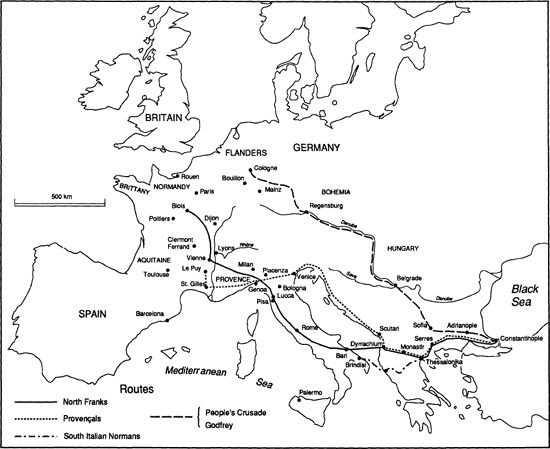
Fig. 1 The armies march to Constantinople
The title ‘People’s Crusade’ is something of a simplification. It was a remarkable phenomenon, for Urban clearly had in mind an expedition of nobles and knights. But the religious fervour of the eleventh century had infected a wide social range. The church had enlisted the people of the countryside into the ‘Peace Movement’ as a moral pressure upon the mighty. Peasants were amongst those who had responded to the ideas of hermits and popular preachers like Robert of Arbrissel who attempted to create for them a new religious order. We know little of Peter the Hermit but he seems to have been much the same kind of charismatic figure as Robert who, significantly, was commissioned by Urban to preach the crusade. So great was his skill that he touched off wild enthusiasm for the crusade, beginning in his own area of Berry and extending across all of France. So profound was his impact that later generations credited him with inventing the whole idea of liberating Jerusalem.28 This was not just a crusade of the lesser people which collapsed through lack of skill in arms and military leadership, for there were a considerable number of people of rank amongst them.29 We know of five major groups of people, all of whom left the west long before the date fixed by Urban II, 15 August 1096, for the gathering of the armies at Constantinople. Peter the Hermit quickly whipped up enormous excitement with his preaching in northern France and by early March 1096 he had dispatched a large force of foot-soldiers with only eight knights under Walter Sans Avoir. Their arrival in the Rhineland seems to have set off a savage wave of persecution and massacre of Jews driven by religious hatred and the desire to raise money. This phenomenon had its more genteel side in Godfrey’s extortion of money from his local Jews. Peter seems to have mistreated Jews in France, for they sent a letter warning their co-religionists of the danger; he would arrive at Trier in early April 1096, bearing letters from French Jews suggesting that support be provided for the crusaders. This is not the place to explore the roots of this bitter religious hatred. It does reveal, however, the underlying hatreds which drove on the crusaders, and their preoccupation with the sinews of war.30 The groups inspired by Peter the Hermit seem to have intended to use the classic pilgrim route across Hungary and so Walter marched to Cologne which he left on 15 April (see fig. 1). They crossed Hungary peacefully, entering on 21 May, but at the border with the Byzantine empire, on or about 11 June, they left sixteen men behind to buy arms in Semlin and these were set upon and mistreated. Once across into imperial territory problems multiplied, for they were refused a market at Belgrade, presumably because the empire was unprepared. After a fracas in which sixty pilgrims were killed, Walter and his army were well received by the imperial authorities and hastened on their way to Constantinople, where they arrived in mid-July 1096.31 Only a reasonably well organised and supplied army could have gone so far with so little trouble. Peter’s army, after menacing Jewish communities, left Cologne by 20 April and was at Semlin by 12 June.32 His force was much larger, and within it military command seems to have been vested in four captains; Godfrey Burel in charge of the infantry, Raynald of Broyes, Walter FitzWaleran and Fulcher of Chartres who joined Godfrey’s army later and would end as a major vassal in the county of Edessa. To these were joined some Germans.33 The presence of men of such status argues also for that of armed retinues and servants, who would have formed a strong core for the force. We know of no troubles in Hungary until the army reached Semlin where news of the beating of Walter’s sixteen men and rumours about Hungarian and imperial intentions led to an attack on the city between 5 and 12 June. This was evidently an organised affair, for Albert of Aachen speaks of knights in full armour leading the attack and the division of two hundred foot commanded by Burel breaking in first.34 After a further skirmish with imperial troops at a river crossing Peter’s army arrived at Nish on 27 June where the Byzantine governor, Nicetas, had withdrawn, abandoning Belgrade because of events at Semlin. He agreed to provide a market in return for guarantees and hostages and all went well until a dispute between a Bulgar merchant and some Germans led to the burning of some mills and Nicetas ordered an attack which captured many of the crusaders’ supplies and inflicted losses on the rearguard. Peter was a mile away at the head of the column of march, which suggests that his army was very large. He led them back to Nish to patch up a peace, but some 2,000 of his men got out of hand and attacked the city and though the rest remained in good order the massacre of their hot-headed colleagues drew them into a conflict at the end of which the army as a whole was scattered. Peter and his four captains rallied some 500 men, then gathered together 7,000 more, but Albert says they had originally had 40,000 and 2,000 wagons. He soon received messages from Alexius, his men gathered again and came on peacefully via Sofia (7 July), Philipopolis (modern Plovdiv) (13 July), Adrianople (modern Edirne) (22 July) to arrive at Constantinople on 1 August.35 Both these forces seem to have been well organised for they had crossed Hungary with little trouble and it was the inability of the Byzantines to procure supplies which caused the real trouble. Under pressure, however, the military organisation of Peter’s force had broken up – it was a bad omen for the future.
In early August a formidable army under the command of a Count Emicho arrived at the Hungarian border. He was a south German noble who was followed by Count Hartmann of Dillingen-Kybourg and a contingent of French, English and Lorrainers including William the Carpenter, viscount of Melun, Thomas of Marie lord of Coucy, and Drogo of Nesle. In May they massacred Jews at Spires and Mainz, but this was not a sign of their disorganisation, for when the Hungarian king forbade them passage through his lands they settled down to capture the border fortress of the Wieselburg with an army which Albert of Aachen says was 200,000 strong including 3,000 knights. This can only be an exaggeration, but Ekkehard agrees that it was formidable and the fact that the siege continued for three weeks before the Hungarian king eventually defeated them suggests good organisation. In the course of the siege the crusaders built a bridge which enabled them to attack the walls with a machine and were close to victory when a sudden panic enabled the Hungarians to win. The French leaders returned to France and joined Hugh of Vermandois in his journey to the east.36 The prohibition on crossing into Hungary by King Coloman I (1095–1114) was probably a result of the troubles caused by other crusading bands. Folkmar and his Saxons were probably involved in attacks on Jews at Prague on 30 May, but in late June they were broken up by the Hungarians because ‘sedition was incited’. Another group, led by a Rhineland priest Gottschalk, was 15,000 strong, according to Albert, and numbered as many knights as foot, but they took to pillaging and cruelty and the Hungarians massacred them in late July. Apparently they were quite well organised; after initial fighting, Coloman proposed a truce under which the crusaders gave up their arms. This enabled the Hungarians to massacre them, but presumably only a cohesive group would have actually surrendered in this way.37 These were probably not the only such groups which made up the People’s Crusade, for we hear of attacks on Jews at various times and places in the Rhineland which are hard to match with the suggested journey times of these known groups. As late as June and July 1095 there were a number of massacres of Jews north of the main departure areas at Neuss, Werelinghoven, Altenahr, Xanten and Moers. We do not know who was responsible for these any more than we know who the people were who were led on their journey by a goose and a goat.38 The departure of the People’s Crusade was a deeply confused affair and we may suspect that there were forces heading for the east of which we know nothing. The Hungarian king must have been thoroughly exasperated by their passage. This spontaneous gathering of forces also affected Italy, for Peter’s forces met with a large Italian contingent at Constantinople, but we know nothing of them or their journey.
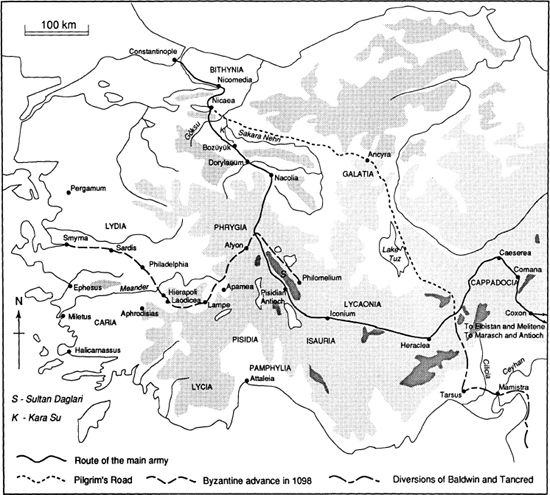
Fig. 2 The journey of the First Crusade across Asia Minor
Peter arrived at Constantinople on or about 1 August 1095 and was well received by Alexius. He advised that the crusaders should await the main armies now equipping in Western Europe, and shipped them all over into Asia Minor to a camp at Civitos (on the coast north of modern Altinova) on the southern shore of the Gulf of Nicomedia some fifty kilometres west of that city (now Izmit), where Albert makes it clear that ample supplies were provided (see fig. 2).39 Peter had charge of a significant military force, elements of which quickly began to tire of camp life and despite his prohibitions, to pillage. Nicaea, the capital of the Seljuk Turks, only lay some forty kilometres to the south down a steep road up the valley of the river Dracon (now Yalaç) and this acted as a magnet to would-be ravagers. A force of 7,000 foot and 300 knights was particularly successful in raiding this vicinity. A group of Germans and Italians of 3,000 foot and 200 knights, provoked by this example of Frankish daring, then attacked and seized Xerigordo, close to Nicaea, in late September and were massacred there by the Seljuks.40 Peter was at Constantinople asking for a reduction in food prices; presumably their level must have been a factor in these outbreaks. Walter Sans Avoir was now faced with demands for vengeance but he refused and most of the other captains of the army, Raynald de Broyes, Gautier de Breteuil and Fulcher of Orléans, supported him. However, Godfrey Burel, the leader of the infantry, disagreed and this crack in the front of authority enabled the popular clamour to succeed. An army of 25,000 foot and 500 knights sallied out to seek vengeance leaving behind only the women, children and the infirm. The Sultan Kilij Arslan’s forces were now well prepared and seeking the crusaders, who left camp on 21 October. They were organised in six groups, each formed around a banner. When they entered woodlands the Turks retired before them into the open plain at the edge of which they stood ready for battle. The westerners paused and sent forward the two groups of knights who were quickly encircled by Turks, who sent up a barrage of arrows and noise. The knights attacked, then recoiled towards the foot at the edge of the forest, and with their aid attacked again, but their horses were cut down by arrows so they were forced to fight on foot and were overwhelmed. Amongst the dead were Walter Sans Avoir and Raynald de Broyes, and when the survivors of the attack rejoined the main body its people took flight and were massacred.41 Peter’s camp soon fell and some 3,000 pilgrims sought refuge in an old fort which the enemy attacked, only to be driven off by imperial forces. Amongst the survivors it would seem that a large proportion were knights.42 The People’s Crusade had ended in tragedy, but not, it is worth saying, in farce. Albert of Aachen provides the only detailed account of events, but it shows an organised force which fought coherently until its élite, the 500 knights, were defeated. Obviously we cannot be certain of the numbers, but the Sultan was sufficiently alarmed to take the field himself at a time when he had other preoccupations. But if Peter’s army was much more than a mere rabble of poor men, it also lacked leadership. His charismatic figure sufficed to hold them together until there was trouble – in the Balkans accidental skirmishing, in Asia Minor rising prices. Even without him his captains knew military common sense when they saw it, but they were unable to present a united front. The failure of the People’s Crusade was a failure of authority – that was the contribution of the princes, who were assembling their forces in the West.
We have seen the princes gathering money, and we can guess that they were also providing themselves with supplies, like those carried in Peter the Hermit’s wagon-train which was captured by the Byzantines in the fighting near to Nish.43 But how did they conceive their military task – what had Urban communicated to them and suggested or commanded, and what did they know of the lands for which they were setting out, and what of their new enemies? Those who set off on the People’s Crusade obviously saw their task as the annihilation of the enemies of Christ – they began with the Jews, may have extended it to the Hungarians in some cases, and were certainly hell-bent on it in the east. For them the crusade was the realisation of the command of God, ‘vengeance is mine’ and they His instruments. That this attitude was shared by all on the crusade is self-evident – the great massacres, such as that at Jerusalem, are clear evidence, but not everyone extended the idea to Jews. The notion of vengeance was an integral part of Urban’s appeal and in a certain sense was the chief objective of the crusade.44 But in the minds of the princes, with their great responsibilities, means and methods must have loomed as large as goals. What could they have learned from Urban II? For Urban the new expedition was part of the wider struggle against Islam, and he would actively prevent Spanish Christians from joining the expedition. He most certainly announced that the goal of the whole expedition was the liberation of Jerusalem, as we have noted.45 He appointed Adhémar, bishop of Le Puy as Legate and leader ‘in our stead’ and he fixed a date for their departure, 15 August 1096.46 He established a political objective which conditioned the conduct of the crusade – assistance for the Christians of the east. In practical terms this meant, above all, assistance for the Byzantine emperor. One of the most striking facts about the early twelfth-century histories of the crusades is the persistence in their accounts of Urban’s speech, of references to the need to help the Greeks. This is remarkable precisely because the contact between Latin and Greek, generated by the crusade, led to bitter hostility to Byzantium in the West. Despite this, Christian fraternity, upon which Urban’s appeal was based, remained a powerful influence upon crusader behaviour towards the Greek empire.47 It must, therefore, have been a powerful element in Urban’s original impulse to the crusade and we may presume that behind it lay the objective, so explicitly stated by Gregory VII in 1074, of uniting the churches of east and west under the authority of the Holy See, in other words ‘that the union of the Latin and Greek churches was one of the impelling motives in the call for the First Crusade’. Adhémar’s carefully conciliatory attitude to the Orthodox patriarch of Antioch who was restored to authority in his city after the crusader conquest, appears to confirm this.48 Certainly the crusade came at the end of a long series of negotiations between Urban and Alexius on unity.49 However, although Urban had laid down what was effectively a political condition which the crusaders had to meet, he appears not to have suggested how this might be done. Urban left military preparation to the leaders under the guidance of Adhémar who, however, does not seem to have been given the authority of an overall military commander, despite his military experience.50
He went, perhaps, a little further than this. We may assume that it was Urban who informed the Byzantine emperor that he could expect important armies led by major leaders. He suggested that they gather at Constantinople. Conceivably he suggested that they should write to Alexius anouncing their coming, as some did.51 He certainly consulted with one of the leaders, Raymond of St Gilles, count of Toulouse, who had been the first to take the cross. The pope was in Raymond’s lands before Clermont and later was in his company in June and July of 1096 at a series of Councils in the Languedoc and Provence.52 It has been suggested that Raymond knew the mind of Urban, who had given him command of the entire expedition. Later he pursued a firm policy of friendship towards the Byzantine empire which we can presume was dear to Urban’s heart, but this is explicable in other terms for Raymond may have followed this line because he found it in his interests so to do. There is no firm indication of Raymond of St Gilles having been given any special position by Urban, and judging by the later efforts of the princes to resolve the question of leadership it is safe to conclude that he enjoyed no such eminence though it is important that he may have known Urban’s mind.53
In leaving the planning up to the crusader leaders, Urban was conforming to the dictates of common sense. He was not a soldier and the conditions of the day, and in particular the tight timetable which he had laid down, precluded any meeting with them to seek their advice or to hammer out a plan. Moreover, he must have known that he could count on a considerable knowledge of eastern affairs amongst the leaders and their advisers. One striking feature of the First Crusade, which will be explored later, was the participation of fleets whose naval aid was essential for the success of the expedition. Most notable were the fleets of Genoa, Pisa and the ‘English’, which seem to have attacked the coastline of North Syria even before the crusaders arrived. We do not have any evidence that any of the military leaders of the crusade, nor the pope, made specific plans with those in charge of these expeditions.54 It is remarkable that they should have materialised in the waters off Antioch at such a propitious moment. The Genoese expedition of thirteen ships perhaps tried to co-ordinate its departure with the movements of the crusaders, for Urban had dispatched a legation to Genoa led by Hugh, bishop of Grenoble, and the later crusader, William bishop of Orange. Raymond of Toulouse may have suggested this for he was later closely associated with the Genoese. It sailed in July 1097 by which time the main armies were deep into Asia Minor.55 The fact that it took until mid-November to arrive at Antioch suggests that it sought information about the armies en route, for this was a long sailing time: by comparison the French fleet on the Third Crusade left Messina on 30 March 1191 and arrived at Acre on 8 June, while in 1183, Ibn Djobair travelled from Ceuta to Alexandria in twenty days.56 The English fleet must have set off much earlier to have reached the coast near Antioch well before the arrival of the crusaders in October 1097. It is, however, difficult to see how all these groups could have co-ordinated their movements. After the seizure of Laodicea, the English seem to have had close relations with Robert of Normandy, but the sources make no mention of any discussions in the West and the term Angli, used of this fleet, group, may refer to the people, generally of the North Sea area. Another English fleet called at Lucca where it picked up a local citizen, Bruno, whose adventures were later described in a letter sent out by the people of Lucca.57 In fact, the Italians must have been very well informed about the eastern Mediterranean. The merchants of Venice, Amalfi and Bari traded with Constantinople and Antioch. Indeed, in 1087, sailors from Bari stole the relics of St Nicholas from Myra. Shipping in this age tended to cling to coasts, and the northern route to the east via the Gyclades and Asia Minor was far safer than that along the North African coast onto which the fragile ships of the age could be easily driven by prevailing norther-lies.58 The merchants of Amalfi had close relations with the Fatimids who had been based in their familiar trading area of Tunis before their conquest of Egypt in 969, which may have been assisted by Amalfitan sea-power. In 996 more than a hundred merchants of Amalfi were killed and property belonging to the city valued at 90,000 dinars was destroyed in a riot in Cairo but contact continued. At the end of the eleventh century, Palermo was a thriving trading city with numerous contacts with the Islamic lands.59 Pisa and Genoa, which both interested themselves in the crusade, were outsiders in this trade for their power was concentrated in the western basin of the Mediterranean, but they would also have known about the east into whose trade they were anxious to break – it is notable that Amalfitans joined the Genoese expedition against Mahdia of 1087.60 Amalfi and Bari were of course within the Norman dominion in South Italy. The trading cities of Italy would have had a considerable knowledge of the east, and it was probably upon their knowledge that the ‘English’ fleet drew when making for Cyprus and the North Syrian littoral.
Knowledge of the east was not, however, confined to the Italian trading cities. The pilgrimage to Jerusalem had become a mass movement in the eleventh century. Glaber’s famous passage about the mass of pilgrims going to the east in and around 1033, provoking some thinkers to speculate that it presaged the end of the world, is well known. In a nearby passage, however, he mentions the death of Robert the Magnificent, duke of Normandy (1027–35) at Nicaea while returning: his son, William the Conqueror, would later have his remains removed to Apulia. Fulk Nerra, count of Anjou, went to Jerusalem no fewer than three times.61 Further, a pattern of mass pilgrimage had developed which would have been familiar to the leaders of 1095. Richard of St Vannes was accompanied on his pilgrimage of 1026–7 William II Tallifer, count of Angoulême, along with many Aquitanians, Normans and Germans (a total of about 700), and his costs were defrayed by the duke of Normandy. In 1054–5 3,000 followed Lietbert of Cambrai on a journey to Jerusalem which was frustrated by war in the area. The decision of some West German bishops to go to Jerusalem in 1064 had also attracted great crowds of followers, perhaps as many as 7,000, and their ostentatious show of wealth attracted attack from brigands who had also troubled Richard of St Vannes, perhaps for the same reason.62 Pilgrimage to Jerusalem went on right up to the First Crusade; a knight from Jumièges appears to have travelled back from Jerusalem at the very time that the crusaders were fighting their way across Asia Minor.63 There was the obvious experience of Robert the Frisian, father of the Robert of Flanders, who joined the crusade. It is likely that he took different routes going to and from Jerusalem. From Anna Comnena we hear of him fighting with Alexius against the Patzinacks and promising to send him military support at Berrhoia (modern Stara Zagora), which is close to the route from the Danube down to Adrianople and thence to Constantinople. He also arranged the marriage of his daughter Adela, widow of Cnut II of Denmark, to Roger Borsa duke of Apulia, which would suggest that he took the route down through South Italy and across the Adriatic to the Via Egnatia and Constantinople. We have no certain knowledge, however, nor do we even know how long Robert spent in the east on a journey which took place between July 1086 and October 1089, but a period of over two years appears likely.64 The 500 knights whom he sent to Alexius served in the Balkans and in Asia Minor and presumably many of them returned to spread their knowledge widely. It is likely, therefore, that very recent and direct knowledge of the roads to the east and the distances to be travelled would have been common knowledge in the circle of the count of Flanders and his close associates, the house of Boulogne. More generally, any of the leaders would have known about the east from vassals and churchmen who had been on pilgrimage. Nor were pilgrims and merchants the sole sources of knowledge of the east. Many Normans took service with the Byzantine emperor, as we have noted. So did many Anglo-Saxons, whose service in the Varangian guard after 1066 is well known. Others settled under imperial auspices in the Crimea on the Black Sea.65 It seems very likely that the Anglo-Saxon monarchy had relations with the imperial court at Constantinople, and a seal of the Confessor bore the curious title Anglorum basileus. Robert II (996–1031) of France sent Ulric bishop of Orléans, as his ambassador to Constantinople in the reign of Constantine VIII (1025–8) with gifts of a precious sword and a reliquary; probably he was seeking a Byzantine bride whose glory would raise the prestige of the house of Capet. In the event his son Henry married Anna of Kiev, a lady with Byzantine relatives.66 A whole host of connections existed between the leaders of the First Crusade and the Byzantine east. They were not launching themselves into an unknown land, and their preparations presumably reflected knowledge of what was ahead of them. When Stephen of Blois, in a letter home to his wife Adela, estimated that, after the fall of Nicaea, Jerusalem was only five weeks away, he was probably drawing upon pilgrim experience which may have been widely shared.67 In summary, the leaders (and indeed many of those they led) would have known about the journey to Constantinople down the pilgrim way, and they would certainly have known something of the Greeks and their dealings. Even beyond Constantinople, the leaders would have had some notion of roads and distances. The South Italian Normans, whose relatives had fought for the emperors, should have known much more and so should the merchants of the Italian trading cities. So the men who would lead the crusade were not rushing headlong into the unknown. The pope had given them objectives and they could draw on a substantial body of knowledge. It was against this background that they prepared their armies and decided on their routes to Constantinople.
Hugh of Vermandois was to be the first of the major leaders to depart. Significantly, he wrote to inform Alexius of his imminent arrival; Anna Comnena has preserved a memory of the letter, but gives it in a bombastic form intended to mock the westerners. Alexius’s immediate reaction to the letter was to alert the Governor of Dyrrachium (modern Durrës or Durazzo), which suggests that, in its original form, the letter mentioned Hugh’s proposed route. He travelled through Italy and, in October, crossed from Bari to Dyrrachium in company with Bohemond’s nephew, William son of the Marquis (see fig. 1). After their small fleet was shipwrecked, Hugh was rescued by the Governor and treated honourably ‘but he was not granted complete freedom’ as he was sent on to Constantinople where he arrived in November.68 The biggest group of north French nobles, led by Robert of Normandy, Robert of Flanders and Stephen of Blois, took the same route, meeting Urban II at Lucca in late October, the occasion when two of their clergy were given legatine powers. Thence they proceeded to Rome, where the disorders attendant on the division of the city between pope and anti-pope scandalised them. After that they journeyed via Monte Cassino to Bari where they were advised that it was too late in the season to make the crossing. Robert of Flanders crossed anyway; his was only a section of the combined force and perhaps he was more strongly motivated.69 We know nothing about his journey nor his relations with Alexius, for he had no chronicler with him. Anna makes no mention of him which is curious, for he was the son of Alexius’s friend and supporter Robert the Frisian. As for Curthose and Stephen, they stayed comfortably in Norman South Italy where they and their nobles could be sure of hospitality, presumably a factor which influenced the comfort-loving Robert to take this route in the first place. Significantly, Fulcher records that during this stay many poor pilgrims deserted – presumably because they were unable to maintain themselves in friendly territory which they could not pillage. It was during this sojourn in Italy that Odo of Bayeux died and was buried in Palermo, where Count Roger created a splendid monument to him. Attendant at his burial was Gilbert bishop of Evreux, though it is not certain that he had taken the cross for we hear nothing of him on the journey.70 It was not until early April of 1097 that Robert and Stephen prepared to cross the Adriatic. After this they enjoyed a peaceful march to arrive at Constantinople on 14 May 1097 by which time the other crusaders were besieging Nicaea. But their journey was not without interest. A ship capsized in Bari harbour drowning four hundred and causing many others to turn back. At the crossing of the river of the Demon (Skumbi) many of the poor were drowned and the foot-soldiers were saved only by the prompt action of the knights with their horses. This kind of attrition, coming on top of the ravages of disease and malnutrition must have appreciably reduced the crusader forces before they reached hostile territory.71
For Bohemond and his south Italian Normans the journey to Constantinople across the Adriatic was a familiar one. In late October his force landed in a number of places, then concentrated near Avlona well to the south of Dyrrachium, and did not join the Via Egnetia until Vodena (see fig. 1). This curious choice of route took Bohemond into an area where he had campaigned against the Byzantines little more than ten years before and where the Normans had been well-received. He probably avoided Dyrrachium, the scene of such heavy fighting in Guiscard’s expedition, because of its concentration of Byzantine forces which were escorting crusaders.72 Bohemond’s particular problem was to transform himself from a much-feared enemy of the Byzantines, whom Anna treats with the gravest of suspicion, into an ally.73 However, only one serious incident occurred: at the Vardar crossing, on the Via Egnetia, when imperial escorts harassed the Normans and were put to flight. Bohemond began the march by ordering his army not to pillage, and certainly sent an embassy on to Constantinople to assure Alexius of his good intentions. When it returned with a senior Byzantine official his guidance was accepted and animals, stolen at Kastoria when the inhabitants refused to grant a market, were returned. After that, presumably as a sign of goodwill, Bohemond agreed to leave his army in the charge of Tancred and go on to Constantinople where he arrived on 1 April. However, Bohemond’s march took a very long time to reach Constantinople, a fact of considerable importance.74
The peaceful passage of such substantial armies was a triumph for Alexius’s organisation. He had alerted his governors at frontier points like Dyrrachium and moved his fleet into the Adriatic to control the Franks. Along the routes were disposed Patzinack and other troops, who formed a policing force, while food was stockpiled.75 However, to have a friendly army march through your territory was, as the king of Hungary had discovered earlier, almost as bad as to be attacked by a hostile one. In either case food was demanded, and linguistic and cultural differences made the prospects of trouble very great indeed. The count of Toulouse left the west in mid-December 1096 with what historians believe was the largest of all the armies, accompanied by substantial numbers of poor pilgrims. We assume that they crossed the plain of the Po and moved through Istria before we are quite definitely informed by their chronicler, Raymond of Aguilers, that they entered Sclavonia and followed the old Roman road south parallel to the Dalmatian and Montenegrin coast via Scodra (modern Shkodër) to Dyrrachium. The wild inhabitants of this obscure region caused them much trouble. Even a treaty with Constantine Bodin king of Zeta (by 1070 – after 1101), had very little effect in curbing their attacks.76 Probably Raymond did not travel through Italy to Bari because it was December, when it was not easy to cross the sea. A sea passage for such a large army would have been costly and ships might not have been available. From Aquileia he could have taken the old Via Gemina into the Save valley and down to Belgrade on the main pilgrim route and we do not know why he turned south. As it was, the army, which arrived at Dyrrachium in February 1097 after much skirmishing with the natives, was hungry and tired, and relieved, as its chronicler tells us, to be in what was assumed to be friendly territory.77 They were travelling along the Via Egnetia at the very worst time of the year, late winter and early spring, when food stocks were at their lowest, and efforts to forage were frustrated by attacks from imperial troops who killed, amongst others, Peter and Pons of Fay-Chapteuil, while, in mid-February, the bishop of Le Puy was wounded by Patzinacks and was later left at Thessalonica to recover. Exchanges with the imperial escorts came to a climax at Roussa which the Provençals sacked on 12 April 1097.78 However, at Dyrrachium Count Raymond seems to have received letters of safe-conduct from the Byzantines and he had apparently sent on envoys to Constantinople for about 18 May these met the army at Rodosto. They brought with them assurances of safe-conduct from the Emperor and asked that Raymond should hasten on to Constantinople to discuss matters with Alexius and the crusader leaders who had already arrived. A few days after this, to the great annoyance of Count Raymond, his army was scattered by imperial forces, probably as a result of ravaging the countryside.79 The problems of the Provençals were the result of travelling through the winter when food was short. They were compounded because, for part of their journey, they were following behind Bohemond’s troops.
For Godfrey it was natural to take the route via Ratisbon and then down the Danube into the Byzantine empire but this route had been closed by the king of Hungary because of the disorders of the People’s Crusade. As he approached Hungary in early September, Godfrey met survivors of the earlier debâcles who were returning home. He camped at Tulina and sent his relative, Godfrey of Esch-sur-Sûre, who had gone on crusade with his brother Henry, to investigate the situation and to ask King Coloman for passage.80 Godfrey of Esch had apparently been used by the duke on an earlier embassy to Coloman, and this was perhaps why Godfrey was soon able to meet Coloman and to arrange terms. By the treaty which Godfrey had proclaimed, in the army there was to be no ravaging or attacks and all goods were to be paid for. Coloman agreed to provide a market at fair prices. To guarantee the peace, Godfrey gave his brother Baldwin (who was unwilling), his wife and members of his household as hostages. In the event, Godfrey got on well with the king, his army entered Hungary at the end of September and its journey passed off well. It was a good time of the year to be on the march, and food was no problem. At the Save crossing into imperial territory in early November the presence of imperial troops caused such anxiety that Godfrey sent on many of his knights, Albert says 1,000, to secure passage, which they did without meeting any resistance. Alexius had evidently prepared for the coming of the Franks, for shortly afterwards, his envoys met Godfrey and offered a market for food-providing that the newcomers agreed not to ravage. Albert reports ample supplies at Nish, where they arrived on 4 November and rested for four days, and a positive plenitude at Phillipopolis, where they rested for eight in late November and early December.81
The trouble which erupted in the last stages of the journey was not about food, but about politics. Godfrey was informed that Alexius was keeping Hugh of Vermandois together with Drogo of Nesle and Clarembold of Vendeuil in prison. He sent envoys to demand their release and, when this was refused and food was denied at Adrianople, he allowed the army to ravage the area of Salabria until Franks, sent as imperial envoys, came bearing promises that the prisoners would be released; perhaps what this really means is that they convinced Godfrey that the distinguished Franks were not prisoners and that all was well. It was in this affronted mood that Godfrey left Adrianople on 8 December and arrived at Constantinople on 23 December 1097, the first of the great princes. He had travelled at a good time of year, and the closing of Hungary meant that there was no army immediately ahead of him to eat up supplies. Byzantine organisation worked well to feed one of the biggest of the western armies.82
The army of the North French must also have been large, but it had presumably resupplied in Italy, and it was able to make very good time, landing at Dyrrachium on 9 April and arriving at Constantinople on 14 May. This was a very quick march: 920 kilometres in thirty-six days, averaging twenty-five per day. By contrast, Bohemond left Avlona on 1 November 1096 and his army arrived at Constantinople on 26 April, a journey of 178 days at a daily average of just over five kilometres. The count of Toulouse arrived at Dyrrachium in early February 1097 and was at Constantinople at virtually the same time as the Italian Normans, 27 April; almost the same distance in half the time with a much bigger army averaging over 11 kilometres per day.83 It is tempting to think that the chronologists have made an error about the dating of Bohemond’s march, but this does not appear to be the case. The author of the Historia Belli Sacri states quite baldly that Bohemond crossed the Adriatic on the Feast of All Saints, 1 November 1096, and agrees with the Anonymous who was certainly with Bohemond’s army, that Christmas was spent at Kastoria.84To make the point even more forcefully the Anonymous is unusually clear about the date of the skirmish at the Vardar crossing on 18 February which means an average march of only four kilometres per day up to this point; by this time the count of Toulouse’s army had only just left Dyrrachium. The Provençals were the largest army and might have been expected to move slowly, yet by Roussa they were only four days behind the Normans who averaged only 7.3 kilometres per day for this part of the journey, and as Tancred, in the absence of Bohemond, rested the army, they were only a day behind by the time they got to Constantinople. It took Bohemond three months to reach the Via Egnetia, and then another three to get to Constantinople. Such delay must have been deliberate; Bohemond was travelling through an area in which he had fought in 1082, and he knew the roads. He remained in the general area of his earlier victories from November 1096 to mid-February of the following year, apparently free from Byzantine military supervision. Even when he reached the Via Egnetia, at which point imperial forces appeared, he dawdled. This was purposeful procrastination.
As the leaders approached Constantinople they were probably pondering two closely related problems: how the crusade was to be led and how they were to regularise their relationship with the emperor. Equally, each would have been wondering how any settlement would effect his individual power and prestige. Raymond of Aguilers says that Count Raymond was led to believe that Alexius was about to take command of the crusade to Jerusalem by messengers from Alexius and the crusader leaders at Constantinople urging him to leave his army and hasten on to see the emperor. This may, however, only be a version of camp rumour for the chronicler was always bitterly anti-Byzantine. Raymond of Toulouse’s later offer to Alexius to give him homage if he would come to Jerusalem may have been a bargaining step. The Anonymous alone suggests that the emperor was intending to come on the journey in person, but this should be seen in the context of his reporting.85 The princes most certainly knew of Urban II’s political directive. There is a tendency to see this as the determinant factor in the minds of the Franks as they approached Constantinople, but in fact it is likely that more prosaic military and political considerations were in their minds. Their difficulty was that they were approaching Constantinople as individuals who had not spoken to one another and had no clear view of what to do. Urban had not developed a plan for the crusade, but an idea, and had left the participants to work out the details. The leaders probably appreciated the simple truth which Fulcher of Chartres would later point out so clearly to posterity. ‘For it was essential that all establish friendship with the emperor since without his aid and counsel we could not easily make the journey, nor could those who were to follow us by the same route.’ They must also have wanted help on supplies, guidance on routes, knowledge of enemy dispositions and methods, the presence of allies and all the myriad things that an army needs to know if it is to fight well. The mention of reinforcements was a deep preoccupation of the crusaders, and would appear frequently in their letters to the west.86 However, because they lacked any plan and were each on his own, the initiative lay with the emperor. He probably had a good idea of Urban II’s wishes, but he too had military and political priorities which would strongly influence the settlement between the two sides.
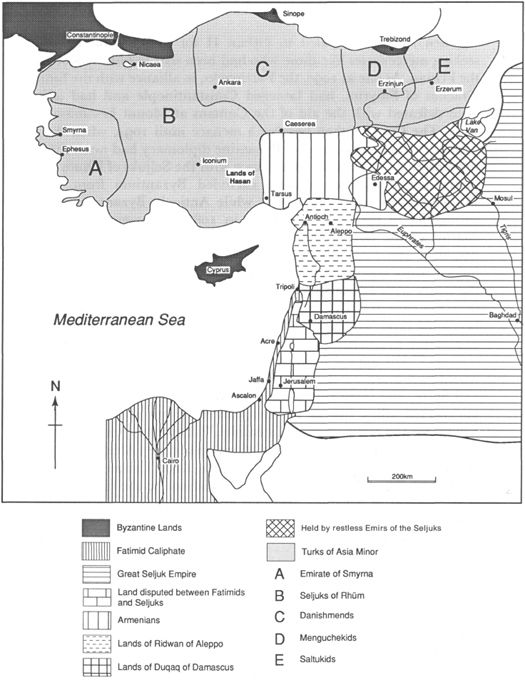
Fig. 3 Friends and enemies in the Middle East, 1095
When Alexius appealed to Urban II for military aid he was seeking mercenaries like those who had been sent to him by Robert the Frisian. As late as 1090, the Patzinacks, in alliance with the Emir Tzachas of Smyrna, had besieged Constantinople and had only been defeated with the aid of the Cumans at Mount Levunion in 1091. The Cumans then became a menace until 1094, when their siege of Adrianople collapsed. Byzantine diplomacy had neutralised the ambitious Tzachas by an alliance with the Seljuks of Rhum but their huge dominion virtually excluded Byzantium from Asia Minor. Nicaea was their capital while Antioch, Byzantium’s last stronghold in the east, had fallen in 1085 and come under the control of the Syrian Seljuks (see figs. 2 and 3).87 During the desperate 1080s Alexius had often been very short of money, and indeed Anna says that at one stage the treasury was so empty that the doors were left open and Alexius was forced to take property from the church.88 By the time of the crusade such complaints are becoming rarer, and, presumably as Alexius’s régime stabilised, the underlying prosperity of the empire enabled him to replenish his reserves.89 His appeal to the west for aid was carefully timed. He would have known of the divisions amongst the Turks in Asia Minor and Syria, and there can be little doubt that he wanted to use his unexpected allies, just as he had wanted to use the mercenaries before, for the restoration of his empire.90 However, grave difficulties arise for understanding the relationship between Alexius and the crusaders because of the sources available. Anna Comnena’s life of her father, The Alexiad, is at first sight a godsend to the historians; it is an account of Alexius’s attitudes and policies from an intimate member of the family. However, Anna was writing some forty years after the events she describes which happened when she was a child of thirteen, so she is unlikely to have had any real recollection of events. Her access to official sources was very uneven, and for much of the work she probably relied on the recollections of elderly people.91 In these circumstances it is entirely natural that her account of the form of the relationship is often vague. She speaks of Hugh of Vermandois swearing to Alexius ‘the customary oath of the Latins’ and of Bohemond taking the ‘customary Latin oath’, while some unnamed Franks, like Tancred, simply swear an oath to the emperor; no oath is mentioned as having been demanded from the count of Toulouse.92 Some confusion has been caused by translators rendering Anna’s rather general language into specifically feudal terms; Hugh of Vermandois’s oath is translated wrongly, as necessarily implying that he became the ‘man’ of the emperor, but the Greek was not a translation of a Latin term and simply means retainer or supporter, while the phrase ‘liege-man’, applied to the nameless Franks, may be quite wrong in its connotations.93 But sometimes Anna is very specific. She gives us an account of the conflict between Godfrey de Bouillon and Alexius over the Frankish leader’s refusal to come to any arrangement with the emperor which is broadly comparable to that of Albert of Aachen and concludes that:
Godfrey was soon obliged to submit to the will of the emperor. He then went to find him and took the required oath to him; its tenor was that all towns districts and fortresses which he might in the future subdue and which had previously belonged to the empire of the Romans would be handed over to the senior officer sent by the emperor for this purpose.94
This a good basis for a treaty between the crusaders and the emperor; Alexius could hope to regain lost land, and we know that he did so hope because he sent Tatikios with the crusaders to be that ‘senior officer’. The crusaders would be relieved of the responsibility of holding cities whose garrisons would erode the strength of their army on its way to Jerusalem.95 But what was the import of that vague phrase ‘customary oath of the Latins’ with its ‘feudal’ overtones? Moreover, the prominence of return of land in her account, and her vilification of Bohemond, need to be seen in the context of the hindsight which informs her writing. In 1098 Bohemond seized Antioch with the connivance of most of the crusader leaders and its possession then became a matter of dispute between Byzantium and the Franks of the east for all of Anna’s lifetime. In Anna’s view this was a breach of their promise; the crusaders held that Alexius had failed to deliver on his side of this bargain made at Constantinople in 1097. The desire to justify her father in this respect is a very powerful element in Anna’s account of the crusade.96 On the other hand, some of the western sources written by eye-witnesses were not very interested in detailing events which led to one of the most squalid and divisive incidents of the crusade, the quarrel over Antioch which almost broke up the crusade. Fulcher of Chartres speaks of friendship being concluded at Constantinople; in later passages he never mentions the quarrel over Antioch and although he refers to the departure of Stephen of Blois from Antioch he does not tell us that on his flight westward he met Alexius, at Philomelium, who concluded from his report that the crusaders were doomed and turned with his army back to Constantinople.97 The three western eyewitness accounts of the crusade, the Anonymous author of the Gesta, Raymond of Aguilers and Albert of Aachen, never mention the issue of returning land to Alexius in their account of events at Constantinople in 1097. However, all three admit that after the final capture of Antioch the issue of the promise they had made to Alexius to return the city to him became a divisive issue in the army, primarily between Bohemond and Count Raymond.98 Clearly this was an element in the agreements made at Constantinople, but all these and other eyewitness or near eyewitness sources use language of the agreement which suggest another element which clarifies Anna’s ‘customary oaths of the Latins’.
According to the Gesta Alexius demanded that Hugh Magnus, the first of the leaders to arrive at Constantinople in November 1096, should swear fealty to him, ‘ei fidelitatem faceret’; this was certainly a customary oath in the west. Bohemond, the same source tells us, took a precisely similar oath. However, the Anonymous gives a long account of Godfrey’s dealing with Alexius and concludes simply that he made a pact, ‘pactum iniit cum imperatore’, with no mention of an oath of any kind. However, in describing negotiations between Alexius and the count of Toulouse, the Anonymous says that Raymond refused to become his vassal, ‘hominum et fiduciam’, and Raymond of Aguilers agrees, but his passage is largely based on that in the Gesta.99 The implication is that others had taken such an oath. This inconsistency is a matter of some importance, for the oath of vassalage represented a much closer tie between one man and another than that established by mere fealty, and it is usually a consequence of the giving of a fief, of which there is no question here. The caveat has to be taken seriously, for vassalage did not always imply a landed relationship. In the famous oath of Bonneville, Harold first swore fealty to William, ‘ei fidelitatem … juravit’, and promised to safeguard his succession to the throne of England. This act made Harold a vassal of William, for it was accompanied by the placing of Harold’s hands between those of the duke ‘satelliti suo accepto per manus’, and only then did he proceed to confirm Harold’s possession of lands – fealty, homage and investiture are all separate elements.100 Moreover, there is another element in the Anonymous’s account of events. Just as Anna stresses one-sidedly the obligations of the Franks, so he stresses those of the emperor who:
guaranteed good faith and security to all our men, and swore also to come with us, bringing an army and a navy, and faithfully to supply us with provisions both by land and sea, and to take care to restore all those things which we had lost. Moreover he promised that he would not cause or permit anyone to trouble or vex our pilgrims on the way to the Holy Sepulchre.101
The Anonymous gives a particular picture of events at Constantinople; the oath is a ‘crafty plan’ of ‘the wretched emperor’ and he claims that all the leaders refused to swear it, and only consented ‘driven by desperate need’. The implication is clear; the oath is devalued by the circumstances in which it is taken. Further, there was no occasion when the leaders conferred on the matter to reject it, as stated here in a passage which includes one obvious interpolation. There then follows the careful enumeration of the Byzantine obligations.102 Overall the account in the Gesta is highly convenient in view of the later dispute over Antioch when Bohemond would make the case that the Byzantines had broken their oath. It is as if the later comment about the princes having become vassals of Alexius slipped through in the drama of the passage about the count of Toulouse’s refusal to take the oath. Moreover, Albert of Aachen quite consistently says that the leaders became the men of Alexius, and his account is peculiarly interesting.
Godfrey is Albert’s hero and his reputation is carefully safeguarded. His was the first major army to approach Constantinople, where it arrived on 23 December 1096. Even before he reached Constantinople, Godfrey heard of the supposed ‘captivity’ of Hugh of Vermandois and had raided the countryside in vengeance. At Constantinople Hugh was sent to invite Godfrey to a meeting with Alexius, but Godfrey refused to go on the advice of some mysterious strangers, originally Franks but now inhabitants of the city. The emperor withheld supply, then restored it and a Christmas peace was arranged. In late December Godfrey, still under the influence of the mysterious strangers, refused again to meet Alexius. The issue was distrust and fear of treachery, and Godfrey sent envoys to explain this to Alexius who responded with assurances which the Lorrainer spurned. Food supplies were again withdrawn by Alexius and this led to friction and an open attack on Constantinople by the Franks on 13 January 1097 and, after this had been repulsed, six days of ravaging. Anna Comnena’s account is broadly comparable, except that the attack on Constantinople is wrongly dated to Easter 1097, but she makes it clear that Alexius feared that Godfrey might intrigue with Bohemond. It is interesting, therefore, that Albert of Aachen tells us that Godfrey received ambassadors from Bohemond, on or about 20 January, who suggested that he should fall back on Adrianople for the winter and await Bohemond’s forces with a view to a joint attack on Constantinople. Albert says that disgust at this suggestion of Bohemond’s was Godfrey’s prime motive for arriving at a peace with Alexius. However, Godfrey was also subject to harrassment by imperial forces and threats of withdrawal of food supplies. Moreover Alexius complimented this pressure by diplomatic overtures and offers to exchange hostages.103 Once hostages had been exchanged, the emperor’s own son John amongst them, Godfrey went for an audience with Alexius in a scene in which Albert notes the etiquette of the imperial court in which Alexius remained seated. Godfrey then took what was unmistakably an oath of vassalage: ‘[Godfrey] gave him [Alexius] his hand and declared that he was his vassal, and all the leading men who were present at the ceremony or came later did the same.’104 In the course of his account, Albert reveals that all the leaders became the ‘men’ of the emperor. This, however, includes Raymond of Toulouse who we know took a modified oath of a type customary in Provence under which he promised not to harm the emperor or his lands.105 The overall impression that the leaders swore an oath of vassalage is enhanced by Ralph of Caen whose Gesta Tancredi is unrelievedly hostile to the Byzantines. He says that Bohemond gave hominagium to Alexius, but that Tancred slipped across the Hellespont to avoid it and later at Pelekanum refused any oath. The Gesta confirms Tancred’s evasion as do Albert and Anna who, however, say that he swore eventually at Pelekanum.106 The overwhelming impression is that the leaders of the crusade were asked to take a very serious oath. Godfrey’s resistance owed much to a general sense of distrust fanned by misinformation, and the count of Toulouse was angry because his army had been attacked. All the leaders found themselves exposed as individuals in a strange land to the diplomatic wiles of the emperor, of whose determination there can be no doubt. Alexius wanted to control the army while it was in his dominions and to make sure that it restored any lost imperial land. He wanted something much more than a simple agreement to this effect – he knew something of western society and was determined to cast the arrangement in the most solemn form possible. He had wanted mercenaries; by making the independent leaders who came his sworn men, his vassals, he very nearly achieved this end. Alexius was able to approach each leader separately, and use the oath of one as a pressure to achieve that of the next, and we must not forget that he extracted it not only from the princes, but also lesser lords like Tancred whom he pursued so mercilessly. Bohemond was in a different position; under the will of his father Byzantium was his inheritance. His own army was much too small to attack, but he deliberately travelled very slowly watching events. He sent envoys to Godfrey proposing an alliance against Alexius, and Anna says that her father took steps to intercept any further communications of this sort. When he failed to attract support for his designs on Byzantium, Bohemond changed tack. He adopted a policy of friendship, swore the oath of homage, then asked to be made Grand Domestic of the East, commander of the imperial forces in Asia. Bohemond understood that Alexius was seeking to place the crusaders in much the same position as the mercenaries he had hired before who had also sworn ‘customary oaths’, and so shrewdly asked for an office which would make him commander of the whole crusader force – it was refused, but in temporising terms.107 Alexius had wanted mercenaries – he tried to reduce the crusaders to as near to that status as was possible. Fulcher is extremely evasive about the whole vexed question – he wrote as a servant of the house of Boulogne and was aware of the controversy over Antioch. But in a revealing passage he tells us that after the capture of Nicaea ‘our barons received permission from the emperor to depart’.108
The form of the agreement between the leaders and Alexius was therefore that of an oath of vassalage. This was a very solemn undertaking, but it reflects the flexibility of such undertakings which were sometimes used by major princes as forms of peace between them.109 All the princes already had lords in the West, but multiple homage was commonplace. Robert of Flanders was the vassal both of King Philip of France and Henry IV of Germany. The new vassalic tie, into which he and others entered, was clearly for a specific set of circumstances and would have made little difference to their lords in the west. The notion of liege-homage was only slowly establishing itself: in the treaty between Henry I of England and Robert of Flanders, Henry was effectively allying with Robert against their overlord the king of France, and the solution to the problem was for Robert to promise to advise King Philip against war with England and, if pressed, to send as few troops as was compatible with his vassal status. By such devices would liege-homage emerge, but not yet.110 However, the demand seems to have shocked Godfrey, but in the end he was isolated and vulnerable to the threat of withdrawal of supply. His oath was a tremendous pressure upon all who came after, particularly as it was preceded by that of Hugh of Vermandois and his companions and followed by those of many in his own force. The count of Toulouse took a different kind of oath but one customary in the south where fealty rather than acts of homage was central in relationships between nobles.111 And it may be that in the course of the discussions he came to see the value of the friendship with Alexius which Urban had advocated. But whatever the form of the oath, in substance Alexius and the leaders were creating a treaty, or at least an understanding. What was its nature?
Anna Comnena insists that return of conquered imperial territory was a vital part of the agreement. Although her insistence on the one-sided nature of the agreement which placed obligations upon the crusaders almost certainly reflects the Byzantine view that the crusaders were, virtually, mercenaries at the command of Alexius at least within the old Byzantine lands, there is no doubt that Alexius had to enter into obligations as well. Such obligations are detailed only in the Gesta and its derivatives in a form which probably represents a maximal interpretation, to say the least. That Alexius gave military assistance to the crusade at Nicaea is self-evident from all accounts, and we know that Tatikios accompanied them on the march to Antioch, while Byzantine ships were active in their support and in bringing supply.112 However, it is extremely unlikely that Alexius swore to come with them at any stage as the Anonymous would have us believe. Raymond of Aguilers says that Alexius explicitly ruled out personal participation. He certainly did not participate in the siege of Nicaea and Anna tells us quite plainly that this was because he did not trust the crusaders and, indeed, she shows that he later deceived them in the ‘drama of betrayal’ by which Nicaea surrendered.113 If Alexius really had promised to go, all the sources would have said so – it was not the kind of statement that could be kept secret. The Gesta’s statement should be read in the context of its presentation of the betrayal at Philomelium – it is a deliberate exaggeration of Alexius’s promise to give military aid to the crusaders. There were good reasons why Alexius could not join the western army for, as he said to Raymond of Toulouse, he had many enemies on many frontiers. What he did not say was that Jerusalem was strategically irrelevant to the empire and that any emperor who went off on such irrelevancy would be endangering his throne.114 Of course this does not mean that Alexius could not decide to join them at some future date when conditions might be very favourable, merely that he had no intention of binding himself to such a dangerous course of action, and did not. From the emperor’s point of view the treaty with the leaders was very satisfactory. The leaders were his vassals. He recognised that this was a fragile bond, hence his insistence on some renewing their oaths at Pelekanum after the siege of Nicaea and on making a wide range of senior crusaders take the oath. In this capacity they were sworn to return to him all former imperial territories. There must have been some geographical limitation on this, for, if one goes back far enough in time, all of the Middle East had been ruled from Constantinople. In September 1098, Raymond of Toulouse seized Albara and installed a Latin bishop there. Since at this time he was the champion of imperial rights, and was resisting Bohemond’s seizure of Antioch, he would hardly have offended his ally Alexius by holding the city himself and appointing an alien bishop. Furthermore, Count Raymond was later to hold Laodicea of the emperor (see fig. 4).115 Antioch and its immediate area probably formed the boundary of the old imperial posessions which were to be restored. Of course, the Greeks were very sceptical of the ability of the westerners to conquer any of this, as Anna indicates, but should they succeed Alexius was in a position to profit with a minimum commitment of his own.116 From the point of view of the crusaders they had obeyed Urban’s directive and profited from the addition of imperial forces which would be substantial at Nicaea, rather less thereafter. In the longer run the Byzantines would take over cities and fortresses which it would be unwise to leave unguarded in their rear, but which were irrelevant to the achievement of Jerusalem. In addition, they were promised naval aid and supplies and a clear passage for any reinforcements that might come after them. It is very probable that they were also able to lay plans for the war in Asia Minor, for Anna says that Alexius advised them about the tactics of the Turks and he must surely have explained something of the political situation in the Middle East for he certainly suggested how they could exploit this by negotiating with the Egyptians.117 Adhémar was ill at Thessalonica at the time that most of the arrangements were made and we know nothing of his dealings with the imperial authorities. However, he was later at pains to establish close relations with Simeon, the Patriarch of Jerusalem, with whom he wrote two letters to the west, and after the fall of Antioch John the Oxite, its Orthodox Patriarch, was restored.118This suggests that after the initial difficulties, good relations prevailed.
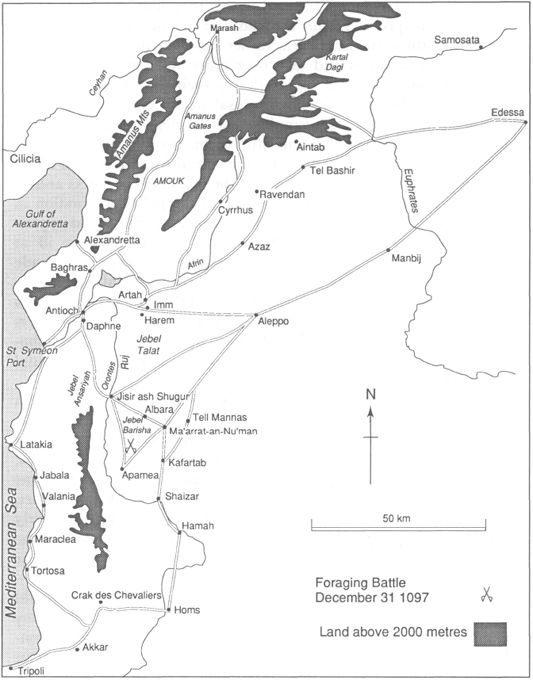
Fig. 4 Syria and the First Crusade
In addition, the negotiations at Constantinople produced a special relationship between Alexius and Raymond of Toulouse. Quite how this was achieved is not clear; they had begun on very bad terms indeed, according to the Latin sources, as we have noted, with Raymond refusing any oath of homage. However, by the time the army was setting off to Nicaea Raymond was at Alexius’s court, hence his late arrival at Nicaea.119 Anna never mentions the early hostility; in her story all is sweetness and light from the first, and she suggests that it was mutual mistrust of Bohemond which brought the two men together.120 However, this may well reflect later events – hindsight is highly developed in the Alexiad. Later, Raymond would appear as by far the wealthiest of the crusaders and when the army was frustrated at Antioch by the quarrels of the princes the suggestion was made that those who favoured the imperial party, amongst whom Raymond was the most prominent, were in Byzantine pay, but this may merely have been camp rumour. Raymond appears as far wealthier than any of the other leaders – in the spring of 1098 he took over the Mahomeries tower at Antioch when his followers were murmuring about his paid Tancred to man the fort by the St Paul Gate and produced money to compensate knights for loss of horses. In early 1099 he offered huge sums to the other leaders to enter his service.121 After the crusade was over Raymond would hold Laodicea for Alexius and act with him in dealing with the crusade of 1101.122 There is no clear evidence, but it is possible that Alexius gave Raymond of St Gilles significant military subsidies. What is certain is that under the pressure of events at Antioch in the summer of 1098 Raymond became a close ally of the emperor. Between the conversations at Constantinople and this time there is little direct evidence of his attitudes, though Albert of Aix says he received rich presents from the emperor.123
The arrangements at Constantinople laid the basis for cooperation between Byzantium and the crusading army. Militarily the crusaders were strengthened by the deal with Alexius. But one matter never seems to have been discussed at Constantinople – leadership of the crusade in the absence of the emperor. The princes had made their arrangements with Alexius as individuals. None of them had overlords with any real power and even men of the second rank were used to a high degree of independence. The device of a council of leaders seems to have emerged quite naturally in this situation and Adhémar would seem to have been its mentor and political guide – as a priest would later say.124 But this was a dangerous omission for a military expedition, and one for which they would later pay dearly. However, after the arrangements made at Constantinople the leaders could turn their attention to the clash of arms which was now imminent.
1 Crozet, ‘Le voyage d’Urbain’ 274–7; Hills, Raymond IV, pp. 105–8; GR, p. 456.
2 OV, 4. 85, 211, 115:5. 27.
3 David, Robert Curthose, p. 228.
4 Andressohn, Godfrey de Bouillon, pp. 34–5, 39–40, 41, 43–5; Mayer, Mélanges, pp. 20–1.
5 It is not certain whether Robert called at Constantinople on his outbound or return journey. Verlinden, Robert le Frison, p. 158–9, suggests that Robert met Alexius whilst returning in 1089. Alexiad, pp. 229–30, 232–3 reports the meeting and the request for aid without giving any dates. On the letter of Alexius and its use as a basis for forgery, Verlinden pp. 162–4; on Robert II, see M. M. Knappen, ‘Robert of Flanders on the First Crusade’, in L. J. Paetow, ed., The Crusades and other Historical Essays presented to D. C. Munro (New York, 1928), pp. 79–100; he gained great prestige from crusading, Dunbabin, France in the Making, p. 291.
6 Fawtier, Capetian Kings, p. 18; GN, p. 149; P. Jaffé, Regesta Pontificum Romanorum, 2nd edition, 2 vols. (Leipzig, 1885–6), 1. 688.
7 GF, p. 7; Malaterra, p. 102, says that because of Bohemond’s recruiting activities, the armies of the two Rogers so melted away that the siege had to be abandoned; Yewdale, Bohemond, pp. 31–2.
8 Yewdale, Bohemond, p. 33; GF, p. 63; see above p. 13.
9 Chronique de Saint-Pierre-le-Vif de Sens, dite de Clarius, ed. R. H. Bautier and M. Gilles (Paris, 1979), p. 381; Hagenmeyer, kreuzzugsbriefe, pp. 138–40; Runciman 1. 165; GF, pp. 63–5.
10 AA, 314 says Eustace travelled with the North French forces but he is never mentioned by their chronicler, Fulcher of Chartres: Runciman, 1. 147 n. 1. It is possible, as Runciman suggests, that his may have been one of the many smaller independent contingents which arrived at Constantinople in the spring of 1097.
11 Robert II of Flanders (1093–1111) had succeeded his father only in 1093; above p. 56; Stephen Henry, count of Meaux and Blois, was quite experienced but had long lived under the shadow of his father Theobald (1037–1089/90): Bur, Comté de Champagne, p. 230; Eustace III of Boulogne was the successor of the famous Eustace II whose death is usually dated between 1082 and 1088: Andressohn, Godfrey de Bouillon, p. 25, but there is room to think it may have occurred as early as 1076: Mayer, Mélanges, pp. 20–1.
12 Bur, Comté de Champagne, pp. 286–7; on the house of Boulogne see above p. 45; Mayer, Mélanges, pp. 32–6.
13 Hills, Raymond IV, pp. 15–19.
14 Verlinden, Robert le Frison, p. 165; Dunbabin, Origins of France, pp. 291–2; on the question of the ‘Norman world’ and its sense of identity see G. Loud, ‘Gens Normannorum – myth or reality?’, Battle, 4 (1981) 104–16.
15 GR, 2. 523, 603–4.
16 Grossman, Financing of the Crusades, pp. 36–7; David, Robert Curthose, pp. 91–6.
17 Andressohn, Godfrey de Bouillon, pp. 51–2; Grossman, Financing of the Crusades, pp. 31–2; A. V. Murray, ‘The army of Godfrey de Bouillon 1096–99: structure and dynamics of a contingent on the First Crusade’, Revue Belge de Philologie et d’Histoire 70 (1992), 301–29. I am very grateful to Dr Murray for allowing me to see an advanced copy of this article; (Soloman) Bar Simson, Chronicle, The Jews and the Crusaders, tr. S. Eidelberg (Wisconsin, 1977) p. 25.
18 Mayer, Mélanges, pp. 43–4.
19 Grossman, Financing of the Crusades, p. 35.
20 Ibid, p. 34 who notes that Bohemond seems to have kept control of much of his property in Italy
21 Grossman, Financing of the Crusades, p. 36 citing Hagenmeyer, Kreuzzugsbriefe, p. 143.
22 On southern French society and economy at this time see A. R. Lewis, The Development of Southern French and Catalan Society 718–1030 (Austin, 1965) pp. 395–400; RA, p. 88, 111–12; for the importance of the fair at St Gilles, R. H. Bautier, The Economic Development of Medieval Europe, by H. Karolji (London, 1971), p. 104; Grossman, p. 33, argues for the sale of the Rouerge, but this is contested by Hill and Hill, Raymond IV, p. 37 who believe that Raymond could easily have financed his crusade from income. On the coinage used, see D. M. Metcalf, Coinage of the Crusaders and the Latin East (London, 1983), pp. 2–6.
23 On which see below pp. 311.
24 Recueil des Chartes de l’Abbaye de Cluny, ed. A. Bernard and A. Bruel, 6 vols. (Paris, 1876–1903), 5. 51. Cluny got the land, for Achard died in a skirmish between Jerusalem and Jaffa on 18 June 1099: RA p. 141. For other grants see Grossman, Financing of the Crusades, pp. 44–56; Cowdrey, ‘Pope Urban’s preaching of the First Crusade’, 177–88; Riley-Smith, Idea of Crusading, pp. 45–7.
25 J. Sumption, Pilgrimage (London, 1975), pp. 169, 205–6.
26 The sources for the great German pilgrimage are: Annales Altanenses Maiores, MGH SS 20. 782–824; Lambert the Monk, Annales Hersfeldenses, MGH SS 3. 18–116; Marianus Scotus, Chronicon, MGH SS 5. 558–59. For commentary see E. Joranson, ‘The Great German Pilgrimage of 1064–65’, in L. J. Paetow, ed., The Crusades and other Historical Essays presented to D. C. Munro(New York, 1928), pp. 3–43.
27 Glaber, pp. 96–7, 132–7, 198–205. On the abortive French pilgrimage of 1054 see L. Bréhier, L’Eglise et l’Orient au Moyen Âge (Paris, 1921), pp. 44–5.
28 The tradition that Peter went to Jerusalem and was inspired to preach its liberation by his sufferings has been thoroughly examined by E. O. Blake and C. Morris, ‘A hermit goes to war; Peter and the origins of the First Crusade’, W. J. Shiels, ed. Monks, Hermits and the Ascetic Tradition(Oxford, 1985), 79–107, who suggest that the notion that he may have influenced Urban II cannot be totally dismissed. The present writer sees the roots of the Crusade in papal policy and Urban’s own thinking, though their idea that Peter might have been an official preacher appointed by Urban, p. 83, cannot be dismissed. On popular religious movements and the ‘Peace of God’ in the eleventh century see above pp. 6–7 n. 21.
29 For a general survey see H. Hagenmeyer, Peter der Eremite (Leipzig, 1879). The original work exploding the idea that this was simply a peasant rabble was that of F. Duncalf, ‘The Peasants’ Crusade’, American Historical Review, 26 (1921), 440–453. This has been given considerable precision by Riley-Smith’s research on individuals in Idea of Crusading, pp. 49–57.
30 H. Hagenmeyer, Chronologie de la Première Croisade (Paris, 1902) pp. 13, 18; on the persecution at this time see Riley-Smith, Idea of Crusading, pp. 52–7. This was not the first great persecution, the ‘First Holocaust’ as he calls it. Jewry had already suffered one major persecution amongst the West Franks, on which see R. Chazan, ‘1007–1012: the initial crisis for northern European Jewry’, Proceedings of the American Academy for Jewish Research, 38–39 (1970–71), 101–17.
31 AA, 274–6.
32 For the chronology of Peter’s march and that of Godfrey through Eastern Europe I have followed J. W. Nesbitt, ‘The rate of march of crusading armies in Europe: a study and computation’, Traditio, 19 (1963), 181 in his revision of Hagenmeyer.
33 AA, 286–7; Riley-Smith, Idea of Crusading, pp. 50–2 identifies Hugh of Tübingen and Walter of Tegk as amongst the Germans, but doubt has been cast on the source of this information, on which see below p. 92, n. 36.
34 AA, 277.
35 AA, 277–84.
36 Emicho is usually identified as the Count Emicho of Leiningen listed along with other crusaders in the Chronicle of Zimmern, ed. H. Hagenmeyer, pp. 17–88. In a devastating critique of the value of this source A. V. Murray, ‘The army of Godfrey Bouillon’, 315–22 has shown this to be almost valueless and cites a recent study, Ingo Toussaint, Die Grafen von Leiningen: Studien zur leiningischen Genealogie und Territorialgeschichte bis zur Teilung von 1317/18 (Sigmaringen, 1982), pp. 25–8 which suggests that Emicho may have come from Flonheim on the middle Rhine. Bar Simson, pp. 28–9; Ekkehard of Aura, Hierosolymita, RHC Oc. 5 [hereafter cited as Ekkehard], p. 20; AA, 292–5; Riley-Smith, Idea of Crusading, pp. 50–1.
37 AA, 289–91; Ekkehard, pp. 20–1.
38 Hagenmeyer, Chronologie, pp. 26–8; (Eliezer) Bar Nathan, Chronicle, in Mainz Anonymous, The Jews and the Crusaders, tr. S. Eidelberg (Wisconsin, 1977), pp. 85–91; AA 295.
39 GF, pp. 2–3; Alexiad, p. 311; AA, 283, 284.
40 AA, 284–5; GF, pp. 3–4. The location of Xerigordo is unknown.
41 It is now impossible to fix the location of this battle, for Albert is alone in describing it and the only clue is that it took place at the edge of the woods and vegetation patterns have changed. Probably it was fought on the upper Yalac near the present route 595, along which there are several possibilities, from the Gulf of Izmit (Nicomedia) to Iznik (Nicaea) via Yalakdere.
42 AA, 287–9.
43 AA, 287–92.
44 See above p. 4 and the very clear discussion in Riley-Smith, Idea of Crusading, pp. 50–7.
45 Riley-Smith, Idea of Crusading, pp. 19–20; see above p. 4
46 Hagenmeyer, Kreuzzugesbriefe, pp. 136–37.
47 W. M. Daly, ‘Christian fraternity, the crusaders and the security of Constantinople’, Medieval Studies, 22 (1960), 43–91.
48 A. C. Krey, ‘Urban’s crusade; success or failure?’, American Historical Review, 53 (1948), 235–50; Cowdrey, ‘Pope Gregory VII’s “Crusading” plans’ 27–40.
49 On which see P. Charanis, ‘Aims of the medieval crusaders and how they were viewed by Byzantium’, Church History, 21 (1952), 123–134, and the same author’s brief note in American Historical Review, 53 (1948), 941–4.
50 J. Richard, ‘La Papauté et la direction de la première croisade’, Journal des Savants, (i960),
51 It is very evident that Alexius knew that major armies were on the way and was making preparations to provide for them, although the ‘People’s Crusade’ arrived early; see above pp. 88–95. Alexiad, p. 308, is mendacious in suggesting that Alexius had no foreknowledge.
52 Hill and Hill, Raymond IV, pp. 30–2, ‘Justification historique du titre de Raymond de Saint-Gilles; “Christiane milicie excellentissimus princeps’”, Annales du Midi, 66 (1954), 101–12.
53 See below especially pp. 297–324.
54 On the role of the fleets and their actions see below pp. 209–220.
55 P. F. Kehr, Regesta Pontificum Romanonum. Italia Pontificia, 10 vols. (Rome, 1906–75), 6. 2. 323: Hills, Raymond IV, p. 34; Caffaro, De liberatione civitatum orienti, RHC Oc. 5, 49–50.
56 M. Mollat, ‘Problèmes navales de l’histoire des croisades’, Cahiers de Civilisation Médiévale, 10 (1967), 351.
57 Hagenmeyer, Kreuzzugsbriefe, p. 145.
58 Bautier, Economic Development, p. 99; J. H. Pryor, Geography, Technology and War: Studies in the Maritime History of the Mediterranean 64–1571 (Cambridge, 1988), pp. 87–101 and see map, p. 14.
59 A. O. Citarella, ‘The relations of Amalfi with the Arab world before the crusades’, Speculum, 42 (1967), 300, 310; C. Cohen, ‘Un texte peu connu relatif au commerce oriental d’Amalfi au X siècle’, Archivio Storico Napoletano, 34 (1955), 61–67; D. Abulafia, The Two Italies (Cambridge, 1977), pp. 42–49.
60 Cowdrey, ‘Mahdia Campaign’, 15–16, though Citarella, pp. 311–12 believes that Pantaleone took part in this as an individual and that Amalfi, because of its good relations with Arab powers, held aloof. On the Mahdia campaign see above p. 48.
61 Glaber, pp. 204–5, 202–5, 60–1. On Robert’s remains see K. Giggaar, ‘England and Byzantium’, 83.
62 H. Dauphin, Le Bienheureux Richard, abbé de St-Vanne-de-Verdun (Louvain, 1946), pp. 281–94; E. Joranson, ‘Great German Pilgrimage’, in L. J. Paetow, ed., The Crusades and other Historical Essays presented to D. C. Munro, (New York, 1928), pp. 3–43.
63 Riley-Smith, Idea of Crusading, pp. 20–1.
64 C. Verlinden, Robert le Frison, pp. 152–7, 168; Alexiad, pp. 229–30, 232–3.
65 Godfrey, ‘The defeated Anglo-Saxons’, 68–74.
66 Cigaar, ‘England and Byzantium’, 86; Glaber, p. 202–3; Dunbabin, France in the Making, p. 136.
67 Hagenmeyer, Kreuzuggesbriefe, p. 140.
68 Alexiad, pp. 313–15; GF, pp. 5–6.
69 FC, pp. 75–6; on the chaplains see below p. 303 n. 17.
70 FC, p. 76; David, Robert Curthose, pp. 223–4.
71 FC, pp. 76–8.
72 GF, pp. 7–8; On Guiscard’s expedition see above pp. 74–7.
73 On Byzantine attitudes to the Normans see J. Hermans, “The Byzantine view of the Normans’, Battle, 2 (1979) 78–92.
74 GF, pp. 8–11; see below pp. 106–7.
75 Alexiad, pp. 315, 324.
76 RA, pp. 36–8.
77 RA, p. 38; A. C. Krey, The First Crusade (Princeton, 1921, Gloucester, 1958), p. 65: ‘We believed we were in our own country, thinking that the Emperor and his satellites were our brothers and helpmates’.
78 RA, pp. 38–9.
79 RA, pp. 40–1.
80 AA, 299–302.
81 AA, 303–5.
82 AA, 304–5; on the size of his army see below pp. 129–30.
83 Compare the figures suggested for the march through the Balkans of between 29 and 17. 6 kilometres per day, on which see above p. 90, n. 32. The average daily mileage figures used here are not to be taken literally. Speed of march must have varied enormously according to the nature of the country, tiredness of army etc: the Provençals were tired by the time they reached Dyrrachium and had troubles with the Byzantines, while the North French were rested and local arrangements went smoothly. The figures are used here to indicate comparative rates of progress and they can be very revealing.
84 Historia Belli Sacri, RHC Oc. 3 [hereafter cited as HBS], 177; GF, p. 8.
85 RA, pp. 40–2; HBS, 179 also relates that Count Raymond received letters urging him to press on to Constantinople ahead of his army and stating that the emperor would lead them to Jerusalem, but this interesting source, which has been insufficiently explored, depends on Raymond of Aguilers at this point; GF, p. 12 and see below p. 113–14.
86 FC, p. 80; Kreuzzugsbriefe, pp. 141–2, 146–9, 154–5, 165.
87 G. Ostrogorsky, History of the Byzantine State, tr. J. Hussey (Oxford, 1956), pp. 317–20 summarises the position of Byzantium on the eve of the crusade. See also R. J. H. Jenkins, ‘The Byzantine Empire on the eve of the Crusades’, Historical Association Pamphlet (1953); P. Charanis, ‘The Byzantine Empire in the eleventh century’, in K. Setton and M. W. Baldwin, eds., A History of the Crusades, 6 vols. (Pennsylvania, 1959–) (hereafter cited as Setton, Crusades1), 1. 177–219.
88 Alexiad, pp. 156–8.
89 A. Harvey, Economic Expansion of the Byzantine Empire 900–1200 (Cambridge, 1989), p. 244: ‘However, the eleventh century is most notable for a steady expansion which extended into the twelfth century and affected all aspects of economic activity.’
90 On the situation in Syria see below pp. 197–205.
91 France, ‘Anna Comnena’, 20–1; G. Loud, ‘Anna Komnena’, 41–57 shows how good Byzantine intelligence about the Normans of South Italy may have been; J. H. Pryor, ‘The oath of the leaders of the First Crusade to the Emperor Alexius; fealty, homage’, Parergon, 2 (1984)’, 112.
92 Alexiad, pp. 315, 325, 327, 329, 341.
93 Alexiad, pp. 315, 325; Pryor, ‘Oaths of the leaders’, 117, 122–4
94 Alexiad, p. 323, tr. Pryor, p. 122.
95 Alexiad, p. 341.
96 France, ‘Anna Comnena’, 22–31.
97 France, ‘Crisis of the First Crusade’, 289–90; Runciman, 1. 320.
98 GF, pp. 75–6; RA, pp. 83, 93–4; AA, 434.
99 GF, pp. 5–7, 11; RA, p. 41, who explains that the count’s anger was a result of hearing of his army being attacked on the road to Constantinople by imperial troops.
100 WP, pp. 104–5; Pryor, ‘Oaths of the Leaders’, 115–22 takes the view that it was unthinkable for men of the status of the leaders to become vassals when they already had lords at home and were not receiving lands.
101 GF, p. 12.
102 GF, pp. 11–12; A. C. Krey, ‘A neglected passage in the Gesía and its bearing on the literature of the First Crusade’, in L. J. Paetow, ed., The Crusades and other Historical Essays presented to D. C. Munro (New York, 1928), pp. 57–79, shows clearly that Alexius’s promise of Antioch to Bohemond recorded here is an interpolation.
103 AA, 305–11; Alexiad, pp. 319–23.
104 AA, 311.
105 AA, 312–13; RA, pp. 41–2; J. H. Hill and L. L. Hill, ‘The convention of Alexius Comnenus and Raymond of St-Gilles’, American Historical Review, 58 (1953), 322–7, Raymond IV, pp. 48–52.
106 Ralph of Caen, Gesta Tancredi, RHC Oc. 5 [hereafter cited as RC], 612–13, 619–21; GF, p. 13; AA, 313; Alexiad, p. 341.
107 Alexiad, p. 329; Pryor, ‘Oaths of the Leaders’, 115 draws attention to the oaths of earlier Frankish mercenaries.
108 FC, p. 83.
109 J. F. Lemarignier, Recherches sur l’Hommage en Marche et les Frontières Féodales (Lille, 1945), pp. 113, 161.
110 Diplomatic documents preserved in the Public Record Office (London, 1964), pp. 1–4. A recent study of Byzantine-Crusader relations, not used by Pryor, ‘Oaths of the Leaders’, concludes that the leaders took oaths of vassalage, but is sceptical of the notion of liege homage being applied to the relationship; R. J. Lilie, Byzanz und die kreufahrerstaaten (Munich, 1981), pp. 22–3. The notion has been applied, however, to the relationship between Bohemond and Alexius: J. Ferluga, ‘La ligesse dans l’empire byzantin’, Sbornik Radova, 7 (1961), 97–123.
111 Poly and Bournazel, Feudal Transformation, p. 75 and see the article by Hill and Hill above p. 115, n. 105.
112 On the siege of Nicaea see below pp. 162–5 and on Byzantine naval aid pp. 210–20.
113 Alexiad, pp. 336–7.
114 RA, p. 41.
115 RA, p. 91–2. On Laodicea see David, Robert Curthose, pp. 230–44.
116 Tatikios’s instructions were to take over any cities which the crusaders conquered ‘if indeed God granted them that favour’: Alexiad, p. 341.
117 See below pp. 165, 166.
118 Hagenmeyer, kreuzzugsbriefe, pp. 141–2, 146–9; on the restoration of John the Oxite, see AA, 433.
119 Alexiad, p. 330; AA, 314.
120 Alexiad, pp. 329–31.
121 RA, pp. 62–3, 94, 100.
122 Alexiad, p. 353; J. L. Cate, ‘The Crusade of 1101’, in Setton, Crusades, 1. 354.
123 France, ‘Tatikios’, 143–5; AA, 314.
124 RA, p. 73.