
CHAPTER 5
After the conclusion of the agreements between Alexius and the leaders, the crusader forces gathered in Asia Minor. Godfrey’s army had crossed in Lent of 1097 and doubtless they were joined by other contingents such as that of Robert of Flanders. Bohemond’s force crossed under the command of Tancred in late April though he stayed with the emperor, while the army led by Godfrey, Robert of Flanders and Tancred, including the ‘feeble debris’ of the ‘People’s Crusade’, marched along the Gulf of Nicomedia to that city via Rufinel to begin their approach to Nicaea. The Anonymous says that they were too numerous to take the road used by the ‘People’s Crusade’ and opened up their own route direct to Nicaea using 300 men to clear and mark the way. This probably means that the old Roman road from Nicomedia to Nicaea was badly overgrown and had to be cleared for the army. This road crosses the Naldökan Daglari, mountains which rise to over 1,400 metres, and the crusaders marked it with crosses for those who would follow them (see figs. 2 and 5). They arrived at Nicaea on 6 May 1097 and even at this early stage food was short and the army was relieved when Bohemond arrived with supplies.1 The count of Toulouse had also stayed behind, according to Anna Comnena establishing very cordial relations with Alexius, and did not arrive before Nicaea until 14 May, while the north French under Robert of Normandy and Stephen of Blois only arrived at Constantinople on that day and did not reach Nicaea until 3 June. The crusader force was augmented by a Byzantine contingent of some 2,000 under Tatikios, to which was later added a smaller force under the command of Boutoumites with boats to cover the Ascanian Lake which lay along the city’s western perimeter. Both these men were trusted confidants of Alexius and had considerable experience in dealing with westerners. Alexius himself settled at Pelekanum (on the north coast of the Gulf of Izmit, opposite Civitos) and from there manipulated the activities of his commanders.2 It was only slowly that the full strength of the western army gathered and it seems likely that it did not reach maximum until after the siege of Nicaea, for at that time Alexius (at Pelekanum) was at pains to demand the oath be taken by those who had not done so, which suggests the late arrival of some contingents.3 But as more than one crusader source produces a figure for the strength of the army at this time, when they were about to march into enemy territory, it is an appropriate juncture to consider the matter of numbers.
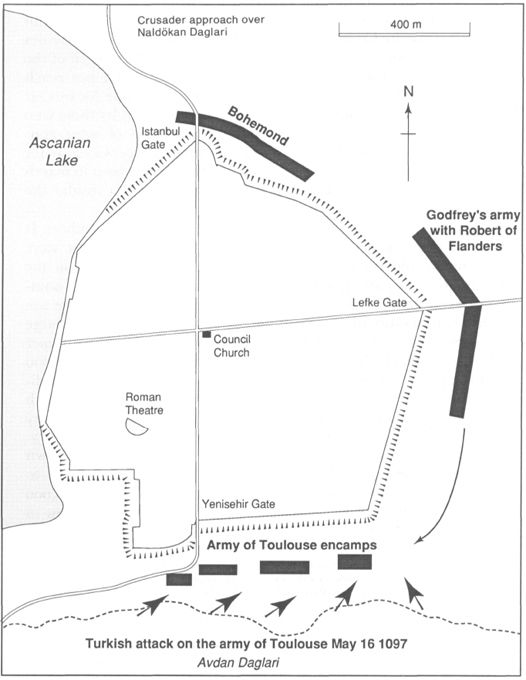
Fig. 5 The Siege of Nicaea and the Turkish attack of 16 May 1097
It is often said that medieval people were not good at numbers. It was an essentially local world in which large gatherings were uncommon and therefore impressed themselves unduly upon the imaginations of participants. Literacy was relatively rare and numeracy even rarer.4 But the fact is that most people in most eras are pretty bad at estimating large numbers of people. I recall one large demonstration in which I participated in Hyde Park in the summer of 1982 for which the organisers claimed an attendance of 300,000 and the police suggested 60,000 – a discrepancy of positively medieval proportions. Of course politics has something to do with such estimates; the police, as the guardians of law and order, try to play down such events while the organisers have the opposite tendency. Just such political considerations entered into the crusade’s own estimates. Simeon, Patriarch of Jerusalem and Adhémar wrote to the west asking for reinforcements and stating: ‘We have 100,000 mounted knights and armoured men, but what of it? We are few in comparison with the pagans, but verily God is fighting in our behalf’.5 The rhetoric warns us that though this may be a serious estimate, the writer must have been anxious not to pitch the figure too high or too low lest he discourage people from coming, hence also the stress on the magnitude of the task. We must recognise that large numbers in round figures need to be treated with caution, but that smaller figures may be quite accurate if there is reason to believe that the source is in any way authoritative. Furthermore, the leadership must have felt the need to know what troops were at their disposal and this must have become very acute in the later stages of the crusade when numbers seem to have been heavily reduced by the attrition of battle, starvation and illness. The Papal Legate Daimbert who arrived in the East at the very end of the crusade wrote to the West announcing its success and stated that an army 300,000 strong at Nicaea had been reduced to 20,000 by the battle of Ascalon on 12 August 1099. We need not accept these numbers, or even the proportion of losses implied, only that the crusaders themselves recognised that they had suffered terrible attrition.6 Since nobody actually tried to conduct a count of participants we can only hope to arrive at a general estimate, but a view of numbers is vital if we are to understand why the crusade was successful.
However, before numbers can be calculated we need some definition. The contemporary chroniclers refer to the leaders, whom they often call ‘Princes’, knights, foot and the poor. Setting aside the Princes and lords of high rank of whom we often have some individual knowledge, men like Anselm of Ribemont, two of whose letters to the West have survived, or Raymond Pilet who played a notable semi-independent role, it is important to realise that knights, foot and poor are not watertight categories. Knights were social superiors well equipped for war – yet on the road across the Anti-Taurus many abandoned that equipment and many more lost horses in the course of the campaign. Raymond of Aguilers distinguishes between knights and milites plebei, poor knights who seem only to have been mounted at times when horses were plentiful.7 Such poor knights must have slipped easily into the great mass of the army – but who were they? The term ‘poor’ is a difficult one. Contemporary sources were clearly aware of armed men other than knights – the letter of Simeon and Adhémar to the West written in October speaks of mounted knights and armoured men who were presumably the professional retinues of the lords and the greater knights.8 As horses became scarcer knights reinforced this group which became a very important element of the crusader army by the end of the siege of Antioch. But in addition to this group there were the servants, who must have formed the largest single group in the army. Many of these would have had a military function – to look after horses and arms as well as to perform menial tasks. Horses need a great deal of looking after and for this purpose alone knights must have taken large numbers of followers. In the West we have noted that a whole infrastructure was needed to support the warhorses of the upper classes, but humbler riding and draught animals also needed much care. Every knight must have started with at least three animals: a warhorse, a palfrey and a pack-horse. The mercenaries which William Rufus and Henry I arranged to employ from Robert of Flanders were each to be provided with three warhorses, but I am assuming that this represents the equipment of a really professional soldier. Many of the knights would have had as many warhorses plus numbers of palfreys and pack animals and undoubtedly the richer knights and great nobles had many more.9 Thus, in association with the knights (whose numbers are below estimated to have been about 6,000–7,000) a minimum of 20,000 horses would have begun the journey, and in addition there were pack and draught animals including oxen for the carts. The servants needed in order to look after these 20,000 alone would have constituted a substantial army. In the following of important men, servants and retainers of all kinds must have been numerous; almost any knight would have had at least one. If those with a quasi-military function could arm themselves they could be pressed into service easily, but on the other hand if his master died a man of this type could easily find himself in the wider mass of general domestic servants and non-combatants. For the army attracted large numbers of poor pilgrims, some infirm, with women and children. This last group of genuine non-combatants must have dwindled quickly under the impact of deprivation and disease, for they must have been the poorest and therefore most vulnerable to disease. By 1099, however, anyone fit enough to bear arms, except for clergy, was probably in the infantry. They were disciplined and trained by sheer force of circumstance. Many of them were dismounted knights who might from time to time find horses. Thus an army with a huge civilian tail became progressively smaller and more militarised as time went on, under the pressure of enemy attack.
Fulcher of Chartres’ statement that the army gathered at Nicaea was 600,000 strong including 100,000 ‘protected by mail hauberks’ is clearly sheer fantasy, as is Ekkehard’s figure of 300,000. Albert of Aachen says the army was 300,000 strong at Nicaea (manuscript variants say 600,000) with women and children in addition, and he also indicates that the Turks believed that 400,000 were attacking Nicaea. Anna Comnena says that Godfrey’s army alone numbered 10,000 cavalry and 70,000 infantry, which is surely as wild as the statement by Albert that Godfrey led 60,000 knights to the rescue of Bohemond at the battle of Dorylaeum.10 On the other hand, Albert reports Godfrey attacking the enemy leader with fifty sodalibus during this battle and adds that the enemy suffered losses of 3,000, a surprisingly modest figure in the light of the implied size of the Turkish army – which Anselm of Ribemont placed at 260,000 and Tudebode at 360,000.11 Indeed, when it comes to specific battles the total numbers suggested by the sources reduce dramatically. On 31 December 1097 a force under Bohemond and Robert of Flanders sent out to forage ran into the army of Damascus attempting to relieve Antioch. Albert of Aachen says that the westerners had 15,000 foot and 2,000 knights and the Anonymous gives an overall figure of 20,000 – though Raymond of Aguilers suggests that there were only 400 Frankish knights present.12 There is a much greater consensus on the second battle fought against the relieving force of Ridwan of Aleppo on 9 February 1098. On this occasion the approach of an enemy army came at a moment when suffering in the bitter winter was at its height and losses in horses had been heavy. The council of leaders decided to send all their knights under the command of Bohemond to ambush the enemy at a narrow passage between the river Orontes and the lake of Antioch, leaving the foot to defend the camp. Albert says that only 700 could find horses and this figure is confirmed by Raymond of Aguilers and by Stephen of Blois in his second letter to his wife Adela.13 Of course this is a measure of horses rather than men as we have already noted. The figure 700 occurs again for Albert says that when the crusaders were preparing for the betrayal of Antioch at a time when Kerbogah’s relief army was approaching, they pretended to repeat the tactics of the Lake battle and allowed the garrison to see 700 cavalry march away – suggesting that even then this was the size of the cavalry component.14 In the later stages of the crusade Albert’s estimates of the total size of the army grow much more modest. In February 1099 Godfrey de Bouillon and Robert of Flanders were forced by public opinion to leave Antioch with an army 20,000 strong which when joined to that of Raymond of Toulouse, Robert of Normandy and Tancred at ’Akkār made a total of 50,000, of which only 20,000 were fit to fight. The total figure had risen at Jerusalem to 60,000 ‘including both sexes’, which I take to mean including non-combatants. By the end of the siege the Christians could muster only 20,000 fighting men against the Egyptians at Ascalon on 6 August 1099.15 These figures suggest that in the later stages of the crusade there was a core fighting force of 20,000 men which could be augmented in emergency by a number of less well-armed people drawn from amongst the poor. There is nothing impossible about these figures in themselves, but the suggestion that in the army at Ascalon Godfrey alone could lead 2,000 cavalry (and 3,000 foot) does not sit well with the attrition of horses which we have observed, and generally 50,000 seems a lot after three years of fighting and marching. In many ways the evidence of Raymond of Aguilers is far more impressive.
Raymond of Aguilers says that at the start of the siege of Antioch the army had 100,000 armed men (armatorum), a figure which reappears in the two letters sent by Simeon Patriarch of Jerusalem to the west, although in the second, that of January 1098, it is specifically stated that this figure includes losses so far incurred.16 As both these letters were inspired by Adhémar, and Raymond was in his mouvance, we can assume that this was some sort of quasi-official estimate of numbers at the start of the crusade. As such it is likely to be an overestimate, and we must note that it does not include non-combatants. But it is for the later stages of the crusade that Raymond of Aguilers furnishes us with very consistent and convincing indications of numbers. Historians have noted some of his figures but have not noticed how full a picture he offers of the manpower situation of the crusade in the period after the fall of Antioch.17
As we have noted, after the capture of Antioch the army fell to quarrelling over its fate and the advance to Jerusalem was stalled in North Syria for over 5 months (July 1098-January 1099). By this time Raymond of Aguilers was a chaplain to the count of Toulouse and thus close to an important leader. At Rugia on 4 January 1099, Raymond of Toulouse offered money to the other leaders, and we know that amongst them was Tancred who accepted it: ‘on the agreement that he would be in his service until they gained Jerusalem’.18 We can assume that similar terms were offered to the other leaders. Such a deal would have restored momentum and had the effect of making Count Raymond leader. The offer made was as follows: 10,000 solidi to Godfrey de Bouillon and Robert of Normandy; 6,000 to Robert of Flanders; 5,000 to Tancred. This must reflect the strength of the forces disposed of by each leader at that time, and as the quality and constitution of the foot element was uncertain probably reflects their strength in knights. Now Tancred accepted and followed Count Raymond with forty knights and a number of foot-soldiers.19 On this basis we can guess that Robert of Flanders had fifty knights, while Robert Curthose and Godfrey each had 100. In addition, Raymond says that money was given to other leaders proportionately (prout). This presumably refers to secondary figures whose stature has been discussed above, but we know no details of the offers made to them. The sources give the impression that Raymond of Toulouse had by far the biggest of the armies, and at this very juncture, as the army was contemplating the march south, Raymond tells us that the count had 300 knights in his army.20 When he was joined, therefore, by Tancred and Robert of Normandy Raymond of Toulouse had only some 450–500 knights, allowing for any independents who may have joined him, while 150–200 remained in the service of Godfrey and the count of Flanders at Antioch and its environs, together with those in any independent groups who refused the offer. Raymond of Aguilers makes clear that all this must be read in the context of a shortage of men. At Ma’arra where they were starving some Provençals deserted, despairing of proceeding ‘without the help of the Frankish people’, and when the count decided to conduct a razzia to revictual his army they complained that he could not do that and hold Ma’arra with a mere 300 knights. Furthermore, the count was so anxious about the manpower situation that when he marched south he made the bishop of Albara leave only a tiny garrison of seven knights and thirty foot to hold the city.21 The razzia improved the food situation and at Homs a friendly reception from its ruler enabled the pilgrims to buy precious horses, increasing their cavalry strength to about 1,000. When an attack on Jabala was proposed Tancred opposed it, pointing to the weakness of an army which had started with 100,000 knights and 200,000 foot and now had barely 1,000 of the one and 5,000 of the other.22 This shortage of manpower must explain the many doubts and hesitations of the leaders in the summer of 1098 and their desperate hope for reinforcements expressed in their letter to Urban II of 11 September 1098.23
The count of Toulouse must have had the question of numbers very much in his mind when, after a prosperous march with much good foraging and looting, he halted the army before ’Akkār which was conveniently close to the coast where sea power facilitated communications with the other forces in and around Antioch. Godfrey and Robert of Flanders eventually left Antioch and besieged Jabala, then came to the aid of Count Raymond when he announced that an enemy army was in the field. This proved to be a chimera and the joining of the two forces was marred by bitter divisions over whether to continue the siege of ’Akkār which was eventually abandoned in early May 1099. Raymond gives no figures for the combined force at this stage. In his account of the discussions at Ramla when a suggestion was made that the army should attack Egypt, those who were against it pointed to the weakness of an army which had barely 1,500 knights and few foot-soldiers.24 He gives an estimate of their strength on the eve of their assault on Jerusalem on 13/14 July 1099. There were, he says, 1,200–1,300 mounted men and 12,000 foot, with in addition the disabled and the poor: the reduction in the number of knights from 1,500 probably reflects the deaths of horses and men during the siege. These figures arc broadly in line with those we have already noted: a force of around a thousand knights and 5,000 or more infantry under Count Raymond was joined at ’Akkār by one of 200 knights and, we may guess, roughly 4,000–5,000 infantry. These would have been augmented by stragglers, and by men from the English and Genoese fleets.25 In August the crusaders marched out of Jerusalem against an Egyptian relief force gathering at Ascalon and destroyed it in battle on the twelfth of that month. On the eve of the battle Raymond estimates the crusader army at 1,200 knights and 9,000 foot.26 These figures suggest that the capture of Jerusalem had cost the army almost a quarter of its fighting strength. It may seem odd that the complement of knights recorded is not much smaller, but fluctuations in their number were related to supply of horses and while they must have suffered losses, the garrison’s horses were captured during the sack.27 These figures have the ring of truth, as many commentators have remarked, but what is impressive is the consistency with which we can trace numbers in Raymond’s account since the time of the fall of Ma’arra and the Rugia meeting. In January 1099 a force of some 14,000 fighting men, including at the most 1,500 mounted troops, was available to march to Jerusalem. This allows for losses due to sickness and disease, the fighting around ’Akkār and, in addition, some coming and going of which we hear no trace. These figures relate to numbers of fighting men – there is simply no way of estimating the non-combatants. By the time Ascalon had been fought this number had dwindled to not many more than 10,000, of whom something like 3,000 stayed at Jerusalem.
The figure seems strikingly small only because we have become hypnotised by the huge numbers mentioned in other sources, but it should not surprise us. The army must have suffered appalling losses since it set out. As we have noted, even before it left Europe pilgrims were dying. Nicaea was a major siege with intense and large-scale military activity which must have been costly. During the siege the Christians fought off an enemy relief army and then engaged the Turks of Asia Minor in a major battle at Dorylacum. The siege of Antioch lasted for nine months and during it the army fought off three major relief expeditions, while we hear of numerous minor clashes which we can be sure represent only a fraction of the totality. There followed the savage second siege of Antioch, the attack on Ma’arra and the fighting around ’Akkār. This attrition of battle must have been costly in lives, but there was also starvation, disease and accident. The army had barely started the siege of Nicaea when it was asking for food, while Albert records the deaths of 500 poor due to thirst only a few days after Dorylaeum when even the falcons and hunting-dogs of the rich were dying. By December 1097 the army at Antioch was starving, a state which must have been semi-permanent during the winter which followed.28 The count of Toulouse was desperately ill during the crossing of Asia Minor, during much of the siege and even at the moment of the great battle with Kerbogah in which he was unable to participate. Baldwin of Boulogne’s English wife died at Marasch and a knight of the house of Boulogne, Adelrard of Guizan, in mid-October 1097. Godfrey de Bouillon was mauled by a bear while hunting and suffered a long illness.29Matthew of Edessa actually says that during the siege of Antioch the Franks lost one in seven of their men to plague.30 But in addition to these obvious attritions of strength there were other factors at work to reduce the size of the army by January 1099. In the autumn of 1098 Baldwin had begun operations in conjunction with native Armenians, in the area of their settlement east of Antioch, capturing many places including Tell-Bashir and Ravendan. In early February Thoros, prince of Edessa, asked for his support and Baldwin gathered 500 mounted troops, only to be repulsed by a Turkish attack. Eventually he got through to Edessa with 200 sociis and by March he had overthrown Thoros and was in complete control of the city.31 It is, of course, difficult to be certain how many of Baldwin’s troops were native Armenians – a group with a strong military tradition – and how many Frankish. Matthew of Edessa says that he had 100 with him at Tell-Bashir and took only sixty to Edessa. Fulcher says that he had only eighty knights with him when he went to Edessa.32 Possession of Edessa was militarily extremely useful to the crusade, but it had to be garrisoned, as had its dependencies, and Frankish troops used for this purpose could not go on to Jerusalem. When Baldwin wanted to complete his pilgrimage at Christmas 1099 he took only a small force and joined Bohemond and Daimbert of Pisa’s bigger force in marching to Jerusalem, but when his brother died on 18 July 1100 he could afford what Fulcher describes as ‘a little army’ of 200 knights and 700 foot, without stripping Edessa.33 At the start of the siege of Antioch Raymond of Aguilers remarks on the number of cities and forts held by the crusaders which had to be garrisoned, with the result that many knights were leaving the army.34 Anselm of Ribemont, writing in November 1097, said that the army held 200 fortresses and cities, while Stephen of Blois, writing late in the first siege of Antioch gave a figure of 165.35 Some of these must surely have been garrisoned by Tatikios’s troops on behalf of Alexius, but even so the Franks seem to have been left with many on their hands and would not have been willing to abandon all. Moreover, there was the question of Antioch and its area which by the winter of 1098 was firmly in the hands of Bohemond.36 The quarrels between the leaders in the summer and autumn of 1098 and the creation of a Frankish dominion in North Syria created a fluid and confusing situation and considerable opportunities for wealth. The leaders took many of the poor into their service.37 We have noted that Raymond of Toulouse stripped Albara of its garrison so that only seven knights and thirty foot were left to hold it, but this very rapidly grew to sixty knights and seventy foot, presumably from stay-behinds. Albert says that immediately after the crusade Godfrey had a force of 3,000 troops in Jerusalem, which fell to 200 knights and 1,000 foot by the following spring.38 It is unlikely that Edessa could have been held by many fewer, though its total forces included good quality native troops and we can assume that Antioch required something like the same numbers to hold it. Quite possibly a lot of these men subsequently made their way to Jerusalem and then returned to the west – accounting for the disparity between the figures which Albert gives for 1099 and 1100. We can reasonably assume that some 300–500 knights and a commensurate number of foot, say about 3,000–5,000, were tied up in the nascent principalities of North Syria and places like Albara, Maraclea and Tortosa, but this may be an underestimate.
The army also suffered from desertion. Early in 1098 Louis, archdeacon of Toul, left the siege of Antioch for a safer place forty-eight kilometres away, though perhaps he returned. In the second siege of Antioch desertions grew numerous – William of Grandmesnil, Bohemond’s brother-in-law, fled with a group of North French, while most notorious of all was the flight of Stephen of Blois who was ill just before the betrayal of Antioch and seems to have believed that the arrival of Kerbogah had doomed the army. After the capture of the city the leaders sent Hugh of Vermandois to Alexius to see if he would take control of the city; an ambush en route killed his companion, Baldwin of Hainault, and Hugh never returned.39 All these men would have had escorts and companions and their departure was, therefore, a considerable blow to the army. To counter this attrition the crusaders did receive some reinforcements. Fleets put into Port St Symeon, notably the English who took with them Bruno, a citizen of Lucca. He returned to his city in the summer of 1098, but the stream of western ships arriving in North Syria brought others, like the 1,500 Germans from Ratisbon who came to Antioch in the summer of 1098 and died of the plague.40 But it is unlikely that such reinforcements were in any way commensurate with the losses the crusader army suffered, for we hear too little of them.
It is hardly surprising that the army which captured Jerusalem should have been so small; it was of much the same order as that with which William conquered England in 1066 and Guiscard attacked Byzantium in 1081. Clearly it had started out very much larger: we have Daimbert’s figures suggesting losses of 93.4 per cent which means that only one in fourteen of those who gathered at Nicaea in June 1097 assembled for departure in September 1099.41 Of course, we must remember that many stayed, either permanently or for more or less short periods, in Syria, but that is still a quite staggering loss. Losses in pre-industrial armies could be appalling. In the Seven Years War (1756–63) 135,000 of the 185,000 recruited for the Royal Navy died of disease.42 It has been calculated that 70 per cent of the class of twenty-year-olds called to the colours in France in 1812 became casualties.43 Amongst such losses battle casualties were not the greatest single element. Napoleon’s huge invasion army of 1812 lost 30 per cent of its effectives to desertion and sickness before it fought its first battle at Smolensk on 17 August 1812. Of a total force of 611,000 which crossed the Russian frontier at various times after 24 June 1812, only 107,000 returned; of the rest 400,000 were casualties and 100,000 prisoners but only 74,000 died in open battle.44 It needs to be stressed that most of these losses were not the result of the legendary Russian winter. In the Crimean War 4,285 British soldiers died in battle or of wounds, while 16,422 died of disease. The Union army in the American Civil War lost 96,000 in battle to 183,287 to disease. Even in the First World War the ratio of battle to non-battle casualties was 1:1.3.45 As Daimbert’s letter shows, contemporaries believed that the crusade’s losses had been huge, and our knowledge of the general conditions of war, and the specific hardships of their theatre of battle, tends to confirm this. Is it possible to estimate the number in the army at the start of the campaign – when they prepared to leave Nicaea?
Raymond of Aguilers suggests that 60,000 died in Asia Minor in the destruction of the People’s Crusade, but he was not well informed about this event and refers to it only in a context of attacking the emperor Alexius whom he blamed for its failure.46 This is a political figure if ever there was one. Albert tells us that 3,000 foot and 200 knights were lost in the German raid on Nicaea, and that the army, which was shortly afterwards destroyed by the Turks, numbered 25,000 foot and 500 knights. He states specifically that the non-combatants were left behind in the camp. So the final strength of the People’s Crusade was 28,000 foot and 700 knights plus non-combatants; of these, 3,000, including a disproportionate number of knights, survived to join the main army.47 These figures do not sound unreasonable for this People’s Crusade was obviously a large-scale and striking affair. It is impossible to suggest how many there were in contingents which never got to the east or to estimate Peter the Hermit’s losses in the Balkans, but if we assume Albert’s figures are somewhat optimistic and should be read to include non-combatants, we can estimate the People’s Crusade at somewhat above 20,000. It is much more difficult to suggest an overall figure for the main armies. We have noted that a figure of 100,000 may well have represented some kind of official guess. The largest ever crusading army was probably that of Frederick Barbarossa which set out from Ratisbon in May 1189 and is generally reckoned to have been 100,000 strong including perhaps 20,000 mounted troops.48 Therefore the figure of 100,000 is not impossible. It should be noted, however, that Barbarossa had immense authority and went to considerable lengths to prepare his way diplomatically and to organise his army. Even so when he died it fell apart. The business of holding together and above all feeding a host of 100,000 would have been enormously difficult and indeed until the era of modern industrialisation, such considerations continued to be a major brake on the size of armies. During the period 1700–1763 only some two million men served in the armies of France, the greatest European power of the day, and there were never more than 200,000 in its forces at any one time. Napoleon’s army in Russia in 1812 collapsed through indiscipline, largely brought about by a scorched earth policy which deprived it of food.49 There are some indications of just such problems on the march across Asia Minor. A day or two after leaving Nicaea the army divided into two with Bohemond, Robert of Normandy, Stephen of Blois and Tancred in the vanguard and the larger part of the army following on.50 Fulcher confesses he did not understand why this was and Raymond of Aguilers blames the rashness of Bohemond, but Albert says clearly that it was the need for foraging which enforced this division. On 1 July 1097 the vanguard was ambushed by the Turks of Anatolia near Dorylaeum, and after their victory the crusader leaders resolved to keep the army together, but not long after, Albert says, they again had to divide for foraging purposes and this time Tancred and Baldwin formed a smaller vanguard.51 Even so the army was in for a fairly grim passage through Anatolia. After Dorylaeum, the army experienced the heat of the Anatolian plateau where in July a daily maximum of 28° centigrade and a minimum of 15° centigrade can be expected. Albert reports that in this arid zone ‘water was in shorter supply than usual’ and 500 died. So terrible were the sufferings that women abandoned newly-born babies and when water was reached some died from excessive drinking. The Anonymous and Fulcher both confirm these problems though without mentioning numbers.52 However, it is difficult to get any sense of the scale of the army’s loss beyond the general feeling that it was very large. What the evidence does permit, however, is a sense of very deep suffering.
The road across the Taurus Mountains was so steep that knights and others threw away their equipment rather than carry it. At Gaeserea-in-Cappadocia in September mean temperatures of 12–15° centigrade can be expected. By Christmas, as we have noted, food was short but the siege of Antioch began with plentiful food supplies in a pleasant climate. However, the weather gradually became more severe. The temperatures and precipitation during the siege of Antioch were as follows:

Little wonder that Stephen of Blois commented on the excessive cold and immoderate rain so like winter in his homeland which was so hard on the poor. He had been led to expect heat in an exotic clime.53 By Christmas, as we have noted, food was short and the military expedition of Bohemond and Robert of Flanders, although it fought off a relief force, was unable to improve the situation, and starvation led to a wave of desertions which Adhémar tried to counter with a period of religious celebration intended to improve morale.54 For the main army at Antioch this was a bitter winter and to find food they were obliged to form into groups of 200–300 because of marauding Turks. So frequent were their attacks, however, that the knights were reluctant to protect such groups until the count of Toulouse offered to replace horses lost in such skirmishing.55 On the other hand, the crusaders did receive supplies from Armenian princes and the monks of the Black Mountain and later from Baldwin of Edessa and ships which put into St Symeon Port.56 Further, although the crusaders had decided at the very start of their siege that they would invest Antioch closely, the fact that they had acquired so many cities and fortresses, such as the base established by Raymond of Toulouse at Rugia even before they got to Antioch, meant that the army had bases for foraging and supply. Godfrey and Robert of Flanders seem to have got help from Baldwin at Edessa and to have had forts on the roads leading there. Tancred later had land near ‘Imm and Harem and Bohemond gained Cilicia.57 Indeed, in the summer of 1098, after the defeat of Kerbogah, the Anonymous reports that all the princes retired to their own lands. Ralph of Caen alleges that Robert of Normandy, whom Raymond of Aguilers notes as absent from Antioch by Christmas 1097, spent most of his time at Laodicea and had to be dragged back in the final crisis of the siege.58 The visionary, Peter Bartholemew, seems to have spent most of the winter of 1098 travelling about looking for food. He saw his first vision at Antioch in January 1098, and his second while foraging near on 10 February, while a third occurred at St Symeon port and a fourth at Mamistra from whence he was seeking to sail to Cyprus with his lord. Ralph of Caen gives us a diatribe on the sufferings of the army during the winter.59 In the spring of 1098 as conditions improved the crusader leaders made it a priority to blockade the Bridge Gate from which the Turks were sallying forth and interrupting their communications with St Symeon which was the handiest port for contact with Byzantine Cyprus. So important was it that they were prepared to defeat heavy enemy resistance and later to invest in a big garrison for the new strong-point.60 Thereafter, we hear less of starvation until the second siege of Antioch, when the crusaders found themselves trapped in a city which they had besieged for nine months and then sacked. All our sources are agreed on the horrors of starvation which now overcame the army; Albert, who stresses that the leaders tried to get food into the city before Kerbogah arrived, tells us about the awful camel meat for which Godfrey had to pay so much.61 These appalling conditions were repeated during and after the siege of Ma’arra when the army was desperate for food and there were accusations of cannibalism.62 Thereafter, shortages of food seem to have occurred only momentarily during the siege of Jerusalem where thirst was the major problem for they were attacking the city in June and July when the average minimum temperature is 170 centigrade and the average maximum 290 centigrade.63 In general we can probably assume that disease became more of a problem in the heat of Syria and Palestine. Overall the record is one of suffering and much death. In a letter written early in the siege of Antioch, probably at the end of November 1097, Anselm of Ribemont asked those at home to pray for his dead companions and gave a list of thirteen, seven of whom had died in battle and six through illness.64 We can assume that this was a list of those whom he knew and would be likely to be known to the recipients of his letter; of course, these are men of some substance, knights and in one case an abbot. Given that this list comes at a time before the worst horrors of the siege of Antioch, at a time when Anselm says that food was plentiful, we can see that losses were mounting very steeply indeed. Overall, there seems to have been no sudden holocaust, simply a steady attrition due to disease and hardship which increased at moments of crisis – Albert’s 500 dying at once from thirst appears to be exceptional. But to this attrition must be added that of fighting and here again the evidence is very limited.
The sources are very coy about crusader losses in battle. A letter of the leaders to the West refers to 10,000 being lost in the fighting around Nicaea; this is a nice round number but it suggests heavy losses.65 The Anonymous says that during the fighting around this city ‘many of our men suffered martyrdom’, though it must be admitted that he rarely mentions numbers anyway.66 Albert of Aachen says that at Dorylaeum the vanguard suffered 4,000 casualtics, including some knights, and he records the massacre of 300 of Bohemond’s men outside Tarsus.67 There was, however, one occasion when numerous sources took notice of crusader losses – in the fighting on the St Symeon road which followed the decision to build the Mahommeries Tower and so prevent enemy sallies from the Bridge Gate. About 4 March 1098 an English fleet put in to St Symeon and the crusader leaders decided to use the material and reinforcements to fortify a small hill with a mosque which stood outside the Bridge Gate from which the garrison had hitherto been able to interrupt their communications with the sea. On 6 March Bohemond and Raymond returned to Antioch with a great convoy bearing the equipment, food and reinforcements brought by the fleet. They were ambushed and their forces scattered. However, the crusaders rallied and drove the Turks back into the city with heavy losses.68 This was a comparatively small engagement, not on the scale of Dorylaeum or the two battles against the relief forces from Damascus and Aleppo, but it was fought out in the presence of the whole army. For this reason it stood out in the minds of those who witnessed it and they gave figures. Albert says that 500 Christians died, with many wounded and taken prisoner in the initial ambush, but gives no figures for Christian losses in the subsequent fighting. Raymond of Aguilers suggests losses of 300 Christians in the initial battle, but gives no further figures except for enemy losses of 1,500. The Anonymous reports crusader losses of 1,000 and enemy losses of 1,500 and he is followed by many others like Tudebode. In his second letter written in July 1098, Anselm of Ribemont says the army lost 1,000 and the enemy 1,400, while Stephen of Blois suggests 500 foot and two horsemen on the Christian side and 1,230 of the enemy. In the letter of the people of Lucca 2,055 Christian losses are reported and only 800 enemy.69 This was a sharply fought battle but on a limited scale; crusader losses, however, seem to have been well over 500 in all, and perhaps very much higher. This was partly because there were a lot of foot-soldiers in the convoy which was overrun, while the knights could flee to fight again. But there was much fighting of just this kind around Antioch with small forces, 200–300 with mounted escorts setting out to forage; Albert describes one which got into trouble and had to be rescued. Raymond of Aguilers, as we have noted, tells us that these expeditions were so costly in horses that at one stage knights refused to go. Albert and Tudebode describe siege activity which must have been costly in manpower. From time to time there was larger-scale action such as that on 29 December 1097 when the Turks killed twenty knights and thirty foot and captured the standard of Adhémar of Le Puy.70 When we add to this heavy attrition the major battles and the savage and continuous combat which characterised the second siege of Antioch (for none of which, unfortunately, are figures given) the impression grows of very heavy crusader losses. In the end we can only get an impression of battle losses for the evidence is not satisfactory. Taken together with our knowledge of numbers at the end of the crusade which is reasonably certain, we can at least make an educated guess at the size of the army which left Nicaea.
In September 1099 when Daimbert of Pisa, Raymond count of Toulouse, Robert of Normandy and Robert of Flanders wrote to the West anouncing the crusader victory they stated that the army at Ascalon was 20,000 strong. If this figure was based on the numbers arriving at Laodicea for transport home it may have represented a pardonable exaggeration. The force which came up from Jerusalem under Raymond and the two Roberts, including non-combatants, was of the order of 10,000. Many of the 4,000–5,000 troops, here estimated as being in North Syria, would also have made for the city and the opportunity to go home.71 A milling mass of 12,000 or more arriving and going off at various times would have been difficult to count. In addition, 3,000 remained at Jerusalem and probably something of that order at Edessa and Antioch. A round figure of the order of 20,000 survivors seems likely of whom fewer than 2,000 would have been knights. In the light of all they had gone through and all the attritions they had faced an overall loss rate of 3:1 would appear reasonable. That would have fallen rather more heavily on the followers than on the knights and lords; they might have been more at risk in battle but battle losses were only a fraction of total losses and their superior wealth must have meant they were less exposed, though never immune, to malnutrition and its attendant risks. So a likely figure for the army at its greatest would be around the 50,000–60,000 mark including non-combatants. Losses at Nicaea probably were quite heavy for, as we shall see, they attacked the city vigorously, so there were probably about 50,000 in the army as they left Nicaea, of which 7,000 were knights or lords. They and an unknown number of trained soldiers formed the core of an army which could call up as many as it could arm in an emergency. In time, the proportion which fought must have been very high, for the old, the sick, the children and the weak must have died like flies, the need for men was acute and there must have been plenty of captured weapons available. It has already been noted that the main force of the People’s Crusade was of the order of 20,000, of whom about 3,000 survived to march on, so a total of 70,000–80,000 reached Asia Minor at one time or another. Thousands more must have died on the road to Constantinople, or turned back before they got there and yet others may never have left. By any standards it was a very large force indeed which left Nicaea in late June 1097; its main enemies were those of every army, starvation, malnutrition, disease but they were familiar ghosts which haunted medieval men. They are commented on in our sources when they strike the important, or reached unusual heights, but the daily attrition was so much to be expected, so commonplace, that it has left little record. However it was the best ally of the Turks.
1 AA, 311–12, 314; GF, p. 13–14.
2 Alexiad, pp. 336–7; Boutoumites had much naval experience but he was also a diplomat who dealt with Hugh of Vermandois. Tatikios was an experienced soldier who had commanded western mercenaries against the Patzinacks in 1090. The two had campaigned together in Bithynia in 1086: B. Skoulatos, Les Personnages Byzantins de l’Alexiade (Louvain, 1980), pp. 181–5, 287–92. On the reasons for Alexius not joining the crusaders, see below pp. 156–7.
3 Alexiad, p. 340.
4 On numeracy see Murray, Reason and Society, especially pp 141–212. There is a remarkable passage on numbers by Ibn-Khaldûn, Muqaddima; an Introduction to History ed. and tr. F. Rosenthal, abridged N. J. Dawood (Princeton, 1967) (hereafter cited as Ibn-Khaldûn), pp. 11–13, when Ibn-Khaldûn attacks uncritical use of sources which produces gross exaggerations: ‘An army of this size (600, 000) cannot march or fight as a unit. The whole available territory would be too small for it. If it were in battle formation, it would extend two, three, or more times beyond the field of vision’. Such common sense is rare in any age!
5 Hagenmeyer, kreuzzugsbriefe, p. 142, Krey, The First Crusade, p. 132.
6 Hagenmeyer, kreuzzugsbriefe, pp. 168, 172.
7 GF, p. 27; RA, p. 106.
8 See above, p. 125, n. 5.
9 On the treaty see above pp. 116–18; M. Bennett, ‘La règle du Temple as a military manual, or how to deliver a cavalry charge’, in C. Harper-Bill, C. J. Holdworth and J. Nelson, eds., Studies in Medieval History presented to R. Allen-Brown, p. 7 says that the Rule of the Temple limited each knight to one or two warhorses, one riding animal and one packhorse with a squire for each warhorse. This reflects the military conditions of the later twelfth and thirteenth centuries.
10 FG, p. 81; Ekkehard, p. 21; Alexiad, p. 318; AA, 329–30, 365.
11 AA, 330, 331; Hagenmeyer, Kreuzzugsbriefe, p. 145; Peter Tudebode, Historia de Hierosolymitano Itinere, ed. J. H. Hill and L. L. Hill (Philadelphia, 1974) [hereafter cited as Tudebode], p. 36.
12 AA, 373–5; GF, p. 30; RA, pp. 53.
13 AA, 400–1; RA, pp. 380; Hagenmeyer, Kreuzzugsbriefe, p. 151.
14 AA, 400–1.
15 AA, 454, 461, 463, 496.
16 RA, p. 48; Hagenmeyer, Kreuzzugsbriefe, p. 147 and see above p. 125, n. 5.
17 Riley-Smith, Idea of Crusading, p. 63 and Runciman 1. 363, for example, both quote Raymond of Aguilers’ figure for the army at Jerusalem.
18 RA, pp. 100, 112.
19 RA, p. 102.
20 RA, p. 102.
21 RA, pp. 101–2, 105.
22 RA, p. 104.
23 Hagenmeyer, kreuzzugsbriefe, p. 165.
24 RA, p. 136.
25 RA, pp. 134, 142, tells us that the English burned their worn-out boats as the army left ’Akkār, while six Genoese ships put into Jaffa during the siege of Jerusalem only to be trapped by the Egyptian fleet, whereupon, on 19 June, they were burned and the sailors joined the siege.
26 RA, p. 156.
27 AA, 477.
28 GF, pp. 14, 30; AA, 339–40; RA, p. 50.
29 RA, pp. 46, 62, 79; AA, 358.
30 Matthew of Edessa, Chronicle, RHC arm. 1 (Hereafter cited as Matthew), 33.
31 AA, 351–5.
32 FC, p. 90; Matthew, 35.
33 FC, pp. 129–30, 137.
34 RA, pp. 46–8.
35 Hagenmeyer, kreuzzugsbriefe, pp. 145, 151.
36 Runciman 1. 338 gives Bohemond’s army a strength of 500 knights when it left Italy, on the basis of unverified evidence, but Yewdale, Bohemond, p. 37, found the same figure in Lupus Protospatarius. The 10, 000 knights plus many foot mentioned by Albert in Bohemond’s army at Constantinople is clearly a nonsense: AA, 312. However, the general impression is that Bohemond had a small and well-disciplined army and a figure approaching 500 plus servants would not seem unreasonable. By the time he reached Antioch that would have been reduced substantially, and some may have left him in order to go to Jerusalem, as did the author of the Gesta Francorum.
37 GF, pp. 72–3.
38 RA, p. 105; AA, 507, 517; on conditions in the early kingdom see J. Prawer, ‘The Settlement of the Latins in Jerusalem’, Speculum, 27 (1952), 491–5; Riley-Smith, ‘The settlement of Latin Palestine’, 721–36; Murray, ‘The origins of the Frankish nobility of the kingdom of Jerusalem’, 281–300, and ‘The army of Godfrey de Bouillon 1096–99, 328–9.
39 Yewdale, Bohemond, p. 68; AA, 375, 434–5; GF, pp. 56, 63–5, 72.
40 Hagenmeyer, Kreuzzugsbriefe, pp. 165–7; AA, 446.
41 See above p. 125, n. 6.
42 J. Keegan and R. Holmes, Soldiers: a History of Men in Battle (London, 1985), p. 144.
43 J. Houdaille, ‘Le problème des pertes de guerre’, Revue d’Histoire Moderne et Contemporaine, 17 (1970), 423.
44 G. F. Rothenberg, The Art of Warfare in the Age of Napoleon (Indiana, 1978), pp. 54–5, 251; G. Lefebvre, Napoleon from Tilsit to Waterloo, 1807–1815, tr. J. E. Anderson (Paris, 1936, London, 1969), pp. 311, 317.
45 Keegan, Soldiers, pp. 143–4.
46 RA, p. 44.
47 AA, 284–7.
48 E. N. Johnson, ‘The Crusades of Frederick Barbarossa and Henry VI’, in Setton, Crusades, 2. 87–122; Runciman 3. 11; Barbarossa’s army took three days to pass a single point; Nesbitt, ‘Rate of march’, 178–9.
49 Houdaille ‘Le problème des pertes’, 54; Rothenberg, Art of Warfare, pp. 316–17.
50 AA, 328–9; RA, p. 45; GF, p. 18; FC, p. 85; Hagenmeyer, Kreuzzugsbriefe, p. 145.
51 AA, 332–3, 340–1.
52 AA, 339–40; GF, p. 23; FC, pp. 87–8.
53 Hagenmeyer, Kreuzzugsbriefe, p. 150.
54 GF, pp. 27, 33–4; RA, pp. 53–4.
55 AA, 375; RA, p. 55.
56 AA, 203–4; Matthew, p. 33; on fleets see below, pp. 209.
57 RG 640–50. I have followed Riley-Smith, Idea of Crusading, p. 75 identifying these areas.
58 GF, pp. 26, 72; RC, 649; RA, p. 50; on Robert’s relations with Laodicea see David, Robert Curthose, pp. 230–44 and below pp. 215.
59 RA, pp. 68–72; RG, 650–1.
60 GF, pp. 39–42; RA, pp. 59–62; AA, 383–6.
61 RA, p. 59; GF, pp. 62–3; AA, 407, 412.
62 GF, p. 80; RA, pp. 100–1; RC, 675; AA, 450.
63 GF, p. 89; RA, pp. 139–40.
64 Hagenmeyer, Kreuzzugsbriefe, p. 145.
65 Hagenmeyer, Kreuzzugsbriefe, p. 154.
66 GF, p. 17. GF gives the numbers on the foraging expedition as 20,000 knights and foot, In February 1098 he says that there were barely 1,000 horses in good condition, reports the death of 1,000 Christians and 1,500 of the enemy in the battle on the St Symeon road and says that the Egyptian army at Ascalon numbered 200,000: pp. 34, 40–1, 96. It is unfortunate that so many medieval writers who used the Gesta copied this reticence.
67 AA, 329–30, 346–7.
68 GF, pp. 39–42; RA, pp. 59–62.
69 AA, 383, 386; RA, p. 59; GF, pp. 40–41; Tudebode, pp. 54–5; Hagenmeyer, Kreuzzugsbriefe, pp. 151, 158, 166.
70 AA, 367–8; Tudebode, p. 57; RA, p. 51.
71 See above pp. 133–4.