
CHAPTER 7
At Antioch the army of the First Crusade had arrived in the fractured borderlands of Islam – an area of acute political fragmentation where small political units proliferated. It is tempting to consider the victory an inevitable triumph of the unified and zealous crusaders over a disunited and poorly prepared Islam. It is true that some of the Islamic powers took little notice of the crusade and continued with their internecine conflicts. To later generations of Muslim writers, raised on the spirit of Holy War, this was shameful, but at the time it was to be expected because of political circumstances. However, too much scorn should not be poured on the Islamic powers of North Syria.1 The major cities of the area were a firm underpinning for its defence; the siege of Antioch would last nine months. Three major battles would be fought in efforts to lift the crusader siege and there were innumerable minor ones. For the crusaders it was a terrible struggle, a military epic indeed, the success of which was a more than adequate demonstration that their journey was the work of God.2 Political fragmentation in this area was real, but even so military resistance was considerable (see fig. 3).
North Syria lay far from Constantinople and it was not until the crusade was approaching Antioch that its ruler, Yaghisiyan, began to realise that his position was at stake. He has been appointed by Malik Shah to rule Antioch and a substantial part of the former lands of Philaretus in 1086–7 in what amounted to a check to the Shah’s brother, Tutush, who held Damascus and Jerusalem. With the death of Tutush in the war for the Sultanate against his nephew Berkyaruk (1094–1105), in 1095 his sons became rivals for power; Ridwan at Aleppo, where Tutush’s vizir Ibn-Badi held much power but was soon replaced by Janah-al-Dawlah, and Duqaq at Damascus, where the emir Sawitakin was at first influential. Ridwan of Aleppo (1095–1113) and Duqaq of Damascus (1095–1104) met in the battle of Qinnisrin on 22 March 1097 when victory for the former brought his restless governor of Antioch to heel, but Ridwan’s restless atabeg Janah-ad-Daulah was able to hold Homs against him. In this context Ridwan made an alliance of convenience with Fatimid Egypt which initiated his pro-Shi’ite policies.3 This process of fragmentation was greatly facilitated because Berkyaruk was deeply preoccupied with events in the east, and he relied on Kerbogah, atabeg of Mosul to watch events in the west.4 It was the preoccupation of the Seljuk Sultan, and his failure to dominate Syria, that gave free rein to the divisions which were endemic there. Kurds, Turks, Circassians, Arabs, Bedouin, all were very different peoples who were in no sense united by Islam, and they ruled over or alongside Armenian and Syrian Christians who were very numerous. And the land itself, with stretches of desert between fertile zones around major cities, favoured these divisions. The Great Seljuks had never succeeded in attaching Anatolia to their dominion despite the relative weakness of its divided Turkish clans, but they had imposed a precarious stability in Syria until the death of Tutush. The position of Ridwan of Aleppo, a Sunnite in a zone with a large Shi’ite population who negotiated with the Fatimids against his brother Duqaq and later allied with the Assassins, is indicative of the political complexities of the area.5 At the time of the arrival of the crusaders, he and Yaghisiyan were in alliance with Sokman of Diyār-Bakr, who, with his brother Il-Ghazi (the Artukids, the sons of Artuk who died in 1091) also, ruled Jerusalem as vassals of Duqaq of Damascus, against Abou’n Nedjim of Homs. Yaghisiyan promptly returned to Antioch, alienating both his allies, and set about expelling many Christians from Antioch and preparing its defence. The Orthodox Patriarch of the city was imprisoned, though not all his flock were driven out.6 He was too weak on his own to take action against the approaching Franks and soon found it prudent to send one son, Shams-ad-Daulah, to appeal for help to Duqaq and another, Muhammed, to the Turks of Anatolia and to Kerbogah of Mosul. It is interesting to note that at the time the crusaders were aware of this, for in a letter written just after Easter 1098 Stephen of Blois comments on Shams-ad-Daulah’s diplomatic efforts.7 This was a fairly comprehensive diplomatic effort, for the other powers of Syria were not much interested. Shams-ad-Daulah would abandon Damascus for Ridwan only when Duqaq had been defeated by the crusaders in December 1097, but he seems to have ignored the other powers of the area. The Banū-Munqidh of Shaizar were an Arab dynasty with no affection for Turks and no leaning towards Jihad. The founder of their greatness, Abu el-Hasan ‘Ali ben Munqidh, claimed that he persuaded rather than coerced the Byzantine population of Shaizar into accepting his rule, even ‘permitting their pigs to graze with my flocks.’8 The Banū-‘Ammār ruled an independent principality based on Tripoli which was Shi’ite. Duqaq ruled at Damascus with the support of his great minister, Tughtigin, while Janah ad-Daulah, atabeg of Homs, was no friend of his former master Ridwan and much concerned to pursue his vendetta with Yousuf ben-Abiks, lord of Marbij. In the north, Balduk of Samosata was deeply concerned with Baldwin and his encroachments in Edessa.9 Undoubtedly, in the normal course of events a dominant force would have emerged in the area, but at the very moment when the crusade appeared there was nobody, and the result was a critical delay which allowed the crusaders to establish their siege at Antioch and to strengthen their hold on the surrounding countryside, which rebelled against Yaghisiyan’s tyranny as soon as the Franks appeared.10 It was, however, only a delay, for relief was attempted and for the moment Antioch was strongly defended by its geographic situation and its formidable walls. Although most modern writers stress that the crusade was unexpected and that its nature was misunderstood, the nearby Islamic powers did mobilise substantial forces and showed considerable determination to resist this new enemy.
At the start of his account of the siege of Antioch Raymond of Aguilers tells us about the garrison of the city, ‘There were, furthermore, in the city two thousand of the best knights, and four or five thousand common knights and ten thousand and more footmen’.11 There is no need to suppose that these figures are accurate but, though his terminology is vague, Raymond here confirms what we have already noted, that the crusaders understood the composite nature of the forces they were now facing. The model of state organisation in the Islamic world was the Caliphate, although the Caliphs themselves since the ninth century had been excluded from effective power at Baghdad by the rise of major groups and factions at the court, of which the Seljuks, after 1055, were only the latest. The Islamic world was literate and sophisticated, and the régimes at Baghdad under the Abbassids controlled a number of specialist offices which amounted to ministries, Diwans, whose efforts were controlled and co-ordinated by a Vizir. Under the Seljuks the Vizir Nizam-al-Mulk (died 1092) and his family, who were of Iranian origin, dominated the machinery of government.12But the vital importance of the army meant that the office of the army, the Diwan al-Jaysh headed by the Arid al-Jaysh, was a central force which spawned subordinate offices such as those which looked after mercenaries and māmluks. The connection between war and finance was patent and much commented upon.13 The importance of this office was enhanced by its control of the ’Iqta. These were originally quite small grants of the right to gather state incomes with modest tax-exemptions, made for the maintenance of soldiers and used for that of tribal elements associated with the holders of power at Baghdad. However, the need to maintain groups of Turkish soldiers and the tendency of all régimes, culminating in that of the Seljuks, to unify military and civil authority, meant that governorships of important provinces and cities, like Antioch, were held as ’Iqta, the holder in his turn letting out ’Iqta to the troops of his command, who thus became tied to him. In the more fluid society of the Near East, with a flourishing money economy, the ’Iqta never became territorial, as did the fief or honour in Europe, and political instability and changes of régime tended to prevent ’Iqta becoming hereditary.14 Cash payment to professional troops continued to be an important element in their pay, and the complex diversity of the machinery controlled by the Vizirs under the power of the Shah administered a relatively complex army. Nizam al-Mulk (c.1018–92) had been in the administration of the Ghaznavids before he served Alp Arslan and Malik Shah, until his assassination in 1092. In his Book of government he demanded that the wise king should pay careful attention to the regular payment of proper wages to soldiers, and he relates an occasion when a ruler needed to conciliate the local population and executed a soldier for pillaging, justifying the act by reference to his regular pay, bistgani.15 The Seljuk Sultans were as anxious as any of their predecessors to reduce their dependence upon their tribal supporters, the Turks whose courage and skill had raised them up, a general point noted by Ibn-Khaldûn.16 The machinery which they found in Baghdad from 1055 enabled them to do this, and Nizam al-Mulk emphasises the need for a composite army selected from appropriate races in the tradition of the Caliphate, though it is interesting that he appears to acknowledge the supremacy of cavalry. The heart of the military system were slave-soldiers who were often Turks, the māmluks, who formed the guard of the Sultan (and indeed of the Caliph). Since the ninth century these Turkish troops had been replacing Iranians as the élite force and many of their commanders had come to hold important offices of state.17 The Seljuks preferred to recruit from their own people into such formations, which were far more disciplined and loyal under the eye of the ruler, and it was clearly politic to give large numbers of them honorific and highly visible positions at court, such as the 1,000 of their sons enrolled as pages. They received careful military and other training, intended to inculcate loyalty and a spirit of service. The Seljuk Sultans brought leading families from the Turkish tribes into their service; we have noted the example of Artuk who was employed by Malik Shah in Bahrain and Mesopotamia and, finally, by Tutush in Jerusalem. Such notables could play a major role as special troops in Islamic armies.18 By such methods, the Turkish tribes were either domesticated or encouraged to move out of the settled heart of Islam – especially to the Byzantine frontier where they could expend their warlike energies and form a reservoir of military talent. However, substantial Turkish tribal forces were maintained by the Caliphs and by their quasi-feudal governors like Yaghisiyan on ’Iqta and represented the élite element in their forces. It was these māmluks who formed the core of the personal followings, the ’Askars, of the princelings and emirs of Syria. Overall, the military potential of the Sultan, ruling over all of Syria, Mesopotamia, Iran and the eastern realms and able to call on allies elsewhere, was enormous when the Seljuks were at their greatest. This was made possible by the administration in Baghdad and there is some evidence of a systematic infrastructure. Local government was required to keep stocks of fodder, as Nizam al-Mulk indicates, and it is probable that under Malik Shah central government tried to retain parcels of land in the provinces for its provision. Huge numbers of troops are sometimes mentioned – 46,000, even 70,000 horsemen alone, though Nizam al-Mulk suggests smaller numbers between 10,000 and 25,000.19 In 1086 Anna Comnena says that Bursuk advanced into Asia Minor on the orders of Malik Shah with 50,000 men, which must surely be an exaggeration. In 1071, Romanus IV’s army at Manzikert was numbered at 300,000 by the Moslem sources which show that he reduced his effectives by dispersing effort and engaged in battle with only 100,000, but even this figure is excessive, while the mere 14,000 attributed to Alp Arslan seems rather small.20 At the time of the First Crusade a maximum all-out effort by the Fatimid Caliphate could raise only an army of 15,000, and that seems to have been the case for some time.21 It is almost certain that the Seljuks under Malik Shah were much stronger than their Egyptian enemies, but the princelings of Syria were individually weaker. However, Kemal ad-Din, although he gives a figure of 320,000 for the whole crusader army and implies that their force of 30,000 was defeated by an inferior number of the army of Damascus on 30 December 1097 (the Foraging Battle), tells us that the army of Ridwan of Aleppo defeated in February at the Lake Battle was larger than the crusader force. His emphasis on division in the army of Kerbogah as a cause for its defeat implies its numerical superiority over the Franks as does Ibn al-Qalanisi’s remark that, at the time of Kerbogah’s relief force, the armies of Islam ‘were at the height of their strength and numbers’.22 We need not think of the powers of Syria as being helpless before the crusaders. The ’Askar of Yaghisiyan, Ridwan or Duqaq might be limited, but in the face of a perceived threat it could be augmented by recruiting a composite force and making allies. This process involved a policy of conciliation and co-operation which would naturally be complex and, above all, slow. No effort was made to strike at the Franks as they approached Antioch, although Kemal ed-Din says that ’Artāh sought reinforcements, presumably from Aleppo.23 Of all the local powers Sokman of the Artukids had by far the most consistent record, for he fought with Ridwan and Kerbogah, but his family’s hold on Jerusalem was directly threatened by their coming.24 For other rulers, the Franks were just a novel force, like the great Byzantine expeditions of earlier days, which would pass away, and for now simply had to be endured. Hence Balduk’s alliance with Baldwin and the indifference of the rulers of Tripoli who actually allowed the Franks to buy food and supplies in their city.25 The divisions in Syria certainly played into the hands of the crusaders, and the divorce from the centre of Seljuk power in Baghdad was probably even more serious. In that sense, divisions within Islam of course cleared the way for the crusade’s victory, but this in itself will not do as an explanation. For the powers of Syria, though divided and slow to act, were not febrile and could field considerable forces from secure bases against an army whose strength was sapped by the long and bitter siege of Antioch. There was nothing inevitable about the Christian victory and they could easily have been overwhelmed by the local Syrian powers whose equipment and fighting methods proved formidable.
In the armies which the crusaders now faced the speed, mobility and fire-power of the elite Turkish cavalry remained an important element. Such tactics were not usually in themselves enough to win against determined enemies; for that, battle at close quarters was essential. The Turks were fully prepared to fight at close quarters, and indeed it was precipitate haste to do so which caused their defeats at Nicaea and Dorylaeum. As we have noted they probably wore rather lighter armour than the Franks but at Dorylaeum were fully prepared to fight at close quarters.26 As the crusaders moved into the more settled lands of Islam they understood that the armies facing them were rather different, as has been noted already. Infantry was clearly a feature of these armies, in contrast to the entirely mounted nomads. They were bowmen or spearmen, and in general were not armoured.27 The western chroniclers do not often describe their enemies but the Anonymous reports that in the army of Kerbogah there was a heavily armoured element, even more comprehensively protected than the crusaders because their horses wore a special kind of armour: ‘The Agulani numbered three thousand; they fear neither spears nor arrows nor any other weapon for they and their horses are covered all over with plates of iron.’
The description inevitably reminds one of the heavily armoured Persian cavalryman so feared by the late Roman army, the ‘cataphract’ or in colloquial Latin clibanarius, ‘boiler boy’. There was a marked tradition of heavy cavalry in Persia which may well be where these people originated, although it should be noted that rather similar troops appear in Egyptian armies.28 Cahen thinks it is possible to see a general development in Islamic armies towards a heavier type of horseman. This probably arose from settlement, for the skills of the Nomad, particular for his kind of fighting, vanish with the open ranges which dictate his way of life, hence the emphasis in Islamic thinking on recruiting Turks directly from the steppe. Almost certainly any such tendency to heavier horses was accelerated by the experience of the crusades.29 Certainly from about the time the army approached Antioch references grow to well-armoured Turks with hauberks. Albert mentions them at the crossing of the Iron Bridge and comments on them again in the battle on the St Symeon road in March 1098, while it is difficult to see how the desperate closequarter fighting within Antioch during the second siege could have been possible if the Moslems lacked armour. In the battle against Kerbogah Engelrand of St Pol was clad, according to the Chanson d’Antioche, in a splendid eastern ‘haubere jaseran’. Raymond of Aguilers was presumably registering the differences between well-equipped and less well-equipped Turks when he spoke of the garrison of Antioch having ‘two thousand of the best knights, and four or five thousand common knights’.30 The garrison must have had ordinary infantrymen who also formed an element in the relief forces, and specialist troops equipped with siege machinery. Albert mentions a mangonel used against the crusaders in the early fighting near to the Dog Gate, while Fulcher records petrariae and fundibula. It was, Albert tells us, with such a machine that the garrison of Antioch tossed the heads of two of their more notable victims, Adalbero of Metz and his lady back to the crusaders.31 The sources also speak of Armenian archers fighting in the garrison at Antioch. In the fighting on the St Symeon road the Anonymous says that the Armenians and Syrians, under the command of the Turks, were made to fire arrows at the crusaders – he had earlier commented that the Turks held their wives and made them spy on the army. Armenians had a high reputation as archers, both on foot and on horseback; Albert says that Baldwin attacked Kerbogah’s army as it approached Edessa ‘with the bows of the Armenians and the lances of the Franks’. There were Armenian archers in the service of all the Islamic armies at this time. In Egypt the ruling Vizirs, Badr al-Jamali (1074–94) and his son al-Afdal Shahanshah (1094–1121), were Armenian Moslems and so numerous was the Armenian community at Cairo, which provided nearly half the regular army stationed in the capital, that they had their own church and Patriarch.32 The Islamic armies in no way lagged behind the crusaders in the range of military skills and capacities. Their military technology was clearly the equal of that of their new enemies and their officers enjoyed a tradition of training and writing about the theory and practice of war unequalled in the West. If Ibn-Khaldûn is accurate Moslems had long recognised the need for fighting in close formation, though he acknowledges the speciality of the Franks in this art. The novelty of Turkish mounted bowmen in Latin sources should not disguise from us the fact that Islamic armies understood the need for all arms and formations to work together in disciplined formation.33
The Armenian strategy followed by the crusader army since it left Heraclea created a large friendly area to the north and west of Antioch, acting as a shield for their siege. The march down the Amouk and the capture of ’Artāh provided a strong grasp over a rich agricultural area. The road now brought them to the ‘Iron Bridge’ which the Antiochenes held in force.
This was a fortified bridge across the Orontes with a tower at either end, probably built shortly after the time of Justinian (527–65) (see fig. 7).34 The Anonymous mentions the fight at the Iron Bridge briefly and Raymond of Aguilers not at all, but Albert provides a vivid description. The army had concentrated at the approaches to the bridge and received a sermon from Adhémar alerting them to the dangers which they faced, so on the morning of 20 October they approached the Iron Bridge in battle order – Robert of Normandy and his knights going ahead as a vanguard, supported by a corps of foot-soldiers 2,000 strong. The garrison of the bridge, a hundred strong, offered fierce resistance. Then another 700 Turks from Antioch (the figure is probably exaggerated) arrived at the river bank to prevent the army using the fords across the river. They were well equipped with mail shirts, and a duel of archery ensued in which the Turks had the upper hand. In the end Adhémar exhorted the soldiers and they formed a tortoise (testudo), a wall of interlocked shields held over their heads against the enemy missiles, and by this means seized the bridge. Once this had happened, others charged across the river by the fords and drove the enemy back in an engagement in which Guy, the French king’s Dapifer, distinguished himself.35 But the enemy were not pursued for the army was determined to approach Antioch carefully and it rested on the battlefield.36 It might almost seem perverse for the crusaders to have taken this route obliging them to challenge a well-defended crossing, but its seizure meant that they commanded the road from Aleppo and the extensive agricultural resources of the Orontes valley. It was not that the bridge was all that formidable an obstacle – Kerbogah would seize it in June 1098 although it was defended. Probably the fords close by, which Albert mentions as a feature of the battle, made it vulnerable.37 Rather, possession of this crossing made it impossible for any large enemy force to surprise the crusaders encamped around Antioch and it provided a bridgehead for raids out into Syria. Possession of the valley of Ruj held by the Provençals also facilitated such raids. The other major fortress commanding the approaches to the Iron Bridge, Harem, was not attacked and was causing the crusaders grave difficulties by November 1098. Harem stands on the northern spur of the Jebel Talat, which forms the east bank of the Orontes with superb views of the Iron Bridge and the Antioch-Aleppo road.38 Its garrison was well placed to harass the Franks around Antioch and make communications with Ruj difficult (see fig. 4). It fell to the Armenians only after the defeat of Ridwan’s relief army in February 1098, improving control over the approaches to the Iron Bridge; later Kerbogah captured it.39 But the crusader army had put Antioch in a vice; the only possible approach for a relief army lay along the Aleppo road across the Iron Bridge which was thus an outwork of defence for the besiegers. Of course small parties could always attack, and as we shall see they did. But Antioch had been largely cut off by the Armenian strategy of the crusader army and it was further isolated by sea-power which made a vital contribution to the success of the First Crusade.
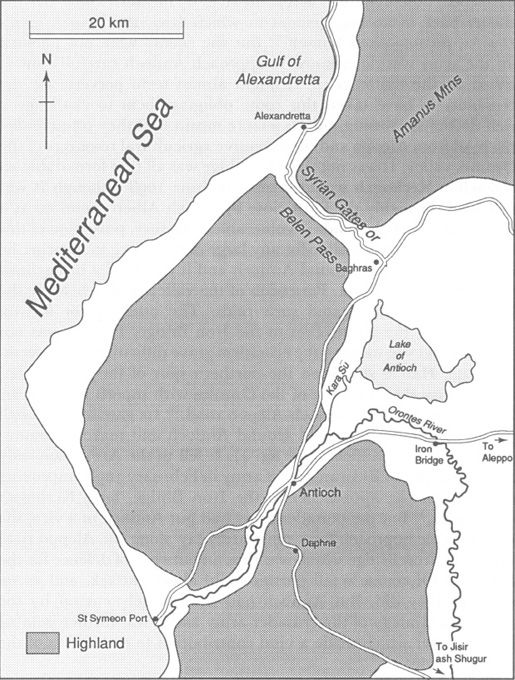
Fig. 7 Antioch and vicinity
We hear a good deal about naval activity in support of the crusade. Ships from Genoa, Pisa, Venice, Greece and England are all mentioned as being active during the crusade.40 Of their value to the crusaders there can be no doubt at all. By Christmas 1097 the army had eaten up everything in the immediate vicinity of Antioch and, despite its ability to draw upon a friendly hinterland across which much of the army had dispersed, was forced to mount major military expeditions to fend off starvation. In these circumstances food brought in by sea was probably a vital element in sustaining the army. Raymond of Aguilers speaks of western ships plying to Cyprus and protecting Greek shipping engaged in the same task and the visionary Peter Bartholemew sought food in Cyprus, while Bauldry mentions the sailors and merchants living by the coast who were killed during the second siege of Antioch.41 Ralph of Caen says that goods were imported into Laodicea from Cyprus and sent on to Antioch.42 Indeed, Cyprus seems to have played a key role as a source of food and supply for the army; when the leaders discussed their strategy with Alexius at Constantinople and Pelekanum, Cyprus must have been seen as a very important supply base. The crusaders arrived at Antioch about 20 October 1097; by the end of the month Adhémar, the Papal Legate, was sending a letter back to the West in conjunction with Symeon, Patriarch of Jerusalem, who is known to have been a refugee in Cyprus at this time, during which he sent lavish presents to the crusaders at Antioch.43 When Alexius promised to send supplies to the crusaders he was presumably thinking of Cyprus, the convenience of which, for the projected siege of Antioch, would have been known not only to the emperor but to all concerned. Most trading ships making for the Levant would have used Cyprus as a port of call and it was certainly known to pilgrims. Ordericus tells us that Abbot Thierry of St Evroul (1050–7) rested at St Symeon, the port of Antioch, before taking ship for Cyprus where he died.44 Ralph of Caen says that during the siege of Antioch, Robert of Normandy resided at Laodicea but sent food, brought from Cyprus, to the main camp at Antioch. As the army of Raymond of Toulouse, Robert of Normandy and Tancred marched south, it was the prospect of contact with Cyprus which was one of the factors which decided them to turn towards the coast instead of inland along the Damascus road.45 It is remarkable that chroniclers, as hostile to the Byzantines as Ralph of Caen and Raymond of Aguilers, mention Cyprus as a source of food for the army. This underlines the importance of the Byzantine alliance, and it was probably the Cyprus connection that made the other leaders reluctant to support Bohemond’s bid for Antioch at the conference of November 1098. The food and supplies they had received made it difficult to argue that Alexius had never supported them, and there was the prospect of more yet to come. This logistical and naval support was essential for the crusaders – it is hardly possible to believe that without such Byzantine help they could have survived the siege of Antioch.46
Sea power was important to the crusaders’ communications. According to a manuscript of Bauldry of Dol, a Greek living on the coast near to Antioch was able to take ship for Constantinople three days after the victory over Kerbogah on 28 June 1098 and bring news of it to Alexius in eleven days. At almost exactly the same time Hugh of Vermandois was sent to Constantinople overland, but did not arrive until 25 July.47 The relative speed of sea travel explains why the crusaders could write letters home. The risks of the slow overland journey to Constantinople were revealed when Hugh of Vermandois and Baldwin of Hainault were ambushed on their diplomatic mission to Constantinople and the latter killed, and by Albert’s story of the Danish reinforcements who were killed near Philomelium during the siege of Antioch.48 Adhémar of Le Puy was in contact with Symeon Patriarch of Jerusalem in exile on Cyprus within a fortnight of the arrival of the army before Antioch. He was probably in Cyprus again early in 1098; for he almost certainly inspired Symeon’s letter to the West of late January 1098 and it is likely that he was not present for the Lake Battle on 9 February. We are told that arrangements for the battle were finalised ‘in the house of the bishop’ which implies his absence. The bishops of Orange and Grenoble were brought to the East on a Genoese fleet.49 According to Ralph of Caen, when the crusaders at ‘Akkār thought an enemy was threatening, they dispatched Arnulf of Choques to Antioch on a little boat which travelled via the ports of Maraclea, Valania, Jabala and Laodicea to Antioch, while Stephen of Blois fled by sea, probably to Attalia, before striking inland to meet Alexius at Philomelium. One manuscript of the work of Bauldry of Dol reports that two clientes of Bohemond, who were present at Philomelium were determined to give their lord a Christian burial and so went to St Symeon by ship from Cyprus and there found 500 reinforcements newly arrived, presumably by boat. Reinforcements were brought by sea – Albert of Aachen mentions 1,500 arriving at St Symeon in August 1098 from Ratisbon, only to die of plague.50 Bruno of Lucca boarded an English ship in late 1097 and was at Antioch by early March 1098. Sea travel in winter was very hazardous and this journey demonstrates the determination of the sailors. He returned by the autumn of 1098 when his proud fellow-citizens wrote to inform the world of all that had happened.51 His journey shows just how far the crusaders could remain in touch with the distant West. Their envoys to the Egyptian Caliphate were told to go by sea and the Egyptian envoys, who came to Antioch in February 1098, certainly also travelled by boat. After the defeat of Kerbogah’s army, Bohemond sent the defeated prince’s tent to Bari as a trophy of victory.52 The naval power of the Greeks and the West which was concentrated in the Levant was absolutely essential to the success of the crusade, for although the reinforcements they brought were probably few their skills were of very great importance to the land army.
On 15 July 1097 a Genoese fleet of thirteen ships, twelve galleys and one hybrid oared ship, a sandanum, filled with armed men and equipment left for the East. It put into St Symeon, the port of Antioch, on 17 November 1097. A few days later, on 23 November, the leaders resolved to build a fortress on the mountain called Malregard.53 On 4 March 1098 an English fleet put into St Symeon, bearing Bruno of Lucca, and the very next day the leaders decided to build the fort outside the Bridge Gate which would be known as the Mahommeries Tower.54 On 17 June 1099, as the crusaders were besieging Jerusalem, a fleet of six ships put into Jaffa, amongst them two Genoese vessels. Immediately the leaders dispatched a strong armed escort to bring the supplies to Jerusalem, and when an Egyptian fleet threatened, the sailors burned their boats and went to Jerusalem where William Ricau served as the engineer who built the siege tower and other machines of the count of Toulouse.55 On this last occasion our sources stress the shortage of wood in the area. An early assault on the city had failed because only a single assault ladder could be built. It would seem that the fabric of the dismantled ships, the lumber they were carrying and above all the skills of the sailors must have been absolutely vital for the building of machines. Albert also reports that, because there was a lack of wood during the siege of Antioch an effort was made to build a fort by the St George Gate with stone and earth.56 This remarkable sequence demonstrates the close connection between supplies coming by sea and siege activity. Sailors were used to spars, masts, lashings and all the paraphernalia which was needed to build siege equipment – their coming meant not just raw material but much needed skills. It is worth remarking that at Nicaea Henry of Esch had built a machine which had collapsed in use, probably because of his lack of know-how.57 Fleets, therefore, provided a vital element of support for the crusader army and it is difficult to see how they could have succeeded without such naval support. The connection with Cyprus was probably essential during the long siege of Antioch, and this was kept open by a continuous Greek and western naval presence. They were fortunate that the Turks had no fleet, though corsairs and the like could easily have cut their communications with Cyprus if there had been no naval forces to protect them. Once they attacked the Fatimid lands the Egyptian fleet made itself felt, which underlines the importance of the crusader negotiations in neutralising it.58 Sea power was a vital element in the success of the crusade, but unfortunately it is very poorly chronicled and the particulars of its exercise are hidden from us. We know that a Genoese fleet of thirteen ships came into Levantine waters in November 1097, but we do not know how long it stayed or whether the two ships which appeared at Jaffa during the siege of Jerusalem were part of it or had come later. Pisan and Venetian ships are mentioned only in passing and we are given some highly confusing information about the English.59 We are very poorly informed on the question of ports.
During the siege of Antioch three major channels of supply are mentioned: the ports of Cilicia, Mamistra (Misis), Alexandretta (Iskenderun) and Tarsus, Laodicea (Latakia) on the Syrian coast, and St Symeon which was the port of Antioch some twenty-seven kilometres away at the mouth of the Orontes (see figs 2, 4 and 7). St Symeon port was by far the most convenient of these, for it was very close to Antioch, but the road passed in front of the Bridge Gate and so the Turks could easily attack people travelling down to the sea. Caffaro of Genoa has a vivid description of the fighting on the road to Antioch in November 1097, when a Genoese fleet of thirteen ships put into St Symeon.60 Alexandretta was more than sixty kilometres away, and to reach it involved a march over the Ammanus range via a road which Ralph of Caen described as very difficult; it also lead from the Bridge Gate so the early stages of any journey would be difficult. Laodicea was over eighty kilometres distant, and was not materially nearer to Cyprus than St Symeon.61 We know that the cities of Cilicia were captured by the forces of Baldwin and Tancred, but the question of how and when St Symeon and Laodicea fell to the crusaders is much more difficult. There is no mention of them being captured by any element of the army. Raymond of Aguilers tells us that when the army left ‘Akkār in May 1099 they were joined by a number of English sailors who burned their nine or ten vessels, all that remained of the thirty with which they had come originally. According to Raymond they had responded to the appeal for the crusade and ‘captured’ the ports of Laodicea and St Symeon even before the crusader army arrived at Antioch. His word obtinuerunthas recently been translated simply as ‘arrived at’, for which there is warrant though the sense of acquisition would be more frequent and more natural.62 However, we can be quite sure that Laodicea was captured by the time that the crusaders arrived at Antioch because Kemal ad-Din tell us that twenty-two ships came from Cyprus on 19 August 1097 and seized it, though he does not say to whom these ships belonged. In a letter written early in the siege, Anselm of Ribemont says it was captured at the same time as Tarsus, which tends to confirm Kemal ad-Din and Raymond of Aguilers that it had fallen before the army arrived at Antioch. The Florinensis Brevis Narratio Belli Sacri suggests that Laodicea fell after Nicaea.63 The sources are less precise on St Symeon, but they all seem to assume that it was in crusader hands from the moment of their arrival at Antioch without ever mentioning its capture. Moreover, within a fortnight of the start of the siege on 20 October 1097 Adhémar was in Cyprus with Patriarch Symeon of Jerusalem, and within a month a Genoese fleet could put into this harbour.64 There seems, therefore, good reason to believe that both St Symeon and Laodicea were captured from the sea before the crusaders reached Antioch, and every reason to accept Raymond of Aguilers’s statement that this was the work of an English fleet originally some thirty ships strong. This was clearly quite different from the English fleet which brought Bruno of Lucca to the East seven months later in March 1098.65 The existence, therefore, of an English fleet which arrived in the east before the crusade and continued through to the bitter end is established, though how it related to the English who brought Bruno of Lucca is unknown – and what did they do in the meantime? Some light is cast on this matter by Ralph of Caen who says that during the siege of Antioch Laodicea was held by the English who were sent by the Emperor Alexius. After the Norman Conquest of England many Anglo-Saxons took service with Alexius, perhaps with the consent of William, and formed a permanent element in the Byzantine forces. Amongst them was a fleet which probably helped to save Constantinople in 1091 under Sigurd or Siward Barn. It is entirely possible that it was just such a force which took Laodicea. Finding themselves threatened from landward attack, these English appealed to Robert of Normandy as in some senses their natural lord and he came to the city where he found life so easy that it was only much later, and after three appeals for help, that he was persuaded to abandon it, for it was well supplied from Cyprus. However, he did send generous supplies to Antioch. Ralph gives no dates, but his suggestion that Robert was absent from the siege is supported by the fact that the sources do not often mention any activity of his during much of the siege, and Raymond of Aguilers says that by December 1097 Robert was absent.66 The implication of Ralph’s statement is that the capture of Laodicea, and perhaps St Symeon also, was the result of co-operation from the emperor, presumably based on Cyprus. It does not precisely contradict Raymond’s statement that the English had come from their own lands for we know of another English fleet which came in March 1098 and Raymond may have muddled the two. It would be remarkable if the departure of an English fleet to the East had not attracted some attention from native chroniclers, and Ordericus Vitalis records that during the second siege of Antioch (June 1098) Edgar Aetheling led a fleet with 20,000 men from England and the other islands and seized Laodicea, which he afterwards gave to Robert Curthose who left a garrison there during his march to Jerusalem. However, the Greek protospatharius Ravendinos drove out the Franks.67 Now much of this story was clearly confused. Laodicea was conquered long before the second siege of Antioch. In late 1097 Edgar the Aetheling was engaged in imposing his nephew on the Scottish throne so it is unlikely that he joined the crusade. Moreover his actual pilgrimage to Jerusalem is very precisely dated to 1102 by William of Malmesbury.68 In any case, it is hard to believe that if Edgar had come to the East the fact would have escaped the attention of crusading chroniclers, simply because he was of royal blood. Ordericus’s evidence strengthens the suggestion that Robert of Normandy held Laodicea at some time, as does Guibert’s remark that the citizens of Laodicea revolted against Robert and abjured the use of the money of Rouen.69 But Ordericus does add something more – that after Robert Laodicea passed to the Greeks. Ordericus’s story was told in order to explain Bohemond’s siege of the port which was definitely held by the Greeks in September 1099 at the time when the main army was returning from Jerusalem.70 Caffaro of Genoa, who had been in Syria early in the twelfth century, records that at the time of the final capture of Antioch the city was held by Eumathios Philokales, duke of Cyprus.71 As Robert Curthose quite definitely fought against Kerbogah in June 1098 this suggests that he relinquished the city to the Greeks – who, after all, are portrayed as the masters of the English – either because of revolt in the city or because of repeated calls from the other leaders, as reported by Ralph of Caen, to come to Antioch or indeed possibly because of both factors. It is very likely that the Greeks were in control of Laodicea by the autumn of 1098 at the latest, because Raymond of Aguilers reports that at the end of the siege of ’Akkār after a vision, Raymond of Toulouse sent Adhémar’s brother to recover the dead bishop’s cross and mantle which had been left at Laodicea.72 Raymond would surely only have left such valuable things at Laodicea in the care of friends – and after the fall of Antioch he was in close alliance with the Byzantines. However, the story of Laodicea and the English fleet is immensely complicated by the very different stories told by Albert of Aix.
According to Albert, when Baldwin was at Tarsus during the Cilician expedition he suddenly saw a fleet ‘whose masts of wondrous height were covered in the purest gold and shimmered in the rays of the sun’. The sailors were commanded by Guinemer of Boulogne, their caput et magisterwho had been a man de domo comitis Eustachii a close associate, therefore, of the house of Boulogne. They explained that they were men of Flanders, Antwerp and Frisia who had been living for eight years as pirates and had landed in order to divide their loot, and they asked Baldwin and his friends what they were doing. On hearing of the crusade they agreed to join it. Three hundred of them joined with two hundred of Baldwin’s men to garrison Tarsus, while the rest reappear in the suite of Tancred as he seized fortresses in Cilicia and the port of Alexandretta.73 Subsequently, just as he is about to tell us of the Lake Battle in February 1098 Albert says that Guinemer, after he had left Baldwin and Tancred at Mamistra, took once more to the sea and captured Laodicea, but got no support because he contributed nothing to the army. His guard was lax and the Greeks managed to take the citadel of Laodicea and threw him into prison, from whence he was later liberated after the victory at Antioch at the special request of Godfrey of Bouillon.74 This is all very odd and is further complicated by a quite separate story which Albert tells later. At the end of the crusade the returning armies found Bohemond and Daimbert of Pisa besieging Laodicea, which, Albert says, had been captured from the Saracens by Guinemer with a fleet manned by the same people as before, but this time including Danes, and allied with the men of the lands of Raymond of Toulouse. After the fall of Antioch, Guinemer handed the city over to Raymond of Toulouse; after this he was captured and imprisoned by the Greeks and freed at the request of Godfrey. When Count Raymond marched south, faithful to his oath to Alexius, he turned the city over to the Greeks.75 The contradictions in these stories are evident. In one story Guinemer seems to have been thrown into gaol during the siege of Antioch, while in the other he appears as holding the city until the summer of 1098 when he turned it over to Raymond, and was then put in gaol. In the earlier story he is clearly stated to have been freed at the request of Godfrey shortly after the victory over Kerbogah when Yaghisiyan’s wife was being ransomed – but this date was not possible in the later story. In the second story the Danes are added to the list of people in the fleet and the Provençals suddenly appear as allies, apparently as a result of early contact with them. Furthermore, the passage about the masts of the fleet has a very poetic ring and Albert is known to have used poetic source material including that which underlay the Chanson d’Antioch.76 However, we need not dismiss Guinemer altogether, for such wanderers were not so very unlikely. Robert the Frisian, a younger son, was given money and a fully equipped boat by his father, Baldwin V of Flanders, in order to make his fortune and, although the stories which accrued later about him were fantastical, the simple core of the story indicates how adventurous people could travel afar.77 It seems likely that some of the Anglo-Saxons who fled England after the conquest were accommodated in the distant Crimea and there was probably an important English presence at Constantinople.78 When we consider the range of western mercenaries serving the Byzantine emperor and the Zirids of North Africa at this time, we ought perhaps to see Guinemer as a real person, and it should be noted that his story does not appear to derive from the Chanson d’Antioch and that Albert does break into lyrical passages from time to time, as in his description of Godfrey’s army rushing to the relief of Bohemond at Dorylaeum.79 Albert was not generally interested in fleets at all – his sources were apparently men of the army, generally incurious about maritime matters. It is remarkable that, although he gives us a very detailed account of the capture of Jerusalem, he never mentions the arrival of ships in Jaffa whose importance we have noted; it was the Provençals who provided their escort from the coast and the men of Godfrey were not involved.80The great exception to his disinterest, and probably that of his informants, was Guinemer and the reason for that is obvious – he was a close connection of the house of Boulogne. Guinemer probably did help in Cilicia as indicated, but Albert attributes the capture of Laodicea, by a northern fleet, to him. Albert was then faced with different accounts of his activities, probably given to him at different times, which he could not reconcile. The essential difference between the two stories as they concern Laodicea is the influence of the count of Toulouse in the later version and the different dating which, by implication, this imposed. Guinemer, after helping in Cilicia, was captured by the Greeks, perhaps held at Laodicea, and released at the request of Godfrey. Laodicea was captured on 19 August 1097 by an English fleet either acting on Alexius’s orders or in conjunction with Byzantine forces in Cyprus, which then based itself in the city to which it invited Robert of Normandy. His departure, almost certainly at the time of Kerbogah’s march to Antioch, saw the city fall to the power of the Byzantine Governor of Cyprus, who may well have co-operated with Raymond of Toulouse before the latter’s departure south. After the siege of ’Akkār the English sailors abandoned their now useless ships and joined Raymond who, after the crusade, took possession of the citadel of Laodicea with 500 men in the name of the emperor.81 At some time after the main army had gone home, Alexius ordered Raymond to hand over Laodicea to Andronicus Tzintziloukes.82 The matter of Laodicea is important, for it shows us the degree of co-operation between Byzantium and the crusaders. The early arrival of the English fleet in Byzantine service in August 1097 prepared the way for the crusader army, for whom its activities protecting the route to Cyprus were very important. Of the other English fleet which arrived in March 1098 we hear no more, but it is possible that elements of it joined the English already in the East and based at Laodicea. The Genoese fleet which arrived in November 1097 also seems to have left ships behind, or perhaps was followed by others, and they too plied to the islands as we know from Raymond of Aguilers. Bauldry of Dol mentions Venetian ships, as does Raymond of Aguilers, and also Pisans – which probably refers to Daimbert’s fleet.83 Of the Venetians’ activities we know nothing, but then there seems to have been quite a settlement of sailors and traders at port St Symeon, and small contingents like that of Guinemer must have arrived from time to time to play a role.84 This great maritime endeavour, led and supported by the Byzantines, was one of the key factors which enabled the crusader army to survive the bitter nine-month siege of Antioch and to triumph over their enemies.
The arrival of the army before Antioch on 21 October triggered a debate on strategy. The suggestion was made in the council of leaders on 21 October that the army should mount a distant blockade of Antioch. Those who favoured the idea pointed out that the army was tired – they had after all been marching for some four months – and much of it was dispersed amongst captured strong-points. Better to sit out the winter in comfort, they urged, and wait for the arrival of reinforcements from the emperor and the West. It was an intelligent idea and evidently was supported, and perhaps even conceived of, by Tatikios who may well have known that this was the method by which the Byzantines had recaptured Antioch in 969 when Baghras was an important base (see fig. 7).85 Tatikios revived the idea when the army was starving in January and February 1098. The count of Toulouse, however, urged his comrades to trust in God and pressed successfully for an immediate and close siege, and this was the course of action taken.86 The great virtue of the close siege was that it kept the army together under the control of its leaders; a distant blockade could have had a very adverse effect on the sense of purpose of the Christian army. However, many crusaders were on garrison duties away from Antioch and Raymond of Aguilers says that knights were all too eager for such work.87 These captured fortresses and cities were the fruits of the Armenian strategy which the crusaders had followed, and despite Raymond’s fulminations it now served them well. As already noted, the Armenian population sent aid and their merchants sold food, albeit at a high price, but the availability of these lands as a source of food was very valuable. The presence of many knights in fortresses facilitated this and reduced the food problem to a degree. In effect, the crusaders imposed a close siege upon Antioch and enjoyed some of the benefits of a distant blockade and their situation was later improved when Baldwin of Boulogne took over Edessa.
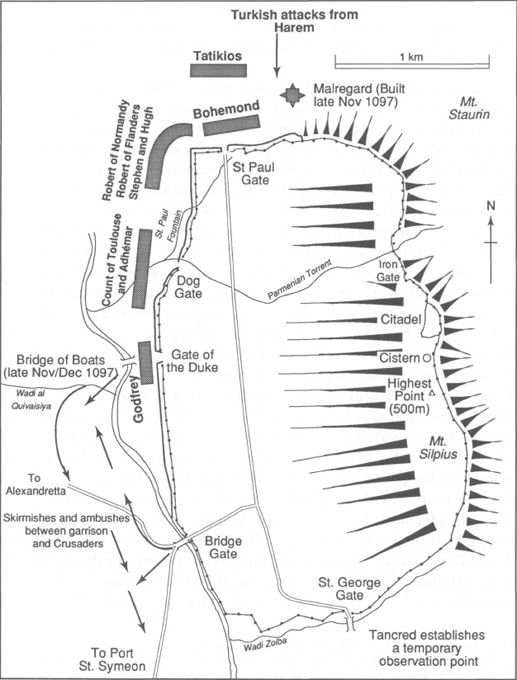
Fig. 8 Siege of Antioch, October 1097 – February 1098
The reason for this debate was quite simply the scale of the problem which they now faced. Antioch was no longer the magnificent city of late Roman times, when its population had reached 300,000 and it rejoiced in its position as capital of the East. Its prosperity was ruined by a series of disasters – the fire of 525, the earthquakes of 526, 528 and 588, the Persian sack of 540, the plague of 542 and the Arab capture of 638. However, though the inhabited city was much reduced, it still sheltered within the walls of Justinian’s rebuilding completed by 560 and as modified by earthquake, war and the ravages of time.88 The crusaders were much struck by the splendour and strength of the place, as was Ibn Butlân in 1051 when he described its walls as having 360 towers: archaeological investigation has found evidence of over sixty (we are not sure of the original total).89 Antioch was built on the eastern bank of the Orontes river, though its walls touched the stream only at the Bridge Gate (see figs. 7 and 8). The fortified area was about three kilometres long and two kilometres deep extending up the eastern wall of the Orontes valley formed by the northern extension of the Jebel al-Ansariye. The mass of Mount Silpius included in the enceinte rises to a height of 512 metres and about 700 metres north of its highest point stood the citadel, rebuilt after the Byzantine reconquest of 969 and dominating the whole enclosure. The wall then dropped into the deep gully of the Parmenian torrent where the Iron Gate restrained this dangerous stream before climbing onto the southern flank of Mount Staurin and then descending sharply to the plain by the Orontes at the northern edge of the city.90 The crusaders approached the city from the north, and here in the valley bottom the wall was pierced by three gates which the crusaders called the St Paul Gate at the very foot of the mountain, the Dog Gate further along and then the Gate of the Duke nearer the river. This northern wall of the city was a double wall, for Albert of Aix mentions an outer wall in connection with operations outside the Dog Gate and tells us that Tancred lurked in the space between the main wall and the barbican before launching a surprise attack on the besiegers during the second siege.91 Beyond the Dog Gate the wall angled towards the river bank, though it is not clear that the outer wall continued at this point, which it met at the Bridge Gate giving access to the plain on the west bank of the Orontes and the roads to St Symeon Port, Alexandretta and Marasch. After that the wall followed the river fairly closely then turned away from it to the St George Gate, from which a road ran to the ancient suburb of Daphne and beyond down to Laodicea and inland to Syria via the Jisr ash-Shogur. The wall then followed the line of a gorge, the Wadi Zoiba, rising up onto Mount Silpius. The inhabited part of the city nestled down on the lower slopes of Mounts Staurin and Silpius and the narrow strip of plain by the Orontes. In ancient times the city’s dominating feature had been the great colonnaded Street of Herod and Tiberias, running from north to south. It must have existed in some form in crusader times, for its line has now survived in the modern Kurtulus Caddessi. But there was a huge and barely inhabited area within the circuit of some twelve kilometres, amply studded with towers. In Byzantine times the city was held by a garrison of 4,000, such was the passive strength of the defences and their inaccessibility. Yaghisiyan seems to have had forces of about the same size. Raymond of Aguilers, as we have noted, suggests a garrison of 2,000 first-rate knights, 4,000–5,000 other mounted men and more than 10,000 foot. Stephen of Blois gives a total number of 5,000 enemy troops in the city which was probably much nearer the mark for the evidence of events suggests that the garrison was no more than adequate for its task. At the end of December 1097 the crusaders sent a major foraging expedition out into Syria at a time when Duqaq of Damascus was approaching with a relief army; on 9 February 1098 the crusaders fought against another relief force under Ridwan of Aleppo. On both occasions Yaghisiyan’s garrison mounted major sorties in support of the expected relief but although these punished the crusaders they were not strong enough to inflict a major defeat upon them nor to burn the Bridge of Boats which enabled the crusaders to cross the Orontes and threaten the Bridge Gate or travel to St Symeon. When the crusaders threatened to build a counterfort outside the Bridge Gate, Yaghisiyan made a desperate effort to prevent it by ambushing the supply column coming up from the coast, but despite initial success he was unable to prevent the construction.92
Once they had resolved upon a close siege the crusader leaders were forced into a cautious strategy. Because Antioch was so large the risk to the attacker was dispersal of his strength. There could be no question of surrounding this huge area; the crusader army was not big enough and any effort to invest a considerable section or sections would open the way for the enemy to sally out and defeat the crusaders in detail. Nor was there much chance of a sudden assault being successful. In the flatter areas the defences were formidable and the enemy could move their forces about quickly. In the mountains it would be very difficult to move large bodies of troops across the jumble of rocks, ravines and harsh slopes and to sustain them while they tackled the walls which rise to twelve metres and are sited to take advantage of the very rough terrain. Of course this cut both ways – the enemy could not seriously assault them from this direction, but with their knowledge of the pathways of the area the Turks could and did mount raids which sapped crusader strength. There is a back road to the high eastern defences of the city; today it leaves the Aleppo road some two kilometres north of what was the St Paul Gate and winds around the city passing via the modem Altinözü into the upper Orontes valley near the Roman bridges at Jisr ash-Shugur which give access to the Syrian plain. There was certainly at least a path here, for its use was vital in the final crusader assault on the city and it probably led to the Roman road from Antioch via Delphi to the Jisr ash-Shugur (see figs. 4 and 7).93 It was presumably used by both sides for raiding. But the dominating factor which shaped the actions of the army, once they had decided on a close siege, was the need to avoid dispersal of effort. This explains the very slow and very systematic extension of the siege, so that as late as March 1098 Bruno of Lucca could tell his fellow citizens that the army ‘had surrounded the city in siege, though not very well’.94 The crusader army had approached from the north and it was from here that they systematically extended their grasp over Antioch. It was not perhaps the ideal position but they were well placed to fend off enemy attack coming down the Orontes valley onto their rear and to have attempted to establish major forces on the west bank of the Orontes opposite the Bridge Gate immediately would have strained the army’s resources (see fig. 8). The sheer size of Antioch enjoined upon the crusaders a cautious strategy of building up the blockade; Kerbogah’s failure to appreciate this problem was later a major factor in his defeat. In the first phase of the siege, which would last until Christmas 1097, the crusader army steadily extended its grip on the city, though at a great cost in lives.
Albert of Aachen’s account of the order of battle of the besieging army is largely supported by that of Ralph of Caen. Neither the Anonymous nor Raymond of Aguilers gives an order of siege such as that which they provide for Nicaea.95 Albert says that Adhémar of Le Puy commanded the army for the approach to Antioch but does not make clear that Bohemond had already gone before and arrived at Antioch on 20 October.96 He gives a poetic description of the army in all its glory and numbers – 300,000 – as it took lunch on 21 October 1097 close to the city at a place called Altalon. He then records its deployment for the siege (see fig. 8). Albert seems to have been given an order of siege related to the point at which the army came up to the city on its north wall by the St Paul Gate. He says that a group of lesser figures, Tancred together with Roger of Barneville and Adam FitzMichael established themselves close to ‘Altalon’ and kept the Turks blockaded there which suggests that this group was close to Bohemond who took ‘the gate towards Persia, at the point where the mountain meets the plain’ – a good description of the location of the St Paul Gate, the natural point of entry for any force coming down the valley of the Orontes. Ralph confirms that Tancred was close to Bohemond but suggests that he was encamped with the next contingent along, the North French. Albert says that Tatikios, whom Ralph never mentions, took up station somewhat back from the city wall, but forward of him were Baldwin of Hainault, Robert of Normandy and Robert of Flanders. Beyond these were the forces of Stephen of Blois and Hugh of Vermandois. This is confirmed by Ralph, with the exception of the names of lesser leaders. Somewhat later, after a brief description of the city, Albert makes it clear that Adhémar and Raymond of Toulouse were attacking the Dog Gate, and that beyond them was the gate besieged by Godfrey opposite which a pontoon bridge was later constructed across the Orontes. Ralph’s more schematic description also appears to confirm this. This left the army with major problems which are rather well summarised by Ralph of Caen.97 St Symeon was their obvious port of supply, but via the Bridge Gate the garrison was in a position to cut the road and to raise havoc with small groups or individuals foraging in the plain to the west and south of the city. They could also attack traffic going to Laodicea and, to a lesser extent, Cilicia. Their access made it difficult to establish a force along the southern part of the wall; south of the Bridge Gate the western wall was so close to the river that an attacking force could have done nothing, while the southern wall was built on a deep gully, the Wadi Zoiba, which made it almost unapproachable. On this side the St George Gate, giving access onto the road to Laodicea, was the only point on the southern circuit worth attacking but as long as the enemy had free access over the Bridge Gate this was hazardous. In addition, the garrison could sally forth from the western side of the river and fire on the Frankish camps close to the walls, and this, as Raymond of Aguilers reports, they did.98 Control of the bridge over the Orontes in front of the Bridge Gate was therefore the vital point in the attack on the city. As long as that gate was open the garrison could take the initiative and could easily bring in supplies via the unguarded St George Gate which it covered. There was, however, a limit on what a garrison of not more than 5,000 could achieve. Yaghisiyan could only harass the crusaders in the hope that they would tire of the siege or that they would be defeated by the allies he was actively seeking. For the crusaders, it was vital that they close the Bridge Gate because of the damage the garrison could inflict upon them. This was not achieved until March of 1098, by which time the siege was six months old. In that period there were other priorities pressing upon the crusader army.
The crusaders seem to have recognised that there was little chance of taking Antioch by assault, and nothing of the sort seems ever to have been suggested. Stephen of Blois, who would later be chosen to command the crusade, remarked to his wife that Antioch was ‘a city great beyond belief, very strong and unassailable’ and this opinion was supported by Raymond of Aguilers while Fulcher suggests that the leaders adopted a Micawberish policy of sticking out a siege and seeing if something would turn up.99 All these are writing with hindsight but Fulcher was probably right in a sense. All they could do was to conserve their own forces and squeeze Antioch, disrupting the normal life of the city in the hope that something would give. They were probably aware that the Greeks had seized it in 969 after a blockade, by corrupting one of the commanders, and that treachery had opened its gates to Sulayman in 1086.100 This strategy of blockading Antioch meant that there were very few siege operations such as those we have noted at Nicaea. Early in the siege Adhémar and Raymond were faced by constant sallies from the Dog Gate. Outside it, just below the confluence of the Parmenian torrent and the stream from St Peter’s fountain, was a marshy area with a small bridge (see fig. 8). The Provençals first tried to demolish the bridge with hammers and other tools but it was too strong. Then they built a wooden penthouse covered with osier which they pushed onto the bridge; this would not only have prevented sallies but would have also acted as a base for operations against the gate. The enemy showered the machine with arrows – probably the real reason the bridge could not be demolished – and the Christians replied with bows and crossbows, but the defenders sallied forth and drove off the attackers and set the penthouse on fire. Then three mangonels were built in the hope of destroying the outer wall which defended the city at this point, but they failed. In the end the Provençals organised masses of men (Albert says 1,000) to block the bridge with huge stones and tree-trunks.101 Albert never dates this fight but it seems to have occurred early on, before the Bridge of Boats, which was certainly in place by December 1098, was built.102 Another machine was used in late March or April 1098. After the building of a fort outside the Bridge Gate, the leaders decided to built another penthouse, a talpa which they pushed onto the bridge with a view to breaking it down, thereby preventing any further enemy sallies. Although it got onto the bridge and began its work, the enemy caught its crew asleep and burned it, much to the irritation of the army as a whole.103 In neither case was the machinery used in an all-out assault – merely as a means of tightening the screw on Antioch.
The very early part of the siege was remembered by the chroniclers as a happy time when food was plentiful and the enemy quiescent; with the resources of the Orontes valley and the Amouk at their disposal, and fairly free access out into the Syrian plain foraging was easy. But this did not last for long as enemy forces from Antioch and Harem began to harass the army. The main effort of the garrison seems to have been devoted to attacking along the west bank of the Orontes from both the Bridge Gate and the St George Gate, near which there was a ford, cutting communications with St Symeon (see fig. 8). Their activities figure large in the accounts of Raymond of Aguilers and Albert, for the forces about which they are best informed were close to this area. The Anonymous does not mention this fighting – he was preoccupied with enemy raiding down the valley of the Orontes and the mountains above Bohemond’s camp.104 The crusaders identified Harem as the main base of these raiders and sent Bohemond and Robert of Flanders to attack it (see fig. 4). Their scouts found it but were driven back to where Bohemond’s main force lay in ambush. In the subsequent fighting, Alberadus of Cagnano was killed and Herman of Cannae lost a horse, but the enemy suffered numerous casualties. Harem was not taken and remained such a grave threat that when materials and skilled men arrived with the Genoese fleet on 17 November the leaders resolved to build a fort, which later rejoiced in the name Malregard, on the hill above the camp of Bohemond.105 It was well placed to check enemy raids coming down the Orontes valley or around the back of the city’s defences.
Much greater pressure was exerted upon the garrison of Antioch by the construction of the Bridge of Boats (see fig. 8). Albert of Aachen is very clear about its purpose – to check enemy raids and open the road to St Symeon, and he is quite clear that it was situated near to the Duke’s Gate which the Germans besieged.106 It enjoyed a limited protection because attackers had to cross the Wadi al Quivaisiya which flowed into the west side of the Orontes a little way to the south. Unfortunately, nobody says when it was built, but it was certainly in place by the time of the foraging expedition of December 1097.107 Ralph mentions the new bridge but his account of the siege is schematic and the author of the Gesta Francorum never mentions it. Albert’s dating at this point is very poor and he is ignorant of the expedition to Harem, the building of Bohemond’s tower and the arrival of the Genoese fleet, but the context of his account suggests that the Bridge of Boats was built in November 1097. Christmas can certainly be taken as the absolute outside date for the building of this bridge and the probability is that it was built much earlier, drawing on the materials and expertise brought by the Genoese. The pace of siege warfare was, by modern standards, intolerably slow but we can see just how active and organised the crusaders must have been. It was no small achievement to construct Malregard and the Bridge of Boats, which must have been fortified to withstand enemy attack, in a period of less than six weeks, at a time when the army was depleted by knights who were keen to serve outlying forts and when there was a good deal of continued small-scale fighting.108 This is a tribute to the smooth functioning of the collective leadership which was probably well suited to the conduct of a siege with its deliberate pace. The crusaders must have been painfully aware of how open Antioch was on its southern flank, and Albert says they awarded Tancred forty silver marks per month and sent him into the mountains to establish a camp to blockade two gates on that side of the city and observe enemy movements. It is not clear which two gates are intended but one is described as being in the mountains and the other near the Orontes, which suggests that Tancred was between the St George Gate and the posterns above it.109Raymond of Aguilers and the Anonymous both say that Tancred was paid to establish a fortress outside the St George Gate in April 1098. It is possible that Albert has misdated the event but he appears to be telling us about some earlier initiative so perhaps the episodes of gallantry and success related by Ralph of Caen occurred at this time. Moreover, in the New Year of 1098 the Anonymous describes this area as ‘Tancred’s mountain’ and Albert says specifically that Tancred abandoned this position at the end of 1097. Indeed, the emphasis in Albert’s account of Tancred’s doings is on surveillance and fighting in the mountains, rather than the counterfort at the St George Gate of which we hear later.110 If Tancred did establish himself here for a time it must have been a blow to the city. Their garrison was aggressive in its efforts to attack the crusaders and they enjoyed the great advantage of height, for from Mt Silpius they could observe the whole crusader army and its movements. This was the other side of the coin. The crusaders had begun a war of attrition – Yaghisiyan tried the same thing. By the Gate of the Duke there were woods where some of the Franks relaxed. On one occasion a noble archdeacon of Metz was playing dice with a lady when they were ambushed and on another Arnulf of Tirs was killed going to the rescue of some people who had been ambushed. After this, Godfrey ordered the clearing of the woods.111 Albert lamented the sufferings of the army: ‘Morning, noon and night every day there were these sudden attacks, sallies, scenes of carnage and endlessly you could hear in the Christian camp always new lamentations over further losses’.112
Tancred on his eminence could not always check the enemy. In vengeance for such suffering, Hugh of St Pol and his son Engelrand crossed the Orontes by night and the next day sent a foot-soldier out onto the road before the Bridge Gate as a lure. They killed two of the Turks who pursued him and captured the two others, and the rejoicing in the camp at the sight of these prisoners indicates the strain of the siege.113 On another occasion the Turks were shooting across the river at the Christians; they hoped to inflict losses and to draw any force sent against them into an ambush. Engelrand of St Pol led a force across the Bridge of Boats and killed a Turkish horseman, but he had to be careful not to pursue the Turks into their ambush. The strategy to which the crusaders were committed meant a long drawn-out war around Antioch in which encounters such as this, and the business of blocking roads, raiding and bearing enemy raids, would be the day-to-day experience of the army. Sometimes there were greater deeds. The Anonymous records the attack on Harem. Albert tells us that after the building of the Bridge of Boats, which was about a kilometre upstream of the Bridge Gate, there was a major fracas. A group of 300 knights and foot crossed the bridge to forage when the enemy sallied forth, causing heavy casualties and driving the survivors back to the new bridge. The leaders then launched 5,000 mounted men (the figure is surely a gross exaggeration), mostly in mail shirts, against the enemy, Henry of Esch swam across, though fully armoured, rather than endure the delay to get on the bridge. The Turks retreated, then called up reinforcements who pushed the Franks back to their bridge causing heavy losses, especially amongst the foot-soldiers.114 This kind of warfare must have been nerve-wracking and exhausting to both sides. However, the effect upon the crusaders must have been brutal for they were out in the open while the Turks at least had a secure base.
Against this background, the advance of the siege by the building of Malregard and the Bridge of Boats indicates a pattern of considerable effort and organisation in the period up to Christmas 1097. As we have already noted, there was a common fund and presumably it was from this that Tancred was paid. The committee of leaders seems to have had real authority. It was their collective decision, as we have seen, to impose a close siege on Antioch, to attack Harem, to build Malregard and to launch the expedition which resulted in the foraging battle of 30 December 1097. In the absence of Adhémar and perhaps Robert of Normandy, the leaders met to decide on dispositions for the Lake Battle on the night of 8 February 1098 and decided on the building of the Mahommeries tower in March and Tancred’s fort outside the St George Gate in early April. The matter of how to deal with the proposed betrayal of the city was debated by them, probably in two meetings at the end of May or early June 1098.115 It is no wonder that, speaking of the decision to launch the foraging expedition of late December 1097, Albert speaks highly of the authority of the Council: ‘For it had been decided from the first that no person, great or small had the right to oppose that which was ordered in the name of the whole army.’116 This committee was probably rather wider than the important princes and it is possible that yet wider assemblies were held for special purposes on occasion. At the start of the siege, all the leaders swore an oath to see the matter through and there was a similar oath taken in the emergency of the second siege of Antioch. The Anonymous’s account of the decision to build the Mahommeries Tower can be read as having been taken in a wider assembly in which all applauded the proposal of the leaders.117 They certainly seem to have run the siege competently. The construction of counterforts like Malregard and Tancred’s more temporary structure by the St George Gate was a familiar part of the repertoire of war as we have seen, but considerable authority, organisation and, above all, harmony would have been needed to achieve it in the difficult circumstances at Antioch.118
In a general sense they were very experienced in this war of attrition which they were now embarked upon, for it resembled the campaigns so many of them had waged or participated in throughout the west; raiding, destroying, foraging, small-scale conflict, this was what they were used to. But the hit-and-run methods of the Turks, evolved out of the circumstances of steppe warfare, were peculiarly well suited to the circumstances of the siege of Antioch where small-scale skirmishes were the norm, as we have observed and rapid fire very effective. These tactics had been grafted onto Moslem armies generally.119 Albert describes the sallies which killed Adalbero of Metz and Arnulf of Tirs, but stresses that the Turks were always pouncing on pilgrims in the plain, opposite the city, going to St Symeon or looking for food. Raymond of Aguilers, speaking of the fighting outside the city when the Turks had heard of the absence of much of the army on the foraging expedition at the end of December 1097, makes it clear that this kind of thing had become a way of life:
‘They repeated their customary assaults. The Count, moreover, was compelled to attack them in his usual manner’.120
The use of language in this passage is a revelation of military reality.121 But the crusaders did learn from the march across Asia Minor and the dangerous small-scale fighting outside Antioch. Albert reports how Hugh of St-Pol was moved by the losses of the foragers and mounted a revenge attack with his son Engelrand and their following. The garrison then sent out twenty mounted men who turned in their saddles and fired arrows backwards across the river into the camp, hoping to provoke the Franks into a pursuit which could then be ambushed from inside the Bridge Gate.122This was certainly what happened, according to Raymond of Aguilers, during the absence of the foraging party in December 1097, when Turks sallied out from Antioch and drew the Provençals up to the Bridge Gate where reserves fell upon them. Although it was recognised that the Turks were trying to provoke the crusaders on this occasion, Engelrand of St Pol was again sent out to prevent them from being seen to have gained a victory of sorts by enjoying immunity, but he took care not to pursue the enemy too far, and a general and highly confused mêlée then developed on the plain before the city, with knights and Turks criss-crossing like Spitfires and Messerschmits in a dogfight, and indeed the comparison is apt for in both cases there was a huge audience watching their champions. Albert records evident delight and applause when Engelrand unseated and killed a Turk with his lance, but stresses that he was very careful not to get trapped.123 The crusader instinct, indeed the only sensible tactic in view of Turkish fire-power, was to close with their enemies. When attacked by the army of Damascus during the foraging battle of December 1097, Raymond of Aguilers says that Robert of Flanders charged at them, forcing them to retreat. The dangers of this instinct were all too obvious – they led to heavy losses at ’Artāh and to the loss of Roger of Barneville at the start of the second siege of Antioch as small crusader forces were drawn into ambushes.124 To prevent charging too far, there needed to be clear command in any particular action – supplied by Hugh of St-Pol in Albert’s story, but this was a very difficult problem on a larger scale in an army run by a committee. Another natural response of the crusaders was to close ranks for mutual protection, a tactic we have described used by the Byzantines and the crusaders themselves at Dorylaeum. During the fighting on the plain outside Antioch, at the time of the foraging battle, Raymond of Toulouse organised his footmen into close order and it was with a tortoise of interlocking shields that the Iron Gate was carried. In the spring of 1098, when the Mahommeries Tower had been built, some Provençal knights were ambushed nearby; they formed a circle abutting an old house and so prevented the enemy from outflanking them. A manageable solidity was organised in the cavalry in the Lake Battle by dividing them into squadrons.125 There is every sign that the mass close-order charge of knights with lances couched was being used increasingly. In the disastrous charge at ’Artāh, Ralph says that after initial disorder the Franks organised themselves and charged. ‘At the first shock the lance goes forward, pierces and throws [the enemy] down.’ Describing the relieving charge led by the count of Flanders in the same fight Albert says that the Franks ‘attacked the enemy with their lances held before them’. We have noted that Engelrand of St Pol unhorsed his victim with his lance before killing him, the classic pattern of knightly encounter and in his skirmish the Turks are described as fighting with bows, the crusaders with lances. Baldwin of Edessa fell upon the advance guard of Kerbogah’s attack on his city ‘with the lance of the Franks and the bow of the Armenians’.126 The examples of Hugh of St Pol in the plain outside the Bridge Gate and Bohemond during the attack on Harem show the Franks learning to set ambushes themselves. It was a difficult business, but the disciplines of war were forcing the Franks into methods of countering Turkish tactics, and above all the fire-power upon which they were based.
We tend to make a sharp distinction between a siege and field warfare, but in reality this is false. A siege was a kind of battle involving most of the general techniques of war in addition to some specialised ones. In the case of Antioch the nature of the crusader strategy – a close blockade without assault – makes the point very clearly. The opening phase of the conflict had seen the crusaders gradually tightening their grip on the city, though at a terrible price. In the next phase they were to be seized by a crisis of supply. One vital aspect of all war – and we have noted Vegetius on the point – was to deny the enemy food. For the crusaders this was easier said than done, for Antioch appears to have been well-stocked. Had it not been, then the siege simply could not have endured. But also food could find its way into the city through the St George Gate and the Iron Gate, even perhaps the Bridge Gate, and, in addition, all the posterns along the mountains. In the end such supply was not satisfactory for a major city, especially one with large disaffected elements – Syrian and Armenian Christians of which the crusaders were well aware. The Anonymous claims that many of them were forced to fight for the Turks because their womenfolk were hostages.127 But it must be repeated that attrition cuts both ways. In any siege the attackers are at least as likely to starve as the defenders – and by Christmas 1097 this situation was hurting the army badly.
1 ’Thus the princelings of Syria, when the crusaders arrived, had for making war only the handful of slaves which the revenues from their meager provinces enabled them to buy.’: Cahen, ‘The Turkish invasion’, 165.
2 On this theme of God’s delivery of the army see especially Blake, ‘The formation of the Crusade Idea’, 11–31, and the further discussion in Riley-Smith, Idea of Crusading, pp. 91–119.
3 R. W. Crawford, ‘Ridwan the maligned’, in J. Kritzeck and R. Bagley-Winder, eds. Studies in Honour of P. K., Hitti (London, 1959), pp. 135–9.
4 Cahen, ‘The Turkish invasion’, 152, 165–7.
5 B. Lewis, ‘The Isma’ilites and the Assassins’, in K. Setton and M. W. Baldwin, eds., A History of the Crusades, 1. 111; Crawford, ‘Ridwan the maligned’, 135–44 sees his policy purely in political terms. On his relations with the Fatimids see Köhler, Allianzen und Verträge, p. 58.
6 HBS, 186.
7 Kemal ad-Din, Chronicle of Aleppo, RHC Or. 3. [herafter cited as Aleppo Chronicle], 577–8; Hagenmeyer, Kreuzzugsbriefe, pp. 150–2.
8 Sivan, L’Islam et la Croisade, p. 18.
9 Cahen, Setton, Crusades, pp. 165, 322; Aleppo Chronicle, 579; Holt, Age of the Crusades, p. 26.
10 Aleppo Chronicle, 577.
11 RA, p. 48; Krey, The First Crusade, p. 127.
12 Cahen, ‘The Turkish invasion’, 153–4
13 Ibn Khaldun, pp. 198–201 expounds upon this.
14 On the iqtâ’ see C. Cahen, ‘Contribution à l’histoire de l’iqtâ’, Annales: économies, sociétés, civilisations, 8 (1953), 25–52 and ‘The Turkish invasion’, 153–60; Bosworth, ‘Recruitment, muster and review’, pp. 59–77; R. G. Smail, Crusading Warfare (1097–1193) (Cambridge, 1956), pp. 65–6.
15 Nizam al-Mulk, Traité de gouvernement composé pour le Sultan Malik Shah, ed. C. Schefer, 2 vols(Paris, 1892–3) [hereafter cited as al-Mulk], vol. 1. 99, 113–14.
16 ibn-Khaldun, pp. 146–7.
17 al-Mulk, 1. 100–1; On the Turks see above pp. 145, 149.
18 al-Mulk, 1. 102, 103–4, 111; see above p. 198 and Cahen, ‘The Turkish invasion’, 158.
19 al-Mulk 1. 98; Muhammad ben Ali ben Sulaiman Ravandi, Rabat al-sudur wa ayatal surur, ed. M. Iqtal (Leiden and London, 1921) [hereafter cited as Ravandi], p. 131 – I owe this reference to Professor A. K. S. Lambton.
20 Alexiad, p. 206; Cahen, Turkey, pp. 79–80, ‘The Turkish invasion’, p. 168, ‘La campagnede Mantzikert’, 629–31. On the numbers at this battle see above pp. 152–3.
21 See below pp. 359–60.
22 Aleppo Chronicle, 578, 579, 583–4; Damascus Chronicle of the Crusades, p. 46.
23 Aleppo Chronicle, 578; AA, 358–60; RC, 669.
24 Aleppo Chronicle, 579–80.
25 The Provençal priest Ebrard was at Tripoli seeking food just before the capture of Anitoch: RA, p. 117.
26 See above p. 180.
27 Nicolle, ‘Early medieval Islamic arms’, 60.
28 GF, p. 49. Oddly the Anonymous had twice mentioned these unidentifiable people, pp. 20, 45, without commenting on them in any way; There is a famous second third century graffito of a clibanarius reproduced in P. Brown, The World of Late Antiquity (London, 1971), p. 162; Nicolle, ‘Early medieval Islamic arms’, 34; on Egyptian armies see below pp. 359–60.
29 ’Djaysh’, Encyclopaedia of Islam, 2. 506; Ibn-Khaldun, pp. 95, 109, 114, 228 but he is pursuing a general idea that primitive men decay from the luxury of civilisation.
30 AA, 363, 385; Chanson d’Antioche, 8133; RA, p. 48.
31 AA, 367–71 for the fighting at the Dog Gate see below p. 228; FC, p. 94.
32 GF, pp. 41, 29; AA, 397; Holt, Age of the Crusades, pp. 12, 14, 75; J. Hamblin, The Fatimid Army during the Early Crusades, unpublished Ph.D. thesis, University of Michigan 1985, pp. 18–23.
33 Ibn-Khaldun, pp. 223–30. See also the manual of war studied by G. Tantum, ‘Muslim warfare: a study of a medieval Muslim treatise on the art of war’, in R. Elgood, ed. Islamic Arms and Armour (London, 1979), pp. 187–202. There were evidently many earlier models for this late medieval example.
34 E. S. Bouchier, A Short History of Antioch (Oxford, 1921), p. 195 who suggests it owed its name to the fact that iron was used in the structure of the towers, a point mentioned by AA, 362. However, the Orontes was called the ‘Far’ – GF calls the Bridge the Ponlem Farreum – but this may have been corrupted to Fer – ‘Iron’: GF, p. 28, n. 1.
35 He was perhaps the same as Walo the Constable whom Anselm reports was killed towards the end of the siege of Antioch: Hagenmeyer, Kreuzzugsbriefe, pp. 157–60
36 AA, 362–4.
37 GF, p. 50.
38 On Harem see Dussaud, Topographie, p. 172; G. Lestrange, Palestine under the Moslems (London, 1890), p. 449; The modern village is dominated by the huge citadel from which one can see the Iron Bridge, the modern Jisr al-Haleb, and to far beyond the modern Syria/Turkey frontier post at Bab al-Hawa beyond which, alongside the Aleppo road, are1.2 kilometres of the Roman road.
39 See below p. 272; Aleppo Chronicle, p. 579.
40 BD, 18; OV, 5. 31 (using BD), 271; RA, p. 134–5.
41 RA, pp. 134–5 and see above p. 138; BD, 65.
42 RC, 649.
43 Hagenmeyer, Kreuzzugsbriefe, pp. 141–2; AA, 489.
44 OV, 3. 68–75.
45 RC, 649; RA, p. 105.
46 A. Lewis, Naval Power and Trade in the Mediterranean 500–1100 (Princeton, 1951), pp. 225–49 suggests that Byzantine mercantile and naval power was in decline at this time especially relative to that of the Italian cities, and this may well be true but the Greeks made a major effort from Cyprus. On Byzantine naval power see H. Ahrweiler, Byzance et la Mer, Bibliothèque byzantine, Etudes 5. (Paris, 1966).
47 BD, 80; Hagenmeyer, Chronologie, pp. 180, 304, 305.
48 GF, p. 72; AA, 435.
49 Hagenmeyer, Kreuzzugsbriefe, pp. 141–2, 146–9; RA, p. 56; Caffaro 49.
50 RC, 681; AA, 417; Hagenmeyer, Chronologie, 387, p. 237; BD, 73, n. 17; such large figures need to be treated with caution for ships were quite small carrying of the order of eighty passengers, fifteen crew and forty horses in the twelfth century. Later vessels could carry up to 1,000: S. M. Foster, Some Aspects of Maritime Activity and the Use of Sea-power in Relation to the Crusading States, D. Phil. thesis, University of Oxford, 1978, pp. 109–20; AA, 446.
51 Hagenmeyer, Kreuzzugsbriefe, pp. 165–7.
52 HBS, 181, 206; AA, 383; GF, pp. 37–8, 42 speaks of the Egyptian envoys being at the coast.
53 Caffaro, 49–50; RA, 49; GF, p. 30.
54 Hagenmeyer, Kreuzzugsbriefe, pp. 165–7; RA, p. 59; GF, pp. 39–40 mentions the decision but not the fleet; AA, 383 refers to ships without specifically mentioning any new arrival.
55 Caffaro, 56–7; RA, pp. 141, 147; GF, p. 88.
56 AA, 467, 377; RC, 688–9; RA, p. 139; GF, p. 88.
57 Rogers, Siege Warfare, p. 126, suggests that the coming of the ships transformed the crusaders’ engineering capacity; see above p. 163.
58 On Cyprus see P. Edbury, The Kingdom of Cyprus and the Crusades 1191–1374 (Cambridge, 1991), pp. 1–5. On the strength of Egyptian naval power on the Palestinian littoral see below p. 327, n. 7.
59 See above p. 98 and below p. 336; Foster, Maritime activity, p. 56, points out that the only firm figures we have of Western naval strength are thirteen Genoese ships which put into St Symeon in October 1097, the thirty English ships mentioned by RA and six ships which entered Jaffa of which two were Genoese: see above p. 98, below pp. 214, 336.
60 Caffaro, 50; this reads very like other descriptions of the fighting on 6 March 1098, but only Bohemond is mentioned as escorting the sailors. Caffaro mentions some of the Genoese knights as fighting on horseback, which could mean that they had transported horses from the west – but not necessarily.
61 RC, 639.
62 RA, p. 134, Hills’ own translation, The History of the Frankish Conquerors of Jerusalem (Philadelphia, 1968), p. 113; Niermeyer, Mediae lalinitatis lexicon minus (Leiden, 1976), p. 733.
63 On Laodicea see David, Robert Curthose, pp. 230–44; Aleppo Chronicle, 578; Florinensis Brevis Narratio Belli Sacri, RHC Oc. 5. 371.
64 See above pp. 98–9.
65 See above p. 134.
66 RC, 649; RA, p. 50; AA, 380–2 lists him as being at the Lake Battle in February 1098, but Albert’s lists of names are often erratic. Tudebode, p. 43, says he was told to defend the camp; Shepherd, ‘The English in Byzantium’, 52⏻93.
67 OV, 5. 271.
68 GR, 2. 366, 310; Barlow, William Rufus, p. 371; N. Hooper, ‘Edgar the Aetheling: Anglo-Saxon prince, rebel and crusader’, Anglo-Saxon England 14 (1985), 208–210, emphasises that Edgar left England with an army to support the claim of his nephew Edgar to the Scottish throne in 1097 and thinks it unlikely that he could have reached the east as Ordericus suggests, but accepts William of Malmesbury’s account of the pilgrimage of 1102 when he fought at Ramla.
69 Edgar was the son of Edward the Exile and grandson of Edmund Ironside (died 1016): Hooper, ‘Edgar the Aetheling’, 197–214; GN, p. 254.
70 Bohemond persuaded Daimbert of Pisa to lend his fleet for this enterprise: AA, 500–1; Yewdale, Bohemond, pp. 87–9.
71 Caffaro, 66.
72 RA, p. 128.
73 AA, 348–9, 357.
74 AA, 380, 447
75 AA, 500–1.
76 David, Robert Curthose, pp. 237–8 handles Albert’s account very roughly and makes some of these points.
77 Lambert of Hersfeld pp. 121–5 is the chief source for the stories which are analysed by C. Verlinden, ‘Le chroniqueur Lambert de Hersfeld et les voyages de Robert le Frison, Comte de Flandres’, Annales de la Société d’Emulation de Bruges 76 (1933), 83–94.
78 See above p. 101.
79 M. Brett, ‘The military interest of the battle of Haydaran’, in V. J. Parry and M. E. Yapp, eds., War, Technology and Society in the Middle East (London, 1975), pp. 60–77; Chansond’Antioche, 1. 143–70 and see also S. Duparc-Quioc’s ‘La composition de la Chansond’Antioche’, Romania, 83 (1962), 11–12; AA, 331.
80 RA, pp. 140–2.
81 AA, 503–4.
82 Alexiad, pp. 353–4; David, Robert Curthose, p. 238 rightly criticises P. Riant, ‘Inventairecritique des lettres historiques des croisades’, Archives de l’Orient Latin, 1 (Paris, 1881), 189–91 and Chalandon, Alexis I Comnène, pp. 212–17 for assigning this letter to the first half of 1099. In fact Anna’s account of the later stages of the First Crusade is a mess – she confuses their victory at Ascalon on 12 August 1099 with the near disaster of Baldwin I at second Ramla on 17 May 1102; the letter makes much more sense if read as part of the Provençal-Greek alliance as it developed after the crusade.
83 BD, 18; RA, pp. 134–35. Ordericus’s references to fleets are based on those of Bauldry 5.31 – BD, 18, 5.99 – BD, 65, 5. 161 – BD, 98, except for the story of Edgar Aetheling p. 271.
84 AA, 414; BD, 80.
85 As Rogers, Siege Warfare, p. 83 points out; on the siege of 969 see Bouchier, Antioch, pp. 216–19.
86 RA, pp. 46–7, 54; the matter is discussed by France, ‘The departure of Tatikios from the Crusader army’, 138.
87 RA, p. 48.
88 G. Downey, A History of Antioch in Syria (Princeton, 1961) pp. 528–9, 545–552.
89 RA, pp. 47–8; GF, pp. 76–7; Ibn Butlân cited and tr. G. Lestrange, Palestine under the Moslems, p. 370; G. Rey, Étude sur les monuments de l’architecture militaire des croisés en Syrie etdans l’île de Chypre (Paris, 1871), Pl. 17.
90 AA, 365 describes the city as two miles long and 11/2 wide. On Antioch see: Rey, Étude sur les Monuments, pp. 183–204 and Pl. 17; Lestrange, Palestine under the Moslems, pp. 367–77; the massive account of the excavations done in the 1930s, G. W. Elderkin et al., eds. Antioch-on-the-Orontes: the Excavations of 1932 (Princeton, 1934–48), is skilfully distilled in Bouchier, Antioch, and for the walls see especially p. 220. Antioch has expanded enormously since these books were written. The old city (to the east of the Orontes) has grown far beyond the line of the walls on the plain and the lower slopes and their remains have vanished. It is only on the ridge high above the city (Mounts Staurin and Silpius) that there are substantial remains, most notably of the citadel, as modified by the crusaders. On the southern side these extend down into the edge of the town by the Hastahane, the city hospital, where the remains of the aqueduct remain a notable feature. The west bank of the Orontes forms the new city and here all evidence of the past has been buried under a carpet of concrete flats and shops. The various water courses have all been culverted and therefore we are reliant on the observations of the pre-war and earlier scholars, though the Parmenian torrent remains evident above the city. In 1972 the ancient bridge over the Orontes was demolished and replaced. At present the citadel and the walls high on Mount Silpius are approached by what I have called the ‘back road’ which goes via Altinözü to the Syrian plain through the mountains. It may give readers some sense of the scale of the ancient enceinte to know that from the Bridge Gate to the wall above the city on this road is a drive of fourteen kilometres.
91 AA, 367–8; 407–8.
92 Ibn Butlân writing in 1050 cited and tr. Lestrange, Palestine under the Moslems, p. 370; RA, pp. 48, 51–2, 58, 60–2; Hagenmeyer, Kreuzzugsbriefe, pp. 149–52; GF, pp. 32, 39–41; on the Bridge of Boats see below p. 230 and on the fighting on the St Symeon road p. 254.
93 See below pp. 263–4.
94 Hagenmeyer, Kreuzzugsbriefe, p. 166.
95 GF, 14–15 provides some information but RA, p. 43 is much fuller for Nicaea.
96 AA, 364–5; GF, p. 28.
97 AA, 366;RC, 641–2, 643.
98 RA, pp. 48–9.
99 Hagenmeyer, Kreuzzugsbriefe, pp. 149–52 Krey, First Crusade, p. 155; RA, pp. 48–9; FC, p. 93.
100 Bouchier, Antioch, p. 218; Cahen, Turkey, pp. 76–7.
101 AA, 367–8.
102 RA, p. 51
103 Tudebode, pp. 50–1.
104 RA, pp. 49–51; AA, 367–73, 419; GF, pp. 29–30.
105 GF, pp 29–30; RA, p. 49 tells us that Robert of Flanders went on this expedition; Tudebode, p. 36; HBS, 187.
106 AA, 368, 366.
107 See above p. 224.
108 RA, p. 48 comments on this, though it should be noted that AA, 366 says that some had returned to Godfrey’s army from Mamistra.
109 See the map p. 221.
110 AA, 370, 374; RC, 64–45; RA, p. 63; GF, pp. 32, 43.
111 AA, 370–1.
112 AA, 372.
113 AA, 372; Hugh and Engelrand figure in the Chanson d’Antioche, 11. 1354, 1377, 1380, 2638, 2673, 2729, 2890, 3651, 4704, 4724, 6135 which develops the theme of the rivalry between the father and son enormously.
114 AA, 368–70.
115 GF, pp. 29–30, 35, 39, 43–46; RA, pp. 46–7, 49, 56, 58, 59, 64.
116 AA, 374.
117 On the make-up of the Council which governed the crusade see above pp. 20–1; FC, p. 93; RA, p. 74; GF, pp. 39, 58–9.
118 For example see above pp. 41–3.
119 al-Mulk, pp. 111–13.
120 See above p. 231; RA, pp. 54–5.
121 See above pp. 229–32 and AA, 372; RA, p. 50, Krey, The First Crusade, p. 134.
122 See above pp. 147–8; Latham and Paterson, discuss this technique of firing backwards in Saracen Archery, p. 74 and illustrate it in their ‘Archery in the lands of Eastern Islam’, in R. Elgood, ed. Islamic Arms and Armour (London, 1974), 82–4.
123 RA, p. 51; AA, 371–3.
124 RA, pp. 51–2; see above pp. 192–3.
125 RA, pp. 51, 56, 57, 63; AA, 363; GF, p. 36.
126 RC, pp. 639–41; AA, 331, 373, 397.
127 GF, pp. 29, 41.