
CHAPTER 8
The siege was significantly tighter by December 1097 but by that time operations were running into a new phase for the sources are unanimous – food was desperately short. This crisis of supply saw the crusade come desperately close to failure. Albert of Aachen says they had simply eaten up the resources of the countryside and the surrounding cities round about. Ralph of Caen speaks of shortage, stressing how food had to come from afar: Syria, Cilicia, Rhodes, Cyprus, Chios, Samos, Crete and Mytilene. It was a bitter winter, quite unexpectedly like home as Stephen of Blois would remark, and Ralph speaks of its harshness rotting the weapons of the army. Even Stephen of Blois, who was an incorrigible optimist, speaks of the suffering and starvation amongst the North French from which many were rescued only through God’s aid and the wealth of the leaders. Anselm recalled that bitter winter: ‘Why recount the trials of many kinds, which, even if passed over in silence, are sufficiently evident in themselves – hunger, intemperate weather and the desertion of faint-hearted soldiers.’1 Such hardship must have had a devastating effect on the army encamped in the plain outside Antioch and exposed to the worst of the weather. In December 1099 Baldwin of Edessa and Bohemond met at Baniyas south of Laodicea and marched south to Jerusalem where they arrived in fulfilment of their crusading vows on 21 December. During this march of only some three weeks in winter weather Fulcher records deaths due to exposure. The attrition in the crusader camp must have been appalling. The nature of casualties has already been discussed but it is worth remembering that in the American Civil War 200,000 men died in battle, and twice that number from disease.2 Moreover, the enemy were pressing hard, especially from their bases beyond the Iron Bridge, so that the Anonymous confesses: ‘No-one dared to go into the land of the Saracens except with a strong force.’3
A strong force led by Bohemond and Robert of Flanders was accordingly assembled and sent off to ravage for food towards the lands of Aleppo only to encounter a powerful enemy army led by Duqaq of Damascus. The Anonymous says that Bohemond volunteered, but both Raymond of Aguilers and Albert report that he and Robert of Flanders were sent by the leaders, Raymond noting that Godfrey was ill and Robert of Normandy absent. It is not clear who was in command, and probably neither leader was. It was a substantial force but surely not as large as the Anonymous’s 20,000 infantry and knights nor Albert’s reported 2000 knights and 15,000 foot; Raymond of Aguilers says there were 400 knights, which sounds reasonable in view of what we know of loss of horses, and mentions the infantry, whose numbers we cannot estimate, only in passing when he says that Bohemond was alerted to the presence of the enemy by some of his peasants. His figure of 60,000 for the enemy must be regarded as a gross exaggeration.4 The expedition entered the valley of the Orontes, for according to the Arab sources it met the army of Damascus near Albara and later fell back on Ruj, the base which Raymond of Toulouse had captured on the eve of the siege of Antioch. This suggests that they aimed to ravage the rich area of the Jebel Barisha where they would later establish a strong lodgment.5 It is likely that the expedition reached Ruj by taking the road via Daphne to the Orontes crossing at the Jisir ash-Shogur, for Bohemond came back over ‘Tancred’s mountain’, which is crossed by the Antioch – Daphne road and so-called because Tancred later blockaded the St George Gate there.6 This route must have been the normal line of communication with Ruj and explains how they managed to keep such an exposed area in their control through the bitter winter of 1097. Harem effectively cut them off from the plain of North Syria (see fig. 4). The force which they encountered was that of Duqaq who had left Damascus about the middle of the month and was accompanied by his great atabeg, Tughtigin, and Janah-ad-Daulah of Homs. He was responding to the supplications of Shams-ad-Daulah who, as we have noted, had been sent by his father to seek aid for Antioch.7
The Franks were completely unaware of the presence of an enemy force in the vicinity of Albara; according to Raymond of Aguilers the crusaders were attacking a village when some of their footmen cried out that the enemy was at hand and Robert of Flanders and a small group which included some Provençals rode out to chase them off. They were successful, then suddenly saw the enemy main force, notably many foot, on a nearby hill. Albert says they awoke one morning to find the enemy all about them. The Damascus army was making its way north and had reached Shaizar when news came of the Frankish incursion and it moved to the attack.8 The Arab accounts tell us little else about the battle. Amongst the Western sources Ralph of Caen makes no mention of it at all, perhaps because Tancred was not present, and neither does the second letter of Stephen of Blois, written in April 1098. Anselm of Ribemont, writing in July 1098, gives it only a brief mention. The Anonymous was not present and was obviously reporting second hand. He does not mention surprise and simply says that as the enemy approached they divided into two forces with the intention of surrounding the Franks, but that Robert of Flanders and Bohemond charged shoulder-to-shoulder in a single line into the enemy who took to flight, and so ‘we came back in great triumph’ and Our men took their horses and other plunder’. It all sounds very straightforward – a brief hard fight and to the victor the spoils. But it is precisely on this point that equivocation sets in, for having told us that they were victorious and seized spoil, the Anonymous goes on to say that when they returned to Antioch very few of Bohemond’s men had any plunder.9 Raymond of Aguilers was not an eyewitness either and presumably got his information from the Provençals who accompanied Robert of Flanders. He says that enemy scouts caught Bohemond unawares when he was plundering; they were driven off by Robert of Flanders who then confronted the enemy main force. Robert was reinforced and sent against the enemy as a vanguard while Bohemond trailed behind to prevent the enemy surrounding them: ‘For the Turks have this custom in fighting: even though they are few in number, they always strive to encircle their enemy. This they attempted to do in this battle also, but by the foresight of Bohemond the wiles of the enemy were prevented’. According to him when the enemy saw that the Franks were determined to close they fled and were pursued for 3.2 km, while Bohemond joined in the execution. However, this account suffers from the same strange inconsistency as that of the Anonymous – the admission that there was no plunder, and Raymond’s explanation strains credulity – it was he said: ‘A strange result of this achievement … after the enemy had been put to flight the courage of our men decreased, so that they did not dare to pursue those whom they saw headlong in flight’.10 Surely, if there had been any pursuit at all the enemy camp would have been looted? These two accounts are fairly compatible if we take the Anonymous’s reference to Bohemond and Robert riding to battle side-by-side figuratively rather than literally, but it is a strange battle in which the victor gains no spoils. This can be explained in part; the crusaders had fought a hard battle and avoided encirclement but, unable to destroy the enemy, they feared to press and fell back on Ruj. This theory of a drawn battle is perfectly plausible and the Moslem sources which simply say that the Franks fell back to Ruj and Duqaq to Homs can be read as substantiating it. In this view the Anonymous and Raymond were claiming victory when the reality was rather different for almost any victory would have yielded the plunder of the enemy camp.11
There is another weakness in these two accounts; they both report a battle of knights – whatever happened to all the infantry whom Raymond mentions and the Anonymous says were present in large numbers? Albert of Aachen tells us about them. He was dependent upon Lorrainer knights for information and as far as we know none were present, but the Lorrainers were later to enjoy close relations with the Flemings, so we cannot just dismiss his account. According to Albert, on the morning of 31 December the crusaders found themselves surrounded. Bohemond called the knights together and formed them into a phalanx, ‘a tightly-packed front, a tortoise of shields’, and broke out of the enemy encirclement abandoning their booty and leaving the foot to be massacred – presumably the heavy casualties mentioned in the Arab sources. The following day Robert of Flanders, who had become separated from Bohemond, gathered 200 knights and attacked the enemy who were by now thoroughly dispersed, and recovered some of the plunder but was forced to abandon it. The main difficulty of the account is Bohemond’s role – he is said to have returned to Antioch crestfallen and what little glory there was thereby went to Robert of Flanders, but Raymond of Aguilers, otherwise no friend of Bohemond, says that he gained a great reputation at this time. However, Albert generally minimises Bohemond’s deeds, perhaps consciously in order to exalt Godfrey – this shows most clearly in the battle against Kerbogah.12 If we allow for this bias Albert’s account explains the salient facts rather better than any other, especially the lack of plunder and the fate of the infantry. Moreover, his explanation of the fate of the infantry receives a kind of endorsement from Raymond of Aguilers who says that when six weeks later the leaders were planning the Lake Battle, they decided not to send infantry out against Ridwan’s approaching army for fear that some in their ranks would panic.13 This is rather puzzling, because by this time a large number of horseless knights could have provided high-quality infantry but it becomes much more understandable if there were clear experience that infantry could not stand in the open, and anyway they were likely to remember, by recent example, that knights could abandon them all too easily. Moreover, in a more general way the accounts of this conflict are sketchy, which suggests that it was something less than a glorious victory. Since we do not even know where the battle took place and are faced with contradictory and vague accounts, it cannot be reconstructed with any certainty.14 The foraging battle was a drawn battle; the crusaders were surprised but their cavalry broke out of an enemy trap and fought well, in close order and perhaps with a rearguard. They even returned to the fray again the next day, but they were unable to gather food and their victory was gained at the expense of a massacre of infantry. The enemy, for their part, were either unable or unwilling to follow up their advantage and contented themselves with having repulsed an attack. From the crusader viewpoint the result of the battle was in a sense victory, for survival was victory and it may well have been from this perspective that a rather inglorious episode was later written up by those chroniclers who mentioned it, albeit with inconsistencies. It was ignored by others or dismissed briefly. Albert was not personally involved and simply recorded what he had learned, with all its limitations and confusions, some years later. But the episode shows that the crusaders were learning to deal with Turkish attacks. They knew the need for close order at Dorylaeum. The use of a rearguard was in a sense developed during the attack on Harem in November 1097 when knights attacking the castle fell back upon Bohemond’s main force which then crushed the enemy.15 That such a sensible adaptation to the needs of war against the Turks could be employed in an army taken by surprise points to a high degree of discipline and order at least amongst the knights. A factor in instilling this was undoubtedly the sense that they had to win together or die separately, and this was probably an even more powerful incentive on the next occasion when they met an enemy army, at the Lake Battle some six weeks later. The Foraging Battle was a near-disaster for the crusader army, perhaps because of the lack of a single command. They suffered heavy losses and returned victore et vacuo, victorious but empty-handed, as Raymond of Aguilers puts it, with little food for the army.16
The check administered to the army deepened the crisis. Starvation continued with appalling losses, we have already observed. There was unrest and the crusader leaders established judges to impose order and peace. Associated with this were the ecclesiastical celebrations in early January 1098, called for by Adhémar, whose most notorious measure was the expulsion of women. This was a desperate effort to revive morale which had plummeted in the wake of the failure of the foraging expedition. To reassure their followers the princes promised to see out the siege. Even so there were deserters, most notably William the Carpenter, Lord of Melun and Peter the Hermit who fled ‘because of this great wretchedness and misery’. Bohemond caught both of them but William later sloped off anyway.17 Others secretly considered leaving and even Bohemond wavered, announcing that he could not bear to watch his men and horses dying of starvation. Louis, archdeacon of Toul fled with 300 followers to a place about 4.8 km from Antioch which was well-supplied, only to be slaughtered by the Turks.18 The fact that food was to be found reminds us that this was the period of the wanderings of Peter Bartholemew in search of food.19 Food was available – the Anonymous says that after the failure of the foraging expedition Syrian and Armenian merchants bought up supplies and sold them at high prices.20 The problem was not just lack of food, although that was to a degree inevitable in winter, but getting it to the camp. For in the winter sea travel was difficult and the Turks were stepping up their attacks on the crusader army. Albert says that it was at this time of great misery that the crusaders got into the habit of foraging in well-protected groups of 200–300, but even so there was terrible carnage.21 The Provençal knights refused to cover such foraging expeditions in January 1098 because of the loss of horses, and Count Raymond was obliged to offer them compensation. The military significance of this event has escaped notice somewhat. It was a profoundly ominous sign for the crusader army – that knights were fearful of escorting foraging expeditions. In the war of attrition this was a clear sign that the strain was telling, the balance tilting away from the crusader army in favour of the enemy. If this continued then the army would starve to death. It was not something confined to the Provençal army – all the leaders were obliged to offer compensation for lost horses in the same way as the Count.22 It cannot be too heavily emphasised that the first object of war is to get food and to deny it to your enemy; if the crusaders were becoming unwilling to fight for it they faced starvation and collapse. This is a tribute to the skill of the Turks in Antioch and their allies in Harem and along the Aleppo road. The absence of Robert of Normandy, who remained at Laodicea, and the illness of Godfrey and Raymond of Toulouse could not have helped matters while the departure of Tatikios, the imperial representative, in early February 1098 must have depressed morale even further.23
The Anonymous says Tatikios departed promising to fetch supplies and reinforcements and, according to Raymond of Aguilers, to bring imperial aid. Their comments are, however, deeply informed by hindsight; the general tenor of their remarks is a charge of cowardice but it appears that Tatikios left before news of the approach of a major enemy relief force reached the army. Albert lists Tatikios amongst those present at the start of the siege, remarks that he took up a position behind the others because he was ‘ever ready for flight’, and draws attention to his presence later at Philomelium as one who had deserted the army; however he gives no account of his actual departure, a subject on which Ralph of Caen is also silent. The letters of Stephen of Blois and Anselm of Ribemont, which are contemporary documents, do not mention his departure at all. Perhaps, in the circumstances, it seemed quite a good idea for him to seek imperial aid and this story was accepted at the time. In retrospect the event assumed a quite different importance and indeed it was to have disastrous implications for the Byzantine alliance.24 It is likely that Tatikios had resurrected his idea of a distant blockade of Antioch, precipitating a quarrel with the count of Toulouse who was obliged to develop a scheme whereby he compensated knights who lost horses on foraging expeditions, thus depriving Tatikios’s policy of its chief rationale. Tatikios thus found himself isolated, suspicious of Bohemond and at odds with the count of Toulouse, and so he decided to leave the army to seek help. In the circumstances of isolation and starvation in which the army found itself this must have appeared pretty reasonable at the time.25 Albert of Aachen mentions further efforts to mount foraging expeditions by Godfrey de Bouillon and Raymond of Toulouse, both of which failed. So severe was the crisis of morale that in the face of disorders in the army severe measures had to be taken to enforce discipline and morality; one of the victims was an adulterous couple who were whipped and paraded naked round the army as per the arrangements made in the New Year.26 This appalling winter of 1098 with its severe losses was a terrible test of the will of the crusader army and in these dark hours efforts to tighten the siege all but came to a halt.
Albert of Aachen records what may have been one effort to close a major gate of the city early in 1098. He is vivid in his descriptions of the savagery of the enemy raids coming out of Antioch. He believed that the main source for these raids was in the mountains and far away from the St Paul Gate which was besieged by Bohemond, this suggests the St George Gate, but his topography is always weak and it is possible that the Bridge Gate was intended. Here, he tells us, Count Raymond made an effort to establish a redoubt and one day ambushed an enemy attack, capturing a young man of noble family. The princes tried to use him to get his family to betray the city but Yaghisiyan heard of the matter and stopped negotiations. The unfortunate young man, accused by native Christians of having persecuted them, was tortured and decapitated. This may be the same person whom the Historia Belli Sacri describes as an Emir who had put to death twelve pilgrims by throwing them off the city wall; he was captured by Peter Raymond of Hautpoul and an effort was made to use him to gain a lodgment in the city. When this failed he was killed.27 Albert’s dating is very confused and it is possible that the story relates to Raymond of Toulouse’s tower, the Mahommeries, built in March 1098 outside the Bridge Gate, especially as Raymond of Aguilers says that until this tower was built the Count had done little due to illness and was accused of laziness.28 It is probable, however, that this was an earlier effort to tighten the siege for Albert later refers to the construction of the Mahommeries in the clearest terms.29 However, there can be no doubt that the starving army was quite clearly on the defensive in January and February 1098 and indeed perilously close to defeat. The Anonymous’s comment on the situation of the army at this time is eloquent and apposite:
We were thus left in the direst need, for the Turks were harrying us on every side, so that none of our men dared to go outside the encampment. The Turks were menacing us on the one hand, and hunger tormented us on the other, and there was no-one to help us or bring us aid. The rank and file, with those who were very poor, fled to Cyprus or Rum or into the mountains. We dared not go down to the sea for fear of those brutes of Turks, and there was no road open to us anywhere.30
It was at this point that the crusaders heard of the approach of a strong enemy relief army under Ridwan of Aleppo. Yaghisiyan had sent his son Shams-ad-Daulah to seek assistance and after Duqaq’s failure to relieve the city in December 1097 he proceeded to Aleppo.31 The increased enemy pressure which the Franks seem to have been feeling by the end of January, was probably the result of this diplomacy for from Harem Ridwan was in a good position to mount attacks on the crusaders. Matthew of Edessa suggests that the crusader leaders tried to counter Antiochene diplomacy by telling Duqaq after the foraging battle that they had no designs outside the old Byzantine lands. The Historia Belli Sacri suggests that the battle took place because a converted Turk, who had taken the Christian name Hilary, defected and told the Aleppans of the plight of the crusader army though this seems unlikely.32 The besiegers were now, as the Anonymous makes clear, in some sense besieged. In early February Ridwan’s army was approaching and on 8 February the leaders held a meeting to discuss what to do about the approaching enemy army which was by now very close. Aleppo is only one hundred kilometres from Antioch – Raymond of Aguilers says a mere two days journey and he is supported by Ibn Butlân, who says it was a ‘day and a night’s march’.33 Ridwan achieved a high degree of surprise for the leaders met in the house of the bishop (who presumably was absent) on 8 February, by which time they knew the enemy were encamped at Harem only thirty-five kilometres away (see fig. 4). The central fact about this battle on the crusader side was that they had very few mounted knights at their disposal – only 700 in all and many of them mounted on pack animals and even oxen.34 The leaders then took a highly significant step: for the first time they appointed a single commander for the whole force. They chose Bohemond. Even before the crusade he had enjoyed a great military reputation, as Albert tells us, and Raymond of Aguilers testifies to the glory he had won fighting against Harem and on the foraging expedition.35 The dangers of the situation had forced the leaders to accept one commander against all their instincts for independence. It was almost certainly Bohemond’s plan which they now followed; it was agreed to divide the army taking almost all the knights available (700) out by night under the command of Bohemond so as to avoid warning the garrison, leaving the foot to defend the camp.36 Even the Islamic sources agree with the western accounts that their army was very small as compared to that of Ridwan. Kemal ad-Din reports that the Aleppan army was defeated by a smaller Frankish force.37 We do not know how long it took Ridwan to raise his force nor are there any indications of its size from the Islamic sources. Albert of Aix suggests 30,000 but more impressive is the testimony of two near-contemporary crusader letters, those of Stephen of Blois and Anselm of Ribemont, which suggest that it numbered 12,000.38 That might appear quite modest, and indeed the only major allies supporting him were Sokman the Artukid emir of Amida and the emir of Hamah, but it must be judged in relation to the military strength of the crusader army which had dwindled markedly.
According to the Anonymous the engagement took place ‘between the river and the lake’ and Raymond of Aguilers agrees, adding that the army used these obstacles on its flanks to prevent the enemy encircling them. They formed, he says, into six squadrons each in a little valley. Raymond’s account of the fighting is very schematic – at first the crusaders pushed forward against an enemy firing arrows and it was pretty hard going with heavy losses, but then the enemy front line became entangled with the main force and the enemy fled to Harem, which was promptly burned. The Anonymous corroborates this account with rather more detail. According to him, Bohemond was placed in command by the council of leaders and at dawn sent forward a reconnaissance force which reported the enemy marching with two squadrons thrown forward of a main force. Bohemond then organised his army into five squadrons thrown ahead with his own held in reserve. The description of the fighting is very vivid – the Anonymous was evidently there and gives dramatic detail from which it would appear that the crusaders charged and hand-to-hand fighting ensued. The enemy main force then came up and at the climax of the battle, at the very moment when the crusader line seemed about to break, Bohemond committed the reserve and the enemy fled, setting fire to Harem in their precipitate retreat.39 This virtual unanimity is impressive, but Raymond did employ the Gesta Francorum as a source, particularly for the period February–March 1098 using no fewer than three passages concerned with the Lake Battle itself, and others with events in this period, which seems to indicate that Raymond was relying on it.40Moreover, neither of these accounts makes the location of the battle clear, while Raymond’s remark that the army chose to rest its flanks on the river and the lake appears to be an elaboration based on the Anonymous’s statement that the battle was fought between the lake and the river and should be seen in the light of Raymond’s earlier comments about the enemy technique of surrounding. Furthermore, his notion of a defensive battle with the crusaders forming a line backed by a reserve is not quite what appears in the Gesta Francorum and is rather vitiated by his statement that the distance between the river and the lake at this point was a mile, for he also tells us that St Symeon was ten miles from Antioch (actually twenty-six kilometres) which appears to mean that a small force of 700 in six squadrons, of which one was held in reserve, was strung out across two and a half kilometres as a blocking force.41 Moreover, if the leaders had wished to fight a purely defensive battle, why did they not take their infantry and hold the Iron Bridge? Raymond and the Anonymous give no real idea of the site, although the latter refers to the enemy coming towards the army from the river. Stephen of Blois who was present says that it was fought in a little plain near the Iron Bridge but does not say which side of it. Ralph of Caen was writing rather later at Antioch and says that the crusaders crossed the Iron Bridge into a little plain where a small hill concealed them. Further, he tells us that Conan of Brittany died in the battle and reports that he had seen his grave on the site in question.42 This is convincing evidence of the location and Ralph’s account of the battle is interesting. According to him the crusaders deployed, hidden from the enemy by a small hill, and charged at them; this disconcerted the enemy who feared that more were concealed behind the hill. The suggestion is that it was an ambush which succeeded because the attack with lances forward (erectis hastis) was fully co-ordinated and the enemy were apprehensive that the little hill might conceal more troops. Albert’s account is suspect because he tells us that Adhémar, who probably was away, played a major role, that Raymond of Toulouse, whom no other account mentions, was present, and that Robert of Normandy, who was probably away at Laodicea, fought. However, we have no very definite evidence of where they all were and Raymond does not mention the count of Toulouse in his account of the infantry fighting back at Antioch. Moreover, Tudebode says that Adhémar, Eustace of Boulogne and Robert of Normandy were left behind to defend the camp.43Albert agrees with the Anonymous that the 700 knights set out by night. This is an important point for any force crossing the Iron Bridge in daylight would have been observed either by scouts or from Harem. At day-break, Albert says, they sent forward scouts led by Walter of St-Valéri-sur-Somme and Bohemond the Turk on the basis of whose information Adhémar and the other leaders led a charge into the massed ranks of the enemy who fled. Albert’s account tends to exalt the role of Godfrey and ignore Bohemond, but he does add the interesting detail that the enemy’s resistance was somewhat lessened because heavy rain had made their bows useless.44
We have, therefore, two views of the battle – that of Raymond of Aguilers who portrays it as a defensive struggle in which the crusaders stood between the river and the lake, and that of Albert and Ralph who portray it as an ambush. The account of the Anonymous is very much that of one caught up in the event and, while undoubtedly true as far as it goes, lacks context and could be read as corroborating either view. In fact, the crucial factor is location. What is certain from the information of Ralph is that the battle was fought beyond the Iron Bridge and that a hill featured in it. To this we can add that the army was between the river and the lake, according to the Anonymous and others. The land beyond the Orontes is a rolling plain with elevations between 86 metres and 90 metres crossed west-east by the Antioch-Aleppo road which climbs very gently away from the Iron Bridge. To the north and below the 81 metres contour line was the great Antioch Lake (Amikgölu) whose southern shore was then quite close to the road, probably on the 86 metres contour line. A little over two kilometres east of the Iron Bridge, and on the north side of the road is a hill, the Tainat Höyügü (Arabic, Tell Tayinat), rising to 101 metres, and 622 metres long and 503 metres wide. It was surely here that the battle took place, for this site agrees perfectly with what Ralph and the other sources tell us – a small hill between the river and the lake (see fig. 9).45 By taking up this position just north of the road Bohemond was placing the enemy towards the river, as the Anonymous suggests. It was a terrible risk, for behind and to his left lay a marsh, and the only retreat back to the Iron Bridge would be cut if the enemy broke through along the road. But if the crusaders had wanted to block Ridwan’s path and fight a grinding battle they would surely have chosen to do so at the Iron Bridge where geography gave them advantages and where their infantry would have been very useful. It is evident that the crusaders, and specifically Bohemond, decided to attack Ridwan before he was prepared, hence the secret departure by night and the decision to take only cavalry whose mobility would enable them to prepare an ambush. In any case the battle was extremely well conceived. The crusaders could not afford to stand on the defensive and they outmanoeuvred Ridwan by marching by night and ambushing him. Their troops were marshalled in squadrons which made control easier. They obviously kept together and because of surprise and the wet weather which inhibited the use of bows, they were able to close with the enemy in what seems to have been a tight compact formation. Ridwan’s main force was preceded by two squadrons, according to the Anonymous, and it would have been these that the initial charge of Bohemond’s five forward units took in the flank. These two squadrons fell back and became enmeshed with the main body. At this point the sheer mass of the enemy army threatened to break through the crusader army, but Bohemond recognised the crisis of the battle and unleashed his reserve whose charge finally crushed the disordered enemy. This was generalship of a very high order and shows the crusaders maximising their resources and learning from the enemy. The use of a reserve quite clearly held back to engage the enemy main force once committed is the salient feature of Bohemond’s dispositions. The Anonymous and Albert speak of a sharp charge in squadrons, and Ralph of Caen adds that this occurred, erectis hastis – the suggestion is of a classic charge of knights with couched spears falling upon an exposed enemy. The coherence and discipline of the crusader army enabled it to destroy a much larger force which may well have expected them to fight defensively on the Iron Bridge. It was the aggressive tactics of Bohemond which won the battle. But there was here a further point of some importance for the future. This was the first time the crusaders had fought a major engagement under single command: at Dorylaeum nobody was in command, while there was a similar problem in December 1097. This raised the question of an overall leader. It was perhaps no coincidence that shortly after this Stephen of Blois seems to have been chosen as overall commander.46
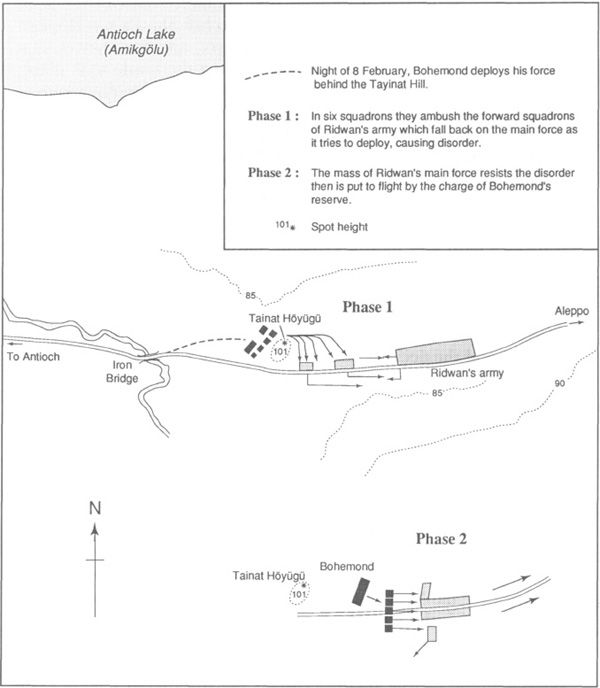
Fig. 9 The Lake Battle: 9 February 1098
The success at the Lake Battle ushered in the third and decisive phase of the siege, during which the crusaders were able to tighten the screw on Antioch (see fig. 10). It must have been a great relief that Harem, commanding the approaches to the Iron Bridge now passed to the Armenians.47The defeat of Ridwan happened at a happy moment, for in the crusader camp were envoys from Egypt who had come in response to the embassy they had sent by sea earlier. This delegation was given the heads of slain enemies as tokens of victory. They seem to have stayed for some time according to the Anonymous who mentions their presence in the camp on 9 February and at St Symeon in the wake of the victory over the garrison on the St Symeon road on 6 March. Stephen of Blois actually says that some kind of understanding was reached with them: ‘the Emperor of Babylon … established peace and concord with us’, while Albert of Aix describes this as a friendly meeting and in the context of the siege of Jerusalem accuses the Fatimids of having broken the agreement then made. Islamic tradition strongly asserts that at this time the Egyptian Vizir, al-Afdal, pursued a policy of friendship towards the Franks and that indeed he later regretted this.48 From the Fatimid point of view the westerners could offer important aid against the Turks and indeed in July 1098 in the wake of Kerbogah’s defeat they were able to seize Jerusalem. The question of Jerusalem was of course an important stumbling block for only twenty years before it had been in Egyptian hands. Raymond of Aguilers, who gives the only clear account of the terms of discussion, reports that the army was willing to agree to ally with al-Afdal and restore to him all that he had lost to the Turks, provided that he would give them Jerusalem and the lands around it. However, if al-Afdal saw the crusade as primarily a Byzantine expedition it was possible to see this demand for an arrangement there in the light of the past Byzantine protectorate over the city.49 It is clear that some kind of modus uiuendi was reached with the Egyptians which perhaps anticipated, rather than agreed, the formation of a protectorate over Jerusalem on earlier Byzantine models. A crusader delegation returned to Cairo with the Egyptian emissaries and was to spend a year there.50 This may well have contributed to the inactivity of the leaders in the summer and autumn of 1098 and increased their reluctance to attack the Fatimid sphere of influence, something which was undertaken only reluctantly.
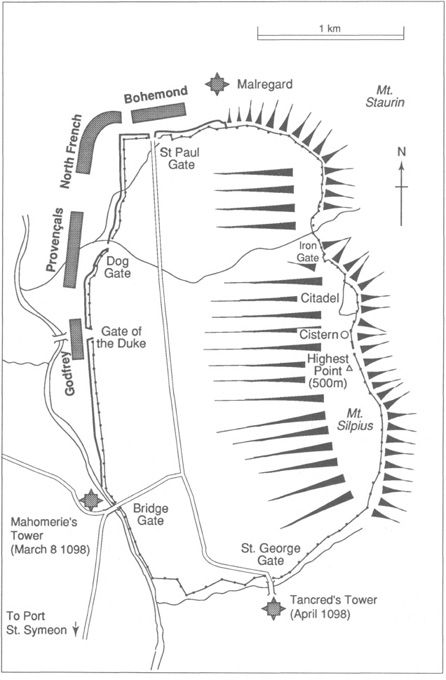
Fig. 10 Siege of Antioch, March–May 1098
It was the arrival of an English fleet at St Symeon on 4 March 1098 which enabled the crusaders to take the next step in tightening the siege. The following day a meeting of the leaders resolved to build a counterfort outside the Bridge Gate, and Bohemond and Raymond of St Gilles were dispatched to escort the sailors and reinforcements bringing up material from the coast. It is hardly surprising that this evoked a very sharp response from the garrison who ambushed the convoy and dispersed it, only to be defeated when reinforcements were called up. This action received considerable and detailed attention, as we have noted, because it took place close to the crusader camp. Albert of Aachen says that it was Godfrey, acting on the orders of Adhémar, who organised the counter-attack. He sent out ten knights to reconnoitre, and these were challenged by twenty Turks. When thirty knights were sent the enemy responded with sixty and, as a result, a general mêlée developed and the garrison was drawn into a sharp battle in front of the Bridge Gate and driven back onto it. Godfrey commanded this and distinguished himself by hacking a Turkish knight in half despite his hauberk. Raymond of Aguilers says that Godfrey played a very notable part cutting the enemy in two and adds that early in the action a Provençal knight, Ysoard of Ganges, led an infantry charge against the enemy with distinction.51 Ambushes of this kind were the staple of Turkish warfare and in particular of the war of attrition. This kind of action continued even after the establishment of the Mahommeries Tower which was confided to the care of Count Raymond. So important was the Bridge Gate that the Turks attacked the new fort savagely, forcing an action in which the count distinguished himself. It was presumably in an effort to prevent this kind of thing that the leaders attempted to destroy the bridge with a penthouse and all but succeeded.52 The Mahommeries Tower, as the crusaders called it, was built on a hill, the site of a Moslem cemetery, close to the Bridge Gate. The entire west side of the Orontes is now a built-up area with considerable alterations to its topography. However, about fifty metres beyond and to the right of the bridge the land slopes quite sharply northwards: by contrast, there is only a gentle rise to the left. It is likely that the tower was erected in this area where, in the nineteenth century, there was still a Moslem cemetery.53 With the Bridge Gate blocked, the crusaders were then able to complete the siege by establishing Tancred at a monastery outside the St George Gate on 5 April 1098 where shortly before a crusader raid had captured a rich booty of horses (see fig. 10). He would soon capture a rich caravan attempting to enter the city. Because he was a secondary leader Tancred had to be subsidised to the tune of 400 silver marks, of which 100 were provided by Raymond of Toulouse.54
The active role of Raymond of Toulouse at this time is very notable. Raymond of Aguilers says that he had been ill earlier in the siege and was seeking to re-establish his reputation, and there may be truth in this. However, he had led a foraging expedition, albeit abortive, into Syria, played a major role in the fighting on the St Symeon road and taken responsibility for the Mahommeries tower which was bound to be a flashpoint, as well as subsidising Tancred. He seems to have been wealthier than the other leaders and to have had the largest army, for Tudebode remarks that he was given the new counterfort ‘because he had more knights in his household and also more to give’.55 Bohemond also had a formidable reputation at this time; he had led the expedition against Harem, accepted custody of Malregard, led the foraging expedition, commanded the army which defeated Ridwan of Aleppo and played a major part in the fighting on the St Symeon road.56 By any standard these were the two leading princes in the army, so it is very odd that in his second letter to his wife Stephen of Blois announced that he had been made by the other princes ‘lord and director and governor of all their acts up to the present time’ and this is supported by other sources.57 Unfortunately, we do not know when this election was held, though the natural sense of the passage in Raymond of Aguilers suggests fairly shortly before the capture of the city in June 1098. Certainly Stephen did not command any major military action of which we know. The suggestion that he was a kind of quartermaster is seductive, but hardly in accord with the terms used by the sources, the Anonymous’s ductor and Raymond’s dictator.58 It can only be a guess but perhaps he was chosen to chair the meetings of the leaders, possibly at Easter 1098. He seems to have been ill shortly after that and so never exercised any real authority. Certainly such an appointment would have been logical by the spring of 1098, for the blockade of the city was now very tight and needed a high degree of co-ordination for its maintenance. The council of leaders was probably the only way in which final authority could be exercised, but the near-disaster of the foraging battle and the success in the Lake Battle exposed its limitations. The army needed a single commander, even though such a dominance was alien to the leaders, and this was a step towards giving it one. They agreed on Stephen of Blois who never seems to have been a masterful personality.
The blockade was not, of course, perfect. It could not be because access to the city via the mountains was always possible. However, the key importance of the steps which they had taken, and especially of the blocking of the Bridge Gate, was clearly recognised. Albert has a long imaginary passage in which Sulayman advises Yaghisiyan to seek aid from Kerbogah, and messengers are sent all over the Moslem world to such exotic places as Samarkand and Khorasan. It is a piece of high drama, signally poetic and interesting because it refers to many real people, amongst them Balduk of Samosata. The drama of the piece underlines the point made at the start – the building of the new counterforts meant that the fate of Antioch now lay in the hands of its allies.59 Even so, there was still much hard fighting for the crusaders. Albert describes the sufferings of the army and in particular the dearth of horses. Baldwin sent help from Edessa, including horses and arms. It was at this time that Nichossus of Tell-Bashir sent a tent to Godfrey, but this was seized by his rival Bagrat of Cyrrhus who diverted it to Bohemond. This caused dissension in the crusader camp as Godfrey and his ally Robert of Flanders confronted the Norman; probably the story reflects Frankish involvement in the rivalries of the Armenian princes.60 The supply situation must have been considerably eased by the establishment of outposts around Antioch by some of the leaders: Raymond of Toulouse continued to hold Ruj in Syria, while Godfrey and Robert of Flanders dominated the ’Afrin valley, and Tancred may have been charged with Harem and perhaps ’Imm (both of which he held in the summer of 1098) on the Aleppo road. But there was also much fighting. After the attempt to destroy the bridge with a penthouse, Peter Tudebode tells us that Raynald Porchet, a knight who had been captured, was led onto the wall of the city and, in the sight of the Christian army required to renounce his religion. When he refused he was beheaded at the order of Yaghisiyan who also burned to death other prisoners held in the city.61 Of course such savagery served a political purpose – to make it difficult for any of the garrison to betray the city by exacerbating hostility and, in this case, playing on religious hatred. A little later, Anselm tells us that some of the enemy pretended to be willing to surrender the city, then trapped and killed the crusaders, including Guy the Constable, who tried to receive their surrender.62
The story of the capture of Antioch is a familiar and dramatic tale of betrayal. Perhaps the crusaders knew that Antioch had fallen to a similar act of treachery in 969 and that the Turkish capture of 1086 also owed much to treachery.63 The story as told by the Anonymous has been generally accepted by historians. He reports that one Pirus (translated as Firuz), the commander of three towers, ‘struck up a great friendship with Bohemond’ who approached the other leaders and suggested that a single commander should be appointed who should be given control of the city. Anna Comnena says that Bohemond, confident in his arrangements with Firuz, proposed a competitive siege with the winner being given the city, and Kemal ad-Din says much the same.64 This idea was rejected on the grounds that all had shared in the labour and all should share in the rewards. Shortly after news came of an enemy relief army, in fact that of Kerbogah Atabeg of Mosul, and an assembly of the leaders agreed that if Bohemond could seize the city he should have it, providing that the emperor did not come to their aid. Bohemond then got in touch with Firuz who sent him his son as a hostage, and suggested that on the next day the army should pretend to prepare to go out into the Saracen lands. Then, in council with Godfrey, Robert of Flanders, Raymond of Toulouse and the Legate, it was arranged that the forces of knights and foot in this expedition should separately approach Firuz’s towers, the former by the plain, the latter by the mountains. There followed an exciting episode, in which the Anonymous clearly participated, as the crusaders got into the city. In all this the only date mentioned is the fall of the city on the night of 2–3 June 1098.65
The identity of Firuz and his reasons for betrayal are naturally interesting. The Anonymous tells us nothing about him except his name. Raymond of Aguilers says that he was an unnamed Turk, on which point Fulcher agrees but tells a fanciful story of him being commanded to betray the city in a vision. Albert tells us nothing about the betrayer but says that a converted Turk called Bohemond was active in the negotiations, and he appears to be repeating camp gossip when he says that it was believed that Bohemond had captured the betrayer’s son in a skirmish. Bar-Hebraeus says that a Persian betrayed the city.66 Ralph of Caen gives no name but says that the betrayer was a rich Armenian whose wealth had been confiscated by Yaghisiyan, and that he sent word to Bohemond because of his high reputation, although the towers held by himself and his family were some distance away. Anna Comnena agrees that the traitor was an Armenian renegade and this is supported by Michael the Syrian who simply says that Armenians betrayed the city. This identification receives support of a kind from Matthew of Edessa who describes the traitor as one of the chief men of the city but gives no nationality.67 The Damascus Chronicle describes the betrayer as an armourer in the service of Yaghisiyan called Firuz, information also adduced by Ibn al-Athir. Kemal ad-Din names the armourer as Zarrad and says that he was punished by Yaghisiyan for hoarding.68 In a city with a polyglot population such confusion is not unnatural and it is tempting to see attrition working upon a man of uncertain loyalty, perhaps Armenian, straining his relations with his master – hoarding is a classic crime of shortage. However, we cannot be certain of the truth of such an elegant and symmetrical explanation, although we can be reasonably sure that Ralph’s remark that Bohemond had promised him great wealth and honour is a better explanation for his behaviour than are the friendship proposed by the Anonymous and the miracle reported by Fulcher.69
But the question of the dating of events is rather difficult and a matter of some importance. The date of the fall of Antioch on the night of 2–3 June 1098 is not in doubt.70 What the chronology of the Anonymous would suggest is that Bohemond opened the question of Antioch at an unspecified date before its fall, then reopened the question when news had come of the approach of Kerbogah’s army. At this council he was promised the city. A few days of exchanges ensued, then Firuz suggested that ‘on the morrow’, i.e. 2 June, the army set off on its feigned march. As it happens, the date of this council of leaders can be fixed, because Albert of Aachen says that rumours of the approach of Kerbogah’s army had caused the leaders to send out reconnaissance forces in all directions. These reported the presence of the enemy to an assembly of leaders which met and promised Bohemond the city, seven days before Kerbogah’s arrival – 29 May 1098.71 According to Fulcher of Chartres, Kerbogah’s army besieged Edessa for three weeks before moving on to Antioch where we know its first elements arrived the day after the crusader capture of the city on 4 June. Matthew of Edessa confirms that there was such a siege but gives no dates other than to say that the siege lasted until the harvest time. Albert says that the attack on Edessa lasted a mere three days, but Fulcher was most certainly present at Edessa at this time. If we allow a week for the army to reach Antioch from Edessa, this suggests that the siege lasted from 4–25 May 1098.72 The problem is that as we have noted, the crusaders were in close touch with Edessa and its outlying fortresses were only a day or two’s march away, yet they appear to have been entirely ignorant of the enemy attack until late May; if we allow four days for the reconnaissance force to go out and return, then their ignorance still lasted until 21 May, by which time, Albert says, rumours were causing consternation in the crusader camp. The approach to Edessa of such a huge army as that credited to Kerbogah could hardly have been a secret affair, and indeed Albert says that Baldwin knew enough of it to arrange to attack its advance guard ‘with the bows of the Armenians and the lances of the Franks’ very successfully.73 It is quite extraordinary that the crusaders should have been unaware of the presence of an enormous and hostile army only a few days march away. It is true that they seem to have bumped into the relief force of Duqaq in December 1097 but that was coming up from deep in hostile Syria. They certainly had to plan hastily for the approach of Ridwan in February 1098 but Aleppo was fairly close – Raymond of Aguilers says only a two day march away – and they did not control the approaches along the road.74 Baldwin of Edessa was aware of Kerbogah’s approach – he was clearly not taken by surprise.
Perhaps the inaction was due to a mistaken appreciation of the purpose of the attack. Kerbogah has been much blamed for spending time attacking Edessa, giving the crusaders the opportunity to seize Antioch. It is worth noting, however, that he did not know Antioch was going to fall and that his arguments with Yaghisiyan’s son over terms seem to have gone on very late in the day. More importantly, we need to recognise that the army which he raised was an alliance and that this had implications. Kerbogah was acting on the authority of Bagdad but he had to deal with independent rulers and at some stage he had to gather his army. It is possible that he chose to bring much of it together at Edessa where an attack might bring results and would in any case please the local Moslem rulers. His attack there was perhaps not at first perceived as a threat to the main crusader army at Antioch, especially as his force may have been gathering strength. Kerbogah could not take the short route from Mosul to Antioch via Sindjar and Aleppo because of the hostility of Ridwan. Instead he must have travelled via Nusaybin (ancient Nisbis) to Edessa. Albert says that Kerbogah concentrated his forces at Sooch, perhaps Tell ach-Chaikh near Mardin, before moving on to Edessa.75 He had to get together a very large number of allies; Fulcher lists twenty-eight of whom seven are also mentioned by Albert. Of the twenty-eight no fewer than fourteen can be identified including five of those in common with Albert who, however, adds another three, Pulagit, Amasa of Niz and Amasa of Cuzh who are unknown, plus Ridwan who definitely never joined the army. Of those identified five are confirmed by Kemal ad-Din and four by Ibn al-Athir who adds the name of Arslan-Tasch of Sindjar.76 We can, therefore, identify with some certainty some of the allies of Kerbogah: Duqaq of Damascus, Arslan-Tasch of Sindjar, Qaradja of Harran, Balduk of Samosata, Janah-ad-Daulah of Homs, Tughtigin atabeg of Damascus, Sokman of Mardin whose Artukid clan also held Jerusalem, the Arab commander Wassab ibn-Mahmud to whom can be added the sons of Yaghisiyan, Shams-ad-Daulah and Muhammed.77 Fulcher’s Emir Bajac may well be Albert’s Balas of Amacha and Sororgia, for this town was involved in the politics of Edessa and would have been known to both of them.78 Overall, it was a huge army; Matthew of Edessa suggests incredible figures of 800,000 cavalry and 300,000 foot attacking a Frankish force of 15,000 knights and 50,000 foot, while Bar-Hebraeus and Michael the Syrian settle for 100,000 mounted men. Such figures are probably fantasy, but the Damascus Chronicle says that they were an ‘uncountable force’.79 It was certainly a very large army indeed and its concentration must have taken time both for military and diplomatic reasons. Further, the concentration at Edessa could only have been partial – the chroniclers are surely listing the army as it was at its greatest and we have already noted the comment of Kemal ad-Din that en route Duqaq subjugated Tell-Mannas, a city to the east of Ma’arra (Ma’arrat, an-Nu’mān) which had asked for Frankish aid.80 This and simple geography suggest that the Damascene force came up to meet Kerbogah at Antioch. Kemal ad-Din also reports the presence in the Moslem army of nomads, probably from Asia Minor, who feared Ridwan, and Bar-Hebraeus reports that Kerbogah’s army, perhaps meaning elements of it, encamped at Baghras which is at the foot of the Belen pass (see figs. 4 and 7).81 In his account of the reconnaissance forces sent out by the crusader leaders, Albert stresses that they reported to the leaders that the enemy were coming from all directions.82 This suggests an army gathering strength as it went along, a process requiring careful military and diplomatic preparation which may well explain both the delay at Edessa and the failure of the Franks to recognise its size and ultimate purpose.
Once the nature and scale of the threat which Kerbogah posed was known to the crusader leaders they acted very quickly. Bohemond had demanded a price for entry into the city and something like it was quickly conceded. Albert simply says that all promised the city to Bohemond, but the Anonymous makes the promise conditional and makes the leaders say that ‘we will thereafter give it to him gladly, on condition that if the emperor come to our aid and fulfil all his obligations which he promised and vowed, we will return the city to him as it is right to do.’83 Even this is probably an overstatement. As we have noted the Anonymous tends to exaggerate the obligations of Alexius to the army, and if there had ever been any question of the emperor coming in person, as this passage suggests, then there would have been no grounds for an argument in November 1098. Rather, even under the extreme pressure of this desperate situation, the leaders were mindful of the oaths they had sworn and of all the benefits that they had received in the past and might receive in the future, and promised only that Bohemond could have the city if the emperor did not make arrangements to take and protect it. This promise appears to have been made by a very small coterie of leaders. Albert says that all met to discuss the report of the coming of the enemy army and a debate took place with Godfrey, Robert of Flanders and Raymond of Toulouse urging that the army as a whole march out to attack Kerbogah, while others urged that the camp should be manned and the army divided as before. It was then that Bohemond took aside Godfrey, Robert of Flanders and Raymond of Toulouse to a secret place and told them of the plot with Firuz and his demand to be ruler of the city, to which they then agreed.
Ralph of Caen tells us later that Tancred was kept in ignorance of the plot to seize the city and the arrangements for it.84 The Anonymous says that it was Firuz’s idea to pretend that a section of the army was going out as if to plunder Syria in order to lull the defences. Albert credits Bohemond with the plan and says that Godfrey and Robert of Flanders led out this force of 700 knights on 2 June as though signalling to the garrison of Antioch their intention to repeat the tactic of the Lake Battle by ambushing the enemy’s vanguard, but they came back under cover of night by secret paths led by Bohemond the Turk and approached the section of the wall held by Firuz. The Anonymous simply says that by night knights returned by the plain and the footsoldiers by the mountain to the appointed spot.85 On 2 June this expedition set out and under cover of night turned back and returned to what the Anonymous has Firuz call ‘the western mountain’, the southern side of the defences, for it is clear that Firuz’s tower was on that side of the city.86 The Anonymous has Firuz suggest this feint so that the army ‘should pretend to go out and plunder the land of the Saracens’, which is rather an odd statement, for at this critical juncture nobody would have been thinking of such a thing. However, it is probably expressed this way because the direction of their march reminded the Anonymous of the expedition which led to the Foraging Battle, for it was surely in that direction that they set out. Once into the mountains by Daphne the army probably rested, then the infantry took the paths into the mountains towards the back road and Firuz’s tower, while the cavalry rode back up towards the St George Gate then climbed on foot to the appointed spot (see fig. 11). Once they had gathered under cover of night they prepared to mount a two-pronged attack. Albert’s informants were with Godfrey, while the Anonymous was with Bohemond’s force, and this conditions their accounts.
The Anonymous participated in the secret entry into the city and describes it as a commando raid by an élite group. A party of knights approached the wall with a ladder just before dawn and sixty of them mounted into the tower of Firuz, who became worried by the absence of Bohemond and the small numbers. Bohemond and his followers, including the Anonymous, then came to the foot of the ladder and showed themselves, calling up. A large number of them ascended when suddenly the ladder broke, but those inside opened a small postern gate and as more and more crusaders poured in cries of horror arose in the city and the main army began its assault and a great slaughter.87 It is very much the story of a participant, vivid and clear but lacking in context which is to some extent provided by Albert. According to him a Lombard interpreter from Bohemond’s household approached the tower and spoke in Greek (mentioned by the Anonymous as the language used between the traitor and the Franks) to its occupants who urged the Franks to come up and get established before the coming of the watchmen who toured the defences every night – a detail mentioned by Raymond of Aguilers who, however, says the Franks waited until they had passed.88 There was much hesitation amongst the attackers, according to Albert, and this may have been because of the earlier experience when Guy the Constable was killed. However, Godfrey exhorted those who were hesitating, a rope was lowered, a leather ladder hauled up and sixty men entered until the weight of people dragged down the portion of the wall to which the ladder was attached causing losses; this is rather different to the Anonymous’s statement that the ladder broke. Raymond of Aguilers adds that Fulcher of Chartres was first up and Ralph gives the name as Gouel. The watch then arrived and was killed and as the fighting spread most of the 700 knights were admitted through a postern gate and hard fighting ensued.89 The two accounts and that of Ralph are generally compatible, but Albert gives a very prominent role in the commando party to Godfrey and Robert of Flanders. Bohemond, Raymond of Toulouse and Tancred then, he says, rallied the main army which was totally surprised to find Christian forces in Antioch – a detail supported by Raymond of Aguilers.90
However, Albert does add some interesting information which provides us with a strong clue as to the location of Firuz’s tower. He says that as the assault force got into the city it sounded trumpets as a signal to Godfrey and Robert of Flanders who attacked a gate near the citadel; the purpose was surely to seize the citadel – in which they failed. The next day Bohemond would make a determined but fruitless attempt to seize the citadel in the course of which he would be wounded by an arrow in the leg.91 So the night attack was two-pronged. Almost certainly Bohemond led the effort to enter Firuz’s tower which it appears was quite close to the citadel for Godfrey and Robert of Flanders, who led the attack on it, were in the same general area. The contemporary sources are very vague on the location of Firuz’s towers. The Anonymous says cavalry reached it by the plain and infantry by the mountain. Albert confirms that a force of 700 knights was led to it by night over small paths by Bohemond the Turk, while Ralph of Caen describes it as a long way from the tents of Bohemond. William of Tyre is much more specific; he tells us that Firuz held a tower called the Two Sisters in the south wall of Antioch, close to the St George Gate, and this has been presumed to reflect traditions current in the Principality of Antioch in the twelfth century.92 However, it is evident from Albert’s description that the point of entry must have been much closer to the citadel. The implication of the Anonymous’s account is that Firuz’s three towers were in a lonely place. Raymond of Aguilers speaks of them being ‘on the hill of the city’ and Ralph says that it was at a point too wild for horses to venture; this argues against the vicinity of the St George Gate which had been invested by Tancred and would have been well manned. Furthermore, the Wadi Zoiba is a formidable barrier along these southern defences. In addition, the Anonymous reports that as day broke and the Franks became established in the city Bohemond set up his banner where all could see it on ‘a hill opposite the citadel’. It has been suggested that this must refer to the high point to the south of the citadel where there is a tower still visible across the whole of Antioch, however this is not precisely opposite the citadel. There is another tower further along which is at the top of the south side of the gully facing the citadel and though this could not be seen across the whole city, it could be seen plainly by the main crusader army mainly concentrated outside the northern defences (see fig. 13). William of Tyre says that by this time the Franks had captured ten towers, and by counting we can arrive at Firuz’s towers, roughly at the point where the defences turn west to form the south wall of the city, descending Mount Silpius. Moreover, the accounts agree that near Firuz’s tower was a postern and there is one in this area. There can be no certainty, but it is very likely that these towers at the south-east corner of the defences were those betrayed by Firuz (see fig. 11).93
The failure to seize the citadel was to have considerable consequences for the crusader army. But what followed the break-in to the city was a terrible massacre in which many Christians, as well as Moslems, died – how could it be otherwise, as Albert says, when much of the fighting was in the shades of night; 10,000, he says, perished, and the Franks were assisted by an uprising of the native Christians.94 One of the casualties was Yaghisiyan himself who fled the city and was killed by local Christians.95 Kemal ad-Din says that he panicked, thinking that the citadel had also fallen, rode off with an escort and later fell off his horse and was killed by Armenians, a story confirmed by Bar-Hebraeus and Ibn al-Athir, who adds that he was decapitated by an Armenian butcher. The Damascus Chronicle simply says that he died at Armanaz near Ma’arrat Masrin on the Aleppo road north of Idleb, through constantly falling off his horse.96
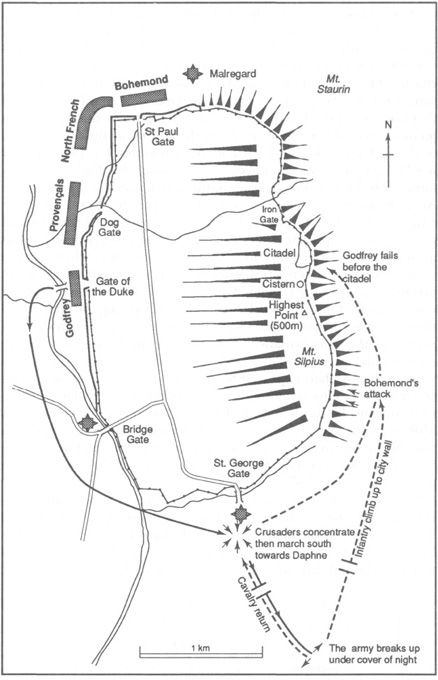
Fig. 11 Crusader capture of Antioch, night of 2/3 June 1098
The capture of Antioch is a great story in the best Bulldog Drummond tradition. Such incidents have so often formed key moments of films about the Second World War that one can almost see the participants in khaki bearing sten-guns, rather than encumbered with swords, shields and armour. And it is a cliff-hanger in another sense – for advancing towards the city was the huge army of Kerbogah. The plot to get into Antioch was a last ditch effort by the crusader army. Had it failed, then disaster would surely have followed, but that, of course, is in the best tradition of all great stories. Naturally this is to look at events in our idiom. For the crusaders, what happened was nothing less than a miraculous delivery by the hand of God. Raymond of Aguilers rejoiced in the slaughter of the enemy – ‘the Lord had confounded them!’ and bewailed not the massacre of people but the loss of horses when some Turkish riders were driven off a cliff: ‘Our joy over the fallen enemy was great, but we grieved over the more than thirty horses who had their necks broken there’.97 Reports of the spoils after the victory are contradictory. Raymond of Aguilers describes a vast booty, but Albert says there was not much. Above all there was not much food – hardly surprising, for Antioch had been invested for nine months and its stores were badly run down.98 In any case, there was little time for plundering, although Raymond of Aguilers accuses the army of dallying over pagan dancing women and so failing to take the citadel, because on the day after its fall the vanguard of Kerbogah’s army arrived at Antioch.99
The siege of Antioch had lasted for over eight months and during it the crusader army suffered appalling privations and terrible casualties. It was a close blockade rather than a set-piece siege in the usual sense of the word. The central problem which the army faced was simply staying alive in the face of enemy efforts to deny them food. By early February 1098 the army was in a desperate situation and it was saved by the brilliant victory over Ridwan’s army. But the crusader leaders showed themselves well able to organise their huge force and avoided overstretching it. Leaders and led learned a lot about their enemies in the course of the siege during which all the techniques of contemporary war were tested. Raiding, wasting, small-scale combat by horsemen and infantry were the day-to-day experience of an army which was becoming more cohesive and more experienced. In the long agony of the siege the morale of the army, their faith in their destiny was tested to the full and this was what delivered them in the end. But the army was also becoming much smaller and the fall of the city produced no relief, but yet more disasters.
1 Hagenmeyer, Kreuzzugsbriefe, 150, 157–60.
2 FC, p. 131; Terraine, White Heal, p. 17.
3 AA, 374; RA, p. 50; GF, p. 30; FC, p. 94; Hagenmeyer, Kreuzzugsbriefe, pp. 149–52; RC, 647.
4 GF, p. 30; RA, p. 51; AA, 373; on horses see below pp. 281–2.
5 See below pp. 309–10.
6 GF, p. 32.
7 Damascus Chronicle of the Crusades, p. 43; Aleppo Chronicle, p. 579; on the capture of Rugia see GF, p. 26.
8 RA, pp. 51–52; AA, 373; Damascus Chronicle of the Crusades, p. 43.
9 GF, pp. 30–3; Hagenmeyer, Kreuzzugsbriefe, pp. 150, 158.
10 RA, pp. 51–2.
11 Runciman, 1. 221 offers this explanation; Smail, Crusading Warfare, p. 171 offers no general comment, simply observing that, on the basis of these two sources, the crusaders had learned not to allow themselves to be surrounded.
12 AA, 373–4, 425; RA, p.53.
13 RA, p.56.
14 The tendency of later writers to present tidy and logical accounts of battles which are essentially chaotic affairs is thoroughly criticised by J. Keegan, The Face of Battle (London, 1976). It is worth noting that in Operation Battleaxe’ in the Western desert in 1941 twenty tanks of Seventh Armoured Brigade, one fifth of their strength, simply went missing and were not accounted for until two years later, and even that story was unconfirmed: B. Pitt, The Crucible of War: Western Desert 1941 (London, 1980) pp. 300–1.
15 GF, pp. 29–30.
16 GF, p. 33; RA, p. 53; AA, 375; on the battle see below pp. 246–52.
17 GF, pp. 33–4; AA, 378–9 FC, p. 95; Gesta Francorum Iherusalem expugnantium, RHC Oc. 3. 499;RA, pp. 54–5; on the attempted disciplinary action see J. A. Brundage, ‘Prostitution, miscegenation and sexual purity in the First Crusade’, in P. Edbury, ed., Crusade and Settlement in the Latin East, (Cardiff, 1985), pp. 58–9.
18 FC, p. 94; RA, pp. 53–4, who suggests that Bohemond was even then trying to gain Antioch; AA, 375.
19 See above pp. 209–10.
20 GF, p. 33.
21 AA, 375.
22 RA, pp. 54–5; on this see France, ‘Departure of Tatikios’, 145; J. Richard, ‘La confrérie de la première croisade: à propos d’un épisode de la première croisade’, in B. Jeannau, ed., Etudes de civilisation médiévale: mélanges offerts à E. R. Labande, (Poitiers, 1974), pp. 617–22.
23 RA, 50, 55–6; 62, GF, pp. 34–5.
24 GF, pp. 34–5; RA, pp. 54–5; AA, 366, 417.
25 RA, p. 55; France, ‘Depature of Tatikios’, 144–6; see also Richard, ‘La confrérie de la première croisade’, 617–22.
26 AA, 378–9.
27 AA, 378–9; HBS, p. 189.
28 RA, p. 62.
29 AA, 386.
30 GF, p. 35.
31 Aleppo Chronicle, p. 579.
32 Matthew, 33; HBS, 190.
33 RA, p. 49; Ibn Butlân, tr. and cited in Lestrange, Palestine under the Moslems, p. 370.
34 On the shortage of horses see below pp. 281–2; there is virtual unanimity on the figure of700; RA, p. 56, AA, 380, Stephen of Blois and Anselm in Hagenmeyer, Kreuzzugsbriefe, pp. 151, 157. The only dissenter is RC, 647 who gives a figure of 200.
35 AA, 344 and see above pp. 75–7, 239–41; RA, pp. 53–54.
36 RA, p. 56; GF p. 35.
37 Aleppo Chronicle, p. 579.
38 AA, 380; Hagenmeyer, Kreuzzugsbriefe, 149–52, 157–60.
39 RA, pp. 56–8 GF, pp. 35–8.
40 Anonymi Gesta Francorum, ed. H. Hagenmeyer (Heidelberg, 1890), pp. 50–8 passages number 7 and 8 (2), and see also 6, 9, 10. My own work confirms this dependence.
41 RA, pp. 49, 52; Smail, Crusading Warfare, p. 171 follows this interpretation.
42 Hagenmeyer, Kreuzzugsbriefe, pp. 149–52; RC, 647–8.
43 RA, pp. 56, says that the leaders met on 8 February: ‘in the house of the bishop’ which strongly suggests that he was away, and later tells us that Count Raymond had been ill for much of the winter, p. 63; on Robert of Normandy see above pp. 215–19; RC, 647 lists Godfrey, Stephen of Blois and Bohemond as present, and to this list common sense would suggest we add Tancred and Hugh of Vermandois who seem to have spent much time with Stephen, but this list is a guess; PT, p. 43
44 AA, 380–2.
45 The Lake of Antioch has now all but vanished due to drainage schemes. Pre-war maps show it to have been three to four kilometres north of the Aleppo road, but, by then, drainage efforts had made an impact on its size. Moreover, Raymond of Aguiler’s statement that it was only two kilometres above the river refers to mid-winter when it would have been at its greatest. There are other mounds along this road (indeed, the Amouk is dotted with them) but the Tell Tayinat is the only one which can be described as being between the river and the lake. Set north of the Aleppo road it is aligned NE to SW. On its southern end, close to the road, is a Moslem cemetry, but the top of the hill is disfigured by an abandoned factory of 1950s vintage.
46 See below p. 256.
47 Aleppo Chronicle, p. 579.
48 On the sending of the embassy see above p. 211; GF, pp. 37, 43; RA, p. 58; AA, 379, 383, 463, 484–5; Hagenmeyer, Kreuzzugsbriefe, pp. 149–52; Köhler, Allianzen und Verträge, pp. 64–5.
49 RA, pp. 109–10; Köhler, Allianzen und Verträge, p. 64. Köhler pp. 56–69, thinks that the Egyptians saw the crusade as a Byzantine force but their ambassadors were at Antioch for a month and had the chance to examine the crusader legates who returned with them for a year; even if there were also Byzantine emissaries there, they could hardly have failed to understand the differences. However, this does not alter the possibility that they were prepared to consider making arrangements reflecting earlier Byzantine dealings with the new force.
50 Köhler, Allianzen und Verträgen, p. 60, suggests that they were accompanied by a Greek embassy, but there is no evidence for this. Indeed, given that Tatikios had left the crusader camp by the time of their arrival, it is difficult to think who would have had the authority to create a Byzantine delegation. Lilie, Byzanz, pp. 51–2, thinks it is unlikely that the Byzantines would have wished to see contact between their allies and Egypt and is sceptical of Raymond of Aguilers’ report of the contacts between Egypt and the crusade, which he sees in the light of this writer’s known hostility to Byzantium. Köhler, Allianzen und Verträgen, pp. 66–8 argues strongly that Raymond was reliable in this context. Essentially, it seems unlikely that Raymond would have invented such controversial material.
51 On the sources and the numbers involved see above pp. 140–41; AA, 384–5; RA, p. 60
52 RA, pp. 62–3; PT, pp. 50–1; above, p. 229.
53 GF, p. 42; RA, p. 61–2. For the Moslem cemetry see Rey, Monuments, Pl. xvii. About 250metres to the right of the Bridge the excavations at Antioch revealed the remains of a late Roman cemetry: J. Lassus, ‘Cimitière au bord de l’Oronte’, in W. Elderkin, ed., Antioch on the Orontes: Excavations of 1932 (Princeton, 1934) pp. 85–92. On the west bank at the entry to the modern bridge there is a roundabout and the slope in question is now covered by a cinema and, across the road, the main Antioch post-office, both dating from French colonial days.
54 GF, p. 43; RA, pp. 63–4.
55 PT, p. 50
56 GF, pp. 29–32, 35–41.
57 Hagenmeyer, Kreuzzugsbriefe, p. 149; GF, p. 63; RA, p. 77.
58 Runciman, 1. 232, n. 1.
59 AA, 389–95.
60 AA, 395–6 and see above p. 167.
61 RC, pp. 649–50; PT, pp. 79–81.
62 Hagenmeyer, Kreuzzugsbriefe, pp. 157–60.
63 Bouchier, Antioch, pp. 217–19, 226–7; Cahen, Turkey, p. 77.
64 AA, 400, says that Bohemond had made contact with Firuz seven months before; Alexiad, p. 344; Aleppo Chronicle, 581.
65 GF, pp. 44–8.
66 This Turk Bohemond was presumably identical with Bohemond the converted Turk, whom Raymond of Aguilers mentions in connection with the negotiations at Ascalon as having been the godchild of the Bohemond himself: RA, p. 159; RA, p. 64; FC, pp. 98–9;AA, 399–400; Bar-Hebraeus, p. 234.
67 RC, 651–2; Anna’s dating at this point is very erratic, for she evidently confuses the relief expeditions of Ridwan and Kerbogah, on which see France, ‘Departure of Tatikios’, 138–9; Alexiad, p. 342; Michael, p. 184; Matthew, 39.
68 Damascus Chronicle of the Crusades, p. 45; Aleppo Chronicle, 580; Ibn al-Athir, p. 192.
69 RC, 653.
70 As Hagenmeyer, Chronologie no. 265, comments, citing GF, p. 48 (and many derivatives);RA, p. 66; letters of Anselm of Ribemont, People of Lucca, and Princes to Urban II, Hagenmeyer, Kreuzzugsbriefe, pp. 157–60, 165–70.
71 AA, 398–400.
72 FC, p. 101; it must be said that the major Arab chronicles, of Aleppo and Damascus and Ibn al-Athir, do not mention the siege of Edessa, though the Aleppo Chronicle, 580, says that they attacked Tell-Mannas which was restored to Duqaq who took tribute and hostages.
73 AA, 397.
74 RA, p. 49.
75 AA, 396; Cahen, La Syrie du Nord, p. 215 n. 35.
76 FC, ed. Hagenmeyer, p. 250, n. 12 lists the variants which appear to come from his first redaction; AA, 394; Aleppo Chronicle, 580; Ibn al-Athir 194.
77 Cahen, La Syrie du Nord, p. 215, n. 35 identifies the Boldagis of Fulcher and Buldagiso of AA with Bouldadji of Djahan, but AA 390, 392, 409 makes it clear that he was the son of Yaghisiyan.
78 AA, 356–7.
79 Matthew, 39, 42; Bar-Hebraeus, p. 235; Michael, p. 184; Damascus Chronicle of the Crusades, p. 45.
80 See above p. 260.
81 Aleppo Chronicle, 583; Bar-Hebraeus, p. 235.
82 AA, 398; the leaders, says Albert, tried to keep the news secret for fear of demoralising the army.
83 GF, p. 45.
84 AA, 398–400; RC, 657.
85 AA, 400–1; GF, p. 46.
86 On the location, see below p. 266.
87 GF, pp. 46–8.
88 AA, 401; RA, p. 64.
89 RA, p. 64; RC, 654; AA, 402–3.
90 AA, 404; RA, p. 65.
91 AA, 403; RM, 806–7.
92 GF, p. 46; AA, 400; RC, 652; WT, 212–13. In view of the Arab sources on the identity of the betrayer, it is interesting that William says the family were called the Beni Zerra, meaning ‘sons of the armourer.
93 RA, 64; RC, p. 654; Rey, Monuments, pp. 196–201. The weakness of the argument is that only WT, 229, refers to ten towers, but the point about the raising of Bohemond’s flag is a good one. On the postern Rey was writing at a time when the walls were more intact than they are now but he was a very careful observer. My own exploration of the remaining foritifications confirms his ideas.
94 AA, 405–6.
95 GF, pp. 47–8; RA, p. 66; AA, 406.
96 Aleppo Chronicle, 581; Bar-Hebraeus, p. 235; Ibn al-Athir, p. 193; Damascus Chronicle of the Crusades, p. 44.
97 RA, p. 65, tr. Krey, pp. 154–5; AA, 405–6, tells a rather similar tale of numbers of the enemy falling to their death after taking a wrong route in an effort to reach the citadel but he suggests there were 1,000 of them. The road up to the citadel from Antioch proper is so steep and dangerous that it is easy to envisage such an event.
98 RA, p. 65; AA, 407.
99 RA, p. 66; GF, p. 49; AA, 407; FC, 101.