
Chapter 2:
A profile of the SS panzer divisions in 1944.
From the hedgerows of Normandy to the icy valleys of the Ardennes, the Waffen-SS panzer divisions proved to be the toughest opponents the Allied forces were to face during the final year of the war. They fought fanatically under the command of skilled and determined leaders. To the end, they simply never seemed to consider the fact that Germany losing the war was reason for them to give up fighting. This always bewildered their British and American opponents, many of whom valued human life far above victory itself.
Who were these men who continued fighting for a lost cause, in the face of overwhelming odds? To understand the Waffen-SS, observers need to go back to the roots of Adolf Hitler’s National Socialist (or Nazi) Party in the 1920s and trace his rise to ultimate power in the 1930s.
Origins
Hitler’s paranoid political philosophy was born in his street-fighting days of the early 1920s. Germany was on the verge of revolution. Coup d’etats or putsch attempts were a regular occurrence as the country’s Weimar fledgling democracy tried to cope with the aftermath of defeat in World War I. The Nazi Brownshirts, or Sturmabteilung (SA), were at the forefront of clashes with communists and the police of the Weimar Republic. When Hitler’s so-called Beer Hall Putsch failed in November 1923, the future dictator became convinced that he would need a reliable élite paramilitary group at his disposal if he was ever to seize and hold power in Germany.
As Germany spiralled into depression, and mass unemployment took hold in the aftermath of the “great world depression” of 1929, Hitler saw his chance. While participating in elections that brought him to the brink of power, Hitler also began mobilizing his paramilitary forces.
Central to his strategy was a small, shadowy group of just over 100 young men known as the Stabswache Berlin (Headquarters Guard Berlin), that was part of the Nazi Schutz Staffel (Protection Squad) or the SS. Dressed in sinister black uniforms, the SS Stabswache Berlin appeared to the uninitiated to be little more than Hitler’s bodyguards. Indeed, the unit was soon renamed SS Leibstandarte Adolf Hitler (Life Guard Regiment Adolf Hitler). They were, in fact, the armed élite of the Nazi Party, loyal only to Hitler.
The list of the membership of this first SS group reads like a who’s who of the future Waffen-SS. It was led by one Josef “Sepp” Dietrich, Hitler’s former chauffeur, who would rise to command the Leibstandarte Division and ultimately the Sixth SS Panzer Army. This unit would contain six Waffen-SS panzer divisions in its final days in April 1945. Many of the famous wartime Waffen-SS divisional and regimental commanders were members of this first group, and the bond they established in it served them well through the war and beyond.
Once Hitler rose to the Chancellorship in January 1933, he moved swiftly to consolidate his hold on power. One of his first acts was the violent elimination of the leadership of the SA in the famous Night of the Long Knives in June 1934. This saw the SS in the thick of the action, seizing scores of SA leaders and then executing them. Dietrich played a prominent part in this purge, overseeing the first extra-judicial killings which were to take place under Hitler’s regime. From this point on, the nature of Germany changed. No longer was it a parliamentary democracy, governed by the rule of law. For the next 12 years it would be a ruthless dictatorship, with the SS acting as Hitler’s killing machine.
In a matter of months, the SS grew into a form of parallel government, to ensure the Nazi Party could never be overthrown from within. The police, prison service, intelligence agencies and judiciary were all kept under close control by their SS counter-parts. Soon the SS boasted hundreds of thousands of members, all working to ensure total obedience to the Führer’s will.
Not surprisingly, Hitler viewed the Germany Army with great suspicion. It alone seemed to possess the wherewithal to remove the Nazi regime from power. Adolf Hitler, the former “Bohemian corporal”, had little time for the aristocratic professional officer corps of the Germany Army, who he blamed for Germany’s defeat in World War I, and immediately set about neutralizing the political power of the General Staff. He made every German soldier swear a personal oath of loyalty to him. Troublesome senior commanders were removed after trumped-up sex scandals, and others were bought off with gifts of huge estates.
Hitler was still worried, though. So he decided to expand his élite bodyguard force into the Nazi Party’s own mini-army. It would be the only armed force in Germany with an official mandate to take armed action within the borders of the new Third Reich. The German Army would be limited to fighting foreign wars. Thus the Waffen-SS (or armed SS) was born.
It was in these early days that the Waffen-SS developed its unique ethos. Recruits were screened for ethnic purity. They had to be able to trace their “blood line” back through several generations in order to prove they had no Jewish relatives. Any physical imperfections, such as tooth fillings or poor eyesight, also counted against the much sought-after membership of the Waffen-SS.
The prominent public role of the first Waffen-SS unit, the SS Leibstandarte Adolf Hitler, guarding their Führer and public buildings in Berlin, quickly led to them being dubbed the “Asphalt Soldiers” by the Wehrmacht (armed forces). They were only fit for parades, the cynics were to claim.
Behind the scenes, Hitler and the head of the overall SS organization, Heinrich Himmler, set in train a number of moves which would turn the Waffen-SS into an élite military formation.
A number of professional staff officers, such as Paul Hausser and Willi Bittrich, were recruited to set up junior officer and non-commissioned officer schools. They would also run staff officer courses and organize logistics. These men ensured professional military discipline and standards endured in the ranks of the Waffen-SS. Their unit would be a far cry from the political cronyism that was rampant in other parts of Hitler’s empire.
The first Waffen-SS units were termed Standarten (roughly equivalent to an army regiment) and they were little more than lightly equipped infantry units. Hitler, however, was determined to ensure his Waffen-SS had the best weapons and equipment. Soon, heavy machine guns, mortars, light artillery and armoured cars were being delivered to Waffen-SS depots.
By the late 1930s the Waffen-SS Standarten had grown into well equipped motorized infantry regiments. They bore names which would later inspire terror, including Leibstandarte and Totenkopf (Death’s Head), and which would be household names during World War II.
As war approached, Hitler decided to regroup. He ordered the Waffen-SS Standarten to be brought together in a single division: the SS-VT. It was included in the war planning for the invasion of Poland, and Hitler hoped it would cover itself in glory in the coming battle against the Poles, whom he considered to be racially sub-human or, in the words of the Nazis, “Untermenschen”.
The combat début of the Waffen-SS occurred during the September 1939 invasion of Poland, where the SS-VT Division was assigned to the Wehrmacht’s Army Group South. The Poles put up patchy resistance and the SS-VT Division was hardly taxed although, of course, Hitler enthused about his élite unit’s performance.
By the following spring, the Waffen-SS Standarten had been expanded into fully fledged motorized infantry regiments, now boasting assault gun battalions equipped with StuG IIIs. Hitler’s favourite Leibstandarte Regiment was assigned to support the panzer drive through Holland and Belgium. Here it clashed with Allied forces, and a detachment under the command of Wilhelm Mohnke massacred a squad of captured British troops. The Totenkopf Regiment failed to cover itself in glory fighting alongside Erwin Rommel’s 7th Panzer Division when it fled after British tanks counterattacked at Arras.
Again Hitler was overjoyed at what he saw as the dazzling combat performance of his Waffen-SS troops, and he ordered yet another expansion. This time there were to be four SS motorized divisions, the Leibstandarte, Das Reich, Totenkopf and Wiking. These units were to be the core of the Waffen-SS for the duration of the war, and officers from them would find themselves in great demand as Hitler expanded his élite force into a fully fledged private army of some 35 divisions. It was intended to be an army to rival the Wehrmacht.
The performance of the Leibstandarte during the invasion of Yugoslavia and Greece in April 1941 created something of a stir in the army High Command. Its tactical flair and efficiency impressed senior army commanders, who were beginning to appreciate that the Waffen-SS men were not just parade-ground soldiers.
In June 1941 during the invasion of Russia, the four Waffen-SS divisions were in the thick of the action, spearheading the dramatic Blitzkrieg advances deep behind Soviet lines. Hitler’s declarations that the war on the Eastern Front was a racial crusade for Lebensraum (or “living space”) for the German people was taken up with enthusiasm by the Waffen-SS troops, and they showed themselves more than willing as they executed Soviet prisoners in large numbers, and helped SS Einsatzgruppen (Task Forces) murder squads to hunt down and kill Jews.
By the winter, the Soviets had regained their balance and launched a massive counteroffensive. Nazi arrogance meant that Hitler had planned on defeating the Russians by the autumn. Accordingly, there were no supplies of winter clothing for the German troops to wear, or even equipment for them to use. It was only the fanatical resistance of élite units such as the four Waffen-SS divisions which, in the end, held the German front together and prevented a rout. By the spring of 1942, the Waffen-SS units were decimated but, despite their losses, had now managed to firmly establish their fighting reputation.
Hitler’s suspicion of his generals was increased after the retreat from Moscow, so he ordered the Leibstandarte, Das Reich and Totenkopf Divisions to be pulled out of Russia and shipped to France. Here they would undergo a thorough programme of rebuilding, and would emerge as the so-called panzergrenadier divisions, although they were to have a full panzer regiment. This extra quota of men was effectively to make them the equivalent of army panzer divisions.
The divisions spent the summer and autumn of 1942 re-equipping and retraining for their new role. This was done under the command of the new SS Panzer Corps of Paul Hausser. The encirclement of the German Sixth Army at Stalingrad in November 1942 forced Hitler to order Hausser’s new formation to southern Russia, in order to relieve the 250,000 troops who were trapped in that city. Needless to say, the task was way beyond the capabilities of the Waffen-SS corps and it ended up being surrounded itself in the Ukrainian city of Kharkov. The SS men were only able to escape thanks to Hausser who, going against the grain, ignored Hitler’s orders to fight to the last man.
Hausser and his troops redeemed themselves in the eyes of their Führer by leading the counteroffensive that retook Kharkov in March 1943 and smashing the Soviet forces in the Ukraine. Three months later, Hausser’s corps went on to spearhead the German offensive at Kursk and found itself locked in the largest tank battle ever to take place in military history. After over a week of heavy fighting, the Soviet defences held and the Germans were forced on the defensive on the Eastern Front, this time for good. For the next seven months, the Das Reich, Totenkopf and Wiking Divisions fought a series of desperate rearguard actions on the Eastern Front as the Red Army’s massive steamroller moved westwards. The Leibstandarte was briefly pulled back to counter the Allied invasion of Italy, but by November 1943 it too was called back to help shore up the Eastern Front. It remained in the East for the next four months, with the result that it suffered horrendous losses while it tried to hold Army Group South’s front together.
Buoyed by the success of the Waffen-SS at Kharkov and the failure of the army panzer divisions to relieve Stalingrad, Hitler decided on a major expansion of the Waffen-SS panzer force during the spring of 1943. A second panzer corps headquarters was to be formed, dubbed the I Leibstandarte SS Panzer Corps, under the command of the Führer’s old personal favourite, “Sepp” Dietrich. From the outset, it was nominally to contain the Leibstandarte Division and a newly formed division, which would be recruited from the ranks of the Nazi youth movement, the Hitler Youth or Hitlerjugend. The Leibstandarte was to provide a cadre of experienced officers and soldiers for the new corps headquarters and the new division.
By the autumn of 1943 the new units were being formed in training depots in Belgium, although the Leibstandarte Division itself would not join them until the following spring, when it was to be released from defensive duties on the Eastern Front.
Not content with this new corps, Hitler wanted more Waffen-SS panzer divisions. Hausser’s corps headquarters, now dubbed II SS Panzer Corps, was itself pulled out of Russia after the failed Kursk Offensive and moved to France to begin raising another two Waffen-SS divisions, the Hohenstaufen and Frundsberg. In the autumn of 1943 a new designation system was introduced, with the panzergrenadier divisions officially being renamed panzer divisions. For example, the premier Waffen-SS unit became the 1st SS Panzer Division Leibstandarte-SS Adolf Hitler (or LSSAH).
Although it was not affiliated to the two Waffen-SS panzer corps, the 17th SS Panzergrenadier Division Götz von Berlichingen was also formed at this point, and it would later go on to play a prominent part in the battles on the Western Front during the following year.
The new Waffen-SS panzer units were initially slow to take shape, with new recruits and equipment arriving in dribs and drabs. As winter approached and it became clear that the British and Americans would soon launch their invasion of France, the pace of training and equipping took on greater urgency. Soon new tanks, armoured half- tracks and other weapons were flowing to the Waffen-SS in France.
The Hitlerjugend Division received the highest priority for men and equipment. Its cadre of Leibstandarte instructors were soon whipping the young 17- and 18-year-olds of the division into shape. Lack of time meant the division concentrated on battlefield skills, not parade drills. Tactical exercises with live ammunition were the norm. Panzer crews were sent to tank factories in Germany to help build the vehicles they would soon drive into battle.
The Hitlerjugend Division was soon conducting complicated battalion, then regimental, and finally divisional exercises. By the spring of 1944, the division boasted nearly 20,000 soldiers and an almost complete inventory of vehicles and equipment, as well as a high standard of training.
The Frundsberg and Hohenstaufen Divisions were not quite as lavishly equipped and trained, but nonetheless they were to benefit from a trip to the Eastern Front in April 1944 to help the First Panzer Army break out of a Soviet encirclement. They saw limited action and allowed Hausser’s successor, Willi Bittrich, to see his units in battle and to sideline a number of incompetent unit commanders. The troops themselves fought well and showed much potential. They stayed in the Ukraine on temporary “loan” to the Eastern Front until early June, when they were recalled to France to fight in Normandy. On their return they would put up an impressive performance, on a par with the other Waffen-SS units. Bittrich’s headquarters team was also first rate, and would later inflict the only strategic defeat on the Allies during the northwest European campaign. This famous defeat was one which would take place at Nijmegen and Arnhem in September 1944.
Languishing in the south of France, the 17th SS Panzergrenadier Division was right at the bottom of the list for receiving new equipment. Its inventory was to number only a single assault gun battalion of StuG IIIs by the time the Allied landings occurred in Normandy in June.
Rebuilding
Shattered by their experiences on the Eastern Front, the Leibstandarte and Das Reich Divisions were pulled back to France in the spring of 1944. Here they would be rebuilt in order that they could act as the spearhead for Hitler’s counter-invasion strategy. The half-starved and lice-infested remnants of the two divisions were in no shape to do much beyond clean and repair their paltry stocks of weapons and vehicles.
Then the Waffen-SS replacement and supply system started to kick in. The new soldiers and equipment were suddenly beginning to arrive in large quantities. Time was short, however, and the quality of the new recruits left a lot to be desired. Most of them were drafted youngsters, or former Luftwaffe (air force) and navy personnel. They were not of the same ilk as the volunteers who had made their way into the ranks of the élite Waffen-SS divisions earlier in the war. The cadre of Leibstandarte and Das Reich veterans had to begin almost from scratch. They found themselves teaching these new Waffen-SS men basic soldiering skills while, at the same time, having to indoctrinate them into the special philosophy of their “divisional family”.
Crucially, by the late spring of 1944, France and Belgium were hotbeds of resistance sabotage activity, and the Allied air forces had started to concentrate their air attacks on communications links in the run-up to D-Day. This made it almost impossible for the two divisions to take their young recruits out on large-scale manoeuvres. When the invasion came, they would go into battle with half-trained units which were unused to operating together. This would put even greater strain on the remaining Eastern Front veterans.
By the late spring of 1944, the five Waffen-SS panzer and one panzergrenadier division earmarked to repulse the impending Allied invasion of France boasted some of the most powerful weapons in the German arsenal. The most common tank was the Panzer V Panther. With its sloped armour, wide tracks, and powerful, long 75mm cannon, it could outshoot, outmanoeuvre and out-armour almost every Allied tank.
The Panther could take out the most common Allied tank, the Sherman, at some 2000m (2187yd) range. In marked contrast, a Sherman tank had to close to within 500m (547yd) to stand a chance of penetrating the sloped side armour of the German monster. The lighter Panzer IV was more evenly matched with the Sherman, but as it was equipped with its 75mm gun, would still enjoy a considerable advantage in range. Furthermore, the protection which was given by its add-on armoured skirts was highly efficient in neutralizing both the hollow-charge bazookas and the PIAT guns which would be aimed at them during a concerted Allied attack.
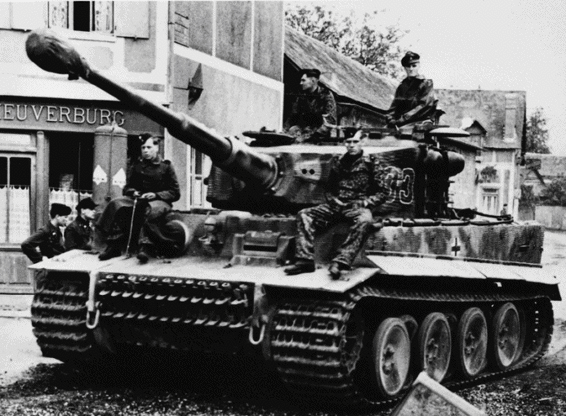
The most feared tank in the German arsenal was called the Tiger I, with its famous 88mm cannon. Its 100mm (3.9in) frontal armour rendered most Allied tank guns useless. The only thing that stood a chance of piercing the frontal armour of the Tiger was the British 17-pounder gun, a weapon which boasted a revolutionary discarding tungsten sabot round.
Contrary to popular belief, the monster Tiger II tank never served with the two Waffen-SS heavy panzer battalions in the fighting in Normandy. One army battalion was directed to the Western Front, but it never got to Normandy, as it was caught up in the German rout during August 1944. The Waffen-SS would not see the benefits of these giant tanks until they used them in the Ardennes Offensive of December 1944.
Waffen-SS units also had large numbers of Jagdpanzer IV, StuG III and Marder self-propelled guns at its disposal. These machines were constructed on converted tank chassis, but lacked rotating turrets. Their heavy cannons were mounted low in their hulls, and this had the advantage of making them easy to camouflage. They were found to be ideal as defensive weapons. The Jagdpanzer IV was based on a Panzer IV chassis and it had the same long-barrelled 75mm cannon as the Panther and thick, sloped armour.
The StuG III was smaller, being based on the obsolete Panzer III, but it had a useful 75mm cannon. The Marder was a lightly armoured tank hunter, built on a Czech tank chassis, and mounting the incredibly powerful 76.2mm antitank gun, the design of which had been captured from the Russians.
The most powerful antitank units in the Waffen-SS divisions were the 88mm Flak guns of the divisional antiaircraft artillery battalion. These guns could punch through the armour of any Allied tank at an unrivalled range of more than 2500m (2734yd).
At the heart of each Waffen-SS panzer division were two panzergrenadier or mechanized infantry regiments, each of which had an antitank company, supplied either with Marders or towed Pak 40 antitank guns. Panzergrenadier companies were lavishly equipped with the shoulder-fired Panzerschreck antitank rocket launcher, which was copied from the American bazooka, or the “throw-away” one-shot Panzerfaust antitank rocket. These weapons turned every infantry squad into a tank-hunting unit.
One panzergrenadier battalion in each division was mounted in armoured SdKfz 251 halftracks, known as SPWs, to allow it to accompany the panzer battalion into close proximity to the enemy. The other five panzergrenadier battalions were carried in soft-skinned trucks. The divisional reconnaissance battalion also had armoured halftracks, as well as Marders.
Supporting the frontline Waffen-SS troops was an array of powerful artillery systems. A number of self-propelled guns called Wespes, with 105mm guns, and Hummels, with 155mm guns, were mixed with towed 105mm and 150mm guns in divisional artillery regiments.
Each panzergrenadier battalion also had its own infantry gun company which boasted self-propelled 150mm and 75mm guns, as well as 120mm heavy mortars. The corps-level firepower was provided by Nebelwerfer multiple rocket launchers.
Tactics
Their experience of three brutal campaign seasons in Russia had transformed the Waffen-SS panzer divisions into some of the most professional armoured formations the world has ever seen. Under experienced commanders – such as Hausser, Dietrich, Bittrich, Kurt “Panzer” Meyer and Jochen Peiper – the Waffen-SS panzer divisions were trained up and inspired to become masters of their art.
Central to German armoured doctrine was the idea of the all-arms battle group (or Kampfgruppe). Unlike in Allied armies, it was considered routine for the Waffen-SS to quickly form Kampfgruppen. These battle groups would combine tank, panzergrenadier, antitank, reconnaissance and artillery units and would operate under a single commander. There was no set size or shape of a Kampfgruppe, as these variable factors would depend on the mission and the enemy being faced.
The close-knit Waffen-SS “family” made the formation and functioning of Kampfgruppen even more effective than it was in the Wehrmacht panzer units. These Waffen-SS officers had all served with each other for several years. As a result, they knew exactly how their comrades operated, and could easily become a member of each other’s command team. Thus they were able to conduct complex tactical manoeuvres through brief verbal orders which had been issued over the radio net.
Time and time again during the campaigns in the West after D-Day, Waffen-SS Kampfgruppen, despite being rapidly formed, would save the day for the German Army. On the Allied side – in contrast to the Germans’ units – the formal and laborious “orders groups” were the norm, making it difficult for their operations to be rapidly improvised.
Mission command (or Auftragstaktik) was at the heart of German Army tactics. Commanders were given an objective to reach and were left to formulate a plan of operation which would achieve the High Command’s intent. During both defensive and offensive operations, German commanders would decide where exactly the Schwerpunkt (point of main effort) was to be. Once this had been identified, they would concentrate as much of their resources as possible in order to secure it.
In the defensive battles in Normandy, this usually resulted in the Germans trying to hold a key piece of high ground that dominated a large area. Holding the high ground would give an important advantage: devastating artillery as well as tank fire could be brought to bear against the enemy, effecting its retreat.
When the Waffen-SS moved to attack, the same principle was used. However, in their manoeuvres the bulk of the German offensive power would be concentrated against the weakest point in the Allied line. Once success had been achieved, an overwhelming force would be concentrated to reinforce these gains.
The Waffen-SS had learned on the Eastern Front that its tanks were true battle-winning weapons, both in the attack and defence role, as long as they were concentrated and used en masse. A division’s panzer battalion would only be committed to action if it could achieve decisive results. It was not to be wasted away in penny packets, holding ground or on limited attacks. The job of holding ground was to be left to the panzergrenadiers, which were to be supported by the antitank units. These two units in turn would often find themselves supported by the Flak battalion’s 88mm guns, operating in the direct-fire role.
Rethinking the battlefield
Once it had been committed to action, a panzer Kampfgruppe would usually boast elements of the SPW battalion, antitank guns and self-propelled artillery. This self-contained force would be able to deal with any likely enemy threat and hold ground once the operation had achieved its objective.
On the whole, the experience the Waffen-SS had gained in Russia was invaluable when it came to fighting the relatively inexperienced British and American divisions which had landed in Normandy. However, no matter how much they had learned, there was one major shortfall: these SS men had never been forced to face massed Allied airpower. The paralyzing effect of the overhead presence of British Typhoons or American Mustangs was to force a rethink by the Waffen-SS commanders. They realized that they would have to change the way they moved their troops around the battlefield. It soon became apparent that the massed tank attacks which had worked so well for them on the Eastern Front were, once executed in the West, extremely vulnerable to devastating Allied air attack.
Fighting spirit
One thing the Waffen-SS – particularly its officer corps – never lacked in abundance throughout the duration of the war was fighting spirit. A major factor in nurturing and maintaining the fighting spirit of the Waffen-SS panzer divisions was their strong sense of unit identity. Both officers and non-commissioned officers alike served almost exclusively in the same regiment or divisions throughout their time in uniform. They had come to know and trust their comrades in arms, and had shared successes and hardships. Each division also had its own distinct set of characteristics.
The Leibstandarte was the élite of the élite. It was the first unit to be formed and the Führer took a personal interest in the division which bore his name, receiving priority for recruits and equipment.
Das Reich had been hardened by years on the Eastern Front, but by 1944 was an unhappy unit under a martinet commander, Heinz Lammerding. The Hitlerjugend adopted many of the traditions of the Nazi Youth movement and was not strong on military formalities. Many of its officers were former Leibstandarte men who were determined to prove themselves as good as their old comrades.
The Hohenstaufen and Frundsberg Divisions were new units but, despite this, were very professional in the way they conducted themselves. In 1944, soldiers of the Waffen-SS panzer divisions all believed that they were serving in the best units in the world. Every single soldier considered himself to be utterly invincible.
The leadership of the Waffen-SS panzer force had developed and matured during the course of the war. There were a number of distinct groups within the Waffen-SS and they all – to varying degrees – meshed together to produce very effective fighting units. There was a rump of senior officers who were all hardcore Nazis, such as “Sepp” Dietrich, who had loyally served Hitler for two decades.
Senior officers such as “Sepp” Dietrich were the owners of the power, positions and lavish property under Hitler’s regime. Moreover, they were passionate believers in Hitler’s cause, particularly his racial war against the Jewish and Slav “Untermenschen” in the East. Men like Dietrich never had any pretensions to be military geniuses, and relied on professional soldiers like Hausser, Bittrich and Fritz Kraemer to run things for them. Dietrich was later to enjoy promotion to the rank of SS-Oberstgruppenführer, or the equivalent of an army lieutenant-general, which many considered to be a serious case of over-promotion. However, what mattered most to Hitler was Dietrich’s loyalty, not his tactical skill. Over the years, Dietrich did manage to pick up the basics of tank tactics; indeed, he had served in the first German tank unit during World War I. He was also far from stupid and would listen to advice from subordinates. His specialty was motivating men to fight and die for the Führer. However, after four years of war, he was now beginning to show the first signs of being disillusioned with the hopeless struggle. Despite this disenchantment, Dietrich’s loyalty to his old boss kept him fighting.
Hausser and Bittrich were the military intellectuals of the Waffen-SS. They were to provide it with its military professionalism and, as a result, they were well respected by their army colleagues. Hitler, however, never quite trusted them. He once called Hausser “crafty fox” in a very uncomplimentary way. However, they were practical, down-to-earth soldiers, and by 1944 they were no longer convinced that Germany would be able to win the war. There was a small core of Himmler cronies in the Waffen-SS panzer divisions. They found their way into senior command posts through Himmler’s personal patronage, and because of this nepotism, they were considered “untouchable”, even if they proved to be totally incompetent. Lammerding of Das Reich and the Hitlerjugend Division’s Mohnke were examples of the individuals who would fit into this category.
The leaders of men
Almost all Waffen-SS combat regiments and battalions in France in 1944 were commanded by hardcore veterans. These were men who had worked their way up through the ranks of their divisions. Most of them had started out their military life as junior officers in the opening days of the war and, by a process of natural selection, ended up shouldering much of the responsibility for the fight against the Allies. The likes of Meyer, Peiper, Fritz Witt, Max Wünsche, Teddy Wisch and tank ace Michael Wittmann were all in their late twenties or early thirties, and could only be described as “natural leaders of men”.
These highly skilled soldiers were men who led from the front. As a result of their actions, they took great pride in accumulating injuries and medals at an alarming rate. They were expert practitioners of armoured warfare. Often their presence on the battlefield was enough to a turn around a calamitous situation and restore the troops’ morale.
Unlike British and American officers – who did not wear their medals on the battlefield – Waffen-SS officers made a great show of their decorations. This was particularly the case if they had won the famous Knight’s Cross for bravery in battle (worn at the neck). Some of them even wore them with their camouflage combat smocks. They were totems of their own bravery in past battles, and their appearance also served to make their followers aspire to win these medals.
These young Waffen-SS officers were totally ruthless, yet at the same time their troops idolized them. This was largely because of their willingness to lead from the front. It was as if they hoped that the aura of invincibility that surrounded them would rub off on the men whom they led.
Unlike some of the older Waffen-SS hands, they had far from given up the fight, and now that the opportunity to achieve fame and notoriety had arisen, they were hungry for glory. Their wishes would soon come true.
Locked into war
For the rank-and-file men serving in the Waffen-SS, their enthusiastic willingness to fight was due to a combination of various factors. Since Hitler’s accession to power, the population of Germany had been subject to daily bombardments of Nazi propaganda. These sinister messages were cleverly crafted so that they whipped up support for Hitler’s warped ideology. The school and university systems were fertile recruiting ground for the Nazi Party, and the indoctrination of those youngsters was a major objective for Hitler’s henchmen. The outbreak of war accelerated this process of indoctrination. Once the Allied bombers started raiding major German cities in massive numbers from late 1942 onwards, the German people could see for themselves what little pity they would evoke from such a ruthless enemy. In the aftermath and carnage of the mass bombings, it was easy for Hitler’s propaganda genius, Josef Goebbels, to declare total war and for German civilians to be swept along by his enthusiasm for the conflict.
With Berlin and other cities being systematically turned into ruins by Allied bombers, German soldiers knew they were locked into a fight to the finish. The men who had served on the Eastern Front also realized that Germany would face no mercy if the Soviets ever broke through and were allowed to push into the Reich.
Even though by 1944 the Waffen-SS found itself relying increasingly on conscripted manpower – including former Luftwaffe and navy personnel – it would nevertheless contain a higher proportion of volunteers than were to be found in line army units. These were a mix of hard core Nazis, professional soldiers seeking rapid career advancement, and a sprinkling of adventurers who wanted to taste the excitement and horror of battle. Their wishes would soon be granted in the killing fields of Normandy.