
8
The overnight insertion march from the helicopter drop-off point to the village of Lam in January 2008 was possibly the coldest night of the tour, with temperatures well below zero. There had been an insurgent meeting in this remote village the day before, but we had just missed them. In the event we spoke to the villagers, who spent most of the day crouched outside their mud houses to absorb heat from the sun. There was no water in the village, as the river was dry in winter; it had to be collected from a well a few miles away. These villagers truly had virtually nothing. Their concern was simply to survive the winter. In that context, wider political issues had little traction with them. Whether insurgents used the village as a transit point between Helmand and Kandahar Provinces was not their problem. In such circumstances our narrative, and indeed the insurgent narrative, held little of interest for them. Any strategic narrative, to be persuasive, must have emotional as well as rational purchase on an audience. This chapter considers the construction of strategic narrative in contemporary conflict; but first we must define its function.
‘Strategic narrative’ is a contemporary term, but is a formalisation of a concept that has been present in all conflicts. Strategic narrative is the explanation of actions. It can usually be detected chronologically before conflict starts, in some form, as the explanation for participation in, or initiation of, the conflict; strategic narrative also operates as the explanation of actions during and after conflict.
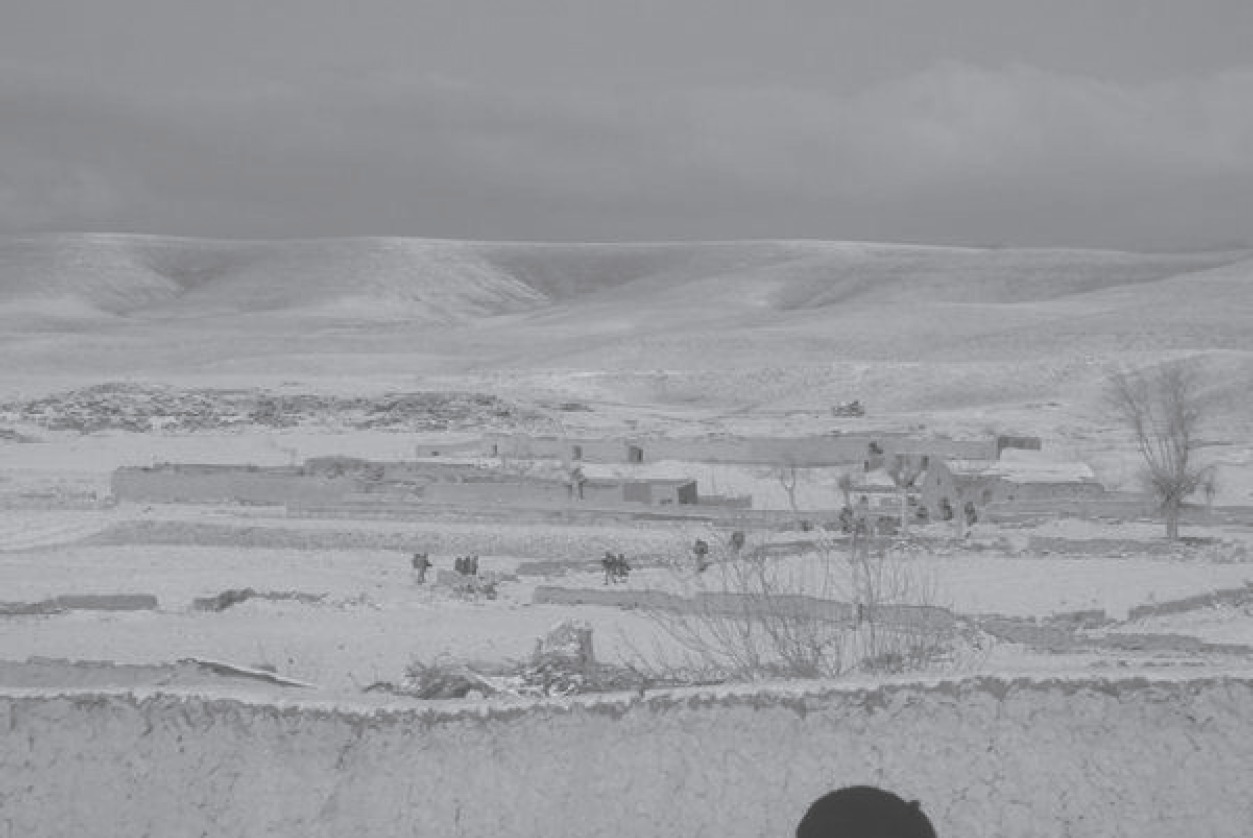
Figure 13: Gurkha patrol through snow in the village of Lam, North Kandahar Province, January 2008.
Strategy seeks to relate actions to policy. A policy outcome is ultimately an impression upon an audience. It can be a physical impression, which in war would typically be defined in terms of death and destruction. It can simultaneously be a psychological impression, typically defined in terms of an evolution in political alignment, not necessarily by consent. For strategy to connect actions to policy it must therefore invest them with a given meaning in relation to its audiences, both prospectively and retrospectively.
Policy starts as an abstract idea, because by logic it has not been achieved yet; policy finishes as a set of accomplished facts, the policy end-state, which in many cases may not meet the original intent, and may not represent a clear end point, as policy in a conflict merges into post-conflict policy. In this sense strategic narrative accompanies policy throughout the lifetime of the conflict (before, during and beyond the period of actual fighting): it explains policy in the context of the proposed set of actions in the abstract, and then explains those actions, having been executed, in terms of how they relate back to policy.
Strategic narrative can be found in various forms which differ in accordance with the rhetorical context. The way the British Prime Minister justifies participation in Afghanistan to the British public differs in style and content from the narrative he might give to international audiences. A British soldier would explain the actions of his patrol to an Afghan audience differently depending a number of factors. Is he speaking to an individual or a group? Is the audience already familiar to him? If so, what is the nature of the existing relationship? What is the socio-political background of the audience? What are the operational circumstances of the discussion? The list goes on. Strategic narrative effectively proposes to its audience a structure through which to interpret actions. In another, intrinsically related, sense it is the expression of policy aims in narrative form. The last chapter, for example, set out how, by adjusting the strategic narrative of Britain’s involvement in the Borneo Confrontation from a colonial to a Cold War context, the United States administration was persuaded to understand, or tolerate, Britain’s actions in that conflict in a different way.
Strategic narrative should be adjusted to the audience. An Afghan peasant, for instance, is not particularly interested in who has power in Kabul; what the coalition and Afghan government are doing locally is far more important. Conversely, a provincial governor might be more concerned by national politics than the local situation in his province. For strategic narrative to vary is normal, in the same way that a salesperson pitches a product differently to resonate with a particular customer. The problem comes when a product is pitched so differently to different customers that it loses credibility because the versions are inconsistent. This is the challenge for strategic narrative today: the strategist has to consider how a narrative can gain purchase on audiences whose political persuasions vary widely, without coming apart. The model at Figure 14 illustrates an ideal form in which each narrative is ‘nested’ within a wider narrative, and is thus consistent.
General Stanley McChrystal stated in 2009 that counter-insurgency ‘is about having a consistent conversation with the Afghan people’. In the context of national level strategic narrative, Captain Wayne Porter of the US navy and Colonel Mark Mykleby of the US marines have argued that the US needs to close the ‘say-do gap’: a convincing narrative means consistency in words and actions across the globe.1 David Kilcullen has argued that it is important to ‘exploit a single narrative’ in his ‘28 Articles, Fundamentals of Company-level Counterinsurgency’:
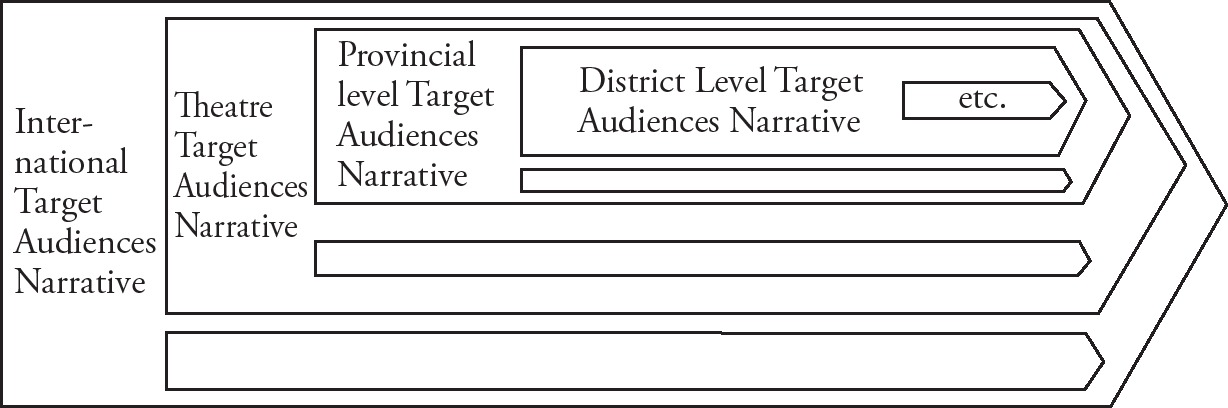
Figure 14: Idealised strategic narrative model (based on a fictional context): each narrative is nested.
Since counter-insurgency is a competition to mobilise popular support, it pays to know how people are mobilised. In most societies there are opinion-makers … who set trends and influence public perceptions. This influence … including the pernicious influence of the insurgents—often takes the form of a ‘single narrative’: a simple, unifying, easily expressed story or explanation that organises people’s experience and provides a framework for understanding events… To undercut their influence you must exploit an alternative narrative: or better yet, tap into an existing narrative that excludes the insurgents.2
This narrative should be realised in a coherent set of actions which give it expression. Figure 15 illustrates how strategic narrative binds together the various lines of operation in Afghanistan.
The diagram draws out how strategic narrative is not just concerned with audiences exterior to one’s side, or coalition. One of its key functions is to achieve unity of effort, ideally to give coherent expression to that side’s ‘will’, as Carl von Clausewitz would put it. In a 2010 lecture on the UK government’s counter-terrorist strategy (named the ‘Contest’ strategy) Charles Farr, the head of its implementation at the Home Office, stated that: ‘people work on Contest in High Commissions and Embassies around the world, in Departments in London, in local authorities, and in policing units up and down this country, they talk about the strategy and they refer to it’.3
The first part of this quotation exemplifies how strategic narrative is essential to overcome potentially fragmented and geographically disparate institutional boundaries on issues that require a cross-government approach. The second part speaks to the importance that a strategy have purchase on those whom it seeks to direct. This may be common sense, but effective, unifying, strategic narratives that are alive in the minds of their protagonists, are less common than distant, bulky tomes that few people one one’s side have actually read, and fewer still are inspired by. Third, this aspect of strategic narrative points to the fact that to draw a sharp distinction between strategy and strategic narrative is misguided: as the explanation of actions, strategic narrative is simply strategy expressed in narrative form.
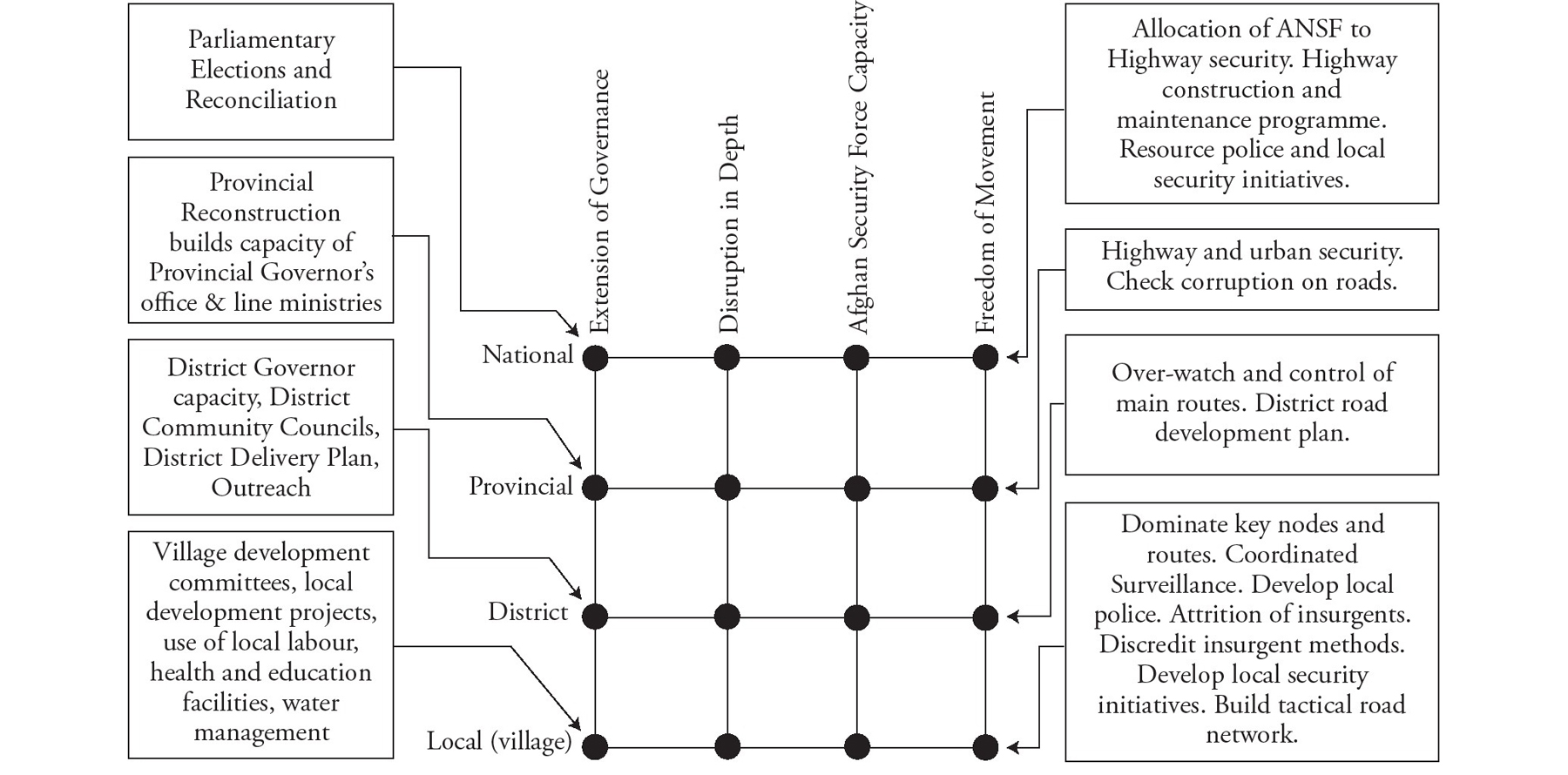
Figure 15: On the vertical axis are the various levels at which ISAF operates in Afghanistan. On the horizontal axis are Lines of Operation (LOOs). In this case the LOOs are drawn from the ISAF Regional Commander for Southern Afghanistan’s priorities at the start of the summer of 2010. The actual substance of the horizontal and vertical axes is only used as an illustration; levels of operation and LOOs can be adjusted in number and substance as required. The boxes to the side show the types of action that are conducted at each level to support each LOO. Only two LOOs are expanded upon here for simplicity, and there would in reality be far more in each of the boxes. However, what this diagram illustrates is that lines of operation have to provide mutual support for one another, and activity at each level needs to be consistent with that above and below it. Strategic narrative plays a vital role in ensuring this coherence between actions, in the sense that it explains to people what is being done, so that people understand those actions in the manner intended by strategy. This includes achieving unity of effort among one’s side, as well as explaining actions to other audiences. (ANSF, top right, signifies Afghan National Security Forces.)4
In reality it is often impossible to satisfy every audience, just as politicians who try to please everybody may find themselves to be in pursuit of an incoherent agenda which actually pleases nobody. An essential variable in strategic success is how far strategy has managed to bind potentially conflicting narratives together into a coherent strategic narrative. In the traditional inter-state paradigm of war, the presence of an enemy whose intention is one’s own destruction tends to concentrate minds; where there is not such an existential threat (a circumstance normal in contemporary conflict), political differences tend to come to the fore and frustrate coherent strategy. This chapter examines how strategic narrative can be constructed in the fragmented political environments that characterise contemporary conflict.
Strategy, meaning and rhetoric
In the film Thirteen Days, which is about the 1962 Cuban missile crisis, there is a great scene when Secretary of Defense Robert McNamara confronts Admiral Anderson, who is directing the naval blockade of Cuba.5 President Kennedy has specifically ordered that there be no firing against Soviet transport ships without his permission. A star-shell (flare) has just been fired over one of the ships as a warning. Secretary McNamara is furious, thinking it was actual firing. He orders firing to stop, and then confronts the Admiral:
ADMIRAL ANDERSON: Get out of our way, Mr Secretary. The Navy has been running blockades since the days of John Paul Jones.
MCNAMARA: I believe the President made it clear that there would be no firing on ships without his express permission.
ADMIRAL ANDERSON: With all due respect, Mr Secretary, we were not firing on the ship. Firing on a ship means attacking the ship. We were not attacking the ship. We were firing over it.
MCNAMARA: This was not the President’s intention when he gave that order. What if the Soviets don’t see the distinction? What if they make the same mistake I just did? There will be no firing anything near any Soviet ships without my express permission, is that understood, Admiral?
ADMIRAL ANDERSON: Yes, sir.
MCNAMARA: And I will only issue such instructions when ordered to by the President. John Paul Jones … you don’t understand a thing, do you, Admiral? This isn’t a blockade. This, all this [US tactical moves during the crisis], is language, a new vocabulary the likes of which the world has never seen. This is President Kennedy communicating with Secretary Khrushchev.
This exchange, though fictionalised, illustrates the importance of the interpretive structure through which people understand actions in conflict, as well as the instability of interpretive structures in situations which do not conform to more conventional templates of conflict, where improvisation is often necessary.
The essential variable governing the stability of a conflict’s interpretive structure is the degree to which it depends upon the application of physical violence. Clausewitz’s concept of the centre of gravity links physical action to a psychological, and essentially political, outcome (as Chapter 6 discusses). For Clausewitz, strategy’s function is to identify the centre of gravity and orchestrate tactical action to strike against it. Victory by ‘strategic manoeuvre’ alone was for Clausewitz highly unstable; to call an enemy defeated because he has accepted the likelihood of actual physical defeat while his forces are largely intact may prove short-lived if he changes his mind.6 Clausewitz placed a premium on tactical outcomes as the pegs on which strategic outcomes were hung. Tactics represented physical reality. Strategy was its exploitation, and represented the psychological component:
In strategy, there is no such thing as victory. Part of strategic success lies in timely preparation for a tactical victory… The rest of strategic success lies in the exploitation of a victory won.7
Tactical actions provided the building blocks for strategy to convert into a political end-state: ‘the original means of strategy is victory—that is, tactical success; its ends, in the final analysis, are those objects that will lead directly to peace’.8 Clausewitz wrote about how strategy is what invests the physical component of tactical victory with its psychological meaning: its ‘sphere of influence’. Superiority in war was a combination of the two.9
Strategy was what gave meaning to tactical actions: ‘we are dealing with one of the most fundamental principles of war. In strategy, the significance of an engagement is what really matters… That is why, strategically speaking, the difference between one battle and another can be so great that the two can no longer be considered the same instrument’.10 The point he makes here is that significance can only be defined against something, which in this case is the result of the war as a whole, and it is strategy’s role to propose and exaggerate that definition. It does this by orchestrating tactical actions and adjusting war itself as an interpretive tool, as Chapters 1–3 of this book set out. Thus, what Clausewitz is hypothetically arguing is that two battles could physically be identical, but as the result of a battle is only definable in relation to a given strategic context, this can vary, and therefore vary the results of the two battles.
In summary, Clausewitz stressed that the physical destruction provided by the engagement was the only advantage that permanently belonged to the victor.11 The perceived meaning, and ultimately the policy outcome, that strategy invests in tactical actions can never itself be considered permanent.
Nonetheless, approaches to conflict which emphasise the perceived over the physical will often be more tempting, often for very sensible reasons, such as the fact that they require, at least if successful, less investment of physical resources. Military approaches have oscillated in terms of the degree to which they have exploited perception in war. Karl-Heinz Frieser’s study of the German 1940 campaign in France argues that Blitzkrieg was not a formal concept at this stage, but the way in which the more imaginative and aggressive German generals operated was a revival in some ways of an older tradition of manoeuvre:12
The Blitzkrieg of 1940 at first seems like nothing other than the revival of the classic operational war of movement of men such as Moltke and Schlieffen. But that is only half the truth. The tie-in of traditional command principles with modern technology resulted in such a tremendous increase in speed during combat operations that there arose a dialectical turnabout, leading to a new, psychological quality. That is the essence of the revolution in the nature of war. The principle of psychological confusion replaced the old principle of physical annihilation… If at all possible, the German Panzers avoided all kinds of combat actions. After they had thrust deep into the enemy’s rear areas, the enemy front collapsed by itself amid wild chaos.13
Karl-Heinz Frieser’s argument indicates that massive reliance on the perceived component of actions in conflict (an idea associated today as much, if not more, with al-Qaeda and its franchise groups as state actors) is neither novel, nor out of place across the spectrum of conflict, including as here in the context of high-intensity, conventional, interstate war. By the same token, the risks attendant on such an approach, which informed Clausewitz’s scepticism about eighteenth-century warfare in his own post-Napoleonic era, are also neither novel, nor restricted to low-intensity warfare. Frieser argues that the German campaign of 1940 was, in its early stages, and contrary to popular perception, a very close run thing.
Great dependence on the perceived component of actions in conflict is therefore not new, nor are the risks of so doing. However, this dependence is undoubtedly driven and exaggerated by today’s information revolution. There is a correlation here with Frieser’s proposition that the successful German exploitation of perception in the 1940 campaign was also underpinned and enabled by agile exploitation of technological developments which irreversibly changed the nature of modern warfare. The Wehrmacht’s spearhead Panzer groups were able to operate over long distances due to radio, and had command organisations which exploited the technology properly.
By contrast, Frieser offers an incredible vignette of the French supreme commander in the final stage of the campaign: Maxime Weygand, who at one point based himself in a headquarters in which there was no radio and only one telephone line, unavailable between midday and 2 p.m. as the telephone exchange girl insisted on her lunch!14 By analogy, liberal powers cannot opt out of today’s information revolution for the purposes of armed conflict, as General Weygand did, even if that makes it incumbent upon us profoundly to adjust the way in which we consider contemporary conflict. Given that the effects of the information revolution are probably irreversible, at least in the visible future, the implication is that the experience of conflicts such as Afghanistan are not anomalous, but actually point to the future.
In contemporary conflict physical destruction tends to matter less to a conflict’s outcome than how those actions are perceived (with certain exceptions). This is primarily because the outcome is defined against several audiences who are not the enemy, and therefore are beyond the range of physical violence. Moreover as various audiences frequently have significantly different interpretations of the conflict in which they are involved or are witnessing, it is much harder for strategy to invest physical actions with a meaning that corresponds with the desired policy outcome because there are so many possible interpretations of any tactical action.
David Kilcullen in The Accidental Guerrilla (2009) describes how the West tends to think about information operations as describing actions in war. Al-Qaeda and the Taliban, however, tend to act in order to convey a message. They are conducting ‘an armed propaganda campaign. The informational side of AQ’s operation is primary. The physical is merely the tool to achieve a propaganda result… Contrast this with our [the West’s] approach: we typically design physical operations first, then craft supporting information operations to explain or justify our actions’.15
My view is that physical actions still matter, even if they are perhaps perceived badly at the time. An analogy might be made with a politician who introduces unpopular reforms which are only appreciated in retrospect. Moreover, the effects of campaigns thus fought are more durable, as Clausewitz argues. That said, the information revolution does not present liberal powers with such a convenient choice. Kilcullen is right to argue that liberal powers in many contemporary cases, such as in conflicts which are highly politicised at the tactical level, need to understand better how to orchestrate actions to achieve a given information effect. In these circumstances, the construction of strategic narrative approximates to the theory of rhetoric.
The construction of strategic narrative, like the construction of oratory, is designed to persuade people of something. The first question the rhetorician must consider is the relationship between the desired outcome and the audience. How does one break down the audience into segmented target groups? Does one seek broad approval from the audience or are certain sections of people targeted? How does one tailor one’s narrative to resonate with each target audience without appearing inconsistent? Does one focus on timing parts of the speech to appeal to specific target audiences which may upset others, and if so, does one condition those who will be upset by appealing to them earlier on in the speech? Second, once the audience has been defined, the rhetorician considers how to convince his audience. In Aristotle’s Rhetoric, he defines three rhetorical resources the orator could use to persuade: logos was appeal through rational argument, and thus referred to the speech itself (logos meant ‘word’, ‘speech’, ‘account’ or ‘reason’ in Greek); pathos was persuasion through emotional appeal, by putting the hearer in a certain frame of mind; ethos was persuasion through one’s own moral standing.
Finally, how does one consider the length of time a meaning has to be impressed upon one’s selected audience? If only short-term consent is intended or expected, rhetoricians may exaggerate the truth, lie, or construct arguments that have no basis in reality. Yet any effect gained upon an audience may quickly fall apart and damage one’s future credibility.
Strategic narrative, as an expression of foreign policy, is often associated with rational propositions. I argue that in contemporary conflict strategic narrative needs to engage people in the domain of logos, the rational narrative, but also go beyond it by using pathos and ethos, in order to broaden its appeal and so gain purchase on politically disparate strategic audiences. This chapter looks at the function of and relationship between logos and pathos in particular; the next chapter examines the function of ethos in strategic narrative, and how all three require projection through confident vision.
Emotional and rational response: the centrifugal and centripetal forces in the narrative of war
‘King George saheb kasto hunu huncha?’ (How is King George?) Man Bahadur Ghimire asked me. We were in his farmstead perched on a steep ridge, a balcony facing the Himalayas, days from the nearest road-head. I was on a duty trek as a Gurkha officer through the remote hill villages of eastern Nepal to check on our regiment’s retired soldiers. It was thus that Man Bahadur Ghimire, former Rifleman in 9th Gurkha Rifles, and veteran of the battle of Monte Cassino, broke a natural pause in the conversation. He posed the question seriously, as if we were discussing a great matter of state in his goat pen. I suddenly felt that I must break the dreadful news to him. In fact, when told about Queen Elizabeth, he immediately absorbed her into his world, and indeed seemed apologetic for having asked, as if he had reminded me of a recent loss. However, he immediately recovered by asking enthusiastically how the Queen was. What struck me was that, although united by a common regimental tradition, we could have been from different worlds, and he was adjusting to me as much as me to him. What fascinated me was his memory of war.
Man Bahadur Ghimire had been shot in 1944 at the battle of Monte Cassino and showed me the scar. He remembered a few place names. Yet his relation of his experience of battle to me was exclusively aural. He re-created all the sounds from the mortar to the machine gun in detail, re-enacting ducking and diving to take cover. This was the common feature of many of the old soldiers I spoke to on that trek, most of whom had in fact fought not in Italy but in Burma. Thus former Rifleman Bom Bahadur Gurung remembered the names of the great battles he had fought in: ‘Kohima, Arakan, Meitktila’. He also described his experience by re-creating the sounds of battle. But above all what animated these accounts was the emotional recollection of battle: the chaos, fear, courage and death of friends. The names of the battles they fought in were only relevant as pegs on which were hung their human experiences of combat.
The worlds we inhabit profoundly shape the way we understand war. The old Gurkhas’ narratives were distinctive precisely because they were so heavily situated in the emotional domain. They had little idea of the broader circumstances which created their war, and even of the logic of the battles in which they themselves fought. They could not tell you why their company was attacking the enemy, just that they were ordered forward, and then confronted the noisy chaos of combat. In a sense the old Gurkhas are for us an anomaly, a group who were in the war and fought in it but did not understand it in ‘rational’ terms. While that may be the case for many soldiers in battle, rationality can be imposed retrospectively through historical understanding. Yet as they have continued to live in a different world in the Himalayan foothills, even this retrospective rationality has bypassed them.
In The Face of Battle (1976) John Keegan argues that writing the history of a battle without the interpretive structure provided by war would be like trying to write the history of a wild party in terms of the impossibility of describing the chaotic.16 This argument identifies how war is simply the definition one imposes on a series of human events. One does not need to use this definition. One can legitimately see chaos in what another would rationally define as a battle. A rational battle narrative can never claim to be definitive. Ahmed Rashid puts this in another way when he describes the conflict in Afghanistan:
‘war is always a mixture of different, conflicting stories, depending on whether you are crouching in a ditch or sipping tea at the Presidential Palace. To have dinner with Petraeus and then tea with President Karzai is a central part of the story, as is journeying to the edge of the city to the tiny, unlit, unheated flats, to talk to a former senior Taliban official’.17
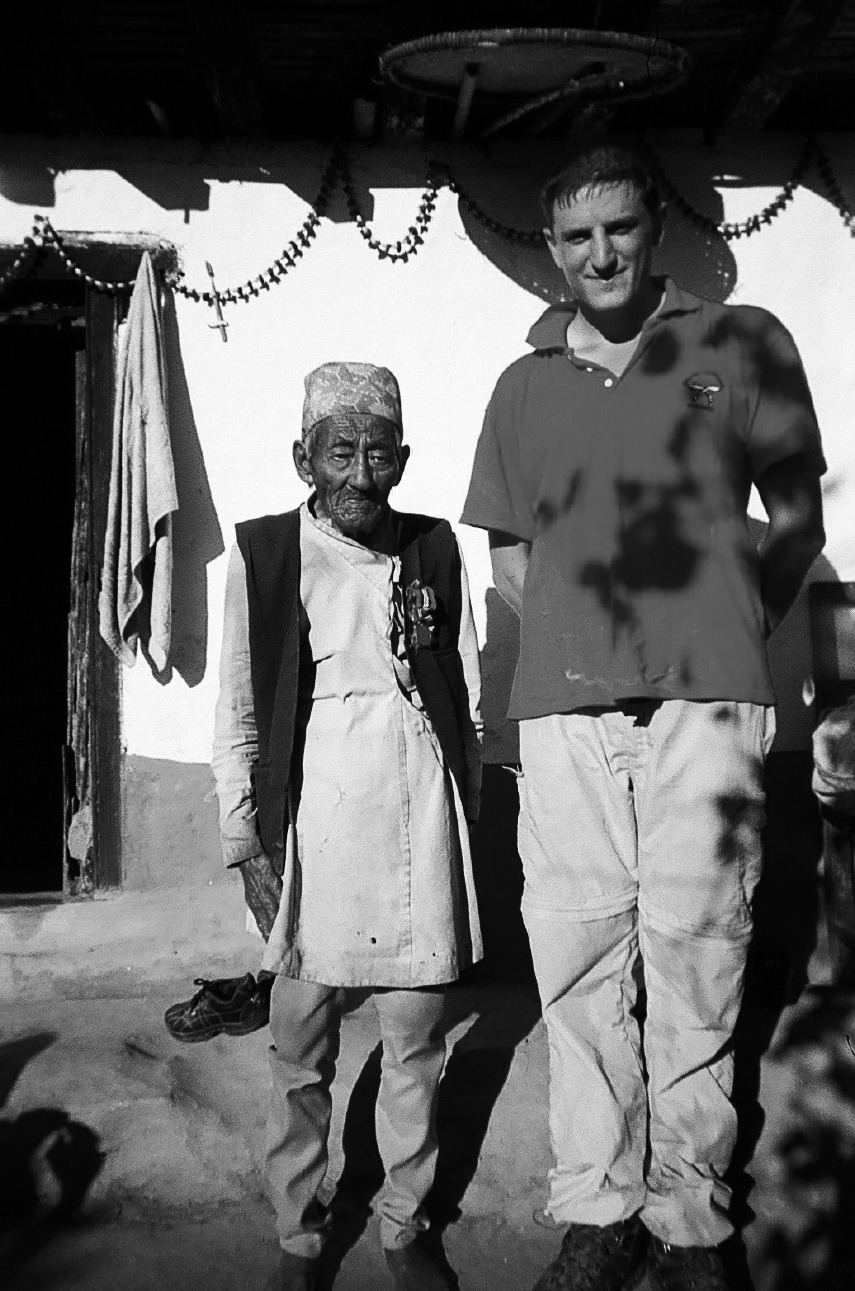
Figure 16: Rifleman Bom Bahadur Gurung, wearing his medals, with the author, at his home in East Nepal, 2008.
War, however, is usually understood in exclusively rational terms. In this form of narrative, events are selected and interpreted in terms of how everything relates to a war’s rationale. Rationality is a centripetal force, as it seeks to unify the narrative of war. A rational narrative would say that this is what happened in the Second World War and this is why it happened. It acknowledges sub-narratives, but they all fit into the ‘big picture’ according to war’s interpretive hierarchy. So a company attack at the battle of Meiktila has its own story, but was part of the wider narrative of the Burma campaign, the War in the Pacific, and the Second World War. Emotional response is a centrifugal force. Emotional narratives of war are fragmentary. There are endless personal definitions of what the war was for an individual. It is a completely different mode of understanding from the rational narrative of war, but is just as legitimate. This applies to civilians as well as combatants. Who is anyone to argue that how a bereaved family understands war is not a legitimate interpretation: that is the war for them.
While there are evidently majority opinions regarding, say, the Second World War, and established historiographical trends, this should not be confused with the idea that there can be a singular definition of what it was. People, both in the singular and the plural sense, will differ in terms of their conception of the experience, be it direct or vicarious. The war ‘was what it was’ for the old Gurkhas. To assume that they ‘don’t understand’ the war they fought in would be mistaken on two levels. First, the essence of war is violence and in that sense it would be perverse to deny their understanding of it. Second, to say that they do not understand the war is illegitimately to claim that ‘the war’ was a single, rationally defined event. War is a mosaic of individual experiences as much as the abstract phenomenon. For any individual, one’s relationship to war in the abstract, its rationale, is mediated through that emotive experience.
How then are ‘rational’ and ‘emotional’ interpretations of war reconciled? Rational narratives are typically given preference by those for whom war has a function, from lance corporal to general to political leader: to understand the outcome of the fight they are in, rationality is required; a rational interpretation of events is required as a basis to plan how to influence them in the way one wants. For the historian, a rational interpretation of war can be required to link it to wider historical narratives. Emotional interpretations are not typically seen as functional. Beyond the domain of individual memory, emotional readings of war are typically found in art. This recognises the legitimacy of that mode of understanding without confusing it with functional understanding.
However, there exists an established tradition of strategic thought that recognises that, while war is planned using the rational mode of understanding, the political and military leader must also pay attention to the emotional mode. In this tradition, the relationship between the rational and emotional is not one of compartmentalisation: the emotional is precisely what legitimises the rational. The two are intrinsically bound together.
Clausewitz stressed that the human, emotional component was intrinsic to war’s nature and formed the ‘passionate’ component of the trinity of war. Passion in the trinity was primarily associated with the people, one of the three components of the trinity’s reflection in the state at war. The human passions unleashed in 1789 were for Clausewitz what caused the transformation of war during his lifetime: the emotional connection of the French citizen soldier with the state mobilised the entire resources of the nation to war.18 Moreover, human passion also interacted with the other two parts of the trinity of war: policy (as represented by the government) and ‘the play of probability and chance’ (as represented by the army). Thus four elements make up the ‘climate’ of war: ‘danger, exertion, uncertainty and chance’.19 War is as much a test of emotional resistance as a rational execution of policy. The ‘climate’ of war produced ‘friction’: ‘everything in war is very simple, but the simplest thing is difficult’.20 In the light of this, the plan in the abstract, in war often thought of in terms of war on a map, had to be grounded in human reality, a concept which Clausewitz extended to strategic theory in general.
Clausewitz repeatedly stressed that the commander of the army must be attuned to moral factors as much as the plan in the abstract: ‘military activity is never directed against material force alone; it is always aimed simultaneously at the moral forces which give it life, and the two cannot be separated’. The commander perceived the moral factors through his ‘inner eye’, his intuitive understanding of his men and the enemy, which combines the emotional and the rational: ‘when all is said and done, it is really the commander’s coup d’oeil, his ability to see things simply, to identify the whole business of war completely with himself, that is the essence of good generalship’.21 By stressing that all the abstract, rational, theory of war had to be synthesised by a human being, the commander, who has to put it in its human context, Clausewitz presents a strong model for how the emotional and the rational are inseparable; by his account, they come together in instinct, the ‘X factor’ of a good commander.
Clausewitz’s attention to the emotional component of war is illustrated in many passages, for example where he is at pains to describe the feeling of a defeated army: ‘abstract concepts of this or that minor loss will never match the reality of a major defeat’.22 Clausewitz was also obsessed with the personage of Napoleon himself, who symbolised for him the unity of reason and intuition.
A perusal of Napoleon’s maxims of war draws attention to why Clausewitz might have considered Napoleon’s style as a battlefield commander in terms of a unity of reason and intuition. In some maxims Napoleon is cold and rational: ‘The first qualification in a general-in-chief is a cool head—that is, a head which receives just impressions, and estimates things and objects at their real value. He must not allow himself to be elated by good news, or depressed by bad’.23 Yet a remarkable number of the maxims show that Napoleon was acutely aware of the psychology of the private solider, and the need for a commander to be attuned to this emotional element: ‘The soldier is best when he bivouacs, because he sleeps with his feet to the fire, which speedily dries the ground on which he lies. A few planks, or a little straw, shelter him from the wind’.24
Napoleon has a realistic view of emotional intuition, in that continuous sensitivity to the issue is required of the commander, not sensationalism: ‘It is not set speeches at the moment of battle that render soldiers brave. The veteran scarcely listens to them, and the recruit forgets them at the first discharge. If discourses and harangues are useful, it is during the campaign; to do away with unfavourable impressions, to correct false reports, to keep alive a proper spirit in the camp, and to furnish materials and amusement for the bivouac. All printed orders of the day should keep in view these objects’;25 alternatively: ‘Every means should be taken to attach the soldier to his colours. This is best accomplished by showing consideration and respect to the old soldier’.26
Napoleon stresses that it is an emotional quality that he desires foremost in his soldiers: ‘The first qualification of a soldier is fortitude under fatigue and privation. Courage is only the second; hardship, poverty, and want are the best school for the soldier’.27 Perhaps this maxim summarises Napoleon’s view: ‘A good general, a well-organized system, good instructions, and severe discipline, aided by effective establishments, will always make good troops, independently of the cause for which they fight. At the same time, a love of country, a spirit of enthusiasm, a sense of national honour, and fanaticism will operate upon young soldiers with advantage’.28
Clausewitz viewed as vital the general’s ability to make decisions which were ‘promoted by strong emotions and by flashes of almost automatic intuition rather than being the product of a lengthy chain of reasoning … after all, waging war is not merely an act of reason, nor is reasoning its foremost activity’.29 To describe this quality Clausewitz used the word geist, which has no equivalent in English; the fact that it is usually translated as ‘spirit’ or ‘intellect’ reflects both the more emotional and more rational possibilities inherent in this concept.30
In summary, throughout On War we find Clausewitz stressing the unity of the rational and the emotional in war. Strategy had to unify both factors: ‘we must allow for natural inertia, for all the friction of its [war’s] parts, for all the inconsistency, imprecision, and timidity of man’.31
The necessity to unify the rational and the emotional has been recognised by military thought concerned with tactical effectiveness. The work of French officer Colonel Ardant du Picq, published posthumously in 1880, stressed the importance of the individual soldier’s psychology to combat effectiveness.32 He argued that fear was the natural response to battle, and that courage was a finite resource that would eventually be depleted. The key to overcome this was esprit de corps. The very language of esprit, ‘spirit’, recognises emotive motivation.
The idea of the corps, ‘body’, links the individual to his unit in a common emotive bond. This strand of thought developed in the French Army of the early twentieth century into the concept of morale, which is now employed far more widely. What has endured most in Du Picq’s work is the training concept that tactics overcome fear through constant rehearsal and small unit cohesion. This is the idea that soldiers in combat fight primarily for each other rather than any wider cause. Moreover, tactical drills provide a default rational interpretation to understand the event. Thus getting shot at becomes ‘a contact’ in which there is a set procedure for dealing with that situation which ideally culminates in the defeat of the enemy. Professor Anthony King has described the outcome of such drills, or set procedures, as ‘the repetition of an established choreography’.33
The unity of the rational and the emotional is today widely accepted at the tactical level. Recruit training seeks to instil a sense of ethos that will drive a soldier’s combat motivation, regardless of how far the individual subscribes to the war’s rationale. Clausewitz posited that: ‘truth [the rational argument] is in itself rarely sufficient to make men act … the most powerful springs of action in man lie in his emotions’.34 Emotions in war ‘act as the essential breath which animates the inert mass’.35 This argument applied beyond just the tactical domain. The political object of war had to have purchase on people’s emotions for it to be successful:
The political object—the original motive for war—will thus determine both the military objective to be reached and the amount of effort it requires. The political object cannot, however, in itself [italics original] provide the standard of measurement. Since we are dealing with realities, not with abstractions, it can do so in the context only of the two states at war. The same political object can elicit differing reactions from different peoples, and even from the same people at different times. We can therefore take the political object as a standard only if we think of the influence it can exert on the forces it is meant to move.36
Any political rationale is interpreted through the prism of emotion, which varies depending on the audience. Plans cannot therefore be made in the abstract without consideration of how they will be interpreted by their intended human audience.
The unity of emotional and rational understanding is fundamentally articulated in the dialectic which informs legitimacy. This is legitimacy in the broad sense rather than any particular moral or legal definition. The synthesis between the rational and the emotional informs action. Thus it can apply to a soldier genuinely fighting for ‘king and country’ as much as to a mercenary who fights for money. In terms of audiences in general, it determines how far people subscribe to a strategic narrative, be it out of genuine ideological attachment, self-interest, ‘subscribe’ in the interest of self-preservation, or endless other reasons why people agree with a proposition.
The legitimisation of the rational narrative by emotional response is an idea already present in fields outside war. The American historian Bernard Bailyn has argued that memory’s relation to the past ‘is not a critical, sceptical reconstruction of what happened: It is the spontaneous, unquestioned, experience of the past … it is expressed in signs and symbols, images and mnemonic clues of all sorts. It shapes our awareness whether we like it or not, and it is ultimately emotional, not intellectual’.
As Gordon Wood writes in the New York Review of Books, Bailyn made remarks about history and memory at the conclusion of a 1998 conference on the Atlantic slave trade that had threatened to fall apart. Many black scholars and others had reacted to the presentations of the cold and statistically grounded papers dealing with the slave trade. Bailyn distinguished between history and memory to calm the conference. He argued that statistics helped, but that: ‘memory of the slave trade cannot be reduced to an alien context; and it is not a critical, rational reconstruction; it is for us a living, immediate, if vicarious, experience’. While meaning may be shaped by history, ‘so too may critical history be kept alive, made vivid, and constantly relevant and cogent by the living memory we have of it’. The point Bailyn eloquently made is this: a rational narrative that does not have purchase on the emotional substance of what it seeks to describe cannot claim legitimacy.37
The fragmentation of strategic narrative: when rational narrative is not legitimised by emotional response
The rational and emotional are of course rarely perfectly aligned. Irony tends to identify the gap between them, which is, to my mind, why it is so prominent in soldiers’ humour. In Memoirs of an Infantry Officer (1930), Siegfried Sassoon starts with his withdrawal from the front to attend a course at an army school: ‘my personal grievance against the Germans was interrupted for at least four weeks’. The lecturer on gas from general headquarters tells the audience of soldiers who have come from the front that gas is still in its infancy: ‘most of us were either dead or disabled before gas had had time to grow up’. Another lecturer addresses them on ‘the spirit of the bayonet’: ‘he spoke with homicidal eloquence’. Sassoon excoriates the lecturer with irony, noting how, as a colonel who had never fought, he was actually awarded a Distinguished Service Order ‘for lecturing’ (the DSO is properly awarded for exceptional leadership of a unit on operations).
Irony gives way to deep cynicism as the emotional and the rational are increasingly misaligned. One of Sassoon’s men and a German sniper kill each other at the same time: ‘he and Kendle had cancelled each other out in the process known as “the attrition of manpower”’. While ‘a certain Prelate’ states that every man who kills a German ‘is performing a Christian Act’, Sassoon talks of ‘the silly stunt which the Bishops call the Great Adventure’. At one point he sees a dead English soldier and writes ‘at the risk of being thought squeamish or even un-soldierly, I still maintain that an ordinary human being has a right to be momentarily horrified by a mangled body seen on an afternoon walk’.
Now back in Britain training recruits in 1917: ‘the War had become undisguisedly mechanical and inhuman. What in earlier days were droves of volunteers were now droves of victims. I was just beginning to become aware of this’. The emotional overturning of the rational is clear in his letter to his commanding officer, in which he refuses to take further part in the war (even though he was wounded and undeployable in any case): ‘I have seen and endured the sufferings of the troops, and I can no longer be a party to prolong the sufferings for ends which I believe to be unjust’.
The distancing of the rational and emotional interpretations is clear when Sassoon deals with the issue of narrative itself with scathing irony: ‘let the Staff write their own books about the Great War, say I. The Infantry were biased against them, and their authentic story will be read with interest’. ‘The War’ for Sassoon does not correspond with his experience of it. He agrees with another infantry officer that ‘the front line is the only place where one can get away from “the War” because in the trenches “it is just one thing after another”’. A failed attack by his unit on 23 April 1917 results in four officers killed, nine wounded and forty other ranks killed: ‘an episode typical of uncountable others, some of which now fill the pages of Regimental Histories. Such stories now look straightforward enough in print, twelve years later; but their reality remains hidden; even in the minds of old soldiers the harsh horror mellows and recedes’.
The process that Sassoon associates with the divergence of narratives is the abstraction of the pure experience, the ‘emotional reality’ into a rational narrative. ‘The Second Battalion were wiped out 10 days ago because the Division General had ordered an impossible attack on a local objective. The phrase “local objective” sounded good and made me feel that I knew a hell of a lot about it’. Here Sassoon is highlighting the use of the word ‘objective’ precisely because it objectifies combat and sucks out the emotional component. He turns on newspapers for avoiding horror, and ‘assuming that the dead are gloriously happy’.
However, Sassoon is more subtle in his treatment of abstraction than just using it to blame generals and journalists. He goes much further than that when he describes a man whose sons are fighting, who has no agenda in his desire to understand what is going on:
‘the Gommecourt show had been nothing but a massacre of good troops. Probably he kept a war map with little flags on it; when Mametz Wood was reported as captured he moved a little flag on a map forward after breakfast. For him the Wood was a small green patch on a piece of paper. For the Welsh Division it had been a bloody nightmare’.
Sassoon is acknowledging here that abstraction is not necessarily malicious; it is a necessary function of rationality. The key point is that Sassoon is not saying that rationality is wrong in itself; that would be nonsense. He is saying that if a rational narrative is not underwritten by its associated emotional experience, the rational becomes divorced from reality. The legitimacy of the rational narrative is underwritten by its emotional basis.
The central importance of the rational-emotional tension is when their functional relationship is reversed. Strategic narrative has to align the rational and the emotional to persuade its audiences. Siegfried Sassoon’s refusal to soldier had no significant impact on the British war effort at the time. However, the widespread mutinies in the French army in 1917 were a major threat to French strategy; they came after the Nivelle offensive, following from the battle of Verdun in 1916, in which the French sustained over 300,000 casualties. In such circumstances strategy has lost control of a strategic audience because the rational strategic narrative no longer has emotional legitimacy; the emotional response now produces a new rationale.
The illegitimate abstraction of emotional experience in the Vietnam War caused a loss of legitimacy in the rational narrative for large tranches of the US domestic population. Neil Sheehan’s Bright Shining Lie (1989), an account of the war based on his extensive time as a journalist in Vietnam, cites such examples of illegitimate abstraction. For instance, the US air force in Vietnam when under General Anthis used to refer to all targets as ‘structures’, which implied some kind of Viet Cong installation.38 The number of ‘structures’ destroyed by aerial bombing was used as a key metric of success. Many on the ground saw that most of these structures were just shacks and barns used by civilians, and their bombing was causing huge animosity among the peasantry, who had to witness the destruction of their villages and deaths of their relatives. Yet this emotion is not communicated by a set of statistics about structures. Sheehan also mentions that the refugees caused by the bombing were abstracted as ‘long-term assets’ by the US Embassy and military command, as they were under Saigon’s ‘control’ in terms of their dependence on the South Vietnamese state.39 When rational abstraction does not correspond to its underlying emotional basis it becomes a denial, not a distillation, of reality.
The photographs and television footage of the war contributed very significantly to shocking the US domestic population into recognition of the bombing campaign for what it was. These new mediums communicated the emotional dimension of war to the domestic population in a far more direct way than had previously been the case. In terms of US casualties, military strategy before Vietnam had generally been justified as an area of professional expertise which inevitably involved casualties. However, after the Tet Offensive and the 1968 Presidential election, the military logic of war started to become even more detached from the emotional response for large swathes of the US domestic public.
The Battle of Hamburger Hill in May 1969, for example, killed eighty-four and wounded 480 US soldiers for an objective that was evacuated days after it was taken.40 The argument proposed by General Creighton Abrams, General Westmoreland’s successor, was that ‘we are not fighting for terrain as such. We are going after the enemy’. The 101st Airborne Division’s commander, Major General Melvin Zais, argued along the same lines: ‘that was where the enemy was, and that was where I attacked him’.41 The rational military argument may well have made sense from a military perspective; at least 633 North Vietnamese troops were killed in the battle. However, this logic struggled to gain purchase with much of the US domestic population.
Neil Sheehan notes that, while more attritional battles earlier in the war had not caused such a political reaction, the fact that more US soldiers were dying per month in 1969 than in previous years created a particularly intense anti-war reaction to the battle. The US army itself by 1969 faced widespread ill-discipline and loss of belief among the ranks. Sheehan also remarks that it was at this stage that the notion that troops were not killed but were ‘wasted’ or ‘blown away’ became common US army slang.42
Strategic narrative and non-state audiences
Clausewitz writes that ‘feelings’ can ‘act as a higher judgement’: the emotional can trump the rational, and proposes a new rationale.43 This distinction often serves more purpose as an analytical tool, since to distinguish between the two in actuality—to dissect an individual’s sources of motivation for subscription to a given position—would be incredibly complicated. There is no clear distinction between rational and emotional sources of motivation at an individual level. Hence existential motivation for participation in war is often intertwined with, rather than distinct from, the war’s political rationale. The endemic association of war with glory has meant that at some level most wars have an element of the existential. A similar argument might be made about armed humanitarian interventions, which are often justified in terms that satisfy an ‘existential’ emotive requirement, that are mixed in with geopolitical considerations.44
A primarily emotive rationale can, for instance, be an organising idea which sees war as the ultimate expression of national values, which could occur even in defeat. This has been termed ‘existential’ war. Hew Strachan identifies how the younger Clausewitz expresses this almost as a creed in manifestos he wrote in 1812. Here he extols the duty to defend the nation’s liberty and values to the last drop of its blood:
Even the destruction of liberty after a bloody and honourable struggle assures the people’s rebirth. It is the seed of life, which one day will bring forth a new, securely rooted tree.45
However, while Clausewitz acknowledged the existential dimension of war, both for the individual and the state participant, he assumed that his actors were within the state, and still bound by its rationale. Thus the general who made instinctive decisions was still in the service of state policy. By the same token, the people’s role was critical: the ‘condition and temper’ of the civilian population mattered to strategy in terms of its ability to support a friendly army with supplies and information, or to deny this to an enemy army.46 However, people’s allegiances were fixed: they were friendly or enemy and, critically, were victorious or defeated with their state.47 The state provided a vital common interpretive ground for the people, the army and the government to understand war in the same way and be defeated or victorious together.
For Clausewitz emotional dynamics underpin his concept of war. The polarity which defined the relationship of state opponents in war was grounded in emotional antagonism. This was not usually between individual soldiers, but between their states: ‘modern wars are seldom fought without hatred between nations; this serves more or less as a substitute between individuals’.48 Indeed the etymology of the word ‘enemy’ is from the Latin in + amicus (friend) giving inimicus (not friend). The distinction between oneself and the enemy is an emotional one; this sets up the antagonism which then determines when to demand recognition of legitimacy of one’s strategic narrative through violence.49
Yet the total identification of strategic audiences with their state, which makes the enemy ‘the’ enemy (a single, unified, entity), is usually an idealised pole; this was so in Clausewitz’s day too.50 In contemporary conflict, the idea that there are audiences within the state who actively try to fight against the policies in war of their ‘own’ state is commonplace. British citizens have been known to fight as insurgents in Afghanistan and other parts of the world. The importance of identification with the state historically has been a matter of degree rather than a clear distinction.
When a strategic audience stops identifying with the state’s strategic narrative, the inter-state paradigm of war starts to break down. This is one of the themes in All Quiet on the Western Front.51 Paul Baümer is a patriotic German soldier who acts on the basis of his country’s rationale for war. His own emotional understanding, however, comes to subvert that rationale. This process evolves predominantly as war’s emotional reality imposes itself on its rationale: ‘a hospital alone shows what war is’.52
As his experience of combat expands, Baümer and his comrades start to doubt their state’s rationale for war. One of his comrades, Tjaden, responds to the suggestion that war starts ‘by one country offending another’: ‘a country, I don’t follow. A mountain in Germany can’t offend a mountain in France. Or a river, or a wood, or a field of wheat’. This problem is brought out by another soldier in this discussion: ‘it’s queer when one thinks about it; we are here to protect our fatherland. The French are over there to protect their fatherland. Now, who’s in the right?’53 The deconstruction of the emotional antagonism between states prefigures Baümer’s loss of hatred for his ‘enemy’ on an individual level. This is illustrated in a key passage in which he has just killed a French soldier:
But now, for the first time, I see you are a man like me. I thought of your hand-grenades, of your bayonet, of your rifle; now I see your wife and your face and our fellowship. Forgive me, comrade. We always see it too late. Why do they never tell us that you are poor devils like us, that your mothers are just as anxious as ours, and that we have the same fear of death, and the same dying and the same agony—Forgive me, comrade; how could you be my enemy?
Once Baümer distances himself from any personal enmity for the enemy, he begins to doubt the rational interpretation. Full realisation comes when his emotional response to killing a French soldier overcomes the purchase of the rational interpretation. His rationale is no longer aligned to the reasons for which he is being told to fight. The book’s final paragraph portrays Baümer’s death as the ultimate irony in its juxtaposition of the war’s rational and emotion interpretations:
He fell in October 1918, on a day that was so quiet and still on the whole front, that the army report confined itself to the single sentence: All quiet on the Western Front. He had fallen forward and lay on the earth as though sleeping. Turning him over one saw that he could not have suffered long; his face had an expression of calm, as though almost glad the end had come.
Identification with the state in the paradigm of inter-state war is an important binding force which associates a rational narrative with a legitimating emotional response. Yet the paradigm of inter-state war does not easily comprehend situations in which people act according to emotional responses which derive from an identity not associated with that of a state party to conflict. Contemporary conflict is characterised by the proliferation of audiences beyond the enemy, as polarity gives way to politically kaleidoscopic conflict environments. These audiences always potentially existed, but were not audiences until the information revolution connected them to the conflict as audiences, hence their proliferation. A second, intrinsically associated trend is the proliferation of audiences beyond state parties as non-state audiences, or non-state actors (usually two statuses of the same entity, in that an action as an actor will probably be a function of interpretation as an audience).
For a state party’s strategic narrative to gain purchase on these audiences it cannot assume pre-existing identification with the state, but neither can it persuade them by force. They are less likely to be persuaded by the rational component of a state party to the conflict’s strategic narrative.
Because membership of a state is often a powerful emotional bond, people who identify with their state are more likely to subscribe to their state’s strategic narrative, even if they may have their own reservations. Conversely, strategic audiences without affiliation to a state party involved in the conflict are more likely to assess the legitimacy of a strategic narrative based on their own emotional response, as they would usually have less reason to follow the rationale of a state which they do not identify with, especially if that state is acting in its self-interest. If these non-state audiences also lie beyond the enemy, neither can they be forced to subscribe to a strategic narrative. Hence the emotional response of non-state audiences becomes of paramount importance in order that those audiences see one’s strategic narrative as legitimate.
The progressive inversion of the rational-emotional functionality is in many ways the leitmotif of the challenge to the paradigm of inter-state war. In contemporary conflict, the emotional aspect of strategic narrative comes increasingly to the fore as a persuasive device.
Where the emotional interpretation becomes functional for an audience, the ‘identity’ of the audience becomes a key factor because identity is usually the basis for emotional response. The massive expansion in the requirement for liberal powers and their militaries to understand the ‘human terrain’, a sort of conflict anthropology, bears witness to the revival of the importance of people’s identities in contemporary conflict.
In Afghanistan, emotional responses by a range of actors of significantly diverse socio-political identities produce alternative rationales to that offered by the competing strategic narratives of the government of Afghanistan and the Taliban. The Wednesday Market Bombing is a practical example of this. On 31 March 2010 a bomb was planted by insurgents in the crowded weekly Wednesday bazaar of a rural part of Helmand Province. It was aimed at the Afghan police, who in the event were not there that day. Around thirteen civilians were killed and many more wounded. Reported on BBC news, the event was transmitted to global audiences, some of whom would have mattered more than others to the conflict’s outcome (the ‘strategic audiences’). All these audiences would probably have varied in their interpretations of the event’s meaning. I arrived on the scene after the event, where the Coldstream Guards had been treating the injured in a nearby International Security and Assistance Force (ISAF) patrol base. This is an edited extract from a note I made at the time:
Shura [meeting] for returning dead bodies from IED this morning… Approx 40 injured/dead, all locals. Struck by dignity of scene: evening last light approaching, locals go out from shura to pray. What will be will be: ‘inshallah…’ Rhythms and liturgies seem to channel their grief… The dead are buried the same day. Life goes on. One of our soldiers was speaking to a mullah: ‘you (us and the Taliban) fight, we die’.
The BBC news story was fair but located the event in a wider government of Afghanistan/ISAF versus Taliban story.54 That is indeed the story into which ISAF and the Taliban leadership tend to weave events. That is not necessarily illegitimate; the insurgents’ intent in this case had been to kill the Afghan police; whether or not they had anticipated such a large blast and the civilian collateral damage is not known. There was another theory that traders from the Ishaqzai tribe wanted to destroy this popular bazaar in Barakzai heartland to shift economic activity in their direction. While I do not think this causal explanation is likely, the fact that locals were speaking in these terms, however conspiratorial, shows that they did not rely only on the polarised narrative to understand the conflict.
The ISAF-Taliban narrative of the war in relative terms is not, indeed, one that many farmers in Helmand care that much about. Unlike civilians in the paradigm of inter-state war, they are not strongly bound to state narratives (of either their official or shadow state). This emotional circumstance is fundamental to understanding the political positions of many Afghans. They do not have ‘divided loyalties’ as the paradigm of inter-state war would see it; they are loyal to their own interests. They are actors in their own right. Their emotional circumstance underpins the conflict’s kaleidoscopic political configuration: this is the bridge to Clausewitz’s ideas, for while Afghanistan is not an inter-state war, the emotional texture of the conflict is the legitimising base of any presentation of its rational, abstracted, form.
When the Afghan conflict is understood in terms of war, war provides a fragmented, rather than a stable, interpretive structure because the war means so many different things to so many different people. This subverts the relationship between the rational and the emotional in the inter-state paradigm of war. In the inter-state paradigm the rational mode of understanding is a centripetal force which unifies events into a single narrative: the ‘big picture’. It is on the basis of this rational ‘big picture’ that strategists can make sense of events and make plans. Conversely, the emotional mode of understanding is a centrifugal force in which what the war means to an individual has endless variation. It is recognised as legitimate but not a basis on which to plan. When the emotional mode becomes functional it acts against the rational by suggesting a new rationale. This is dangerous for the rational interpretation: it begins to fragment as it is pulled by the centrifugal force of emotional interpretation. As globalisation reworks identity both in terms of unifying and dividing people, the rationale for any war will find it hard to gain purchase on every potential strategic audience.
This presents strategic narrative with a problem. An appeal exclusively to logos risks the marginalisation of certain strategic audiences (which policy may well accept as a risk), as arguments based exclusively on national interests may not have a sufficiently broad emotional appeal to audiences beyond one’s state. Conversely, appeal to pathos is inherently unstable, as it encourages strategic narrative to latch onto utilitarian and supposedly universal concepts such as ‘freedom’ to bind together strategic audiences (this is discussed in the next chapter). Problems occur when it becomes clear that national interest starts to compete with these more idealistic propositions when choices about campaign resourcing and achievability of aims need to be made. Yet a connection between logos and pathos is nonetheless required in any strategic narrative to achieve legitimacy. The next chapter examines how to stabilise their relationship, particularly with reference to the last of Aristotle’s rhetorical resources: ethos.